
90% of customers rate an immediate response as essential or very important when they have a customer service question, and only 17% would recommend a brand that delivers a slow but effective solution, according to Help Scout’s customer service statistics roundup. That single contrast changes how ecommerce teams should think about customer service etiquette.
Etiquette isn't just saying “please” and “thank you.” In online retail, etiquette is operational. It shapes whether a shopper keeps browsing, trusts your store enough to buy, comes back after a problem, or leaves with a sour impression they remember longer than your product features.
For Shopify brands, this gets even more practical. A support interaction often happens at the most fragile point in the funnel. The shopper is unsure about sizing, shipping, returns, compatibility, or timing. If the answer is slow, vague, or robotic, the sale can die right there. If the answer is fast, clear, and human in tone, support starts acting like sales.
That applies to both people and automation. Human agents need standards. AI chatbots need those same standards translated into tone settings, response rules, escalation logic, and proactive messaging triggers. Most customer service etiquette advice stops with the human side. Ecommerce teams need the version that works inside live chat, product pages, and cart recovery flows.
Why Customer Service Etiquette Is Your Secret Sales Driver
Customer service etiquette is often treated like polish. In ecommerce, it's closer to conversion infrastructure.
A shopper doesn't separate your product from your service. If they ask about delivery, returns, ingredients, or fit and get a delayed or careless response, they don't think, “support failed.” They think, “this store feels risky.” That judgment happens fast, especially on mobile where patience is thin and alternatives are one tab away.
Speed changes the buying decision
The strongest etiquette signal in ecommerce is speed. Fast acknowledgment tells the shopper someone is present, competent, and ready to help. Slow support does the opposite. It creates doubt before you even answer the question.
That matters because service interactions often happen while purchase intent is still alive. Pre-sale chat isn't a back-office activity. It's a live moment in the buying journey. Good etiquette protects that momentum. Bad etiquette stalls it.
Practical rule: If a shopper asks a question while considering a purchase, your reply isn't just service. It's part of the checkout experience.
Etiquette affects trust before loyalty
Brands usually think about etiquette in retention terms, but the first payoff is trust. A concise answer with the right tone can make a new visitor comfortable enough to buy. A messy answer can make an otherwise interested customer back out.
In practice, strong customer service etiquette does four revenue jobs at once:
- Reduces hesitation: Fast, clear answers remove the friction that keeps buyers stuck.
- Protects margin: Calm, competent service can prevent needless refunds, discounting, or overcompensation.
- Supports repeat purchase: Customers remember whether a problem felt easy or exhausting.
- Feeds word of mouth: People don't recommend stores that make basic help feel difficult.
Human or AI, the brand still speaks with one voice
Customers don't grade your chatbot on a curve. If the bot sounds dismissive, repetitive, or confused, the brand sounds dismissive, repetitive, or confused. The same is true when a human agent copies canned replies without context.
The standard is simple. Every support touchpoint should make the customer feel acknowledged, guided, and respected. That's etiquette in commercial terms. It lowers anxiety, speeds decisions, and keeps more shoppers moving toward purchase instead of toward exit.
The Five Principles of Winning Customer Etiquette
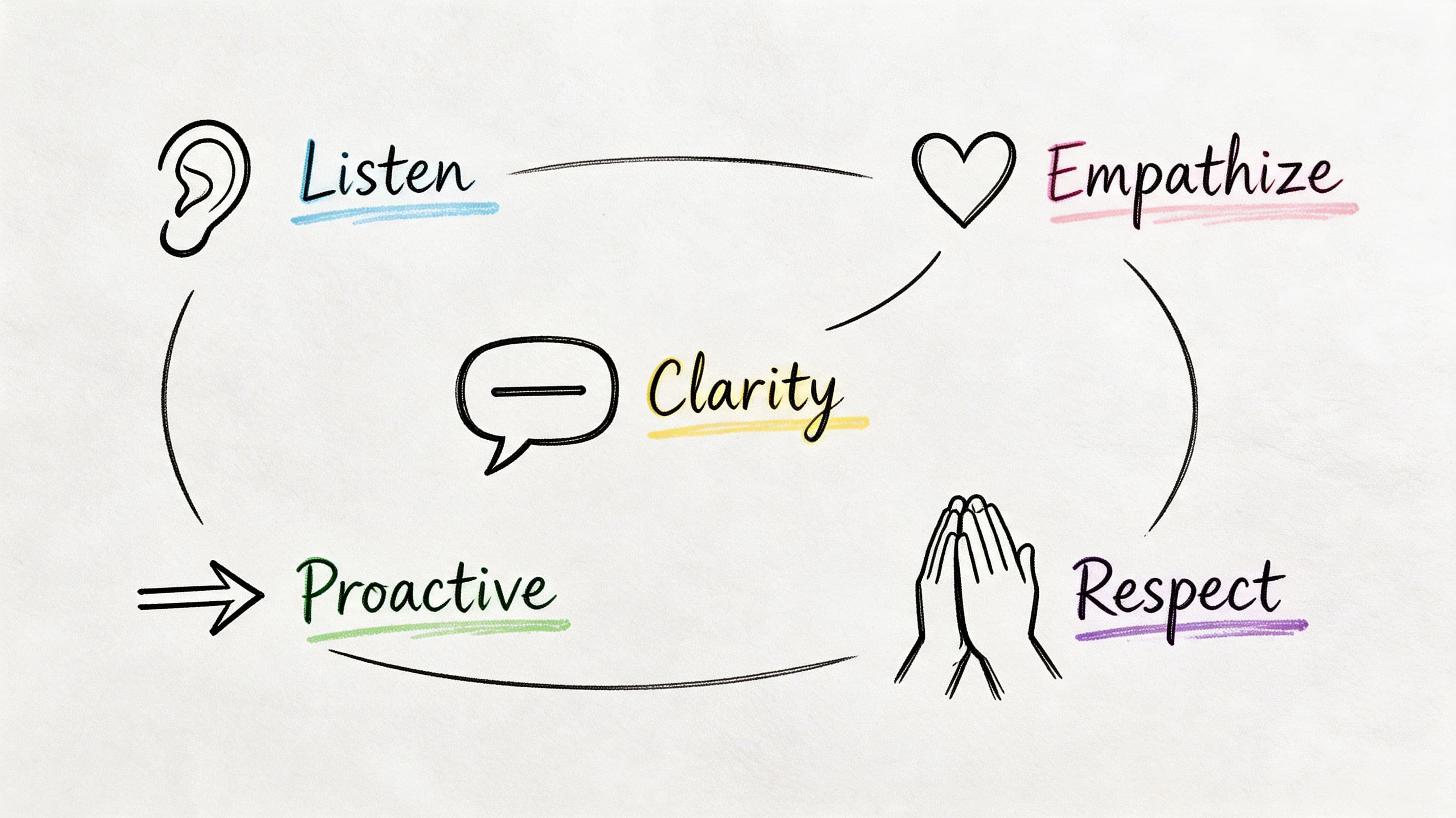
Customer service etiquette gets easier to manage when you stop treating it like a personality trait and start treating it like a system. In ecommerce, five principles do most of the work: speed, clarity, empathy, personalization, and consistency.
Speed sets the emotional tone
Speed is the first proof of respect. It tells the shopper you saw them and didn't leave them hanging. That matters more online because there is no store associate making eye contact or nodding while they check stock in the back.
For human teams, speed means queue design, macros, and clear ownership. For AI, it means immediate acknowledgment, fast retrieval from policy and catalog data, and clean escalation when confidence is low.
Clarity removes friction
A polite answer that confuses the customer isn't good etiquette. It's just a soft version of poor service.
Clarity means short sentences, direct next steps, and no internal jargon. If a customer asks whether a product runs small, they don't need a lecture on manufacturing variance. They need a useful answer that helps them decide what to buy.
A practical way to improve client communication is to review your replies for avoidable ambiguity. Teams often discover they sound professional to themselves but unclear to customers.
Empathy lowers resistance
Empathy isn't sentimental. It's functional. When someone feels heard, they're easier to help.
According to CCFCU’s guidance on customer service etiquette, implementing active listening protocols that include empathy acknowledgment can decrease issue escalation rates by 35% to 50% in ecommerce support. That's a meaningful operational gain, not just a tone improvement.
Personalization proves attention
Using order context, product history, or the customer's actual question shows attention. It tells them they aren't trapped in a generic flow.
That doesn't mean overdoing familiarity. Good personalization is specific and restrained. “I can see your order is in transit, and I’m checking the latest update” works. Forced friendliness and creepy overreach don't.
Consistency makes the brand feel reliable
The hardest etiquette problem isn't one rude reply. It's inconsistency. One agent is warm and clear. Another is curt. The chatbot is fast but vague. Email is formal. Instagram DMs are sloppy. Customers experience that as organizational chaos.
Use this simple operating view:
| Principle | What the customer feels | What the team should configure |
|---|---|---|
| Speed | “They’re on it” | Fast routing, instant acknowledgment, response templates |
| Clarity | “I know what happens next” | Plain-language rules, approved policy wording |
| Empathy | “They understand the issue” | Active listening prompts, better fallback phrasing |
| Personalization | “This answer is for me” | CRM context, order-aware replies, relevant recommendations |
| Consistency | “This brand is reliable” | Shared QA standards across chat, email, and AI |
Etiquette works best when the customer barely notices it. They just feel that getting help was easy.
Essential Customer Service Dos and Don'ts
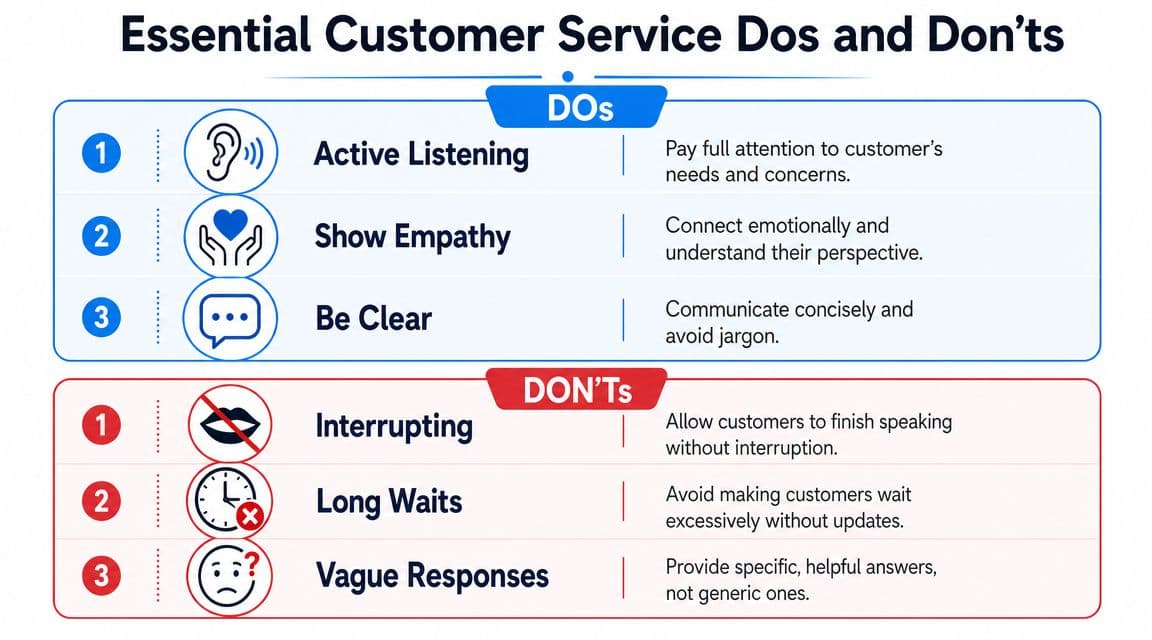
This is the part teams need written down. Not values on a wall. Actual behaviors.
What strong teams do every day
The best support operations don't rely on individual charm. They make good etiquette repeatable.
- Acknowledge first: Start by recognizing the question or issue before diving into policy. “I’m sorry the item arrived damaged” lands better than opening with return conditions.
- Confirm understanding: Restate the issue in plain language so the customer doesn't have to wonder whether you got it.
- Use the customer’s context: Mention the order, product, or scenario at hand. Specificity feels respectful.
- Give the next step immediately: Don't make customers dig for action. Tell them what happens now, who does it, and what they should expect.
- Close the loop: Before ending the conversation, check whether the answer solved the problem.
If you're standardizing behavior across agents, detailed procedures help reduce support tickets with clear procedures. The payoff isn't only efficiency. It also improves tone because agents stop improvising under pressure.
What weak support habits sound like
Bad etiquette often hides inside common habits that teams normalize. These are the phrases and behaviors that erode trust.
- Don't interrupt the customer's story: Cutting in early makes the customer repeat themselves or argue harder.
- Don't lead with policy language: Rules matter, but opening with them can sound defensive.
- Don't blame the customer: Even when the customer made a mistake, framing matters. Move toward a solution.
- Don't give dead-end replies: “Please check our policy page” is an instruction, not help.
- Don't disappear mid-conversation: If research takes time, say so and give an update.
- Don't sound copied and pasted: Templates are useful, but they need editing so they fit the situation.
A quick training scorecard
A support lead can review responses using a compact checklist like this:
| Behavior | Strong etiquette | Weak etiquette |
|---|---|---|
| Opening | Acknowledges issue clearly | Jumps into generic script |
| Tone | Calm, respectful, human | Defensive, flat, or overly casual |
| Explanation | Plain language | Jargon or vague wording |
| Action | Gives next step | Leaves customer to figure it out |
| Closure | Confirms resolution | Ends abruptly |
A good reply does two jobs at once. It solves the issue and lowers the customer’s stress level.
That second part is where etiquette lives.
Ecommerce Etiquette in Action: Scripts and Scenarios
Policy documents don't teach customer service etiquette well. Contrast does. When you compare weak phrasing with strong phrasing, the difference becomes obvious fast.
In live chat, speed matters especially because the session can collapse while the customer is still on the page. According to LiveHelpNow’s customer service etiquette guidance, responding within 30 seconds is a critical etiquette benchmark. Once first response times exceed 60 seconds, drop-off rises by 20% to 30%, while maintaining that speed correlates with a 15% uplift in conversion rates for Shopify stores.
If you're refining onsite support flows, a strong web chat widget strategy helps turn these etiquette principles into practical design choices.
Where is my order
Poor etiquette
Customer: “My package still hasn’t arrived. Where is it?”
Agent: “Tracking was sent by email. Please check with the carrier.”
This answer might be technically correct, but it shifts work back onto the customer and sounds indifferent.
Good etiquette
Customer: “My package still hasn’t arrived. Where is it?”
Agent: “I’m sorry you’ve had to chase this. I’ve checked the latest tracking update for you, and here’s what it shows. If you’d like, I can also explain the next step if delivery doesn’t move.”
The stronger version acknowledges frustration, shows action, and reduces the customer’s effort.
Pre-purchase product question
Poor etiquette
Shopper: “Does this moisturizer work for sensitive skin?”
Agent: “Product details are on the product page.”
That reply wastes the moment. The shopper already asked because the product page didn't settle the question.
Good etiquette
Shopper: “Does this moisturizer work for sensitive skin?”
Agent: “If you have sensitive skin, the safest starting point is to review the ingredient list and patch-test first. If you'd like, I can help compare this one with another option in your catalog based on your skin concerns.”
This keeps the tone careful and useful. It answers without overpromising.
Damaged item complaint
Poor etiquette
Customer: “The candle arrived cracked.”
Agent: “You need to send photos before we can do anything.”
The issue here isn't the request for photos. It's the delivery. The customer hears procedure before empathy.
Good etiquette
Customer: “The candle arrived cracked.”
Agent: “I’m sorry it arrived that way. Please send a photo when you can, and I’ll help move this forward as quickly as possible.”
Same process. Better etiquette.
Return request
Poor etiquette
Customer: “I want to return this.”
Agent: “Returns are only accepted within policy.”
This sounds combative even if the policy is valid.
Good etiquette
Customer: “I want to return this.”
Agent: “I can help with that. Please share your order number, and I’ll check whether the item qualifies under your return policy and what the next step looks like.”
That wording keeps authority without sounding hostile.
The pattern behind the better scripts
The better version usually includes four moves:
- Recognition: Name the problem or question.
- Reassurance: Show you’re taking ownership of the next step.
- Relevant action: Do something concrete, or explain exactly what happens now.
- Low-friction follow-through: Keep the customer from having to guess.
Poor etiquette often sounds efficient to the team. Good etiquette sounds easy to the customer.
That's the distinction worth training for.
Training Your AI Chatbot for Perfect Etiquette
Most chatbot failures aren't technical failures. They're etiquette failures.
The bot answers too inflexibly. It pushes too early. It doesn't know when to apologize, when to ask one more clarifying question, or when to stop pretending it understands. Customers read that as coldness or incompetence, even when the underlying retrieval system is solid.
Give the bot a service personality, not a mascot personality
A strong ecommerce chatbot should sound helpful, calm, and concise. It doesn't need a stand-up routine. It doesn't need brand theater in every line. Overdesigned personality often makes support feel slower because customers have to read through fluff before finding the answer.
Define rules such as:
- Use short openings: Acknowledge the question quickly.
- State uncertainty clearly: If confidence is low, ask a focused follow-up or escalate.
- Avoid forced enthusiasm: Friendly is good. Chirpy in the middle of a complaint is not.
- Never argue with the customer: The bot should clarify, not debate.
A useful framework for keeping automation humane is this guide to Shopify support automation with human touch. The practical lesson is that tone, escalation, and context handling matter as much as answer speed.
Build fallback responses that still feel competent
Fallbacks are where etiquette breaks most often. Weak bots say things like “I don’t understand” or dump the user into a dead end.
A better fallback does three things:
| Bad fallback | Better fallback |
|---|---|
| “I don’t understand.” | “I’m not fully confident I understood that. Can you tell me whether this is about an order, a return, or a product question?” |
| “Please contact support.” | “I can connect you with the right person. Share your order email or order number, and I’ll help route this correctly.” |
| “No results found.” | “I couldn’t find a clear answer in the store policies. I can help narrow it down if you tell me which product or order this relates to.” |
That difference is etiquette in action. The bot stays useful even when it doesn't have the answer yet.
Localize tone, not just language
Multilingual support creates a less obvious etiquette problem. Translation alone doesn't solve tone.
According to Pollack Peacebuilding’s customer service etiquette discussion, 68% of global consumers prefer chatbots for speed, but 42% of non-English interactions are abandoned due to poor localization and tone. For ecommerce brands selling across markets, that means the bot can't just swap vocabulary. It needs to avoid blunt phrasing, awkward directness, and culturally off-key responses.
Train for this by reviewing:
- Greeting style: Some markets prefer warmer openings than others.
- Directness level: “No” may need softer framing depending on the context.
- Policy wording: Keep restrictions firm, but phrase them respectfully.
- Escalation phrasing: Human handoff should feel reassuring, not like the bot gave up.
This walkthrough is worth watching if you're evaluating how support automation should behave in real store environments:
Use proactive messages with restraint
AI also introduces a new etiquette frontier that most classic support guides ignore: proactive selling.
A chatbot can greet, recommend, remind, and recover carts. But if every prompt feels like an interruption, automation becomes a conversion tax. Good proactive etiquette means the message should appear helpful, relevant, and well-timed. It should sound like assistance, not surveillance.
A simple rule works well in practice. Trigger proactive chat when shopper behavior suggests hesitation or intent, then keep the first message light. Offer help before offering a product. The moment the bot sounds pushy, it stops feeling like service and starts feeling like pressure.
How to Measure and Improve Service Etiquette
Customer service etiquette gets better when leaders stop evaluating it only by instinct. You need operating signals that show where the experience feels respectful and where it starts to break.
This doesn't mean reducing etiquette to one score. It means reading several indicators together so you can identify the cause behind a poor interaction.
Track the signals that expose etiquette problems
Start with a practical review set:
- First response time: Slow acknowledgment usually points to staffing, routing, or automation gaps.
- Resolution quality: If issues bounce between agents, customers experience that as poor listening and weak ownership.
- Reopen rate: When customers come back on the same issue, the first answer often lacked clarity.
- Escalation patterns: A spike can indicate tone issues, not just policy friction.
- Conversation reviews: QA should examine whether the reply was clear, empathetic, and action-oriented.
For ecommerce teams trying to build a clean reporting layer, these e-commerce key performance indicators are a useful starting point. The important move is linking operational metrics to customer-facing etiquette outcomes rather than tracking speed in isolation.
Turn findings into workflow changes
One of the most measurable etiquette decisions in ecommerce is proactive messaging timing. According to Indeed’s customer service etiquette guide, personalized abandoned cart nudges boost conversions by 22%, but only if delayed 1 to 24 hours. Nudges sent in less than 1 hour can feel too aggressive and increase churn by 15%.
That kind of finding is useful because it moves etiquette out of the realm of opinion. Timing, wording, and trigger logic can be tested and improved.
Use a simple improvement loop:
- Review transcripts weekly: Look for repeated friction in tone, not just wrong answers.
- Tag failure patterns: Examples include abrupt openings, vague policy wording, and weak handoffs.
- Rewrite the response playbook: Adjust macros, AI prompts, and escalation rules.
- Recheck performance: Watch whether the customer experience becomes smoother after the change.
The cleanest support teams don't just fix mistakes. They remove the conditions that keep producing them.
That applies equally to agents and bots. If the same rude or confusing pattern keeps showing up, the problem usually lives in the system, not in one conversation.
Making Etiquette Your Growth Engine
Customer service etiquette has a direct commercial job in ecommerce. It reduces hesitation, protects trust, and keeps customers moving instead of stalling out.
The important shift is to stop treating etiquette like a finishing touch. It's part of how a store sells. Human agents need it in scripts, judgment, and follow-through. AI agents need it in tone rules, fallback logic, localization, and proactive engagement settings. The principle is the same in both cases. Make the customer feel understood, guided, and respected.
Stores that do this well don't just look more professional. They make buying easier. Questions get answered without friction. Complaints stay contained. Returns feel orderly instead of adversarial. Recommendations feel relevant instead of intrusive.
That's why customer service etiquette belongs in your operating model, not just your training deck. It shapes customer psychology at the exact moments where revenue is won or lost.
Frequently Asked Questions About Customer Service Etiquette
Does customer service etiquette change by channel?
Yes. The principle stays the same, but the expression changes.
Live chat should be short, fast, and highly responsive. Email can carry more detail, but it still needs clarity and a visible next step. Social media support needs extra care because the audience is public and the brand tone is exposed. Phone support needs listening discipline because interruptions feel harsher when spoken aloud.
A simple rule helps. Match the channel's pace, but keep the same standards for respect, clarity, and ownership.
How should you respond to an angry customer in public?
Acknowledge the issue without arguing in public. Keep the reply calm, brief, and helpful. Then move the resolution into a private channel as quickly as possible.
The mistake many brands make is trying to win the exchange. That's not the job. The job is to show observers that the brand is attentive, composed, and willing to help. Public defensiveness usually makes the original problem look bigger.
Can etiquette fix a bad policy or product problem?
No. Good etiquette can soften friction, but it can't compensate for a policy customers find unfair or a product that keeps failing.
The challenge arises when some teams overtrain for tone while under-fixing the root issue. If support repeatedly handles the same complaint with perfect manners, the customer experience is still broken. Etiquette should work alongside operational fixes, not instead of them.
What should a chatbot do when it doesn't know the answer?
It should admit uncertainty cleanly, narrow the issue with one useful follow-up question, or hand off to a human with context preserved.
The worst option is fake confidence. Customers can tolerate limits. They don't tolerate being sent in circles. A bot with good etiquette stays transparent, helpful, and focused on momentum.
How do you keep templates from sounding robotic?
Write templates as starting points, not finished replies. Leave room for the agent or bot to insert context, reflect the actual issue, and adapt the next step.
A good template gives structure. A bad template replaces thinking. The difference shows up in whether the customer feels handled or helped.
What's the fastest way to improve customer service etiquette on a small team?
Audit real conversations. Pick a handful of weak replies and rewrite them. Focus first on openings, clarification, and next-step language.
Small teams often improve quickly when they fix the same repeat offenders: delayed acknowledgment, vague replies, policy-first wording, and abrupt closure. You don't need a huge training program to raise the standard. You need sharper examples and consistent review.
If you want to put these etiquette principles into practice with always-on support, product guidance, and proactive cart recovery, Carti gives Shopify stores a fast way to deliver more responsive, better-mannered customer conversations at scale. It’s built to answer questions, guide shoppers, and support sales without making the experience feel robotic.

Written by
Daniel AndersonFounder of Carti. 10+ years building ecommerce brands in apparel and supplements. Still runs a Shopify store and built Carti to help merchants convert more browsers into buyers.