
Gross Merchandise Value, or GMV, is the total value of all goods sold through your store over a set period before any deductions for fees, returns, or discounts. If a retailer sells 100 t-shirts at $20 and 50 hoodies at $45, the GMV is $4,250.
If you're running a Shopify store, you've probably looked at your dashboard and asked a version of the same question: sales are moving, orders are coming in, but which number tells you whether the business is growing? GMV is one of the cleanest top-line answers because it shows how much merchandise moved through your store.
That matters more than most merchants realize. GMV helps you see demand, compare channels, spot product momentum, and plan inventory. But it also creates confusion when store owners treat it like profit. That's where bad decisions start. The useful way to think about GMV isn't just as a definition. It's as a growth metric with limits.
What Is GMV and Why It Matters for Your Store
A Shopify store can post a big weekend, see orders spike, and still end the month with thin profit. That is why GMV matters. It shows the gross value of merchandise sold over a given period before refunds, returns, shipping charges, transaction fees, and operating costs are taken out.
For operators, GMV is a speed metric. It shows whether product is moving, whether a launch created real demand, and whether a campaign increased order volume or just generated traffic. If I want a fast read on sales momentum across a store, GMV is one of the first numbers I check.
It also gives you a cleaner way to evaluate growth levers inside Shopify. If you raise average order value with bundles, improve conversion with upsells, or add post-purchase offers through tools like Carti, GMV should move. If it does not, the tactic may be getting clicks without producing more merchandise sold. Merchants testing these changes can model the upside with a Shopify upsell ROI calculator before rolling them out store-wide.
Why GMV matters in day-to-day operations
GMV is useful because it helps you make operating decisions quickly.
- Inventory planning: GMV shows where sales volume is concentrated, which helps with reorders and stock allocation.
- Channel comparison: If you sell through your Shopify store, marketplaces, and retail partners, GMV by channel shows where demand is strongest.
- Promo evaluation: A sale that lifts GMV can still be worth running if it helps clear inventory or acquire customers at an acceptable cost.
- Growth tracking: GMV is a practical top-line metric for tracking whether the store is selling more over time.
The trade-off is simple. GMV is strong for measuring demand and weak for measuring business quality.
What GMV does not tell you
GMV does not tell you what you kept. A high-GMV month can still be disappointing if discounting got too aggressive, return rates climbed, or fulfillment and acquisition costs ate the margin.
That is the trap a lot of merchants fall into. They chase top-line growth, celebrate the headline number, and realize later that profit barely moved. Use GMV to measure momentum. Use revenue, contribution margin, and net profit to decide whether that growth is healthy.
How to Calculate Your Store's GMV
A merchant pulls up Shopify after a strong promo weekend and sees orders up. The next question is simple. How much merchandise moved?
GMV answers that fast. For calculation, keep it simple and keep it consistent across reporting periods.
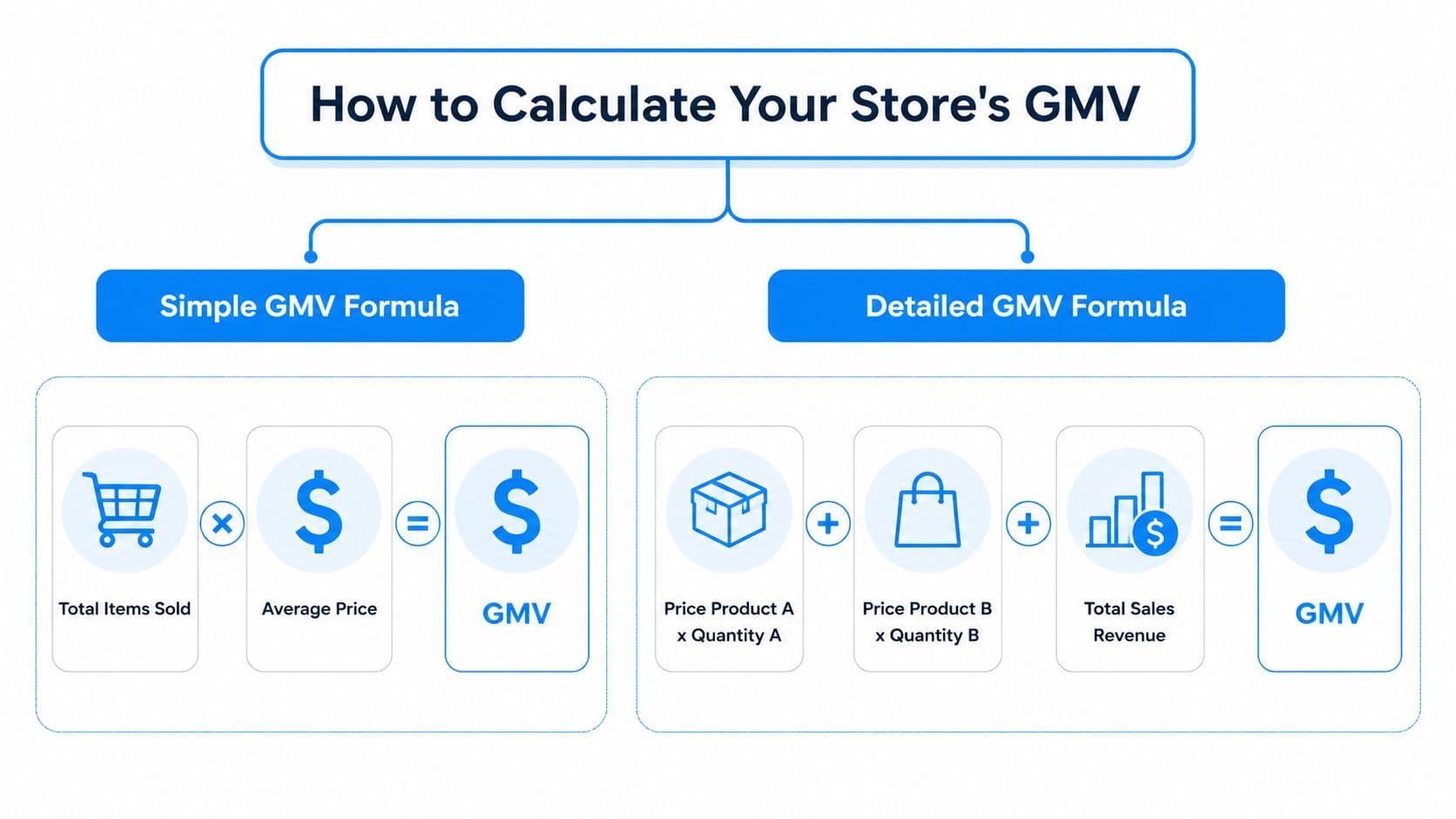
The two formulas merchants actually use
At the SKU level, use:
- Total items sold × selling price
This works well for product analysis. It helps when you want to see which collections, variants, or bundles are driving merchandise volume.
At the store level, use:
- Number of transactions × Average Order Value
That version is usually easier for weekly or monthly reporting because Shopify already gives you orders and AOV. If your AOV is calculated as total order value divided by total number of orders, the math stays clean.
A simple Shopify example
Say your store sold 100 t-shirts at $20 each and 50 hoodies at $45 each in a month. Your monthly GMV is $4,250, based on (100 × $20) + (50 × $45) = $4,250.
That number shows sales volume before you account for returns, refunds, payment fees, shipping subsidies, or ad spend. In practical terms, GMV is the gross sales volume your catalog generated before business realities like fees and returns are factored in.
How to calculate it cleanly in Shopify
Use a reporting process you can repeat:
- Choose a reporting window: Daily, weekly, monthly, or quarterly all work. Pick one and stick with it.
- Choose your method: SKU-based for merchandise analysis, or transaction-based for store-level tracking.
- Keep adjustments out of GMV: Refunds, discounts, chargebacks, and fees belong in revenue and margin reporting.
- Check the same view each period: Compare like for like so trend lines mean something.
One practical note. Promotional spikes can raise GMV while hurting margin, so do not judge a campaign on GMV alone.
For growth planning, GMV becomes more useful when you model the drivers behind it. If you want to estimate how changes in AOV or order volume could affect the store before you roll out upsells or bundles, use this Shopify ROI calculator for AOV and conversion scenario planning.
GMV vs Revenue: What's the Real Difference?
A Shopify store can post a record GMV month and still have a worse business than it had 30 days earlier. I've seen that happen after aggressive discounting, higher return rates, or a jump in shipping and acquisition costs. The top line looked strong. The cash left over did not.
GMV tracks gross merchandise volume. Revenue tracks what the business recognizes from sales under its reporting method. Net profit shows what remains after product costs, operating expenses, fees, and other costs hit the P&L.
Why merchants confuse GMV and revenue
The mix-up usually starts in the dashboard. Both numbers sit close to sales reporting, and both rise when order volume rises. But they answer different questions, so using one in place of the other leads to bad calls on budgets, promos, and inventory.
As Kruze Consulting explains in its breakdown of GMV, GMV differs from GAAP-defined revenue, the AICPA does not provide a GAAP definition for GMV, and companies therefore define it based on their business model. Kruze also notes that GMV reflects the total amount paid by buyers before marketplace fees, refunds, or expense deductions are removed.
For a Shopify merchant, that difference matters fast. If you run a bundle offer or add an AI shopping assistant such as Carti, GMV can climb because each order is worth more. That can be a good sign. It still does not tell you whether the added sales came through at a healthy margin.
GMV vs Revenue vs Net Profit at a Glance
| Metric | What It Measures | Includes | Excludes |
|---|---|---|---|
| GMV | Gross merchandise sold through the store | Full customer-paid merchandise value before deductions | Returns, refunds, fees, operating costs, profit |
| Revenue | Sales recognized by the business after relevant deductions | Actual sales value recognized under the store's reporting approach | Some costs and expenses that still affect profitability |
| Net Profit | What the business keeps after expenses | Revenue minus operating and product-related costs | Nothing material by design. This is the bottom-line result |
How to use each metric in practice
Each metric has a job.
- Use GMV to judge sales momentum, merchandising performance, and whether changes to AOV, conversion rate, or upsells are increasing order volume.
- Use revenue to evaluate the sales number you can report and forecast from with more discipline.
- Use net profit to decide whether growth is worth funding.
This is the trade-off many merchants miss. GMV is useful when you're testing growth levers. Profitability decides whether you should keep scaling them.
Say you launch a storewide discount and add an upsell flow. GMV may rise because more shoppers convert and carts get bigger. If the discount is too deep, return rates increase, or the upsell product carries weak margin, revenue quality and profit can slip even while GMV looks great. In that case, GMV helped you spot demand, but profit tells you whether the offer deserves to stay live.
Strong GMV shows demand and sales activity. It does not confirm healthy unit economics.
Why your internal definition matters
Because GMV is not standardized under GAAP, your team needs one store-wide definition and one consistent reporting rule. Otherwise, marketing reports one number, finance reports another, and nobody trusts the trendline.
Keep the operating rules simple:
- Document your GMV formula
- Use the same time window every period
- Keep GMV separate from revenue reporting
- Review margin and net profit alongside GMV before scaling campaigns
That last point is where mature operators separate growth from vanity. If your goal is to improve merchandising, increase AOV, or test tools like Carti, GMV is a useful lead indicator. If your goal is to decide whether to spend more on ads, add headcount, or reorder inventory more aggressively, bring revenue and profit into the decision before you commit.
Common GMV Reporting Pitfalls to Avoid
A Shopify merchant runs a big weekend promotion, sees GMV jump on Monday, and assumes the campaign worked. Two weeks later, refunds climb, margins compress, and paid traffic costs wipe out the gain. That pattern is common because the reporting error starts after the sale, not before it.
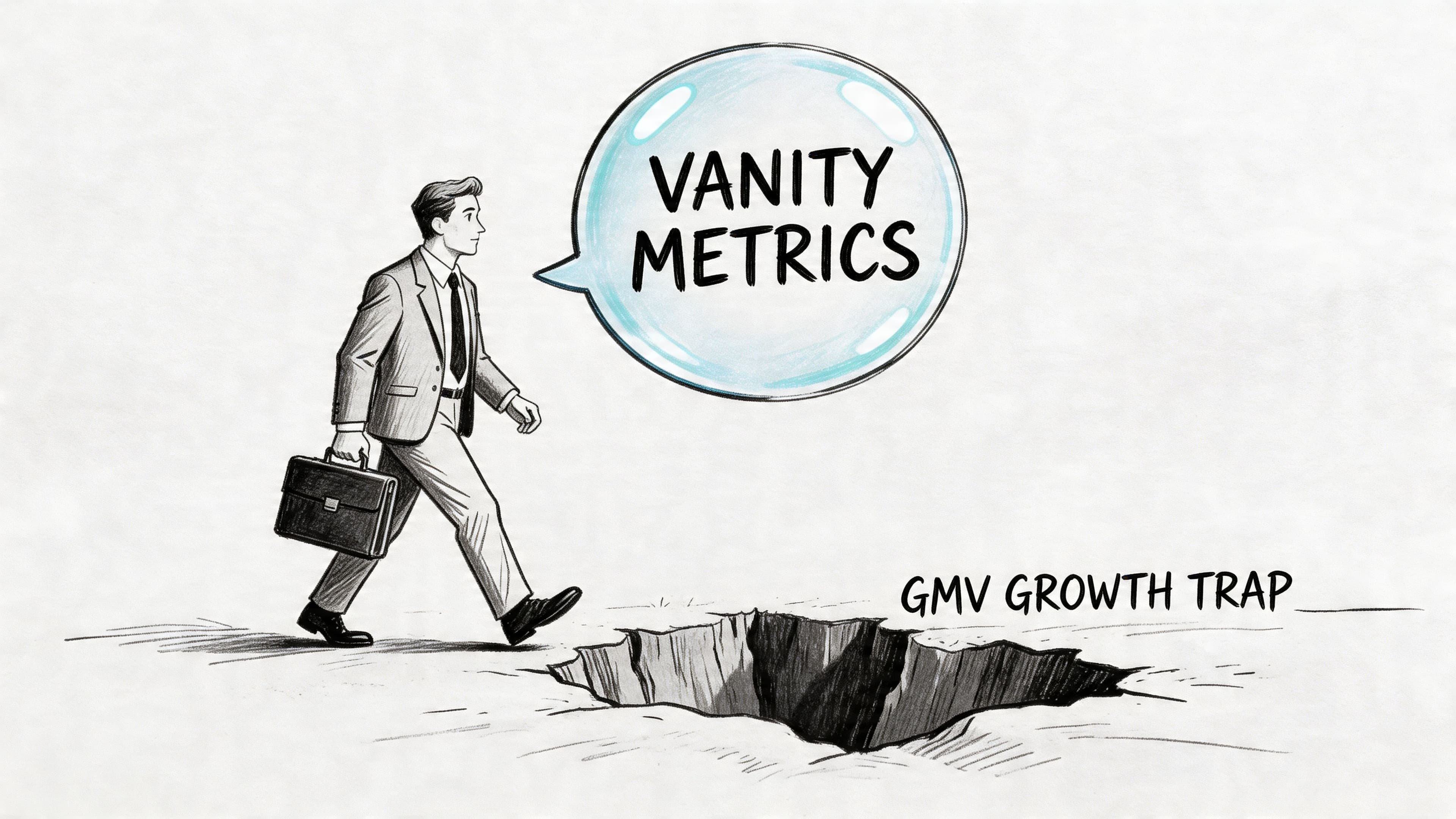
The GMV growth trap
The easiest mistake is reading GMV as proof of business health instead of sales volume. In Graas's article on GMV in ecommerce, the team explains that merchants often optimize for GMV growth even when weaker unit economics sit underneath it, such as higher refunds or heavier discounting.
Read GMV as a demand signal first.
A rising top line can mean your offer is working, your merchandising improved, or your upsell flow increased basket size. It can also mean you pushed too hard on discounts, sold more low-margin items, or mixed strong direct sales with weaker channel performance and lost visibility into what improved.
Reporting mistakes that distort the picture
These are the reporting issues I see most often in Shopify stores:
- Changing the calculation method midstream: If one report uses orders placed and another uses items sold, the trendline stops being useful.
- Combining channels too early: Marketplace GMV, retail pop-up sales, and DTC site GMV behave differently. Roll them up too soon and you hide the source of the change.
- Leaving returns out of the operating review: GMV can make a product launch look strong while post-purchase behavior tells a very different story.
- Judging discount campaigns on GMV alone: Promotions often raise order count and basket size, but they can weaken contribution margin fast.
- Ignoring tool-level effects: Cart builders, bundles, post-purchase offers, and AI sales flows can lift GMV. You still need to check whether they improved order quality or just pushed more gross volume. Teams testing AI ecommerce growth tactics for Shopify stores should review attach rate, return rate, and margin alongside GMV.
GMV answers how much merchandise moved. It does not answer whether the campaign deserved more budget.
A practical reporting setup
Keep the review simple and consistent.
Start with GMV by channel and campaign. Then review net sales, refund rate, discount rate, and gross margin by product, collection, or traffic source. That sequence gives operators a clearer view of what caused the top-line change and whether it is worth repeating.
For example, if a bundle app increases GMV by lifting AOV, that can be a healthy signal. If the same bundle drives support tickets, returns, or low-margin product mix, the result needs a different decision. Keep the app, change the offer, or limit it to higher-margin collections.
When GMV deserves attention, and when profit should lead
GMV deserves more weight when you're validating demand, testing merchandising changes, or improving cart value. In those cases, the main question is whether shoppers are responding.
Profit should lead when you're setting ad budgets, planning inventory, hiring, or deciding whether to keep scaling a promotion. Those decisions depend on what the store keeps, not just what it sells.
Strong operators use GMV early in the diagnosis, then tighten the filter. That habit prevents the common growth trap of scaling volume that looks good in Shopify reports and weakens the business underneath.
Actionable Strategies to Increase Your Shopify GMV
A common Shopify situation looks like this. Traffic is up, orders are steady, and GMV barely moves. In most stores, that means one of two things. Too few shoppers are finishing checkout, or too many orders stop at a single low-value item.
GMV improves when you work those two levers on purpose: transaction volume and average order value.
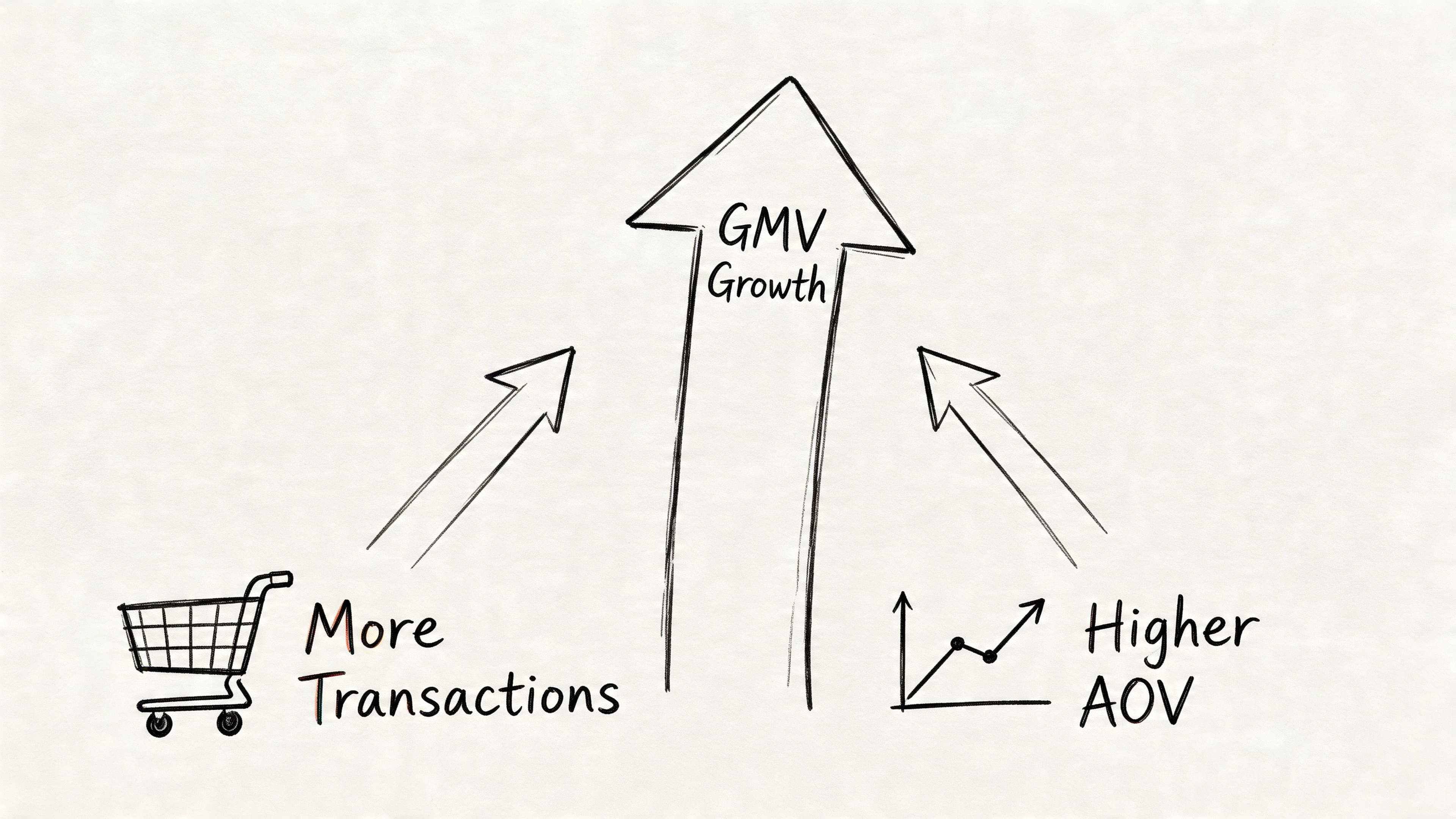
Grow transaction volume
More completed orders raise GMV fast, but the work is rarely about getting more sessions alone. It is usually about removing the reasons ready-to-buy shoppers stall.
Start with the obvious friction points on product pages and in the cart:
- Reduce purchase hesitation: Give clear answers on sizing, shipping, returns, delivery timing, and product use.
- Recover high-intent carts: Abandoned cart flows matter because these shoppers were already close to buying.
- Cut unnecessary steps: Fewer clicks and fewer form fields usually help more shoppers finish checkout.
- Respond while intent is live: Fast support can save orders that would otherwise disappear.
For Shopify merchants, that makes AI and support tooling practical, not theoretical. Cart recovery affects transaction count. On-site recommendations and guided support can also keep a hesitant shopper from dropping off before checkout. If you want a useful breakdown of how Shopify teams apply those tools, this AI ecommerce growth guide for Shopify merchants connects the tactics to day-to-day store operations.
One caution. Pushing transaction volume with aggressive discounts can lift GMV and still leave the business worse off. Use promotions carefully, especially if the products already carry thin margins.
Increase average order value
AOV is often the cleaner lever because you are working with shoppers who already decided to buy. You do not need another visit. You need a better basket.
The strongest AOV tactics usually come from merchandising discipline:
- Bundle products that belong together: Build sets, routines, starter kits, and replenishment pairs that solve a real buying job.
- Cross-sell with context: Recommend add-ons that fit the item, not random products with high inventory.
- Set cart thresholds with intent: Free shipping or gift thresholds work best when the gap feels reachable.
- Place offers where decisions happen: Product pages, cart drawers, and checkout-adjacent moments usually beat generic upsell sections buried lower on the page.
I have seen simple changes outperform flashy ones here. A relevant add-on in the cart drawer often does more for GMV than a broad sitewide discount, because it raises order value without training customers to wait for a sale.
Poor AOV strategy usually has the same pattern. The offers are irrelevant, too aggressive, or too late in the flow. That hurts conversion and trust at the same time.
The best upsell is the one the customer was already close to wanting.
The video below is useful for one specific reason. It shows how conversion support and guided selling can increase completed orders while also improving cart value, which is exactly the trade-off this section is about.
Use the formula as an operating playbook
Treat GMV like a diagnostic tool.
If transactions are soft, audit the path from PDP to checkout. Check where shoppers hesitate, where support requests cluster, and where carts get abandoned. That usually points to a clearer fix than buying more traffic.
If order volume is healthy but GMV is flat, inspect basket composition. Look at attachment rates, bundle take rates, and whether your recommendations are adding useful items or just adding noise.
Tools like Carti can help on both sides if they are configured with intent. Better cart recovery can recover lost orders. Better product suggestions can lift basket size. The trade-off is that poor setup creates clutter, so measure the impact by offer placement, product type, and margin, not by GMV alone.
The best operators use GMV to decide where to work first, then pressure-test whether the lift came from healthier orders or just easier volume.
Tracking GMV as a North Star for Growth
GMV works well as a north star metric because it tells you whether the store is moving more merchandise over time. For operators, that's useful. It keeps attention on demand, order flow, and merchandising performance.
But a north star is not the entire map. If you steer the whole business with GMV alone, you'll miss what happened after the order was placed.
What to pair with GMV
A balanced operating view usually includes GMV plus a short list of companion metrics:
- Revenue: To understand what sales remained after deductions.
- Net profit or contribution view: To see whether growth is worth funding.
- AOV: To track whether merchandising is lifting order size.
- Channel performance: To separate what your Shopify storefront is doing from other sales sources.
- Customer behavior signals: Repeat purchase patterns, return behavior, and product-level performance all add context.
A useful benchmarking mindset is to keep GMV as the headline, then force every big growth decision through a second filter: does this improve business quality too? If not, the store may be buying volume at the expense of durability.
How to use it without getting fooled
The best merchants I’ve seen use GMV in a very specific way. They monitor it closely, act on it quickly, and distrust it just enough.
That means:
- Track it consistently
- Segment it by channel or product line
- Use it to spot momentum early
- Pair it with revenue and profit before scaling harder
If you want a deeper view into how support, conversion, and sales efficiency connect to store performance, this Shopify chat AI ROI metrics guide is a useful companion read.
GMV is worth tracking because it shows the scale of commerce flowing through your store. It becomes powerful when you use it as a directional signal, not as a substitute for financial discipline.
If you want to improve the two drivers behind GMV, transactions and average order value, Carti is built for that job. It helps Shopify merchants answer shopper questions instantly, recover carts, surface relevant product suggestions, and support buyers around the clock without adding support overhead.

Written by
Daniel AndersonFounder of Carti. 10+ years building ecommerce brands in apparel and supplements. Still runs a Shopify store and built Carti to help merchants convert more browsers into buyers.