
You open Shopify, check revenue, and the month looks fine. Traffic was steady. Orders were steady enough. But profit feels off, and you can’t explain why one month felt healthy while another felt tight.
That usually means you’re staring at top-line revenue without looking at how much each order is worth.
For most Shopify merchants, that missing number is AOV, or average order value. It’s one of the clearest ways to understand whether your store is getting more from the traffic you already have. If you improve AOV, you don’t need every gain to come from more ad spend, more sessions, or more discounts. You can make each order do more work.
When merchants ask “what does aov mean,” they’re usually not asking for a textbook definition. They want to know why revenue feels inconsistent, why some campaigns attract low-value shoppers, and which changes raise order size without hurting conversion. That’s where AOV becomes useful. Not as dashboard decoration, but as an operating metric.
Your Revenue Number Is Hiding a Secret
A store can post the same revenue in two different months and still be in two very different positions.
One version gets there through lots of smaller orders. The other gets there through fewer, stronger carts. On paper, the revenue line may look similar. Operationally, those months can feel completely different. One creates more room for fulfillment, support, and paid media efficiency. The other burns through margin faster.
That’s why experienced operators don’t stop at sales totals. They ask what the average order looked like, what customers added together, and whether merchandising pushed people toward better carts or just more transactions.
Practical rule: If your revenue rises but your average order size stays weak, you may be buying growth instead of building it.
AOV helps explain that gap. It shows whether customers are shopping with intent, whether your offer structure is doing its job, and whether shoppers are responding to bundles, upgrades, and threshold-based offers.
For Shopify merchants, this matters most when traffic gets expensive. If paid acquisition costs rise, a weak AOV makes every campaign harder to justify. A stronger AOV gives you more room to absorb those costs without squeezing the business.
The good news is that AOV usually isn’t fixed. It responds to offer design, product pairing, cart prompts, and how clearly you guide the shopper. That makes it one of the most practical revenue levers in a Shopify store.
What AOV Is and How to Calculate It
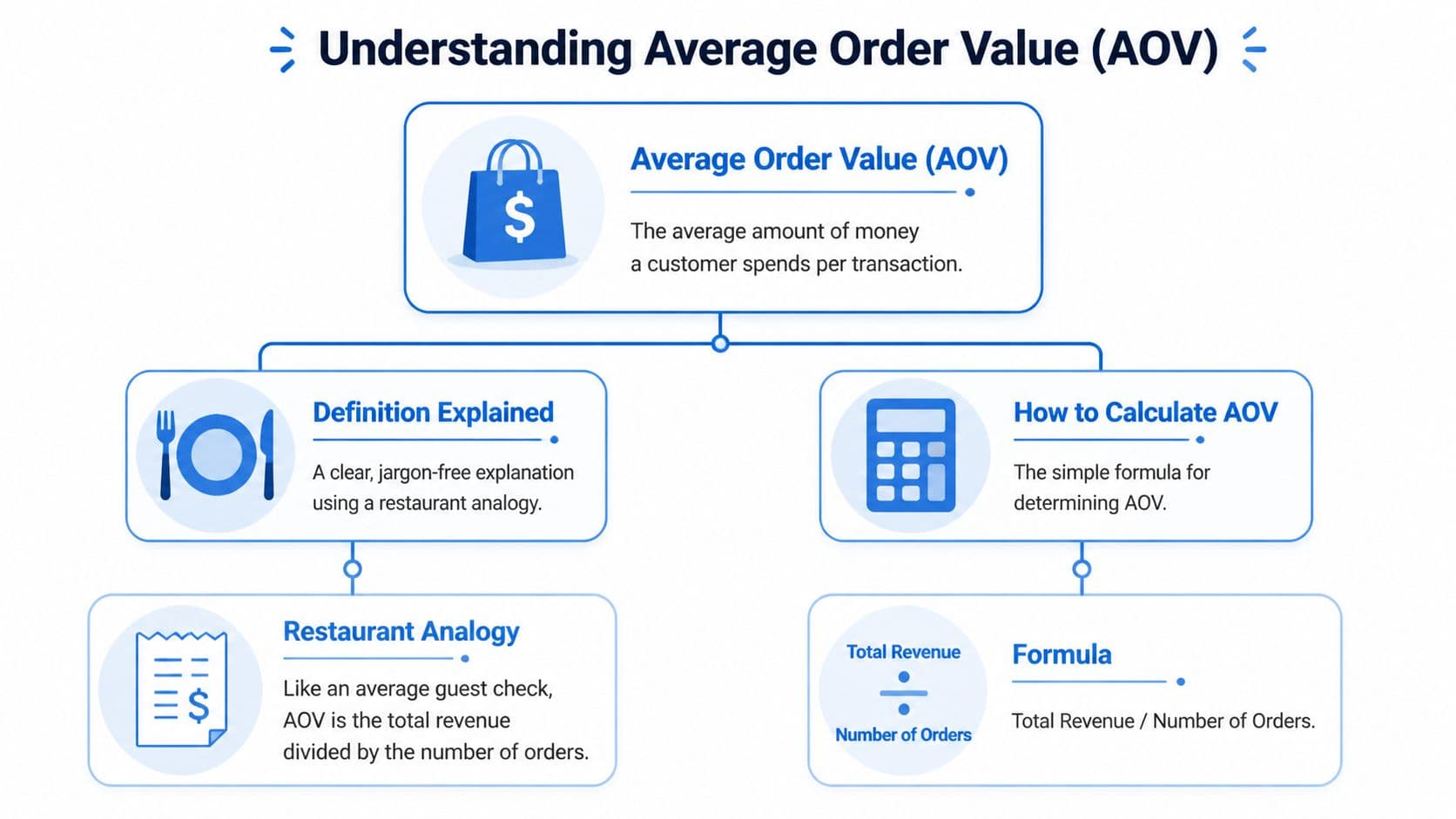
AOV stands for average order value. It tells you the average amount a shopper spends each time they place an order.
A simple way to think about AOV
The easiest analogy is a restaurant check. A restaurant doesn’t just care how many tables it served. It cares about the average bill per table. A table that orders drinks, appetizers, and dessert is more valuable than one that orders only the cheapest entrée.
A Shopify store works the same way. You don’t just want orders. You want stronger orders.
The formula and two examples
The formula is simple. AOV = Total Revenue ÷ Number of Orders Placed. That’s the definition used in Optimizely’s explanation of average order value.
Two examples make it clear:
| Store revenue | Orders placed | AOV |
|---|---|---|
| $31,000 | 1,000 | $31 |
| $100,000 | 2,000 | $50 |
Here’s how the first one works:
-
Take total revenue, which is $31,000.
-
Take total orders, which are 1,000.
-
Divide revenue by orders.
-
The result is $31.
The second works the same way:
-
Total revenue is $100,000.
-
Total orders are 2,000.
-
Divide the revenue by the orders.
-
The AOV is $50.
AOV tracks the order, not the customer. One shopper can place multiple orders, but AOV only asks what the average transaction was worth.
That distinction matters. If a few repeat buyers place larger orders, AOV rises even if your customer count doesn’t. That’s why AOV is useful for judging per-order economics. It tells you whether your store is getting better at building bigger carts, not just attracting more people.
Why AOV Is a Critical Metric for Shopify Stores
AOV isn’t a vanity metric. It’s a direct read on how much revenue each transaction generates, and that makes it a practical signal for store health.
According to Triple Whale’s AOV guide, a higher average order value indicates stronger profitability potential because customers are spending more per transaction, which means a business can generate more revenue from its existing customer base without necessarily increasing marketing spend. That’s the part merchants feel immediately. You don’t need a bigger audience to create more revenue if each order improves.
It makes acquisition more efficient
When AOV rises, your paid traffic becomes easier to support. The same campaign can produce more revenue per purchase without requiring more clicks or more budget. That doesn’t solve every acquisition problem, but it gives you breathing room.
If you already track your core numbers, this fits naturally alongside the broader set of e-commerce KPIs that matter for store growth. AOV is one of the clearest ones because it connects offer strategy to actual transaction value.
It shows whether merchandising is working
AOV also tells you whether your store setup is doing its job. If bundling, premium positioning, or better product recommendations are landing, you should see it in the order size over time. If AOV stalls or slides, that usually means one of three things:
-
Your offer is too flat: Shoppers aren’t seeing a reason to add more.
-
Your merchandising is weak: The store isn’t surfacing logical add-ons or upgrades.
-
Your pricing structure needs work: The path to a larger cart isn’t obvious.
That’s why good operators watch AOV as an action metric, not a passive number. It reflects whether the store is guiding shoppers into more valuable buying decisions.
Common Pitfalls When Measuring AOV
A store can post a higher AOV this month and still be making worse decisions.
That usually happens when merchants treat AOV as a scoreboard instead of an operating metric. The number looks clean in a dashboard, but the inputs behind it are messy. If you want AOV to guide pricing, bundles, upsells, and cart design, you need to measure it in a way that reflects what shoppers chose to buy.
Mistake one using inflated order totals
AOV gets distorted fast when you include charges that have nothing to do with merchandising performance. Shipping fees, taxes, gift wrap, and other checkout add-ons can push the average up without telling you whether customers wanted more product.
For day-to-day store decisions, I prefer a cleaner view. Measure product revenue per order first. Then keep a separate version of AOV if your finance team wants a fuller checkout total. That split prevents a common mistake, which is celebrating an AOV increase that came from higher shipping charges rather than larger carts.
A useful AOV number should help you decide what to sell, how to present it, and what to test next.
Mistake two confusing AOV with other metrics
AOV answers one question. How much value does the average completed order contain?
It does not tell you how much customers intended to spend before abandoning checkout. It also does not tell you what a customer is worth across multiple purchases. Those are different metrics, and they lead to different fixes.
| Metric | What it tells you |
|---|---|
| AOV | The average value of each completed order |
| Cart value | What shoppers put in cart before they complete checkout |
| CLV | What a customer is worth across their relationship with your store |
This matters in practice. If cart value is strong but AOV is weak, the problem may sit in checkout friction, shipping surprise, or weak purchase intent. If AOV is modest but repeat rate is healthy, the store may not need aggressive upsells at all. Merchants using tools like AI sales assistance for Shopify stores usually get better results when they map the tool to the right problem instead of asking one metric to explain the whole business.
Mistake three relying on one blended number
Storewide AOV is useful, but it is not enough.
Blended AOV hides the differences between paid traffic and email, first-time buyers and repeat customers, product categories, discount campaigns, and even device types. A broad average can make a healthy segment look weak or hide a problem that only shows up in one acquisition channel.
A simple example: one collection may pull in low-AOV orders because it attracts entry-price shoppers, while another drives larger carts because add-ons are obvious. If you average them together, you lose the signal. The better move is to segment AOV by source, campaign, product type, and customer status, then compare those slices over time.
If you want another operator-focused perspective on testing AOV tactics, this Ecommerce Boost article is a useful companion read.
A quick walkthrough helps if you want to see how merchants talk through AOV analysis in practice.
The mistake is not tracking AOV. The mistake is trusting a single headline number without checking what is pushing it up, pulling it down, or making it look better than it really is.
10+ Actionable Strategies to Increase Your AOV
A shopper adds a $42 product to cart, then stalls. Shipping will cost extra. The complementary item they need is buried. The better version of the product never shows up. That order could have been worth $60 or $75 with the right merchandising.
That is how AOV usually improves in real stores. Not from one clever tactic, but from a series of small decisions that make the higher-value order easier to build.
For an additional outside perspective, this Ecommerce Boost article is worth reading alongside your own tests. The useful part is the reminder that AOV gains usually come from stacking several small merchandising wins instead of chasing one big fix.
Driving larger carts
-
Set a free shipping threshold above your current AOV. This works because the offer is easy to understand and easy to act on. If your current AOV is $58, a threshold around $65 or $70 often gives shoppers a reason to add one more item without feeling forced.
-
Show progress in the cart. “You’re $12 away from free shipping” beats a sitewide banner because it is specific to the shopper’s current cart. Relevance matters more than volume here.
-
Build bundles people already want. Start with combinations that make immediate sense. A number of Shopify apps can help you create and test these offers. This Kaching Bundle Shopify app review provides a closer look at one option, including its approach to quantity breaks and multipack offers. Starter routines, refill packs, matching sets, and buy-it-together accessories usually outperform bundles built around what the merchant wants to clear.
-
Use quantity breaks on products people naturally buy again. Supplements, socks, coffee, skincare, and household basics are strong candidates. A discount on two or three units can raise order value without making the offer feel like a stretch.
Introducing higher value items
-
Upsell to the next logical version. A larger size, better fabric, premium ingredient, or fuller kit works when the shopper can see the difference. Random expensive suggestions usually get ignored.
-
Cross-sell products that complete the purchase. A case for the device, a cleanser for the serum, a belt for the dress. Tight pairings raise AOV. Loose pairings create friction.
-
Place add-ons before the shopper reaches checkout. The product page and cart are the best places to do this. Once the shopper is mentally done, a late add-on asks them to restart the decision.
-
Use post-purchase offers for extra revenue, not as your main AOV plan. They can work well for low-friction add-ons, but they do not improve the cart the shopper checked out with. Treat them as a second layer.
Operator view: The best upsells feel helpful. The bad ones feel like a popup trying to win an argument the shopper never started.
Using merchandising and timing
-
Create more than one step-up point. One threshold leaves money on the table. A small reward at one level and a stronger reward at a higher level gives more shoppers a reason to keep building the cart.
-
Package around the shopper’s use case. “Travel set,” “starter routine,” and “weekend setup” work because they reduce decision effort. The shopper is buying a solution, not sorting through parts.
-
Give high-margin products better placement. If your best AOV drivers live three scrolls down or only show up in a collection page, they will not pull carts up consistently. Put them near the main buying path.
-
Cut weak recommendations. More offers do not automatically mean more revenue. In many stores, a smaller set of sharper recommendations outperforms a crowded product page.
Prioritizing the right traffic
Some traffic sources are better AOV traffic. Email subscribers often buy with more intent than cold paid clicks. Returning visitors usually need less education than first-time visitors. Branded search can behave very differently from broad discovery traffic.
That should change how you build offers.
A practical workflow looks like this:
-
Segment by source: Paid social, email, search, direct.
-
Compare cart behavior: Look for which sources buy bundles, premium variants, or add-ons.
-
Change the landing experience: Send higher-intent traffic to products or collections that support stronger cart building.
-
Match the offer to the visitor: A first-time paid visitor may need a starter bundle. An email subscriber may respond better to a threshold or premium set.
-
Use guided selling where it helps: If you want a practical view of how AI can recommend products in context, this guide to sales assist AI for ecommerce is useful for planning the implementation.
The goal is fit. Fit between the shopper, the offer, and the moment they are in.
That is also where many Shopify merchants get stuck. They know the AOV tactics. They have seen the list before. What they need is a way to put those tactics in front of shoppers at the right time, with the right product suggestion, without hand-building every path. That is the gap between theory and revenue, and it is exactly where tools like Carti become useful.
How Carti Boosts AOV for Shopify Stores
Carti works best as a live selling layer on top of the tactics above. Instead of hoping shoppers notice your bundles, thresholds, or add-ons, it can surface them in the moment when a shopper is deciding.
It sells like a trained store associate
A good store associate doesn’t throw random products at people. They answer the question first, then recommend the next best item.
Carti can do the same thing on a Shopify storefront. If a shopper asks whether a moisturizer suits sensitive skin, the right next step isn’t a generic popup. It’s a useful answer followed by a relevant suggestion, like a compatible cleanser or a larger size if that fits the catalog.
That matters for AOV because the recommendation arrives inside a real decision, not as background merchandising that the shopper ignores.
It turns common AOV tactics into live conversations
Take a free shipping threshold. A static banner tells everyone the same thing. Carti can make it contextual. If someone already has items in cart, it can nudge them toward an add-on that helps them reach the threshold in a way that feels specific.
The same goes for bundles and premium variants:
-
Upsell behavior: A shopper looking at an entry product can be guided to a more complete option if the difference is meaningful.
-
Cross-sell behavior: A shopper buying one item can be shown the accessory, companion product, or routine step that logically fits.
-
Threshold nudges: A shopper near a cart goal can be prompted with a smart add-on instead of a generic reminder.
For this to work well, the bot needs solid store knowledge. That’s why the quality of the underlying content matters. A chatbot that doesn’t understand product details, policies, and fit guidance won’t improve order quality. In this context, a strong chatbot knowledge base for ecommerce becomes operationally important.
The real win isn’t automation by itself. It’s consistent selling behavior at the exact moment the shopper is ready to act.
That’s the bridge between AOV theory and execution. Bundles, recommendations, and thresholds aren’t enough on their own. Shoppers have to see them in context, at the right time, with the right logic.
Start Tracking and Improving Your AOV Today
AOV becomes useful the moment you stop treating it as a static report and start treating it as a controllable lever.
The first move is simple. Pull your baseline AOV from Shopify analytics and look at it with fresh eyes. Not just storewide, but by source, campaign, and customer type where possible. The single blended number is only the starting point.
Then test one or two changes that can realistically influence cart size. Free shipping thresholds, product bundles, cleaner cross-sells, and better upgrade paths are usually stronger starting points than broad discounting. If you want another practical reference point, this guide to unlocking Shopify revenue offers a useful angle on AOV optimization from the store-growth side.
A simple working plan looks like this:
-
Measure your current baseline.
-
Choose a focused test instead of changing everything at once.
-
Use automation to surface the offer consistently across your storefront.
That last step matters more than most merchants expect. Good AOV strategy often breaks down in execution. The idea is sound, but the shopper never sees the right offer at the right moment.
AOV isn’t only a reporting term. It’s one of the clearest ways to increase revenue from the traffic you already paid for.
Carti helps Shopify merchants turn AOV strategy into action. It can answer product questions instantly, recommend relevant add-ons, nudge shoppers toward bundles or threshold-based offers, and act like a 24/7 sales associate across your storefront. If you want to improve order value without relying only on more traffic, take a look at Carti.

Written by
Daniel AndersonFounder of Carti. 10+ years building ecommerce brands in apparel and supplements. Still runs a Shopify store and built Carti to help merchants convert more browsers into buyers.
Ready to boost your store's sales?
Install Carti in 5 minutes and let AI handle customer questions, recommend products, and close sales 24/7.
Start Free Trial14-day free trial