
About 70.19% of Shopify carts are abandoned, and the biggest single reason is unexpected extra costs, cited in 48% of cases according to Red Stag Fulfillment’s roundup of cart abandonment benchmarks. Most merchants react to that number by tweaking a reminder email. That helps, but it also misses the underlying problem.
The recovery playbook that works on Shopify starts with one distinction many stores ignore. Abandoned checkouts are shoppers who started checkout and gave Shopify enough information to trigger follow-up. Abandoned carts are the larger group who added products and left before checkout. If you only focus on Shopify’s native recovery tool, you’re only chasing part of the leak.
That’s why effective abandoned carts shopify strategy has to work across the full funnel. Tighten the reasons people leave. Turn on native checkout recovery. Add email and SMS for known shoppers. Then add proactive onsite recovery for the anonymous cart traffic Shopify can’t follow up with later.
Why Shoppers Abandon Carts on Shopify
Roughly seven out of ten shopping sessions on Shopify end without a purchase. The biggest mistake is treating all of that lost intent as one problem.
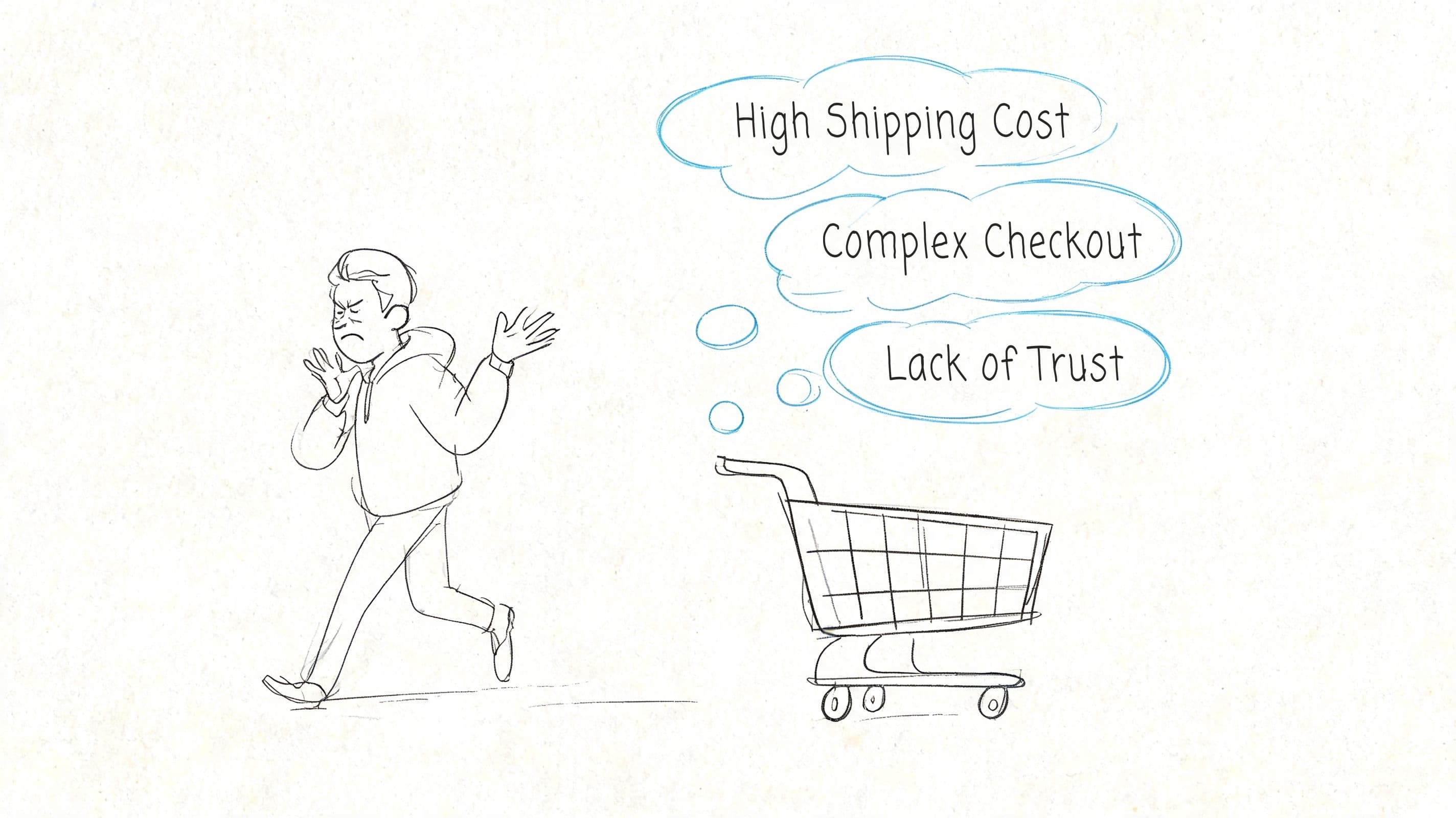
On Shopify, there is a practical difference between abandoned carts and abandoned checkouts. Abandoned checkouts are the high-intent shoppers who entered the checkout flow and can be tracked inside Shopify. Abandoned carts happen earlier, often in much larger volume, and many stores never build a recovery layer for them at all. That gap matters because the reason someone leaves at cart stage is often different from the reason someone drops during checkout.
Start there. If a shopper never reached checkout, sending a checkout reminder will not solve the underlying issue.
Start with an honest funnel audit
Review the path from product page to cart to checkout like a new customer who does not trust your store yet. That standard catches problems internal teams miss because they already know the answers.
Look for these friction points:
- Price clarity: Are shipping costs, delivery timing, or thresholds obvious before the cart?
- Cart confidence: Does the cart answer basic questions like returns, delivery windows, and payment options?
- Checkout effort: Are shoppers running into too many fields, slow loads, or distracting coupon prompts?
- Account pressure: Can buyers continue quickly, or are they being pushed to create an account too early?
- Mobile usability: Is the add-to-cart and checkout path easy to complete with one hand on a phone?
Stores with heavy phone traffic need to be stricter here. Broader mobile commerce behavior on Shopify and beyond explains why minor UX issues hit harder on smaller screens, especially once shoppers are comparing tabs, checking shipping, or multitasking.
A simple rule helps. If the shopper has to calculate the actual order total themselves, trust drops fast.
The friction points that usually matter most
Unexpected costs still kill more purchases than weak reminder copy. If shipping, taxes, or fees appear late, shoppers read that as a pricing problem, not a communication problem. Some leave to comparison shop. Others leave for good.
Checkout complexity is the next leak. Long forms, poor payment coverage, aggressive upsells, and slow pages create hesitation right when intent should be highest. I see this often on stores that spend heavily on acquisition and then force buyers through a clumsy final mile.
Missing reassurance is another common failure. Cart-stage shoppers often want one answer before they commit: delivery speed, return policy, sizing help, product compatibility, or whether the brand looks legitimate. If that answer is buried, many will abandon before checkout even starts. Shopify will never classify those sessions as abandoned checkouts, which is why native recovery alone leaves money on the table.
That is the operational reality. Checkout recovery helps recover high-intent demand. Full-funnel cart recovery gets more of the shoppers who were interested but unconvinced.
Fix the biggest source of friction first. A better reminder sequence helps, but it will not rescue a cart flow that hides costs, drags on mobile, or leaves basic purchase questions unanswered.
Configuring Shopify’s Native Checkout Recovery
Shopify’s built-in abandoned checkout recovery should be turned on in every store. It’s the easiest safety net you have, and there’s no reason to leave it unused.
That said, it’s still a safety net. It is not a complete abandoned carts shopify system.
Turn on the baseline recovery layer
In practice, the setup is straightforward:
- Open your Shopify admin and go to the area where abandoned checkouts and automations are managed.
- Enable recovery automation so shoppers who begin checkout can receive follow-up.
- Review the template copy before you send anything. Generic copy underperforms, especially if your brand tone is sharp everywhere else.
- Make sure links return the shopper to a live cart or checkout state without adding confusion.
- Check timing and branding so the message feels like a continuation of the buying experience, not a disconnected reminder.
For many smaller stores, this one setup change is enough to recover a portion of otherwise lost checkout intent. It’s foundational because it catches shoppers who were already close enough to start payment details.
A quick walkthrough helps if you want to verify the settings visually:
Where the native tool stops
The limitation is the part merchants miss. Shopify’s native tool only works on abandoned checkouts, not the broader pool of abandoned carts. And that broader pool is larger.
According to Recapture’s explanation of Shopify cart versus checkout recovery, abandoned carts represent a 1.5x higher volume of sessions than abandoned checkouts. That means if you rely only on native checkout recovery, you aren’t even attempting to recover more than half of the lost opportunities your store creates.
Here’s the practical difference:
| Behavior | Shopify can identify natively | What you can do |
|---|---|---|
| Shopper adds to cart, never starts checkout | Limited native follow-up | Use onsite prompts, retargeting, and proactive engagement |
| Shopper starts checkout, then leaves | Native recovery available | Use Shopify automation, email, SMS, and stronger sequencing |
The native workflow is useful because checkout abandoners have shown stronger intent. It’s incomplete because many shoppers leave before Shopify has enough information to follow up.
Many stores stall at this point. They congratulate themselves for having “abandoned cart recovery” because one checkout email is live. In reality, they’ve only covered the bottom slice of the funnel.
Use Shopify’s built-in flow. Just don’t confuse it with full-funnel recovery.
Building an Automated Email and SMS Sequence
Once the native layer is live, the next lift comes from orchestration. Single reminders rarely do enough. A structured sequence does.
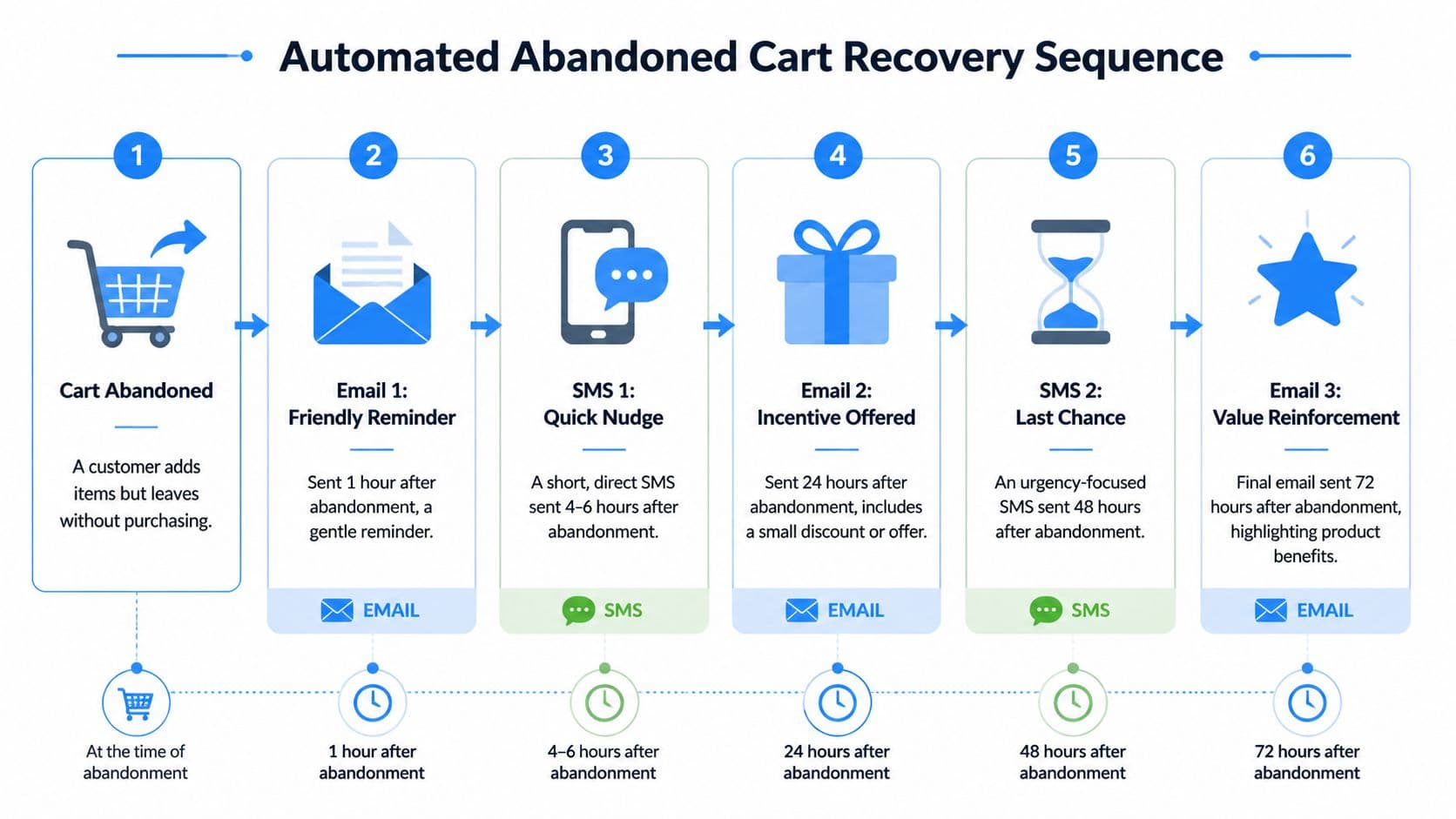
The benchmark to work from is clear. A proven sequence uses Email #1 at 2 to 4 hours, then SMS plus Email #2 at 24 hours, followed by a final urgency email at 72 hours. According to Acoustic’s Shopify cart recovery sequence guide, that mix can produce a 15-22% recovery rate, with the first email driving 5-8% recovery and the SMS touch adding 8-12%.
The sequence that usually outperforms single reminders
A good sequence doesn’t nag. It answers a different objection at each step.
- Email #1 in the 2 to 4 hour window: Keep it clean and product-specific. Show the item, the cart, and the path back. Don’t lead with a discount unless your margin structure depends on it.
- SMS and Email #2 at 24 hours: This is the best point for a stronger nudge. If you use an incentive, tie it to action and keep the copy tight.
- Email #3 at 72 hours: This is the final push. Use urgency carefully. Focus on stock, demand, fit, use case, or a simple “your cart is still saved” message.
What usually fails is the opposite approach. Stores send one email too quickly, say nothing useful, and then disappear. Or they send a flood of discount-heavy messages that train shoppers to wait.
What to say in each message
The structure matters more than clever writing.
Email #1 Focus on continuity. Remind the shopper what they picked and make return frictionless. Product image, product name, cart button. Minimal clutter.
SMS Use this only when you have consent and a clear reason for the message. SMS works best when the shopper already knows your brand and the message removes friction instead of adding pressure.
Email #2 In this email, many brands layer in social proof, shipping clarity, return policy reassurance, or a modest incentive. Choose one angle. Don’t stack everything in one send.
Email #3 Close the loop. If they buy, great. If they don’t, your final email should preserve brand value rather than sound desperate.
Write recovery messages like a good sales associate would speak. Specific product context beats generic persuasion every time.
A practical setup in Klaviyo or Omnisend usually includes product blocks, dynamic cart links, suppression rules, and segmentation for first-time versus returning customers. That last piece matters because the same message doesn’t fit both groups. New visitors often need trust signals. Returning customers often need speed and relevance.
Regional context also affects how you write and send these flows. If you sell into multiple markets, these insights into South African email marketing are useful because they highlight how local habits, deliverability realities, and channel expectations shape campaign performance.
Here’s the trade-off most operators eventually learn. Email scales well. SMS gets attention faster. But if your onsite experience is weak, both channels end up compensating for problems they should never have had to fix.
Deploying Onsite Tactics for Proactive Recovery
Reactive recovery starts after the shopper leaves. By then, you’re already at a disadvantage. You’re competing with distractions, inbox congestion, and the simple fact that intent cools fast.
That’s why the strongest abandoned carts shopify programs don’t stop at follow-up. They intervene while the shopper is still on the site and still deciding.
Why reactive recovery leaves money behind
Some carts can never enter your email or SMS flow because the shopper never starts checkout. You can’t recover what you never captured.
That’s the operational case for proactive onsite recovery. It reaches the higher-volume cart traffic that hasn’t given you contact details yet, and it solves objections in the moment instead of asking shoppers to come back later.
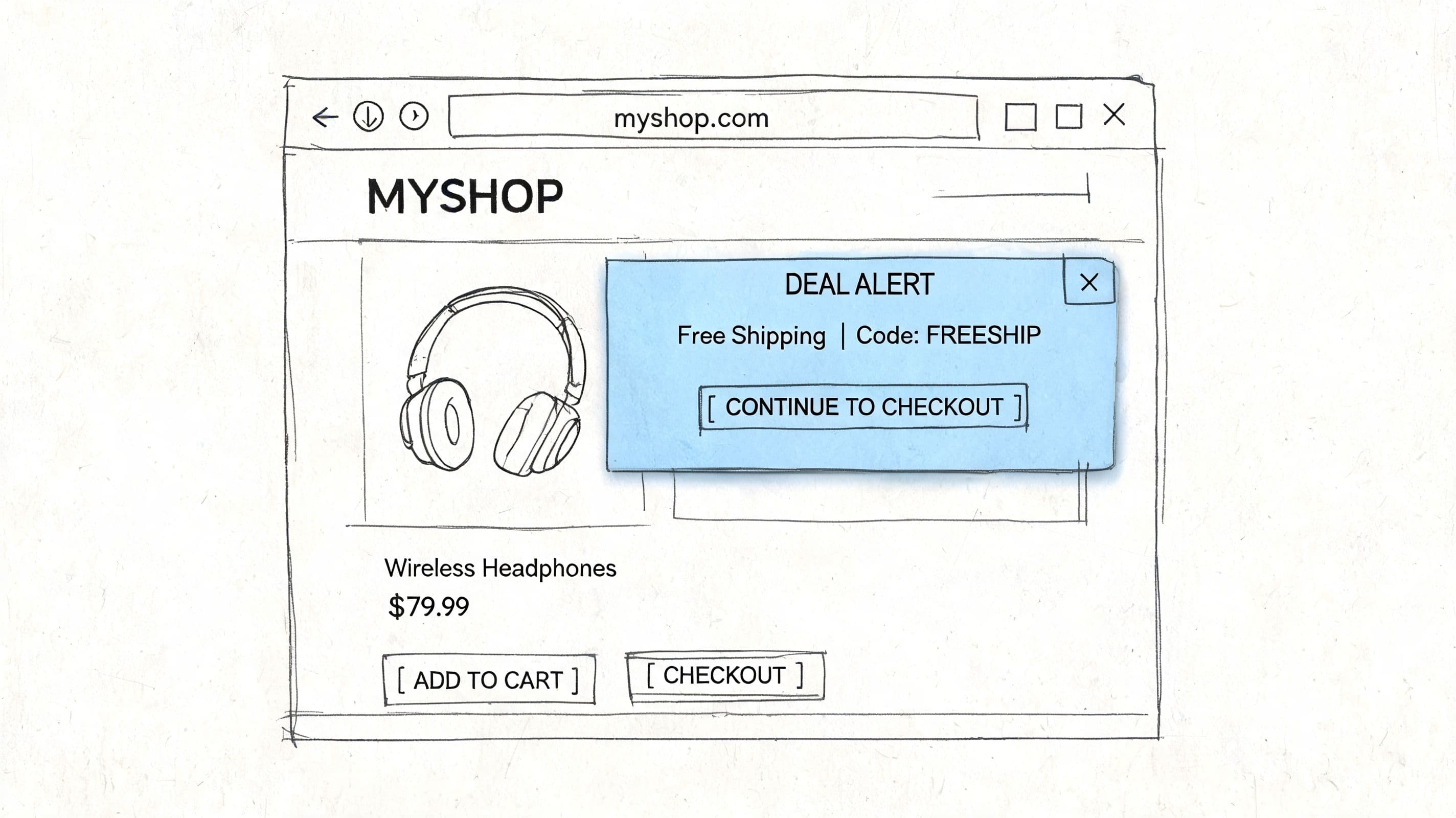
According to Quikly’s overview of Shopify cart abandonment tactics, high-value carts recover twice as well with personalized, real-time engagement, and advanced AI chatbot apps can cut abandonment by 15-25% before the shopper leaves the site. That’s the key distinction. These tools don’t just recover lost carts. They prevent some of them from being lost in the first place.
Onsite interventions that actually help
Not all onsite tactics are equal. Some lift conversion. Others just interrupt people.
The useful options tend to be:
- Exit-intent prompts: Best when they answer a likely objection, such as shipping clarity or return policy reassurance.
- Sticky cart reminders: Helpful for mobile navigation where buyers lose track of the cart state.
- Product-page prompts: Strong when the hesitation is fit, compatibility, ingredients, delivery timing, or bundle choice.
- Live or AI chat: Best when buyers need answers before they commit.
Here’s what doesn’t work well. Random popups with generic discount offers the second someone lands on the page. They attract coupon hunters, distract high-intent buyers, and teach customers to delay.
A better model is behavior-based triggering. If a shopper pauses on shipping information, lingers in cart, toggles variants repeatedly, or shows exit behavior, that’s the moment to help.
Field note: The best onsite recovery message usually sounds like service, not marketing.
For merchants thinking through live chat as a revenue tool rather than a support widget, this guide on reducing cart abandonment with live chat on Shopify is a useful next read. The core value of chat isn’t that it exists. It’s that it answers the exact question blocking the order.
This matters even more for premium baskets. High-value carts often stall because the buyer wants reassurance. They may wonder about sizing, shipping speed, warranty details, ingredients, or whether two products work together. An onsite answer closes that gap faster than any delayed reminder ever will.
The trade-off is setup quality. A bad onsite system feels noisy and scripted. A good one is timely, contextual, and tied to buyer hesitation. That difference decides whether it boosts checkout completion or just adds friction.
Tracking KPIs and A/B Testing Your Strategy
If you don’t measure recovery cleanly, you’ll keep making changes based on gut feel. That usually leads to wasted discounts, messy attribution, and false wins.
The core metric here is straightforward. The Abandoned Cart Recovery Rate is calculated as (Recovered Carts / Total Abandoned Carts) × 100, according to KPI Tree’s Shopify recovery rate guide. The same source notes that basic email sequences often recover 5-10%, while advanced automation can reach 15-25% or higher when segmentation and testing are done well.
The numbers worth watching
Build a simple dashboard around a few metrics you can act on:
| KPI | What it tells you | Why it matters |
|---|---|---|
| Abandoned cart rate | How often carts fail to convert | Shows whether store friction is improving or worsening |
| Recovery rate | How many abandoned carts return and purchase | Tells you whether your recovery system actually works |
| Recovered revenue | Revenue tied to recovery flows | Helps you judge channel quality, not just click activity |
| Message engagement | Opens, clicks, replies, and return visits | Reveals whether the offer or timing is wrong |
| Segment performance | Results by new, returning, high-value, or mobile users | Prevents average performance from hiding weak spots |
For a broader framework on ecommerce measurement, this breakdown of e-commerce key performance indicators is useful because it keeps cart recovery tied to overall store economics rather than treating it like an isolated automation project.
How to test without muddying the result
Most stores test too many things at once. They change timing, copy, discount level, design, and audience in one go, then can’t tell what moved performance.
Test one variable at a time:
- Subject line: Keep email body constant.
- Send delay: Compare one timing shift only.
- Offer type: Test shipping incentive against a direct discount, not both plus new copy.
- CTA phrasing: Change the button language without touching layout.
- Onsite prompt trigger: Compare one behavior threshold against another.
A disciplined testing process matters more than the tool. If your team needs a useful primer, OneNine’s guide to A/B testing website optimization is a solid reference for structuring tests so you don’t misread noisy data.
Good testing removes guesswork. Bad testing creates stories your dashboard can’t support.
The hidden trap is overvaluing recovered orders while ignoring margin quality. A sequence that recovers more carts by overusing discounts may hurt the business if it trains buyers to wait. Track recovery, but evaluate it alongside profitability and repeat purchase behavior.
Advanced Cart Recovery Questions Answered
Should you offer a discount every time
No. Discounts are one tool, not the default answer.
If the cart likely stalled because of uncertainty, answer the uncertainty. Clarify delivery timing, returns, sizing, ingredients, compatibility, or product selection. Save discounts for cases where price resistance is the primary blocker, or where your category is already highly promotional and buyers expect an offer.
A useful rule is to escalate incentives instead of opening with them. Protect margin first. Train shoppers to buy, not to hold out.
How should you treat different shopper segments
Treat them differently on purpose.
A first-time visitor usually needs trust. Use messages that reduce risk and make the next step easy. A returning shopper often needs convenience, speed, or a sharper reminder of the product they already considered. High-value carts deserve more personal handling because the economics justify it.
If you want a second perspective on practical recovery triage, Refact’s piece on ecommerce solutions to reduce cart abandonment has useful ideas for prioritizing the leaks that matter first instead of deploying every tactic at once.
What about international carts and shipping friction
Be more transparent earlier.
If cross-border shipping or duties create uncertainty, surface that before checkout. Don’t wait until the last step to reveal the full reality of the order. International shoppers are often less price-sensitive than merchants assume, but they’re much more sensitive to unpleasant surprises.
This is also where cart-page reassurance helps. Shipping windows, return expectations, and local payment options should be obvious. If those details are buried, recovery messages won’t fix the root issue.
Should abandoned carts and abandoned checkouts get the same strategy
No. They’re different stages with different intent levels.
Checkout abandoners are closer to conversion and easier to follow up with directly. Cart abandoners are broader, less committed, and often anonymous. That’s why a full-funnel program splits the approach. Use email and SMS where identity exists. Use onsite prompts, chat, and retargeting where it doesn’t.
How often should you review the system
More frequently than is common.
Recovery flows degrade. Product assortments change. Shipping policies change. Mobile UX drifts. Messaging becomes stale. Review creative, timing, landing paths, and segment performance on a regular rhythm so the system keeps matching how people shop.
If you want to recover more Shopify revenue before shoppers disappear, Carti is built for that gap. It helps stores answer buyer questions instantly, engage shoppers proactively onsite, and recover purchase intent that email-only setups miss. For merchants who want abandoned carts shopify coverage beyond native checkout reminders, it’s a practical way to add a 24/7 sales layer without a heavy setup.

Written by
Daniel AndersonFounder of Carti. 10+ years building ecommerce brands in apparel and supplements. Still runs a Shopify store and built Carti to help merchants convert more browsers into buyers.
Ready to boost your store's sales?
Install Carti in 5 minutes and let AI handle customer questions, recommend products, and close sales 24/7.
Start Free Trial14-day free trial