
Two-thirds of shoppers feel anxiety right after they click buy, according to Narvar’s 2025 State of Post-Purchase report. That single fact changes how smart Shopify operators should think about post purchase behavior.
The order confirmation page isn’t the finish line. It’s the first real test of trust.
Before purchase, customers react to your ads, offers, product pages, and price. After purchase, they react to reality. They watch for shipping updates. They decide whether your tracking feels clear or vague. They judge how easy it is to get help. They decide whether a return feels fair or hostile. Those actions tell you more about the health of your business than most top-of-funnel metrics ever will.
Many brands still treat this stage like back-office operations. That’s a mistake. Post purchase behavior shapes whether a customer buys again, asks support for help, disputes a charge, tells a friend, or fades away. In practice, this phase sits right at the intersection of retention, margin, support cost, and brand perception.
For Shopify merchants, that makes post-purchase one of the most impactful systems to improve. Not because it sounds good in a CX deck, but because it affects repeat orders, return friction, support load, and how customers talk about your store when the product is finally in their hands.
The Hidden Moment That Defines Your Brand
About 66% of shoppers feel anxious right after they buy, as noted earlier from Narvar's survey. That anxiety becomes real work for a Shopify store. More tracking questions, more return requests, more “where is my order?” tickets, and more second thoughts before the product even arrives.
This is the moment customers decide whether your brand feels dependable.
The sale creates expectation. The post-purchase experience either confirms that expectation or weakens it. A polished product page can win the order, but the days after checkout shape whether a customer trusts you enough to buy again, leave a positive review, or recommend the brand to someone else.
For Shopify merchants, this phase is usually split across apps, inboxes, carrier updates, and return portals. That fragmentation creates cost. It also creates missed revenue. If customers have to search for shipping updates, email support for simple answers, or dig through policy pages for details on product returns, the brand feels harder to buy from than it should.
Strong operators treat post-purchase as a system, not a support queue.
That system needs four things working together:
- Clear expectations at checkout: delivery timelines, shipping methods, and policy language customers can understand fast
- Proactive updates after purchase: messages that answer the next likely question before it becomes a ticket
- Fast self-serve support: order status, edits, cancellations, and return answers available without waiting on an agent
- Recovery paths that protect margin: smart handling for delays, damaged items, and exchanges without turning every issue into a refund
Implementation matters more than theory. An AI chatbot like Carti can sit inside the post-purchase journey and handle the repetitive questions that drain support teams, while also guiding customers toward actions that keep revenue in the business. That can mean surfacing tracking instantly, recommending an exchange instead of a refund, or resolving common concerns before they turn into churn.
The brands that win after checkout do not just communicate more. They remove uncertainty faster, measure the right e-commerce KPIs for retention and support efficiency, and use automation where speed changes the outcome.
Post-purchase behavior is not a back-office issue. It is one of the clearest signals of whether your store is built to retain the customers you already paid to acquire.
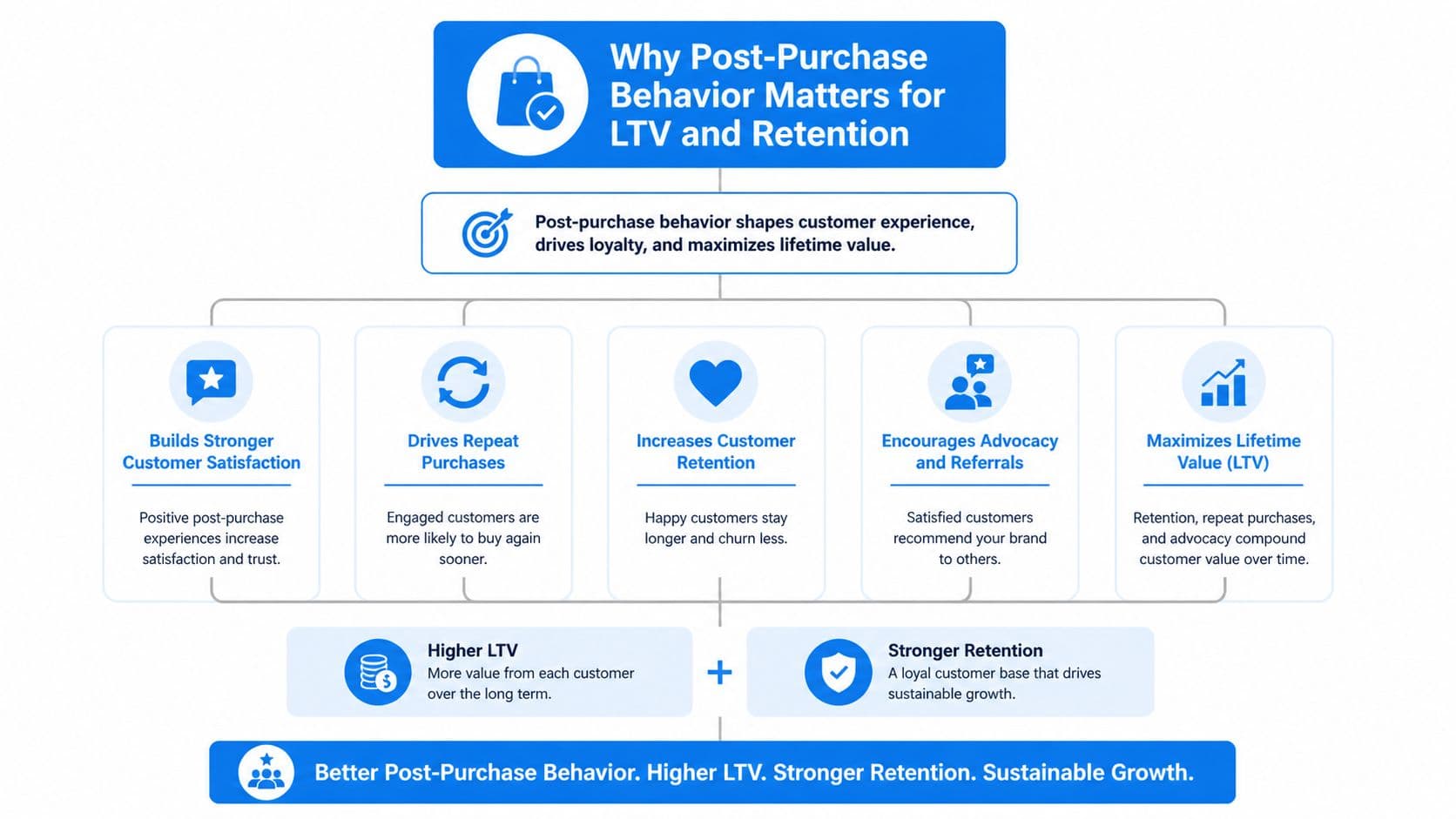
Why Post-Purchase Behavior Matters for LTV and Retention
The easiest way to understand post purchase behavior is this. It’s the customer’s unfiltered response to doing business with you.
Browsing is cheap. Buying creates stakes. After the order goes through, customers reveal what they think through behavior. They check tracking repeatedly. They contact support. They ask for exchanges. They place a second order. Or they never come back. Those signals are much harder to fake than a quick click on an ad.
The retention gap is bigger than most teams think
Radial reports a sharp disconnect in its post-purchase experience research. 79% of shoppers say they won’t repurchase after a poor post-purchase experience, while only 18% of business leaders think their current experience needs improvement.
That gap shows up in the numbers merchants care about most. Lower repeat purchase rate. More support burden. More return-related friction. Weak brand affinity. Reduced lifetime value.
When leadership overestimates the quality of the experience, they underinvest in the systems that protect margin. They keep spending on acquisition while repeat customers churn unnoticed.
What post-purchase behavior says about LTV
Customer lifetime value doesn’t improve because a brand says it values loyalty. It improves when customers trust the next transaction will be easy.
Here’s how that usually plays out:
- Confident customers buy again faster: they don’t need as much reassurance on the second order
- Supported customers forgive mistakes more often: a clean recovery matters almost as much as a smooth first experience
- Customers who feel informed contact support less: lower service load gives teams room to handle higher-value issues
- A strong post-purchase journey increases merchandising opportunities: follow-up recommendations and replenishment prompts feel more natural after trust is established
Practical rule: If you want to raise LTV, start by reducing uncertainty after purchase.
Why this deserves budget, not leftovers
Post-purchase investments often lose internal budget debates because they look operational. That framing misses the point. Tracking clarity, returns UX, issue resolution, and follow-up communication all affect whether the first order turns into a relationship.
The mistake is separating “customer service” from “growth.” In e-commerce, they’re tied together. A weak post-purchase experience lowers the value of every customer you acquire. A strong one compounds the value of each order already won.
Common Post-Purchase Behaviors and KPIs to Track
Brand loyalty is looser than it used to be. Exploding Topics notes in its post-pandemic consumer behavior analysis that 81% of Gen Z and Millennial consumers switched brands within the last year. For Shopify merchants, that means the customer’s behavior after purchase deserves close monitoring, especially around returns, support, and the next order.
If you want to manage post purchase behavior well, don’t start with a giant dashboard. Start by separating customer actions into two buckets. Signals of confidence, and signals of friction.
Signals that usually mean the experience is working
These actions suggest the customer feels secure enough to continue the relationship:
- Second purchase within a short window: the customer trusts your store enough not to re-evaluate from scratch
- Positive review or testimonial: they believe the experience matched the promise
- Loyalty sign-up or account creation: they expect future value
- Product sharing or referral behavior: they’re willing to associate their name with your brand
- Low-touch ownership questions: they’re engaged with the product, not stuck in a service problem
Signals that usually mean trust is under pressure
These actions don’t always mean the customer is lost, but they do show friction:
- WISMO contacts: your tracking or delivery communication didn’t answer the obvious question
- Return initiation: the issue may be product fit, expectation mismatch, or convenience buying
- Order cancellation before fulfillment: confidence dropped after checkout
- Chargeback or aggressive support escalation: the customer thinks your normal service path won’t solve the problem
- Repeated contacts on the same order: your team answered, but didn’t resolve
For store operators refining reverse logistics, this guide to details on product returns is useful because it breaks down the operational side of returns in a way many marketing articles skip.
Mapping customer actions to key business metrics
| Post-Purchase Behavior | What It Signals | Key Performance Indicator (KPI) |
|---|---|---|
| Second order placed | Growing trust and purchase confidence | Repeat purchase rate |
| Review submitted | Satisfaction or disappointment strong enough to share | Review volume and review sentiment |
| Loyalty enrollment | Intent to maintain relationship | Loyalty sign-up rate |
| Referral or share activity | Advocacy | Referral participation |
| WISMO question submitted | Tracking ambiguity or delivery anxiety | WISMO ticket volume |
| Return requested | Fit issue, expectation gap, or convenience shopping | Return rate by product, variant, and channel |
| Order canceled | Buyer’s remorse or poor delivery expectation | Pre-fulfillment cancellation rate |
| Multiple support contacts on one order | Unresolved issue | Recontact rate per order |
| Exchange completed | Customer still wants the product, but not the original selection | Exchange rate |
| No engagement after delivery | Weak experience or low product attachment | Time to second purchase |
Build a scorecard your team can use
A useful scorecard has to drive action. That means tying each KPI to an owner.
Operations should own delivery-related signals. CX should own response quality and resolution patterns. Merchandising should review return reasons by product. Growth should watch repeat purchase timing and post-delivery engagement. If everyone sees the same signals but nobody owns the fix, the dashboard becomes decoration.
If you need a broader framework for choosing the right store metrics, this reference on e-commerce key performance indicators is a good companion.
Actionable Strategies to Improve Post-Purchase Experience
Most post-purchase fixes aren’t complicated. They require discipline more than creativity. The job is to remove uncertainty, reduce effort, and create a reason to come back.
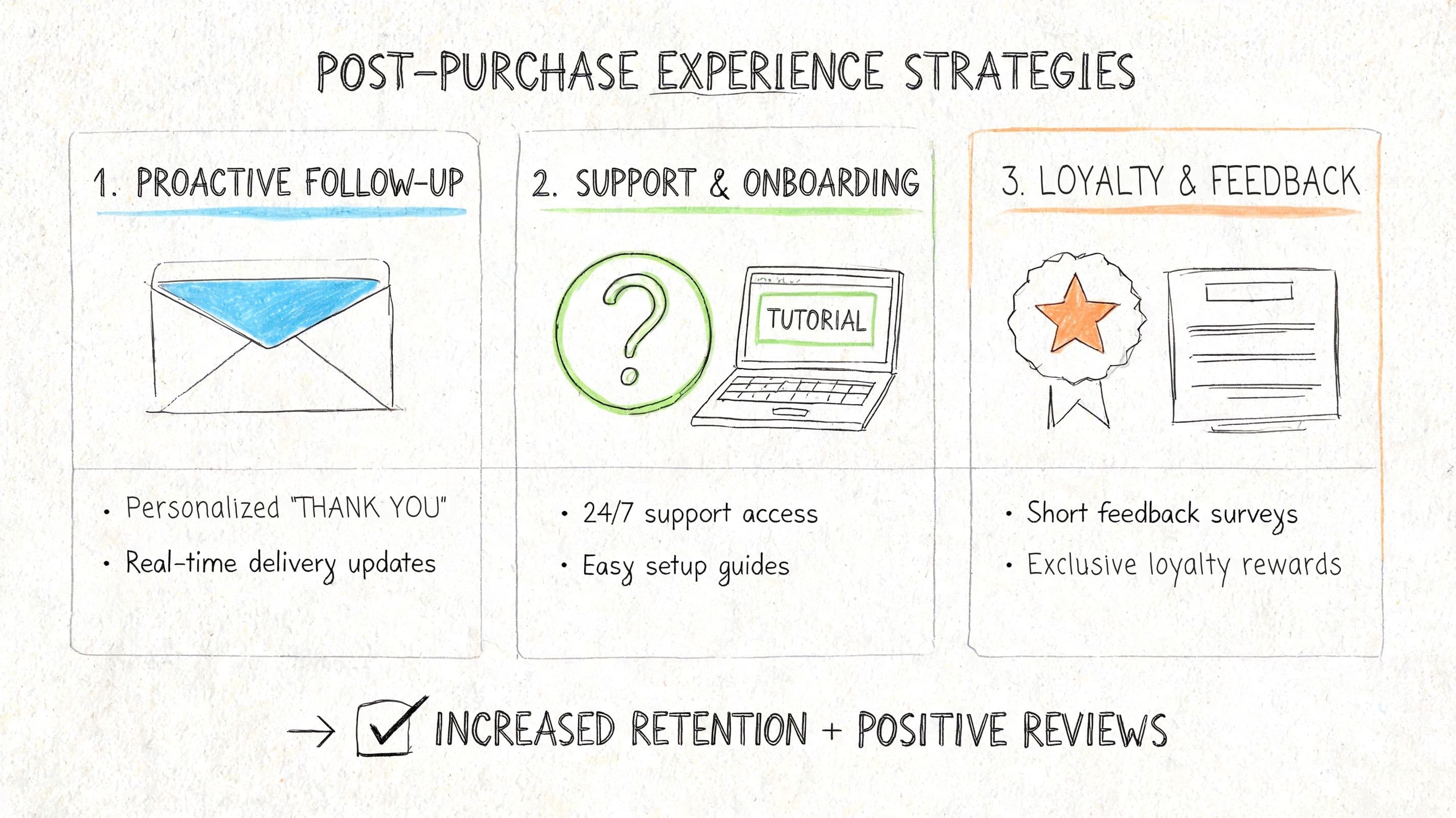
BigCommerce reports that real-time exit-intent personalization and timely follow-up emails can reduce drop-off before abandonment and recover purchases after it. That matters because post-purchase and post-abandonment are connected. The same customer expectation is at work in both cases. Relevance, timing, and low friction.
Communicate before customers have to ask
A strong post-purchase flow answers the next question automatically.
Order confirmation should confirm more than payment. It should restate what was bought, what happens next, and when the customer should expect the next update. Shipping communication should be plain, not vague. If there’s a delay, say so early. Customers are usually more patient with honest updates than with silence.
Poor communication creates avoidable support volume. Good communication lowers anxiety and preserves trust without adding headcount.
Make returns feel fair and controlled
Returns don’t need to be frictionless in a reckless way. They need to be clear.
The best returns experience does three things well. It sets expectations upfront, gives customers a predictable path, and protects the business from abuse. That trade-off is especially important in categories like fashion, beauty, and home where fit, preference, and convenience returns are common.
For recurring revenue stores, the same principle applies to payment recovery. Teams running subscriptions should understand dunning for subscription brands, because failed payments are another post-purchase moment where communication quality affects retention.
The customer doesn’t need every option. They need the right next step without confusion.
Use follow-up offers with restraint
Not every order should trigger an instant upsell. Timing matters.
A customer waiting on a delayed package is not in the mood for cross-sells. A customer who has just received the order, had a clean delivery, and hasn’t raised an issue is a much better candidate. Post-purchase recommendations work when they feel connected to ownership, replenishment, styling, or setup. They fail when they feel like a generic blast.
Personalize the support experience
Support tone matters as much as support speed.
Customers don’t want scripted sympathy followed by a generic link. They want a direct answer, a realistic timeline, and a clear resolution path. Teams that want to improve agent interactions should review practical guidance on customer service etiquette, especially for high-friction moments like delays, damaged items, and returns.
Give customers a reason to stay connected
Loyalty isn’t built with points alone. It’s built when the customer sees a benefit to staying in your ecosystem.
That can mean early access, replenishment reminders, educational follow-ups, reorder convenience, or curated recommendations based on the original purchase. The best retention programs feel useful, not performative. If the post-purchase experience is weak, a loyalty layer won’t save it. If the experience is solid, loyalty incentives can amplify it.
How to Measure and Analyze Post-Purchase Signals
Most Shopify stores already have pieces of the data. Order history lives in Shopify. Support trends live in the help desk. Review sentiment lives in your reviews platform. The problem isn’t lack of information. It’s that teams rarely combine these signals into one operating view.
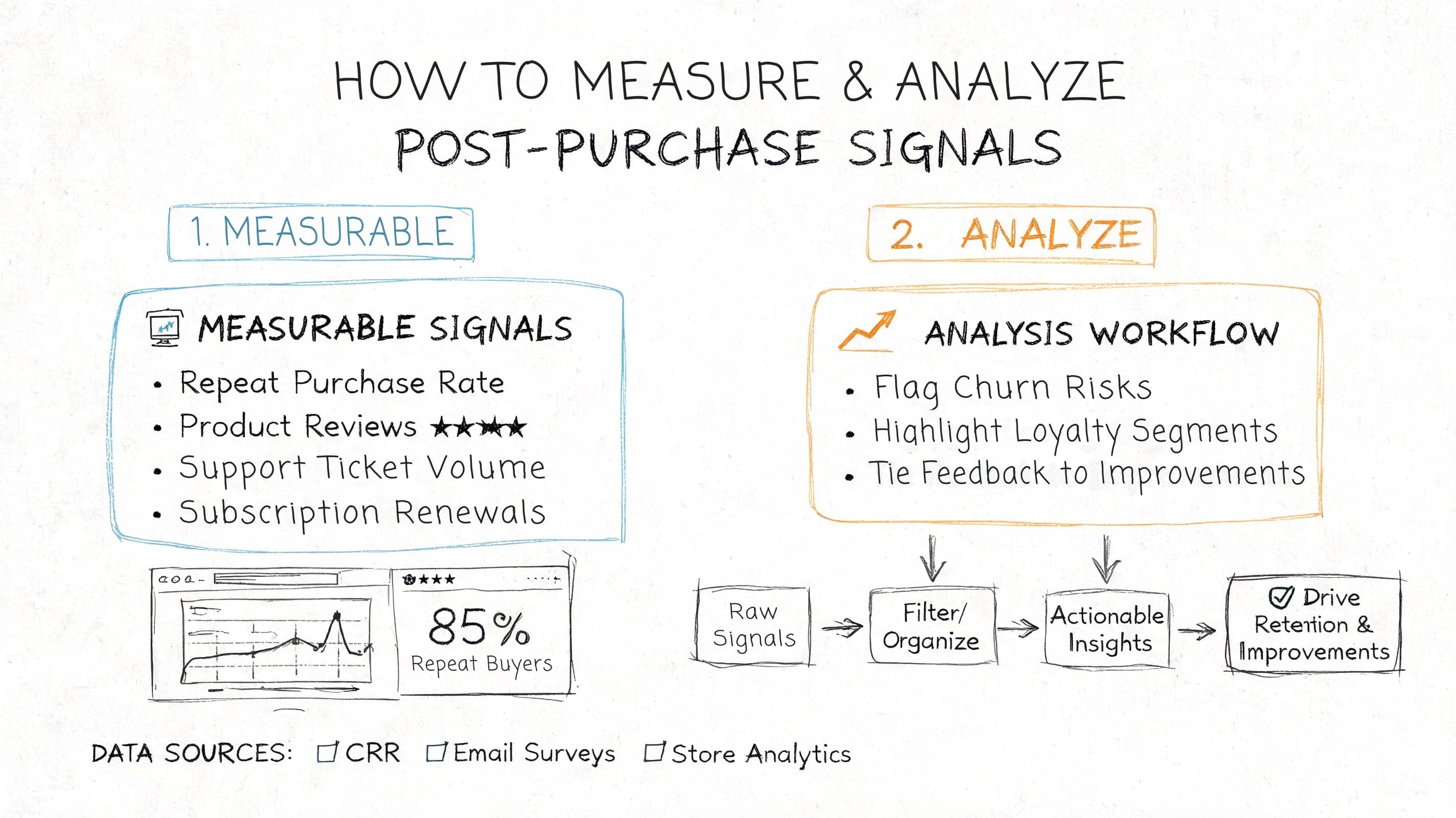
A useful measurement system connects behavior to cause. Don’t just note that returns increased. Identify which SKUs, which acquisition channels, which promises on-site, and which support topics are showing up together. The same applies to repeat purchases. Don’t just celebrate them. Look at what happened before them. Fast delivery, clear onboarding, responsive support, or a well-timed follow-up often leaves a pattern.
Combine behavioral data with customer-reported insight
Many brands stop too early. Clickstream and platform analytics tell you what happened. They rarely tell you why the customer interpreted the experience the way they did.
That’s why post-purchase surveys matter. The 021 newsletter argues in its piece on post-purchase surveys for attribution that customers reduce messy journeys into memorable moments that pixels miss. That makes surveys useful not only for feedback, but also for attribution, CAC, ROAS, and LTV decisions.
Ask short questions that reveal perception, not just satisfaction:
- Best part of the experience: this shows what customers remember
- Biggest point of friction: this often surfaces issues dashboards flatten out
- What nearly stopped you from buying again: this identifies retention risk early
- How did you hear about us: this catches influence paths tracking can miss
A customer may not describe their journey with analytical precision, but they’ll often tell you what mattered most.
Don’t ignore deliverability in your measurement loop
If your post-purchase emails don’t land, your strategy can look broken even when the content is good. Before you judge low engagement on order updates or follow-ups, run your sending setup through an email spam checker so you can separate messaging problems from inbox placement problems.
Build one review rhythm
You don’t need a massive BI project to improve this. A weekly operating review works if it covers the right questions:
- What created the most support demand after purchase
- Which products produced the most returns or exchanges
- Which messages customers engaged with or ignored
- Which survey responses point to expectation gaps
- Which delivery or policy issues are repeat offenders
The goal isn’t more reporting. The goal is faster correction.
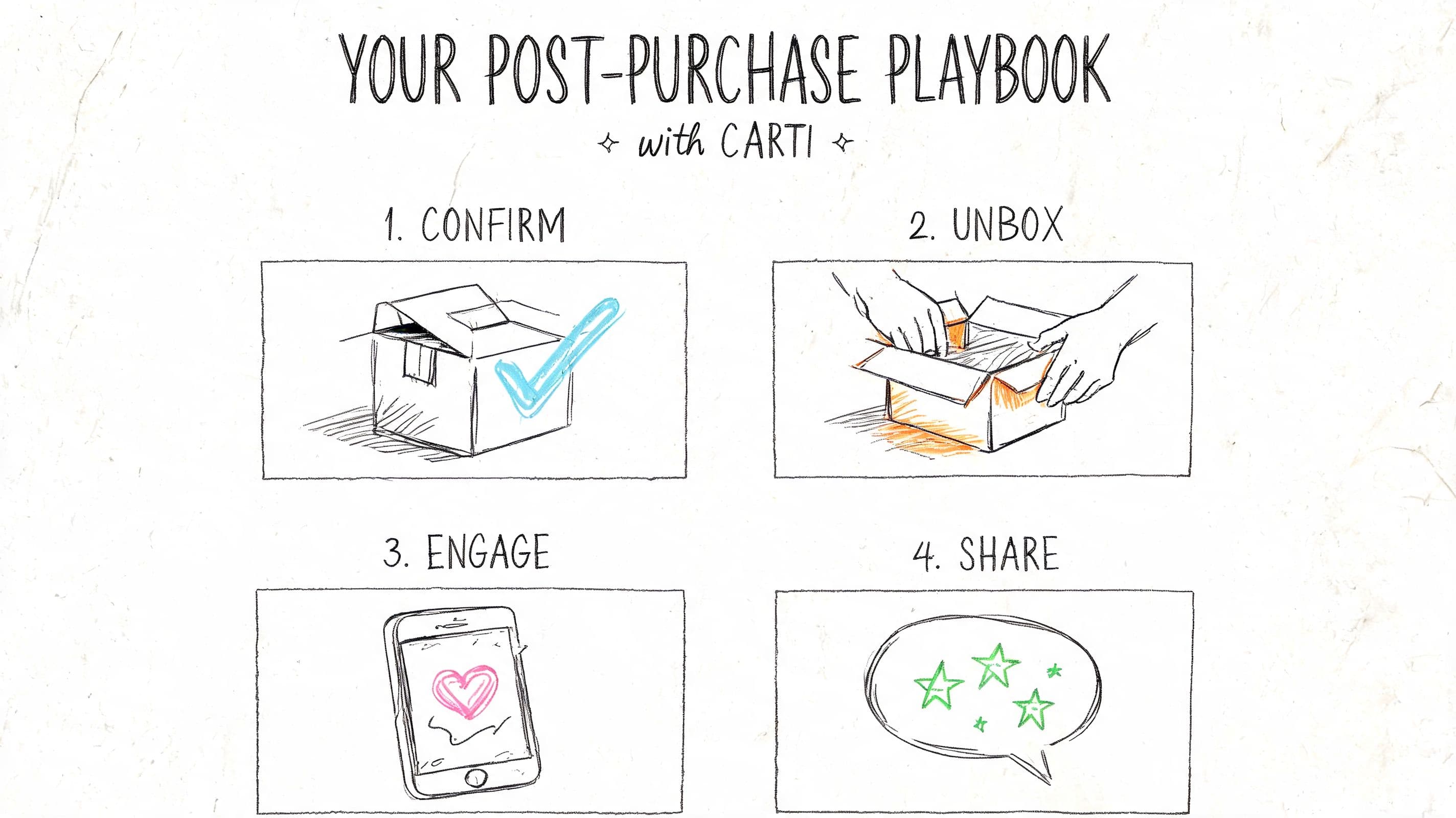
Your Post-Purchase Playbook with Carti
A chatbot only improves post purchase behavior if you give it a clear job. The goal isn’t to automate every interaction. The goal is to handle the predictable questions instantly, route the messy ones well, and keep customers moving toward confidence instead of doubt.
Step one, eliminate simple anxiety fast
Most post-purchase questions are repetitive. Where is my order. When will it ship. How do I start a return. Can I change my address. What happens if the item arrives damaged.
Use Instant Answers to cover those questions with store-specific responses based on your policies, shipping windows, and return rules. This works best when the chatbot is trained on the exact wording customers already use in tickets, chats, and emails. Generic FAQ language usually misses the mark.
A good rule is simple. If a customer can solve the issue without agent judgment, automate the first response.
Step two, use support conversations to create the next sale
Post-purchase support shouldn’t feel like a dead end.
When the order is on track and the customer’s question has been resolved, Smart Suggestions can surface complementary products that fit the original purchase. For fashion, that might be related accessories or matching basics. For wellness, it may be replenishment-friendly items. For home, it may be add-ons that complete the use case.
What doesn’t work is pushing recommendations while the customer is still stuck in a problem flow. Solve first. Suggest second.
The best post-purchase recommendation feels like service, not interruption.
Step three, catch the second-cart drop-off
A lot of merchants focus all recovery effort on the first abandoned checkout and ignore what happens later. That’s a miss. Some customers come back after a decent first order, build a second cart, and then hesitate. That’s valuable intent.
Use Cart Recovery flows to trigger timely nudges when a returning customer abandons that second cart. The messaging should acknowledge familiarity with the brand and remove a reason for delay. Shipping clarity, returns reassurance, and product fit guidance usually outperform hard-sell copy in this stage.
If you’re evaluating how AI can support more of that buying journey, this overview of sales assist AI is a useful lens.
Step four, mine questions for operational fixes
The biggest long-term value often comes from the Insights Dashboard.
Review what customers ask after purchase, not just what they ask before purchase. If the same delivery question keeps surfacing, your shipping page may be unclear. If return questions cluster around a product line, your product detail page may be overselling fit. If customers keep asking whether a product works with another item, merchandising and bundling need work.
Use the chatbot as a listening system, not just a response layer.
A practical operating loop looks like this:
- Support reviews question clusters
- Operations updates policy or shipping copy
- Merchandising adjusts product detail or bundle logic
- Marketing updates post-purchase messaging based on recurring concerns
That’s how an AI chatbot becomes part of retention operations instead of just another widget.
From Transaction to Lasting Relationship
Post purchase behavior tells you what the customer believes after your marketing stops talking.
If they feel informed, supported, and respected, they’re more likely to buy again. If they feel uncertain, ignored, or trapped in process, they leave. That’s why this phase matters so much. It influences retention, support cost, return pressure, and the odds that a first order turns into a longer customer relationship.
The strongest Shopify brands don’t treat post-purchase as a cleanup function. They treat it as a system. They monitor the right signals. They remove friction from communication and returns. They ask customers what stood out. They use those answers to improve the next order, not just explain the last one.
The economics of e-commerce become more durable at this stage. Acquisition secures the initial sale, but the post-purchase experience determines whether that transaction was worth the cost paid to earn it.
Run an audit of your own store this week. Check the confirmation flow. Check tracking updates. Test the return path. Review recent support conversations. Read the survey responses customers leave after delivery. The gaps will be obvious once you look at the journey from the customer’s side.
Then fix the moments that create doubt first.
If you want to put this into practice on Shopify, Carti helps you answer post-purchase questions instantly, reduce repetitive support load, surface relevant product suggestions, and turn customer conversations into insights your team can act on. It’s a practical way to make post-purchase support faster, clearer, and more revenue-aware without adding more manual work.

Written by
Daniel AndersonFounder of Carti. 10+ years building ecommerce brands in apparel and supplements. Still runs a Shopify store and built Carti to help merchants convert more browsers into buyers.
Ready to boost your store's sales?
Install Carti in 5 minutes and let AI handle customer questions, recommend products, and close sales 24/7.
Start Free Trial14-day free trial