
A large independent study of 5 billion website visits found that e-shops using chatbots handled 89.2% of inquiries, compared with 71.2% for stores without chatbots, and those chatbot-enabled sites managed 6 times more customer conversations overall. That's why the best ecommerce chatbot examples in 2026 aren't novelty widgets, they're revenue and service systems that answer questions, rescue carts, and keep shoppers moving when no human agent is online. For a practical lens on conversational commerce, see CartBoss's guide to conversational commerce.
The strongest tools now show a clear pattern, shoppers want utility first. They're open to chatbots for simple issues, but trust drops fast when the task becomes sensitive, especially around payment and resolution. The most effective examples therefore lean into product discovery, sizing help, policy answers, recovery flows, and human handoff instead of trying to automate everything.
1. Carti
Carti is the most Shopify-native example on this list because it turns a store's catalog, policies, and product pages into an always-on sales assistant. It is built for merchants who want a chat layer that does more than answer FAQs, it recommends products, recovers carts, and ties conversations to revenue. The platform positions itself as a storefront assistant that acts like a 24/7 sales associate, with conversion as the primary goal.
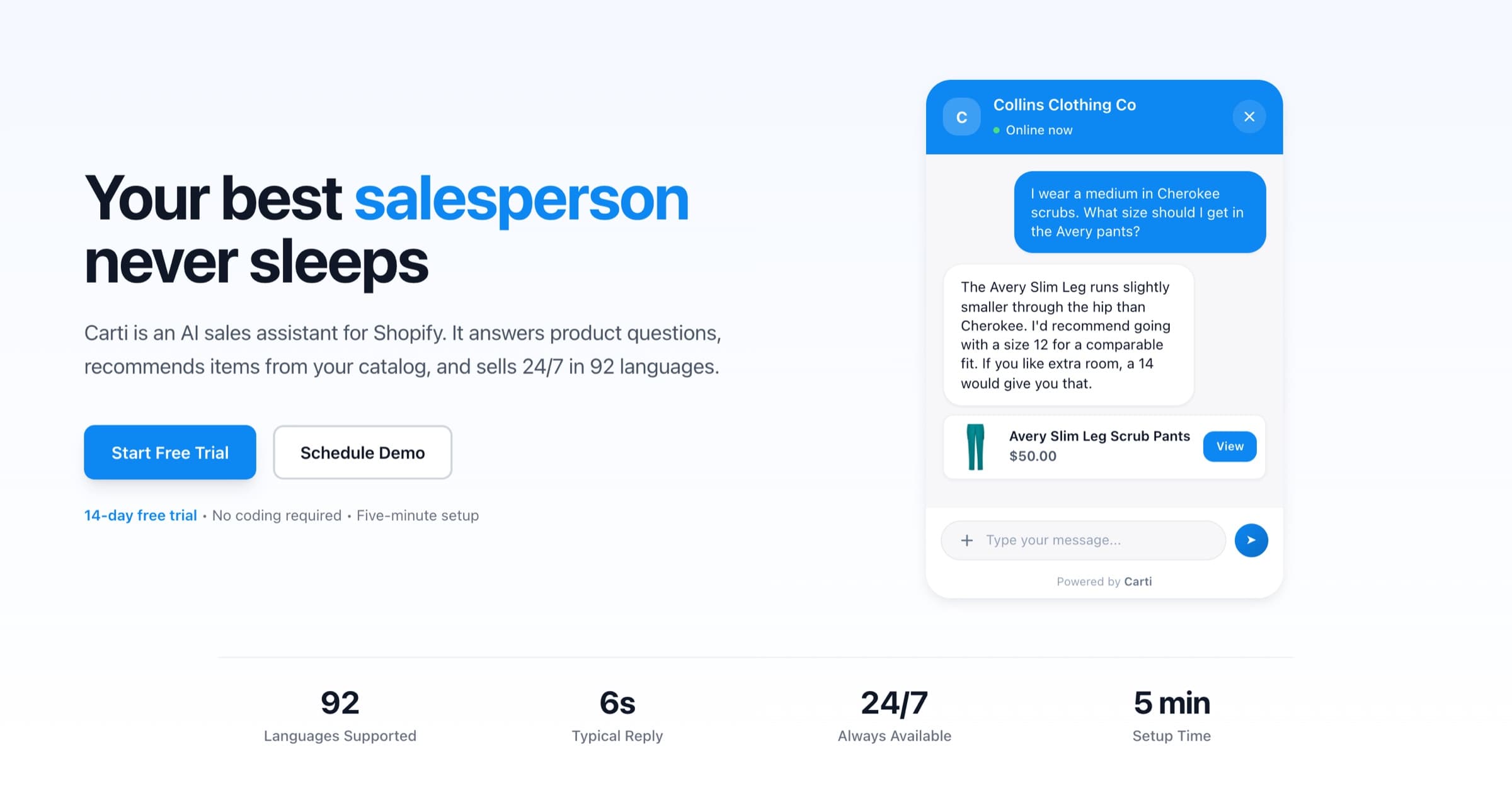
Carti's main advantage is speed with context. It syncs products, collections, variants, and inventory, then answers shoppers in 92 languages without extra setup, which matters when late-night and cross-border sessions cannot wait for a human. The merchant takeaway is direct, faster grounding in product truth reduces friction before a shopper adds to cart.
Three flows that consistently create orders
The strongest conversation shapes are specific, not generic. First is the sizing rescue, where a shopper doubts fit and the assistant answers from the store's size guidance, then adds the correct variant to cart. Second is the post-add-to-cart companion, where one question after the drawer closes leads to the most relevant add-on. Third is the objection-with-proof flow, where the assistant answers a concern with the store's policy and with what reviewers with the same concern said.
Practical rule: the best chatbot scripts do not try to sound clever, they remove uncertainty at the exact moment it blocks purchase.
Carti's own logs describe a real chat that shows why this works. A shopper browsing in Spanish late at night asked whether a blazer would arrive before a wedding that weekend. The assistant answered in Spanish, confirmed the shipping window from the store policy, checked that the size was in stock, and added it to cart, then the order came through minutes later. That is not a flashy automation demo, it is evidence that language support, policy retrieval, and cart action can work in one flow.
Carti's operational layer also matters. It surfaces top questions and friction points in an insights dashboard, flags knowledge gaps, and learns one-line store answers, so merchants can improve content from actual shopper behavior instead of guessing. For a closer comparison with a helpdesk-led stack, see Carti's Gorgias comparison.
Best for: Shopify brands that want revenue attribution, proactive triggers, and catalog-grounded answers.
Watch for: plan conversation caps on lower tiers and the fact that it is built for Shopify, not broader ecommerce platforms.
Website: Carti
2. Gorgias
Gorgias fits merchants that want support and sales inside one operating system. Its AI Agent lives in a helpdesk workflow, which matters because ecommerce teams usually need more than a standalone chatbot. They need a tool that can recommend products, apply discounts, and use customer context across channels.
The main strength is integration depth. Gorgias connects to Shopify data, site content, and policies, then pulls that context into a centralized omnichannel inbox across web chat, email, SMS, Instagram, Facebook, and WhatsApp. A shopper can ask about a product, shift into a support issue, or request a discount without losing the thread.
Vision adds another layer of value. When a customer sends an image of a damaged item or a product issue, the assistant can interpret that input instead of handling every case as plain text. That matters for returns, damage claims, and other post-purchase flows where visual evidence speeds triage.
For merchants comparing helpdesk-led and storefront-led systems, the key question is where the bot should sit in the funnel. Gorgias favors the helpdesk model, which works well for teams that already route customer work through support and need tighter internal governance. A storefront-first chatbot gives more direct merchandising control, so the right choice depends on whether conversion or support operations is the primary goal. For a direct comparison, see Gorgias vs. Carti.
The pricing model also needs scrutiny. Ecommerce automation can bring interaction-based costs, so CX and finance teams should verify how usage is measured before building high-volume flows. That is especially important if the assistant is expected to handle both deflection and sales routing at scale.
A useful way to judge Gorgias is by workflow fit. If your team wants sales automation inside a helpdesk, it matches that structure. If you want a chatbot that acts more like a storefront conversion layer, another setup may be cleaner.
Best for: ecommerce teams that want sales support inside a helpdesk.
Watch for: usage-based costs and support complexity if you are a smaller team.
Website: Gorgias
3. Zendesk
Zendesk fits a different buying posture. It suits brands that need governed AI agents across messaging, email, and voice, not just a storefront chat experience. That matters when ecommerce support spans multiple teams, formal workflows, and tighter oversight.
The main strength is platform maturity. Its Resolution Platform is built around outcome-oriented automation, so the chatbot sits inside a broader system for resolving work, not just deflecting it. For larger merchants, that distinction matters because the bot has to hand off cleanly, preserve context, and fit into an existing support org.
Why enterprise teams shortlist it
Zendesk's appeal is in the tooling around the bot. Agent Builder and copilots help teams create AI-driven automations, and the omnichannel context model helps when a customer moves from chat to email to voice. That continuity reduces the common support failure where the shopper repeats the same story three times.
The platform also fits teams that prioritize governance. Large retailers often need professional services, onboarding, and internal controls alongside AI capabilities. Zendesk's enterprise orientation makes that a rational choice, especially if the chatbot is only one part of a wider support modernization project.
For ecommerce, the strategic question is whether you need a revenue-oriented assistant or a resolution engine. Zendesk is stronger on the second axis. It is the safer option for operations leaders who want more control over workflow design, escalation paths, and multi-team accountability, even if setup takes longer before the bot delivers clear value.
For a closer look at how Zendesk compares with a storefront-first setup, see Zendesk Chat vs. Carti comparison notes.
Best for: enterprise ecommerce teams with multi-channel support operations.
Watch for: heavier implementation and governance requirements.
Website: Zendesk
4. Tidio
Tidio is the approachable option for smaller ecommerce teams that want to move fast. It combines live chat, ticketing, and an AI agent named Lyro, which makes it easier to get from “we need a bot” to “we have a working bot” without a big implementation project. For many merchants, that friction matters more than deep customization on day one.
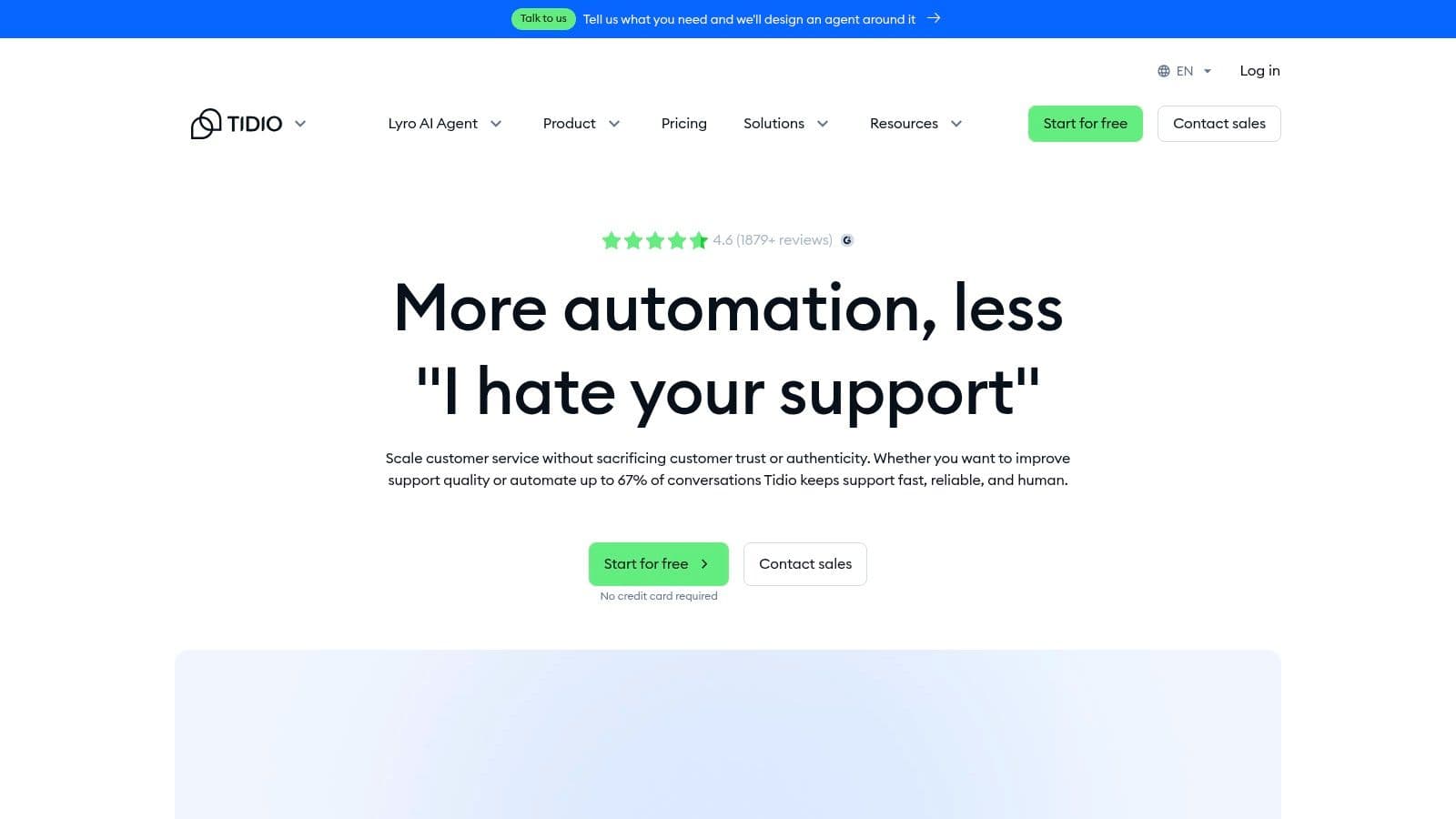
Tidio's appeal comes from its low-code posture. The no-code Flows builder and native Shopify actions let a small team automate common shopping questions, while the multichannel inbox keeps web chat, email, and social messages in one place. That combination is especially useful when a store is still learning which questions deserve automation and which ones still need a human.
A strong fit for early-stage automation
The most useful way to think about Tidio is as a quick-deployment layer for FAQs and basic product guidance. It's less about deep merchandising logic and more about reducing response lag and capturing leads before they drop off. For smaller merchants, that's often enough to make support feel more responsive without hiring more agents.
Good fit rule: choose this kind of tool when your main problem is slow response handling, not complex, catalog-specific sales logic.
The tradeoff is customization depth. More advanced ecommerce teams may outgrow lightweight flow builders once they need tighter revenue attribution, more granular product logic, or complex proactive triggers. But if your team wants a practical entry point and a clean operational surface, Tidio is one of the easier tools to deploy and maintain.
For Shopify brands, the platform's reputation on the app marketplace is part of the draw. That social proof doesn't tell you everything, but it does signal that many merchants have found the onboarding manageable and the basic support use cases dependable.
Best for: small and mid-size stores that need quick chatbot deployment.
Watch for: pricing opacity at usage thresholds and limited enterprise customization.
Website: Tidio
Compare with Carti: Tidio vs. Carti
5. Zowie
Zowie is built around ecommerce automation, not generalized conversational AI. That focus shows up in the way it handles orders, returns, availability, and proactive engagement, which makes it attractive to merchants who want the chatbot to behave like a revenue and service layer at the same time. If your team wants a lightweight storefront widget with strong ecommerce logic behind it, Zowie deserves attention.
Its biggest strategic advantage is assisted-revenue tracking. Many chat tools can answer questions, but fewer can help brands understand which conversations influenced sales. Zowie leans into that reporting layer, which helps merchants justify automation in terms executives understand, revenue influence instead of just deflection volume.
The product also feels built for Shopify-heavy workflows. Native integration with the storefront and, for Shopify Plus merchants, the checkout environment gives it a practical edge for teams that want contextual engagement at high-intent moments. The same is true of its REST and native connector options, which help it plug into broader ecommerce operations.
Where it wins
Zowie makes the most sense when merchandising and support overlap. A shopper checking availability, asking about an order, or hesitating at checkout needs context-aware answers, and Zowie's ecommerce modules are aimed at that exact surface area. That makes it especially relevant for teams that want proactive outreach rather than waiting for the shopper to initiate every conversation.
The constraint is straightforward, pricing is sales-led, so buyers need a quote. For smaller stores, that can slow evaluation. For larger teams, it's usually a reasonable tradeoff if the platform drives measurable assisted revenue.
Best for: ecommerce brands that want proactive support and revenue attribution.
Watch for: quote-based pricing and checkout limitations outside Shopify Plus.
Website: Zowie
6. Richpanel
Richpanel is the self-service-first option in this set. It combines an AI-enabled helpdesk with a portal that deflects order, return, and subscription requests before they reach a human agent. That makes it a strong fit for merchants whose main problem is repetitive post-purchase work, not pre-purchase discovery.
What separates Richpanel from more generic chatbot tools is its emphasis on support containment. Instead of only answering questions, it gives shoppers a place to resolve common issues on their own, while still connecting to platforms like Shopify, Zendesk, Gorgias, and Salesforce. That interoperability matters for brands that already have part of their support stack in place and need a better self-service layer.
The platform's appeal also comes from pricing clarity. Richpanel offers a free starter tier for self-service, which lowers the barrier for merchants who want to test containment before they commit to a larger helpdesk rollout. For teams under pressure to reduce agent load, that can be a practical way to measure whether self-service changes ticket volume.
Operational insight: self-service works best when the store already has clear order, return, and subscription policies. If your policy pages are muddy, the bot just automates confusion faster.
Richpanel is also a reminder that not every ecommerce chatbot example has to chase sales first. In some stores, the biggest win is removing avoidable support work, then freeing agents to handle the cases that need judgment. That's a legitimate ROI story, especially for brands with high post-purchase volume.
Best for: stores that need a self-service portal and support deflection.
Watch for: deeper analytics and heavier customization on higher tiers.
Website: Richpanel
7. Ada
Ada is the enterprise-grade option for brands that need deep governance, flexible integrations, and multiple channels, including web, in-app, messaging, and voice. Its positioning is clear, this is for organizations that want resolution-focused automation at scale, not a light chatbot for a single storefront. That makes it especially relevant for large retailers with complex support surfaces.
The platform's strength is its developer and integration model. APIs, SDKs, and an integration framework let teams connect custom data and actions, which is essential when ecommerce support has to coordinate with order systems, account logic, and internal workflows. In practice, that means the bot can do more than answer a shopper, it can participate in a broader operating model.
Ada also fits regulated or high-governance environments better than lightweight chatbot tools. Enterprise controls and pricing models built around conversation or resolution give operations leaders more options when they're formalizing AI usage across teams. That's useful if customer interactions span multiple product lines, regions, or compliance expectations.
The downside is the same one that makes it powerful, it takes real design work. Brands that want fast deployment and simple product guidance may find Ada heavier than they need. But for large merchants that want to build durable, governed automations, the upfront investment is often the right tradeoff.
Best for: large, multi-channel ecommerce brands with governance needs.
Watch for: implementation effort and enterprise-oriented pricing.
Website: Ada
8. YourGPT
YourGPT is a no-code AI agent platform built for businesses of all kinds, not just online stores. It covers support, sales, and operations, and every plan lets you run more than one agent, so a team can keep separate agents for different jobs under one account. You train each agent on your own content, like your website, help center, and documents, and it can be live within minutes.
For ecommerce, YourGPT connects to Shopify and WooCommerce and handles the questions shoppers ask before and after a purchase, like product details, delivery times, and order status. It suits teams that want one general-purpose AI platform across several parts of the business, rather than a tool built only around the storefront.
Pricing is credit-based rather than per resolution. Essential is $39 a month, Professional is $79, and Advanced is $349, all billed annually ($59, $129, and $499 if you pay monthly). Each plan includes a set number of AI credits with no extra charge per message, and you can buy more credits if you run out. There is no free plan, but a 7-day free trial lets you build and test an agent before you pay.
Best for: businesses that want one AI agent platform for support, sales, and operations, beyond just their online store.
Watch for: credit costs that climb with conversation volume and with the AI model you choose, and no free plan beyond the trial.
Website: YourGPT
Top 8 E-commerce Chatbots Comparison
| Product | Implementation complexity | Resource requirements | Expected outcomes | Ideal use cases | Key advantages |
|---|---|---|---|---|---|
| Carti | Very low, no-code, 5‑minute install | Minimal, small teams, subscription tiers with conversation caps | Typical reply in about 6 seconds, measurable conversion uplift (reported +35%, case studies 3.5x), cart recovery | Shopify-first brands seeking fast revenue-driven chatbot | Fast setup, revenue attribution, Instant Answers, multi‑language |
| Gorgias | Moderate, integrates with helpdesk and Shopify | Small to mid teams, possible per-interaction AI fees | Unified support + sales assistant, efficient automations | Ecommerce teams needing tight helpdesk + sales automation | Deep Shopify integration, omnichannel inbox, automation playbooks |
| Zendesk | High, enterprise deployment and governance | Significant, professional services, admin overhead, higher budget | Outcome-oriented automations, cross-team workflows, enterprise reliability | Large, complex multi-team support organizations | Mature platform, professional services, mature AI tooling |
| Tidio | Low, no-code builder and quick deploy | Minimal, suited to small teams, free trial available | Faster FAQ handling, basic automation, improved small-store support efficiency | Small and mid-size Shopify stores wanting low-friction setup | Quick deployment, approachable UX, Lyro AI, native Shopify actions |
| Zowie | Moderate, ecommerce-focused with Shopify modules | Mid teams, sales-led pricing, Shopify Plus needed for full checkout support | Assisted-revenue tracking, proactive outreach, ecommerce automations | Shopify stores focused on revenue attribution and proactive engagement | Revenue attribution, native Shopify modules, intent/proactive features |
| Richpanel | Moderate, helpdesk + self-service portal integration | Small to mid teams, higher tiers for deep analytics and migration support | Self-service deflection, reduced ticket volume, high merchant satisfaction | Stores wanting a combined helpdesk and self-service portal | No-code self-service flows, clear pricing options, strong Shopify ratings |
| Ada | High, enterprise-grade design and integrations | Significant, dev resources, integration work, enterprise budget | Resolution-focused automation at scale, multi-channel and regulated workflows | High-volume retailers, regulated industries, multi-channel enterprises | Strong governance, API/SDK flexibility, multi-channel & voice support |
| YourGPT | Low, no-code setup with Shopify and WooCommerce connections | Small to mid teams, credit-based plans from $39/month billed annually | General-purpose AI agents for support, sales, and operations | Businesses wanting one AI platform beyond the storefront | Several agents per plan, trains on your own content, no-code setup |
Putting These Chatbot Strategies into Practice
These eight ecommerce chatbot examples point to the same conclusion, the winning tools are the ones that solve a shopper's exact hesitation at the right moment. The strongest flows are the ones grounded in store content, product truth, and timing, not broad conversational theater. That's why sizing rescue, add-on suggestions, objection handling, and cart recovery keep showing up as the highest-value patterns.
The data backs that up. A retail chatbot implementation study reported that average customer response time fell from 45 minutes to 10 minutes after deployment, while first-contact resolution increased from 60% to 85%. In abandoned-cart recovery, AI-assisted flows cut cart abandonment from 74% to 58% and lifted recovery from 3% to 19%, while highly personalized reminders drove 3× higher click-through rates than generic promo emails and messages sent within 1 hour converted at 12% versus 4% after 24 hours. Those are not cosmetic gains, they show that timing and specificity drive the outcome.
The trust layer matters just as much. Only 35% of Americans said they trust AI to handle customer service issues like order problems or delivery updates, and just 14% were comfortable letting AI place orders for them. At the same time, shoppers were far more open to utility tasks like price comparison and item discovery, which means the most credible chatbot strategy is narrow, useful, and easy to hand off when the issue gets sensitive.
The most actionable pattern is straightforward, start with the conversation your customers already have. If shoppers keep asking about sizing, build the sizing rescue. If they hesitate after adding to cart, add one relevant companion question and one genuine add-on. If objections cluster around policy or trust, combine the store policy with reviewer proof and a human handoff path. Review your logs regularly, update the FAQ content behind the bot, and treat every unanswered question as a merchandising gap, not just a support ticket.
Use these examples as blueprints, not templates. The stores that win will be the ones that keep their chatbot close to real shopper behavior, then iterate from evidence instead of guesswork. For a broader view on how this same logic carries into other creative channels, see optimizing AI video ad campaigns.
Carti helps Shopify stores turn browsing into buying with instant answers, smart suggestions, cart recovery, and revenue attribution in one chat layer. If you want an ecommerce chatbot that's built around real store content and proven conversion flows, visit Carti and see how it can fit your storefront.

Written by
Daniel AndersonFounder of Carti. 10+ years building ecommerce brands in apparel and supplements. Still runs a Shopify store and built Carti to help merchants convert more browsers into buyers.
Ready to boost your store's sales?
Install Carti in 5 minutes and let AI handle customer questions, recommend products, and close sales 24/7.
Start Free Trial14-day free trial