
SMS is read fast enough to change the economics of cart recovery. Benchmark summaries report 98% SMS open rates, with messages often read within 90 seconds, while abandoned-cart SMS conversion commonly lands around 10% to 20%, compared with roughly 3% to 5% for email-only recovery. Some 2025 programs recorded a 42.02% click-to-conversion rate, which helps explain why text has become a core recovery channel for Shopify and direct-to-consumer merchants, as detailed in this abandoned cart email versus SMS benchmark comparison.
But speed isn't the strategy. The strongest abandoned cart text programs don't fire because a timer says they should. They respond to what the shopper did, send a short sequence with a clear purpose, suppress messages that no longer make sense, and measure completed orders rather than celebrating clicks. Carti itself doesn't send SMS. It recovers carts on-site and in Messenger and Instagram before a text would fire, but the copy principle transfers directly: a specific question about the shopper's hesitation beats a generic reminder.
Why Your First Abandoned Cart Text Should Wait for a Signal
The default abandoned-cart setup is easy to build and often wrong. A Shopify SMS app waits for a fixed delay, then sends the same reminder to everyone who entered checkout. That schedule treats a shopper who is still comparing products the same way it treats someone who closed the cart after seeing an unexpected shipping charge.
A better first send waits for a behavioral signal. A cart-page revisit, a return to the product page, or another add-to-cart action tells you the shopper is still actively considering the purchase. A cart reload can justify a helpful message. A move from wishlist to cart can indicate renewed intent. A shopper who applies a discount code and then leaves may need price clarity, not another “your cart is waiting” prompt.
Use these events as trigger inputs rather than relying only on a standard 60-minute, 24-hour, and 48-hour waterfall.
The signals worth instrumenting
Track the event that follows the abandonment:
- Cart-page reload: The shopper has returned to the saved order. Offer help with checkout, delivery, or payment.
- Product-page dwell: A shopper who spends meaningful time reviewing a product may be weighing fit, materials, or specifications. Ask about the likely objection.
- Second cart action: Adding another item or changing quantity indicates active consideration. A product-specific reminder is more relevant than a blanket promotion.
- Discount-code bounce: If the shopper applies a code and leaves, confirm the offer rules or explain the final price instead of immediately cutting margin.
Practical rule: A message should answer the question implied by the shopper's latest action, not merely announce that a timer expired.
This signal-first approach also fits a broader proactive customer engagement strategy. The objective isn't to contact every abandoner as quickly as possible. It's to contact the right shopper when the next interaction can remove friction.
Building the Four-Stage Cart Recovery Workflow
A reliable SMS flow has four operating stages: capture, signal, sequence, and suppress. Each stage protects the next one. If the phone number was collected without valid permission, better copy won't make the campaign defensible. If the trigger ignores intent, a polished sequence still feels intrusive.
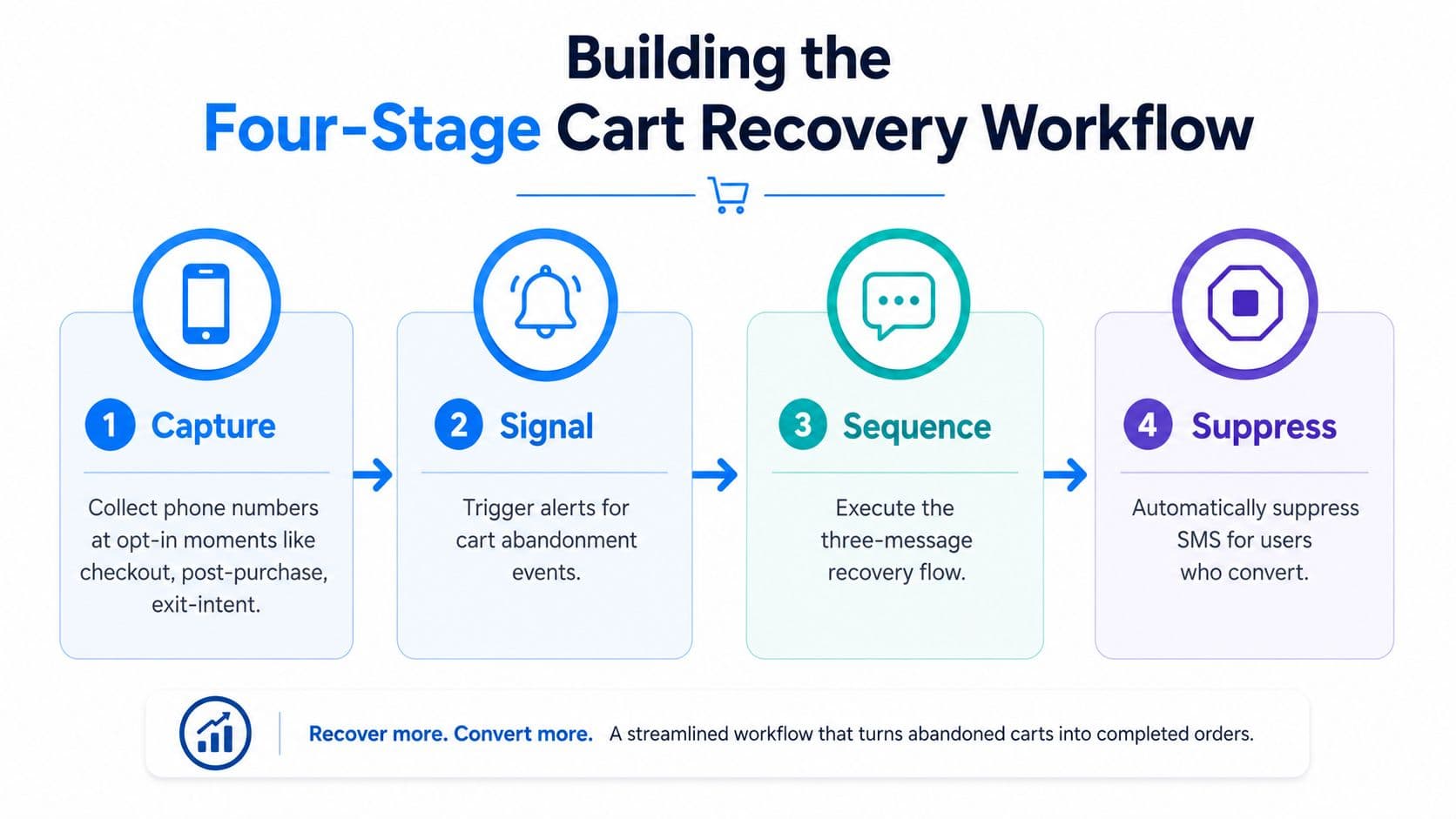
Capture permission at a real opt-in moment
Collect a phone number at checkout, after purchase, or within a clearly labeled exit-intent opt-in. A generic footer field rarely gives shoppers enough context about what they'll receive. Your disclosure should identify the brand, explain that messages may include cart recovery or marketing content, state that consent isn't a condition of purchase where required, and provide the applicable opt-out instructions.
Store the consent event, wording, timestamp, source, and country or region. A Shopify Flow can add the contact to the correct marketing audience, while Klaviyo SMS filters can exclude anyone without the required consent property.
Qualify the abandonment
Don't treat every open cart as a recovery opportunity. Wait for the cart to become idle, then check for a meaningful event such as a cart-page revisit, a product interaction, or a checkout interruption. The exact delay should respect local quiet hours and the shopper's prior message frequency.
The first text should have one job. For a shopper with a sizing question, route toward an answer. For someone who returned with a large cart, emphasize shipping certainty. For a guest who never engaged beyond the first visit, use a simple product reminder without pretending to know the reason for leaving.
Sequence by situation
A three-message structure gives each contact a distinct purpose:
- First message: Send after a qualified signal and use a soft, product-specific question. Don't discount automatically.
- Second message: Send later only if the shopper hasn't purchased, opted out, or resolved the issue. Address the most plausible objection.
- Third message: Use only when a real offer, shipping deadline, or margin-approved incentive justifies another contact.
Email, push, or an in-app prompt can carry longer explanations, product images, reviews, or policy details. They shouldn't be treated as inferior backups. Use each channel for the information format it handles well, while coordinating suppression across the flow. Shopify automation can manage the event logic, as outlined in this Shopify marketing automation guide.
Suppress aggressively
Stop the flow when the order is completed, the customer replies with a resolved issue, the recipient opts out, or the same shopper has already received the full sequence within the previous 30 days. Suppression is a revenue control, not merely a compliance setting. A second unwanted message can cost more goodwill than the first message creates.
Writing Copy That Names the Objection
“Your cart is waiting” describes a database state. It doesn't help the shopper decide. The better line names the product and opens a useful conversation: “Still deciding on the Fairway Blazer? Is sizing the holdup?”
That copy works because it gives the recipient an easy reply. It also makes a testable assumption. If shoppers repeatedly ask about fit, the store can improve its size guide, product page, or support answers instead of endlessly rewriting reminders.
Match the message to the hesitation
Price-sensitive shoppers need clarity about value, payment options, or a legitimate offer. Don't lead with a discount if the shopper hasn't shown price resistance.
“Still considering the Fairway Blazer? Want me to clarify the fit or show the current checkout total? [Cart link]”
Fit-uncertain shoppers need a direct answer. Product and size information should appear before the link, because the link isn't useful if the buyer still expects the item not to fit.
“Is sizing the holdup on your Fairway Blazer? Reply with your usual size and we'll point you to the closest fit. [Cart link]”
Shipping-sensitive shoppers need delivery and cost information stated plainly. If the cart crossed a free-shipping threshold or the shopper saw an unexpected charge, make that fact easy to verify.
“Still deciding on your Fairway Blazer? Want help confirming shipping before you check out? Your cart is saved here: [Cart link]”
The examples are deliberately specific, but they shouldn't imply an answer you don't have. Don't claim low stock, free shipping, or a deadline unless your store data supports it.
Keep every word useful
A short message should identify the brand, name the relevant product, address one objection, and offer one next step. A longer message can explain a policy or answer a question, but extra words don't create urgency by themselves. Put the useful detail near the beginning, use a first-person product reference when it sounds natural, and send shoppers to the saved cart rather than the homepage.
Before sending an abandoned cart text, check five things:
- Specificity: Does it name the product or situation?
- Relevance: Does it address the latest shopper signal?
- Honesty: Are stock, delivery, pricing, and offer claims verifiable?
- Action: Is there one obvious reply or click path?
- Restraint: Would the message still feel helpful without a discount?
Carti's on-site and DM prompts apply this same principle dynamically. Shoppers who engage with its recovery prompts convert at roughly 3.5 times the store baseline, based on the publisher's stated product context, while no SMS open or click rate is claimed.
Timing the Three-Message Sequence
A single reminder can be the right choice when the product is simple, the margin is tight, or the brand has little tolerance for list fatigue. A staged flow makes more sense when shoppers need time to resolve a question and the store can assign a different purpose to each contact.
The first message should arrive after the cart has gone idle, not while the shopper is still browsing. A useful starting window is one to two hours, provided the shopper has given valid SMS consent and the message won't land during local quiet hours. Use a soft callback to the product and ask one low-friction question.
The second message belongs around 24 hours after abandonment. Introduce real urgency through a shipping cutoff, a verified stock condition, or an offer that ends. Manufactured countdown language damages trust and makes the sequence sound automated.
The third message can land around 72 hours, or within the broader 48-to-72-hour range used by many programs, but it should be optional. This is the only point where a discount or free-shipping incentive usually belongs, and only if the gross margin can absorb it.
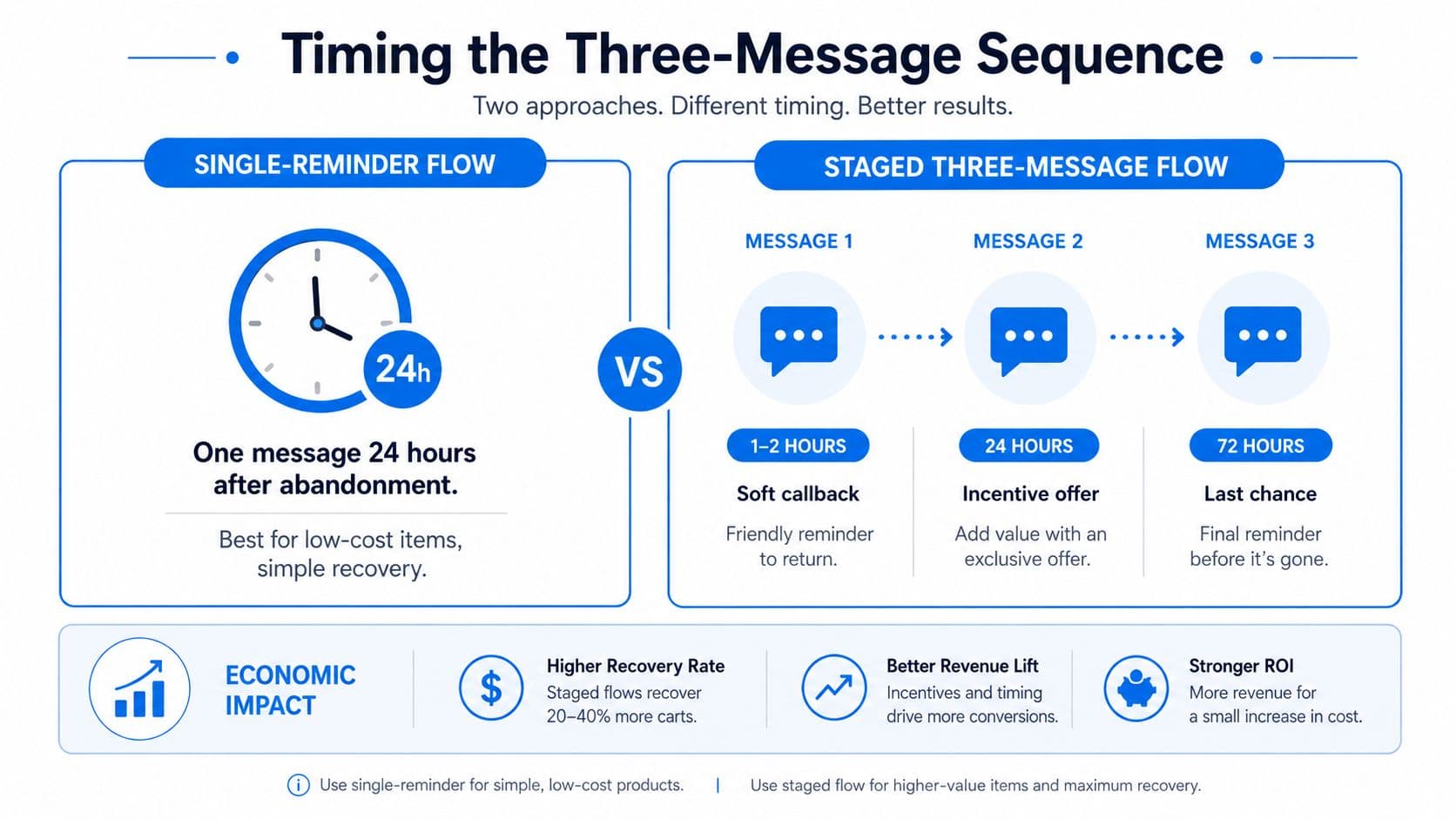
Compare the economics, not just the clicks
A benchmark guide recommends a three-message sequence at 30 to 90 minutes, 24 hours, and 72 hours, with full-sequence recovery rates typically around 10% to 15%. The same source reports first-message opt-outs of 0.3% to 0.6%, rising to 2.5% to 4.5% across the full sequence, making the conversion-versus-fatigue trade-off explicit in its abandoned cart SMS benchmark guidance.
A one-message flow limits contact pressure and may protect a high-value list. A three-message flow can recover additional orders, but only when each send earns its place. Four or more messages shouldn't be the default. If the third message produces little incremental revenue or pushes opt-outs upward, remove it.
Tie the send to the event timestamp
Use the Shopify cart-abandonment webhook timestamp as the start of the clock. Add the chosen delay, then evaluate the recipient's local time zone before dispatch. Recheck conversion, opt-out status, and prior sends immediately before the message leaves the queue.
This matters more than a visually neat automation canvas. A shopper who completed checkout after the first message must be suppressed before the second. A shopper who replies with a sizing question should enter support handling, not continue receiving promotional reminders.
Consent, Quiet Hours, and Cross-Border Rules
Compliance starts before the cart event. In the United States, cart-abandonment SMS guidance commonly places a 48-hour limit on sending after the trigger, as described in Klaviyo's abandoned-cart SMS guidance. That window doesn't replace consent requirements, carrier expectations, or state-specific legal review.
Build a defensible US program
Capture express permission for marketing texts with clear language at the point of opt-in. Identify the sender, describe the message type, preserve the consent record, and support standard STOP and HELP handling. Maintain a local-time quiet-hours policy, because a technically valid message can still create deliverability and customer-experience problems when it arrives at night.
Don't assume that a phone number entered for shipping updates automatically authorizes promotional cart recovery. Separate transactional and marketing permissions where the applicable rules require it, and ask counsel to review the exact disclosure for your offer, audience, and sending platform.
Treat EU and UK consent as operational data
Under GDPR, a phone number is personal data. Consent should be specific, freely given, informed, and recorded in a way that lets the business prove what the shopper agreed to receive. The same standard should guide UK programs, even when a store operates one global automation.
Keep regional consent fields separate. A subscriber's language, country, consent source, and permitted message category should be available to the flow before it selects a template. Carti can respond in the shopper's own language across 92 languages, but language localization doesn't replace lawful consent or regional suppression rules.
Create a market-specific checklist
- United States: Confirm express permission, sender identification, opt-out handling, quiet-hour logic, and the applicable cart-trigger window.
- European Union and United Kingdom: Record granular consent, privacy disclosures, retention practices, and the lawful basis for promotional messaging.
- Canada: Review CASL requirements before sending, particularly consent, identification, and unsubscribe handling.
- Australia: Check local commercial-message rules and recipient consent before activating the flow.
- California: Account for applicable privacy rights, including opt-out and data-access processes, alongside SMS marketing requirements.
Don't copy one global sequence into every market. The same product message may need different consent language, timing logic, sender identification, and suppression behavior depending on where the recipient lives.
Measuring What Actually Converts
Clicks are useful, but they aren't revenue. An independent benchmark dataset covering 1,999,408 delivered cart-recovery texts reported 534,974 clicks, a 26.8% click rate, and 65,566 recovered orders. That equals 12.3% of clicks converting and 3.3% of delivered texts producing a recovered order, according to the CartBoss abandoned-cart SMS benchmark dataset.
The lesson is simple. A strong click rate can conceal weak checkout completion. Measure the funnel in order:
- Delivered: Did the carrier accept the message?
- Clicked: Did the recipient use the cart link?
- Recovered: Did the shopper complete the order?
- Opted out: Did the message create list damage?
- Revenue attributed: Did the recovered order produce profitable revenue?
Use a stable cohort
Compare shoppers who entered the same abandonment definition, received the same message, and had enough time to complete checkout. Use UTM-tagged short links and reconcile those visits with Shopify orders and GA4 campaign data. The revenue attribution framework should distinguish assisted revenue from orders directly attributed to the message.
There's no universal healthy range for every store, product category, margin structure, or consented audience, so compare each stage with your own baseline.
| Funnel Stage | Healthy Range | Investigate If Below | Investigate If Above |
|---|---|---|---|
| Delivered | Program-specific baseline | Consent, list quality, carrier filtering | Unusually high delivery with weak downstream action |
| Clicked | Compare with your stable cohort | Copy, relevance, link destination | Click quality and accidental taps |
| Recovered | Compare completed orders, not clicks | Checkout friction, objection, offer fit | Attribution overlap or duplicate order credit |
| Opted out | Compare by message and segment | Possible fatigue or poor targeting | Confirm suppression is immediate |
| Revenue attributed | Positive contribution after costs | Discount, margin, or attribution problem | Validate incrementality and duplicate credit |
Review the full funnel weekly. Read replies and support conversations, identify recurring objections, then update product pages, shipping answers, sizing guidance, and automated branches. Carti's refinement loop works differently from a campaign-writing workflow: merchants read chat logs to see which questions appeared before abandonment, then fill missing policy or FAQ answers so its on-site and DM assistant can resolve those objections on the next visit.
Carti doesn't require an SMS campaign to be written or scheduled. Its Shopify chatbot activates on-site and in DMs after installation, generates prompts per shopper and cart, and reports attributed orders in its dashboard. For a store that wants recovery before a text would fire, that makes it a complementary layer rather than an SMS replacement.
If your Shopify store is losing buyers to unanswered sizing, shipping, or product questions, visit Carti to add an on-site and DM recovery layer that responds in the shopper's language and surfaces attributed orders. Use the resulting questions to improve your policies, product pages, and SMS sequence instead of sending another generic reminder.

Written by
Daniel AndersonFounder of Carti. 10+ years building ecommerce brands in apparel and supplements. Still runs a Shopify store and built Carti to help merchants convert more browsers into buyers.
Ready to boost your store's sales?
Install Carti in 5 minutes and let AI handle customer questions, recommend products, and close sales 24/7.
Start Free Trial14-day free trial