
The best recommendation isn't a carousel. A generic “you may also like” row asks shoppers to do the merchandising work themselves, while a strong recommendation gives them one relevant product and a reason to trust it. That distinction matters because recommendations can influence a disproportionate share of commerce value. One industry summary reports that recommendations appear on more than 71% of e-commerce homepages, receive 7% of visits, and generate 26% of revenue (WebEngage).
A practical product recommendation template should behave less like a static widget and more like a situational conversation. The seven patterns below cover post-cart questions, concern-aware proof, vertical qualification, behavioral triggers, substitutions, and intent layering. Carti's outcome-level framing is straightforward: engaged shoppers convert at roughly 3.5x baseline, while Carti stores see about 20% higher revenue per visitor. Those figures describe engagement and store-level outcomes, not a guaranteed lift from one canned template.
Evaluate every pattern through six questions: What triggers it? What does it ask? Which product does it recommend? What proof supports the suggestion? What happens if the product is unavailable? How will you measure it? For Shopify merchants, that logic can sit alongside WooCommerce integration features when managing recommendations across commerce systems.
1. Post-Add-to-Cart Companion Recommendation
The moment after Add to Cart is valuable because the shopper has already expressed intent. Instead of immediately showing a grid of loosely related items, ask one useful question about the purchase, then offer the single companion product that answers it.
A skincare shopper adds a moisturizer. The assistant asks about skin type and learns that irritation is a concern. It can then recommend a fragrance-free version, supported by reviews from shoppers discussing sensitive skin. A customer adding a jacket might be asked about the occasion, leading to a weather-appropriate accessory. Someone buying headphones could be asked whether they'll use them outdoors, creating a natural opening for a weather-resistant case.
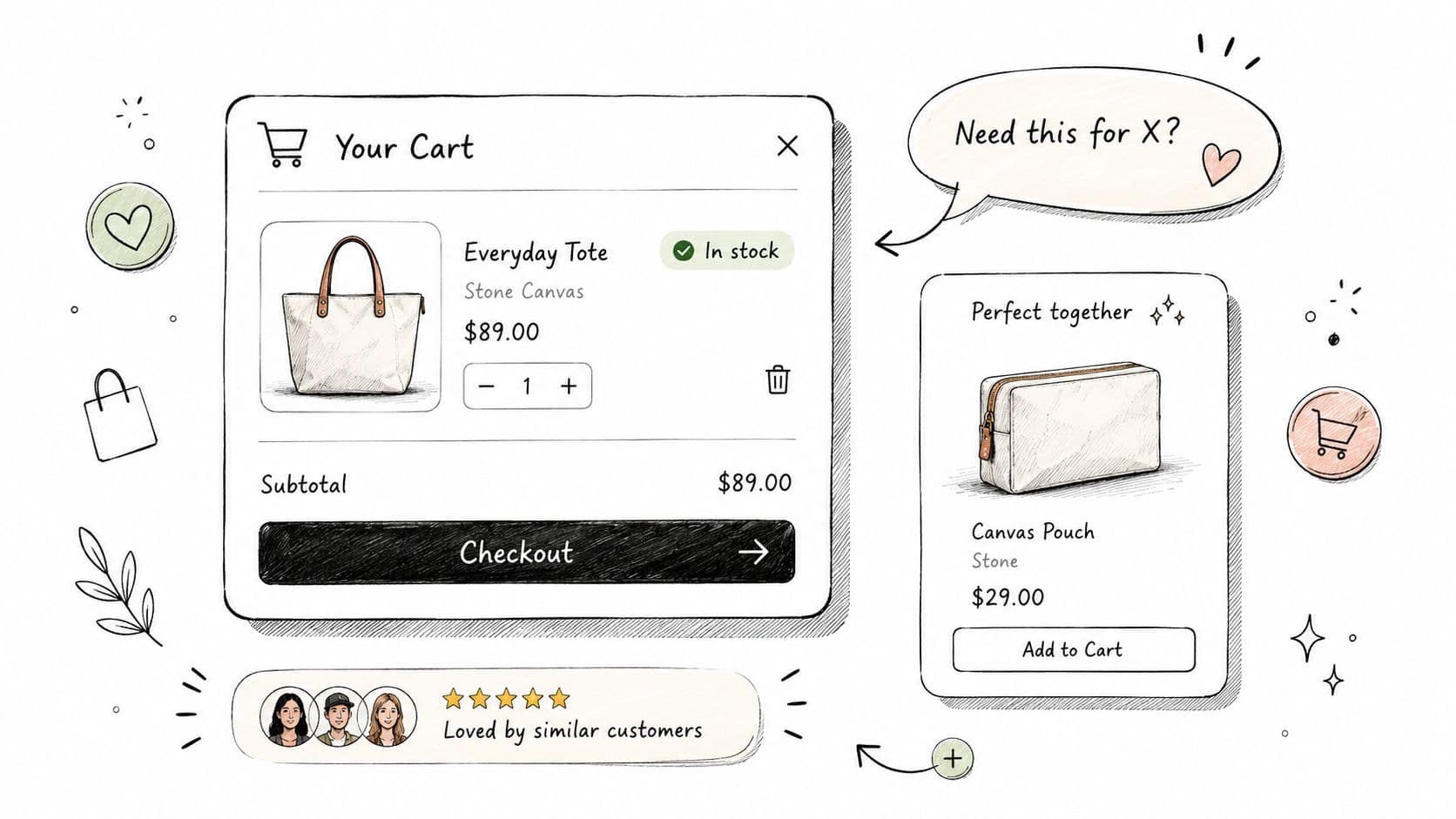
The question must feel like assistance, not an upsell script. Keep it conversational, use the shopper's answer directly, and recommend a product that solves the stated need. Attach two or three relevant review excerpts when the concern creates hesitation. Timing needs testing too. An immediate prompt can feel intrusive, while a delayed prompt can lose the buying moment.
Practical rule: Ask one question, make one recommendation, and explain why that product fits the answer.
Map product relationships carefully. A jacket-to-scarf pairing may make sense for one catalog, while a random accessory row weakens trust. Test question phrasing and measure engagement, add-to-cart activity, assisted conversion, and revenue from the recommendation. The post-add-to-cart cross-sell approach works best when the suggestion feels earned by the conversation.
2. Concern-Triggered Recommendation with Review Evidence
A shopper's objection is often more valuable than a click signal. If someone says, “I have sensitive skin,” “This runs small,” or “Can I use this with my medication?” a generic related-products module misses the buying problem. A concern-triggered product recommendation template translates that statement into one targeted alternative and attaches evidence that addresses the same concern.
For sensitive skin, clinical guidance favors fragrance-free, hypoallergenic, and non-irritating formulations, and a dermatology review identifies cosmetics as a common trigger for sensitive skin (Journal of Drugs in Dermatology). A shopper hesitating over a moisturizer may therefore receive a fragrance-free option alongside reviews from customers who specifically mention sensitive skin. The recommendation isn't “people also bought this.” It's “this product addresses the issue you just raised.”
The same logic applies across categories. A pet owner asking whether kibble suits a small dog should see a small-breed formula with matching-owner feedback. A jewelry shopper unsure about size may need an adjustable band with fit-related reviews. A supplement shopper mentioning blood thinners requires careful product and policy logic, not an improvised assurance.
Build the system around concern language, not only exact keywords.
- Recognize synonyms: Treat “it irritates me” as a possible sensitivity concern and “it runs small” as a sizing concern.
- Rank relevance over star average: A review addressing the shopper's concern is more useful than a high-star review with no relevant detail.
- Offer one clear alternative: Multiple options return the shopper to the uncertainty that caused the hesitation.
- Review mappings regularly: Use incoming chats to update concern-response rules and remove weak associations.
Never imply that reviews replace professional medical advice. For regulated or health-sensitive categories, the assistant should provide product information, flag uncertainty, and direct shoppers to qualified professionals where appropriate.
3. Vertical-Specific Question Flow Recommendation
In pet supplies, vertical-specific flows outperform generic recommendation logic when the purchase depends on expertise. A pet owner may need help with breed sizing, allergies, food transitions, or activity level. A static “related products” carousel can display more items, but it can't resolve the doubt behind the purchase.
A vertical-specific flow asks only the questions that predict a useful recommendation. Pet supplies might use breed, size, dietary restrictions, and activity. Skincare can qualify skin type, primary concern, ingredients, and texture preference. Jewelry may ask whether the purchase is for the shopper or a gift, the occasion, sizing history, and preferred style. Supplements need especially careful handling around goals, medications, dietary restrictions, and formulation preferences.
The questions should reflect purchase friction, not broad demographic profiling. A home décor store doesn't need a shopper's age to recommend a rug. It may need room size, aesthetic, and whether the room has high traffic. A fashion store may learn more from fit preference, body proportions, and occasion than from a general “tell us about yourself” prompt.
The best recommendation data is situational. What someone is doing in this session often matters more than what the store knows about them from last month.
Start with the three to five questions that eliminate the most unsuitable products. Put the highest-friction decision first, then let later questions refine the result. Seasonal variants can add useful context, such as gifting questions for jewelry or warmer-layer preferences for fashion during colder shopping periods.
Carti's content owner reports that its catalog-learning onboarding takes five minutes, but category expertise still requires merchant governance. Review chat analytics, identify unanswered questions, and adjust flows regularly. A good system learns which questions shoppers answer, then removes prompts that create friction without improving recommendation quality.
4. Behavioral Trigger Recommendation
A recommendation can be relevant because of what the shopper is doing right now, not because of a long-term profile. Current product views, cart contents, earlier questions, cart-drawer behavior, and exit intent create a situational picture that a generic homepage widget can't match.
Consider a shopper browsing socks, adding them to the cart, and then closing the cart drawer. A shoe-care product may be appropriate at that moment. A shopper who spends substantial time on a winter coat without adding it may respond better to a sizing question than to another product tile. Someone who adds pants and a shirt could receive a matching accessory in a comparable price tier. If the shopper earlier mentioned a specific use case, the assistant can reference that context, provided the product remains available.
Use behavioral triggers with restraint.
- Set browsing thresholds deliberately: A sustained product view may indicate interest, but a short visit may not justify an interruption.
- Limit exit-intent prompts: Don't show them to shoppers who have recently interacted with chat.
- Use session context explicitly: “You mentioned outdoor use earlier. This case is currently in stock” is stronger than an unexplained suggestion.
- Protect checkout: Don't interrupt a shopper during payment or final checkout steps.
- Review trigger quality: Compare acceptance by behavior type and adjust weak triggers.
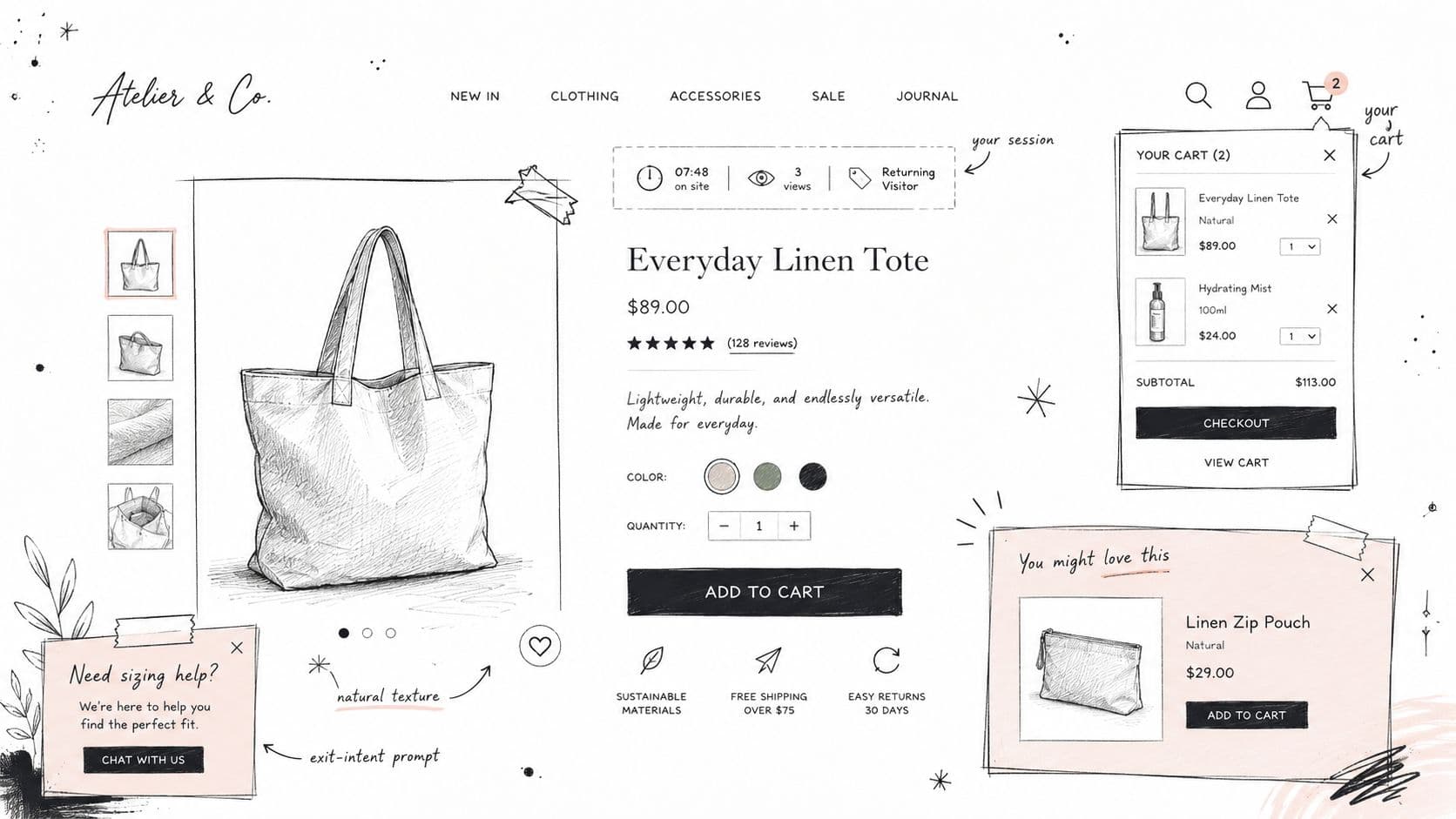
The trade-off is clear. More triggers create more opportunities to recommend, but excessive prompts produce fatigue and make the store feel manipulative. Keep exit-intent copy short, usually one question and one suggestion, and use exit-intent popup strategies as a behavioral intervention rather than a license to interrupt every session. Merchants trying to plug revenue leaks with Crescade should also separate browse-stage assistance from checkout recovery.
5. Review Evidence-Backed Recommendation
A recommendation becomes more persuasive when the proof matches the shopper's concern. Review evidence shouldn't sit beside a product as decorative social proof. It should explain why this particular product is a reasonable answer for this particular situation.
A moisturizer recommendation could surface a verified-purchase review that mentions no irritation and a fragrance-free formula. A dog-food suggestion could prioritize feedback from owners of a similar breed discussing digestion. For headphones, durability reviews from shoppers who used the product in rainy conditions may matter more than generic praise. A jewelry recommendation should surface fit evidence when sizing uncertainty is the barrier.
The presentation needs discipline. Short excerpts are easier to scan than long testimonials, and the assistant should show only the evidence relevant to the recommendation. Use reviewer first name and initial rather than exposing unnecessary personal information. If a shopper has not voiced a concern, broader proof can still help, but the system shouldn't pretend that an unrelated review validates a specific claim.
Build a review evidence layer
Tag reviews by attributes that influence product choice, such as skin type, pet breed, use case, body type, fit, durability, and gifting. Filter for verified purchases where possible and maintain quality controls for authenticity. Recent reviews may better reflect the current product experience, especially after changes to materials, formulas, packaging, or fulfillment.
Avoid inventing excerpts or editing them until they no longer represent the reviewer's meaning. A concise, accurate fragment is more trustworthy than polished copy that sounds manufactured. Rotate relevant examples across a session so the same testimonial doesn't appear repeatedly.
Proof should answer the objection, not merely confirm that other people liked the product.
Measure recommendation acceptance alongside the quality of the evidence. If shoppers click but don't add the product, the review may attract attention without resolving uncertainty. If they engage, add to cart, and complete the purchase, the evidence is doing useful work within the recommendation flow.
6. Inventory-Aware Smart Substitution Recommendation
Nothing damages a recommendation faster than sending a shopper toward a product they can't buy. Inventory-aware logic treats availability as part of relevance. When the original recommendation is unavailable, the system should preserve the need behind it and offer an in-stock substitute, a restock path, or a waitlist.
Suppose a shopper needs a blue blazer and the recommended variant sells out. A navy alternative with a similar aesthetic and price may preserve the purchase. If a skincare set is unavailable, individual products can recreate the intended routine. A dog-food flavor can be replaced by the closest nutritional match from the same brand, while an unavailable jewelry size may call for an adjustable design.
The substitution hierarchy should reflect category logic rather than a single universal rule.
- Fashion and home: Match aesthetic, size, material, and price before broad catalog similarity.
- Consumables: Match nutritional or functional benefits, dietary constraints, and formulation.
- Beauty: Preserve the relevant skin concern, ingredient preference, and product format.
- Jewelry: Preserve fit and wearability before visual similarity.
- High-demand items: Offer a waitlist when the product is expected to return soon.
Set inventory rules before launch. Decide which attributes matter most, what qualifies as low stock, and when the system must substitute instead of presenting an unavailable option. Show clear status language such as “in stock,” “restock expected,” or “join the waitlist,” but only when the store can support that information accurately.
Use the stock-out rate guidance to connect recommendation quality with inventory governance. Track substitution acceptance separately from original-product acceptance. A high substitution rate may indicate effective recovery, but it may also reveal that the primary catalog mapping or purchasing plan needs attention.
7. Multi-Step Qualification Recommendation
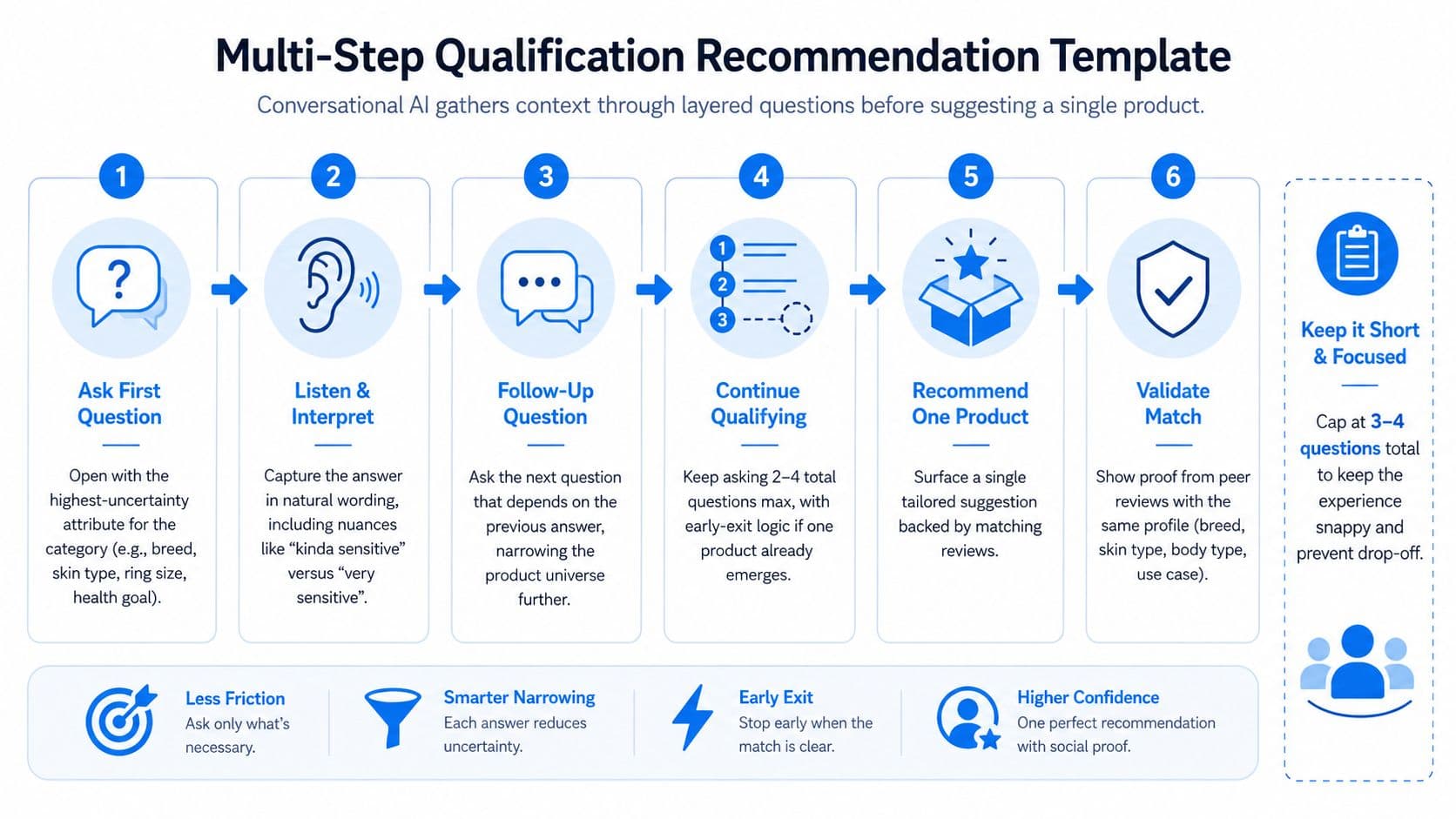
Complex purchases rarely yield to one question. A multi-step qualification flow asks, listens, follows up, and stops as soon as it has enough context to recommend one product confidently. The interaction should feel like a concise expert consultation, not a long product quiz.
A pet-supplies flow might ask about breed, age, food sensitivities, and activity level before selecting one formula. Skincare could begin with the primary concern, then ask about active ingredients, preferred texture, and ingredients to avoid. Jewelry may require the recipient, occasion, typical ring size, and preference for delicate or bold designs. Supplements need careful qualification around health goals, medications, allergies, and preferred form, with safety boundaries built into the response.
The key is progressive intent layering. Start with the question that removes the most unsuitable products, then use the answer to shape the next prompt.
- Keep the flow short: Stop after enough context is gathered, rather than forcing every question.
- Use easy answers first: Yes/no and multiple-choice prompts reduce early friction.
- Ask open questions later: Invite detail only after the category and need are clear.
- Create early exits: If one answer narrows the catalog sufficiently, recommend immediately.
- Sound responsive: Each question should refer naturally to the previous answer.
A rigid form creates abandonment because shoppers can't see why each question matters. A conversational flow earns the next answer by making the previous one useful. Train the wording on real chat history, then review completion and recommendation acceptance by question order. The best sequence may differ between puppy food, running shoes, and engagement rings.
7-Point Product Recommendation Template Comparison
| Template | Implementation complexity | Resource requirements | Expected outcomes | Ideal use cases | Key advantages |
|---|---|---|---|---|---|
| Post-Add-to-Cart Companion Recommendation | Moderate, session & timing logic, pairing rules | Moderate, product-pair mappings, review data, inventory sync | Higher engagement (3.5x for interactors) and a ~20% revenue-per-visitor lift | Cross-sell at checkout across categories, impulse moments | Single timely suggestion, reduces decision fatigue, peer-review evidence |
| Concern-Triggered Recommendation with Review Evidence | High, NLP to detect concerns and map responses | High, attribute-tagged reviews, concern-response mappings, inventory checks | Converts hesitant shoppers, lowers returns, increases trust | High-doubt categories (skincare, pet, supplements, jewelry) | Directly addresses voiced concerns with matched social proof |
| Vertical-Specific Question Flow Recommendation | High, design and maintain category question trees | High, vertical data (breed charts, ingredient DBs), ongoing updates | Outperforms generic engines, reduces category-specific friction | Multi-category stores needing vertical expertise (pet, skincare, jewelry) | Feels expert-guided, scales vertical nuance across the catalog |
| Behavioral Trigger Recommendation (Cart State & Exit Intent) | High, real-time session tracking and trigger management | High, session analytics, inventory integration, trigger tuning | Captures situational intent, reduces abandonment, higher acceptance | Browse and cart stage interventions, exit-intent recovery | Timed, situationally relevant recommendations at inflection points |
| Review Evidence-Backed Recommendation | Moderate, review filtering, excerpt extraction, basic NLP | Moderate, rich review metadata, authenticity filters, indexing | Increases acceptance, reduces regret and returns, builds confidence | Any product where peer proof matters, hesitant buyers | Authentic social proof with transparent, concern-focused validation |
| Inventory-Aware Smart Substitution Recommendation | Moderate–High, substitution rules + inventory API integration | High, real-time inventory, substitution hierarchies, latency handling | Maintains conversions during stockouts, reduces frustration | High-velocity SKUs, multi-warehouse retailers, popular items | Prevents out-of-stock suggestions and offers substitutes, restock alerts or a waitlist |
| Multi-Step Qualification Recommendation (Intent Layering) | Very high, sequential logic, context memory, advanced NLP | High, conversational design, training data, maintenance | Exceptionally well-matched recommendations, less post-purchase regret | Complex, high-consideration purchases (supplements, jewelry, pet supplies) | Deep qualification that mimics expert consultation, highly personalized outcomes |
Turn Templates Into a Learning Recommendation System
The seven patterns work best as a sequence, not as seven disconnected widgets. Start with one high-intent trigger, usually the post-add-to-cart moment or a clearly expressed concern. Add one contextual question, recommend one product, attach evidence that addresses the shopper's hesitation, and validate inventory before expanding the system.
That order keeps implementation practical. A merchant doesn't need to automate every placement on day one. One well-mapped product relationship with accurate stock, relevant reviews, and a useful question can teach more than a storewide rollout built around generic “related products” logic. Recommendation placement should also reflect intent. Salesforce Shopping Index data, summarized by Clerk.io, associates recommendation clicks with 26% of revenue and 24% of orders, while recommendations overall can account for 11.5% of shopping-session revenue in independent industry coverage (The Product Folks' metrics summary). Those figures support measuring commercial outcomes, not just widget interaction.
Track the full path:
- Trigger exposure: Which shoppers encountered the prompt?
- Engagement: Did they answer, click, or dismiss it?
- Recommendation acceptance: Did they add the suggested product?
- Assisted conversion: Did the interaction contribute to a completed order?
- Revenue per visitor: Did the experience improve commercial efficiency?
- Fallback outcomes: What happened when the product was unavailable or the shopper declined?
Use storewide benchmarks cautiously. Triple Whale's 2026 benchmark report places the global average ecommerce conversion rate at 2.66% and the average Shopify store conversion rate at 1.4% (Triple Whale). Segment-level before-and-after measurement is more useful than claiming that one isolated template caused every change.
Carti takes a live-catalog and conversation-based approach rather than forcing merchants to choose from a fixed library of canned templates. It can use current product context, cart contents, earlier session questions, review evidence, and inventory status to shape situational suggestions. Its chat insights can also reveal recurring objections, missing product information, and content updates that should improve future merchandising.
Carti provides Shopify stores with conversational product recommendations, instant catalog-aware answers, proactive sales assistance, and cart recovery support. Use it to turn post-cart questions, shopper concerns, behavioral triggers, and inventory rules into more relevant recommendation flows, then visit Carti to explore the app.

Written by
Daniel AndersonFounder of Carti. 10+ years building ecommerce brands in apparel and supplements. Still runs a Shopify store and built Carti to help merchants convert more browsers into buyers.
Ready to boost your store's sales?
Install Carti in 5 minutes and let AI handle customer questions, recommend products, and close sales 24/7.
Start Free Trial14-day free trial