
Most stores shop for a chatbot by comparing entry prices. That is the wrong place to start with ZipChat. Its published pricing begins with a free tier covering approximately 50 conversations a month, then $80 monthly for about 300 conversations, rising to $600 for about 2,500, and paid plans include a 7-day free trial, per ZipChat's Shopify App Store listing. The sticker price is only part of the bill, because ZipChat also meters each plan in AI replies and sells extra usage separately.
The question that predicts your cost: what does the plan meter? ZipChat prices on AI replies, then translates those reply limits into estimated conversations on its listings. A shopper who asks follow-up questions burns through replies faster than the conversation estimate suggests, so a plan that looks generous on paper can run short in practice. Judge plans on reply volume first.
The cost drivers behind the headline
That same App Store listing shows the free allowance and the monthly plan structure. ZipChat's published pricing page adds annual billing and paid overage packages. Read together, the model is straightforward: the subscription tier sets a reply allowance, and additional usage raises the bill.
| Plan | Monthly price | Estimated conversations | AI replies per month |
|---|---|---|---|
| Free | $0 | Approximately 50 | Not listed in the monthly tiers |
| Starter | $80 | Approximately 300 | 750 |
| Pro | $300 | Approximately 1,250 | 3,000 |
| Scale | $600 | Approximately 2,500 | 6,000 |
The App Store listing presents estimated conversation allowances alongside reply limits, and the two measures behave differently. A conversation is one shopper interaction. AI replies count each individual response the assistant sends, so a single conversation with several follow-up turns can consume several replies.
Practical rule: Compare plans using reply volume first, then treat the conversation estimate as a planning aid.
The Four Published Tiers Decoded
Four tiers, one meter. Each paid plan publishes an AI reply allowance alongside an estimated conversation count, and the reply figure is the cap ZipChat enforces. Read every tier by its reply limit and treat the conversation number as marketing translation.
Free and Starter
The Free tier covers approximately 50 conversations per month. Use it to confirm shoppers open the chat widget and to see which questions they ask. Its capacity sits far below the paid plans, so treat it as a trial of the workflow, not evidence that a paid tier will hold.
Starter runs $80 per month for 750 AI replies, estimated at roughly 300 conversations. That estimate bakes in about two and a half replies per conversation. A store whose threads routinely run five replies deep gets closer to 150 conversations out of the same allowance, so check your average replies per conversation before trusting the published estimate. These figures come from the App Store listing cited above.
Pro and Scale
Pro costs $300 per month for 3,000 AI replies and an estimated 1,250 conversations. Scale costs $600 per month for 6,000 replies and an estimated 2,500 conversations. The per-conversation math barely moves across the three paid tiers, which tells you something useful: upgrading buys volume, not a better unit price. Pick the tier whose reply cap covers your real monthly usage with headroom, and discount the conversation estimates whenever they're built on shorter threads than yours.
As a working threshold, a store averaging more than 25 AI replies a day will exhaust Starter's 750-reply allowance before month end. Stay under that line and Starter holds; absorb the occasional spike with a $49 overage pack rather than prepaying for capacity you don't use. Cross it consistently and Pro's 3,000-reply cap becomes the cheaper fix.
Annual Versus Monthly Billing Math
Annual billing is the part of ZipChat pricing where stores overpay politely: the discount looks clean, while the risk sits in reply volume you cannot forecast yet. ZipChat's pricing page, cited above, lists monthly and annual prices for Starter, Pro, Scale, and Scale Plus, with a published 20% discount on annual terms.
| Plan | Monthly billing | Annual price | Monthly equivalent |
|---|---|---|---|
| Starter | $80 | $768 | $64 |
| Pro | $300 | $2,880 | $240 |
| Scale | $600 | $5,760 | $480 |
| Scale Plus | $1,200 | $11,520 | $960 |
Use the discount as a break-even rule, not a trophy. The annual saving is $192 on Starter, $720 on Pro, $1,440 on Scale, and $2,880 on Scale Plus; treat that saving as roughly the budget for one $49 overage pack per quarter and commit only if expected usage stays inside the annual allowance after your busiest month.
Decide whether the commitment fits
Annual plans still meter the same monthly reply allowances: 750, 3,000, 6,000, and 14,000. The estimated conversation capacity rises from about 300 to 6,000 per month, but that estimate depends on short threads; buy against replies, because follow-up questions burn the allowance faster than the conversation label suggests.
My recommendation: stay monthly until you have seen a promo, launch, or seasonal spike and still finished under the cap. Choose annual when three steady months fit the tier with headroom, and when the cash prepayment does not crowd out ads, inventory, or support staff. If one bad month could force repeated overage packs, the discount is not a bargain.
Overage Packs and What Spikes Really Cost
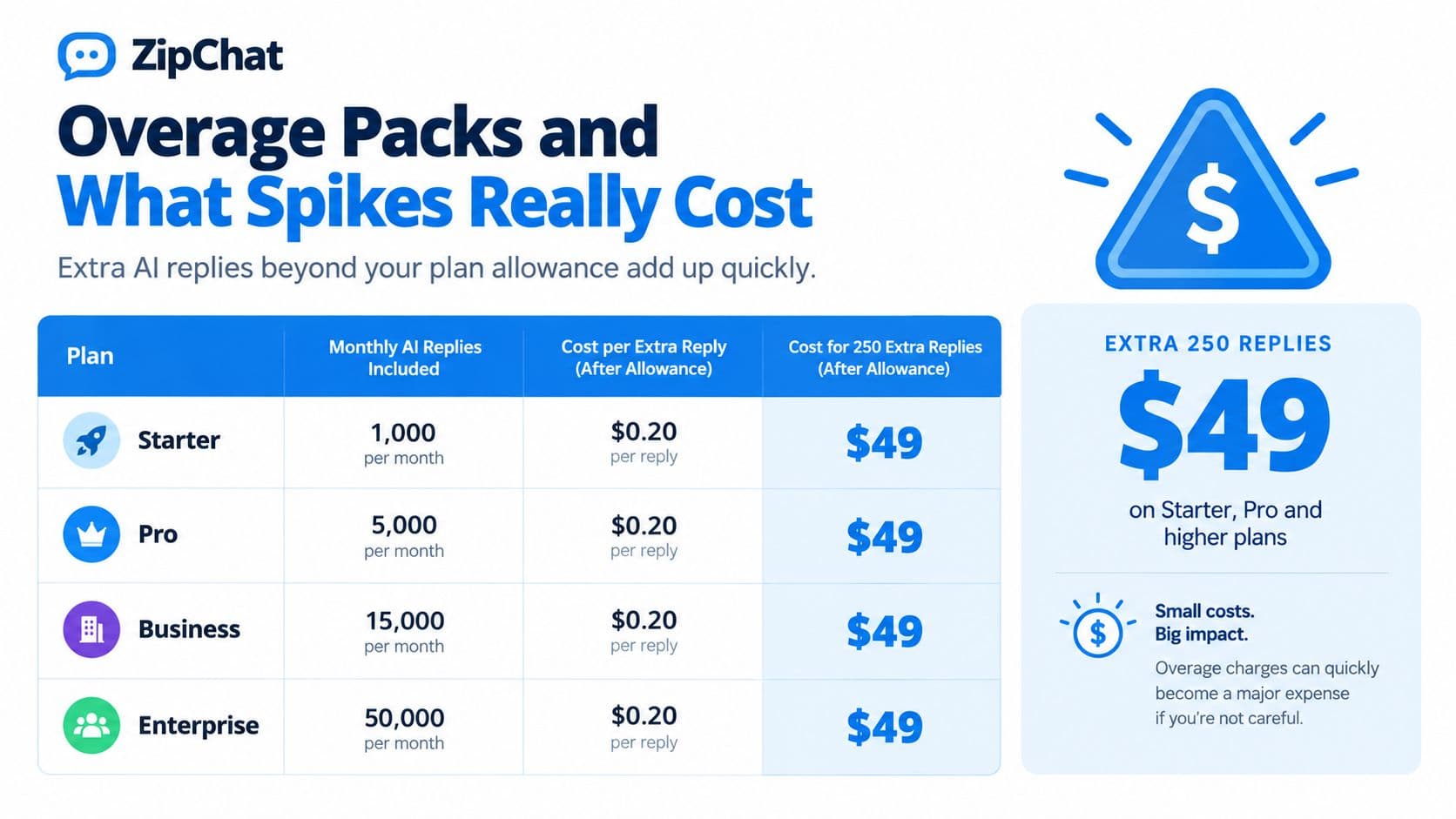
ZipChat sells overflow in fixed packs: $49 for 250 replies on Starter, Pro, and Scale, and $49 for 500 replies on Scale Plus. The published pricing page, cited above, sets out those package sizes and prices.
That flat $49 tag hides two different unit costs. The smaller pack works out to just under 20 cents per reply; the Scale Plus pack lands just under 10 cents. The better rate is a quiet reward for already paying for the biggest plan.
The question during a spike is not how many shoppers arrive but how many replies each one burns. A customer asking "where is my order" uses a single reply. A customer working through sizing, compatibility, and a return policy can consume five or six in one thread. Conversation estimates describe traffic. Reply consumption describes the bill.
Do the upgrade math before you buy packs
Run pack costs against the tier gap, not against your patience. Moving from Starter to Pro costs $220 more per month, more than four packs' worth. Pro to Scale is a $300 gap, more than six packs. Scale to Scale Plus is $600, equal to twelve packs at the 250-reply size. If your spike costs less than the gap, stay put and pay the overage. If you buy that many packs every month, you are renting a tier you should just buy.
Watch the pattern: one pack after a launch is a spike. Three straight months of packs is a tier mismatch.
Scale Plus buyers should forecast against the 500-reply pack, not the smaller size used elsewhere. Before a sale period, take your busiest month on record, apply your reply-per-visitor ratio to the forecast traffic, and price the overage into the promotion budget. If the projected pack spend makes the campaign margins uncomfortable, move up a tier before the traffic lands rather than paying for the spike twice.
How ZipChat Compares to Carti and Other Shopify Chatbots
Put the billing units side by side before you put the prices side by side. ZipChat publishes estimated conversations alongside hard AI-reply limits, which means its allowance is really a reply budget wearing a conversation label. The Carti plans listed here are expressed in AI conversations per month. Different meters, different bills.
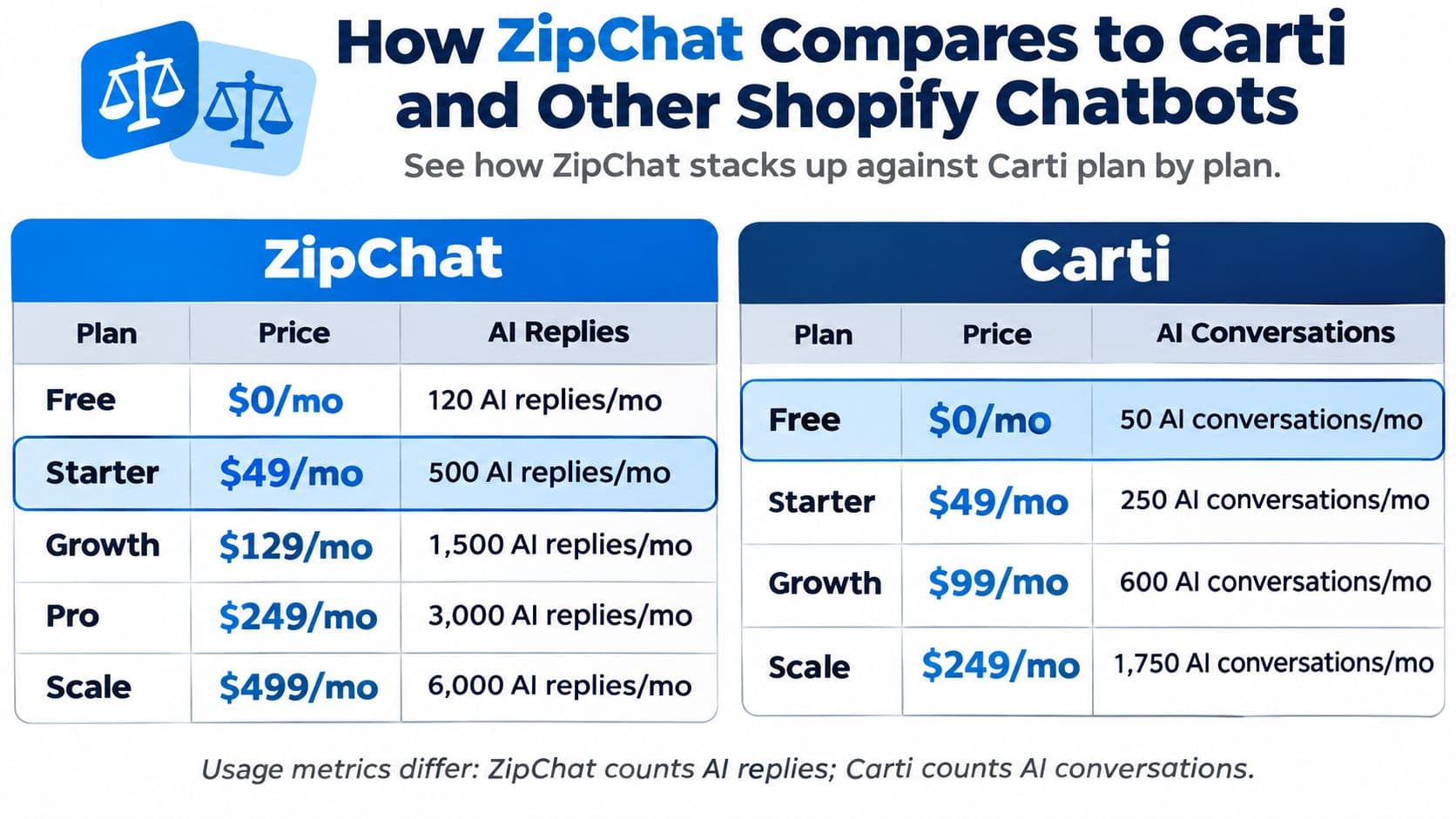
| Option | Published plan | Monthly price | Published allowance |
|---|---|---|---|
| ZipChat | Free | $0 | Approximately 50 conversations |
| ZipChat | Starter | $80 | Approximately 300 conversations, 750 replies |
| ZipChat | Pro | $300 | Approximately 1,250 conversations, 3,000 replies |
| ZipChat | Scale | $600 | Approximately 2,500 conversations, 6,000 replies |
| Carti | Free | $0 | 50 AI conversations |
| Carti | Starter | $49 | 250 AI conversations |
| Carti | Growth | $99 | 600 AI conversations |
| Carti | Scale | $249 | 1,750 AI conversations |
Note: ZipChat allowances are replies with an estimated conversation figure; Carti allowances are AI conversations. Divide price by the unit each product meters before comparing.
Carti also offers a 14-day free trial on paid plans. ZipChat's figures are from the App Store listing cited above. For a closer plan-by-plan review, Shopify merchants can compare ZipChat and Carti.
Compare the unit before the price
On published monthly prices, ZipChat's estimated conversation cost works out to roughly $0.27 on Starter and $0.24 on Pro and Scale, calculated from the listed price and estimated allowance. That math flatters ZipChat, because the number you control is replies: 750 on Starter, 3,000 on Pro, 6,000 on Scale. A store whose threads run long burns that cap faster than the conversation estimate suggests.
Carti's conversation-based pricing is easier to forecast when exchanges tend to stretch, since one long thread still counts as a single conversation. Shortlist on how your tickets behave, not on sticker price. Compare each product's allowance definition, paid overage terms, and expected usage, then verify current plan details on each pricing page before subscribing.
Matching a ZipChat Plan to Your Shopify Store
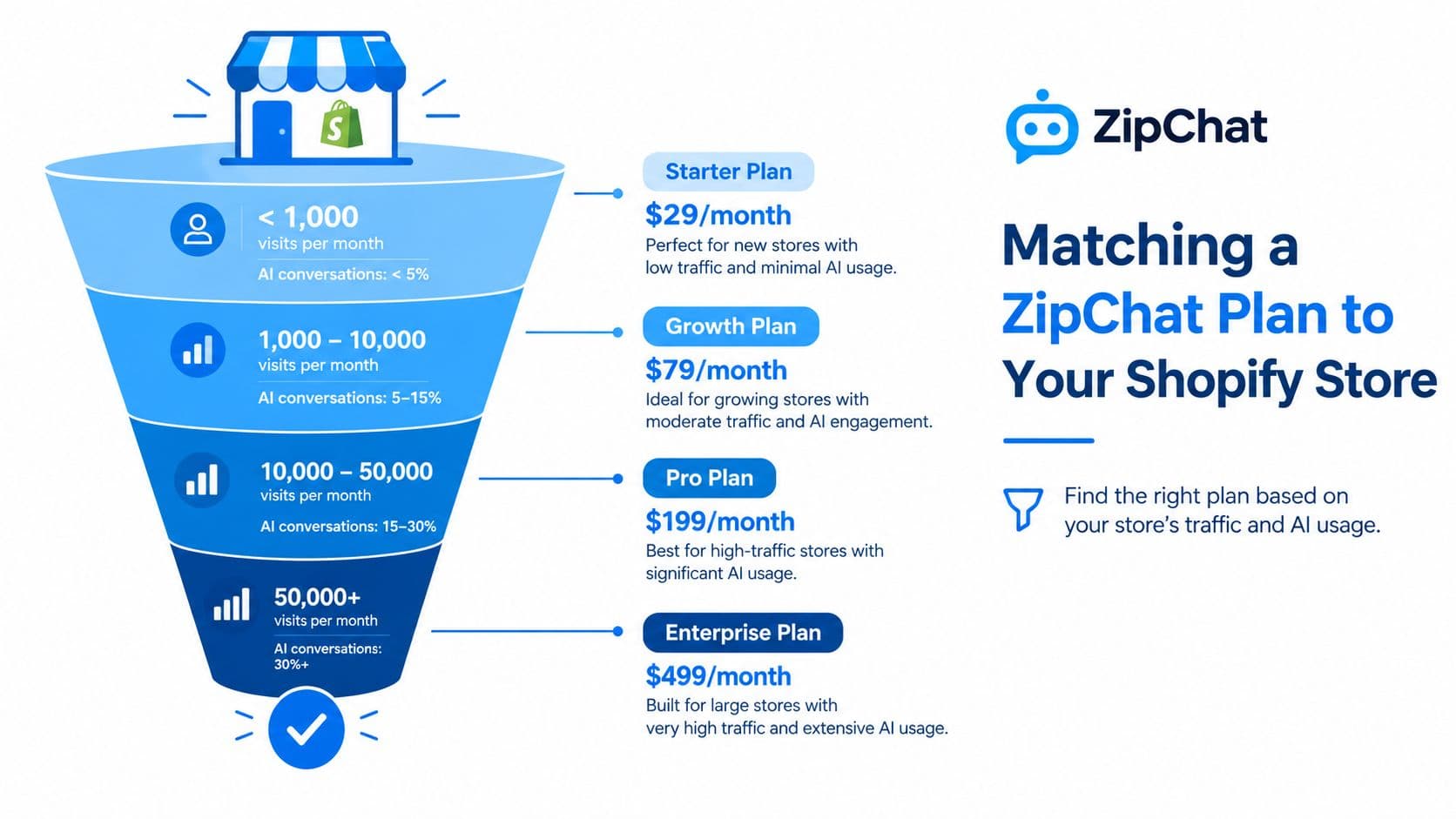
Store traffic alone doesn't select the right tier. A better decision uses three inputs: how many shoppers start conversations, how many replies those exchanges consume, and whether the store's usage is steady or seasonal. ZipChat's estimated conversation capacity gives a starting point, but the published reply cap should guide the budget.
Use observed usage, not guessed traffic bands
A store new to chatbot support can start with the free allowance and learn what shoppers ask before committing to a paid tier. A store that outgrows that limit can compare Starter's reply capacity with its observed usage. If the store's normal monthly pattern exceeds Starter's allowance, Pro may be the more relevant comparison; Scale belongs in the evaluation when reply demand warrants its higher capacity.
Cart abandonment gives merchants a reason to take pre-purchase questions seriously, but it doesn't prove that any particular chatbot will recover a sale. Baymard's analysis of 50 cart-abandonment studies calculates an average cart abandonment rate of 70.22% and identifies concerns including extra costs, slow delivery, returns policies, and unclear order totals (Baymard's cart abandonment research). Clear answers may help shoppers evaluate a purchase, but the subscription should still earn its place through the store's own results.
Make the choice measurable
Before upgrading, record the reply allowance used during ordinary periods and note when usage rises. Compare that pattern with the plan's cap, and distinguish a temporary sales spike from a recurring need. An AI shopping assistant ROI calculator can help structure the business case around store-specific assumptions, rather than treating a chatbot subscription as a guaranteed conversion lift.
A bigger plan is justified by sustained usage, not by the hope that more capacity will automatically create more sales.
Tips for Choosing, Negotiating, and Auditing Your Plan
Before subscribing, verify the unit that controls billing. ZipChat's monthly tiers show both AI-reply limits and estimated conversation capacity, while its published pricing also lists paid overage packages. Confirm which allowance applies to the selected plan and how extra usage is charged.
- Check the allowance: Compare the AI-reply limit with the estimated conversation capacity, and base the budget on the reply cap.
- Review the trial: The Shopify App Store listing identifies a 7-day free trial for paid plans. Confirm the current terms before starting.
- Compare billing choices: Calculate the annual discount against the flexibility of paying monthly, and don't commit until the likely usage pattern is clear.
- Track the first month: Tag conversations by topic so the team can identify recurring questions and estimate reply demand for the next billing period.
- Revisit the price: Check ZipChat's published pricing quarterly so the store's budget reflects the current plan details.
Pre-purchase messaging can be commercially relevant, but a benchmark isn't a forecast for an individual store. Shopify reports that Shopify Inbox converted 17% of pre-purchase conversations into sales in November 2023; that figure applies specifically to Inbox conversations during that month, not to every chatbot or AI shopping assistant (Shopify's customer service statistics). Merchants should judge their own tool using store-specific usage and sales data. For a practical way to review conversation topics and usage, see this guide to chatbot analytics.
Carti is another option for Shopify merchants, with Free at 50 AI conversations a month, Starter at $49 for 250, Growth at $99 for 600, and Scale at $249 for 1,750, plus a 14-day free trial on paid plans. Visit Carti to review its plans and decide whether its conversation-based pricing fits the store's needs.

Written by
Daniel AndersonFounder of Carti. 10+ years building ecommerce brands in apparel and supplements. Still runs a Shopify store and built Carti to help merchants convert more browsers into buyers.
Ready to boost your store's sales?
Install Carti in 5 minutes and let AI handle customer questions, recommend products, and close sales 24/7.
Start Free Trial14-day free trial