
About 7 out of 10 carts never turn into orders. The average global shopping cart abandonment rate in 2025 sits at roughly 70%, according to GeekPlugin's roundup of cart abandonment benchmarks. For a typical Shopify store with 1,000 monthly abandoned carts and an average cart value of $95.84, that's $95,840 in lost revenue per month, or more than $1.15 million per year. Recovering even 15% adds $171,000 annually.
That's why abandoned cart recovery deserves more than a default reminder email. The merchants that recover meaningful revenue usually build a layered system: fix friction inside the session, catch the shopper after they leave, and keep improving the flow as customer behavior changes. Email and SMS still matter. But they work best when they sit on top of a smarter onsite experience that answers questions before hesitation becomes abandonment.
Why 7 in 10 Carts Are Abandoned and How to Fix It
Roughly 7 in 10 carts never turn into orders. For most Shopify stores, that is not a reporting footnote. It is one of the largest missed revenue pools in the business.
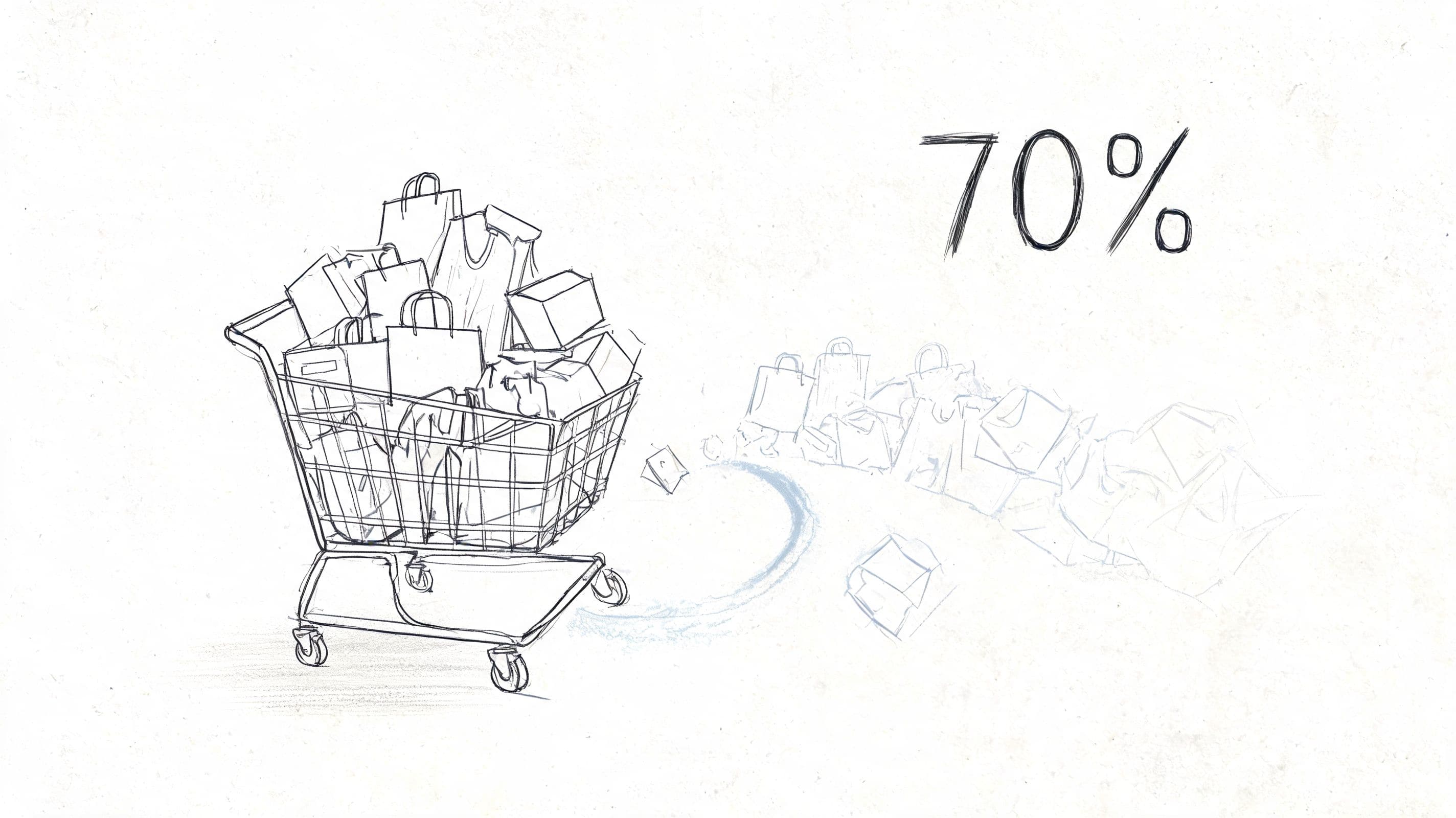
Abandonment is a revenue system problem
Merchants often treat cart abandonment as a single KPI inside Shopify analytics. The better way to handle it is as a conversion system with multiple failure points and multiple recovery opportunities.
That distinction matters.
If paid traffic is working, product pages are getting visits, and shoppers are adding items to cart, demand is already there. Revenue is being lost later in the journey, usually because the store failed to answer a question, reduce friction, or follow up through the right channel at the right time. Broad e-commerce cart recovery strategies usually focus on post-exit reminders. Those still matter, but they are only one layer.
The stronger playbook starts earlier. Email and SMS recover shoppers after they leave. AI chat and onsite prompts can recover them while they are still deciding.
The real causes are usually ordinary
Shoppers rarely abandon because they suddenly stopped wanting the product. They leave because something introduced doubt.
Common causes show up again and again:
- Unexpected costs at checkout. Shipping, taxes, and fees land late and change the value equation.
- Checkout friction. Long forms, forced account creation, weak mobile UX, or limited payment options slow the path to purchase.
- Unanswered questions. Delivery timing, returns, sizing, compatibility, ingredients, and warranty details often block the sale.
- Missing intervention during hesitation. If a shopper pauses on shipping, return policy, or payment, and no one steps in, the store waits until after the exit to respond.
In practice, many abandoned carts are information gaps, not discount opportunities.
That is where a lot of recovery programs underperform. They jump straight to a coupon in email flow one, even though the shopper may have converted with a clear answer on returns or shipping speed five minutes earlier. Stores that treat every abandonment the same leave margin on the table and train customers to wait for an offer.
A better approach matches the response to the friction. If the issue is uncertainty, answer it onsite. If the issue is distraction, send the reminder. If the issue is urgency, SMS can help. If the issue is trust, show proof, policies, and support access before the visitor leaves. Merchants building a stronger service layer usually benefit from reviewing the different customer service types in ecommerce because cart recovery now sits across support, conversion, and retention.
The key shift is simple. Abandoned cart recovery performs best as a layered program. Real-time AI chat handles objections before exit, then email and SMS pick up the shoppers who still leave. That unified approach gets more orders back than treating each channel as its own silo.
Building Your Abandoned Cart Recovery Tech Stack
A solid recovery stack has one job: detect intent, identify friction, and respond through the right channel at the right moment.
Shopify gives you a starting point, but default tooling rarely gives merchants enough control. Once a store reaches meaningful volume, the gap becomes obvious. You need stronger automation, better segmentation, and clearer visibility into what's happening between cart and checkout.
What each tool should do
Think in layers, not apps.
Email platform. This is the foundation. A platform like Klaviyo or Omnisend handles abandoned cart flows, product blocks, dynamic cart content, segmentation, and performance reporting. Email is the right place for visual reminders, product details, trust signals, and second-chance offers.
SMS platform. Tools like Postscript or Attentive add urgency and visibility. Text is best for short reminders, direct checkout links, and time-sensitive prompts. It's not where you explain everything. It's where you make the next action easy.
Onsite chat layer. This is the piece many merchants still treat as support software when it should be part of the conversion stack. A good AI chat layer answers questions instantly, surfaces shipping or return info, recommends products, and steps in during hesitation. If you want context on where this fits in a broader support operation, this breakdown of different customer service types in ecommerce is useful because it shows why reactive support alone doesn't solve conversion friction.
Behavior and analytics layer. You also need a way to see where customers stall. That can come from Shopify analytics, your ESP, session tools, or event tracking. Without that view, merchants often keep editing templates while the actual issue sits in checkout or policy communication.
How to choose without overcomplicating your stack
The wrong stack is usually either too thin or too fragmented.
If it's too thin, you expect one platform to handle email logic, SMS compliance, onsite engagement, segmentation, and reporting. It won't. If it's too fragmented, your tools don't share events cleanly, and your customer gets overlapping prompts from disconnected systems.
A practical setup usually follows this pattern:
- Use Shopify as the commerce source of truth
- Use one primary ESP for cart and browse abandonment
- Use one SMS tool with clear opt-in controls
- Add an onsite AI chat layer that can answer purchase-blocking questions in real time
- Connect reporting so merchandising, lifecycle, and CX teams see the same friction signals
Good abandoned cart recovery feels coordinated to the shopper. It shouldn't look like three departments competing for the same conversion.
When merchants skip that coordination, familiar problems show up fast. Email offers arrive after the shopper already bought. SMS messages repeat the email. Chat asks generic questions with no awareness of cart contents. The result isn't just lower recovery. It creates brand drag.
The best tech stack doesn't shout louder. It responds more intelligently.
Crafting Your Email and SMS Recovery Cadence
Email still earns its place because it works. According to Mailmend's abandoned cart recovery benchmarks, a multi-email sequence boosts orders by 69% over a single email. In that same guidance, the recommended flow is straightforward: the first email within 4 hours as a reminder, the second at 24 hours with an incentive such as 10% off, and a final email at 48 to 72 hours using scarcity. That approach can take conversion from a 4% baseline to over 8%.
The mistake isn't using email. The mistake is using one email, sending it too late, and saying too little.
A practical cadence that works
Here's a simple operating model that fits most Shopify stores.
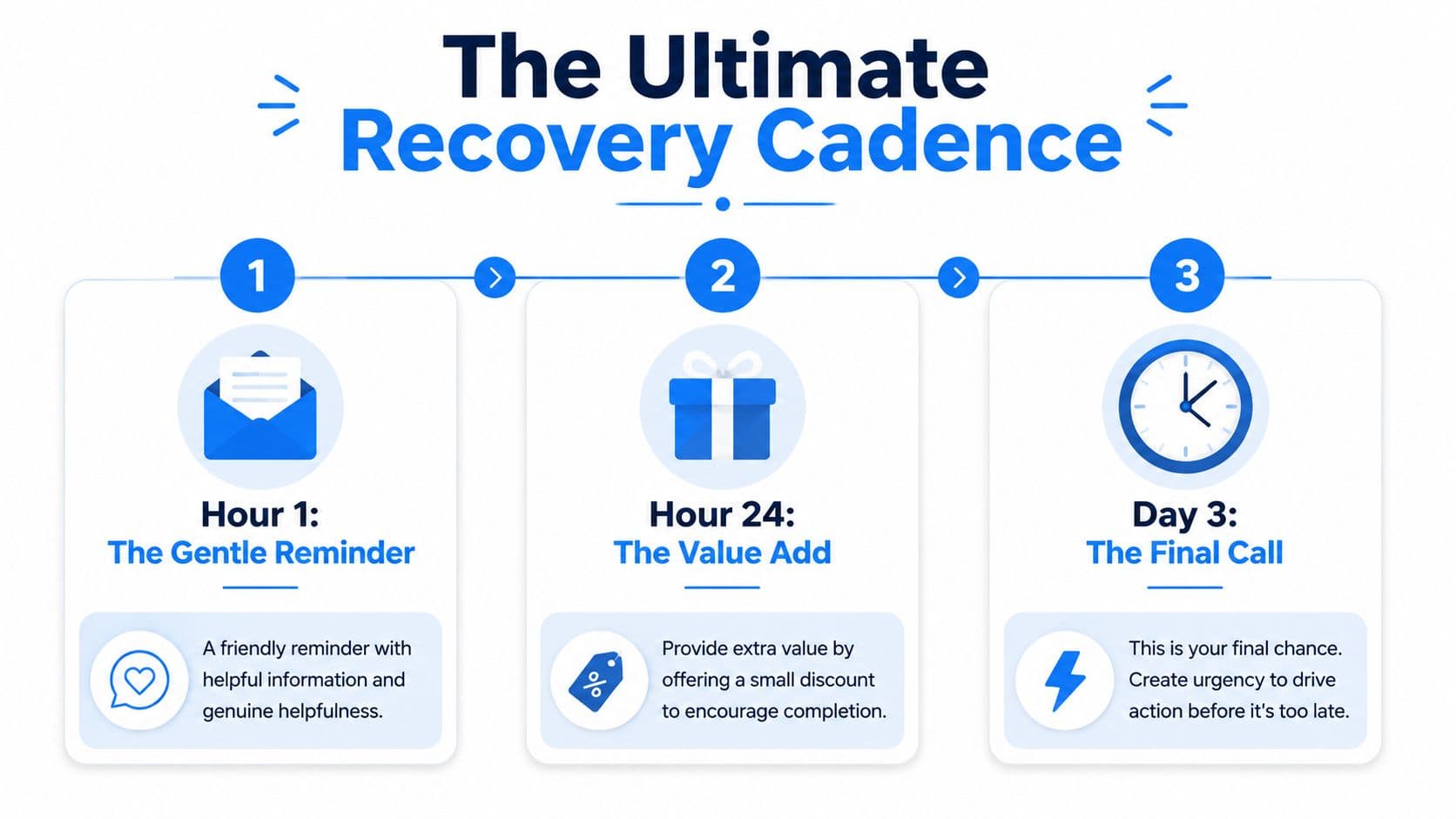
| Time After Abandonment | Channel | Message Focus / Offer |
|---|---|---|
| Within 4 hours | Simple reminder. Show cart contents, product imagery, and a direct link back to checkout. | |
| Shortly after the first email | SMS | Short nudge if the shopper has opted in. Focus on convenience, not explanation. |
| Around 24 hours | Introduce value. This could be free shipping or a modest discount if margin allows. | |
| After the second email | SMS | Follow up only for qualified segments, such as higher-intent or higher-value carts. |
| 48 to 72 hours | Final message. Use urgency carefully, such as low-stock framing or a limited incentive window. |
That sequence works because the channels do different jobs. Email carries the detail. SMS carries the prompt. Neither should duplicate the other word for word.
What to say in each message
The first email should feel like service, not pressure. Show the product image, remind the shopper what they left behind, and remove friction. Include answers to questions that commonly stall conversion, like shipping timing, returns, or payment methods.
A practical subject line style is simple:
- You left something behind
- Still thinking it over
- Your cart is ready when you are
The second email is where merchants often overcorrect. Don't jump to a deep discount by default. If shipping surprise is a recurring blocker, free shipping may be the stronger lever. If confidence is the blocker, add reviews, return-policy reassurance, or a support prompt instead of cutting margin.
For SMS, keep it short and directional.
- Reminder style: “You left items in your cart. Checkout is still ready here.”
- Value style: “Your cart is still waiting. Complete your order now and use your offer before it expires.”
Operator note: If your SMS says more than the customer can absorb in a glance, it's trying to be an email.
The final email should close the loop cleanly. Use urgency only if it's real. If inventory is limited, say so plainly. If the offer ends soon, state the deadline. Don't fake scarcity. Shoppers can smell it.
A few execution details separate strong programs from average ones:
- Use dynamic cart content: Show exactly what was left behind.
- Link back to the restored cart or checkout: Don't send shoppers to a generic collection page.
- Write channel-specific copy: SMS should not be a compressed email.
- Exclude converters quickly: Nothing erodes trust faster than sending a recovery prompt after purchase.
- Cap message frequency: Recovery should feel timely, not relentless.
You don't need a complicated flow to start. You need a clean one that respects timing, channel role, and purchase intent.
Proactive Recovery with AI Chat and Onsite Nudges
Most abandoned cart recovery advice starts after the visitor leaves. That's useful, but incomplete.
According to Recapture's discussion of abandoned cart recovery, email recovers 10% to 15% of carts post-abandonment, but it doesn't address the 63% of abandonments tied to unexpected costs or the 70% of carts abandoned before a visitor even triggers an exit-intent popup. That's the gap reactive channels can't close on their own.
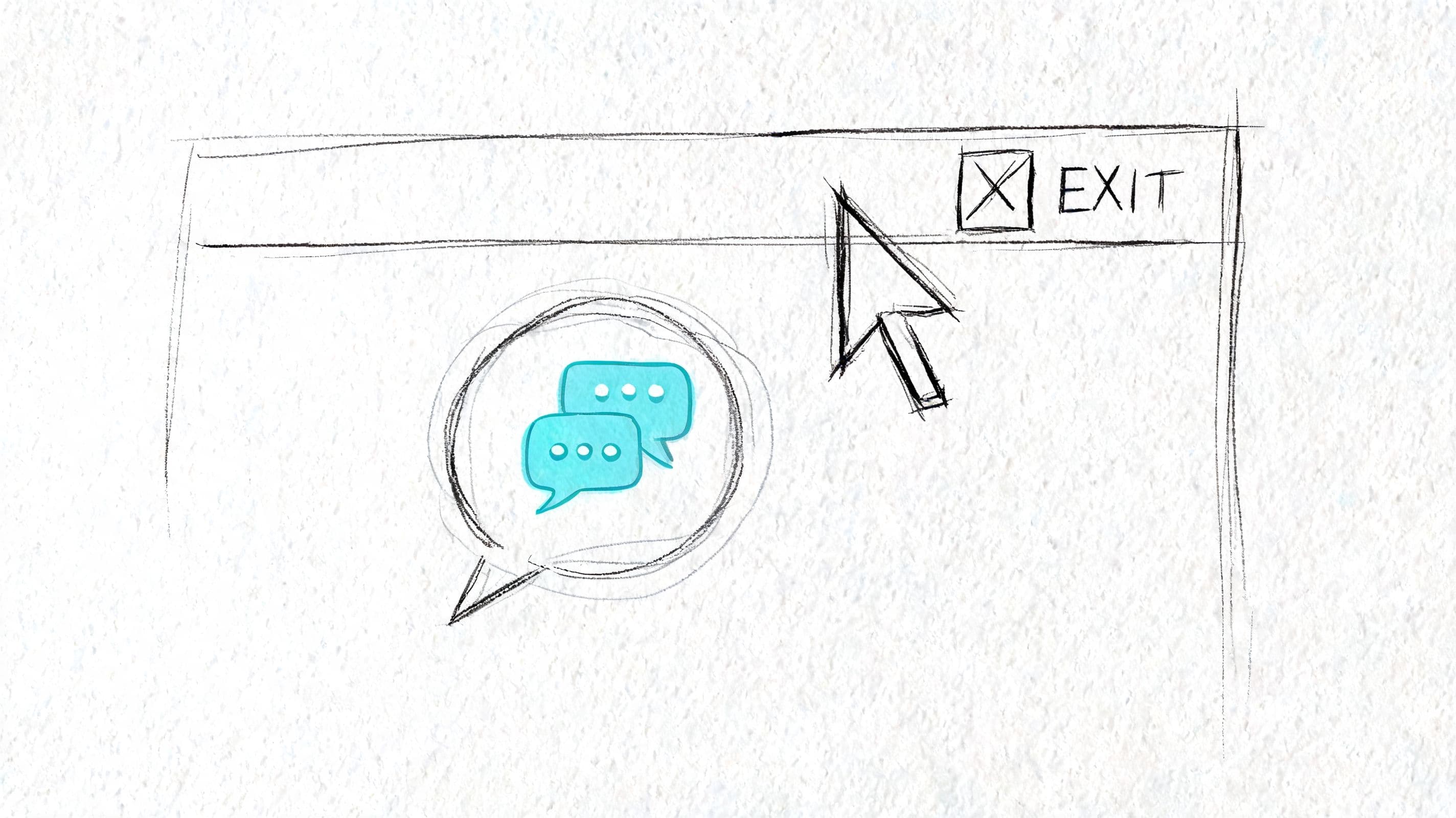
Why reactive recovery leaves money on the table
If a shopper hesitates because shipping isn't clear, your email sequence is already late. The same goes for return questions, ingredient concerns, bundle confusion, sizing uncertainty, and compatibility checks.
That's why the modern abandoned cart recovery stack needs a pre-abandonment layer. AI chat is the most practical version of that layer because it can respond inside the session, at the point where uncertainty appears.
A lot of merchants still deploy chat as a passive widget in the corner. That's underusing it. The stronger use case is proactive assistance based on behavior signals such as:
- Repeated visits to shipping or returns pages
- Long pauses on cart or checkout
- Back-and-forth movement between product and cart
- High-intent behavior paired with no checkout progress
What good onsite intervention actually looks like
The goal isn't to interrupt everyone. The goal is to step in when intent is high and friction is visible.
Good onsite nudges are specific:
- Clarifying delivery timing for a shopper stuck on shipping
- Explaining return policy for a first-time buyer
- Recommending the right shade, size, or product variant
- Pointing out a free-shipping threshold when that helps the customer make the decision
- Answering product questions instantly without forcing the shopper into email support
Bad onsite nudges are generic:
- “Need help?” with no context
- Discount popups shown to every visitor
- Chat prompts that can't answer product questions accurately
- Messages that trigger too early and disrupt browsing
The best chat intervention feels like a store associate noticing hesitation and answering the exact question blocking the purchase.
An AI system becomes valuable when it can pull from your product catalog, policies, and FAQs and turn that information into fast, relevant responses. That's what makes it conversion infrastructure instead of a cosmetic support add-on. If you want a deeper look at how that model works in ecommerce, this guide to the AI chatbot for ecommerce use case is a good reference.
Where AI chat belongs in the shopper journey
It doesn't replace email or SMS. It improves them by reducing the number of shoppers who leave in the first place.
Use chat in three moments:
-
During product consideration
Help with selection, product fit, ingredients, use cases, bundles, and comparisons. -
Inside cart
Clarify shipping, returns, thresholds, promo logic, and checkout concerns. -
At checkout hesitation
Offer reassurance, answer policy questions, and guide the shopper back to completion.
The newer recovery model offers greater strength than the traditional siloed one. Email and SMS chase the shopper after abandonment. AI chat works while the decision is still alive.
Here's a short walkthrough of that shift in practice:
Used well, chat lowers the need to bribe the shopper back later. That's a better outcome for conversion and a better outcome for margin.
How to Optimize and Scale Your Recovery Program
Once your flows are live, the next gains come from segmentation and iteration, not from adding more messages.
According to SlickText's abandoned cart recovery benchmarks, SMS can reach up to 58% recovery on targeted carts, and a unified strategy across email, SMS, and chat can recapture 10% to 15% of total revenue, which the source describes as 4x the typical result. That only happens when the program is segmented and coordinated.
Segment first, then tune the experience
Treating every abandoned cart the same is one of the most expensive habits in lifecycle marketing.
Start with a few practical segments:
- Higher-value carts: These deserve more deliberate treatment, including faster follow-up and stronger onsite assistance.
- First-time shoppers: They usually need reassurance. Lead with trust, shipping clarity, and returns, not immediate discounting.
- Repeat customers: Keep the tone lighter. They may only need a reminder.
- Product-specific friction: If one category drives more questions, build category-specific messages and FAQ support.
- SMS-eligible contacts: Reserve texts for shoppers who opted in and show strong purchase intent.
This is also where remarketing fits best. Once your owned channels are working, you can recover abandoned carts with remarketing to stay visible offsite without forcing every recovery problem into email.
Tests worth running and mistakes worth avoiding
You don't need endless A/B tests. You need a shortlist tied to real buying friction.
Run tests like these:
-
Reminder versus reassurance in email one
Some stores convert better with a plain reminder. Others need shipping or returns reassurance immediately. -
Free shipping versus percentage discount in email two
If late-stage price shock is the issue, free shipping often protects margin better than a blanket discount. -
Channel order for qualified segments
On some stores, email first then SMS works best. On others, a timely text after the first email wins for high-intent carts. -
Cart-page nudge copy
Test policy clarification, threshold reminders, and product guidance separately. Don't bundle every message into one prompt. -
Support-led versus promo-led chat prompts
If your category has fit, regimen, or compatibility questions, support language may outperform promotional language.
Scaling advice: Fix recurring friction at the site level when you can. If the same question appears every day, that's not just a chat issue. It's a merchandising or UX issue.
That's why insights dashboards matter. If your chat and support tools consistently surface the same objections, use that data to rewrite shipping copy, clarify return policy, improve PDP content, or simplify checkout labels. Recovery gets stronger when the store itself gets easier to buy from.
The merchants who scale well don't just optimize messages. They remove the reasons those messages were necessary.
Measuring Success and Ensuring Compliance
If you only monitor open rates, you'll miss whether your abandoned cart recovery program is making money.
The better lens is commercial impact plus customer trust. That means tracking performance across channels, understanding attribution clearly enough to act, and making sure every recovery touchpoint follows consent and privacy rules.
The metrics that matter
Start with a small KPI set and make sure every team uses the same definitions. This overview of e-commerce key performance indicators is a solid reference point if your reporting is still fragmented.
For abandoned cart recovery, focus on:
- Recovery rate: How many abandoned carts return and complete purchase.
- Revenue per recipient: Especially useful for comparing email and SMS efficiency.
- Conversion by message step: You need to know which touchpoint is doing the work.
- Time to recovered purchase: This helps you refine cadence and understand when intent goes cold.
- Unsubscribe and opt-out trends: Strong recovery shouldn't create list fatigue or trust damage.
Don't evaluate channels in isolation. A text may not get the last click but may still accelerate the purchase after an email reminder. Likewise, onsite chat may prevent abandonment that never appears in your cart email report.
If you're also managing paid marketplace traffic, the same discipline applies there. Teams that know how to set the right Amazon PPC bid usually understand this well: channel metrics matter, but decision-making improves when you tie them back to profit and conversion quality.
Compliance rules you can't treat as optional
SMS is the fastest way to create legal and brand risk if you get sloppy. Only text shoppers who have clearly opted in, honor opt-outs immediately, and avoid overmessaging. Consent is not a minor setup detail. It's the foundation of whether the channel is usable.
Email has its own rules. Keep unsubscribe links obvious, identify your brand clearly, and don't blur the line between service communication and marketing if your legal basis depends on that distinction.
For data handling more broadly:
- Be transparent about what you collect
- Limit data use to legitimate recovery and support purposes
- Respect regional privacy requirements
- Make preference management easy
Strong abandoned cart recovery should feel helpful and expected. The moment it feels intrusive, performance usually drops right alongside trust.
The merchants that win here build programs that are measurable, coordinated, and restrained. They don't send more just because they can. They send the right message, to the right shopper, at the right moment, with consent in place.
If you want to add a proactive onsite layer to your abandoned cart recovery program, Carti is built for that job. It helps Shopify stores answer shopper questions instantly, recommend the right products, and step in before hesitation turns into abandonment, all without a heavy implementation project.

Written by
Daniel AndersonFounder of Carti. 10+ years building ecommerce brands in apparel and supplements. Still runs a Shopify store and built Carti to help merchants convert more browsers into buyers.
Ready to boost your store's sales?
Install Carti in 5 minutes and let AI handle customer questions, recommend products, and close sales 24/7.
Start Free Trial14-day free trial