
A shopper lands on a jacket's product page late at night and asks whether it runs small. The chat assistant can answer from the store's sizing details, explain what's missing, or send the shopper away without useful guidance. For the merchant, that exchange matters more than a long feature list.
Shopify merchants comparing Alhena AI alternatives often want a better balance of answer quality, conversation limits, and total monthly cost. A convincing demonstration isn't enough. The assistant also needs to handle incomplete product information, changing inventory, and questions that require human judgment.
The options below span AI chat assistants, conversational commerce tools, helpdesk platforms, and structured product discovery. Each faces the same merchant questions:
- Cost at actual usage: What gets counted, and what happens when usage grows?
- Store fit: Does the product match the catalog, shopping journey, and support workload?
- Trade-offs: Which limitations deserve testing before installation?
- Switching work: What knowledge, workflows, and permissions need rebuilding?
This is a neutral comparison, with Carti among the options rather than a default recommendation. Competitor prices and limits are omitted where a current vendor pricing page couldn't be confirmed from the available evidence. Product links provide starting points for evaluation, not a claim that every current plan has been independently checked.
The strongest choice depends on catalog complexity, traffic, and support workload. A lightweight shopping assistant and a shared support platform solve different problems, even when both appear as a chat bubble.
1. Carti
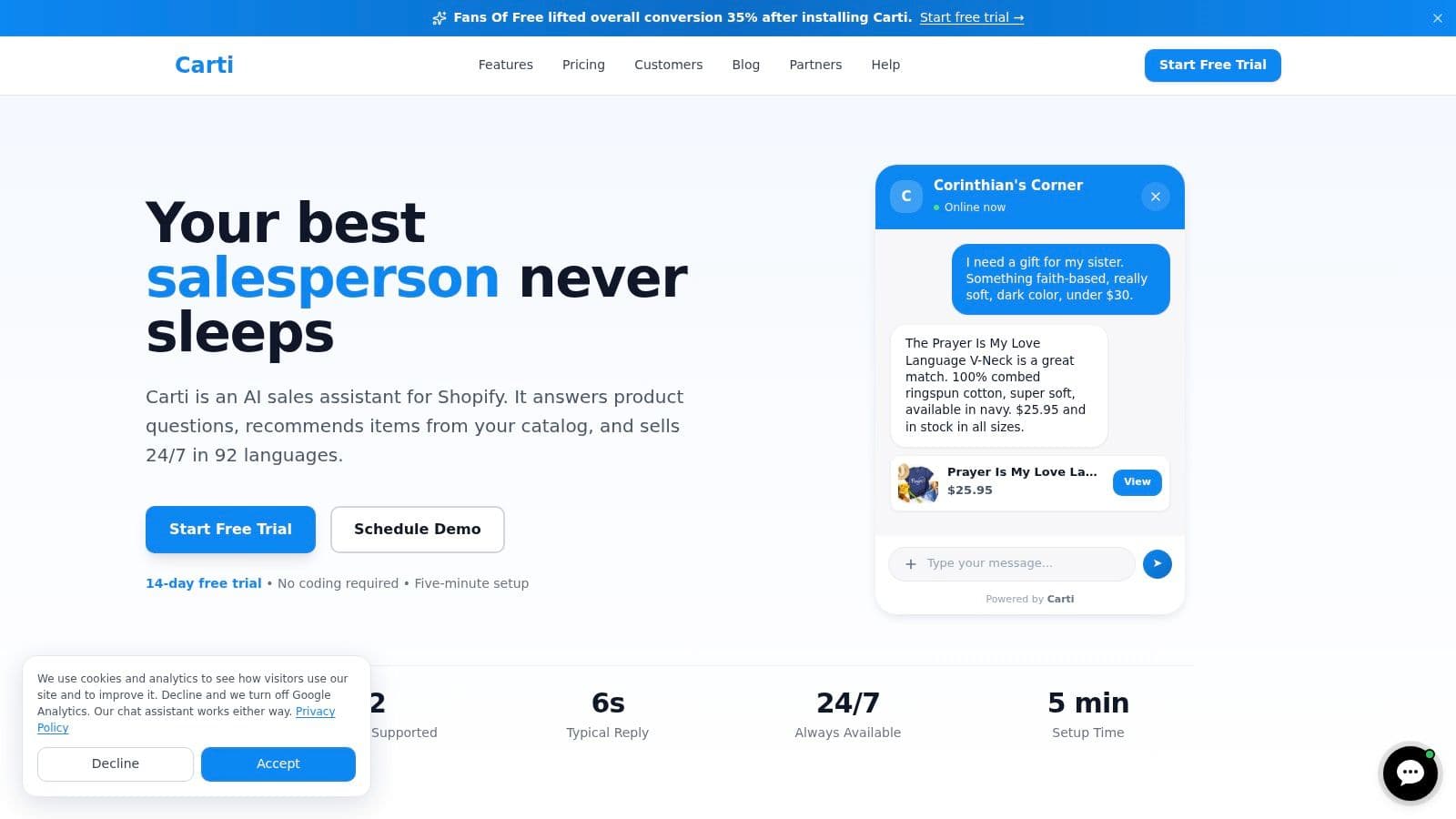
Carti is an AI sales assistant for Shopify that answers customer questions using the store's own products and policies, written in the store's brand voice. The tone can be customized, and a self-improving sales agent is included on every plan. Inside the chat it can recommend a product from the live catalog with its real price and current stock, and place an add-to-cart button in the conversation.
Review data feeds into answers as well. Areviews and Okendo connect without an API key, and Areviews connects on its own.
Cost, Fit, and Switching Work
Pricing is structured around conversation allowances. Free costs $0 per month for 50 AI conversations. Starter costs $49 per month for 250, adding advanced analytics, removal of Carti branding, and priority chat support. The Growth plan allows 600 conversations and Scale allows 1,750; confirm the current price of each tier before budgeting.
- Suitable profile: A Shopify store wanting product guidance and policy answers in chat without replacing its wider support operation.
- Useful reach: Automatic language detection with native replies in 92 languages, requiring no translation setup or extra configuration.
- Main trade-off: Missing sizing attributes, contradictory policies, or thin product descriptions still need merchant attention.
- Switching work: Connect the catalog, load approved policies, set the tone, and test recommendations against actual variants.
The interactive demo on Carti's website is provided for evaluation only. It can show how answers are phrased, but it cannot measure how the assistant performs under real traffic.
A realistic pilot covers three cases: a jacket with unclear fit information, a product with mixed review feedback, and an unavailable variant. The merchant should judge whether the response acknowledges uncertainty rather than turning incomplete evidence into confident advice.
2. VanChat
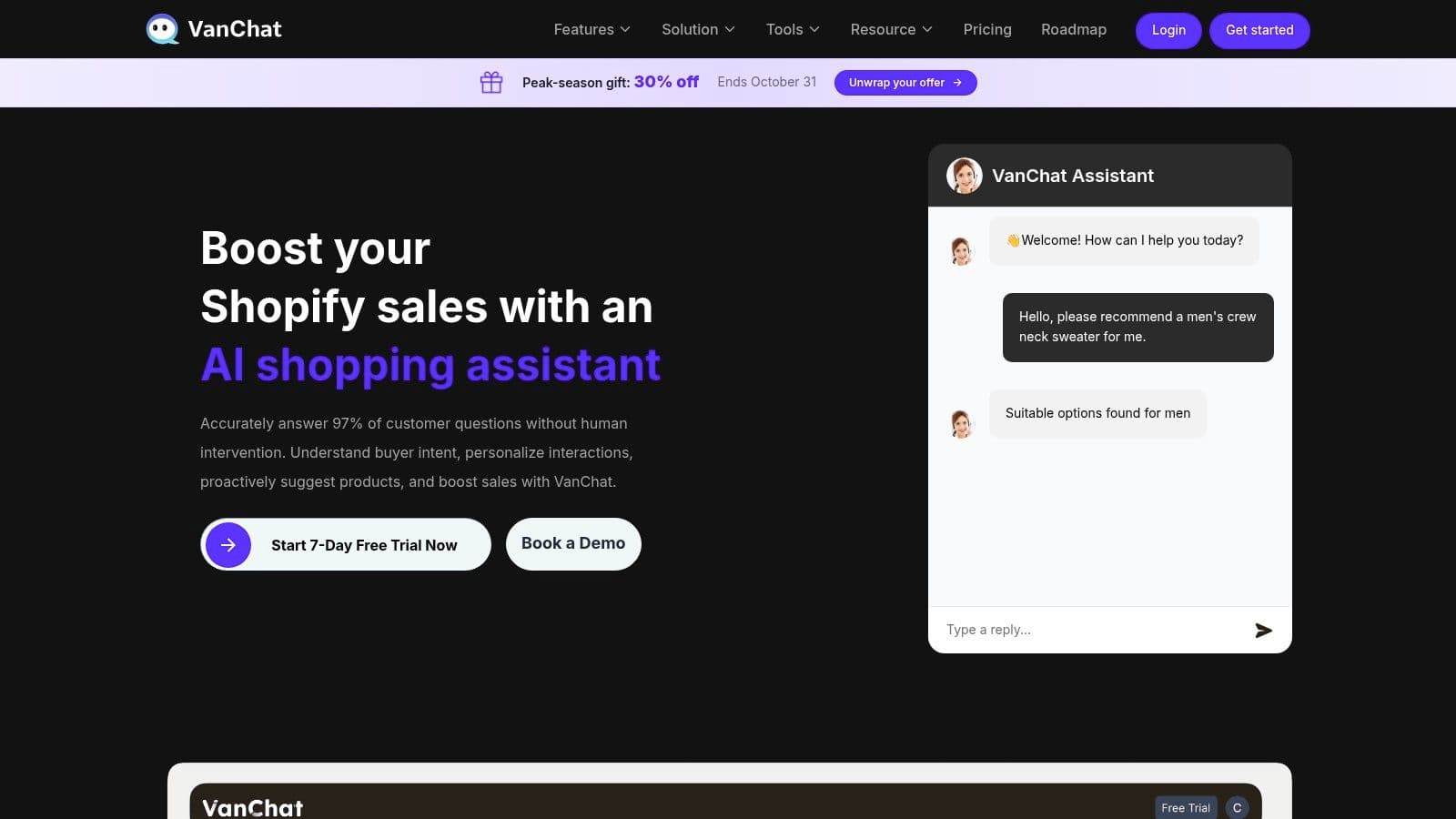
VanChat is a sales-oriented candidate for merchants who want proactive storefront conversations. Its described capabilities include product recommendations, natural-language product search, order tracking, lead collection, and human handoff. The VanChat website is the starting point for checking current product scope and commercial terms.
The relevant distinction is its reply-based billing approach. A reply and a conversation aren't interchangeable units. A shopper comparing several jackets may generate repeated replies before making a decision.
Budgeting rule: Compare the cost of complete shopper journeys, not the headline allowance attached to differently defined billing units.
Store fit. VanChat belongs on a shortlist when product discovery and proactive selling matter more than a broad helpdesk replacement. Multilingual support and Shopify product synchronization are relevant to that evaluation.
Trade-off. Reply-based usage requires careful forecasting. The merchant should also verify which catalog, analytics, and sales capabilities belong to the selected plan. Current prices, plan names, and numerical limits aren't quoted here without a confirmed vendor pricing page.
Switching work. Rebuild product knowledge, configure proactive messages, and test the transition from AI to a person. A successful handoff should preserve the shopper's product choice, unanswered question, and previous messages.
The decisive pilot question is whether extra replies help the shopper decide. Longer conversations shouldn't automatically count as better assistance.
3. Dori

A product-page assistant serves a different moment from a general support inbox. Dori's described approach combines product-page guidance with sitewide chat, making it relevant when shoppers need help comparing options close to purchase.
The Dori website presents a Shopify-focused assistant with product recommendations, comparisons, catalog learning, and add-to-cart support. Brand-voice customization and analytics are also part of its described scope.
Evaluate the Placement, Not Just the Chat
Dori merits consideration for catalogs where product differences require explanation. A skincare merchant, for example, could test whether the assistant distinguishes supplied ingredient information from unsupported suitability advice.
- Cost: Confirm the current conversation allowance, product allowance, and higher-volume terms directly. No numerical pricing claims are included without a confirmed pricing-page source.
- Store fit: Shopify merchants seeking product-page assistance alongside general storefront chat.
- Trade-off: Product-page placement isn't proof that the assistant can resolve ambiguous fit, ingredient, or compatibility questions.
- Switching work: Check page placement, catalog coverage, brand tone, and the route for unresolved questions.
The catalog audit deserves particular attention. A comparison is only useful when the underlying products have comparable attributes.
If one jacket lists garment measurements and another lists only a broad size label, the assistant should identify the missing information. A smooth comparison that fills those gaps without saying so would be a reason to pause deployment.
4. Chizy
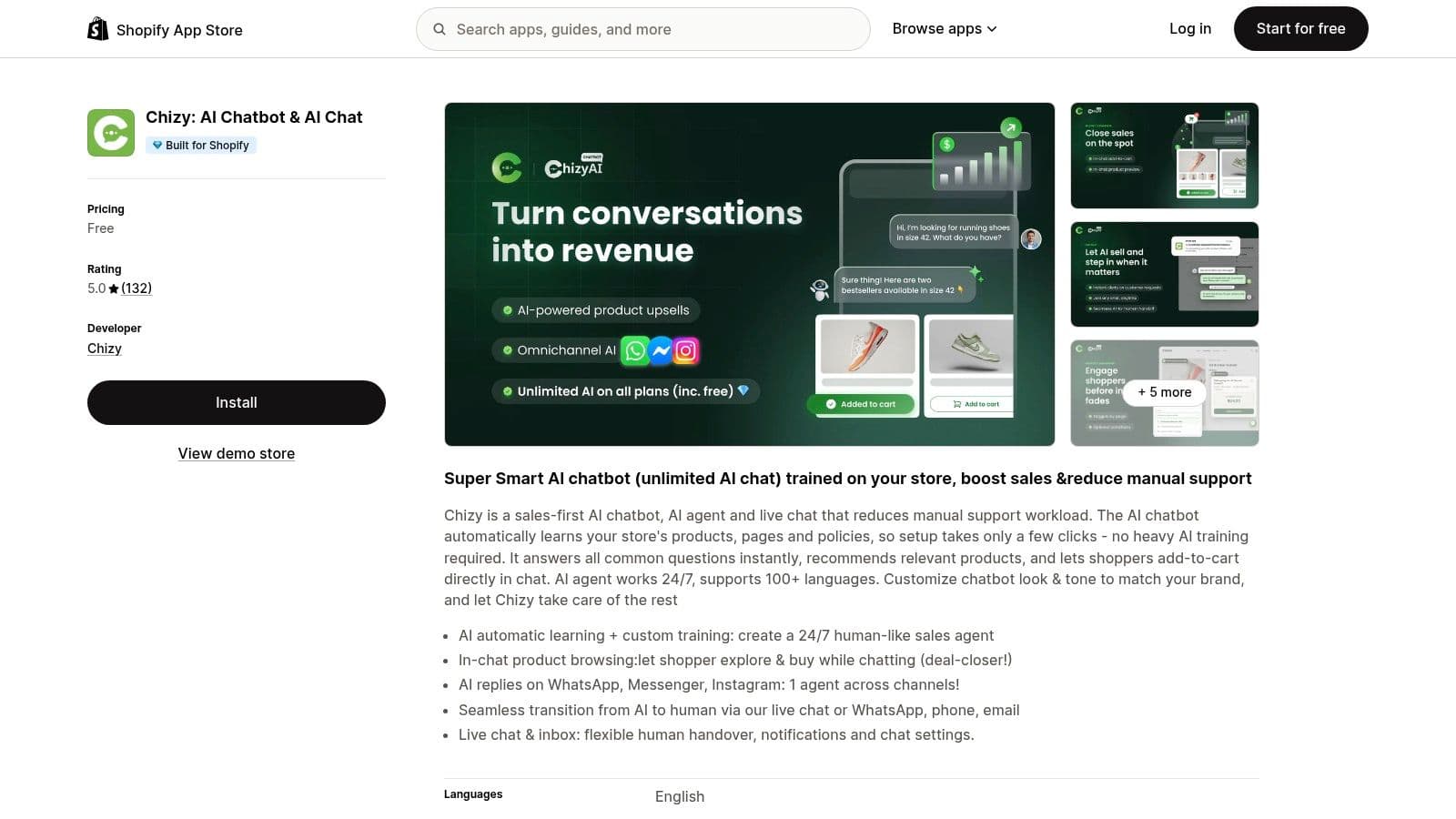
Chizy combines sales chat with live-chat and inbox functions. Its described capabilities include product recommendations, add-to-cart interactions, proactive messages, order tracking, and human handoff. The Chizy Shopify listing provides a direct place to inspect the app's current scope and plan information.
For merchants handling both shopping questions and routine service contacts, that combination is worth testing. Social messaging capabilities described for paid tiers include WhatsApp, Instagram, and Messenger.
The commercial question isn't whether chats are capped alone. Catalog coverage and feature access can matter just as much as message volume. Current prices and numerical limits are omitted because a vendor pricing page hasn't been confirmed.
- Best-fit evaluation: A store looking to combine proactive selling with human chat in the same workflow.
- Main limitation to investigate: Whether the selected tier includes the required products, knowledge sources, and messaging integrations.
- Migration priority: Recreate escalation rules and confirm that staff can see the conversation history.
A useful test should combine a product question with a policy exception. The assistant might explain a jacket's material correctly yet still need human help with an unusual return request.
Merchants should keep those outcomes separate. Accurate product guidance doesn't establish that the same tool should receive permission to make consequential order changes.
5. Talkom
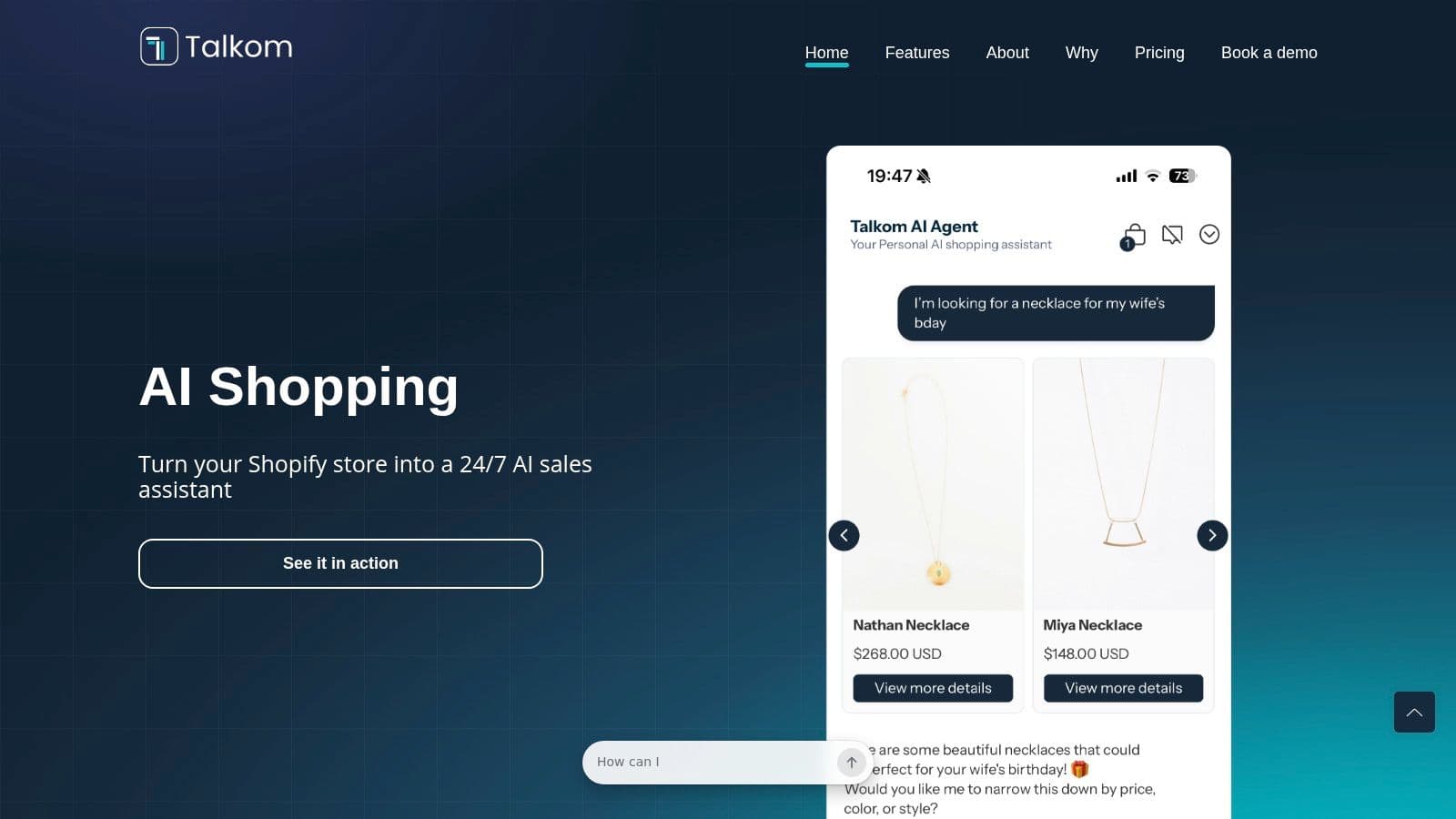
Some shoppers know the outcome they want but not the product name. Talkom's described emphasis on conversational search makes it a candidate for that discovery problem. Shoppers can describe a need, explore products, view details, and add items to the cart through the interaction.
The Talkom website also describes assistance with orders, returns, and refunds. Its reporting covers products shown, clicked, and added to carts, alongside resulting revenue.
Search Quality Needs Its Own Test
Store fit. Talkom is worth evaluating when conventional menus or keyword search leave shoppers struggling to express their needs. The pilot should include descriptive requests that don't repeat catalog wording.
Cost. Confirm current conversation limits and the paid tier needed for actual usage. No competitor price or allowance is quoted without a verified pricing-page source.
Trade-off. A search-style assistant may suit discovery without necessarily matching every merchant's preferred support workflow. Revenue reporting also needs interpretation, since an attributed sale doesn't by itself prove an incremental sale.
Switching work. Test the interface within the store's theme and shopping journey. Check product cards, cart behavior, mobile placement, and access to human help.
The strongest evaluation separates finding a plausible item from finding an appropriate item. A recommendation should preserve the shopper's stated requirements, including material, compatibility, availability, and any supplied budget constraint.
6. Buddy AI
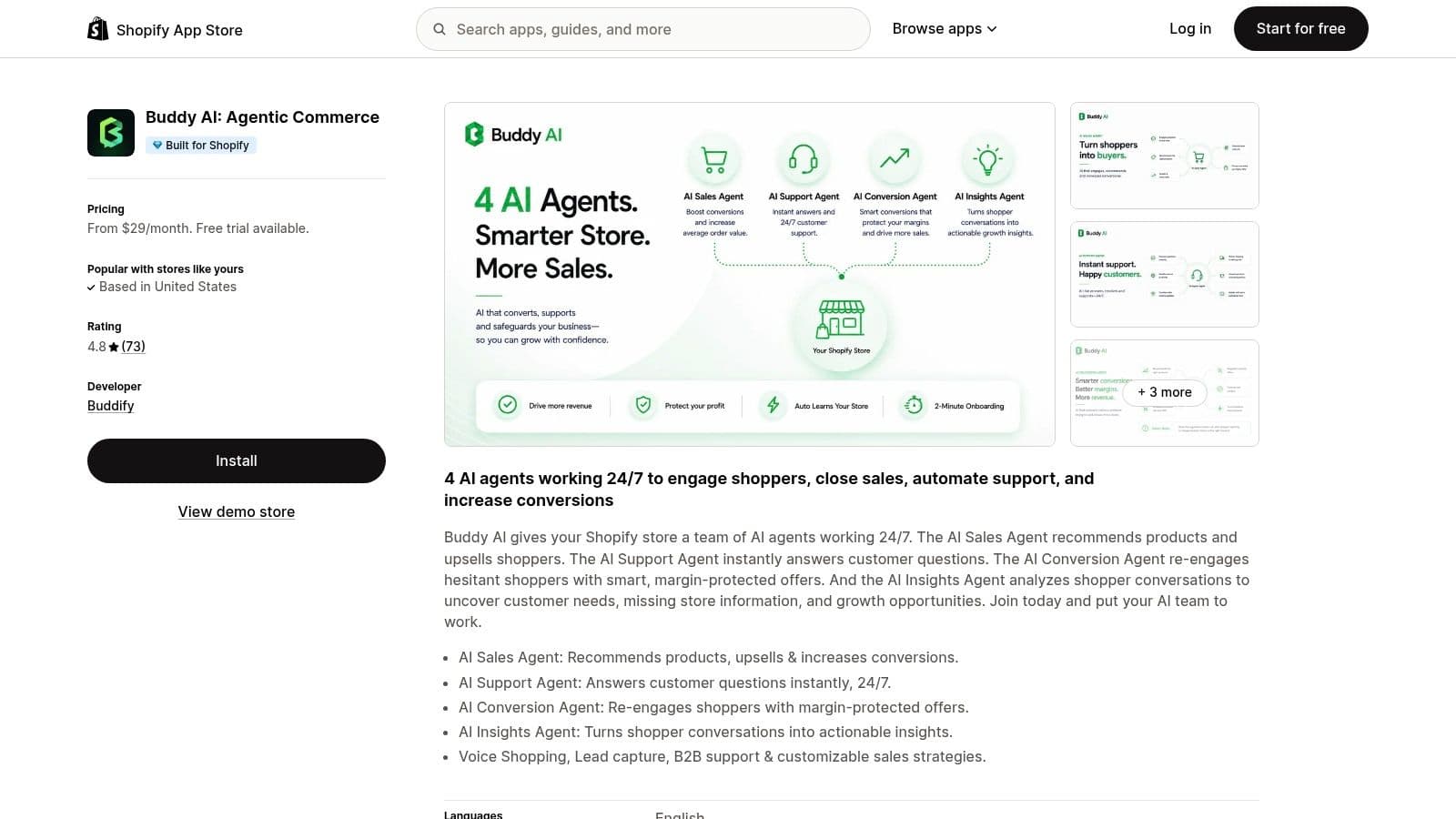
Buddy AI's described offering includes offers customized with margin controls, alongside product recommendations, customer support, lead capture, and conversation analytics. Discounting changes the evaluation.
The Buddy AI Shopify listing presents an approach organized around sales, support, conversion, and insights agents. That makes it relevant for merchants evaluating sales interventions rather than product answers alone.
A discount-capable assistant should be judged on margin protection and rule compliance, not only whether a shopper accepts an offer.
The cost assessment should include any sales-linked charges that apply to the selected plan. Current plan names, commission rates, prices, and reply limits aren't reproduced without confirmation from the vendor's pricing page.
- Store fit: A merchant willing to define and monitor an active sales strategy, including offer eligibility.
- Trade-off: More configurable sales behavior creates more rules to review. A small store seeking straightforward FAQ answers may not need that scope.
- Switching work: Establish discount boundaries, product exclusions, checkout expectations, and ownership of ongoing tuning.
The pilot should include shoppers who request an offer but don't qualify for one. Staff should also test whether the assistant continues to provide useful product help when no discount is available.
A merchant shouldn't have to choose between protecting margin and answering a reasonable sizing question. The assistant's behavior needs to remain useful when promotional tools are restricted.
7. Tidio Lyro
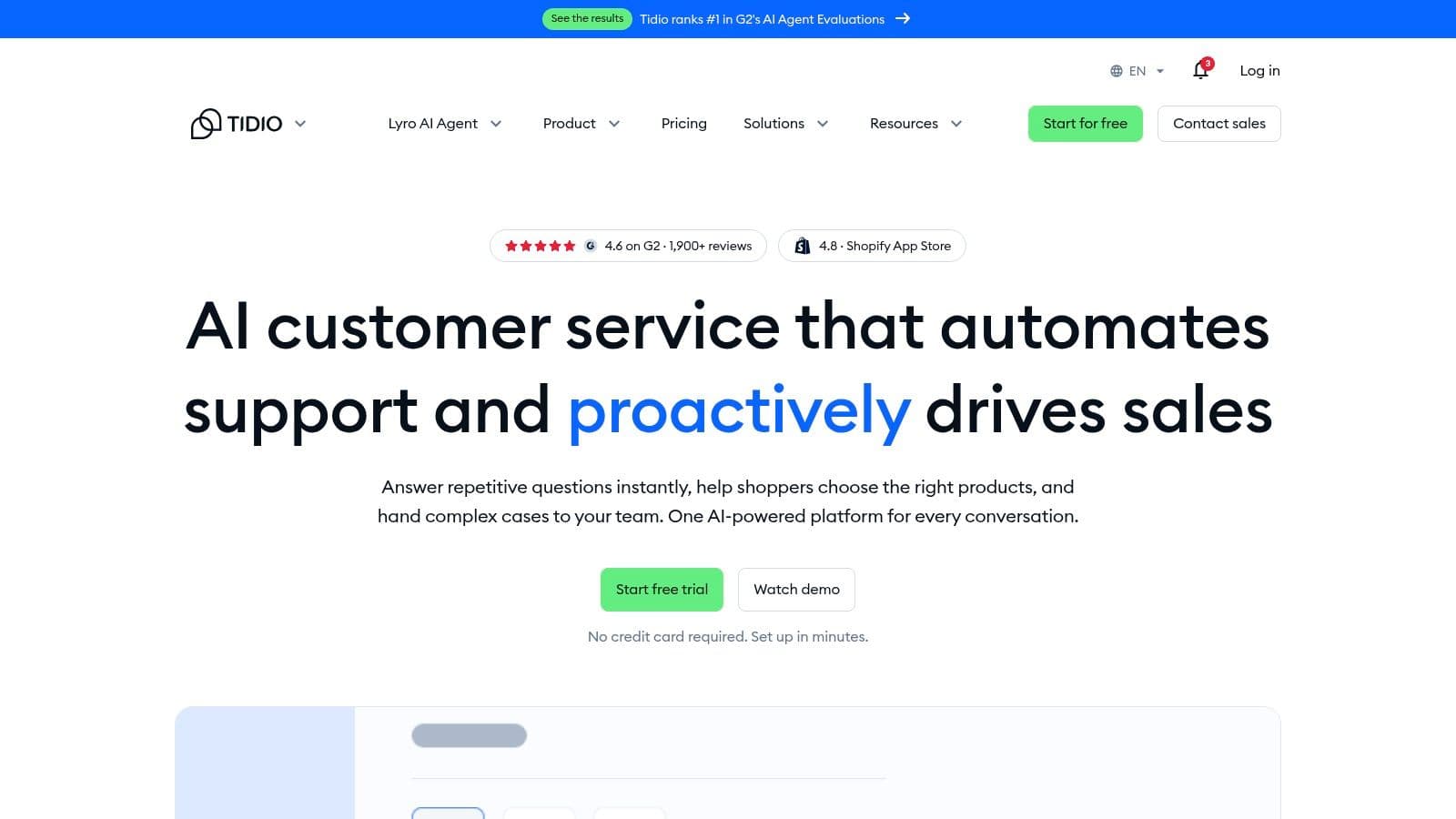
Tidio Lyro belongs in the support-platform category, not just the storefront-widget category. Its described offering combines AI assistance with live chat, ticketing, and automation flows. Shopify-aware product recommendations add a shopping role to that broader service setup.
The Tidio website is the direct product reference. Merchants considering its place in a Shopify stack can also consult this Tidio Lyro review.
Compare the Whole Support Bill
Cost. Evaluate AI usage, human-service capacity, and automation requirements together. A headline AI allowance won't establish the complete cost if the merchant also needs other platform components. Unconfirmed prices and limits are excluded.
Store fit. Tidio is a relevant candidate when staff need a shared environment for automated answers and human support. It may be broader than necessary for a merchant seeking only pre-purchase recommendations.
Trade-off. Consolidation can reduce workflow fragmentation, but it also expands the implementation decision. The merchant needs to assess inbox processes, not merely response quality.
Switching work. Map routing, ticket ownership, knowledge sources, messaging channels, and escalation context before replacing the existing workflow.
Adobe's retail research found that 66% of consumers expected fast automated support, while 33% believed brands delivered it, reinforcing the need to test resolution quality rather than chatbot availability alone (Adobe's retail digital trends report).
8. Rep AI

Rep AI emphasizes proactive sales conversations. Its described capabilities include outreach to shoppers showing hesitation, conversational search, product recommendations, upsells, and cart-recovery features.
The Rep AI website provides the direct product reference. The Rep AI and Gorgias comparison is useful for distinguishing a sales-concierge decision from a helpdesk decision.
For a merchant evaluating proactive assistance, timing matters. A relevant message about sizing can be helpful, while repeated prompts may interrupt a shopper who already knows what to buy.
- Cost: Evaluate the traffic-based commercial structure against actual sessions and selected products. No session rate or trial duration is quoted without a confirmed vendor pricing-page source.
- Store fit: Stores prioritizing guided selling and proactive engagement rather than support-inbox consolidation.
- Trade-off: Session-based billing can't be compared directly with conversation-based billing without store-specific usage data.
- Switching work: Configure triggers, catalog access, inventory handling, and sales-attribution reporting.
The pilot should include visitors who engage with chat and visitors who ignore it. Staff should review whether prompts remain relevant across product pages, carts, and repeat visits.
Assisted revenue is a useful reporting category, but it shouldn't stand alone. Merchants should also inspect recommendation accuracy, unnecessary interruptions, and whether the assistant respects unavailable variants.
9. Gorgias AI Agent / Shopping Assistant
Gorgias is a different proposition for stores already operating a commerce helpdesk. Its shopping assistant sits within a broader customer-service environment rather than functioning only as a standalone product-discovery widget.
The Gorgias Shopping Assistant page describes product recommendations and pre-purchase assistance using catalog and shopper context. The broader offering includes post-purchase support, Shopify actions, reporting, and team handoff.
Existing Workflow Can Change the Decision
For an existing Gorgias merchant, the relevant question is whether native shopping assistance reduces operational complexity. For a merchant without that helpdesk, the decision includes adopting a broader service platform.
- Cost: Model helpdesk requirements and AI billing together. Current prices and resolution-based charges aren't quoted without a confirmed pricing-page source.
- Store fit: Teams wanting shopping conversations and post-purchase service in a shared helpdesk.
- Trade-off: The broader scope may be unnecessary for a low-volume store seeking a lightweight shopping assistant.
- Switching work: Review ticket routing, customer context, order permissions, escalation ownership, and knowledge-source precedence.
A vendor-published survey of 400 ecommerce decision-makers reported that AI handled an average of 31% of customer interactions, but those interactions included order tracking, refunds, exchanges, and shipping questions rather than proof of recommendation quality (Gorgias conversational commerce research).
That distinction matters. Strong support automation should earn credit for service performance, while product recommendations still need their own catalog-specific evaluation.
10. Octane AI
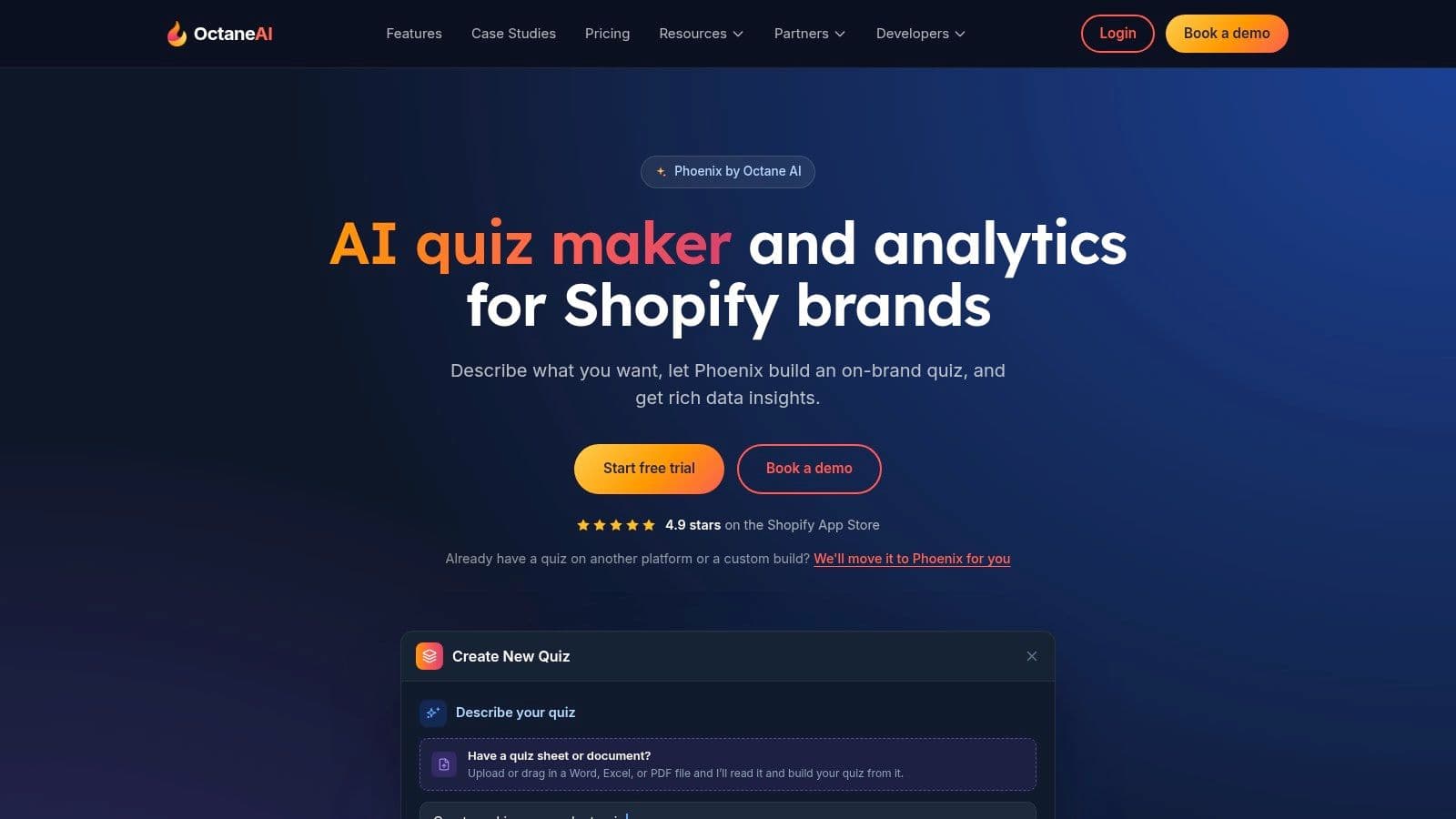
Octane AI is a quiz-first alternative, not a direct substitute for every open-ended chat function. Its described approach guides shoppers through structured questions, recommends products, and captures information shoppers deliberately provide.
The Octane AI website presents quiz creation, personalized matches, recommendation explanations, analytics, and integrations. Merchants considering this route can explore the practical role of a product recommendation quiz for ecommerce.
For beauty, skincare, and other needs-led catalogs, a structured journey may be preferable when merchants want control over the questions asked. It's less suitable as the sole answer channel for unexpected shipping, return, or order questions.
Selection insight: A quiz can constrain the path to a recommendation, but it doesn't remove the merchant's responsibility to validate the recommendation rules.
Cost. Evaluate quiz engagements, applicable AI credits, and required integrations. Current prices, plan names, limits, and trial terms aren't quoted without a confirmed pricing-page source.
Trade-off. Shoppers must follow a designed sequence rather than freely ask whatever matters to them. That can improve consistency while leaving some questions unanswered.
Switching work. Translate product-selection logic into questions, map answers to suitable products, review consent and marketing connections, and test recommendation explanations.
A merchant replacing chat with a quiz should retain a clear route for policy questions and human assistance. Structured discovery and customer service remain different jobs.
Starting price, free plan, and best-fit merchant for each Alhena AI alternative
The table below quotes pricing only where a vendor's current pricing page confirms it. Where a figure could not be confirmed, the cell says so rather than repeat an amount that may be outdated or wrong. Merchants should treat unconfirmed cells as a prompt to check the vendor's own page before comparing costs.
| Item | Starting price | Free plan | Best fit |
|---|---|---|---|
| Carti | Free; paid plans from $49/month | Yes, 50 AI conversations/month | Shopify stores seeking multilingual sales assistance and product recommendations |
| VanChat | Confirm on vendor pricing page | Yes; allowance not confirmed | Shopify stores wanting proactive selling and checkout support |
| Dori | Confirm on vendor pricing page | Yes; limits not confirmed | Shopify stores wanting product-page guidance and comparisons |
| Chizy | Confirm on vendor pricing page | Yes; product limit not confirmed | Smaller Shopify stores wanting sales chat and live-chat handoff |
| Talkom | Confirm on vendor pricing page | Yes; allowance not confirmed | Shopify stores wanting conversational product search |
| Buddy AI | Confirm on vendor pricing page | Free plan not confirmed | Stores seeking customizable sales, support, and insights agents |
| Tidio Lyro | Confirm on vendor pricing page | Yes; AI allowance not confirmed | Merchants wanting AI support alongside live chat and ticketing |
| Rep AI | Confirm on vendor pricing page | Free plan not confirmed | Stores seeking proactive shopper engagement and cart recovery |
| Gorgias AI Agent / Shopping Assistant | Confirm on vendor pricing page | Free plan not confirmed | Merchants already using Gorgias for customer support |
| Octane AI | Confirm on vendor pricing page | No free plan stated; confirm trial terms on vendor site | Shopify stores using quizzes for personalized product matching |
Two practical cautions apply. Plan names, allowances, and prices change often, so a figure copied from a review or directory may no longer match what a vendor charges today. The free-plan column also matters more than the starting price for early evaluation: a confirmed free tier lets a store test real shopper questions before any paid commitment.
Choosing the Right Shopify Chat Assistant for Your Store
The first decision is which job needs improving. Smaller catalogs with light traffic can begin with a suitable free plan and test real shopper questions. Stores already managing a shared helpdesk may favor an assistant that preserves the same inbox, while quiz-led brands may prefer structured discovery over open chat.
Price comparisons should use the merchant's actual workload. Replies, conversations, sessions, resolved interactions, and quiz engagements are different billing units. A low entry price doesn't establish a low monthly cost when the unit being counted differs.
Operational safety deserves equal attention. Claims about grounding answers in store data aren't independently demonstrated error rates. Alhena's Shopify integration documentation provides integration context, but merchants should still test freshness, source conflicts, and action permissions for any replacement.
Move the Knowledge Before Moving the Traffic
Export approved FAQs, shipping and returns policies, sizing details, and product-selection guidance. Rebuild the knowledge base around current sources rather than copying every historical page without review.
The migration should include these practical checks:
- Replay real questions: Check answers against 20 to 30 actual customer questions, including ambiguous fit requests and policy exceptions.
- Test freshness: Change a product attribute or variant's availability, then inspect when the assistant reflects the update.
- Preserve handoff context: Confirm that staff receive the original question, previous answers, and relevant product information.
- Verify language behavior: Check language detection and policy consistency in the languages customers use in practice.
- Monitor plan boundaries: Track conversations or other billable units that fall outside the selected allowance before the invoice arrives.
Run the new tool alongside the old operation for a short period, using controlled testing or separated traffic rather than displaying competing assistants to the same shopper. Keep consequential actions restricted until staff have checked permissions and exception handling.
Delivery answers deserve particular scrutiny. Under the FTC's prompt-delivery rule, sellers without a stated shipment period need a reasonable basis to expect shipment within 30 days, with notification and cancellation obligations when promises can't be met (FTC prompt-delivery guidance).
Confirm every price, plan name, limit, and billing definition on each vendor's own current pricing page. The entry links provide direct vendor starting points, while unconfirmed figures have deliberately been omitted. The best alternative is the one that answers the store's own customers accurately at a cost the merchant can forecast.
For merchants comparing storefront shopping assistance, Carti answers pre-purchase questions from a Shopify store's catalog, policies, and FAQs, and recommends relevant products. Visit the site to evaluate its demonstrations and compare the stated conversation allowances with the store's expected workload.

Written by
Daniel AndersonFounder of Carti. 10+ years building ecommerce brands in apparel and supplements. Still runs a Shopify store and built Carti to help merchants convert more browsers into buyers.
Ready to boost your store's sales?
Install Carti in 5 minutes and let AI handle customer questions, recommend products, and close sales 24/7.
Start Free Trial14-day free trial