
Tidio's free Lyro access is limited to 50 conversations as a one-time quota, and paid Lyro packages start at $39 per month for 50 renewing conversations. That makes the tool easy to try, but not easy to ignore once a store starts getting real traffic.
A Shopify owner usually feels this pressure late at night. A shopper has one question about sizing, shipping, or returns, and the answer is buried somewhere in a policy page or FAQ. If the store doesn't answer fast enough, the sale is gone.
| Plan or benchmark | What it means for merchants |
|---|---|
| Free Lyro access | 50 conversations, one time only, then it stops unless upgraded |
| Lowest paid Lyro package | $39 per month for 50 conversations |
| Review base on Capterra | 590 verified reviews, 4.7 out of 5 overall, with 90% of reviewers saying they would recommend it Capterra review profile |
| Typical vendor resolution framing | Tidio has described Lyro's support resolution capability in the 67% to 75% range across its materials, depending on the product context and metric used Tidio features |
The Reality of Unanswered Store Questions
A shopper doesn't usually leave because of one dramatic failure. They leave because a small question lands at the wrong moment and nothing answers it fast enough. That happens on product pages, collection pages, and in chat boxes that look helpful but don't know the store's real policies.
What a missed question costs
For a Shopify store, the most common lost sale is a boring one. The customer wants to know if a shirt runs small, whether a candle ships fast enough for a gift, or how a return works if the color looks different in person. If the answer isn't immediate and believable, the shopper often closes the tab and moves on.
That's why AI support tools get attention in the first place. They promise to cover the repetitive questions that drain teams and leave revenue sitting in abandoned sessions. A tidio lyro review only matters if it looks at that real use case, not just at the marketing pitch.
Practical rule: support automation should be judged on the questions that show up before purchase, not just on how many tickets it clears after the fact.
Where Lyro fits in that gap
Lyro belongs to the category of systems that try to answer from store knowledge rather than from fixed scripts. That's a meaningful distinction for merchants who are tired of keyword bots that fall apart the moment a customer asks something slightly off-template.
The review base on Tidio suggests strong usability, with 590 verified reviews on Capterra and an overall score of 4.7 out of 5 Capterra review profile. Those numbers describe the broader Tidio product, not Lyro alone, but they do point to a platform that many users find workable.
The trade-off is that support satisfaction is not the same as product recommendation quality. A store can like the interface and still need to test whether the bot gives the right answer on sizing, materials, refunds, or delivery deadlines. That distinction matters more than any generic chatbot claim.
The merchant question that actually matters
The test is simple. Does the assistant lower friction without creating new doubt? If it can answer the routine questions and hand off the hard ones cleanly, it can fit into a store's daily operations. If it sounds confident while being wrong, it becomes another reason customers hesitate.
How Lyro Actually Works
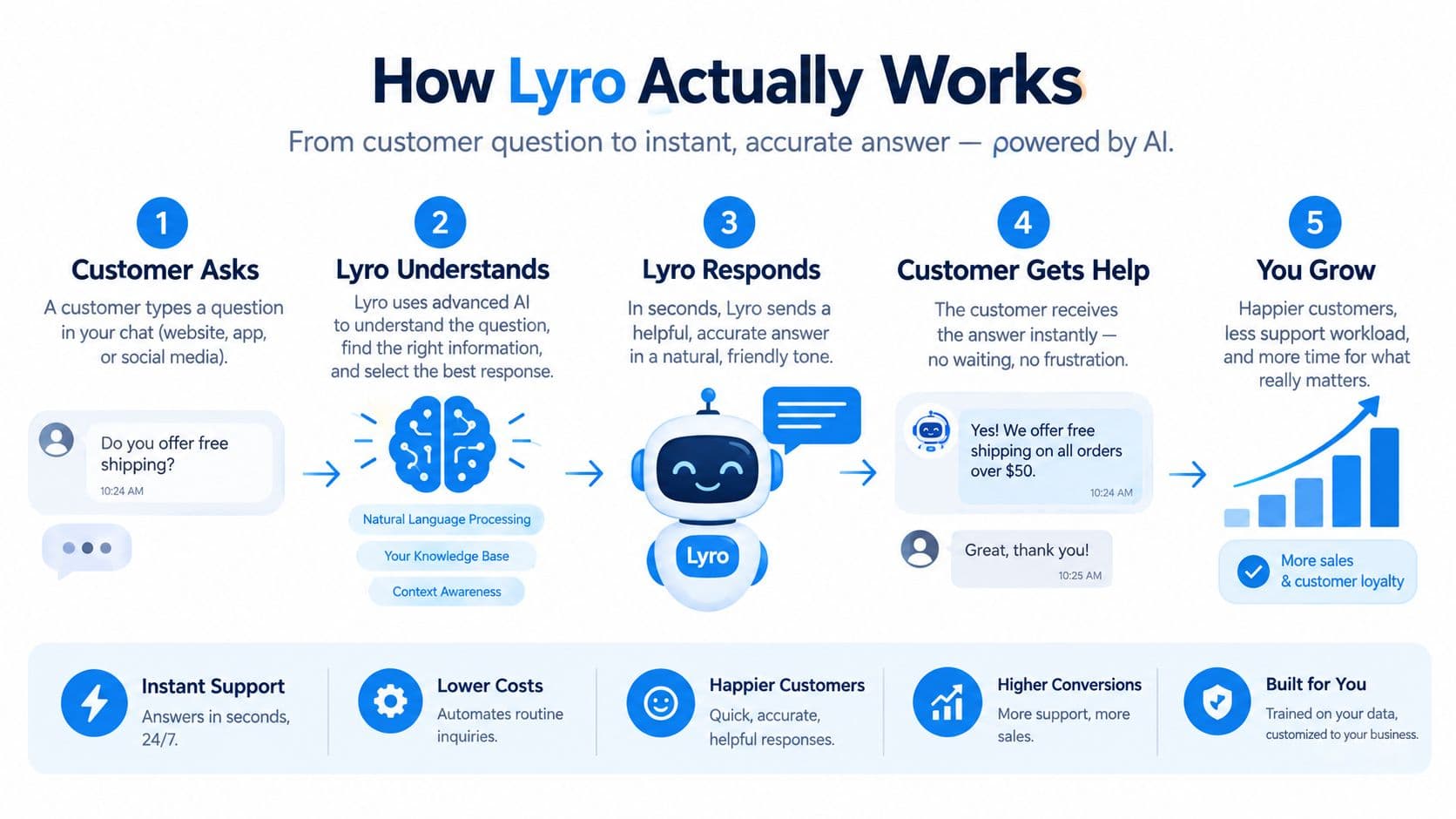
Lyro is built around knowledge-grounded replies, not a rigid decision tree. It reads help-center content, FAQs, website pages, and other support material, then forms answers from that information instead of relying only on prewritten scripts Tidio features.
Knowledge in, answer out
That setup gives it more flexibility than a basic chatbot. A script bot follows the path you planned in advance. Lyro tries to respond from the information it can gather, which is better for stores with broad product lines or changing policies.
When the system lacks confidence, it can transfer the conversation to a human agent Tidio features. That handoff matters because shoppers don't want to be trapped inside a dead-end loop. The best support automation knows when to step aside.
Why grounding matters more than slogans
Tidio describes Lyro's average resolution figure for conversational-AI customers at about 75% across its materials, while other published Tidio materials cite figures around 67% Tidio features. Those are vendor-level aggregates, not store guarantees, and they should be treated that way.
That difference matters because a merchant's result depends on what's in the knowledge base. A store with clear policies, well-written product pages, and clean category structure gives the assistant better raw material. A store with thin or outdated content creates more risk of confident wrong answers.
A resolution rate is useful only when the knowledge behind it is current, complete, and tested against the questions buyers actually ask.
What merchants should measure separately
Support teams should not treat a successful reply as proof of commercial value. A bot can answer a shipping question accurately and still fail on product fit or comparison. For that reason, answer grounding and task completion need separate checks.
A simple test set should include policy questions, catalog questions, and account or order-status requests. That makes it easier to see whether Lyro is helping support, or just sounding responsive. For a practical benchmark on response handling, see this chatbot response-time guide.
Performance Claims and Independent Testing
Independent review coverage tends to place Lyro in repetitive support, multilingual help, and after-hours coverage across live chat, WhatsApp, Instagram, Messenger, and email. That is the strongest pattern in the available commentary, and it fits what support teams usually need most.
What outside testing suggests
One external test reported 87% grounded-answer accuracy for English and Polish, based on 13 correct grounded responses out of 15 prompts Kayako review. That is a small sample, so it's directional rather than conclusive, but it does show how the tool can be evaluated in practice.
The useful part of that test is not the number itself. It's the method. A merchant can copy the idea by building a test set around catalog facts, sizing guidance, return policy interpretation, product comparisons, and ambiguous questions. Then each answer gets scored for correctness, grounding, escalation, and speed.
The weak spot most reviews miss
The riskiest questions are often the most commercial ones. Product pages for fashion, beauty, wellness, and home goods usually trigger questions that go beyond simple FAQ support. Shoppers ask about variant-level inventory, compatibility, ingredients, fit, and comparisons between near-identical items.
Reviews also point to a broader limitation, accuracy can slip when the knowledge base is thin or stale Tidio blog review. That creates a hidden risk. A store may see a high volume of resolved chats while a smaller number of wrong pre-purchase answers quietly hurts trust.
What to test before launch
Test the failures, not just the wins. A clean rollout starts with bad-case prompts, missing-data prompts, and conflicting-data prompts.
A useful test sheet should include:
- Static policy questions, such as shipping, returns, and exchanges.
- Catalog questions, such as fit, materials, and product differences.
- Ambiguous questions, where the right answer is to ask a follow-up or escalate.
- Missing-data cases, where the assistant has to admit it can't answer safely.
- Escalation cases, where a human should take over immediately.
Lyro's reported support for roughly 48 languages is relevant for international stores, but it still needs language-by-language testing because vocabulary, translation quality, and product terminology can change the answer quality Kayako review. Multi-language support is only useful when the outputs stay grounded.
| Lyro Performance Overview | Claim or test result |
|---|---|
| Vendor resolution framing | About 75% across Tidio's conversational-AI customers Tidio features |
| Other published vendor framing | Around 67% in other Tidio materials Tidio features |
| Independent test sample | 87% grounded-answer accuracy, 13 of 15 prompts Kayako review |
| Test context | English and Polish, small reviewer-specific sample Kayako review |
Understanding Tidio Quotas and Pricing
Tidio's pricing structure is where a lot of merchants get surprised. The free Lyro allowance is useful for testing, but it isn't a monthly starter pool. It's a one-time quota of 50 conversations, and once those are used, Lyro stops responding unless the store upgrades Tidio limit article.
How the quota really counts
Tidio defines a Lyro conversation as a customer interaction where the AI sends at least one reply Lyro conversation rules. A thread closes after 15 minutes of inactivity, and if the visitor returns after that gap, Tidio treats it as a new thread that counts again.
That is the hidden trap. A shopper who asks one question, waits, and comes back later can consume more than one counted conversation. For a busy store with casual browsing behavior, that changes the economics quickly.
Multiple questions in one continuous thread do not trigger extra conversation charges, even if Lyro replies many times Lyro AI agent page. That helps when shoppers ask about shipping, returns, and sizing in one back-and-forth exchange. It helps less when traffic is fragmented across separate visits.
What the paid packages look like
Tidio's published pricing table lists monthly quotas of 50, 200, 500, and 1,000 AI conversations chatbot pricing. The monthly-billing prices are $39, $140, $350, and $700 respectively chatbot pricing. The annual-billing prices are $32.50, $116.67, $291.67, and $583.33 per month, with the annual option described as two months free chatbot pricing.
That structure is straightforward once it's understood, but it still demands traffic discipline. Merchants should track conversation starts, thread resets, and escalation frequency, not just raw message volume.
If a store asks the same questions across separate visits, the quota can disappear faster than the chat log suggests.
A practical budget check
Before paying for a plan, a merchant should compare the number of actual support-start conversations, not total messages, against the chosen quota. The right unit here is the thread, not the sentence. That's the difference between a chatbot that feels affordable and one that unexpectedly turns expensive during peak traffic.
Alternatives for Product-Focused Shopping Assistants
Lyro is strongest when the goal is support automation. Some stores need something closer to a sales assistant, especially when shoppers are asking pre-purchase questions that influence conversion.
Where Carti fits
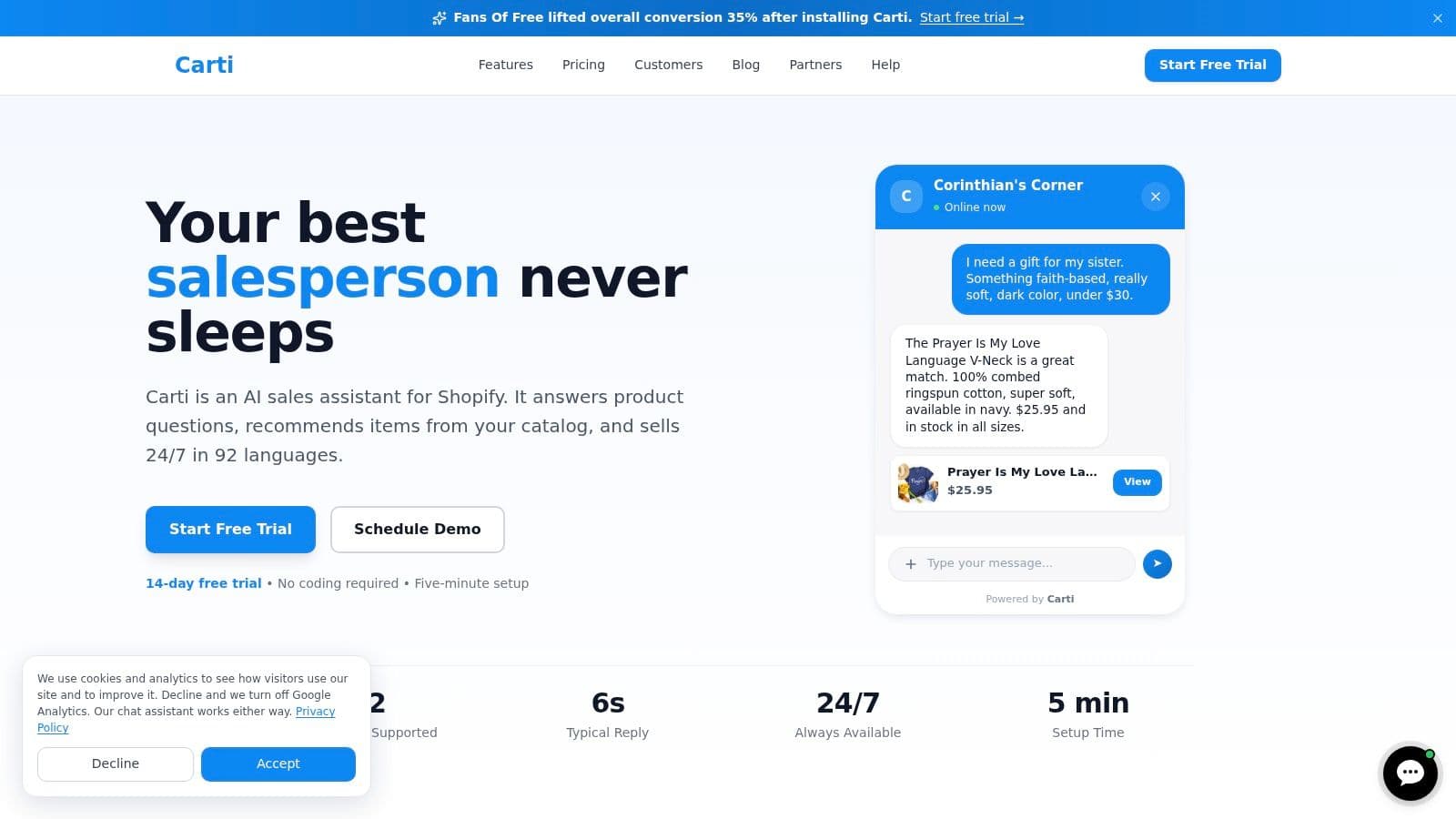
One option is Carti, an AI shopping assistant for Shopify stores. It learns a store's catalog, policies, and FAQs, then answers questions on the storefront about sizing, shipping, returns, and product comparisons. It also recommends products that fit, replies in 92 languages, and can use reviews from Judge.me, Loox, Yotpo, Okendo, and Fera Carti.
Its plans are Free with 50 AI conversations a month, Starter at $49 for 250, Growth at $99 for 600, and Scale at $249 for 1,750. Paid plans include a 14-day free trial Carti. That makes the pricing model easy to read next to Lyro's thread-based billing.
The practical difference for a Shopify merchant
The difference is not just feature wording. Lyro is built around support resolution and handoff. Carti is built around pre-purchase conversation and product guidance. A store that mainly wants fewer tickets may prefer the first model, while a store that wants to turn product questions into sales may prefer the second.
That split matters most in fashion, beauty, home, and wellness. Those categories live or die on fit, ingredient detail, compatibility, and comparison questions. If the assistant can help buyers choose, it becomes part of the sales path, not just the support queue.
How to judge the fit
Use the free or trial access where possible, then test the same product and policy questions in both tools. Measure whether the assistant answers accurately, escalates properly, and respects your rules. For a side-by-side overview of migration questions and feature gaps, see this Tidio alternatives guide.
Which Tool Should You Choose?
Lyro makes sense for stores that need fast support automation across chat and messaging channels. It has a strong case when the daily burden is repetitive questions, especially after hours, and when the team wants human handoff built into the workflow.
Choose Lyro when support is the main problem
If the store is drowning in order-status requests, shipping questions, and policy repeats, Lyro is the more natural fit. Its value comes from answering from stored knowledge and moving uncertain cases to a human agent. That is useful for teams that want to reduce ticket volume without replacing the support desk.
The caution is pricing and measurement. The 15-minute thread reset and the one-time 50-conversation free quota mean traffic behavior matters more than many merchants expect Lyro limit article Lyro conversation rules. If shoppers return in separate bursts, usage can stack up quickly.
Choose a product assistant when conversion is the goal
If the store needs a tool that handles fit, comparison, and recommendation questions before purchase, a shopping assistant is the better category to test. Carti is one option, and its plan structure is easier to map to conversation volume because it lists clear monthly caps and a free trial Carti.
That does not make it automatically better. It does mean the store owner should choose based on the job to be done. A support-first tool and a sales-first tool can both be useful, but they solve different problems.
The checklist that avoids a bad purchase
A good buying process starts with the store's own questions, not vendor promises. Use the same test set on every tool and score these points:
- Accuracy on policy answers, especially shipping and returns.
- Accuracy on catalog questions, especially fit and comparisons.
- Escalation quality, meaning the handoff happens when confidence is low.
- Conversation counting, especially how the vendor defines a billable thread.
- Language coverage, if the store sells across regions.
- Actionability, meaning the assistant does something useful, not just answer quickly.
For a Shopify merchant, the best choice is the one that matches the store's actual pressure point. If support load is the pain, Lyro deserves a test. If pre-purchase guidance is what drives revenue, a shopping assistant built for selling may fit better.
If your store needs an assistant that answers product questions, recommends items, and keeps the conversation tied to the storefront, Carti is worth a look. It's built for Shopify stores that want pre-purchase questions to turn into clearer buying decisions, with language coverage, review-based responses, and simple monthly conversation limits that are easy to test against your own traffic.

Written by
Daniel AndersonFounder of Carti. 10+ years building ecommerce brands in apparel and supplements. Still runs a Shopify store and built Carti to help merchants convert more browsers into buyers.
Ready to boost your store's sales?
Install Carti in 5 minutes and let AI handle customer questions, recommend products, and close sales 24/7.
Start Free Trial14-day free trial