
Turning on a Shopify product recommendation engine and waiting for average order value to rise is popular advice. It's also incomplete. A carousel can be technically personalized and commercially useless if it appears at the wrong point in the journey, repeats the same bestsellers, recommends unavailable products, or gives shoppers no reason to trust the suggestion.
Recommendation systems can create measurable commercial gains, but independent evaluations describe outcomes as variable and context-dependent. Where business effects were measured directly, reported sales increases commonly ranged from 1% to 5% on average, while one pilot recorded a 1.8% revenue increase from purchases made directly through recommendation lists and an online grocery implementation recorded 0.3% direct revenue growth (academic synthesis of recommendation-engine evaluations). Those results aren't a promise. They're a warning to test the system as a business intervention, not treat it as a decorative widget.
The hardest problems are also the ones most guides skip: what to recommend to a first-time visitor, how to expose a new product without behavioral history, and how to explain relevance without making personalization feel like covert upselling.
Why Most Recommendation Engines Fail to Convert
A default “You might also like” block often fails because it answers the wrong question. The shopper isn't always asking, “What resembles this product?” They may be asking, “Will this fit my needs?”, “What completes this purchase?”, “Which option is available now?”, or “What should I choose if I'm buying a gift?”
A product recommendation engine should respond to the shopper's current decision, not merely recycle historical associations. A customer viewing a skincare product may need a compatible cleanser, a routine for sensitive skin, or a less expensive alternative. Showing more products from the same broad category can increase choice without reducing uncertainty.
Static rules create dynamic problems
Rules such as “frequently bought together” and “best sellers” have a place, especially when interaction data is sparse. They become weak when merchants use them everywhere. A product page, cart drawer, homepage, post-purchase email, and recovery message each represent different intent, so the same ranking logic shouldn't control all of them.
Merchants should audit the basics before tuning a model:
- Availability: Remove products that are out of stock, unavailable in the shopper's market, or incompatible with the selected variant.
- Placement: A recommendation beneath the product description may be useful, while the same block above essential product information can distract mobile shoppers.
- Intent: Separate substitutes from complements. A shopper comparing two jackets needs different suggestions from someone who has already added one to the cart.
- Repetition: Cap exposure to products the shopper has already dismissed, purchased, or seen repeatedly without engaging.
- Margin and constraints: Relevance doesn't override delivery restrictions, product compatibility, pricing rules, or inventory priorities.
Practical rule: Treat every recommendation slot as a sales conversation with a specific job. “Complete the basket” and “help me choose” aren't the same job.
The distinction between a large catalog and a useful recommendation set matters in every vertical. A detailed discussion of why more bike listings and recommendations don't automatically produce better discovery is relevant beyond cycling. More inventory can increase noise unless the engine understands fit, use case, price, and the shopper's immediate goal.
A useful system behaves less like a static shelf and more like automated decision support. It ranks a small set of plausible options, respects context, and learns from interaction. It also needs a safe fallback, because a fast, sensible bestseller list is better than a broken personalized block that delays the page or shows irrelevant products.
The Mechanics of Collaborative Filtering and Modern Algorithms
The core idea behind a product recommendation engine is straightforward: collect interaction signals, find meaningful relationships, and rank products a shopper is likely to consider. The engineering becomes difficult because those signals differ in strength and meaning. A purchase usually carries a different intent from a brief view, while a search query can reveal a need that browsing history doesn't capture.
From manual annotations to automated preference inference
Recommendation engines emerged from collaborative filtering, a method that uses patterns in users' ratings, behavior, or interactions. Xerox PARC's Tapestry project introduced the term and concept in 1992, although users still had to create queries and explore stored annotations. The important automation milestone arrived in 1994, when the University of Minnesota's GroupLens project introduced automated collaborative filtering (ACM account of the technology's history).
That change shifted the burden from manual search to inferred preference. Instead of requiring every shopper to describe what they wanted, the system could learn from community behavior and identify similarities between users or items. Explicit signals include ratings and reviews. Implicit signals include clicks, purchases, cart additions, and other interactions.
GroupLens later helped commercialize the approach through Net Perceptions, whose early customers included Amazon.com, CDnow, and Art.com. The ACM records that Net Perceptions ultimately became a company valued at approximately $1 billion, supplying recommendation technology to major retail and information businesses worldwide (ACM account of Net Perceptions).
What the engine does with the data
A simplified pipeline looks like this:
- Collect events: Record product views, searches, clicks, cart additions, purchases, ratings, and stated preferences.
- Represent relationships: Identify products commonly considered together, users with similar behavior, and attributes that correlate with intent.
- Generate candidates: Build a broader set of plausible products using collaborative, content-based, or sequence-aware methods.
- Rank candidates: Order those products for the specific page, session, shopper, and business constraints.
- Learn from feedback: Treat clicks, dismissals, purchases, and skips as new evidence, while accounting for the fact that placement itself affects engagement.
Collaborative filtering is powerful when a store has meaningful interaction history. It can surface an unexpected product because similar shoppers considered it, rather than because its title or category closely matches the current item. It also has a clear weakness: without enough history, the system has little evidence for a new shopper or product.
Content-based signals help fill that gap by comparing product attributes, descriptions, categories, sizes, finishes, ingredients, and use cases. Sequence-aware components add a temporal layer, giving more weight to what the shopper has viewed or added recently. A practical overview of product recommendation using generative AI is useful for teams considering natural-language context alongside conventional behavioral signals.
The durable lesson is that recommendations aren't random suggestions and they aren't fixed merchandising rules. They're a decision layer that becomes more useful as the store captures cleaner, better-labeled evidence.
Designing a Hybrid Architecture for Different Shopper Contexts
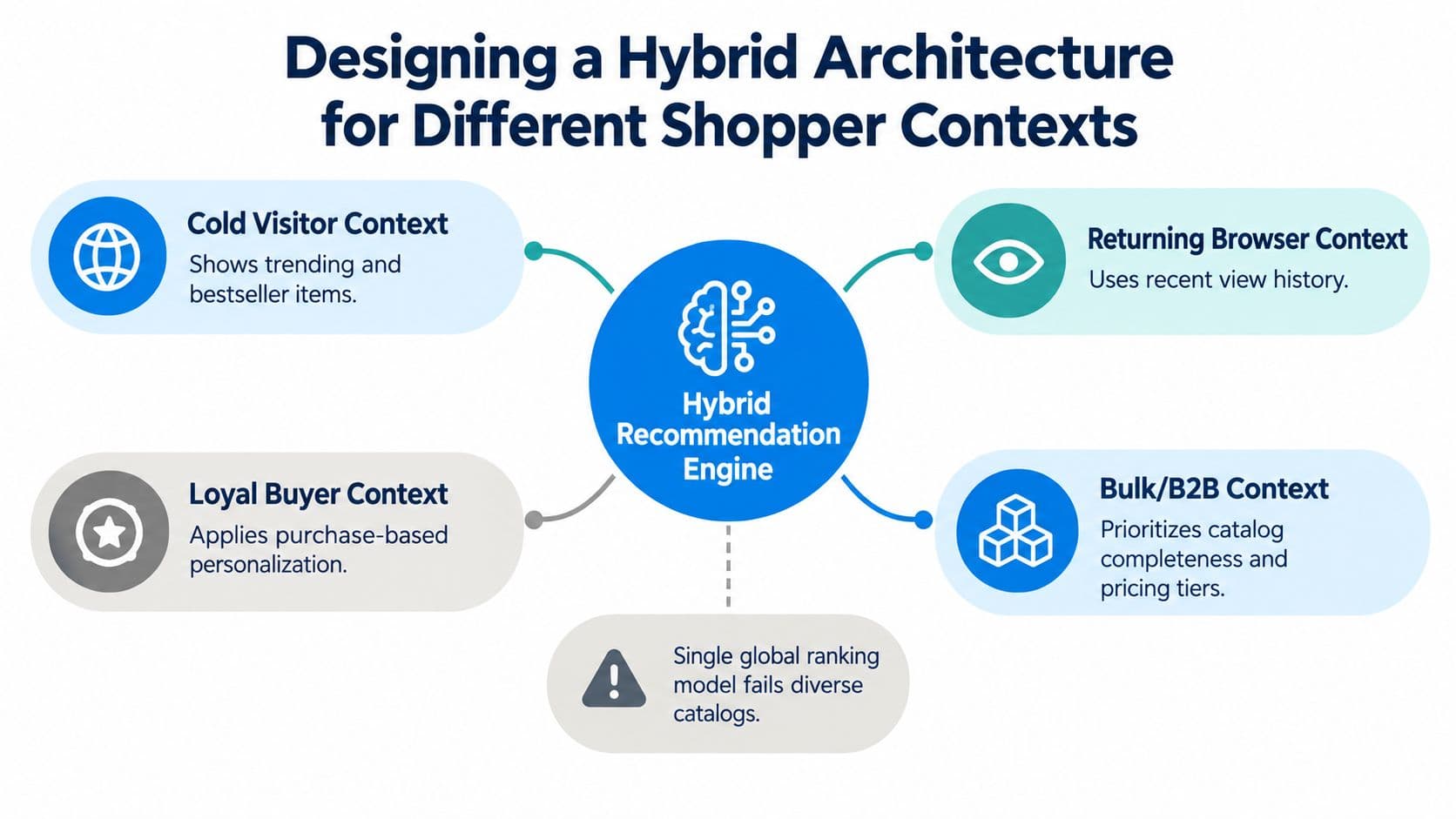
A single global ranker forces different shoppers into the same logic. That usually favors products with the most interaction history and the broadest appeal, which can make the catalog look predictable and leave new or niche products invisible.
Research comparing seven architecture families, including CNNs, RNNs, GNNs, autoencoders, transformers, neural collaborative filtering, and Siamese networks, found complementary strengths rather than one universally dominant model. The benchmark evaluated precision, recall, diversity, and efficiency across retail e-commerce, Amazon-product, and Netflix datasets (benchmark of recommendation architectures). For a Shopify brand, the practical conclusion is clear: route recommendations by context instead of asking one model to solve every merchandising problem.
Match the model to the shopper state
Anonymous homepage visitor: Start with category, availability, popularity, seasonality, referral context, and session events. A shopper arriving from a “gifts for runners” page shouldn't receive the same opening set as someone arriving from a brand campaign.
Returning browser: Use recent views, searches, and cart behavior. Sequence-aware logic matters because the order of interactions can reveal a developing task. Someone who views a camera body, lens, and memory card has a different intent from someone who repeatedly compares camera bodies.
Known buyer: Add purchase-based personalization, but don't treat every past purchase as a permanent preference. Consumables, gifts, and one-time purchases can distort the profile. A buyer who purchased a crib may need accessories now, not another crib.
Product detail page: Combine substitutes and complements deliberately. The right mix depends on whether the product is configurable, replenishable, compatible with other items, or commonly compared against alternatives.
Cart and checkout: Prioritize compatibility, completion, delivery feasibility, and confidence. A cart recommendation should rarely behave like a generic discovery carousel.
Optimize for usefulness, not just clicks
Offline evaluation should include ranked retrieval metrics such as Recall@K or NDCG@K, but those aren't enough. Catalog coverage shows whether the system exposes more than a narrow bestseller group. Intra-list diversity indicates whether the recommendation set gives shoppers meaningful alternatives. Latency and resource cost determine whether the result can be served without damaging the storefront experience.
A model that maximizes clicks by repeatedly showing the same popular products may look successful in a dashboard while reducing discovery and suppressing new inventory. Conversely, a diverse list can improve exploration but lower immediate click-through if the engine introduces products that need more explanation. The right balance depends on the page objective and the commercial cost of overexposure.
A hybrid architecture isn't an excuse to add complexity everywhere. It's a way to keep each recommendation decision tied to the evidence available in that moment.
Solving the Cold Start Problem for New Products and Visitors
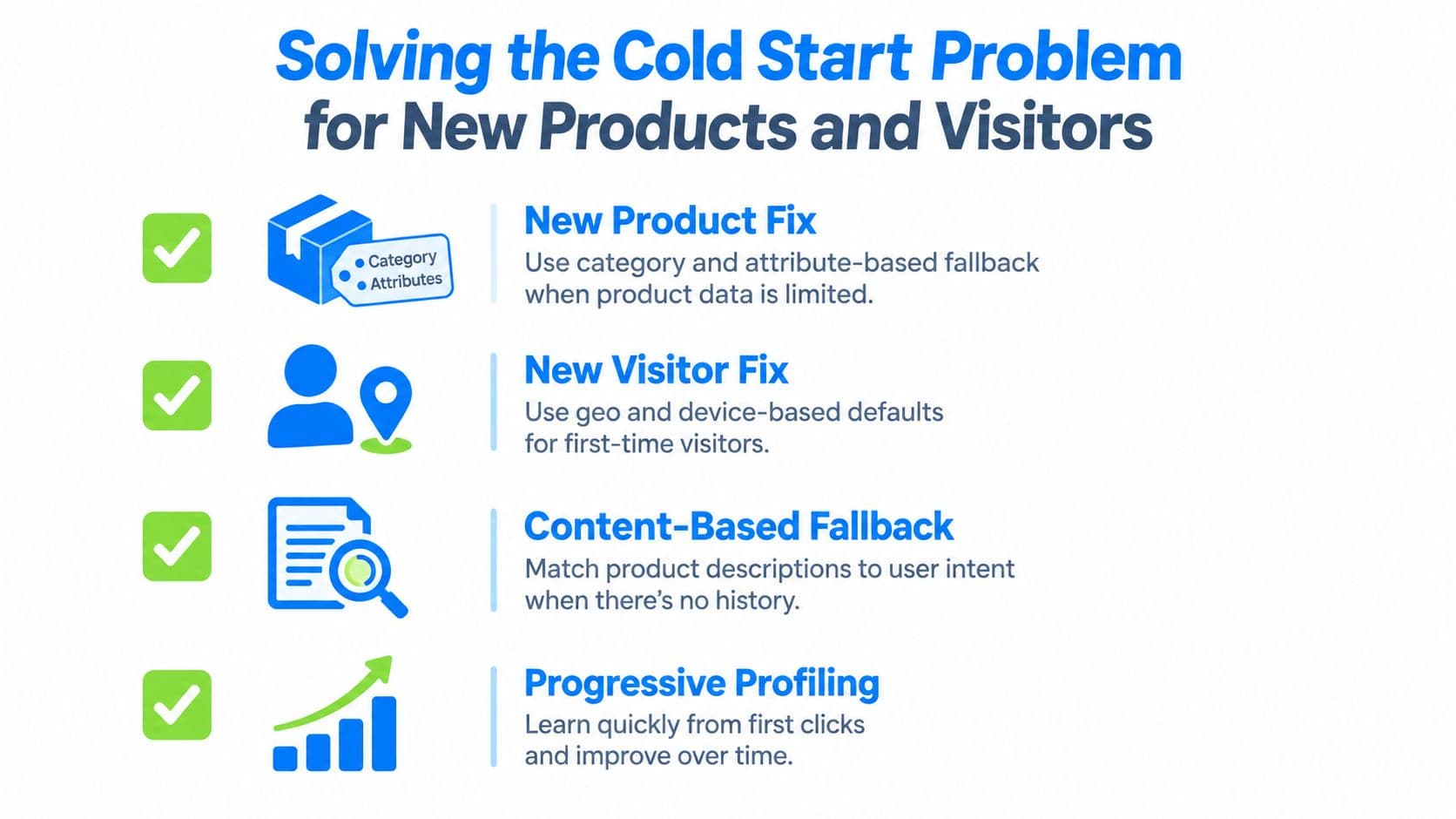
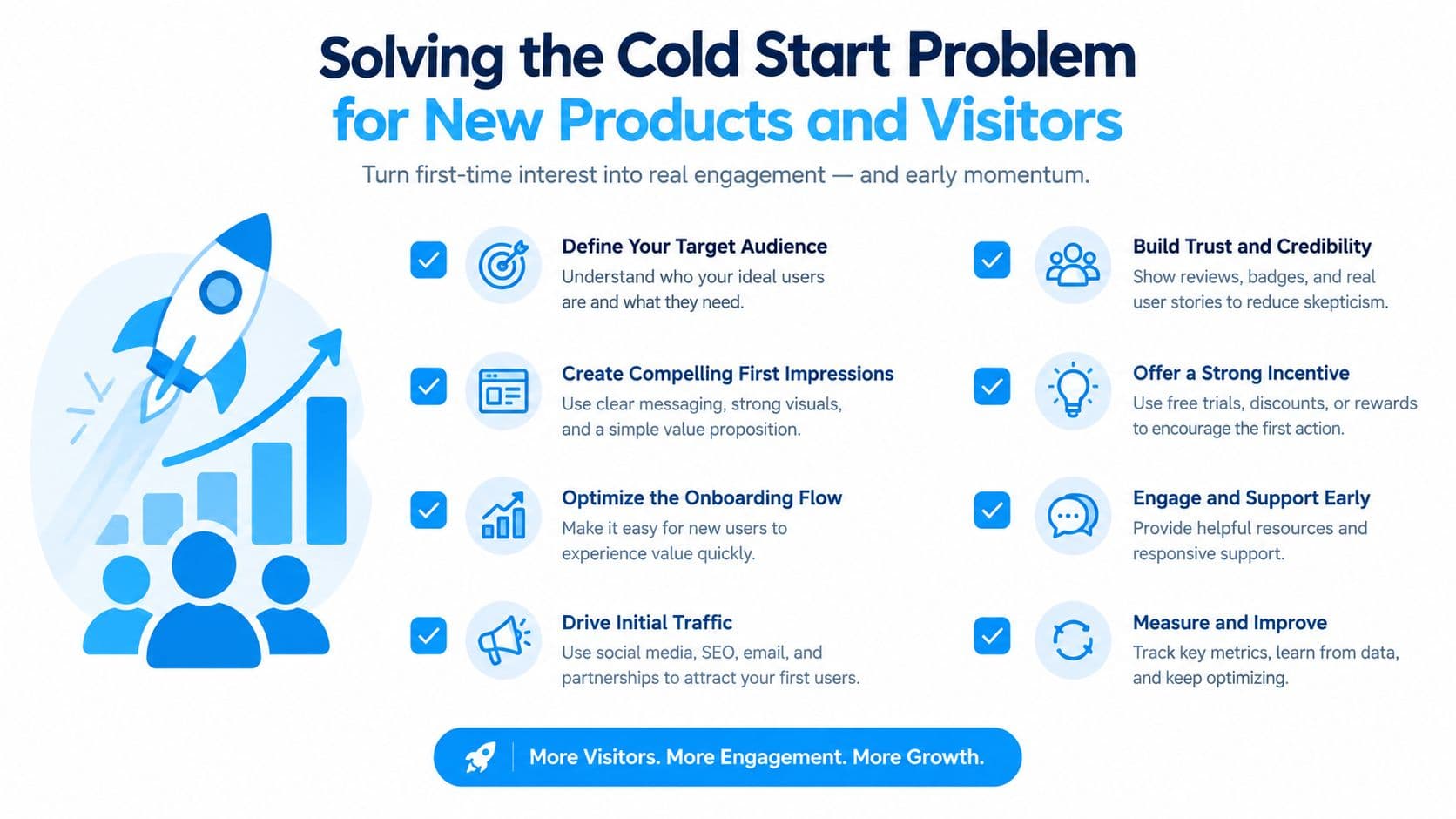
Collaborative signals are weakest when a merchant needs them most. A first-time visitor has no behavioral history, and a newly listed product has no clicks, purchases, or ratings. If the engine waits for historical evidence before showing either one, established bestsellers will keep winning by default.
Research published in 2025 continues to identify insufficient historical interaction data as a significant challenge for new users and items. Text-based recommendation work explores how a system can infer relevance from shopper queries and product-review language while producing explanations without requiring prior user history (research on text-based recommendations for cold-start situations).
Give new products a meaningful starting profile
Start with structured catalog data, not just a product title. Category, use case, material, dimensions, compatibility, finish, ingredients, price band, and availability can all support content-based matching. Descriptions and reviews add language that structured fields often miss, especially for qualities such as “lightweight,” “quiet,” “suitable for sensitive skin,” or “works in a small room.”
A new product should enter an exploration phase rather than remain permanently buried beneath established products. Exploration doesn't mean indiscriminate promotion. Set eligibility rules, match the product to relevant contexts, and monitor engagement separately from mature products. If an item receives views but no cart activity, the problem may be positioning, price, creative, or product-market fit rather than ranking alone.
Give anonymous visitors a useful first answer
A first-session visitor can still provide intent through a search query, landing page, device context, referral campaign, location, selected filters, and early clicks. Ask a lightweight preference question when the category benefits from it. A beauty store might ask about skin goals, while a home store might ask about room, style, or budget.
A quiz can turn an empty profile into explicit preference data. For implementation ideas, see this guide to a product recommendation quiz for ecommerce. The question should earn its place by reducing uncertainty, not create an onboarding obstacle before the shopper can browse.
Use a fallback hierarchy:
- Catalog similarity: Match attributes and descriptions to the current product or query.
- Session intent: Weight recent searches, filters, clicks, and cart contents.
- Contextual defaults: Use category, device, referral, and market information carefully.
- Controlled popularity: Show relevant trending or bestselling products only after applying availability and category constraints.
- Progressive learning: Shift toward collaborative signals as the session and customer history develop.
Measure cold-start quality separately. Compare first-session visitors, new products, and returning customers instead of reporting one blended conversion rate. That segmentation reveals whether the engine is actually solving discovery or just benefiting from shoppers who already know what they want.
Building Trust Through Explainable and Transparent Suggestions
Personalization becomes uncomfortable when shoppers can't tell why a product appeared. A recommendation that seems random, repetitive, or disconnected from the stated need can feel like surveillance or pressure, even if it earns a click.
The interface should answer three questions in plain language: Why this product? What information influenced the suggestion? How can I correct it? Research treats explainability as an active development area connected to transparency, interpretability, and cold-start handling (research on explanatory text-based recommendation).
Explain the relationship, not the algorithm
Avoid vague labels such as “picked for you” when a concrete reason is available. Better explanations describe the connection the shopper can verify:
- “Fits your selected size”
- “Matches your chosen finish”
- “Compatible with the item in your cart”
- “Similar to the products you viewed”
- “Often considered with this product”
The wording should distinguish complements from substitutes. “Complete your setup” implies an add-on. “Compare similar options” implies an alternative. Confusing those roles creates friction, particularly when a shopper is still deciding whether to buy the original product.
Give shoppers control over the profile
A recommendation engine shouldn't make shoppers feel trapped inside an inferred identity. Add controls such as “show fewer like this,” “not relevant,” or “shopping for someone else.” These signals can improve the next recommendation and demonstrate that the merchant respects correction.
Trust also requires evaluation beyond revenue. Track acceptance, hide and dismiss actions, repeat visits, customer-service complaints, and performance across languages and markets. A short-term click isn't automatically a success if the shopper later disengages because every interaction produces the same narrow set of products.
For fashion, beauty, wellness, and other categories where personal context affects compatibility, explainability is part of product quality. The merchant isn't merely trying to persuade. The merchant is showing the shopper how the suggestion fits the decision already in progress.
Measuring Real Business Impact Beyond Algorithmic Accuracy
A recommendation model can perform well offline and still fail in the storefront. Offline metrics ask whether a relevant item appeared in a ranked list. Business evaluation asks whether the placement helped a real shopper make a better purchase without reducing profitability or trust.
A cosmetics e-commerce evaluation used 8,738,120 event records and reported test metrics of recall 0.31, MRR 0.56, and NDCG 0.60 after a 70% training, 15% validation, and 15% test split (study of neural-network collaborative filtering in cosmetics e-commerce). MRR emphasizes how early the first relevant product appears. NDCG gives more credit to relevant items near the top. Both are more informative for ranked suggestions than treating the task as simple classification.
Keep offline and online questions separate
| Metric Type | Specific Metric | What It Measures | Business Value |
|---|---|---|---|
| Offline retrieval | Recall@K | Whether relevant products appear in the selected ranking depth | Candidate-generation quality |
| Offline ranking | MRR and NDCG | How prominently relevant products appear | Visibility in the first suggestions |
| Catalog health | Coverage and intra-list diversity | Whether the engine exposes a broad, varied assortment | Discovery and reduced repetition |
| Experience quality | Latency and resource cost | Whether recommendations arrive efficiently | Page performance and operational viability |
| Engagement | Click-through rate and add-to-cart rate | Interaction with recommendation placements | Early funnel response |
| Commercial outcome | Conversion rate, average order value, revenue per session | Purchases and basket economics | Direct business performance |
| Experiment result | Incremental revenue and profitability | Difference between exposed and control groups | Causal business impact |
Click-through rate is useful but easy to misread. A prominent, visually attractive carousel can earn clicks without producing profitable orders. A recommendation can influence a purchase even when the final click comes from search, navigation, or checkout, while an irrelevant suggestion can distract the shopper and lower confidence.
Run controlled experiments by placement
Create a control group that sees the existing experience and an exposed group that sees the recommendation treatment. Keep the comparison tied to a defined period and segment results by placement, traffic state, category, device, and shopper status. Don't combine homepage, product page, cart, email, and chatbot results into one number.
Track at least:
- Add-to-cart rate: Did the suggestion move the shopper into a stronger buying action?
- Conversion rate: Did exposed shoppers complete purchases more often?
- Average order value: Did the basket change, and was the change profitable?
- Revenue per session: Did the experience create more value per visit?
- Incremental revenue: Did the treatment outperform the control rather than merely receive attributed clicks?
- Negative signals: Did dismissals, exits, complaints, or repeat-session declines increase?
The evidence supports a practical benchmark, not a universal promise. Reported directly attributable sales effects are often modest, so a merchant should protect margin and customer experience while looking for incremental value.
Integrating Conversational AI for Proactive Sales Assistance
Static carousels wait for shoppers to interpret the catalog. A conversational assistant can ask what matters, clarify constraints, compare options, and update recommendations as the shopper answers. That interaction is especially valuable when product fit depends on information the catalog alone can't infer.
A practical rollout starts with the same context routing used for storefront recommendations. Anonymous sessions can begin with popularity, metadata, and session events. Returning shoppers can add collaborative embeddings. Sparse catalogs and newly launched products need content-based fallbacks rather than a forced behavioral model.
Turn intent into recommendation evidence
A shopper might say, “I need a lightweight moisturizer for sensitive skin,” or “I want a gift under my budget for someone who likes minimalist interiors.” The assistant can extract constraints, match them against catalog attributes and review language, then explain why each suggestion qualifies.
The conversational layer should not replace inventory and merchandising rules. It must exclude unavailable products, distinguish substitutes from complements, respect variant constraints, and avoid claiming certainty where the catalog lacks evidence. It should also pass useful signals back into the recommendation system, including stated preferences, rejected options, and the reason a shopper accepted a suggestion.
For merchants improving the input layer, an AI Product Description Generator can help create clearer, more structured product copy. Better descriptions won't solve personalization by themselves, but they give content-based and language-aware systems more reliable material to match against shopper intent.
Measure the assistant as a sales channel
The evaluation target changes when conversation changes the basket. A shopper may accept a recommendation after asking a question, add a complementary product, or switch to a better-fitting substitute. Measure recommendation-attributed add-to-cart and purchase rate, but also compare complete sessions against a control experience.
The same ranked-retrieval discipline applies inside the assistant. In the cosmetics evaluation cited earlier, recall, MRR, and NDCG showed different aspects of ranking quality. For conversational recommendations, optimize the first few suggestions, then evaluate whether the dialogue improves relevance instead of just increasing message volume.
A Shopify chatbot such as Carti can provide instant catalog and policy answers, use Smart Suggestions based on shopper behavior and context, and support cart-recovery interactions. Review the implementation through the same standards as any recommendation tool: clear explanations, sensible fallbacks, measurable experiments, and controls that let shoppers correct the system. More guidance on this workflow is available in the article about a product recommendation chatbot.
Start with one high-intent placement, instrument the events, and establish a control experience before expanding. Then add conversational questions where static merchandising leaves too much uncertainty, especially for new visitors, new products, and compatibility-sensitive categories.
Carti helps Shopify brands answer product questions, provide context-aware Smart Suggestions, and engage shoppers before uncertainty turns into abandonment. Visit Carti to explore a no-code AI sales assistant for recommendations, support, and cart recovery.

Written by
Daniel AndersonFounder of Carti. 10+ years building ecommerce brands in apparel and supplements. Still runs a Shopify store and built Carti to help merchants convert more browsers into buyers.
Ready to boost your store's sales?
Install Carti in 5 minutes and let AI handle customer questions, recommend products, and close sales 24/7.
Start Free Trial14-day free trial