
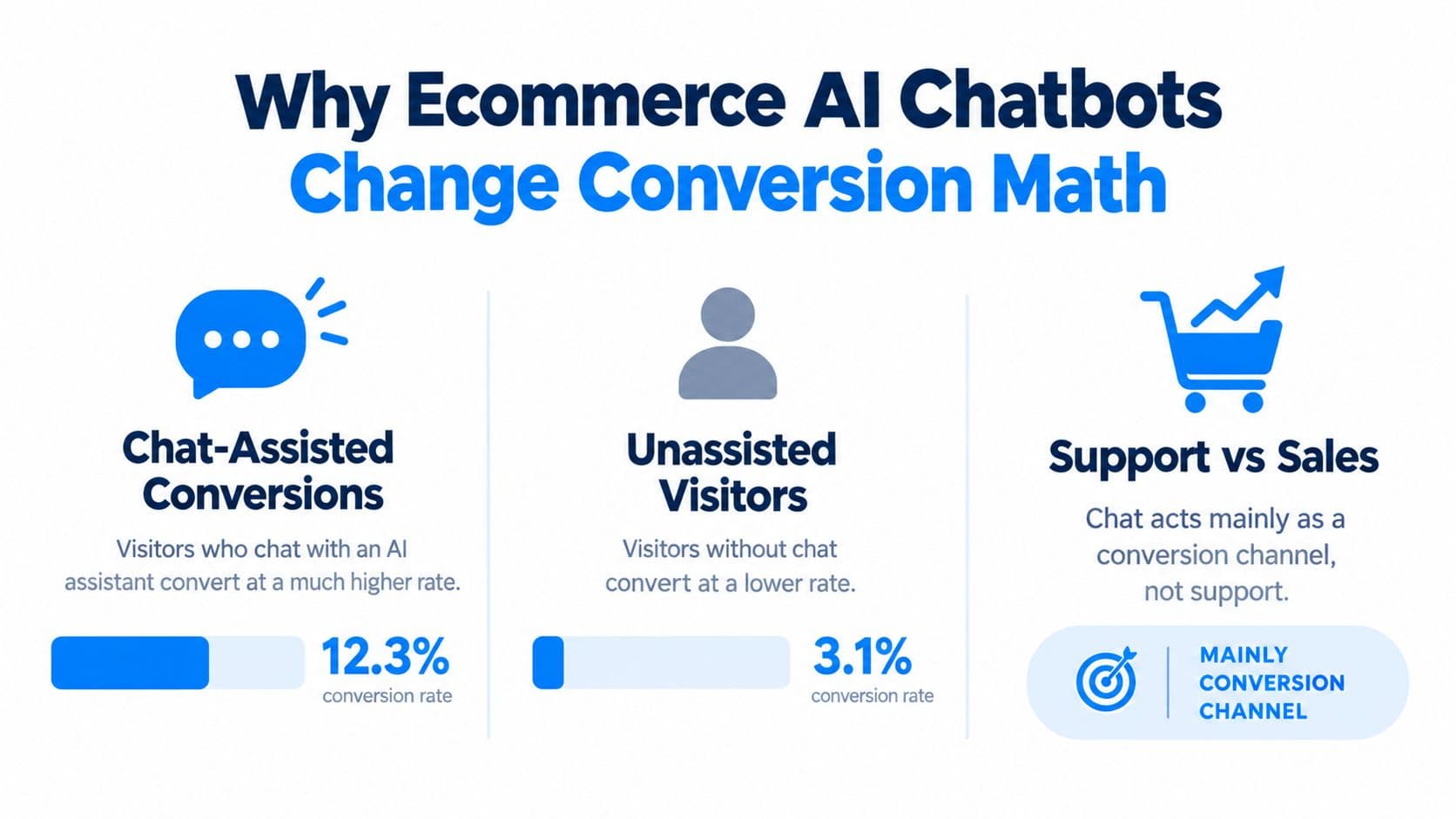
Visitors who interact with AI chat convert at 12.3%, compared with 3.1% for unassisted visitors. That roughly fourfold difference shows that an ecommerce AI chatbot can function as a sales engine, not just a support widget.
The important question for a Shopify merchant isn't whether a chatbot can answer “Where's my order?” It's whether the assistant can remove uncertainty while the shopper still has buying intent, recommend a relevant product without inventing details, and help the customer reach checkout without creating another layer of friction.
That distinction separates useful conversational commerce from decorative automation. A chatbot that only repeats FAQ content may reduce a few support tickets. A properly connected assistant can influence product discovery, resolve objections, recover hesitation, and expose the questions that prevent customers from buying.
The trade-off is real. Speed and convenience mean little if the bot gives outdated stock information, misstates a return rule, or recommends an unsuitable product with complete confidence. The strongest ecommerce chatbot strategy therefore combines conversion assistance with accuracy governance and visible shopper control.
Why Ecommerce AI Chatbots Change Conversion Math
A cited analysis of 17 million sessions found a 12.3% conversion rate among visitors who interacted with AI chat, compared with 3.1% for unassisted visitors, indicating a roughly fourfold difference (Resourcera analysis of AI in ecommerce). That result doesn't prove that chat alone caused every purchase. Shoppers who start a conversation may already have stronger intent than people who browse without speaking.
It still changes how operators should evaluate the channel. A visitor who asks whether a jacket runs small, whether a replacement filter fits a particular model, or whether an order can arrive before a specific date has revealed a commercial objection. Standard analytics may record a product-page view. Conversation reveals the reason the shopper might leave.
The moments that create commercial value
An assistant earns its place when it helps at a decision point that static navigation handles poorly. Those moments commonly include:
- Product selection: The shopper knows the outcome they want, but not which product, variant, or bundle fits.
- Objection handling: The customer needs certainty about sizing, ingredients, compatibility, shipping, payment, or returns.
- Comparison: Several products appear similar, and the shopper needs a plain-language distinction.
- Checkout confidence: The customer hesitates because the final cost, delivery timing, discount rule, or required field isn't clear.
- Cart recovery: The shopper has shown intent but needs a timely answer before abandoning the session.
Passive browsing leaves these questions hidden. Conversational assistance makes them explicit, which gives the merchant a chance to address them while the product remains in context. That doesn't mean every visitor needs a pop-up or a sales script. It means the store should be able to respond when a shopper signals uncertainty.
Commercial rule: Measure the chatbot by the buying problems it resolves, not by how many conversations it starts.
What to measure instead of message volume
Message count is an engagement metric, not a revenue metric. A bot can generate a large number of greetings and still distract customers from completing their orders. Shopify teams should connect chat events to assisted conversion, checkout progression, product discovery, recovered checkout value, and resolution speed.
The cleanest analysis compares shoppers who receive the experience with a suitable control group. Track whether conversations lead to a product view, add-to-cart event, checkout start, purchase, escalation, or exit. Also separate high-intent questions from casual browsing, because a recommendation conversation and a post-purchase tracking request have different commercial purposes.
The conversion gap is best treated as a strong signal, not a promise. It suggests that assisted shoppers behave differently, but it doesn't eliminate the need for controlled testing. The winning implementation is the one that removes a specific barrier without adding new interruptions.
What an Ecommerce AI Chatbot Actually Does for Sales
A modern ecommerce AI chatbot connects three jobs that merchants have traditionally managed separately: customer support, product discovery, and purchase assistance. The customer doesn't experience those as separate departments. Someone asking about a product's material may also need a recommendation, a stock check, and a delivery estimate before deciding.
Industry reporting indicates that retail and ecommerce represented approximately 30.34% of the chatbot market, the largest share among industry verticals (Ringly's chatbot market statistics). That commercial concentration makes sense because online stores have a high volume of repeatable questions, structured product data, and measurable actions after each interaction.
From answers to guided decisions
A basic FAQ widget waits for a keyword and returns a fixed response. A sales-oriented assistant interprets intent, asks a useful follow-up question, and retrieves the information needed to move the shopper forward.
For example, a customer might type, “I need a necklace for everyday wear under my budget.” A useful flow could clarify style, material, recipient, and timing, then show products that match those constraints. It shouldn't present a generic collection page and call that personalization.
The same principle applies to categories with complex attributes. A beauty store may need to distinguish skin concern from product type. A home retailer may need room dimensions and compatibility details. A jewelry merchant may need to account for metal, stone, occasion, and care requirements. When a customer is still exploring, resources such as smarter jewelry sourcing tools can help merchants think more carefully about the product knowledge behind recommendations.
The catalog is the operating system
Conversational fluency can't compensate for disconnected store data. The assistant should retrieve current product titles, variants, prices, availability, attributes, shipping rules, and return policies from authoritative systems. It should know whether a recommendation is actually purchasable and whether the selected variant is available.
This architecture also changes the assistant's role after the recommendation. It can answer a follow-up question, show an alternative, suggest a compatible add-on, or help the shopper reach the relevant cart action. Those steps form one buying workflow rather than isolated support tickets.
Cart recovery needs similar context. A timely prompt can address a question about delivery, a discount rule, or product suitability. An untargeted message that appears while the customer is reading or comparing products is more likely to feel like pressure.
Service and sales should share a handoff
The bot shouldn't trap the customer in automation. It needs a clear route to a person when the issue involves a complaint, a sensitive order problem, a policy exception, or uncertainty that the available data can't resolve.
The practical standard is simple: automate the repeatable answer, not the responsibility for the outcome. Product facts can come from the catalog. Policy answers can come from approved rules. A human should take over when the answer requires judgment, empathy, or an exception.
How Shopify Merchants Should Implement AI Chat Correctly
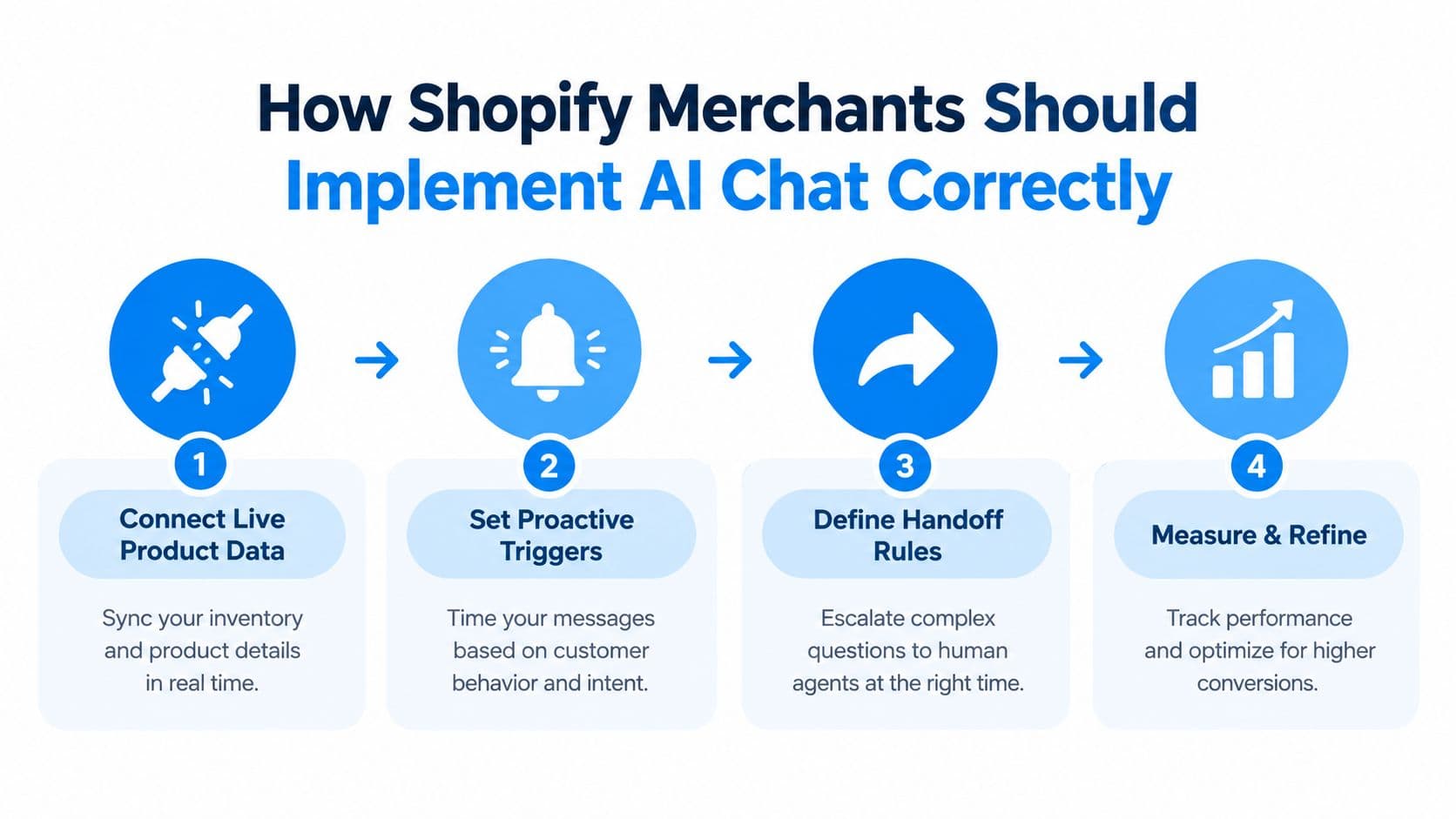
Shopify implementation starts with data, not personality. A friendly tone may make an answer more pleasant, but it won't fix a chatbot that recommends an unavailable variant or quotes a general delivery window to the wrong destination.
Start with live commerce data
Connect the assistant to the information that changes and the information that governs customer decisions.
-
Sync product and variant data. Include titles, descriptions, attributes, prices, images, availability, and variant relationships. The bot should distinguish a product from the exact size, color, or configuration the shopper wants.
-
Ground policy responses. Shipping, returns, exchanges, taxes, duties, payment methods, and discount rules should come from approved store sources. Don't ask a generative model to reconstruct policy from memory.
-
Pass cart context. Responses should reflect the current product, quantity, destination, promotion, and checkout state when that information is available. “Can I return this?” requires a different answer before purchase than after delivery.
-
Create refusal and escalation rules. If the system can't verify an answer, it should say so and offer a human route. Confidence in an unsupported answer is a conversion risk.
For merchants building a broader sales workflow, conversational AI for sales provides a useful reference point for connecting chat interactions to commercial intent rather than treating them as standalone support events.
Use event triggers, not constant interruption
Proactive engagement works when timing reflects behavior. A message after repeated checkout errors may be helpful. The same message appearing on every page load is noise.
Useful triggers include:
- Repeated form errors: Offer help with the specific field or payment issue instead of opening a general conversation.
- Extended inactivity: Ask whether the shopper needs clarification when they appear stuck on a product or checkout step.
- Back-navigation from checkout: Address uncertainty about delivery, returns, pricing, or the selected item.
- High-intent language: Prioritize questions containing entities such as size, delivery date, price, compatibility, and returns.
- Cart changes: Offer relevant assistance after a product is removed, a variant is changed, or a discount is attempted.
Keep the first response short. Give the shopper an answer, a relevant action, and a visible way to dismiss the assistant. The bot should reduce navigation cost, not compete with the checkout interface.
Test commercial outcomes
Compare treatment and control cohorts using checkout progression, error recovery, assisted conversion, incremental revenue per session, escalation rate, and customer complaints. Clicks and conversation volume can support diagnosis, but they shouldn't define success.
Review failed conversations manually. Look for missing attributes, ambiguous policy language, stale inventory, repetitive prompts, and handoffs that force the customer to start again. Each failure should become a catalog, workflow, or content improvement, not merely a reason to adjust the bot's wording.
The Hidden Risk of Unverified AI Recommendations
A fluent answer can be commercially dangerous when the underlying information isn't verified. The chatbot may sound like an experienced sales associate while relying on a stale product description, an incomplete returns page, or an assumption about fit that the store never approved.
Adobe's 2025 retail research found that 66% of consumers expect fast support from automated systems, yet only 33% believe brands deliver it (Adobe retail digital trends research). Speed creates an expectation, but accuracy determines whether the interaction strengthens or weakens trust.
Separate facts from suggestions
Every response should have a source category.
| Response type | Suitable source | Handling |
|---|---|---|
| Price, stock, variant, or product attribute | Shopify catalog and inventory data | State the verified fact |
| Shipping, return, exchange, or payment answer | Approved store policy and destination rules | Retrieve the applicable rule |
| Product recommendation | Catalog facts plus shopper-provided preferences | Explain the relevant match |
| Suitability, safety, or exception | Approved guidance or human agent | Escalate when certainty is limited |
This separation matters most in fashion, beauty, wellness, home products, and jewelry. Sizing, ingredients, compatibility, care requirements, and intended use can determine whether the recommendation is appropriate. A wrong answer may lead to a return, a complaint, or a lost customer even if the original conversation appeared successful.
Teams should also timestamp volatile answers such as stock and delivery estimates. If the system can't verify current information, it should disclose that limitation rather than fill the gap with a plausible sentence. A visible source or “last updated” cue can help shoppers understand what the assistant knows and what it is recommending.
Design the handoff before launch
Human escalation isn't a failure of automation. It's part of a safe sales architecture.
Define handoff rules for complaints, sensitive personal situations, policy exceptions, uncertain product suitability, and repeated failed answers. Transfer the conversation history, selected product, cart details, and attempted resolution so the customer doesn't have to repeat the problem.
A practical framework for reducing unsupported outputs is described in how to prevent AI hallucinations. The operating principle is straightforward: restrict the assistant's factual claims to retrievable sources, test difficult edge cases, and log what data produced each answer.
More conversational polish won't repair weak governance. In ecommerce, a concise and transparent “I can't verify that, but I can connect you with support” is often safer than a confident recommendation that happens to be wrong.
Building Trust-First Chat Experiences for Shoppers
Automation converts best when customers understand what it is doing. A shopper may welcome fast product help and still hesitate if the store doesn't explain whether the assistant is using personal data, making inferences, or sharing conversation details.

A 2025 multi-market survey found that 54% of consumers were likely to engage with an AI chatbot, while 43% remained concerned about privacy or security weaknesses (Attest consumer adoption of AI report). Those responses aren't contradictory. Customers can want convenience and still demand control over how the experience works.
Make the assistant's boundaries visible
Use a clear AI label near the chat entry point. Explain what information the assistant uses for recommendations and give shoppers a way to continue without personalization. The explanation doesn't need legalistic language. It needs to answer the questions a cautious customer has.
For anonymous visitors, start with low-risk catalog assistance. Product attributes, availability, compatibility, and published policies generally require less personal information than an inferred profile. Ask only for details that improve the recommendation, and explain why a question matters.
Don't infer sensitive characteristics from browsing behavior. A shopper looking at a product category hasn't necessarily disclosed a health condition, identity, income level, or personal circumstance. The assistant should work with information the customer chooses to provide, not derive sensitive conclusions from browsing patterns.
Give every market equivalent control
Translated answers aren't enough for a global Shopify store. Customers should receive comparable disclosure, fallback, policy clarity, and human escalation regardless of language or location. Shipping, duties, returns, and delivery responses also need destination-specific grounding.
The assistant should preserve shopper control throughout the conversation:
- Optional personalization: Let customers request recommendations without forcing account creation or unnecessary data sharing.
- Clear disclosure: Identify AI-generated assistance and distinguish catalog facts from suggestions.
- Easy exit: Keep the close, dismiss, and human-support options visible.
- Context-preserving handoff: Pass the conversation to an agent without making the customer start over.
- Respectful follow-up: Don't repeatedly re-engage a shopper who has dismissed the assistant.
The video below offers another perspective on designing conversational experiences that remain useful without becoming intrusive.
Measure trust alongside revenue
A test that reports only conversion can hide a damaging experience. Track opt-outs, escalations, complaints, unsupported-answer reports, repeat contacts, and return-related conversations alongside assisted purchases.
A trust-first test may produce fewer conversations than an aggressive prompt strategy. That isn't automatically a loss. If the remaining conversations resolve higher-intent questions and create fewer complaints, the store may be building a healthier sales channel.
Operational standard: Give shoppers a fast answer, a reason to trust it, and a simple way to reach a person.
For teams connecting store documentation to an assistant, knowledge base integration is the practical foundation. The content source should be maintained like a revenue system, with ownership, update rules, and review for policy changes.
When an Ecommerce AI Chatbot Makes Sense for Your Store
An ecommerce AI chatbot makes sense when customers repeatedly need help choosing, validating, or completing a purchase, and when the store can supply reliable answers. It isn't automatically the right first investment for a small catalog with simple products, clear shipping, and minimal support demand.
Use this decision filter:
- Product complexity: Customers compare sizes, materials, ingredients, compatibility, use cases, or configurations.
- Question density: Support receives recurring pre-purchase questions that product pages don't answer clearly.
- Intent visibility: The store needs to understand why shoppers hesitate, leave products, or abandon checkout.
- Catalog readiness: Product attributes, variants, inventory, policies, and shipping information are structured and maintained.
- Human coverage: The team can handle escalations and review failed conversations.
- Measurement discipline: The store can connect conversations with cart, checkout, purchase, and support outcomes.
A simple FAQ assistant may be enough when the primary problem is repetitive order tracking or policy lookup. Guided selling becomes more valuable when shoppers struggle to choose among similar products or need advice that depends on several attributes. Proactive engagement belongs later in the sequence, after the store has verified that the assistant's answers are accurate and that the trigger timing helps rather than distracts.
For a Shopify operator, the safest rollout starts with a narrow use case. Ground the assistant in a limited set of approved product and policy sources, review conversations, and expand only after the failure modes are understood. Product recommendations, cart assistance, and post-purchase support can then share a consistent handoff rather than operating as disconnected bots.
The commercial case is strongest when the assistant targets a measurable obstruction. If customers leave because they can't confirm delivery, understand returns, select a size, or identify the right product, chat can act as a conversion layer. If the store hasn't maintained its catalog or policies, adding AI will amplify uncertainty faster than it creates revenue.
Start with one customer segment, one high-intent journey, and one success measure. Keep the assistant transparent, make human help easy to reach, and judge the result by profitable customer progress rather than conversation activity.
Carti gives Shopify stores a 24/7 AI sales assistant that answers product questions, recommends relevant items, supports cart recovery, and uses catalog and policy information to guide shoppers. Test a focused, trust-first chatbot workflow by visiting Carti and choosing the purchase journey you want to improve first.

Written by
Daniel AndersonFounder of Carti. 10+ years building ecommerce brands in apparel and supplements. Still runs a Shopify store and built Carti to help merchants convert more browsers into buyers.
Ready to boost your store's sales?
Install Carti in 5 minutes and let AI handle customer questions, recommend products, and close sales 24/7.
Start Free Trial14-day free trial