
Most e-commerce teams start in the wrong place. They assume a more advanced personalization algorithm will automatically produce more sales. In practice, product recommendation using generative AI often fails for a less technical reason: shoppers don't fully trust the suggestions they receive.
A recommendation can be relevant and still lose the sale if the customer can't verify its price, availability, compatibility, or reasoning. The commercial opportunity is real, but the winning systems don't treat the language model as an autonomous merchandiser. They use it to make proven recommendations easier to understand, easier to validate, and easier to act on.
The Hidden Bottleneck in AI Recommendations
The popular advice is to make recommendations more personal. That matters, but personalization alone doesn't remove the final obstacle between product discovery and checkout. Shoppers increasingly ask whether the recommendation is accurate, current, and truly relevant, rather than merely matched to their browsing history.
That concern is visible on both sides of the market. A major retail survey found that 66% of consumer and retail organizations were most likely to use generative AI for customer-data analysis and personalized recommendations, while 62% were prioritizing generated marketing copy and product summaries, according to KPMG's consumer and retail generative AI survey. Retailers clearly see recommendation generation as commercially useful, but the customer still has to believe the output before buying.
Consumer intent is encouraging, although it isn't unconditional. Accenture's retail generative AI research found that 48% of consumers were likely to use conversational AI for advice and recommendations. That creates an opening for conversational commerce, but an opening isn't the same as trust.
Verification friction changes the job
I use verification friction to describe the extra work a shopper performs after receiving an AI suggestion. They open another tab, inspect the product page, compare specifications, check reviews, confirm delivery details, or ask whether the item is currently in stock. Every additional check creates an opportunity for doubt, delay, or abandonment.
A generic “You may also like” carousel rarely addresses that friction. A conversational recommendation can do better by explaining the selection with facts the shopper can inspect:
- Reason for selection: “This jacket has the waterproof rating you asked about.”
- Catalog evidence: “The available size is medium, and the current product price is shown below.”
- Use-case fit: “It pairs with the hiking trousers already in your cart.”
- Decision boundary: “This suggestion isn't suitable if you need a fully insulated winter coat.”
Practical rule: If a shopper can't verify the reason for a recommendation from the interface, the explanation is decoration, not conversion infrastructure.
This is why the useful question isn't “How advanced is the model?” It's “Can the customer understand and validate the recommendation without leaving the buying journey?” For broader context on applying AI to commercial workflows, Ruit's article about commercial AI offers a useful starting point, but the implementation detail matters most at the catalog and storefront layers.
Grounding Your Data and Catalog Requirements
A language model can't compensate for unreliable product data. If its retrieval layer contains stale inventory, incomplete variants, or contradictory attributes, the model may produce a fluent answer that sends the shopper toward the wrong product.
A dependable Shopify implementation starts with a canonical product record. Don't pass the model a loose block of marketing copy and expect it to infer commerce rules. Give it structured fields with clear ownership and update behavior.
Build a factual product layer
At minimum, separate these data categories:
- Identity fields: product ID, variant ID, title, brand, category, and canonical URL.
- Commercial fields: current price, compare-at price where applicable, currency, promotion eligibility, and subscription terms.
- Availability fields: inventory by variant, sellable status, shipping restrictions, and expected replenishment state.
- Product attributes: dimensions, materials, compatibility, ingredients, care instructions, and technical specifications.
- Behavioral signals: views, add-to-cart events, purchases, returns, and explicit preference signals.
- Policy content: delivery, returns, warranties, exclusions, and any category-specific restrictions.
Keep variant-level data separate from parent-product data. A recommendation engine that identifies a shoe correctly but ignores the customer's size availability hasn't solved the buying problem. The retrieval query should filter unavailable variants before the language model sees the candidate set, not ask the model to make that decision afterward.
Bundles and subscription boxes need their own rules. A bundle shouldn't be recommended as though each component were independently purchasable, and a subscription shouldn't be described with one-time purchase language. Encode those distinctions as fields and enforce them in application logic.
Use retrieval as the factual boundary
A practical retrieval-augmented generation, or RAG, flow looks like this:
- Event collection: Capture browsing, search, cart, purchase, and explicit preference events with consent and clear retention rules.
- Catalog normalization: Clean titles, map attributes to consistent values, remove duplicate products, and identify missing required fields.
- Candidate generation: Use a conventional recommender, rules, or a search index to produce eligible products.
- Live filtering: Check inventory, price, region, variant availability, and policy eligibility immediately before generation.
- Grounded prompting: Provide only the approved candidate records and instruct the model to use no unsupported product facts.
- Output validation: Parse product IDs and claims, then reject any response that references an item or attribute absent from the retrieved records.
This separation is important. The recommendation system can rank candidates, while the generative layer explains why those candidates fit the shopper's context. Teams exploring implementation safeguards can also review this practical guide to preventing AI hallucinations, particularly when designing validation between retrieval and display.
The model shouldn't invent a product because the shopper asks for something unavailable. It should say that the exact item isn't available and offer the nearest eligible alternative, with a factual reason for the substitution.
Choosing the Right Generative Model Architecture
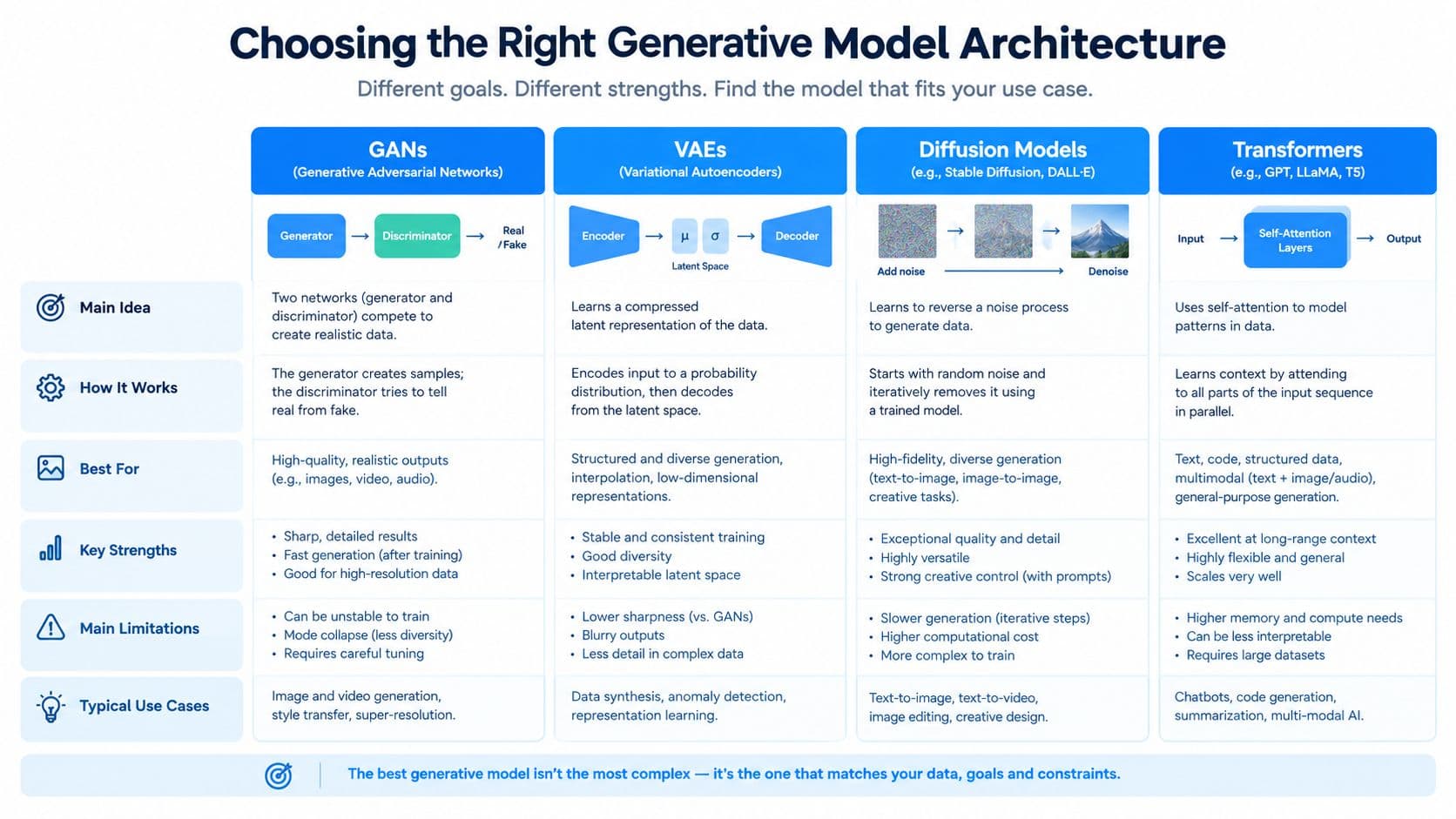
There are three broad approaches, and each solves a different problem.
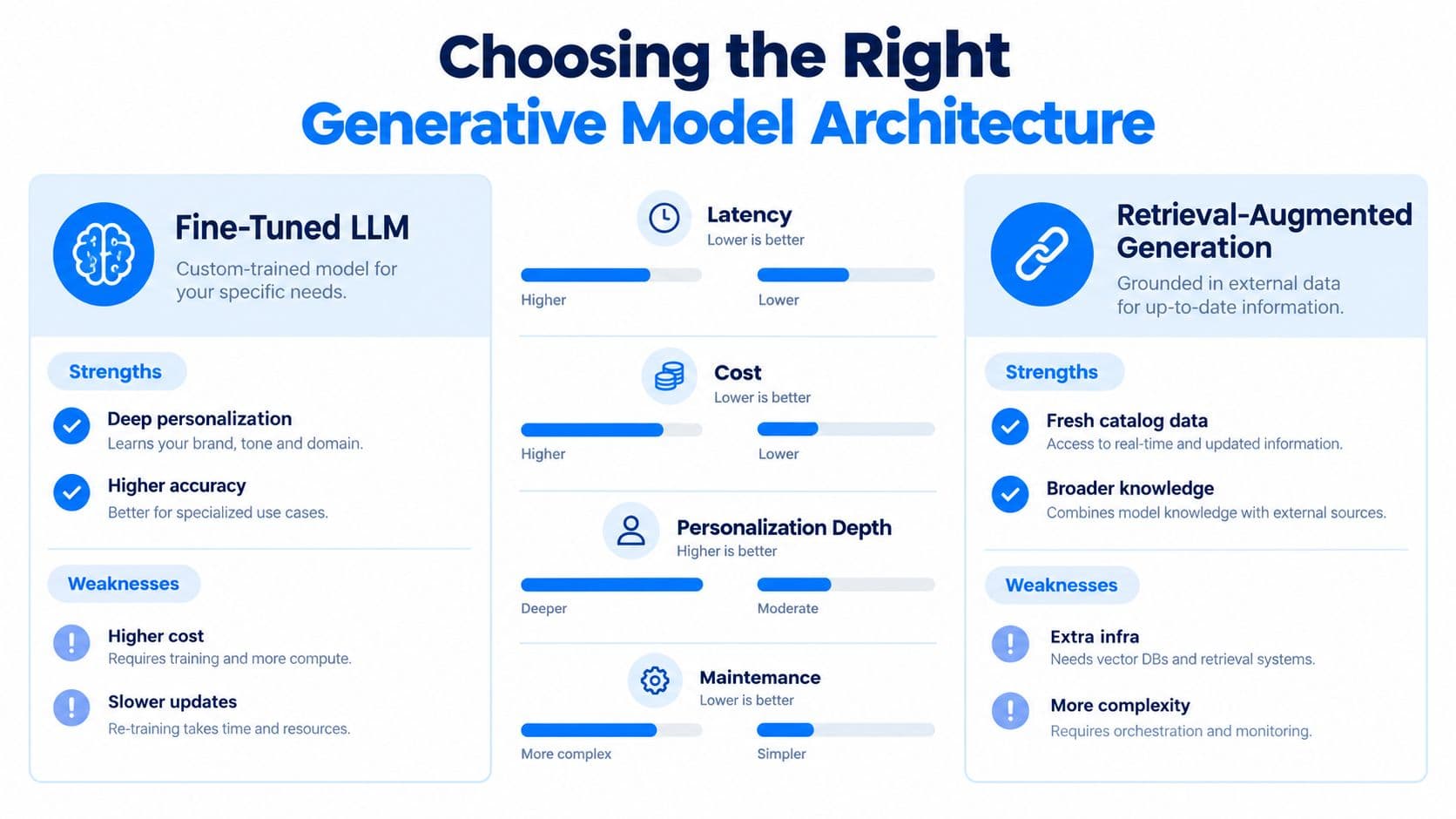
A large foundation model accessed through an API is fast to prototype and usually strong at language, comparison, and explanation. It becomes less attractive when every recommendation requires a fresh, lengthy prompt containing customer history and catalog context. Latency, token usage, data handling, and peak-demand capacity all become operational concerns.
Fine-tuning can make a model better at a specific vocabulary, tone, or product domain. It doesn't turn stale training data into live inventory. A fine-tuned model can still recommend an unavailable variant or state an outdated price unless the application supplies current commerce data at inference time.
RAG keeps the factual layer outside the model and retrieves current records when needed. It introduces search infrastructure, indexing work, and another failure point, but it gives the team a cleaner way to update catalog truth without retraining the model.
Prefer a hybrid recommendation path
For a busy storefront, I generally separate ranking from generation:
- A collaborative-filtering, content-based, rules-based, or hybrid ranker selects eligible products.
- A retrieval layer adds current catalog, stock, policy, and shopper-context data.
- The language model creates a concise explanation, comparison, bundle rationale, or conversational response.
- A validator checks that the response contains only approved product IDs and claims.
This architecture avoids using expensive free-form generation for a task that ranking models already handle efficiently. It also lets the store display recommendations when the language service is slow or unavailable. The shopper can still see a validated product carousel, while the explanation loads separately or falls back to a templated reason.
A recent e-commerce study reported improvements after adding an LLM, with precision moving from 0.75 to 0.82, recall from 0.68 to 0.77, F1 from 0.71 to 0.79, and CTR from 0.56 to 0.63, based on about 500,000 user behavior records and roughly 50,000 products. These figures come from the study of LLM-enhanced recommendation systems, and they support a measured conclusion: generative components can improve relevance and diversity, but they don't remove the need for coverage controls.
The same technical analysis found that decoding limitations could cause systems to ignore up to 20% of otherwise appropriate items. That makes unconstrained autoregressive generation a poor substitute for a candidate-retrieval layer, especially for long-tail catalogs.
For Shopify teams comparing implementation paths, this overview of generative AI for e-commerce provides additional context. The right choice depends on catalog volatility, traffic patterns, data sensitivity, explanation requirements, and whether your team can operate retrieval and evaluation infrastructure.
Raw generation is most useful for language tasks, not as the only source of product truth. A smaller model with strong retrieval and strict output schemas can outperform a larger model that receives ambiguous catalog data.
Deploying On-Site Personalization and Recovery Nudges
A recommendation engine earns revenue only when it appears at the right moment. On a Shopify store, that moment might be a product-page question, a size-selection hesitation, a cart containing an incomplete routine, or an abandoned checkout where the customer needs reassurance rather than a discount.
Consider a shopper viewing a facial cleanser. A static cross-sell might show three unrelated bestsellers. A grounded assistant can ask what concern the shopper is trying to address, use the answer to filter eligible products, and explain a complementary recommendation through specific catalog attributes. It can also say when a product isn't suitable, which is more credible than presenting every item as a fit.

Put recommendations inside the decision
The interface should expose the evidence behind the suggestion without forcing the shopper into a separate research task. Useful placements include:
- Product pages: Recommend alternatives after the shopper expresses a preference such as material, fit, size, or budget.
- Cart drawers: Suggest a compatible accessory or replenishment item using the products already selected.
- Search results: Clarify ambiguous queries and offer a short list with differentiating attributes.
- Post-purchase flows: Recommend care products or compatible additions only when the order context supports the suggestion.
- Checkout recovery: Address a likely hesitation with accurate delivery, returns, sizing, or compatibility information.
A recovery message shouldn't say “You forgot something.” It should answer the question the shopper appeared to have. If a customer viewed several sizes and left, the follow-up can direct them to the sizing guide. If the cart contains a product with a known accessory, the message can explain compatibility. If the shopper paused after checking delivery information, show the relevant policy rather than an arbitrary percentage-off offer.
That approach works because it reduces uncertainty instead of trying to overpower it with urgency. It also keeps the generated message tied to observable context rather than inventing a personal reason for abandonment.
For teams designing discovery flows beyond standard recommendation carousels, the SubmitMySaas-2 product discovery guide is a useful resource for comparing ways shoppers find and evaluate products. On Shopify, the operational priority is to connect discovery events to a reliable catalog response, not merely to add another chat bubble.
Keep the assistant commercially disciplined
The assistant should have explicit boundaries. It can recommend products, answer catalog and policy questions, compare eligible items, and suggest compatible additions. It shouldn't promise delivery dates that aren't in the source data, make unsupported health claims, or pressure a shopper to buy because the model predicts a high likelihood of conversion.
A tool such as Carti can sit in this layer as a Shopify AI sales assistant that answers catalog questions, provides product suggestions, supports cart recovery, and uses browsing or cart context to shape its responses. The same principles still apply: its output should be grounded in current store data, and the merchant should review how explanations and fallback behavior appear to customers. For scaling the experience across pages and segments, this guide to personalization at scale provides a useful implementation reference.
Evaluation Metrics Beyond Standard Click-Through Rates
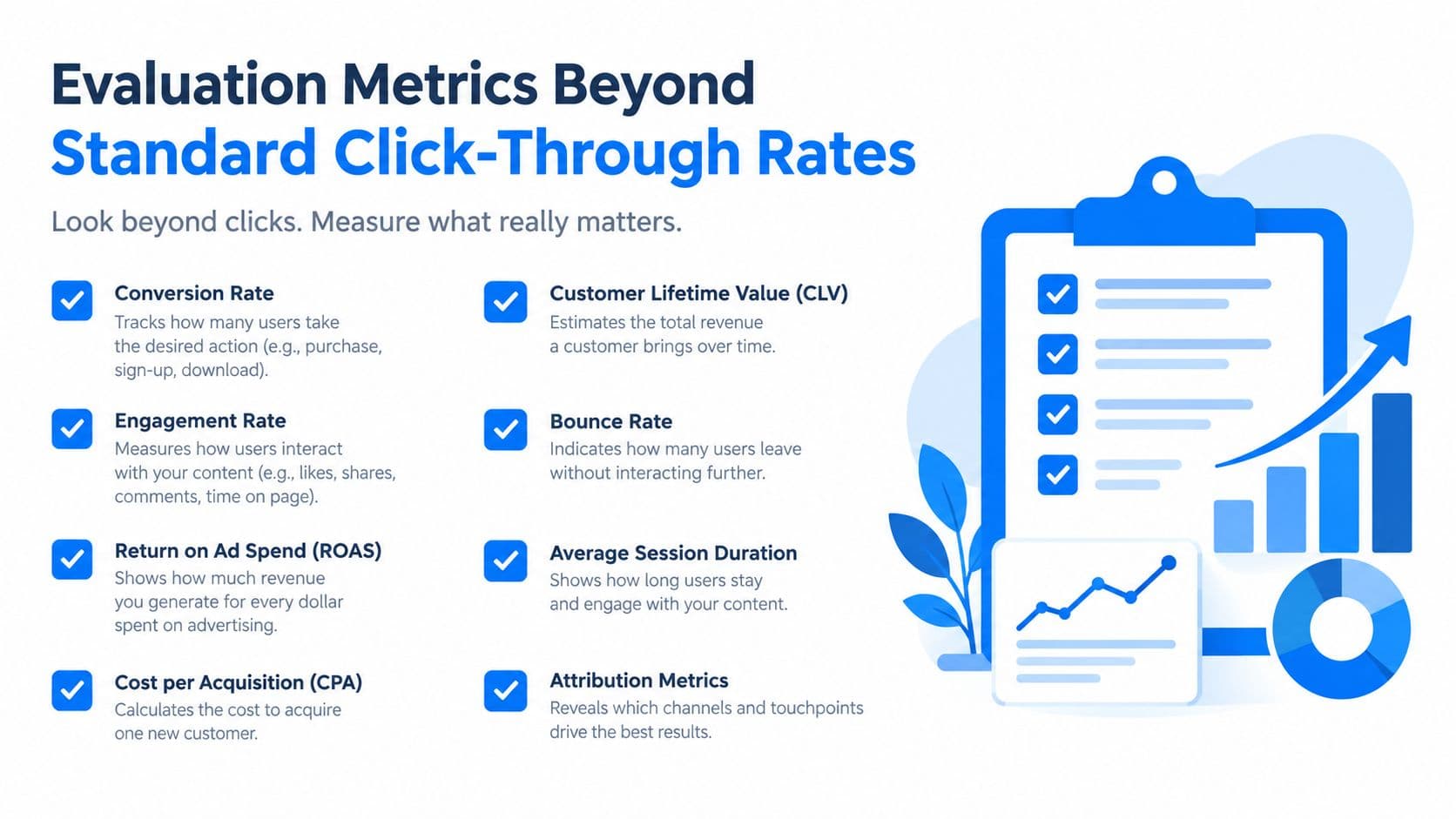
Click-through rate can tell you whether a recommendation attracts attention. It can't tell you whether the product exists, whether the explanation is true, whether the shopper later returns the item, or whether the system systematically favors popular products at the expense of relevant alternatives.
A reliable evaluation program needs several layers because each layer catches a different failure mode. Recent research on evaluating LLM-based recommenders recommends adding catalog grounding, safety and compliance, diversity, intent alignment, human review, and production monitoring to traditional relevance evaluation.
Validate the output in stages
First, test factual grounding against live commerce data. For every generated recommendation, verify the product ID, variant, price, stock state, category, and cited attributes. Run these checks against the same source that powers the storefront, not a periodically exported document that may already be stale.
Next, measure ranking quality offline. Hit Ratio, precision, recall, F1, NDCG, and related metrics remain useful for assessing whether the system retrieves relevant products. They should be segmented by new versus returning shoppers, category, device context, inventory depth, and cold-start conditions. A single blended score can hide weak performance in important catalog areas.
Then, review the explanation. Use a structured rubric for factual accuracy, relevance to the stated intent, clarity, tone, policy compliance, and uncertainty handling. An LLM-as-judge can help with scale, but it shouldn't be the only reviewer. Human auditors need to inspect difficult categories, edge cases, and responses where the model expresses confidence without sufficient evidence.
Monitor behavior after launch
Production monitoring should look beyond engagement. Track recommendation acceptance, add-to-cart behavior, purchases, returns, substitutions, customer complaints, and requests for clarification. A recommendation that earns clicks but produces confusion or returns isn't necessarily helping the business.
Add explicit checks for:
- Inventory drift: The generated item is no longer available or the selected variant has changed.
- Price drift: The displayed explanation conflicts with the current product price or promotion.
- Popularity bias: The system repeatedly surfaces bestsellers while neglecting suitable long-tail products.
- Coverage gaps: New products, low-interaction products, and underrepresented categories rarely enter the candidate set.
- Privacy leakage: The response reveals personal history, inferred traits, or information from another shopper's session.
- Policy violations: The model makes medical, safety, warranty, or delivery claims that the catalog and policies don't support.
Use sampled conversation reviews alongside automated alerts. Distribution shift can appear when a seasonal assortment changes, a campaign drives unusual traffic, or shoppers start using language the system hasn't encountered. A model that passed offline tests can still degrade when the live audience and catalog change.
The strongest teams set launch gates. A response that fails product-ID validation should never reach the customer. A response with a questionable explanation can fall back to a factual template. This is less glamorous than adding another model, but it protects the buying experience.
Building Shopper Trust Through Explainability
Personalization answers “which product?” Explainability answers “why should I believe this recommendation?” The second question often determines whether the shopper continues toward checkout.
A recent shopper survey found that 49% considered a clear explanation of why a product was chosen the top trust builder, while 67% said price was the most important detail for AI to get right. The same research found that 58% lose trust in a brand when an LLM provides incorrect product information, as reported by Rithum's research on explainable AI recommendations.
The interface should make the explanation short, specific, and inspectable. “Recommended for you” says almost nothing. “Recommended because you selected a fragrance-free moisturizer, and this product lists no added fragrance” gives the shopper a claim they can verify on the product page.
Make uncertainty visible
Avoid explanations based on hidden behavioral conclusions such as “This is perfect for your lifestyle.” Use observable signals instead:
- “You viewed waterproof trail shoes.”
- “This charger is listed as compatible with the device in your cart.”
- “The product is available in the selected size.”
- “This option costs less than the other products in the comparison.”
Price and stock should be fetched as close to display time as practical. If the system can't confirm a detail, it should say so or omit the claim. A cautious answer builds more confidence than a polished answer that later proves wrong.
Privacy affects explainability too. Ask for consent before using behavioral data beyond what the shopper expects, provide a clear way to reset or dismiss personalization, and avoid exposing sensitive inferences. The customer should understand what information shaped the suggestion without feeling watched by an invisible scoring system.
Verification is now part of the conversion path. Research on AI commerce trust found that 86% of AI-assisted shoppers confirm recommendations through another source before buying, 42% wouldn't trust an AI recommendation for a purchase over $25 without checking elsewhere, and 53% suspect companies may seed misleading information to influence AI recommendations, according to Product.ai's trust in AI commerce report. Merchants that expose evidence, current pricing, product availability, and clear reasoning can reduce that extra research step.
The practical standard is simple: recommend only what the store can sell, explain only what the data supports, and give shoppers enough evidence to make the decision themselves.
Carti helps Shopify stores turn product questions into grounded recommendations, with instant catalog answers, behavior-aware suggestions, and cart recovery assistance in one AI sales assistant. Visit Carti to see how a conversational recommendation layer can reduce verification friction and help more shoppers move from browsing to buying.

Written by
Daniel AndersonFounder of Carti. 10+ years building ecommerce brands in apparel and supplements. Still runs a Shopify store and built Carti to help merchants convert more browsers into buyers.
Ready to boost your store's sales?
Install Carti in 5 minutes and let AI handle customer questions, recommend products, and close sales 24/7.
Start Free Trial14-day free trial