
Your Shopify chatbot is live, the support queue is lighter, and then a shopper asks whether a jacket is waterproof. The bot answers yes with complete confidence, but the product page never said that, your policy docs never said that, and now the customer is making a purchase decision on a detail you can't stand behind. That's the practical problem behind AI hallucinations in commerce, they usually don't look like sci-fi glitches, they look like a bot filling in missing product facts, shipping rules, or return exceptions with a tone that sounds certain enough to trust.
What makes this maddening is that the failure often isn't in one place. The model may have decent language ability, but the answer can still go wrong because the knowledge base is messy, the retrieval step pulled the wrong page, or the prompt gave the model too much room to improvise. If you want a useful primer on the broader myth that models “understand” like people do, the truth about AI sentience is a helpful read, and if you're comparing chatbot behavior with general-purpose assistants, the distinction matters a lot in production, which is also why teams often separate product bots from open-ended tools like Chatbot vs ChatGPT.
Why Your Chatbot Confidently Gives Wrong Answers
A shopper asks whether a jacket is waterproof, and the bot says yes without hesitation. That answer can come from three very different failures, and in production, you need to know which one you're looking at before you fix anything.
The wrong answer may start before generation
Sometimes the model is drawing from parametric memory, which is just its internal pattern store, and it fills gaps because the needed fact wasn't in the prompt or the retrieved context. That's how you get smooth language with a wrong claim attached to it. The model isn't “deciding” to lie, it's doing what it was trained to do, which is generate the most plausible continuation.
Other times the problem is upstream in retrieval. A product catalog might contain an old description, a duplicate page, or a policy snippet that belongs to a different SKU line, so the chatbot gets a misleading context window and then answers faithfully from the wrong evidence. In commerce, that failure looks like certainty, but it's really a bad search result dressed up as a confident answer.
Practical rule: if the bot keeps making the same kind of mistake, inspect the retrieved context before you rewrite the prompt.
Prompt ambiguity makes the model guess
A vague question like “Does it run big?” sounds simple to a shopper, but it's underspecified for a bot. Does “big” mean sizing, fit, fabric stretch, or shipping packaging? If the prompt doesn't force the system to ask a clarifying question, the model often chooses one interpretation and answers as if it were the only one.
That's the operational reality behind most commerce hallucinations. The bot isn't broken in one dramatic way. It's usually being fed weak data, noisy retrieval, and an instruction layer that never set a hard boundary on when to stop and ask for help.
The best diagnosis is layered. If the knowledge base is wrong, fix the source. If retrieval is wrong, fix the search. If the generation step is still improvising, tighten the prompt and the refusal rules. That sequencing matches the broader guidance from MIT Sloan's AI guidance on addressing hallucinations and bias, which treats hallucination control as a system design problem rather than a single prompt trick.
Building a Clean Knowledge Base for Grounded Responses
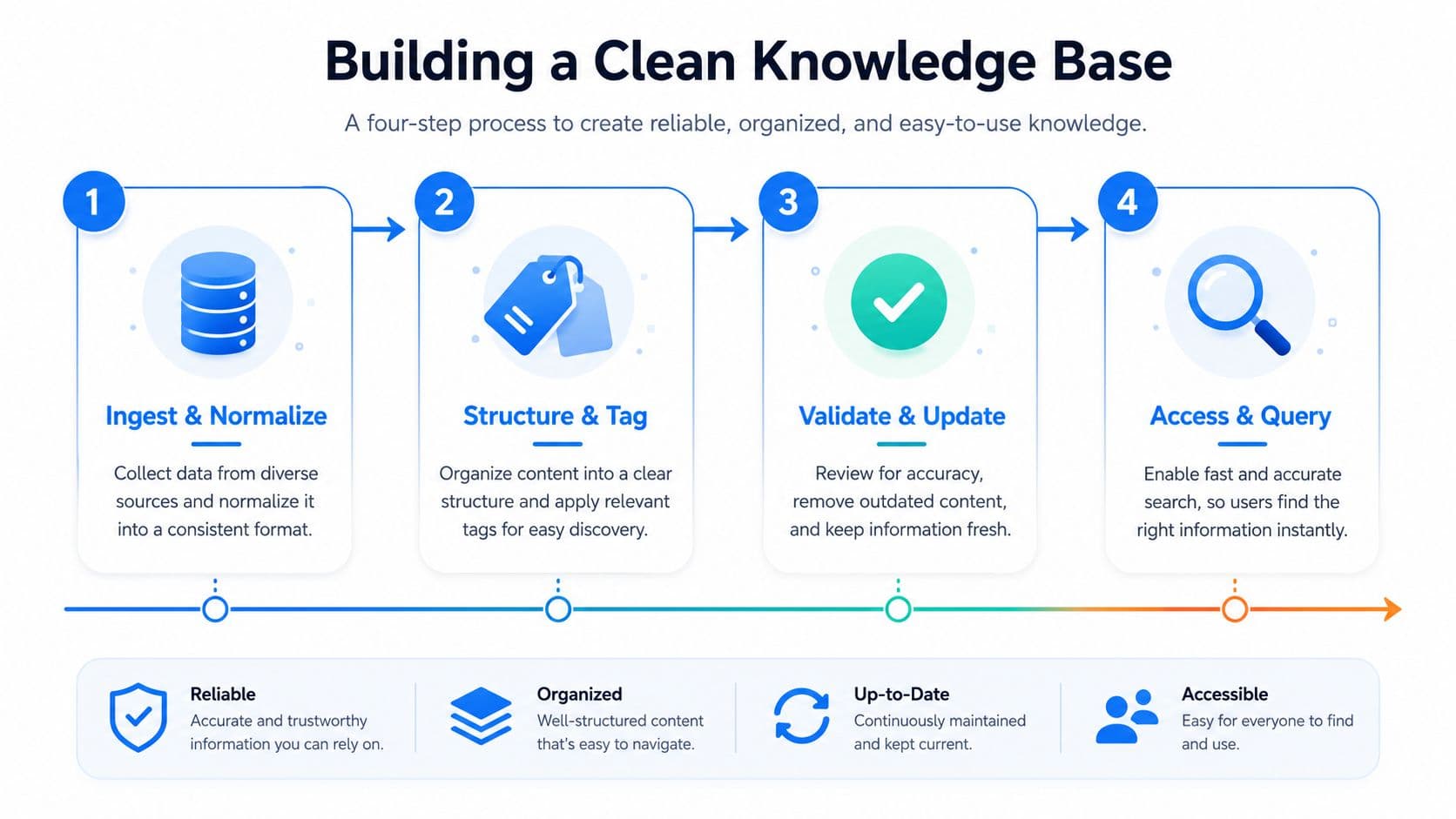
Start with prompt engineering because it feels fast. That's backwards. If the bot is trained to answer from a messy pile of product pages, shipping notes, old FAQs, and duplicated policy docs, no prompt will make the underlying evidence trustworthy. The foundation is a clean, structured knowledge base, and that means treating content operations like part of the chatbot stack.
Start with normalization, not ingestion
Pull product data, FAQs, shipping rules, and policy pages into one canonical structure. Don't let the bot crawl whatever happens to be live on the storefront, because storefront content often contains marketing language, partial edits, and seasonal text that shouldn't answer policy questions. The job is to normalize naming, remove duplicates, and make each source traceable.
That's where metadata pays off. Tag each record by recency, source reliability, content type, and product line. When a shopper asks about an order cutoff or a return exception, the retrieval layer should know which document is current and which one is a stale draft.
Keep chunks coherent
Chunking matters because a chatbot can only use the context it sees. Product descriptions, return policies, and shipping rules should stay intact enough that you don't split a condition from its exception. Microsoft's guidance on grounded-generation pipelines stresses chunking plus hybrid search, because search accuracy improves when the system can find the most relevant evidence before the model starts generating an answer, and that same guidance recommends continuous evaluation with both automated tests and human review, as described in Microsoft's best practices for mitigating hallucinations in large language models.
A clean setup also needs filtering before retrieval. If a query is about a return window, don't let the system drag in promotional copy, off-topic blog posts, or old seasonal campaigns. IBM's guidance, cited in the same operational thread above, points toward model boundaries and ongoing testing, which is exactly what matters when your catalog changes faster than your support team can manually audit every page.
Handle edge cases explicitly
Out-of-stock items, preorder windows, and holiday shipping delays need their own structured records. If you bury those exceptions in paragraph text, retrieval will miss them or mix them with the wrong product. In practice, the safest path is a knowledge base that separates evergreen facts from temporary overrides and keeps both accessible through metadata.
For teams building this layer from scratch, it helps to think in terms of content governance first and AI second. The internal architecture becomes easier to reason about when the product knowledge base is designed for search, not just for humans. A useful companion reference is how to build a chatbot knowledge base, especially if your current content is spread across CMS pages, help docs, and merchant notes.
Retrieval-Augmented Generation That Works
A lot of teams say “use RAG” as if that settles the hallucination problem. It doesn't. Retrieval-augmented generation only helps when the retrieval source is curated, relevant, and stronger than the model's own memory, which is why grounding matters more than the model brand underneath it.
The strongest evidence in the material you provided comes from a 2025 systematic study of medical chatbots. When the chatbot used information from a curated source called CIS, hallucination rates dropped to 0% for GPT-4 and 6% for GPT-3.5, compared with 6% and 10% when using Google, and for questions outside CIS coverage, Google-based chatbots still hallucinated 19% of the time with GPT-4 and 35% with GPT-3.5, according to the study published at PMC. The point is not the medical domain itself, it is the pattern. Grounding in a reliable domain-specific source can move error rates from double digits to near zero, and it also makes the model more willing to admit when it does not know.
Why source quality beats model hype
In commerce, that means a well-maintained product catalog beats scraped web results every time. A trained model can sound polished while citing the wrong return policy, but a grounded pipeline with trusted internal docs gives the system a much better chance of staying within the business rules you enforce.
A retrieval layer only helps if the retrieved evidence is the thing you'd want a support rep to quote back to a customer.
MIT Sloan's guidance lines up with that operational reality. Their recommendations on retrieval-based tools, diversified sources, structured prompts, and lower temperature match the shift from prompt-only advice to system design, as summarized in MIT Sloan's AI hallucination guidance. The model should answer after it finds trusted documents, not before.
Handle uncertainty as a feature
A good RAG system does not force an answer for every question. If the question falls outside coverage, the bot should surface uncertainty, ask for clarification, or escalate. That behavior is a feature, because the customer experience is better when the bot says it cannot verify a detail than when it invents one.
The source pipeline deserves more attention than the generation step. Causaly's retrieval-first guidance argues that teams should improve the search stage first by planning targeted queries, searching full text and private documents together, normalizing terminology, removing duplicates, and filtering off-topic results before the model answers, as outlined in Causaly's discussion of stopping hallucinations in scientific R&D. That same operational lesson applies to commerce chatbots. Noisy retrieval creates confident errors even when the model itself is capable.
Prompt Engineering and Generation Controls
Once retrieval is solid, prompts become a control layer instead of a rescue plan. That's the right place for them. A structured system prompt can keep the bot inside its lane, while temperature settings and refusal rules reduce the chance that the model will improvise when the retrieved context is thin.
Write boundaries into the system prompt
The bot should know its role, its evidence source, and its failure mode. For a Shopify store, that usually means telling it to answer only from retrieved content, never to guess on product specs, and to ask a clarifying question when the user's request is ambiguous. If you leave those instructions implied, the model tends to over-answer.
A practical prompt pattern looks like this in plain language, not as a gimmick:
- Role boundary: answer as a store support assistant, not as a general web search engine.
- Evidence boundary: use only retrieved product, policy, or FAQ content.
- Refusal boundary: if the source doesn't cover the question, say you don't have enough information.
- Clarification boundary: if the question could mean multiple things, ask one short follow-up.
Lower randomness, then keep the model honest
Temperature controls matter because lower randomness reduces the odds that the model will take a creative leap. MIT Sloan's guidance explicitly calls out adjusting temperature to reduce randomness, which is useful because production bots don't need surprise, they need repeatability and restraint, as described in MIT Sloan's hallucination guidance.
You also want refusal prompts that sound natural. “I don't have that information in the current store documents” is better than a long disclaimer, because it's concise, honest, and easier for a shopper to act on. The goal is not to make the bot timid, it's to make it selective.
Practical rule: if the answer can affect checkout, shipping expectations, or a return decision, the prompt should prefer refusal over invention.
The biggest shift in the last few years is that prompt engineering stopped being the main defense. It still matters, but it now works as part of a layered system with retrieval, verification, and human review. That's the only arrangement I've seen hold up across real traffic, real product churn, and the usual chaos of a live store.
Verification Layers and Fallback Flows
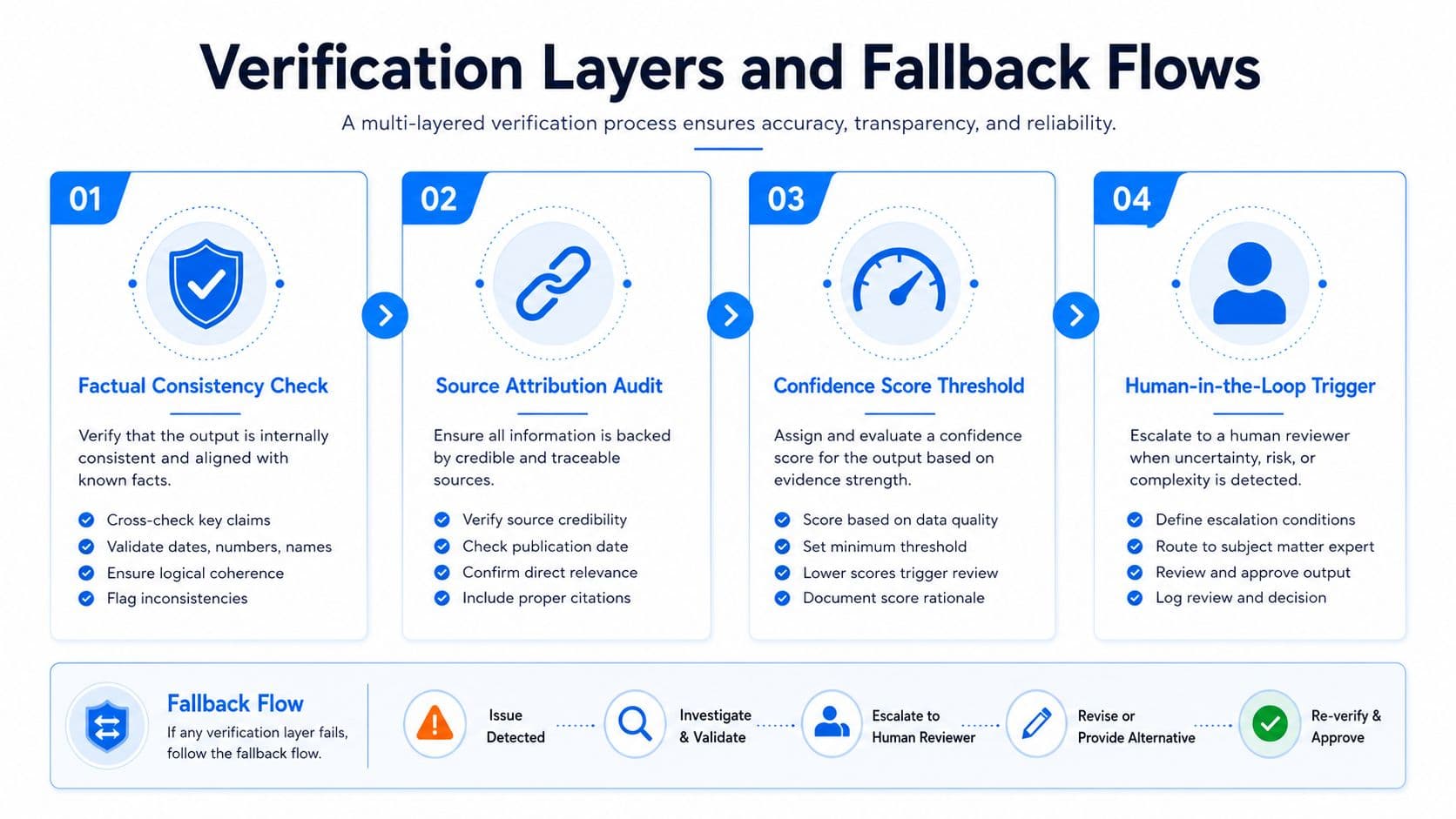
Even with clean retrieval and careful prompts, some bad answers will still slip through. That's why the post-generation layer matters. You're not trying to make hallucinations impossible, you're trying to catch them before the shopper sees them and before they affect a purchase decision.
Double-check the answer against the evidence
A simple but effective move is to ask the model to verify its own output against the retrieved context before it responds. That second pass should be explicit, not implied. Industry guidance in your brief recommends a verification layer after generation, with human fact-checking for high-stakes outputs and cross-referencing trusted databases or curated knowledge bases, which is also where IBM's view of human review as a final backstop fits in.
Confidence thresholds become useful here. If the answer looks uncertain, or if the supporting evidence is weak, route the message to a human agent or redirect the shopper to a product page with the relevant policy text. Palo Alto Networks also recommends measuring variation across multiple generations because high semantic variation signals a higher hallucination risk, which makes sense operationally, unstable answers are often the ones you don't want to auto-send, as summarized in Palo Alto Networks' AI hallucinations overview.
Build fallback flows that preserve momentum
A weak fallback is a dead end. A better fallback is a handoff that keeps the customer moving. If the bot isn't certain about a size chart, it should point to the product page, offer to connect the shopper to support, or surface a relevant policy article instead of stalling in a generic apology loop.
That's especially important for commerce because the user often wants a fast decision, not a philosophical debate with the bot. A fallback flow should protect the experience without pretending certainty that isn't there. If the system can't verify an answer, it should still help the shopper progress.
Use validation as a gate, not a report card
The point of verification isn't to score the bot after the fact. It's to stop risky text before it goes live. A second validation pass, refusal rules, and human review for sensitive cases create a layered defense that catches more errors than any one control alone.
The most reliable pattern I've seen is simple enough to operationalize: generate, verify, and only then publish. That order matters more than any single model setting.
Monitoring and Testing as Ongoing Operations
A chatbot that looks fine at launch can still start drifting the moment the store changes underneath it. Product names get updated, policies get rewritten, bundles get retired, and support macros age out faster than anyone expects. If the monitoring loop is weak, the bot keeps answering with confidence long after its source material stopped being trustworthy.
Hallucination control has to stay visible across the whole workflow. PwC's AI hallucinations overview points to the need for controls across data quality, retrieval, post-response checks, governance, and human review, which matches what breaks in commerce. The hard part is not finding a single model setting that sounds smart. It is keeping the inputs clean, the retrieval layer honest, and the final response checked before it reaches a shopper.
Track the signals that matter
Accuracy by itself does not tell you enough. Refusal rate, escalation frequency, and the volume of conversations that need a human clean-up pass are usually more useful in production. If those numbers move the wrong way, something in the pipeline changed even if the bot still sounds polished.
Operational analytics help here. A proper chatbot analytics view lets you see which intents are failing, where users are dropping off, and which responses are triggering escalations. That matters because a chatbot can look fluent while consistently missing the same few questions over and over.
For testing, use edge-case prompts on a schedule. The most useful cases are the messy ones, delayed shipping, partial returns, mixed-cart orders, and product comparisons that sit between categories. A practical guide for building those cases is how to create test cases, and the same discipline applies to chatbot QA, you need examples that pressure the happy path instead of confirming it.
A bot fails when it answers too confidently to a question it should have escalated, not only when it is plainly wrong.
Watch for drift, not just defects
A chatbot can pass launch checks and still degrade later because inventory, policy pages, or catalog structure changed. That is why observability matters. If you can trace inputs, retrieved documents, and final outputs, you can usually tell whether the break came from content drift, retrieval noise, or generation behavior.
The stores that stay stable also review borderline conversations on purpose. A small sampling of escalations, near-misses, and “looks right but isn't” replies catches patterns that dashboards miss. I have seen this work better than chasing exotic tooling, because the recurring failure is usually plain and repetitive.
A lightweight review loop is enough to expose most of the damage. Someone on the team should inspect a sample of conversations, check the retrieval trail, and confirm whether the bot answered from current source material or from stale context. That habit keeps the system honest, and it gives the team a clear way to decide whether the next fix belongs in the knowledge base, retrieval, generation, or verification layer.
Your Hallucination Prevention Deployment Checklist
A dependable deployment starts with a simple question, what part of the stack is least trustworthy right now? For some stores, that's the knowledge base. For others, it's retrieval. Smaller shops can get meaningful protection by fixing the top one or two layers first, while larger stores should harden all of them together.
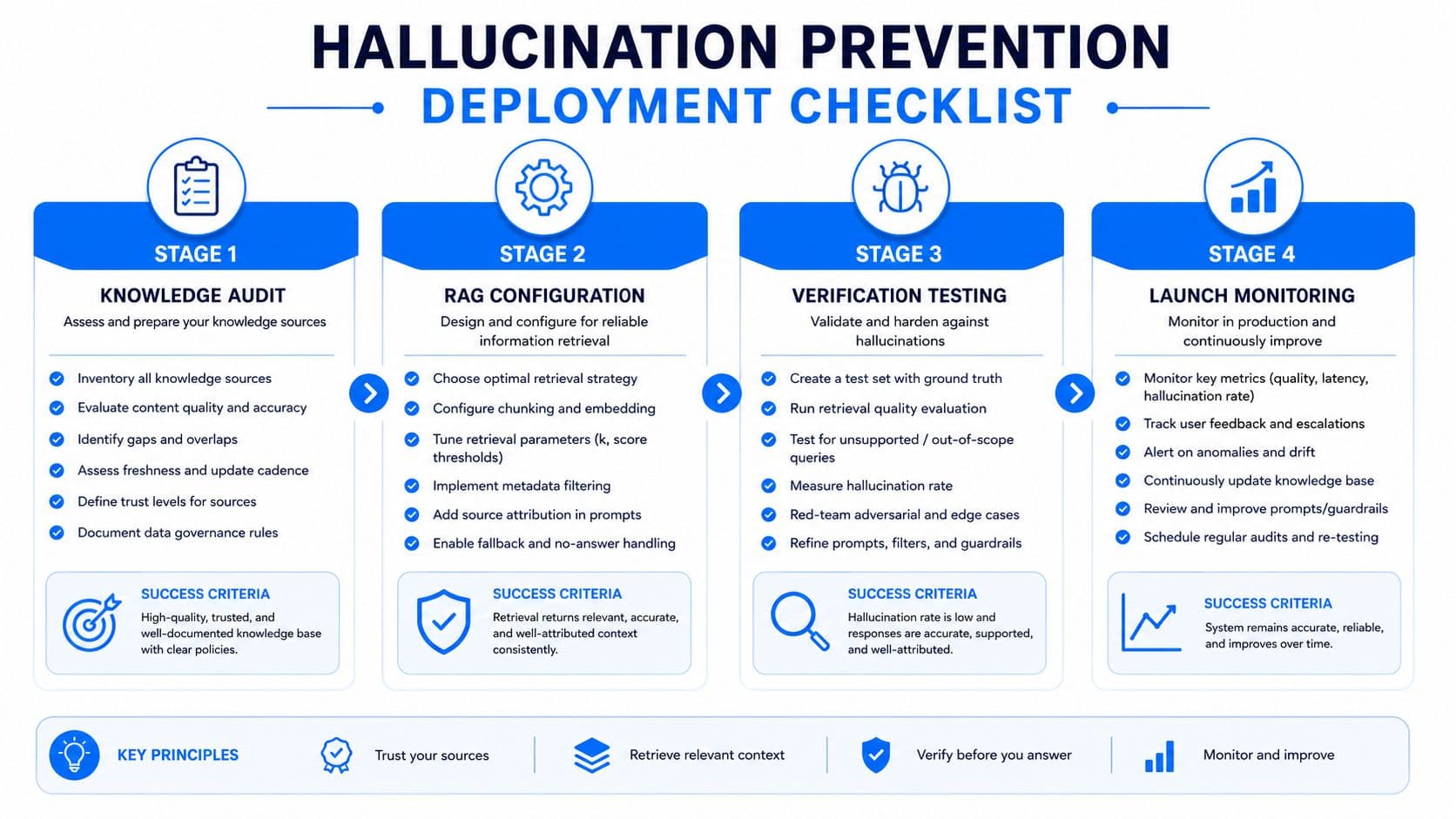
Stage 1 Knowledge audit
- Pass: product, policy, and FAQ sources are centralized, deduplicated, and tagged by recency and reliability.
- Fail: the bot can still ingest stale pages, duplicate content, or off-topic articles.
Stage 2 Retrieval configuration
- Pass: retrieval prioritizes trusted internal documents, uses chunking and hybrid search, and filters out irrelevant results.
- Fail: the model still depends on broad web results or noisy context windows.
Stage 3 Verification testing
- Pass: the bot double-checks answers, applies refusal rules, and sends uncertain cases to a human or a product page.
- Fail: risky answers go straight to the shopper with no second pass.
Stage 4 Launch monitoring
- Pass: the team reviews edge cases, tracks refusals and escalations, and reruns tests as the catalog changes.
- Fail: the bot is left alone after launch and drifts.
If you're deciding where to start, prioritize the layer most likely to cause customer-facing damage. In commerce, that's usually the knowledge base and retrieval path, because bad source material creates confident errors faster than a prompt tweak can fix them. Once those are stable, tighten the generation controls and verification gates, then keep testing as part of normal operations.
If your current bot still guesses on product details, policy exceptions, or shipping questions, Carti can help you move from brittle prompting to a more reliable commerce support workflow. Visit Carti to see how a Shopify chatbot built around accurate product knowledge and proactive support can help you reduce wrong answers and keep shoppers moving toward checkout.

Written by
Daniel AndersonFounder of Carti. 10+ years building ecommerce brands in apparel and supplements. Still runs a Shopify store and built Carti to help merchants convert more browsers into buyers.
Ready to boost your store's sales?
Install Carti in 5 minutes and let AI handle customer questions, recommend products, and close sales 24/7.
Start Free Trial14-day free trial