
If you're running a Shopify store, the question isn't "chatbot vs ChatGPT?" It's what kind of AI can protect margin, answer accurately, and help close sales without creating a new operations problem.
A lot of merchants frame this as a simple replacement decision. Why buy a store chatbot if ChatGPT already exists? That sounds logical until you look at what happens inside a live storefront. Product availability changes. Shipping cutoffs move. Return rules have exceptions. Promotions start and end. The difference between a helpful answer and a costly wrong one is often a single line of policy or inventory data.
That's why the smartest evaluation isn't feature vs feature. It's total cost of ownership, accuracy under real store conditions, and whether a hybrid setup gives you the upside of generative AI without the downside of letting a general model improvise your business rules.
Two Paths to AI Chat Guided Specialists vs Generative Generalists
Can't you just use ChatGPT for your store?
Sometimes, yes. But that's usually the wrong shortcut for merchants who need dependable answers tied to products, policies, and conversion. In practice, ChatGPT and a store-specific chatbot solve different problems, even when they both appear inside the same chat window.
| Approach | Best at | Main weakness | Best fit for Shopify |
|---|---|---|---|
| Guided specialist chatbot | Product questions, store policies, order support, structured selling flows | Less flexible with messy, open-ended requests unless well designed | Day-to-day revenue and support operations |
| ChatGPT-style generative model | Natural language, broad conversation, complex phrasing, multi-part shopper messages | Can answer fluently without being grounded in your live store data | Assisted selling, content help, layered AI experiences |
A guided specialist is like a trained sales associate who only works in your store. It knows your catalog, your FAQ logic, your returns language, and the exact boundaries you want it to stay within. It doesn't need to sound brilliant about everything. It needs to be right about the things that affect revenue and trust.
A generative generalist is different. ChatGPT runs on large language models, and its scale has changed buyer expectations. By 2026, it was processing around 2.5 billion prompts per day globally, up 250-fold from 2023, according to Business of Apps' ChatGPT statistics. That matters because shoppers now expect conversational interfaces to understand natural phrasing, follow context, and respond any time of day.
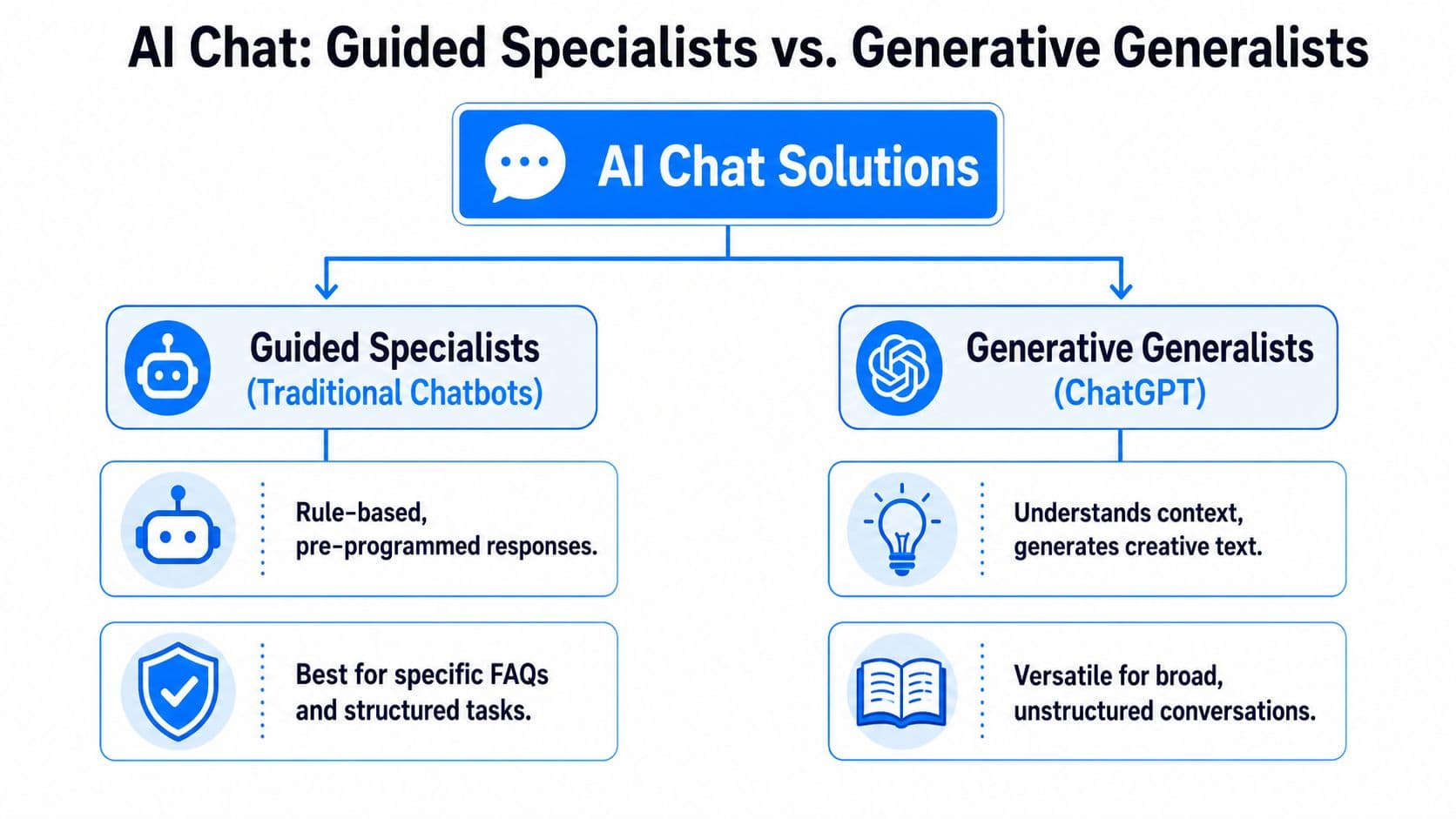
The architectural split is what merchants need to understand.
Why the underlying design matters
A specialist chatbot is typically guided by rules, store data, catalog logic, and predefined response structures. That makes it narrower, but also easier to control. When a shopper asks about shipping, returns, order status, or whether a product matches a use case, the system can stay anchored to approved information.
ChatGPT starts from language ability. It can interpret nuance far better than older bots, and that's why so many merchants are tempted to use it as the default storefront assistant. For a useful outside perspective, this breakdown from Sight AI helps compare chatbot AI and ChatGPT in practical terms.
Practical rule: If the answer must match your store's current facts, the system needs grounding before it needs eloquence.
That distinction shows up clearly in guided selling. A shopper saying "I need something for dry skin, under my budget, and I want it before the weekend" isn't just asking for prose. They're expressing intent, constraints, and purchase urgency. That's where a structured commerce layer matters more than generic conversational range. If you're thinking about onsite selling rather than support alone, it's worth looking at how a guided selling solution changes the role of chat from help desk to buying assistant.
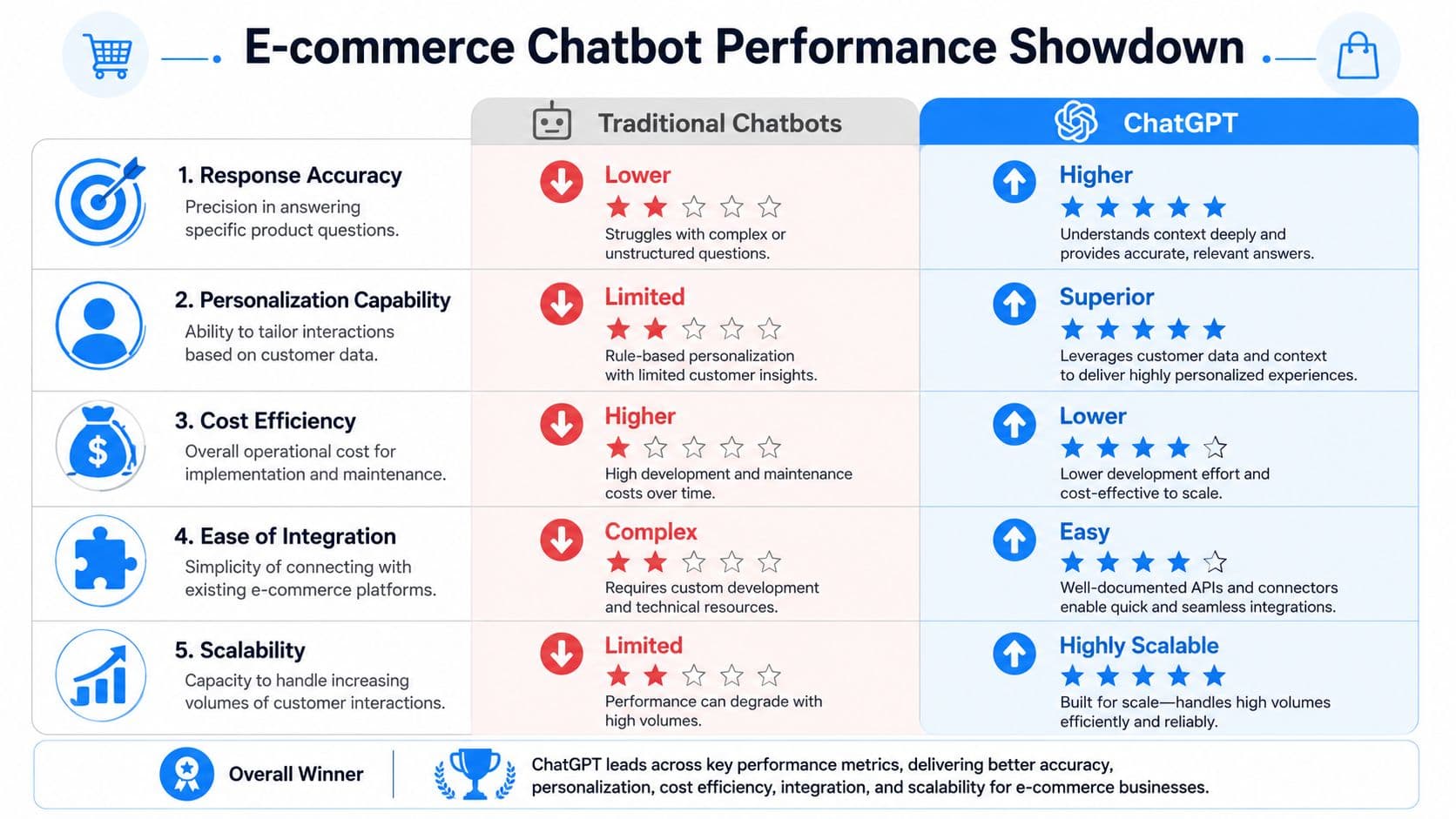
The E-commerce Performance Showdown
Merchants don't buy AI for theory. They buy it for fewer lost shoppers, cleaner support operations, and better conversion paths.
The performance gap in Chatbot vs ChatGPT shows up fast once you judge both systems on actual storefront tasks instead of generic conversation quality.
Accuracy and reliability
Accuracy isn't just a support metric. It's a revenue metric.
If a shopper asks, "Can I return sale items if the size doesn't fit?" a traditional ecommerce chatbot can be very strong if the policy is explicitly mapped. It retrieves the approved answer and stays inside the guardrails. That makes it dependable for fact-bound questions.
ChatGPT-style systems are stronger when the shopper asks a messier version, such as "I'm buying two sizes because I travel next week and might keep one. What's your return policy if one was discounted and one wasn't?" The model can parse that complexity better. But if it isn't grounded in the store's actual rules, it may answer smoothly and still get the policy wrong.
The biggest mistake merchants make is treating fluent language as evidence of factual reliability.
That trade-off matters because support chats often happen right before checkout. A vague or inaccurate answer doesn't just create a ticket. It can stop the purchase.
Conversational depth
In this area, large language models clearly pull ahead.
Modern LLMs like GPT-4 score around 85–90% accuracy on multi-intent ecommerce queries, compared with 60–75% for many traditional systems handling the same kind of complex requests. That's the difference between understanding "My order is late, can I change the address and get a discount?" as one connected problem versus breaking after the first intent.
For merchants, that means a generalist model is often better at handling:
- Layered requests like style preference plus budget plus urgency
- Natural language variation when shoppers don't use clean keywords
- Follow-up turns where the second message depends on the first
A specialist bot can still perform well here, but only if it has enough commerce-specific structure behind it. Without that, it tends to escalate too early or answer only part of the request.
Speed and shopper momentum
Speed isn't just technical latency. It's whether the shopper feels momentum or friction.
GPT-4 class systems typically respond in the 400–800 ms range and support 8k–32k context tokens, while many rule-based chatbots respond faster at 200–400 ms but are often limited to 1–2k tokens, which affects memory over a longer exchange. The result is a familiar trade-off. Rule-based systems often feel quicker on simple questions. Generative systems tend to feel smarter over a longer conversation.
That matters differently depending on the job:
| Store task | Better default fit | Why |
|---|---|---|
| Return policy lookup | Specialist chatbot | Needs exact store-approved language |
| Product recommendation with several shopper constraints | ChatGPT-style system or hybrid layer | Benefits from intent interpretation and context retention |
| Order status and shipping windows | Specialist chatbot | Needs system truth, not a best guess |
| Upsell conversation across several turns | Hybrid or LLM-assisted setup | Benefits from memory and more natural dialogue |
A store owner should also judge performance through analytics, not transcripts alone. If you're evaluating what shoppers are asking before they bounce or buy, this guide to chat bot analytics is useful because it pushes the review beyond "did the answer sound good?"
Fast but rigid can lose a sale. Smart but ungrounded can lose trust. The winning setup depends on which risk matters more for that interaction.
Unpacking the True Costs and Maintenance Burden
The sticker price is rarely the actual price.
When merchants compare a dedicated ecommerce chatbot with ChatGPT, they often compare monthly software fees and stop there. That misses the harder question: what will this system cost to run accurately, safely, and consistently over time?
The visible cost and the hidden one
A model like ChatGPT carries serious infrastructure cost. Estimates place operating cost at roughly $700,000 per day, or about $21 million per month, with each query costing about $0.36 in compute resources, according to Tooltester's ChatGPT statistics review. A Shopify merchant won't pay those exact platform-level costs directly, but the underlying economics still matter. They show why open-ended LLM usage doesn't behave like a cheap, predictable utility.
Traditional chatbots usually sit on cheaper, deterministic logic. Their cost profile is easier to forecast because they aren't generating every answer from scratch. For stores with steady support volume and recurring questions, predictability matters more than novelty.
Here's where merchants often underestimate the gap:
- Prompt management: Someone has to keep refining instructions so the model stays on-brand and avoids risky answers.
- Grounding work: Product data, policies, and promotions have to be fed in or connected properly.
- QA time: Teams need to test edge cases, especially around returns, shipping, discounts, and regulated claims.
- Failure cost: One wrong policy answer can create refunds, chargebacks, manual support cleanup, or abandoned carts.
Why maintenance becomes the real bill
A general model doesn't naturally "know your store" in the operational sense. It doesn't natively track catalog changes, stock shifts, active bundles, or shipping exceptions unless you build that connection and maintain it.
That's why total cost of ownership usually expands in three ways.
First, the system needs supervision. Someone has to review answers, update prompts, and catch drift when store rules change.
Second, complexity spreads. Once you connect the bot to catalog data, order systems, and support workflows, you're not buying a chatbot anymore. You're maintaining an AI application.
Third, risk compounds subtly through edge cases. The tool may do well on common questions and still fail on the exact conversations that decide whether a shopper buys, returns, or complains.
Cheap setup can become expensive upkeep if your team has to keep correcting the AI.
This is why many merchants are better served by software built for commerce operations rather than raw model access. The product fee may not tell the whole story, but neither does a low entry point for an LLM integration. If you're trying to reduce support burden while protecting margin, this guide on how to reduce operational costs points to the right lens: fewer manual interventions, fewer avoidable errors, and less custom maintenance.
Real-World E-commerce Use Cases
Storefront AI becomes easier to judge when you stop talking about "AI" and start looking at actual shopper messages.
Scenario one product discovery with constraints
A shopper types: "I need a blue dress for a wedding, not too formal, and I don't want to overspend."
A basic traditional bot often struggles unless those terms fit an existing flow. It may return a generic category page or ask the shopper to rephrase.
ChatGPT usually does much better with the language itself. It understands the event, tone, and budget sensitivity. But unless it's tied closely to the live catalog, it may recommend products that aren't available, misread price relevance, or answer beautifully without narrowing to buyable options.
A commerce-specific assistant should do something more useful. It should interpret the request, filter to relevant in-stock items, and move the shopper toward a click, not just a conversation.
Scenario two policy question tied to a sale
A shopper asks: "If I buy two shades and keep one, can I return the other if it's opened?"
This looks like support. It's really a conversion question.
A basic bot can answer well if the return policy is clean and explicitly mapped. If the policy has exceptions by product type or hygiene rules, the bot often becomes brittle.
A general model handles the wording better, but this is also where ungrounded answers become dangerous. The shopper isn't looking for a plausible response. They need the right store rule.
Good ecommerce chat doesn't just answer. It reduces hesitation at the exact moment the shopper is deciding whether to buy.
Scenario three shipping urgency and conversion
A shopper types: "Do you have this jacket in black and can I get it by Friday?"
This combines inventory, variant logic, and delivery urgency. A conventional bot may split the question or fail if one part isn't predefined. ChatGPT can understand both intents in one pass, which is valuable. But if it can't check real inventory and shipping rules, it still can't finish the job.
Later in the journey, video demos help merchants see what a more sales-oriented experience looks like in practice:
For Shopify stores, that's the key dividing line. The best system isn't the one that writes the nicest answer. It's the one that can turn a shopper's mixed question into a confident next step: the right product, the right expectation, and a faster path to checkout.
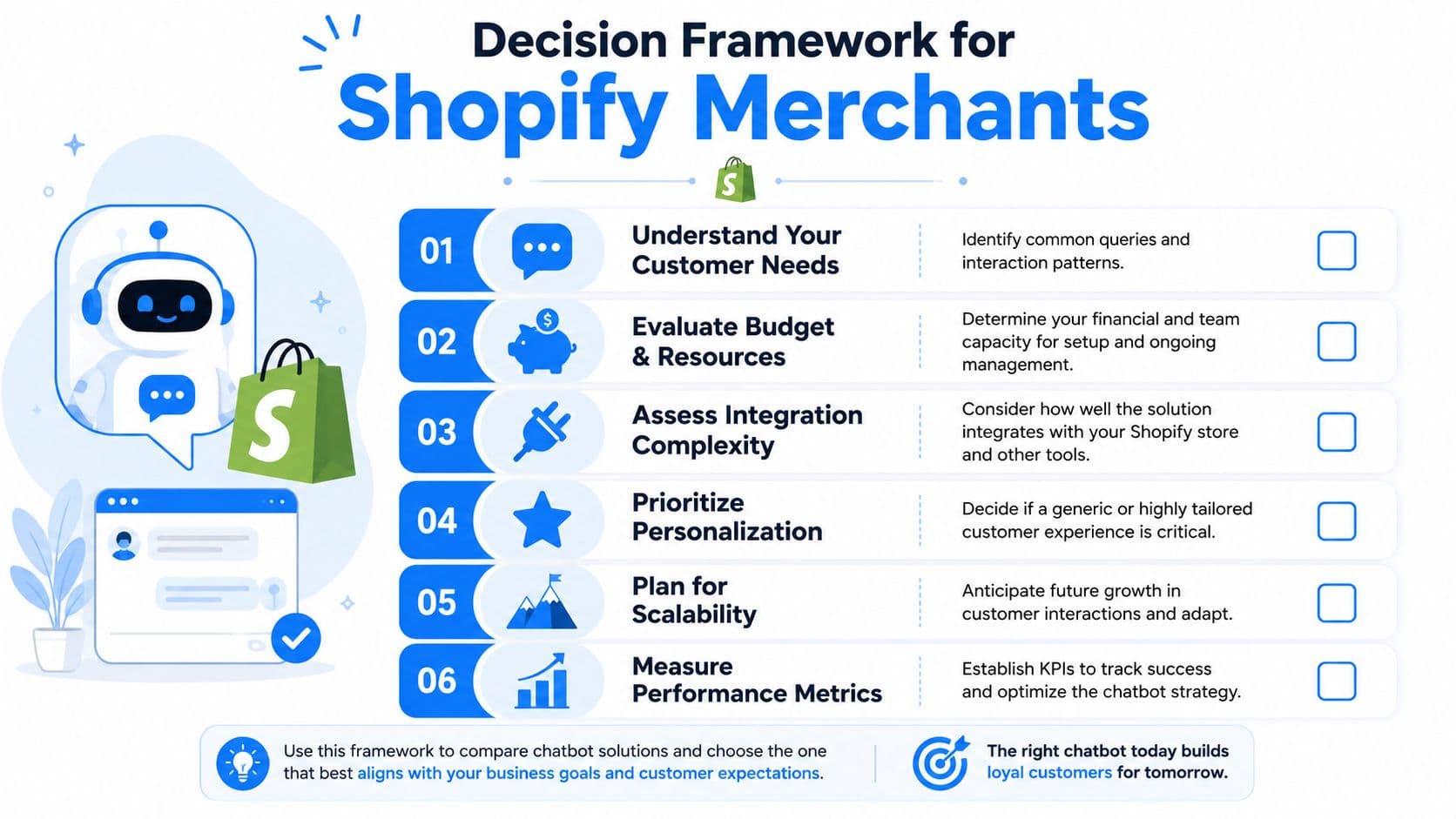
A Decision Framework for Shopify Merchants
Most stores don't need to choose between "old chatbot" and "raw ChatGPT." They need to choose the operating model that fits their revenue goals, team capacity, and risk tolerance.
Choose a specialist chatbot if you need operational control
This is usually the right path when your priority is accuracy on store facts.
Choose this route if you sell products with policy complexity, frequent support repetition, or a catalog that needs structured guidance. It also fits lean teams that don't want to manage prompts, model behavior, or custom retrieval logic week after week.
This option tends to work best when:
- Policy precision matters: Returns, shipping windows, discount logic, or regulated claims can't be improvised.
- Support volume is repetitive: The same pre-purchase and post-purchase questions keep appearing.
- Your team is small: You need automation that behaves more like software than an AI experiment.
Choose a custom LLM route if you have unusual requirements
There are valid reasons to build around a general model.
If you're a large merchant or agency with technical resources, a custom LLM layer can be powerful for concierge shopping, multilingual assistance, richer recommendations, and complex service flows. Modern LLMs outperform many traditional systems on multi-intent ecommerce questions, with 85–90% accuracy versus 60–75% for many older intent-based systems on the same type of query.
That advantage matters when your shoppers ask in messy, human language. But it only pays off if you also have the resources to ground and monitor the model properly.
This route makes sense if you have:
- A technical team that can manage integrations and testing.
- Non-standard use cases that don't fit packaged commerce tools.
- Tolerance for iteration because the system will need ongoing refinement.
Choose a hybrid model if you want both conversion and control
For most Shopify brands, this is the practical sweet spot.
Use a specialist layer for factual store data and operational tasks. Add generative capability where language flexibility improves the buying experience. That gives you the natural conversation shoppers now expect without turning pricing, inventory, or policy answers into improvisation.
A useful way to pressure-test your choice is to ask three questions:
| Decision question | If your answer is yes | Better fit |
|---|---|---|
| Do shoppers often ask messy, multi-part questions? | You need stronger language understanding | Hybrid or LLM-assisted setup |
| Do wrong answers create refunds, complaints, or lost trust? | You need tighter guardrails | Specialist chatbot |
| Do you want AI to drive revenue, not just deflect tickets? | You need selling logic, not just conversation | Hybrid commerce assistant |
Merchants thinking about ROI should also look beyond support metrics. Content, merchandising, and conversion all interact. This piece on Cosmy's ROI improvement insights is useful because it frames performance more broadly than simple automation savings.
The Smartest Path The Hybrid Model for Sales and Support
The strongest answer to the Chatbot vs ChatGPT debate is usually neither extreme.
A pure rule-based bot often feels too rigid for modern shoppers. A pure generative model feels impressive until it starts guessing about facts your business can't afford to guess on. The smarter architecture is a hybrid model where language intelligence sits behind a controlled commerce layer.
That matters because LLMs are still unreliable when they're ungrounded. In one medical study, ChatGPT identified the correct diagnosis as its primary suggestion in only about 40% of cases, according to the PMC study on ChatGPT reliability. Healthcare is obviously not ecommerce, but the lesson transfers cleanly: if the answer must be factual, current, and business-safe, you need guardrails.
For Shopify merchants, the hybrid model works like this:
- Specialist layer for truth: Catalog, policy, shipping, inventory, and approved store logic.
- Generative layer for expression: Natural wording, better interpretation of messy questions, and smoother multi-turn dialogue.
- Decision layer for outcomes: Route the conversation based on risk. Let AI be flexible where flexibility helps. Lock it down where precision matters.
The best ecommerce AI doesn't choose between structure and fluency. It assigns each job to the right layer.
This approach also fits the broader push to build a unified customer experience across marketing, support, and conversion touchpoints. Shoppers don't care which model answered them. They care whether the experience feels fast, relevant, and trustworthy from first question to checkout.
That's why the practical recommendation for most Shopify stores is specialist-first, with generative intelligence added carefully. You get the upside that made ChatGPT so compelling in the first place, but you don't hand your store's operational truth to a model that was never designed to own it.
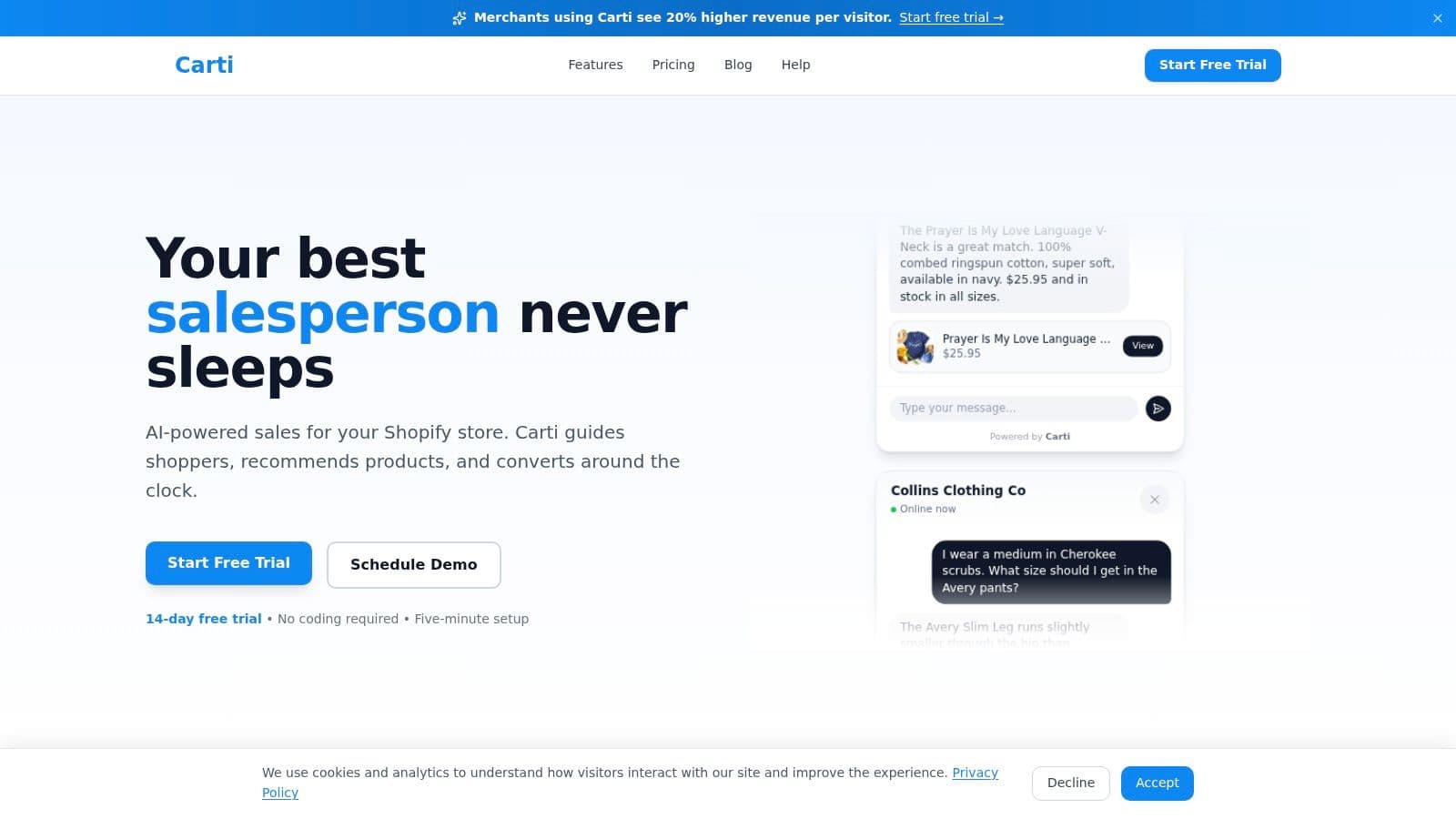
If you want that hybrid approach without building it yourself, Carti is built for exactly that job on Shopify. It helps stores answer product and policy questions accurately, guide shoppers to the right items, and turn chat into a revenue channel instead of another support queue.

Written by
Daniel AndersonFounder of Carti. 10+ years building ecommerce brands in apparel and supplements. Still runs a Shopify store and built Carti to help merchants convert more browsers into buyers.
Ready to boost your store's sales?
Install Carti in 5 minutes and let AI handle customer questions, recommend products, and close sales 24/7.
Start Free Trial14-day free trial