
A shopper lands on your Shopify store, clicks through three product pages, opens your sizing guide, then disappears. Another adds an item to cart, hesitates at the last step, and leaves because one question stayed unanswered. If you sell anything with options, fit concerns, routines, bundles, compatibility issues, or premium price points, this happens every day.
Most stores don't have a traffic problem. They have a decision problem. Shoppers want help choosing, not just access to more products.
That's where a guided selling solution earns its keep. It gives online shoppers the kind of help they'd get from a strong store associate. Not a passive search bar. Not a generic FAQ widget. Real guidance that listens, narrows choices, and recommends what fits.
What Is a Guided Selling Solution?
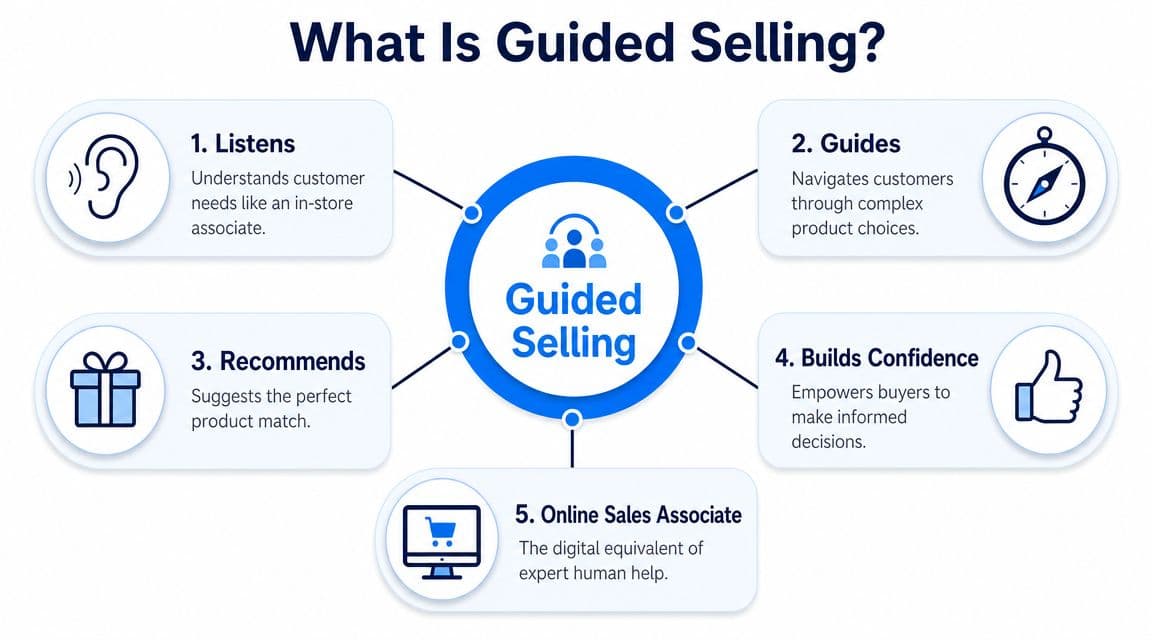
A guided selling solution is the digital version of your best sales associate. It asks useful questions, understands what the shopper is trying to solve, and recommends the most relevant product instead of forcing them to sort through your entire catalog alone.
That matters because most conversion loss on Shopify doesn't come from bad products. It comes from uncertainty. Shoppers don't know which version to buy, whether the item fits their need, or what to pair it with. When they can't resolve that quickly, they bounce.
The online version of a great store associate
In a physical store, a strong associate doesn't start by listing every SKU. They ask a few pointed questions. What are you using it for? What's your budget? Do you want something lightweight, premium, or simple? Then they narrow the options and explain the recommendation.
Online, guided selling does the same job. It turns a static storefront into a consultative buying flow.
Historically, this started in B2B sales environments where reps needed help navigating complex products and configurations. Over time, it evolved into an AI-driven layer inside CRM and CPQ systems that pulls from business data to generate real-time recommendations, according to SAP's explanation of guided selling. That shift is important because the same logic now fits B2C commerce, especially stores with broad catalogs, nuanced fit questions, or high-consideration purchases.
Practical rule: If customers regularly ask “Which one is right for me?” you need guided selling more than you need another discount popup.
Why Shopify merchants should care now
For Shopify merchants, guided selling is no longer a heavyweight enterprise idea. AI chatbots, quizzes, and shopping assistants have made it practical on smaller teams and leaner budgets. You don't need a long implementation cycle to help shoppers choose more confidently.
This also lines up with the broader move toward personalized buying experiences. If you want a solid primer on why relevance drives action, this piece on personalized marketing for SMBs is worth reading. The core lesson applies directly here. Relevance reduces friction.
A good guided selling setup does three things at once:
- Cuts decision fatigue by reducing too many choices into a manageable shortlist.
- Builds purchase confidence by explaining why a recommendation fits.
- Creates sales opportunities through better bundles, add-ons, and alternatives.
If you've been watching the rise of AI shopping experiences, this overview of AI shopping agents helps connect the dots. The practical version for Shopify is simple: the chatbot becomes the front line of guided selling, not just customer support.
How Guided Selling Works on a Shopify Store
The mechanics are simpler than most merchants expect. A working guided selling solution follows a clean loop: gather, interpret, present. That structure comes from how NetSuite describes guided selling, and it maps neatly to modern Shopify storefronts.
Gather
First, the store needs inputs. On Shopify, that usually happens through an AI chatbot, a product finder quiz, an onboarding prompt, or a guided collection page. The job here isn't to ask everything. It's to ask the minimum useful questions.
For example, a skincare store might ask about skin type, primary concern, and routine preference. A fashion brand might ask about occasion, fit, color preference, and price comfort. A supplement store might ask about goal, format, and dietary restrictions.
Good input gathering has a few traits:
- Low friction: Short questions beat long forms.
- Plain language: “What are you shopping for?” works better than internal product terminology.
- Smart sequencing: Each answer should shape the next question.
If you're still getting comfortable with the platform basics, this guide to learn Shopify with Data Hunters Agency is a useful refresher on how store structure and product organization affect the buying experience.
Interpret
Once the system has shopper inputs, it matches those inputs against your product data. At this stage, many stores fall short. They install a chatbot, but the catalog data is messy, product tags are inconsistent, and key recommendation logic doesn't exist.
The interpretation step only works when your catalog is usable. Product titles, tags, variants, collection rules, use cases, ingredient or material details, and policy information all need structure. Otherwise, the system can only give broad suggestions.
The recommendation engine can't rescue a catalog that no one has organized.
This is also why stronger conversational tools outperform simple FAQ bots. A bot that understands what the shopper means, and can map that to product attributes, behaves more like a sales assistant than a help desk. If you want to see how this category has developed, this article on an AI chatbot for ecommerce gives a practical overview.
Present
The final step is where money gets made. The system presents a recommendation, a shortlist, a bundle, or a comparison that feels specific to the customer's intent.
That presentation can take different forms:
| Format | Best use case | What works well |
|---|---|---|
| Chat recommendation | Fast product discovery | Clear reasoning and direct links to products |
| Guided shortlist | Complex categories | Two to four choices with differences explained |
| Bundle suggestion | Routine or kit purchases | Explain how products work together |
| Comparison view | Similar products | Highlight the trade-offs plainly |
What doesn't work is dumping five product cards with no explanation. The shopper still has to do the hard part. Strong guided selling presents an answer, not just options.
Core Capabilities of a Modern Solution
A lot of tools claim they do guided selling when they really just answer support questions. That's not the same thing. A true guided selling solution actively moves the shopper toward a purchase by combining discovery, recommendation, and timely intervention.
What separates guided selling from a basic bot
A basic bot waits for questions like “Where's my order?” or “What's your return policy?” That's useful, but it's defensive. Guided selling is proactive. It steps in before confusion turns into abandonment.
The difference comes down to behavior:
- Basic support bot: Reacts to service issues.
- Guided selling tool: Steers product selection and purchase decisions.
- Strong modern solution: Does both in one experience.
This video shows the kind of conversational commerce shift merchants should pay attention to:
The capabilities that matter in practice
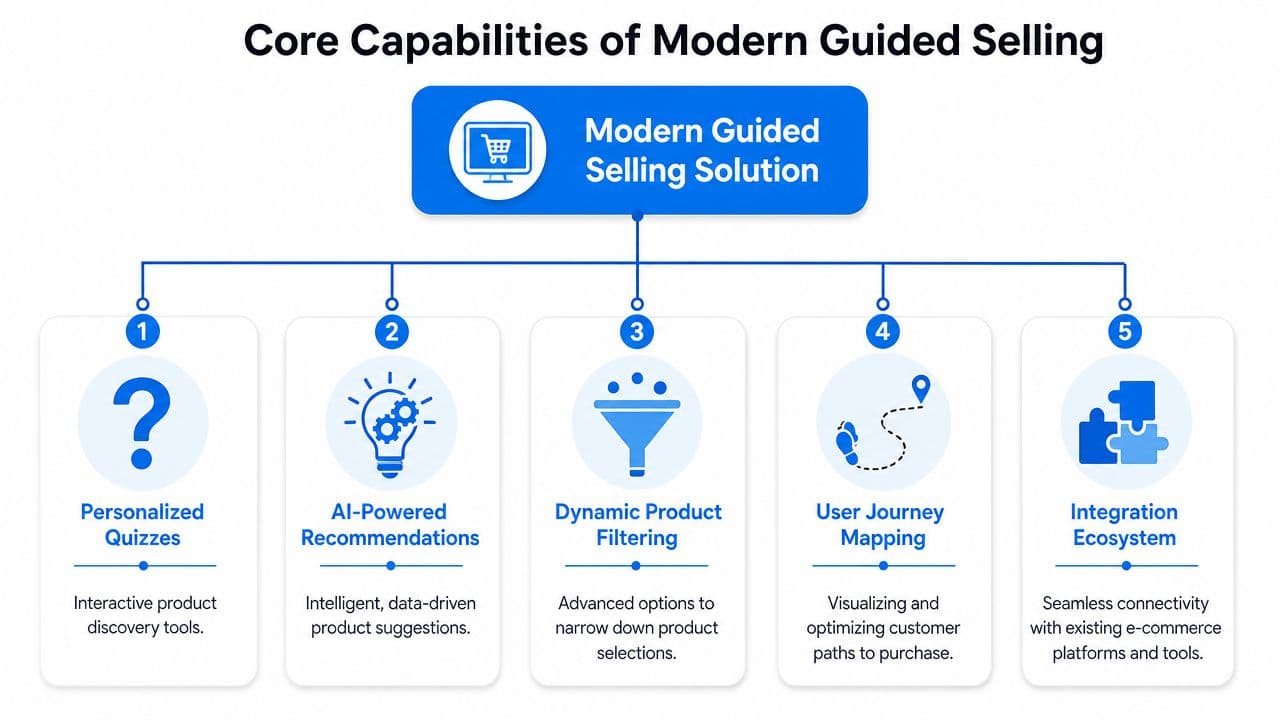
When evaluating tools, I'd focus less on feature count and more on whether the product can do these five jobs well.
-
Needs analysis
The system should ask useful questions that reveal intent. Not generic small talk. Real buying questions. For apparel, that might be event, silhouette, climate, and fit preference. For wellness, it might be goal, routine, and restrictions. -
Dynamic recommendations
Recommendations should change based on answers, browsing behavior, and product context. If every shopper gets the same “best sellers” list, that isn't guided selling. -
Proactive engagement
A modern solution should know when to start a conversation. Category pages, PDP hesitation, repeated returns to sizing info, or cart stalls are all moments where proactive help can recover momentum.
Operator note: The best prompt isn't “How can I help?” It's a specific question tied to what the shopper is doing.
-
Objection handling
Many sales die on operational doubts, not product interest. Shipping timing, return policy, compatibility, ingredients, routine order, and size confidence all need crisp answers inside the buying flow. -
Integration depth
The tool must connect to your store data, not sit beside it. Catalog, variants, collections, FAQs, and policy content should all feed the experience. Many merchants often underestimate the importance of integration in this regard.
If you're comparing this against broader onsite merchandising tools, this guide to ecommerce personalization software helps frame where guided selling fits. It's the conversational layer of personalization, and for many Shopify stores, that's the missing piece.
Business Benefits and KPIs to Track
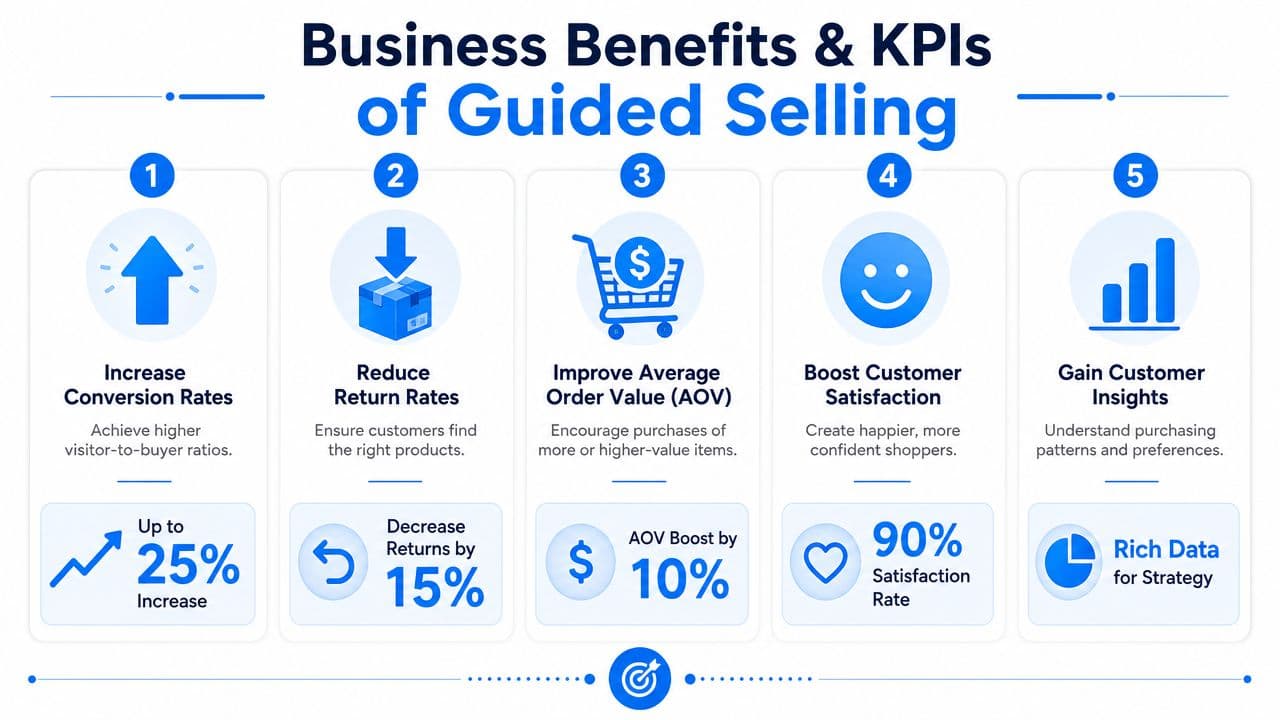
If guided selling only sounded good in demos, it wouldn't matter. What matters is whether it improves buying behavior, increases order value, and reduces wasted support effort.
The reason this category deserves attention now is scale. Gartner estimated that up to 75% of B2B sales would be conducted through guided selling by 2025, as cited in PandaDoc's guided selling overview. That's a projection, not a current store-level benchmark, but it shows how quickly guided selling has moved from a niche B2B workflow to a mainstream sales model.
Where the business impact shows up
On Shopify, the upside usually appears in three places.
First, conversion quality improves. Shoppers get answers faster, narrow choices quicker, and move with more confidence.
Second, basket quality improves. Once the system understands intent, it can recommend complementary items, upgrades, or routine-building bundles that make sense.
Third, support efficiency improves. Repetitive pre-purchase questions stop piling up in your inbox and live chat queue.
For merchants in visual and preference-heavy categories, this matters a lot. If you sell something like press-on nails, where style, shape, wear occasion, and preference all influence purchase, category context matters.
KPIs worth watching
Don't judge a guided selling solution by impressions or chatbot opens alone. Watch metrics tied to revenue and operational load.
-
Chat-influenced conversion rate
Compare sessions with guided selling interaction against sessions without it. -
Average order value with guided interaction
Look for whether recommendation-led sessions produce stronger baskets. -
Product discovery completion
Track how many shoppers finish the quiz or recommendation flow. -
Add-to-cart rate from recommendations
This tells you if the suggestion layer is relevant, not just visible. -
Pre-purchase support ticket mix
Watch whether repetitive product questions decline over time. -
Cart recovery influence
Measure whether guided prompts help rescue hesitant buyers before they leave.
Strong guided selling doesn't just answer questions. It changes what the shopper does next.
One caution. If you deploy the tool and only monitor conversation volume, you'll miss the full picture. More conversations can mean better engagement, or it can mean a confusing flow. Tie the reporting back to product clicks, cart creation, checkout progression, and order quality.
Guided Selling Use Cases for Fashion and Beauty
Fashion and beauty are ideal categories for guided selling because buyers rarely shop on specs alone. They shop with context. Occasion, skin concerns, style identity, finish preference, fit confidence, and routine compatibility all shape the decision.
Fashion shoppers want reassurance, not just filters
A fashion shopper browsing dresses doesn't want to work through dozens of options manually. She wants help answering a few practical questions. Is this for a wedding guest look or daily wear? Do I want fitted or relaxed? Is the fabric better for warm weather? What shoes or layers go with it?
A guided selling chatbot can act like a stylist. It can ask what the outfit is for, what silhouette feels comfortable, and whether the shopper wants understated, polished, or bold. Then it can recommend a tighter set of products with reasoning that feels human.
That last part matters. “This works because it's lightweight and easier to dress up” is better than “Recommended for you.”
Here's where many fashion brands get it wrong. They build advanced collection filters, then assume that's enough. Filters help organized shoppers. Guided selling helps uncertain shoppers. Those are not the same person.
Beauty shoppers need translation from concern to product
Beauty is even more dependent on translation. Customers often know the problem but not the product. They'll say they want to calm redness, build a routine for dry skin, or find a foundation that won't feel heavy. They usually won't say which serum category, formulation family, or finish type they need.
A guided selling solution closes that gap. It can ask about skin type, concerns, sensitivity, desired finish, or current routine, then recommend a product set in the right order. For makeup, it can narrow shade families or formula types. For skincare, it can build a simple regimen instead of pushing isolated products.
In beauty, guidance is part of the product. If the customer doesn't understand how to use it, they often won't buy it.
The practical win is that guided selling lowers the intimidation factor. Instead of making the shopper decode your catalog, it translates needs into a path. That's why these categories often see the clearest qualitative impact from a well-built conversational buying experience.
How to Choose Your Shopify Guided Selling Solution
Most merchants don't need the most advanced platform on the market. They need the one they'll launch, maintain, and improve. A guided selling solution only works when it's live, connected to your catalog, and trained on the questions shoppers really ask.
The selection criteria that actually matter
Start with setup effort. If implementation depends on a developer queue, a custom taxonomy project, and weeks of tuning before anything goes live, many lean teams will stall out. For most Shopify brands, no-code or low-lift deployment is the difference between adoption and shelfware.
Then check integration depth. The tool should understand your product catalog, variants, collections, policies, and common store questions. If it can't pull from real store data, recommendations will feel generic or wrong.
The AI layer matters too, but merchants often evaluate it the wrong way. Don't ask whether the bot sounds clever. Ask whether it can guide a shopper to the right product without inventing answers, missing policy context, or flattening differences between SKUs.
I'd use a checklist like this:
-
Catalog intelligence
Can it understand products beyond title matching? Variants, usage context, and differences between similar items matter. -
Policy awareness
Can it answer shipping, returns, sizing, or routine questions accurately during the buying journey? -
Proactive behavior
Does it wait for users to ask, or can it engage when hesitation is visible? -
Recommendation quality
Does it explain why it suggested an item, or does it just surface products? -
Operational reporting
Can your team learn from what shoppers ask and where they get stuck?
Red flags to avoid
Some tools look impressive in a demo and fail under live store conditions. The usual problems are predictable.
-
FAQ-only behavior
If the system mostly deflects support requests and rarely influences product selection, it isn't true guided selling. -
Weak Shopify sync
Manual product updates create drift. Drift creates bad recommendations. -
One-size-fits-all scripts
If every category uses the same generic flow, the experience won't feel useful. -
No merchandising feedback loop
You should learn which questions repeat, which products cause confusion, and where buyers hesitate.
A guided selling tool should improve your storefront over time, not just sit on top of it.
What good implementation looks like
The best rollout usually starts small. Pick one category where shoppers ask a lot of pre-purchase questions. Build a conversational flow around that decision. Monitor what shoppers ask, tune the recommendations, then expand to other categories.
For a fashion store, that might start on dresses or denim. For beauty, it might start with shade matching or skincare routines. For wellness, it might start with goal-based product selection.
Good implementation also means writing for real customer language. Don't train the system only on your internal merchandising language. Train it on how customers ask. “Will this work for sensitive skin?” is better input than a polished taxonomy label.
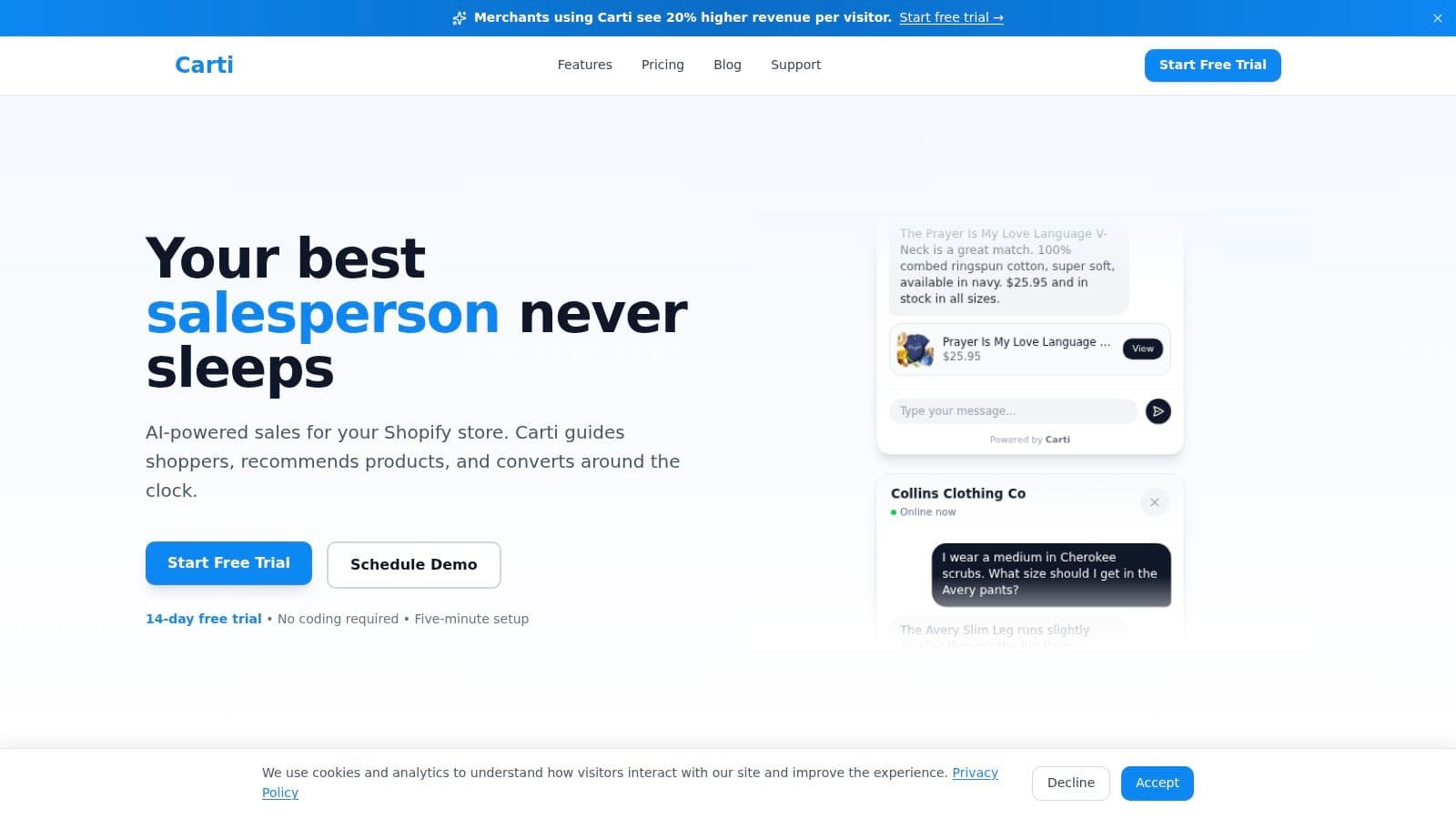
If you want a solution that fits how Shopify teams operate, look for one that installs quickly, syncs your catalog automatically, answers store questions accurately, makes smart product suggestions, and supports proactive cart recovery. That combination is what turns a chatbot into a sales channel.
If you want to put guided selling to work without a long implementation cycle, Carti is built for Shopify merchants who need a practical AI sales associate, not just another support widget. It installs fast, learns your catalog and store policies automatically, helps shoppers choose products, and stays active around the clock to answer questions, recommend items, and recover hesitant carts.

Written by
Daniel AndersonFounder of Carti. 10+ years building ecommerce brands in apparel and supplements. Still runs a Shopify store and built Carti to help merchants convert more browsers into buyers.
Ready to boost your store's sales?
Install Carti in 5 minutes and let AI handle customer questions, recommend products, and close sales 24/7.
Start Free Trial14-day free trial