
A customer profile is a detailed summary of your typical or ideal customer, built from real data on their demographics, behaviors, and purchase history. Unlike a persona, it's a data-driven blueprint for targeting and personalization.
If your Shopify store is getting traffic but not enough buyers, the problem usually isn't “more marketing.” It's that the message is too broad, the support is too generic, and the checkout path isn't built around the shopper who's on your site. In ecommerce, that mismatch is expensive, because the market is broad but still skews mobile and concentrated in a few age bands, with smartphones accounting for nearly 80% of retail website visits worldwide in 2024, global ecommerce sales projected to reach about $6.9 trillion by 2026, and more than 2.86 billion people shopping online according to Statista's online shopping topic page.
A useful customer profile turns that mess into a working system. It helps you decide who to target, what to say, which objections to answer first, and how to automate the follow-up without guessing. Because 81% of retail shoppers research online before buying and the average web-store bounce rate is around 45%, profiles have to reflect people who compare options, expect fast answers, and leave when friction shows up, as Adobe reports.
What Is a Customer Profile?
A customer profile is what you build when you stop marketing to “everyone” and start marketing to the people who buy. For a Shopify store owner, that means turning scattered store data into a clear picture of the customer who creates the most value, then using that picture to guide ads, emails, support, and merchandising. The result is less wasted effort and more relevant traffic.
A practical definition
Adobe describes an ideal customer profile as an actionable, unified view built from actual behavior across web and mobile properties, including purchase history, browsing behavior, campaign engagement, and customer lifetime value. That wording matters because a customer profile is not a fictional backstory.
It's a decision tool.
If you've ever looked at your Shopify analytics and thought, “We've got visitors, but they're not all the same,” you were already seeing why profiles matter. A store selling skincare, home goods, or apparel doesn't need a made-up archetype. It needs a summary of actual customers who keep coming back, which products they view, what they abandon, and what makes them convert.
Practical rule: if a detail won't change targeting, messaging, merchandising, or support, it doesn't belong at the center of the profile.
That's also why audience work is more useful when it starts with analysis instead of vibes. If you need a structured way to think about who you're speaking to, mastering audience analysis is a good companion concept, because it pushes the same discipline of turning raw observations into usable market understanding.
For Shopify merchants, the best customer profile isn't a static PDF. It's a living operating note that shapes what gets automated, what gets personalized, and what gets escalated to a human. It should answer basic commercial questions fast. Who buys, what they buy, what they hesitate on, and what support issue keeps slowing conversion.
For customer experience teams, a profile also connects directly to service quality. A shopper who has already browsed, compared, and added items to cart should not get the same response as a first-time visitor asking what your return policy is. If you want the support side of that picture, our guide on customer engagement fits neatly beside this one.
The Four Core Components of a Customer Profile
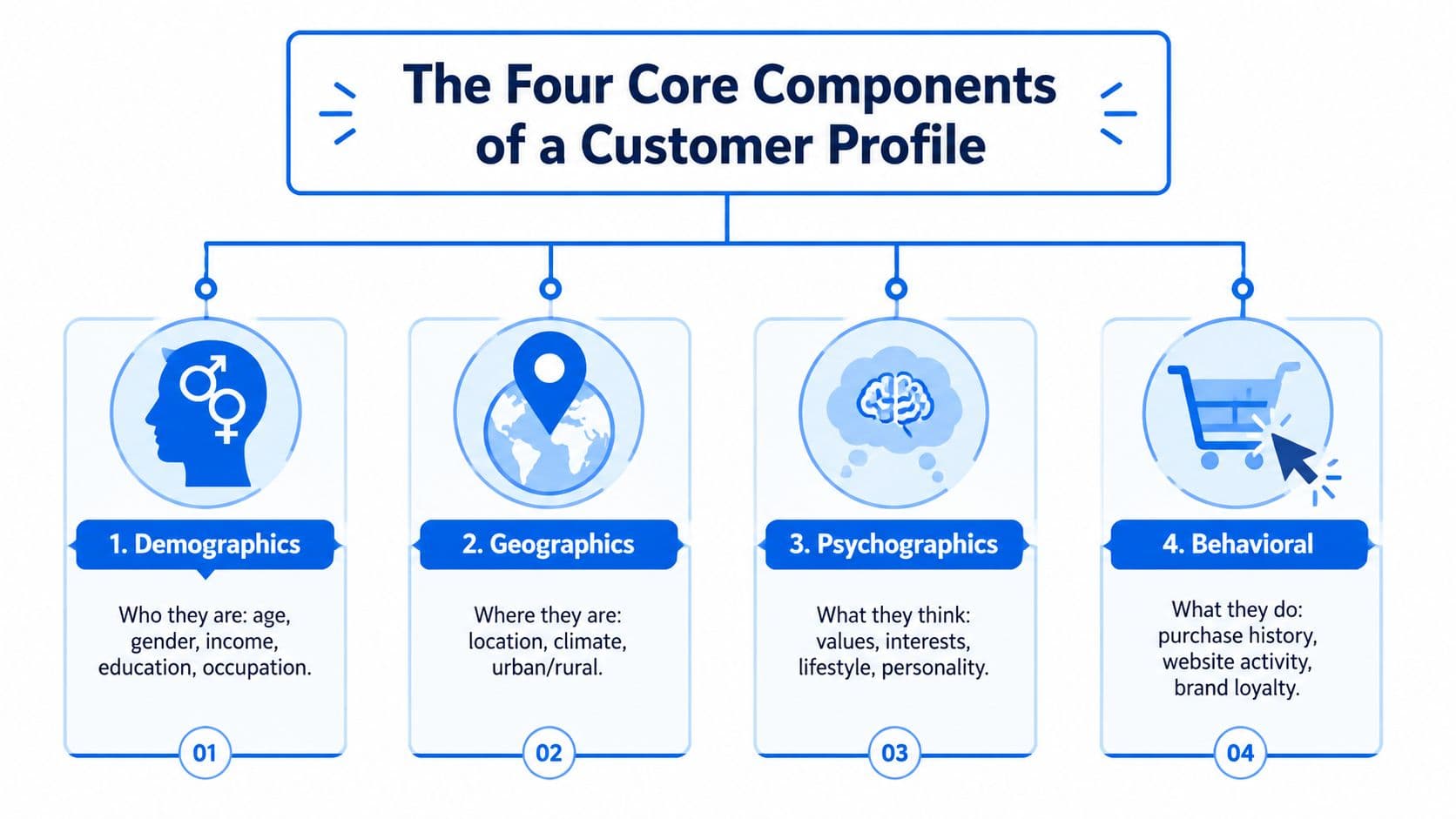
A useful profile has four layers, and each one answers a different commercial question. In a Shopify store, those layers show you who is buying, where they shop from, why they choose you, and what they do before and after purchase. If you only capture one layer, you end up with a profile that looks tidy but does not help with conversion, merchandising, or support.
Demographics and geographics
Demographics answer who they are. For ecommerce, that can include age range, gender, income band, education, occupation, and household role. These fields help you spot the broad groups most likely to respond to a product, offer, or price point, without pretending they tell the whole story.
Geographics answer where they are. Location matters because shipping speed, climate, language, delivery promises, and even product assortment can change by region. A beachwear brand and a winter apparel brand need different location logic, and a store shipping nationally may still find that urban and rural customers behave differently at checkout.
Used well, these fields help you make practical decisions. If buyers in one region regularly need faster delivery estimates, or a certain household type tends to buy bundles instead of single items, that should change how you sort products, set shipping rules, and frame offers.
Psychographics and behavioral signals
Psychographics explain why they buy, including values, interests, lifestyle, and decision drivers. A customer may care about sustainability, convenience, status, comfort, or solving one specific problem. That motivation shapes product page copy and email angles more than age alone ever will.
Behavioral data shows what they do. In Shopify, this is the layer that connects most directly to revenue because it reflects real intent. Look at products viewed, purchase history, repeat order patterns, cart abandonment, email clicks, and support contacts. Combining analytics, purchase history, and customer feedback gives a clearer view of intent and friction than demographics alone, because it shows what shoppers respond to and where they hesitate.
A profile becomes useful when those four layers line up. If a customer is mobile-first, price-aware, and repeatedly browsing a specific category before buying, you have enough signal to tailor ads, landing pages, and recovery messages around that pattern instead of sending the same offer to everyone.
Useful shortcut: demographics tell you who is likely to buy, psychographics tell you what will persuade them, and behavioral data tells you what to automate next.
Customer Profile vs Persona vs Segment
These terms get mixed up all the time, but they do different jobs. If you use the wrong one, your team ends up with polished documents that don't help anyone make a decision. Shopify owners feel this most when marketing has one definition, support has another, and leadership wants one number to tie it all together.
| Criterion | Customer Profile | Buyer Persona | Market Segment |
|---|---|---|---|
| Data Source | Mostly quantitative, plus feedback and CRM context | Mostly qualitative, with some data support | Quantitative grouping logic |
| Purpose | Targeting, personalization, support, merchandising | Content, messaging, creative direction | Audience organization and campaign setup |
| Format | Data summary or living record | Narrative character sketch | Group definition by shared traits |
| Best Use | Operational decisions | Copy and campaign ideas | Paid media and list building |
Where the ICP fits
Salesforce draws an important line between a customer profile and an ideal customer profile, or ICP. In its framing, ICPs are usually B2B company-fit frameworks that cover firmographics and technographics, while customer profiles focus on individual consumer data (Salesforce customer profile). That difference matters because B2C Shopify stores need a customer profile, not a B2B qualification framework.
A buyer persona is useful when you're writing copy or planning creative. It gives a name, a story, and a set of motivations to the customer profile. But the persona shouldn't replace the profile, because personas are narrative tools, not operational records.
A market segment sits at a different altitude. It's a group defined by shared traits, such as device type, geography, or purchase behavior. Segments help you run campaigns, but they don't always tell you how to speak to the person inside the group.
For Shopify, the best setup is usually this. Use the customer profile to define the truth, use personas to communicate that truth internally, and use segments to activate campaigns. If the three disagree, trust the data-backed profile first.
The fastest way to clean up confusion is to ask one question, “Does this help us qualify, personalize, or target?” If the answer is no, it probably belongs elsewhere.
How to Build Your Customer Profile with Shopify Data
Start with the data you already own. Most Shopify stores do not need a giant research project before they can build a strong customer profile. They need a clean pass through the tools they already use, then a way to connect the signals into one usable view.
Pull the highest-signal data first
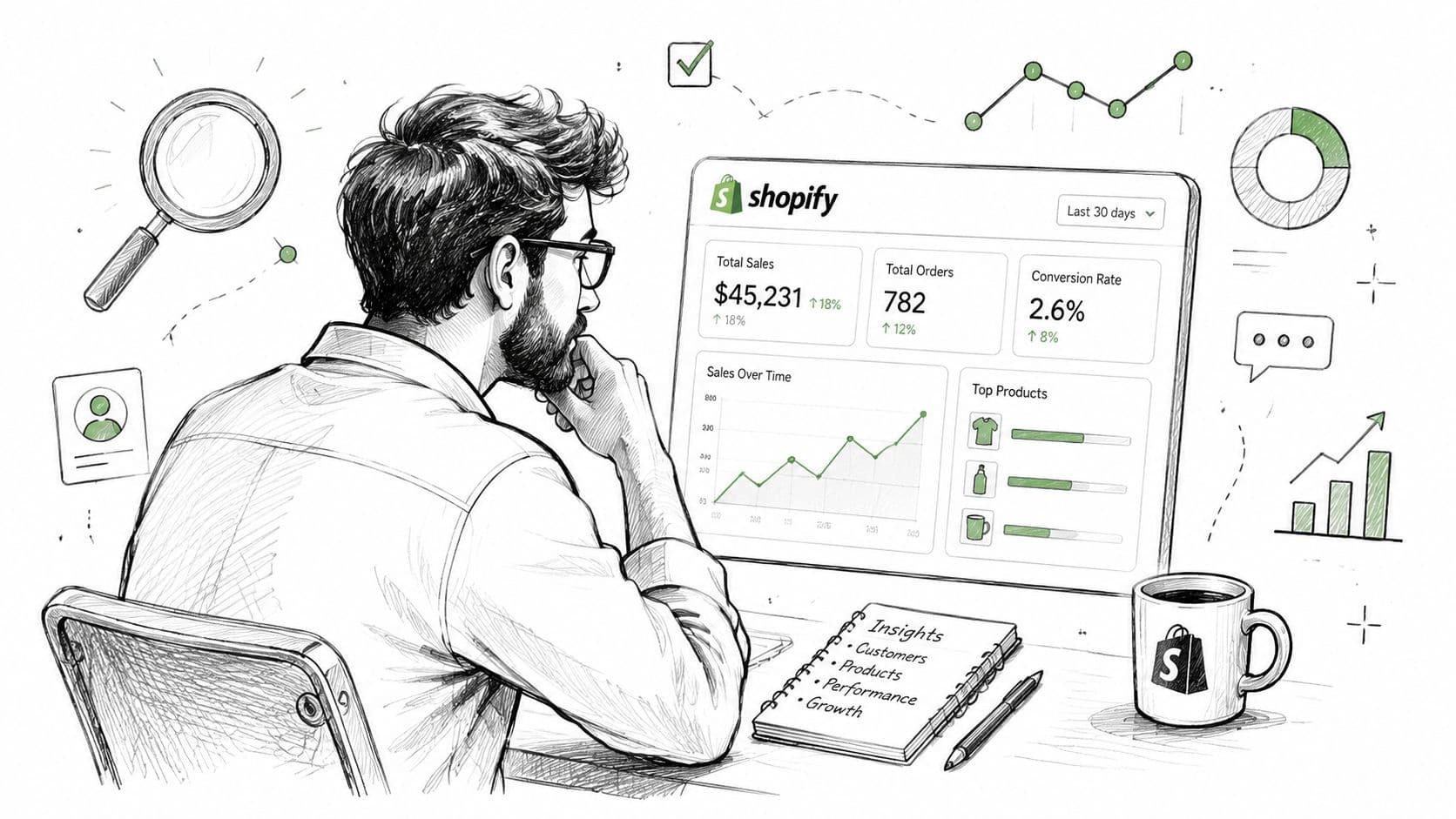
Shopify Analytics gives you the commercial basics, such as top products, repeat purchases, order patterns, and customer location. Google Analytics helps you see traffic sources and device behavior. If your traffic skews heavily toward phones, your profile should reflect that reality, not an imagined desktop shopper.
Customer surveys add the missing “why.” Ask what nearly stopped the purchase, what they were comparing, and what question they still had before buying. Those answers often reveal the words shoppers use to describe their own pain points.
Customer support logs are just as valuable. The same question repeated in chat, email, or tickets is profile data. It shows where friction lives, which objections delay purchase, and which product details need to be surfaced earlier.
Use support and engagement data, not guesswork
For ecommerce, behaviorally anchored inputs are the strongest signals. Purchase history, customer feedback, and web analytics reveal intent and friction without relying on assumptions. That is why support transcripts, FAQ patterns, and product questions are so useful.
If you want a deeper operational view of what customers ask and how they move through the store, our guide on customer analytics solution is worth pairing with your profile work. It helps when you need to turn support questions into merchandising fixes or automation rules.
Here is a practical way to organize the inputs:
- Shopify store data: top products, repeat buyers, order frequency, location, cart abandonment patterns.
- Analytics data: device usage, traffic source mix, landing pages, returning visitors.
- Customer feedback: survey responses, reviews, and support themes.
- Campaign data: email clicks, ad audiences, promotional response patterns.
Useful check: if the same customer type shows up in three different tools, you have probably found a real profile pattern rather than a one-off trend.
For merchants building paid acquisition around first-party signals, the PPC playbook for 2026 is a useful reference for shaping audience quality and ad relevance from profile data.
The last step is to consolidate the patterns into a short, usable summary. Do not write a brand story. Write a working profile that names the customer, what they need, what they do before buying, and where they get stuck. If a future team member cannot use it to make a decision, it is too vague.
Using Profiles to Increase Conversions and Support
A strong profile pays off in the parts of the store that touch revenue fastest. It sharpens ad targeting, improves onsite messaging, supports email automation, and gives support teams more context before they reply. The goal is not a nicer document. The goal is a store that is easier to buy from.
Turn profile data into conversion actions
A customer profile should change what your store does next. If it shows a buyer who compares options heavily, product pages need stronger proof, clearer FAQs, and less filler. If it shows a customer who values convenience, checkout, shipping, and return details need to be visible before the last click. If it shows repeat buyers with a narrow product preference, upsells should stay tightly relevant.
Profile data also helps you decide where friction is costing sales. A shopper who hesitates at the product page needs a different response than one who already abandoned cart after seeing shipping terms. The first may need more proof, the second may need a clearer delivery promise or a faster path back to checkout.
The same logic applies to ad targeting and onsite messaging. If a profile points to a specific intent or objection, the creative, landing page, and offer should reflect it. Otherwise the store keeps paying to attract traffic that the page does not answer well.
A profile should also help you focus on the questions that keep blocking purchase. Ecommerce researchers at Adobe note that shoppers often research before buying, and that stores lose a large share of visitors before they move deeper into the funnel. Profiles help you decide which questions to answer first, so the page does more of the selling before support ever gets involved.
That makes support part of conversion work, not just a cost center. A shopper with one abandoned cart does not need a generic “Can I help?” message. They need a response that matches their stage, their likely objection, and the product they already showed interest in.
Use support context to improve the sale
A profile that includes support data changes how pre-purchase questions get handled. Instead of treating every inquiry as isolated, agents can spot patterns and respond with better context. A customer asking about sizing, delivery, or compatibility is often signaling a buying barrier, not just asking for information.
Support feedback also helps improve the store itself. When recurring questions are folded back into the profile, the team can tighten copy, add missing FAQs, and reduce repeated friction on the product page. That lowers the pressure on live support to save every sale manually.
This works best when product discovery, support, and conversion are treated as one process. The customer profile is the reference that keeps them aligned. It tells the team what people need before they buy, what stops them, and what reassurance moves them forward.
Practical rule: if a customer asks the same question before buying, the answer belongs on the page, in the automation, or in the profile.
For Shopify teams using AI chat, profile data is especially useful because it lets the chat layer act like a real sales associate. Instead of answering in generic terms, it can surface relevant products, handle objections with context, and guide shoppers toward the next best action based on what they have already done. That works best when the profile includes browsing behavior, purchase history, and support themes, not just broad audience labels.
Tools and KPIs for Managing Customer Profiles
Profiles work best when they live inside a repeatable system. For most Shopify stores, that means a CRM or customer list, analytics tooling, and a support layer that feeds real questions back into the profile. The structure matters because profiles decay quickly when they're left as a one-time project.
A practical stack usually starts with Shopify's customer records, then adds Google Analytics for behavior, and a help desk or support platform for qualitative context. Once those sources are connected, the profile stops being a static note and starts becoming an operating reference for marketing, support, and merchandising.
The next thing to watch is not just whether the profile exists, but whether it changes decisions. The best KPIs are the ones that show profile quality is translating into profit, not just cleaner reporting. For a useful KPI framework, our guide on e-commerce key performance indicators is a strong complement.
Track these outcomes:
- Conversion rate by customer segment to see whether personalized messages are working.
- Average Order Value, or AOV, to check whether profile-driven offers and bundles are increasing basket size.
- Customer Lifetime Value, or LTV, to measure whether the right customers are returning and buying again.
If those metrics improve after profile updates, the profile is doing real work. If they don't, the profile is probably too broad, too stale, or built from the wrong signals.
Keep the process simple. Review the profile regularly, update it with new support themes and purchase behavior, and remove assumptions that no longer match what your customers do. A profile should make your team faster and more confident, not give them another document to ignore.

Written by
Daniel AndersonFounder of Carti. 10+ years building ecommerce brands in apparel and supplements. Still runs a Shopify store and built Carti to help merchants convert more browsers into buyers.
Ready to boost your store's sales?
Install Carti in 5 minutes and let AI handle customer questions, recommend products, and close sales 24/7.
Start Free Trial14-day free trial