
You're probably collecting more customer data than you think.
A shopper lands on your Shopify store, accepts cookies, asks a product question in chat, gets a smart recommendation, joins your email list, abandons a cart, then comes back from a retargeting ad. That feels like normal e-commerce. Under GDPR, it's a chain of data processing decisions, and every one of them needs a lawful basis, a clear purpose, and a defensible setup.
That's why understanding GDPR compliance matters so much for Shopify merchants in 2026. The challenge isn't usually the storefront itself. It's the stack around it: analytics scripts, review apps, popups, email tools, customer support platforms, and AI features that profile behavior in the background. Generic GDPR guides rarely deal with that reality. They explain the law at a high level, then leave merchants to guess how it applies to live chat prompts, product suggestions, and app permissions.
Why GDPR Compliance Is a Business Imperative
For many store owners, GDPR feels abstract until they map it to an ordinary customer journey. A newsletter form collects an email address. A chatbot captures a question and ties it to browsing behavior. A personalization app tracks viewed products and device details to suggest what to buy next. None of that is unusual. All of it can fall inside GDPR.
The financial exposure is no longer theoretical. Cumulative GDPR fines since May 25, 2018, have exceeded €7.1 billion, the average cost of a single violation reached €4.4 million in 2023, and fines can reach up to 4% of annual global turnover, according to this GDPR fines and enforcement overview. For a Shopify merchant, the takeaway is simple: privacy mistakes can become business risk fast.
That matters even if you're not based in Europe. If you offer goods or services to EU customers, GDPR can still apply. A small brand with a polished storefront and a global shipping option doesn't get a pass because it isn't a household name.
Practical rule: If your store uses forms, cookies, pixels, chat, analytics, reviews, or automated recommendations, treat GDPR as an operating requirement, not a legal side task.
There's also a second reason merchants should care. Buyers are paying closer attention to how stores handle data. They notice vague cookie banners, bundled opt-ins, and chatbots that feel invasive. Privacy now sits next to delivery, returns, and support quality as part of the customer experience.
AI raises the stakes further because it often hides the line between helpful automation and opaque profiling. If you're also looking at the broader compliance picture around automation, this guide to understanding enterprise AI risks is useful context alongside GDPR.
The Seven Core Principles of GDPR Explained
GDPR makes more sense when you stop reading it like a statute and start reading it like store operations.
Think about a high-end physical boutique. A customer gives you their details for a delivery, asks to join your VIP list, and trusts you to keep that information private. You wouldn't scribble down extra details for no reason, use the address for unrelated promotions, or leave the client book open on the counter. GDPR applies that same logic to digital commerce.
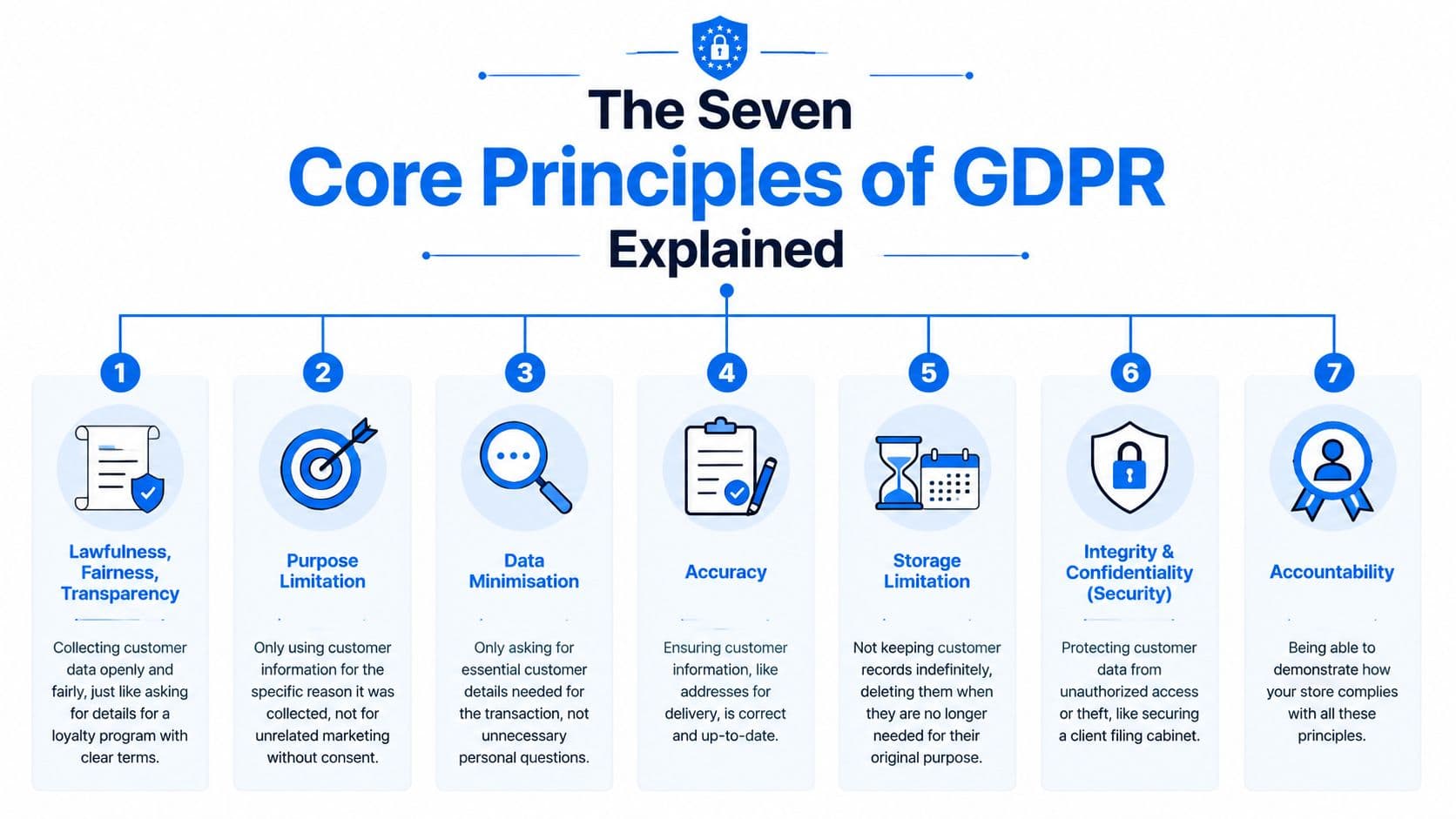
According to Osano's GDPR overview, the seven core principles are lawfulness, fairness, and transparency; purpose limitation; data minimization; accuracy; storage limitation; integrity and confidentiality; and accountability. The regulation also defines personal data broadly, including IP addresses and device information, which is why ordinary Shopify tools need careful setup.
What these principles look like in a store
Lawfulness, fairness, and transparency means you tell people what you're collecting and why, in language they can understand. If your popup says “Get updates,” but the data also feeds ad audiences or product profiling, that isn't transparent.
Purpose limitation means you use data for the reason you collected it. A shipping address is for fulfillment. It isn't automatically fair game for unrelated marketing.
Data minimization is one of the easiest principles to understand and one of the most ignored. If a purchase only requires a name, shipping details, and payment information through the appropriate processor, don't collect extra fields because they might be useful later.
Accuracy matters because bad data creates bad outcomes. Wrong addresses cause failed deliveries. Old contact details can lead to failed support follow-ups or incorrect account records.
Why Shopify merchants get tripped up
Storage limitation means you shouldn't keep customer data forever just because storage is cheap. Retention should follow purpose. If you no longer need certain data for support, fulfillment, compliance, or legitimate business operations, review whether it still belongs in your systems.
Integrity and confidentiality means securing the data you hold. In a store, that would mean locking the filing cabinet. Online, it means controlling access, using secure tools, and making sure apps and integrations don't expose customer information carelessly.
Accountability is the principle that catches many merchants off guard. It's not enough to mean well. You need to show how you comply. That includes your policies, consent records, vendor agreements, and the internal decisions behind your setup.
The strongest GDPR programs usually look boring from the outside. Clear notices, limited data collection, tidy retention rules, and documented decisions beat flashy legal language every time.
If you're focused on understanding GDPR compliance in practical terms, these principles are the foundation. Every app install, popup design, chatbot flow, and analytics change should be tested against them.
Lawful Bases for Processing Data You Must Know
Most Shopify merchants don't need to memorize every legal theory in GDPR. They do need to understand one operational truth: every processing activity needs a documented lawful basis.
For stores, the two bases that create the most confusion are consent and legitimate interest. Merchants often blur them together, especially when they add marketing tools or AI personalization features.
Consent means active permission
Consent has a high bar. It must be clear, specific, informed, and unambiguous. That standard matters because weak consent design remains a common failure point. Under GDPR Article 6, a documented lawful basis is required for all processing, and a 2024 EU report found that 68% of non-compliant e-commerce sites failed due to invalid consent mechanisms like pre-ticked boxes, as summarized in this GDPR compliance checklist analysis.
Here's what usually works better in practice:
- Separate choices: Give users distinct options for email marketing, analytics cookies, and any profiling-related features.
- Clear labels: Say what happens after consent. “Receive product updates by email” is stronger than “Stay in the loop.”
- Easy withdrawal: If someone can opt in in one click, they should be able to withdraw just as easily.
What doesn't work well is bundled language. If one checkbox covers newsletters, behavior tracking, and personalized offers, you're creating risk.
Where legitimate interest can help and where it fails
Legitimate interest can apply in some business contexts, but merchants often overreach with it. It may support limited processing that customers reasonably expect, especially where the impact on privacy is low and the purpose is tightly defined. It is not a universal shortcut for any tracking or personalization you'd prefer not to ask permission for.
A useful way to think about it is this:
| Processing activity | Usually safer basis |
|---|---|
| Newsletter signup | Consent |
| Non-essential cookies | Consent |
| Behavioral profiling for recommendations | Consent is often the safer route |
| Basic operational communication about an order | Another lawful basis may apply depending on context |
If your tool builds a profile from browsing behavior, chat interactions, or purchase patterns, don't assume “legitimate interest” will carry the whole process.
For merchants working through understanding GDPR compliance, lawful basis decisions should be written down. Not just assumed. If you can't explain why a specific app processes specific customer data, you don't have a strong position if a regulator or customer asks.
Understanding Data Subject Rights and Your Responsibilities
GDPR gives customers real control over their personal data. For merchants, that means privacy can't stop at a policy page. You need a working process for requests that arrive through email, contact forms, chat, or support tickets.
In Shopify, these requests are operational. Someone may want a copy of their data, ask you to correct an error, object to certain processing, or request deletion. The hard part usually isn't the principle. It's coordinating across Shopify, apps, support tools, email platforms, and anyone else holding the customer's data.
The rights customers can exercise
The rights commonly discussed under GDPR include access, rectification, erasure, restriction, portability, objection, and rights related to automated decision-making and profiling. In practice, customers rarely phrase requests in legal language. They'll say things like “What data do you have on me?”, “Delete my account,” or “Stop using my data for recommendations.”
That means your team needs a simple triage process:
- Confirm identity carefully: You need to avoid handing data to the wrong person.
- Locate the systems involved: Shopify alone may not be the full record.
- Respond consistently: Support, marketing, and operations should follow the same playbook.
For teams that want a concise example of how a company frames privacy responsibilities for operational use, understanding Fluesta's privacy for teams is a useful reference point.
A practical Shopify response table
Data Subject Rights and How to Fulfill Them in Shopify
| Data Subject Right | What It Means for the Customer | Your Action as a Shopify Merchant |
|---|---|---|
| Right to be informed | The customer wants clear information about how their data is used | Keep your privacy notice current, readable, and specific to your real tools and workflows |
| Right of access | The customer wants a copy of their personal data | Export the relevant customer information from Shopify and gather related records from connected apps and support tools |
| Right to rectification | The customer wants incorrect data corrected | Update customer details in Shopify and any connected systems where the same information appears |
| Right to erasure | The customer wants data deleted when there's no valid reason to keep it | Review what can be deleted, what must be retained for legal or operational reasons, and complete deletion across vendors where appropriate |
| Right to restrict processing | The customer wants you to stop using data in certain ways without fully deleting it | Flag the account internally, pause the relevant processing activity, and make sure your tools reflect that restriction |
| Right to data portability | The customer wants their data in a usable format | Provide the relevant data in a structured export and make sure it's understandable, not just raw fragments |
| Right to object | The customer wants to object to specific processing such as direct marketing | Suppress the customer from the relevant marketing or profiling workflows promptly |
| Rights related to automated decision-making and profiling | The customer wants clarity or control where automation affects them | Explain whether profiling is taking place, what it does, and disable or limit it where the request requires that |
A good response process is less about legal jargon and more about operational hygiene. Assign ownership, use a standard intake method, and keep a record of what was requested and what your team did.
Customers usually judge privacy by the response they get after they ask for help. A slow, confused answer creates more distrust than a dense policy ever will.
Controller vs Processor: What Shopify Merchants Must Understand
One of the most important GDPR distinctions is also one of the most misunderstood. You are usually the data controller. Your vendors are usually processors.
That's because you decide why customer data is collected and how it's used in your store. You choose the email platform, the review app, the support tool, the loyalty plugin, and the chatbot. Shopify and those apps process data within the environment you've assembled.
Who decides and who acts
A simple test helps. Ask two questions.
- Why is this data being collected? If your business decides that, you're acting as controller.
- Who processes it on your behalf? That vendor is usually acting as processor for that activity.
The controller carries the main accountability burden. If an app mishandles data, “the app did it” usually isn't a satisfying answer.
What this means for your app stack
For Shopify merchants, this translates into vendor management. You need to know what each app accesses, what it stores, and whether it offers a Data Processing Agreement. If a tool can't explain its data handling clearly, that's a warning sign.
Your review process should include:
- Check the DPA: Make sure vendors offer terms that reflect GDPR processor responsibilities.
- Limit app sprawl: Every installed app expands your data surface area.
- Review permissions: Remove tools that no longer serve an active business purpose.
Shopify merchants should also review platform guidance around privacy and customer data handling in the Carti data and privacy help center.
A clean app stack is easier to secure, easier to explain to customers, and easier to manage if you ever need to answer a regulator or handle a deletion request.
A Practical GDPR Compliance Checklist for Your Shopify Store
Theory helps. Checklists keep stores out of trouble.
The most effective GDPR work I see in Shopify stores starts with a blunt inventory: what data you collect, where it goes, who can access it, and whether the customer would understand that flow if you explained it plainly. Merchants often jump straight to policy generators. That's backwards. If your actual setup is messy, the policy only documents the mess.
Start with visibility, not policy templates
Begin by auditing your stack.
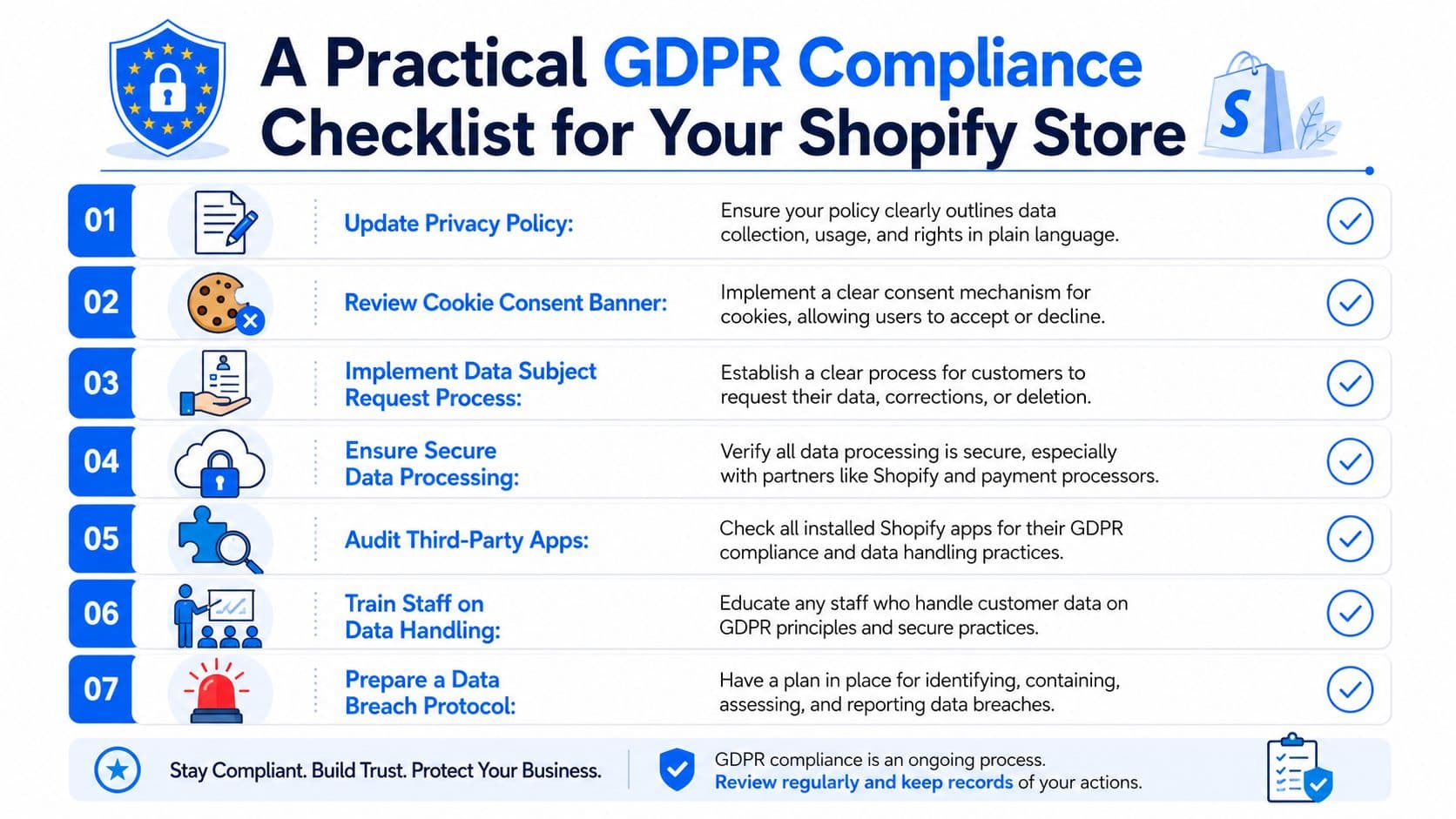
List Shopify itself, payment providers, analytics tools, popups, email platforms, review apps, loyalty systems, customer support software, and every AI feature on the site. Then document four things for each one: what data it touches, why it uses it, what lawful basis you rely on, and whether customers are told about it clearly.
This step usually reveals the biggest problems fast:
- Legacy apps still installed: Old apps may retain access long after the project that required them ended.
- Privacy notices that lag behind reality: The store added tools, but the notice never changed.
- Unclear ownership: Nobody on the team knows who approved a script or what it does.
If you need a benchmark for how your customer-facing notice can communicate data handling clearly, review the structure in the Carti privacy policy.
Fix consent before you add more tools
Consent design is where many stores create avoidable risk. Cookie banners often default to convenience over compliance. Email popups mix promotional consent with broader tracking language. Chat tools feed recommendation engines without making that obvious.
For non-essential cookies and similar tracking, use a setup that gives people a real choice. Avoid pre-selected options. Avoid vague labels. Avoid bundling multiple purposes into one accept button.
A practical review should include:
-
Cookie banner language
Separate necessary functions from analytics, marketing, and profiling-related activity. -
Email capture forms
Don't hide consent inside broad terms. Be explicit about what subscribers are signing up for. -
Checkout and account flows
Don't assume an order automatically grants permission for unrelated marketing or behavior analysis.
Treat AI personalization as profiling
This is the area most generic guides miss.
Retailers are using AI chat, smart recommendations, and on-site personalization to improve conversion. That can be useful for shoppers. It can also trigger profiling concerns if the store infers preferences from behavior and uses those in ways the customer hasn't clearly agreed to.
Recent enforcement highlighted that problem. According to GDPR.eu's GDPR explainer, there has been a 40% increase in fines against retailers for failing to separate consent for marketing from consent for behavioral analytics, and 68% of Shopify merchants using AI chatbots for smart suggestions do not explicitly disclose data usage for profiling.
That creates the modern implicit consent trap. A customer asks, “Do these jeans run small?” The chatbot answers, then in the background uses the interaction, browsing history, and product interest to drive future suggestions. From the merchant side, that feels like smart merchandising. From a GDPR perspective, it may be profiling that needs clearer disclosure and consent handling.
Don't treat chatbot consent as a one-time banner problem. If the tool shifts from answering questions to shaping recommendations based on behavior, your disclosure needs to reflect that shift.
What works better is granular, contextual notice. If a chat or recommendation feature uses behavior to personalize suggestions, say so in plain language near the interaction point, not only in the privacy policy footer.
Lock down the technical basics
Privacy compliance is also technical. Weak security settings can turn a policy problem into a breach problem.
Under GDPR Article 32, organizations must implement appropriate technical and organizational measures, including encryption of personal data in transit and at rest, along with controls such as secure cookie attributes and proper security headers. The same legal analysis notes that the ICO took action in 2023 against a retailer that lacked basic encryption, resulting in a £1.2M fine, as described in this breakdown of technical measures for GDPR compliance.
For Shopify merchants, that means checking more than the storefront theme. Review how apps handle sessions, what staff can access, and whether customer data is exposed in avoidable ways through integrations or exports.
A practical technical checklist includes:
- Use secure vendors: Choose tools that explain how they protect customer data.
- Limit team access: Staff should only access the customer data they need for their role.
- Review exports and downloads: Customer CSV files and support exports are easy to forget and easy to mishandle.
Here's a useful walkthrough if you want a quick visual explainer before reviewing your own setup:
Prepare for requests and incidents
Even well-run stores need a response plan. GDPR requires speed and discipline when something goes wrong or when a customer asks you to act on their rights.
The regulation applies globally to organizations offering goods or services to EU data subjects, follows a strict opt-in consent model, and requires breach notification within 72 hours of becoming aware of an incident, as outlined in this GDPR requirements guide. That window is short. You won't meet it by improvising.
Your store should have a simple internal playbook:
- Request intake: One clear path for access, deletion, correction, and objection requests.
- Breach workflow: Identify, contain, assess, document, and escalate quickly.
- Vendor contacts: Know who to call at each provider if a data issue involves their systems.
The stores that handle GDPR well don't rely on one hero on the team. They build repeatable processes that survive app changes, staff turnover, and growth.
Moving Beyond Compliance to Building Customer Trust
The best reason to take GDPR seriously isn't fear. It's trust.
Customers share data because they want something useful in return: faster checkout, better support, relevant recommendations, easier reordering. If your store collects data carefully, explains its use clearly, and respects boundaries, privacy becomes part of the value you offer.
That mindset improves practical decisions. You install fewer low-value apps. You write cleaner notices. You avoid invasive defaults. You make support more consistent because your team knows what to do when people ask questions about their data.
Security also shapes trust. If your team is reviewing how customer communications are protected, this MailX TLS encryption guide is a helpful technical reference for understanding secure transmission in plain terms. For stores serving international audiences, privacy messaging also needs to be understandable across languages, which is where multilingual support for customer communication becomes relevant.
Understanding GDPR compliance is really about building a store that customers can rely on. That's good risk management. It's also good commerce.
If you want to offer faster support and better shopper guidance without losing sight of privacy expectations, Carti helps Shopify stores deliver instant answers and product assistance around the clock. It's designed for real storefront operations, with no-code setup, multilingual coverage, and AI support that fits modern e-commerce workflows.

Written by
Daniel AndersonFounder of Carti. 10+ years building ecommerce brands in apparel and supplements. Still runs a Shopify store and built Carti to help merchants convert more browsers into buyers.
Ready to boost your store's sales?
Install Carti in 5 minutes and let AI handle customer questions, recommend products, and close sales 24/7.
Start Free Trial14-day free trial