
Most store owners still talk about chatbots as a support tool. That framing is too small. The more useful question is whether your bot helps shoppers buy.
The gap is obvious in the cart. Global cart abandonment still sits at 70.19% according to GreetNow's chatbot statistics roundup. That means most purchase intent leaks out before checkout is complete. Some shoppers need a sizing answer. Some want shipping clarity. Some hesitate because they can't tell which product fits their use case. If nobody responds in the moment, they leave.
That's why e commerce chatbots matter. Not because they reduce repetitive tickets, though they can. They matter because they insert a sales conversation into the exact point where hesitation happens. And stores are treating them that way. E-commerce chatbots reached a 78% adoption rate among online businesses in 2026, with businesses reporting a 67% increase in sales and a 20% median increase in order value within seven days of implementation, according to Conferbot's 2026 chatbot statistics.

A good chatbot acts less like a help widget and more like a floor associate who never gets tired, never misses a product detail, and shows up before the shopper disappears. A bad one does the opposite. It interrupts, misreads intent, and creates another reason to bounce.
Introduction Why 97 Percent of Your Visitors Leave
Roughly 97 percent of store visitors leave without buying. That number gets treated like a traffic quality problem. In practice, a large share of those exits happen much later, at the point where buying intent meets uncertainty.
A shopper adds a serum but still needs to know if it will irritate sensitive skin. Someone browsing a sofa cannot tell whether it will fit up a narrow stairwell. Another customer reaches checkout, sees shipping costs, and pauses long enough to disappear. Those are sales conversations your store failed to have in time.
The underlying conversion problem
Most ecommerce sites are still built to wait. Product pages wait for the customer to keep scrolling. FAQ pages wait to be found. Email flows wait until after the session is over. The shopper does not.
That gap is where revenue leaks.
E commerce chatbots earn their keep when they shorten the distance between interest and purchase.
Store owners who get value from chatbots usually evaluate them the wrong way at first. They ask whether the bot can deflect tickets or answer common questions. A stronger test is whether it helps a hesitant shopper make a buying decision while that shopper is still on the page, still comparing options, and still willing to spend.
I see chatbots as part of the sales layer, not just the support stack. If the bot cannot guide product discovery, handle objections, and keep momentum toward cart or checkout, it is not doing enough to justify the install.
The increasing importance in 2026
Adoption has picked up because the use case is commercial. Merchants want tools that recover indecisive shoppers, raise basket size, and convert traffic they already paid for.
That shift is also changing how founders think about AI. The useful question is not whether a chatbot sounds smart. It is whether it sells. Million Dollar Sellers has useful insights on AI for ecommerce founders that reflect that broader change in how operators are evaluating AI tools.
If you run a Shopify store, judge a chatbot like any other revenue asset. Can it answer the question that is blocking purchase? Can it recommend the right product with enough context to reduce hesitation? Can it move the customer forward without creating another layer of friction? Those are the standards that matter.
What E-commerce Chatbots Actually Do
The old mental model is a popup that answers “Where's my order?” or links to a returns page. That's still part of the job, but it's not the whole job and it's rarely the reason a store sees meaningful upside.
A modern ecommerce chatbot should function more like a sales associate on a strong retail floor. It listens, narrows options, answers objections, and nudges the shopper toward the next step. Done well, it isn't a floating FAQ. It's part of the conversion path.
They remove friction at the moment of doubt
Online shoppers don't need help all the time. They need help at specific moments. Usually when a product choice feels risky or when checkout uncertainty creeps in.
That means the bot's role is highly practical:
- Clarify product fit: Help the customer choose the right size, material, bundle, or variant.
- Handle buying objections: Answer policy, shipping, warranty, or compatibility questions without sending the shopper into a maze of help pages.
- Guide the next click: Move the conversation toward product pages, cart, or checkout instead of ending with a dead-end answer.
- Support higher basket value: Surface relevant add-ons when they solve a real problem for the buyer.
A lot of founders are now thinking about AI through that commercial lens, not just through support automation. If you want a founder-focused view of that shift, Million Dollar Sellers has useful insights on AI for ecommerce founders that line up with what operators see in live stores.
Customers use them for speed, not novelty
Customers don't open chat because they're excited to talk to a bot. They use it because they want a fast answer. According to the verified data from Conferbot, 75% of customers prefer chatbots for simple inquiries like order tracking and FAQs. That preference matters because speed preserves intent.
Practical rule: If your chatbot can't help a shopper make progress in a few turns, it's not a sales tool. It's a distraction.
Many installations fail because merchants, drawn by the perceived efficiency of chatbots, subsequently load them with generic scripts that lack sufficient catalog knowledge to sell. This approach results in a support veneer with weak commercial value.
The better approach is to judge the bot by questions like these:
- Can it connect answers to products?
- Can it recommend with context?
- Can it reduce uncertainty without escalating everything to a human?
- Can it support the sale after the first question is answered?
If the answer is no, then you don't have much of a chatbot strategy. You have a widget.
The Three Types of E-commerce Chatbots Explained
Not all chatbots fail for the same reason. Some are too rigid. Some are clever but uncontrolled. Some land in the middle and work well because they combine structure with flexibility.
The easiest way to think about the three main types is this. One follows a script exactly. One improvises. One knows when to do each.
Rule-based chatbots
A rule-based bot is the digital equivalent of a phone tree with better design. It works from predefined flows, buttons, and keywords.
That makes it useful for narrow tasks. It can answer basic policy questions, route people to tracking pages, or guide users through a short decision tree. For a store with a simple catalog and repetitive support questions, that may be enough.
Its weakness is obvious. Real shoppers rarely phrase questions the way you expect. Once the conversation moves off-script, the experience starts to feel robotic fast.
AI and ML chatbots
An AI or machine learning chatbot behaves more like a sales rep who can handle unscripted conversation. It interprets intent, handles varied language, and can respond to more nuanced questions.
That flexibility matters in ecommerce because shoppers don't ask tidy questions. They say things like “I need something like this but less firm,” or “Which one is better for hot sleepers?” A capable AI bot can work with that.
The trade-off is control. If the system isn't trained on your catalog, policies, and tone, it can sound confident while being unhelpful. In ecommerce, that's dangerous. Wrong guidance doesn't just hurt CX. It hurts conversion.
Hybrid chatbots
Hybrid bots usually make the most sense for growing stores. They use structured logic where precision matters and AI where conversation matters.
For example, returns workflows, order lookup, and shipping policy answers can stay controlled. Product discovery, comparison, and recommendation can be handled more conversationally. That balance tends to produce a better store experience because it avoids two extremes: brittle scripts and loose improvisation.
Chatbot Type Comparison
| Factor | Rule-Based Chatbot | AI/ML Chatbot | Hybrid Chatbot |
|---|---|---|---|
| Setup complexity | Lower. Built around fixed flows and predefined replies. | Higher. Needs stronger training and testing. | Moderate. More moving parts, but more practical control. |
| Cost profile | Usually simpler to budget. | Often broader in scope because it handles more use cases. | Varies, but can align cost to high-value use cases first. |
| Flexibility | Limited. Strong only inside planned scenarios. | High. Better for natural language and edge cases. | Balanced. Structured where needed, flexible where helpful. |
| Sales usefulness | Best for straightforward guidance and routing. | Stronger for product discovery and objection handling. | Often the most commercially useful because it can both guide and govern. |
| Scalability | Harder to maintain as scenarios grow. | Can scale better if the underlying data is solid. | Scales well when operations and policy complexity increase. |
A small store with repeatable questions may start with rules. A brand with a wider catalog and more nuanced discovery usually benefits from AI. Most serious Shopify operators eventually want hybrid behavior, whether or not the vendor calls it that.
Essential Chatbot Features That Directly Increase Revenue
Features earn their place when they increase conversion rate, raise average order value, or recover carts that would have been lost. Everything else is decoration.
I evaluate chatbot features the same way I evaluate any sales tool. Can it answer the question that blocks checkout, guide the shopper to the right SKU, or add a relevant product without hurting the main purchase? If the answer is no, it does not deserve much implementation time.
Fast answers protect purchase intent
Speed matters because buying intent is fragile. A shopper who has to hunt for sizing, delivery timing, compatibility, or return details often leaves the session instead of waiting around for help.
The feature to look for is not just “instant response.” It is coverage of the questions that stop orders.
In practice, that means the bot should handle:
- Product detail questions: materials, dimensions, ingredients, compatibility, care, fit
- Checkout confidence questions: shipping times, return policy basics, taxes, warranty, subscription terms
- Decision questions: differences between similar products, which option fits a stated need, what to buy first
A fast bad answer still loses sales. Accuracy and retrieval matter as much as response speed, especially for catalogs with variants, bundles, or technical specs.
Recommendation logic should help shoppers choose
Recommendation features get oversold. What works is simple. Ask a few useful questions, narrow the field, explain the match, then offer the next-best item only if it supports the purchase.
That is very different from dumping five “you may also like” cards into chat.
Good sales-focused recommendation flows do three things well. They reduce choice overload, translate product differences into plain language, and keep the shopper moving toward a decision. For a practical example of how this works, see this guide to a product recommendation chatbot.
The best chat recommendations feel like help from a strong sales associate. Short questions. Clear reasoning. No showing off.
Cart recovery depends on timing and context
Recovery features make money when they trigger at the right moment. A shopper who pauses on the cart or checkout page is not always price sensitive. Often the blocker is more specific. Delivery date, sizing confidence, discount confusion, payment options, or one last product question.
Baymard Institute's research on checkout usability shows that extra costs, delivery concerns, and trust issues are common reasons shoppers abandon checkout, which is exactly why reactive chat prompts can work if they address the actual objection in the moment. A generic interruption does not help. A targeted prompt can.
Three recovery patterns are worth prioritizing:
- Stall-based prompts: trigger after meaningful hesitation, not the second someone opens the cart
- Objection-aware responses: answer shipping, returns, fit, and payment questions differently
- Offer restraint: use discounts selectively, because training shoppers to wait for a coupon will hurt margin over time
This is the trade-off many teams miss. Aggressive recovery can lift short-term conversion and still make the business worse if it conditions shoppers to expect incentives.
Handoffs and lead capture still affect revenue
Some purchases need a human to close them. Higher-ticket products, custom configurations, B2B orders, and products with compliance or fit complexity often fall into that category.
A chatbot should know when to stop pretending it can finish the sale alone.
Look for features that let the bot pass along chat history, capture the shopper's stated need, and route the conversation to the right team without forcing the customer to start over. If live coverage is limited, email or SMS capture tied to the abandoned session can still salvage demand that would otherwise disappear.
The practical framework is straightforward. Score every chatbot feature against three commercial outcomes: more conversions, larger baskets, or more recovered revenue. If a feature does not clearly support one of those, it belongs lower on the roadmap.
Chatbots in Action Industry Use Cases
The value of e commerce chatbots changes by category. The common thread is the same. The bot has to reduce uncertainty that blocks the sale. The details depend on what the shopper is trying to evaluate.
Fashion
A shopper lands on a dress page, likes the cut, and hesitates on size. She's between sizes, the model stats don't quite map to her body type, and she wants to know whether the fabric has stretch.
A useful bot doesn't dump a size chart and disappear. It asks a couple of short questions, compares the fit profile across sizes, and then suggests a matching layer or accessory if it's relevant. In fashion, the bot often plays two roles at once: fit advisor and stylist.
That matters because fashion friction is rarely about product availability. It's about confidence.
Beauty
Beauty shoppers often need translation, not just information. “Will this work for dry skin?” is different from “What's in it?” Shade matching, routine building, finish preference, and ingredient concerns all require context.
A good beauty chatbot can narrow options based on skin type, finish, or use case, then explain why a given item fits the shopper's answers. It can also help with routine logic. Cleanser before serum, serum before moisturizer, and so on. That kind of guidance increases the odds that the shopper buys the regimen instead of a single SKU.
If your catalog requires interpretation, chat can sell better than search.
Home goods
Home goods shoppers ask practical questions that are easy to underestimate. Will this table seat six comfortably? Does the shelving unit require two people to assemble? Is the fabric removable for cleaning? Will this lamp work in a small bedroom?
Those aren't support questions in the usual sense. They're purchase blockers. A strong bot handles them with specifics, then leads naturally to the product page, related items, or delivery guidance. For home brands, the bot often replaces the in-store associate a customer wishes they had.
The categories differ, but the pattern doesn't. The bot wins when it helps the shopper feel certain enough to move forward.
Shopify Integration and Implementation Checklist
Most chatbot projects fail before the first conversation. The issue usually isn't the interface. It's weak setup. If the bot doesn't understand your catalog, policies, and common objections, it won't sell well no matter how polished the widget looks.
What to check before you install anything
First, ensure you need a chatbot right now. According to Let's Talk Shop's ecommerce chatbot guide, Shopify merchants report that chatbots should be skipped entirely if a store has fewer than 30 daily chat sessions. The same source says the honest benchmark is a 5–15% conversion lift only when bots are properly configured.
That's a useful reality check. If your store has low inquiry volume, high-consideration products, or no one available to maintain the system, a chatbot can become shelfware.
Second, check the quality of the integration itself. A chatbot needs access to more than page copy. It should understand your product catalog, variants, FAQs, and store policies. If setup is painful, the system usually stays undertrained.
For Shopify merchants comparing approaches, this walkthrough on how to add a chatbot to Shopify covers the implementation basics clearly.
Implementation checklist
Use this list before launch, not after complaints start:
- Define one commercial goal first: Pick the main job. Product discovery, cart recovery, or pre-purchase support. Don't ask one bot to solve everything on day one.
- Map your top conversion blockers: Pull questions from support tickets, reviews, and live chat transcripts. Those are your sales objections in plain language.
- Train on real store data: Product pages, collection logic, shipping rules, returns, warranty terms, and common edge cases all need to be included.
- Set brand voice boundaries: The bot should sound like your store, but clarity matters more than personality.
- Create escalation rules: Some conversations should hand off quickly. Complex B2B orders, damaged shipment claims, and emotionally charged complaints are obvious examples.
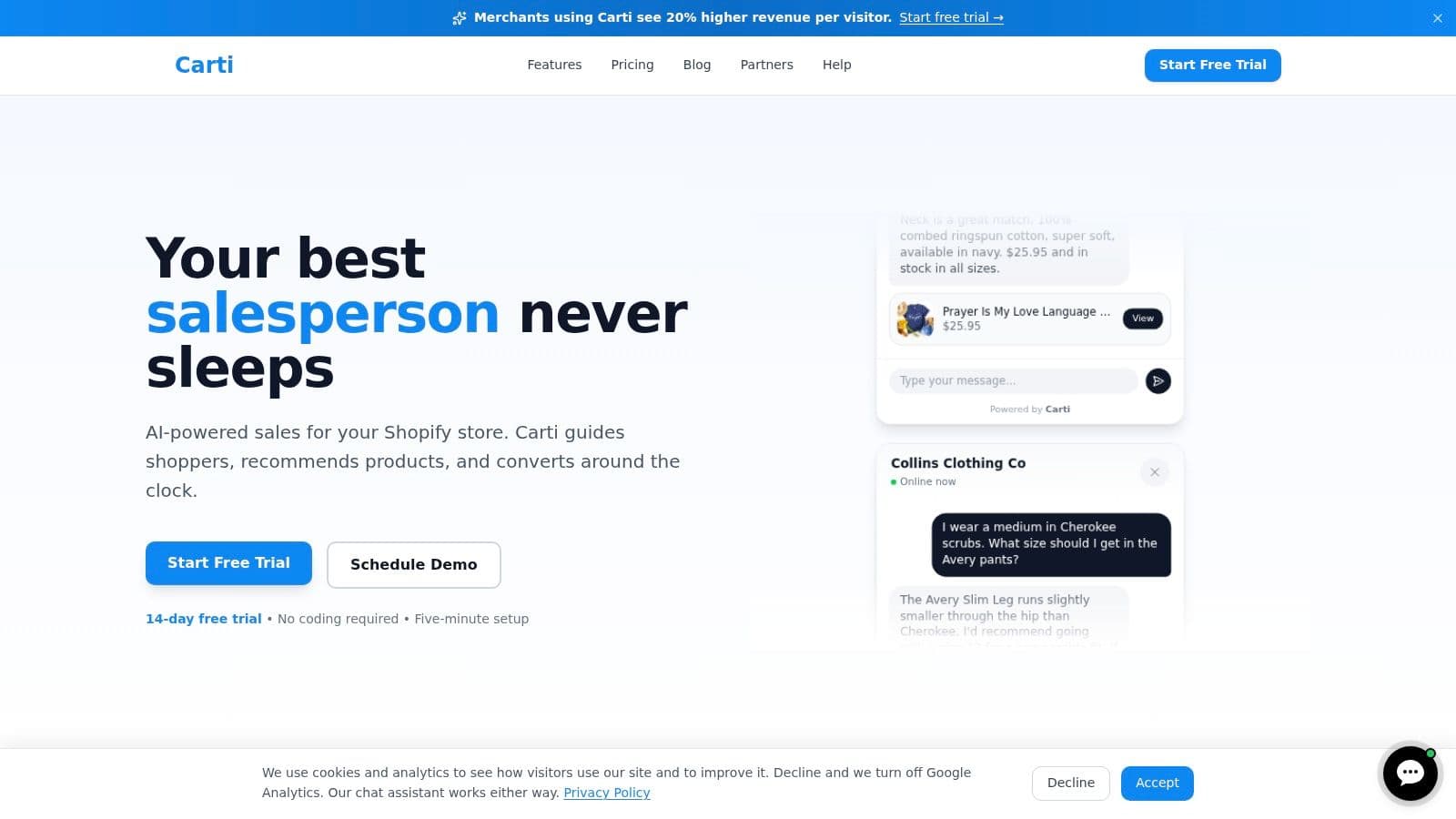
One Shopify-specific option is Carti, which is built for Shopify stores and positioned around no-code setup, catalog ingestion, policy learning, proactive sales help, and multilingual responses. The important part isn't the label on the tool. It's whether the tool can be trained fast enough and accurately enough to support real purchase decisions.
A short demo helps if you're evaluating how this looks inside a live storefront:
Policy accuracy is where weak bots fall apart
This point gets missed in most chatbot buying guides. Policies aren't static, especially if you sell across regions. Shipping windows differ. Return rights differ. Warranty language may differ. A bot that treats policy as one generic FAQ can create customer frustration and unnecessary risk.
Peopleloop's reporting on ecommerce chatbots highlights the operational challenge here: advanced bots need to interpret intent and retrieve answers from dynamic knowledge bases that reflect changing policy rules across jurisdictions. In practice, that means your chatbot setup should include regular policy review, not just product training.
If your bot can't answer policy questions accurately, it won't just fail as support. It will fail as a sales asset too.
Measuring Success and Choosing Your Chatbot Partner
A high chat volume can look healthy while revenue stays flat. The better test is simple. Did the bot help more shoppers buy?
That means measuring chatbot performance the same way you would measure a sales channel. Look at what happens after the conversation, not just inside it.
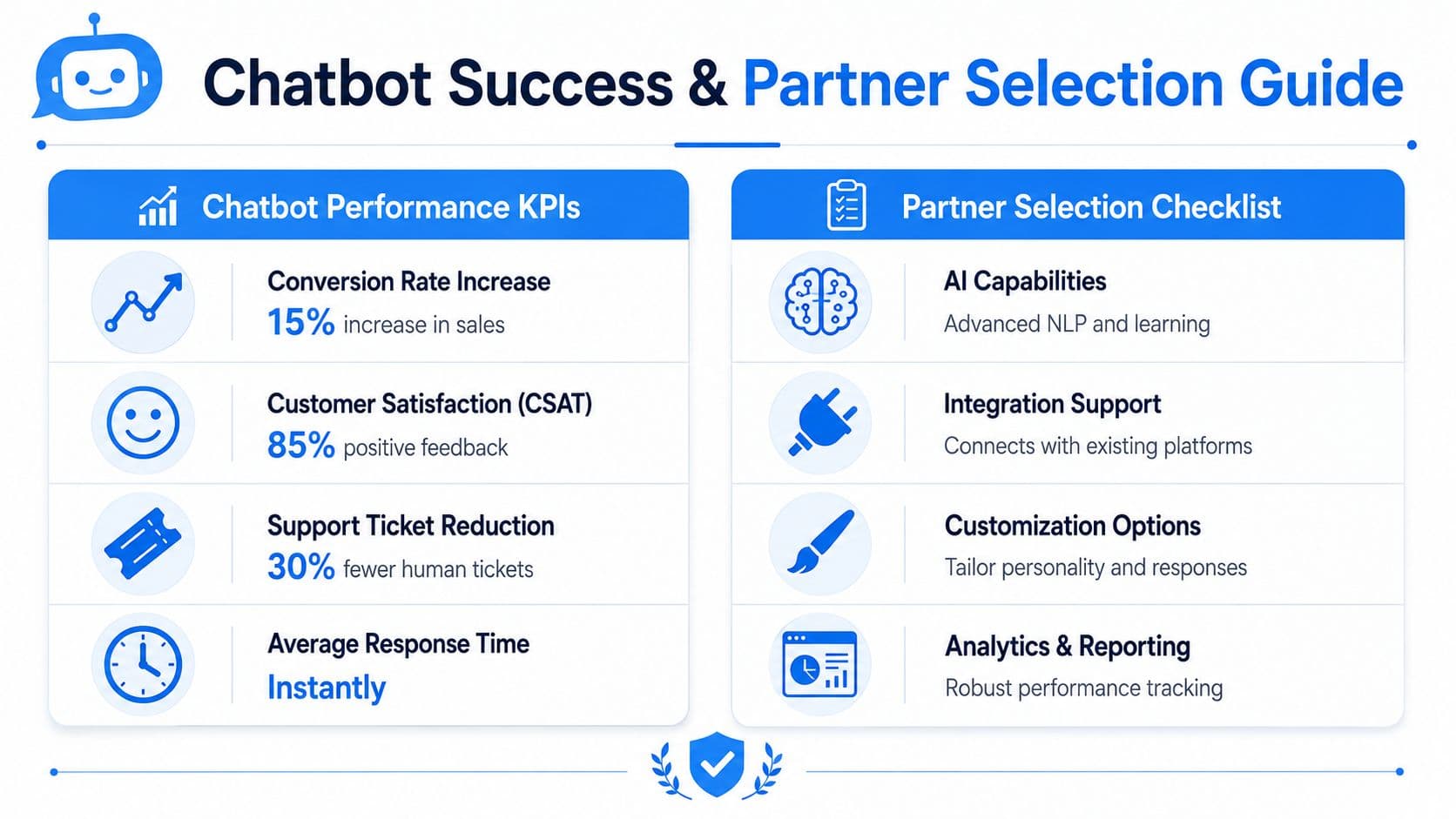
The numbers that matter
Start with revenue metrics first, then operational ones.
- Conversion rate from chat-assisted sessions: Separate visitors who engaged with the bot from those who did not, then compare performance against a clean baseline.
- Revenue per chat session: A chatbot that answers a lot of questions but drives low-value orders is less useful than one that closes fewer, higher-intent shoppers.
- Cart recovery influenced by chat: Track whether the bot re-engaged hesitant shoppers and pushed them back into checkout.
- Average order value: Product recommendations should increase basket size, not distract buyers with irrelevant options.
- Human handoff rate: Some handoffs are healthy. Too many usually signal weak product knowledge, poor policy coverage, or clumsy conversation design.
- Response speed: Slow replies kill momentum, especially on mobile where purchase intent fades fast.
One metric on its own can mislead. I have seen bots deflect tickets well and still hurt sales because they gave vague product guidance. A strong chatbot reduces support load and improves commercial performance at the same time.
If you are comparing higher-end tools, this overview of an enterprise AI chatbot solution for ecommerce is a useful reference point for evaluating analytics, context retention, and integration depth.
How to choose a partner without buying hype
The sales test is straightforward. Can this bot help a shopper move from question to purchase with less friction and more confidence?
Use that filter during demos and trials:
- Catalog understanding: Can it answer detailed pre-purchase questions using your real product data, not generic summaries?
- Recommendation quality: Can it suggest the right products, bundles, or alternatives based on intent, budget, and use case?
- Policy accuracy: Can it handle shipping, returns, warranties, and region-specific rules without creating risk?
- Optimization workflow: Can your team review conversations, spot lost-sale moments, and improve prompts, data, and flows over time?
- Human escalation: Can it pass the conversation to support or sales with enough context that the shopper does not need to start over?
- Reporting: Can it show which conversations influenced orders, not just how many chats it handled?
A flashy demo proves very little. A good partner will show how the bot performs on your catalog, your edge cases, and your conversion path.
That is the standard I would use. E commerce chatbots earn their keep when they function like sales infrastructure. If they cannot guide product discovery, remove purchase hesitation, and recover intent that would otherwise be lost, they are just another line item in your app bill.
If you want a Shopify-focused option built around product answers, recommendations, and cart recovery, take a look at Carti. It is designed to help stores turn pre-purchase questions into completed orders without forcing shoppers to wait for human support.

Written by
Daniel AndersonFounder of Carti. 10+ years building ecommerce brands in apparel and supplements. Still runs a Shopify store and built Carti to help merchants convert more browsers into buyers.
Ready to boost your store's sales?
Install Carti in 5 minutes and let AI handle customer questions, recommend products, and close sales 24/7.
Start Free Trial14-day free trial