
A familiar pattern plays out on Shopify stores every day. A shopper lands on a product page from a paid ad, likes what they see, and has one last question before buying. They open chat and ask whether a variant runs small, whether shipping is delayed, or whether a return is free. The answer comes back in their language, but it feels off. A product color name is mistranslated. A policy line sounds robotic. A shipping message reads like it was stitched together from a dictionary.
That shopper usually doesn't complain. They leave.
This is why translation accuracy matters more than most merchants think. Not because it makes your store look polished, but because the wrong phrase in the wrong place kills confidence at the exact moment a buyer needs reassurance. On a multilingual storefront, weak translation isn't a content problem. It's a conversion problem.
The Hidden Cost of a Bad Translation
A German shopper adds a product to cart. They're ready to buy, but the shipping message in chat uses awkward phrasing and a strange tense. The answer might be technically close to correct, yet it doesn't sound trustworthy. For an international buyer who already has to trust a foreign brand, that small wobble is often enough to stop checkout.
Merchants usually notice translation issues too late. They see lower conversion in a market, more repetitive support tickets, or more abandoned carts after product-page engagement. The store doesn't look “broken,” so the problem gets misdiagnosed as pricing, offer quality, or ad traffic. In reality, buyers are hitting moments of hesitation that bad translation creates.
Where the damage shows up first
The highest-risk errors aren't always dramatic. They're often small and commercial:
- Variant confusion: A shopper asks whether “Ocean” is a blue, green, or teal shade. The answer translates the color directly and loses the brand meaning.
- Policy ambiguity: A return policy translated too loosely sounds more restrictive than intended.
- Checkout friction: Payment or delivery instructions that feel unnatural make buyers second-guess whether the order process is reliable.
- Product misuse: Sizing notes, care instructions, or compatibility details lose precision and create post-purchase frustration.
Practical rule: If the translated sentence influences trust, eligibility, price, delivery, or product fit, treat it as sales-critical content.
That's the hidden cost. Weak translation doesn't always create visible support disasters. More often, it removes certainty. And e-commerce conversion depends on certainty.
Why merchants underestimate it
Many teams still think translation quality is mainly about product descriptions. It isn't. The sharper risk sits in the short, high-intent text strings buyers rely on when they're close to purchase: chat replies, shipping clarifications, return terms, checkout labels, size guidance, and post-click reassurance.
Those are the words that either close the sale or push the buyer back into comparison mode.
What Translation Accuracy Means for E-commerce
Translation accuracy in e-commerce has three jobs. It must preserve meaning, sound natural, and fit the buyer's context. If any one of those fails, the sale gets harder.
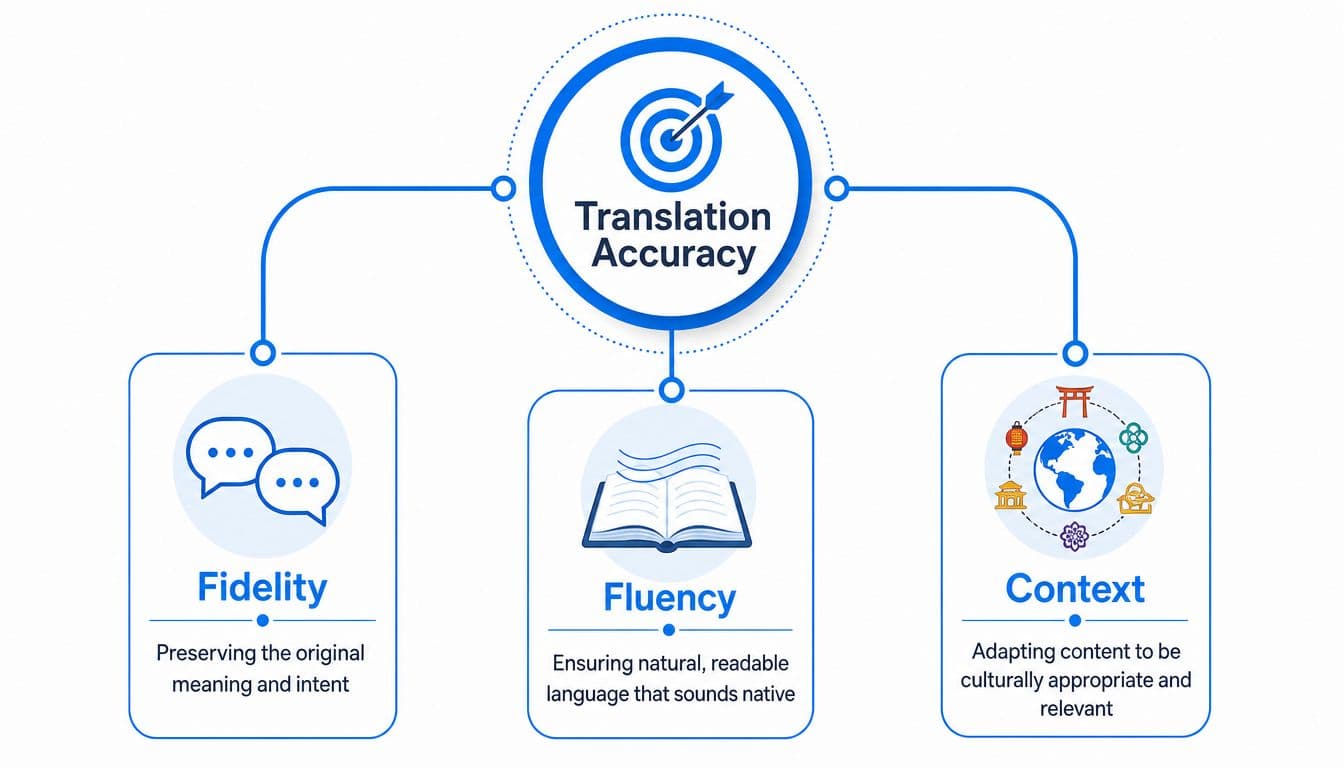
A useful way to think about it is like a GPS. The destination is the original meaning. The route is how naturally the message gets there. The traffic conditions are the cultural and commercial context that can make a direct route the wrong one.
Three pillars matter on a storefront
Fidelity means the translation keeps the original intent intact. If your source says a product is water-resistant, the translated version can't drift into waterproof. If your shipping policy says processing takes place before dispatch, the translation can't collapse those steps into one.
Fluency means the sentence sounds like a native speaker wrote it. This matters more than many merchants expect. Buyers use fluency as a shortcut for credibility. If your wording sounds machine-made, buyers assume your service may be unreliable too.
Context means the text fits the situation, market, and buying moment. A chatbot answer, a product title, a return notice, and alt text each need different handling. The same literal translation can be fine in one place and damaging in another. Teams working on multilingual customer support usually discover this quickly because support language lives so close to buyer intent.
Why a high score can still fail a sale
Projected 2026 benchmark data shows AI translation systems reach an average 96% accuracy across 133 languages, but performance drops to 55–70% for low-resource languages. The same source notes that even at 99% accuracy, a 1,500-word document still contains approximately 15 errors, enough to change meaning, terminology, or brand trust, according to Elite Asia's analysis of AI translation accuracy in 2026.
That gap explains why merchants get misled by headline scores. A store doesn't lose sales because a translation engine misses lots of easy sentences. It loses sales because the few errors left are concentrated in important places.
A translated storefront doesn't need perfect language everywhere. It needs dependable language where buying decisions happen.
On a product page, one bad adjective may be harmless. One bad answer about returns, materials, compatibility, or delivery timing isn't.
How Translation Accuracy Is Measured
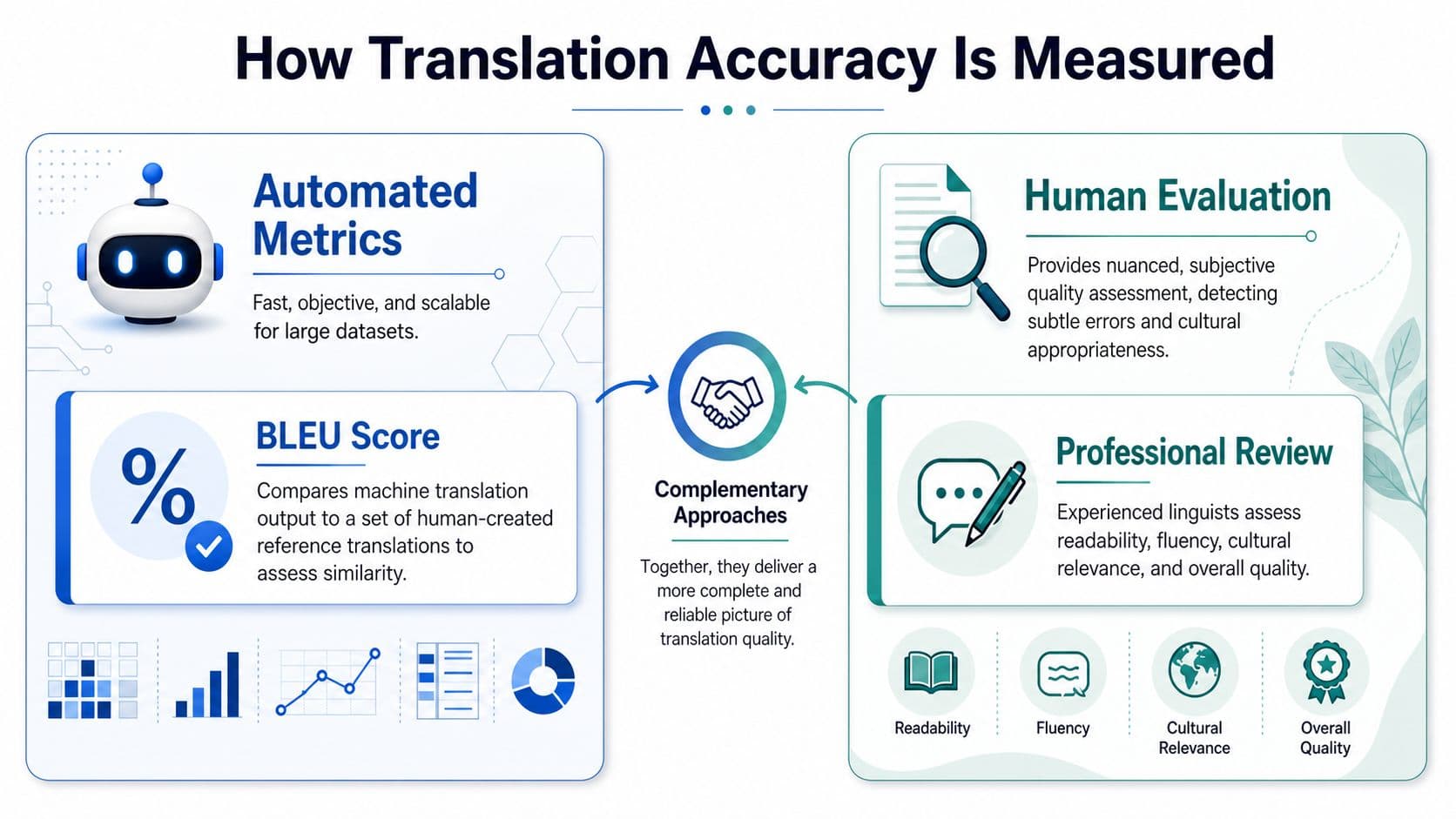
Merchants hear a lot about translation scores, but most of those numbers answer only part of the question. In practice, translation accuracy gets measured in two different ways: machine-based comparison and human judgment. You need both, but they do different jobs.
What automated metrics do well
Automated metrics are like a spellchecker with a bigger vocabulary. They compare output against a reference translation and look for overlap, similarity, and consistency. That makes them useful for spotting broad quality shifts across large volumes of text.
If you update hundreds of product descriptions or export a full catalog into multiple languages, automated checks help you catch obvious breakdowns fast. They're efficient, repeatable, and good for monitoring at scale.
A simple comparison makes the trade-off clear:
| Method | Best use | Weak spot |
|---|---|---|
| Automated metrics | Large batches, consistency checks, rapid QA | Miss nuance, tone, and buyer intent |
| Human evaluation | Customer-facing copy, policy text, chat flows | Slower and more expensive |
The problem is that stores don't sell through overlap scores. They sell through trust. Automated metrics can tell you a sentence resembles a reference. They can't reliably tell you whether the sentence sounds reassuring to a first-time buyer in a checkout flow.
Where human review earns its keep
Human review works like a skilled editor. A native reviewer can catch whether a sentence sounds stiff, whether a policy line feels harsher than intended, or whether a translated product phrase creates the wrong impression.
That matters because acceptability and usability aren't the same thing as literal correctness. A line can be grammatically fine and still weaken conversion because it sounds foreign to the market.
Use human review first in these areas:
- Checkout and cart text: Payment, shipping, taxes, duties, and delivery promises
- Policy pages: Returns, exchanges, warranties, subscriptions, cancellations
- High-margin product pages: Hero products, bundles, giftable items, seasonal launches
- Support scripts and chatbot intents: Pre-purchase questions, objections, and edge cases
Review the words buyers hesitate over, not just the words they read.
For low-risk content, automation can carry more of the load. For revenue-critical content, human review is still the standard that matters.
Why AI Translations Fail in Conversational Commerce
Conversational commerce is harder than standard page translation because buyers don't speak in neat, predictable strings. They use fragments, slang, urgency, and half-formed questions. They mix product names with emojis, abbreviations, and assumptions your brand team never wrote into the catalog.
That's where generic AI translation starts to wobble.
Commerce language is messy by nature
A buyer doesn't ask, “What is the exact material composition of this product?” They ask, “Is this scratchy?” Or, “Will this work for a narrow foot?” Or, “Can I get this before Friday?”
Those questions depend on context from the product catalog, shipping rules, merchandising language, and buyer intent. If the system only translates words without grounding them in store-specific meaning, the answer can sound polished and still be wrong.
A useful parallel shows up in voice systems. If you've looked at this complete voice to text guide, the pattern is familiar. Raw transcription quality isn't enough when the primary challenge is interpreting messy, real-world user language. Chat translation has the same problem.
The failure points that hurt revenue
A 2021 UCLA study found Google Translate preserved intended meaning in only 82.5% of medical discharge instructions, with accuracy ranging from 94% for Spanish to 55% for Armenian. The same reviewed research notes AI tools misinterpret culturally specific phrases about 40% of the time, while major European language pairs may see 90–97% accuracy but technical content and low-resource language pairs often drop to 75–85%, as summarized by Smartling's review of translation accuracy research.
E-commerce isn't healthcare, but the lesson is the same. Once language gets specialized, risk rises fast.
Common failure patterns on storefronts include:
- Brand terms getting flattened: “Ocean,” “Stone,” or “Cloud” may be color or finish names, not ordinary nouns.
- Product names losing distinction: Collections, bundles, and limited editions can get translated as descriptions instead of names.
- Slang and shorthand breaking intent: “Does this pill?” “Is it TTS?” “Can I wear this out-out?” all need interpretation, not just translation.
- Culture-specific phrasing landing badly: Humor, gifting language, and fit advice often become awkward or misleading when translated directly.
Merchants using an AI chatbot for ecommerce run into this quickly when the bot handles both support and selling. The task isn't merely bilingual response. It's bilingual judgment in a buying context.
The most expensive translation errors aren't the obvious ones. They're the answers that sound acceptable but make the buyer less certain.
That's why one-size-fits-all translation tools often underperform in chat. They weren't built around catalog nuance, pre-purchase objections, or conversion intent.
Actionable Strategies for Improving Translation Quality
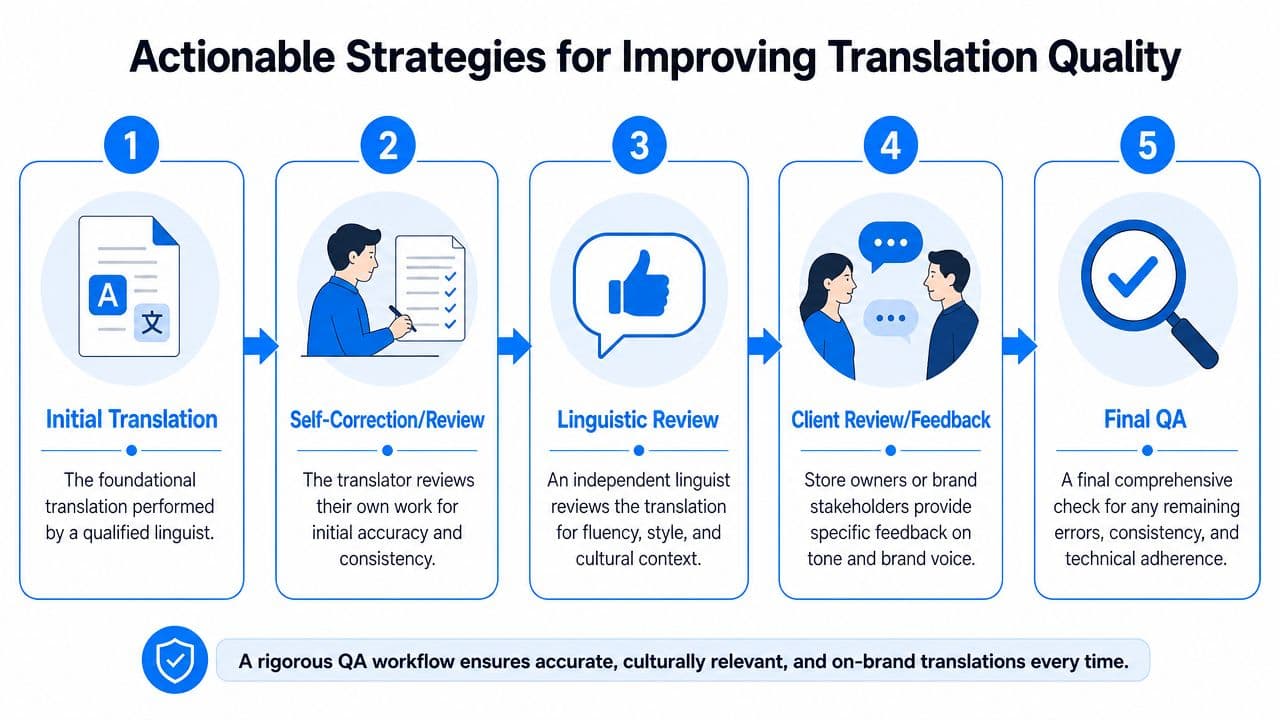
Most stores don't need to review everything with the same intensity. They need a system that protects revenue-critical content first, then improves the rest over time.
Prioritize by conversion risk
Start by sorting content into three buckets.
High risk includes product pages that carry purchase intent, checkout and cart language, shipping and returns policies, subscription terms, sizing help, and any chat flow tied to objections. This content should get human review before or shortly after launch.
Medium risk includes collection pages, category intros, automated support replies for common questions, and promotional banners. AI can draft this well, but someone should spot-check it with a native speaker or market lead.
Lower risk includes long-tail catalog content, archived blog posts, basic FAQs, and low-traffic informational pages. Here, AI can do more of the work if you monitor customer feedback and keep an escalation path.
A simple operating model works well:
- Review first: Hero SKUs, high-AOV products, bundles, and top entry pages by market
- Monitor next: Repetitive support issues, refund reasons, and buyer questions that repeat in one language
- Refine continuously: Update glossary terms, policy phrasing, and product attributes that create confusion
Build a lightweight QA loop
The strongest workflow is usually hybrid. AI handles scale. Humans protect meaning where mistakes are costly.
Place this kind of process into your localization routine:
- Draft with AI for speed across product, support, and catalog content.
- Review high-impact strings with a native speaker or specialist reviewer.
- Feed back recurring issues into your glossary, style guidance, and chatbot training data.
- Retest customer-facing flows after promotions, new launches, or policy changes.
- Audit by market using real support transcripts and on-site search queries.
This walkthrough is a useful visual reference for the process:
The biggest mistake is reviewing only body copy and skipping the microcopy that drives trust. Buttons, labels, alt text, chat prompts, return conditions, and variant names often do more commercial work than long descriptions.
Localize for search, not just readability
Literal translation can subtly undermine discoverability. The contrarian point many merchants miss is that “99% accuracy” is irrelevant without context-aware localization for search terms. AI often translates page titles, meta descriptions, and alt text directly instead of adapting them to local keyword behavior. One example from this analysis of AI translation for e-commerce shows that “running shoe” alt text in French should become “chaussures de course” rather than a literal equivalent.
That matters because SEO translation and conversion translation overlap. If the page ranks for the wrong term, the wrong buyer lands on it. If the alt text or metadata uses unnatural phrasing, search visibility can weaken even when the on-page copy looks fine.
Use this checklist:
- Map local keywords: Don't reuse English phrasing by default.
- Protect schema fields: Product name, description, and currency values need market-appropriate localization.
- Review media text: Alt text and image captions affect both accessibility and discoverability.
- Focus first on priority SKUs: Your best sellers deserve the best review workflow.
How Carti Delivers Reliable Multilingual Support
Generic translation layers usually sit on top of the store. They translate text after the fact. That approach can work for basic content, but it struggles in live support because the system often lacks the product, policy, and buyer-context needed to answer well.
Why Shopify context changes the result
Carti is more useful to think of as a commerce-native support layer than as a generic translator. It learns the store's catalog, FAQs, and policies automatically, which matters because most damaging translation errors in support come from missing context, not just missing vocabulary.
That setup reduces common storefront problems:
- Catalog grounding: Product names, variants, and attributes are tied to the actual store data.
- Policy awareness: Answers about shipping, returns, and order questions reflect store rules instead of generic phrasing.
- Conversational fit: Responses are designed for pre-purchase support, not just static page translation.
- Wide language coverage: Merchants can serve buyers in many markets without building a custom localization stack first.
For brands thinking beyond support alone, strategic expansion still needs market planning. A practical companion read is this guide on planning new market entry with AI, especially if you're deciding which regions deserve deeper localization investment.
What that means in daily operations
On Shopify, reliability comes from speed plus relevance. A bot that answers instantly but mishandles product context still creates friction. A bot that understands the store's own language can handle more buyer questions without sounding detached from the actual shopping experience.
Carti supports 92 languages out of the box, which is outlined on its page about multilingual Shopify support across 92 languages. For merchants, the practical upside is simpler deployment. You don't need to become a localization manager to give international shoppers usable support.
That doesn't remove the need for good strategy. You still need to decide which product pages, support intents, and policy flows deserve the closest review. But a system built around Shopify context gives you a better starting point than a generic translation plug-in bolted onto chat.
From Accurate Words to Real Conversions
The core issue isn't whether a translation engine can hit an impressive score. It's whether your store communicates clearly enough for a buyer to trust the next step.
That changes how merchants should evaluate translation accuracy. Don't ask only, “Is this understandable?” Ask, “Would this wording remove doubt for someone about to pay?” On product pages, in chat, and during checkout, that's the standard that matters.
The practical approach is straightforward:
- Protect high-stakes content first.
- Use AI for speed where risk is lower.
- Add human review where trust, clarity, or compliance can break.
- Localize metadata and search language with market intent in mind.
- Treat support conversations as conversion moments, not just service tasks.
Strong multilingual commerce isn't built by chasing a perfect number. It's built by identifying the phrases that influence buying behavior and making those dependable.
Translation should sit much closer to revenue strategy than is typically the case. On a Shopify store, accurate words don't just explain the offer. They help close it.
If your Shopify store is serving buyers in multiple languages, Carti gives you a practical way to answer faster and more accurately without stitching together a separate support workflow. It learns your catalog, policies, and FAQs, responds in 92 languages, and helps turn multilingual conversations into completed checkouts instead of abandoned carts.

Written by
Daniel AndersonFounder of Carti. 10+ years building ecommerce brands in apparel and supplements. Still runs a Shopify store and built Carti to help merchants convert more browsers into buyers.
Ready to boost your store's sales?
Install Carti in 5 minutes and let AI handle customer questions, recommend products, and close sales 24/7.
Start Free Trial14-day free trial