
You can see the problem in your dashboard before you hear it from your finance team. Traffic from Germany, Quebec, Mexico, or Singapore starts climbing. Product page engagement looks healthy. Add-to-cart happens. Then sales stall, support tickets get messy, and chat transcripts fill up with broken English, pasted screenshots, and customers asking basic questions they would've answered themselves if the help content felt native.
Most stores read that situation as a translation task. It isn't. It's a revenue problem.
When shoppers can't get a clear answer in the language they prefer, they hesitate. They leave. They buy from a competitor that feels easier to trust. For Shopify merchants, multilingual customer support sits much closer to conversion, repeat purchase, and brand perception than typically appreciated. It shapes whether international demand turns into profitable growth or expensive leakage.
The Hidden Cost of Speaking Only One Language
A shopper lands on your store from a paid campaign in Spain. They like the product. They don't fully understand the return policy, shipping timing, or sizing nuance, so they open chat. The reply arrives in English, or worse, in machine-translated copy that sounds stiff and off. Nothing dramatic happens. They just don't buy.
That's the hidden cost. Not a support failure in the narrow sense. A lost sale, a weaker first impression, and a brand that feels less ready for the customer than the customer was for the brand.
For e-commerce teams, this shows up in places that are easy to misread:
- Soft conversion loss: Buyers browse, ask questions, then disappear before checkout.
- Lower repeat intent: A first order may happen despite friction, but the customer won't feel confident coming back.
- Support inefficiency: Agents spend time untangling basic questions that localized self-service could have prevented.
- Brand trust erosion: Even if the words are technically correct, the experience can still feel foreign and unsafe.
Practical rule: If customers need support to complete a purchase, support is part of your sales funnel.
The upside is just as real as the downside. Stores that treat multilingual customer support as a commercial capability, not a translation add-on, usually make better decisions. They prioritize the right languages, localize the highest-friction moments first, automate repetitive questions, and reserve human attention for situations where trust matters most.
That approach works because global buyers don't need perfect coverage everywhere. They need a buying experience that feels clear, credible, and easy in the places where demand already exists.
Why Multilingual Support Is a Revenue Driver, Not a Cost Center
Many organizations still budget support as overhead. That's a mistake when you sell across borders. Language directly changes whether a shopper converts, returns, or leaves.
The business case is unusually clear. In a widely cited customer support survey summarized by Intercom's multilingual support research, 74% of customers were more likely to buy again from a brand when they received support in their own language, and 40% would not purchase at all if service was unavailable in their language. The same summary notes that another analysis found a 30% increase in customer satisfaction after implementing multilingual support.
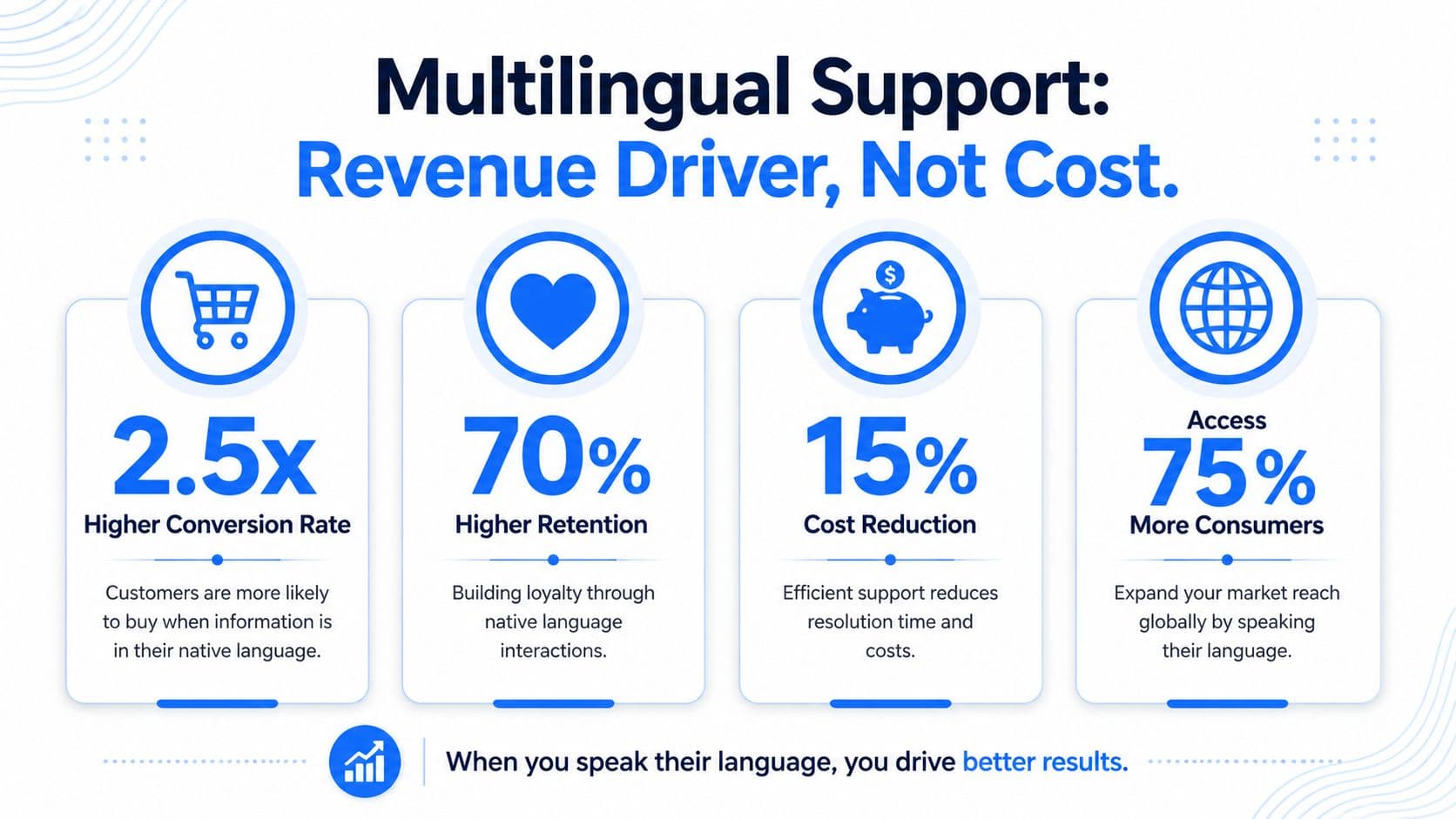
What those numbers mean on a storefront
For a Shopify merchant, these aren't abstract CX metrics. They map to commercial outcomes you already care about.
| Where language matters | What happens when support is native-language |
|---|---|
| Pre-purchase questions | Buyers get unstuck faster and are more willing to complete checkout |
| Post-purchase reassurance | Returns, shipping, and product-use questions create less anxiety |
| Repeat purchase behavior | Customers are more likely to come back because the first experience felt safe |
| Brand perception | The store feels established in-market instead of imported and improvised |
If you sell products with sizing, ingredients, compatibility questions, subscriptions, or delivery complexity, support language matters even more. Those categories create hesitation naturally. The wrong language amplifies it.
Why finance teams should care
Multilingual customer support changes both sides of the P&L. It can help drive more revenue through stronger conversion and repeat purchase, and it can reduce wasted support effort when customers get answers without extra back-and-forth. That's why the best operators don't ask, “Can we afford multilingual support?” They ask, “Where are we already paying for not having it?”
If you want a practical operator view on the commercial side, this guide to multilingual support for businesses is useful because it frames language support as a growth lever rather than a back-office obligation.
Buyers don't separate service from commerce. If support helps them decide, it's part of revenue generation.
The key shift is simple. Stop treating multilingual support as something you add after international growth appears. In most stores, it's one of the things that enables that growth in the first place.
Translation vs Localization: A Critical Distinction for CX
A lot of multilingual support programs fail even when the words are technically correct. The sentence is understandable. The answer is factual. The customer still leaves uneasy.
That happens because translation and localization aren't the same job.
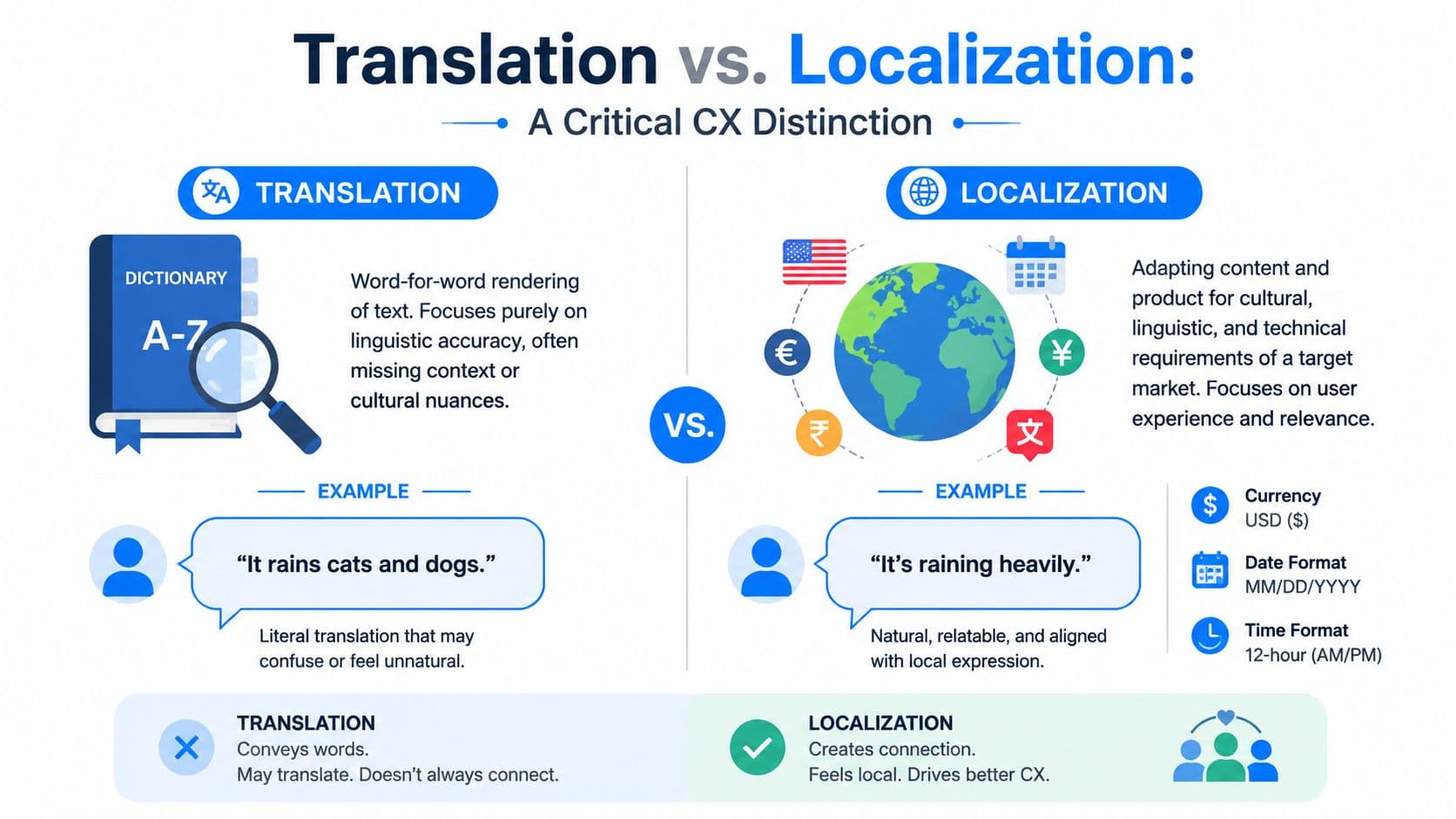
Translation solves words
Translation is word transfer. It takes one language and renders it in another. That's useful for basic comprehension, especially for simple FAQs, shipping updates, or short product facts.
Imagine converting a recipe word-for-word. The ingredients list might survive, but the result can still be wrong for the kitchen, the palate, or the tools available locally.
If your support team relies on raw translation alone, common failures appear fast:
- Tone feels off: Friendly in one market sounds casual or dismissive in another.
- Formality misses the mark: A direct answer can feel efficient in one language and rude in another.
- Escalation language lands badly: What sounds reassuring to one customer can sound evasive to another.
- Idioms create confusion: The words translate, but the meaning doesn't.
Localization solves trust
Localization adapts the message to how people in that market expect help to sound and work. That includes tone, formality, interaction style, and the surrounding context of the answer.
As noted in Digital Humans' guidance on culture in multilingual customer service, effective support has to adapt to local norms. The failure mode isn't only wrong wording. It's “right words in the wrong style,” which can reduce trust. The same source also argues that better outcomes may come from supporting fewer languages with stronger cultural localization.
A short explainer helps clarify the difference in practice:
For teams working on product and app experiences alongside support, this piece on automating Django .po file translation is useful because it reinforces the operational gap between technical translation workflows and true localization.
Support quality isn't just about saying the same thing in another language. It's about making the answer feel native to the customer receiving it.
The practical takeaway is hard but important. Five well-localized support experiences usually beat a sprawling list of thin, robotic language options. Coverage impresses internal teams. Natural communication converts customers.
A Practical Roadmap for Implementing Multilingual Support
Most stores overcomplicate this. They think they need a giant language operation before they can serve international shoppers well. They don't. They need sequence, clear priorities, and the discipline to separate repeatable questions from trust-sensitive ones.
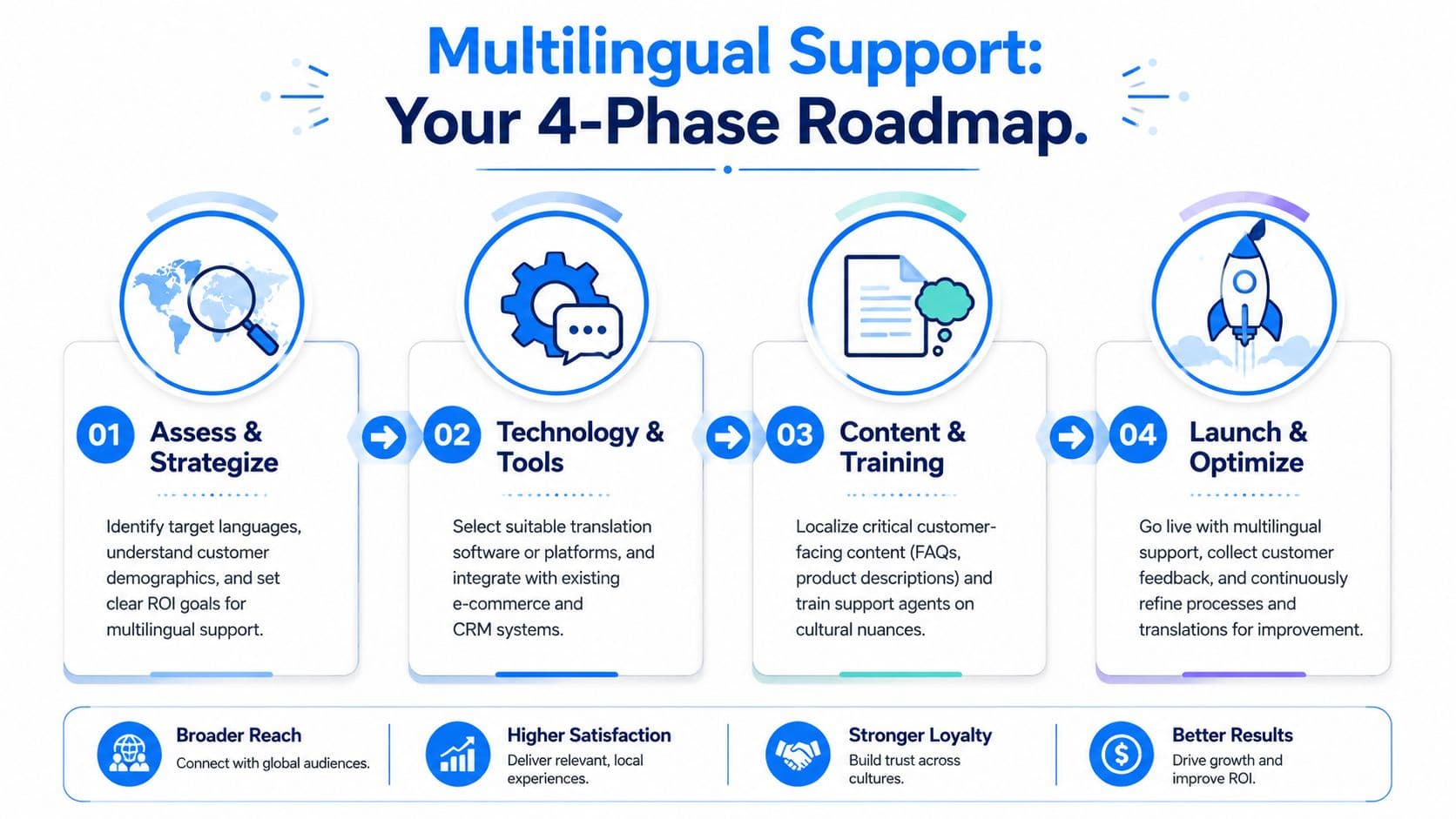
Start with demand, not ambition
Pick languages from customer evidence, not brand aspiration. Look at ticket language requests, browser language, help-center search terms, shipping destinations, and where revenue is already trying to happen.
A common mistake is launching too broadly. A better approach is to rank languages by two things:
- Commercial importance: Markets where you already see traffic, carts, or repeat customers.
- Support friction: Markets where buyers ask basic pre-purchase questions that block orders.
That gives you an operating order. Start where language support can remove obvious buying friction, not where a map in a board deck looks impressive.
Automate the repeatable work
Once you know your priority languages, build self-service and AI support around the questions that repeat constantly. Shipping times. Returns. Order tracking. Product compatibility. Size and fit. Subscription changes. Warranty basics.
According to Crescendo's analysis of multilingual customer support, a hybrid AI and human model can reduce overall support workload by 60% to 90% when connected to accurate knowledge bases, and AI support can operate across 50+ languages. The same source highlights the importance of native-speaker QA, glossaries, locale-specific tone guidance, and sampling audits to prevent translation drift.
That matters because automation only works when the source material is reliable. If your returns policy is vague, your shipping exceptions aren't documented, or your product catalog is inconsistent, AI will spread confusion faster.
A solid first build usually includes:
- Localized FAQs: Put high-volume answers in the customer's preferred language.
- Multilingual chat automation: Handle repetitive pre-purchase and post-purchase questions instantly.
- Glossaries and approved phrasing: Protect product names, policy language, and brand tone.
- Escalation rules: Trigger human review for refund disputes, damaged orders, VIP customers, and emotionally charged conversations.
If you're tightening the automation side first, this article on automated customer support is a helpful companion for mapping what should be handled instantly versus escalated.
Escalate high-stakes conversations to humans
Not every issue should be automated. The right model is hybrid.
Use AI for speed and consistency where the issue is routine. Use humans where the customer needs judgment, empathy, exception handling, or culturally sensitive communication. Slang, edge cases, policy disputes, delivery failures, and high-value pre-sales conversations often belong here.
Skills-based routing matters too. Detect language before queue assignment, then route by language and issue type. If a customer starts in French and gets bounced to an English-only queue, handle time rises and confidence drops before the conversation even begins.
Build self-service for the questions customers ask every day. Save human time for the moments that decide whether the customer stays.
That's the operating model that scales. Not human-only. Not AI-only. Structured automation backed by humans who step in when trust is on the line.
Common Pitfalls That Undermine Global CX
The most common multilingual support mistake is easy to describe. Teams chase breadth before they can deliver quality. They want a long language list, global messaging, and coverage everywhere, then wonder why customer feedback stays mixed.
Broad coverage can look impressive on a slide. Customers experience the execution, not the slide.
Broad coverage can hide weak execution
A weak multilingual program usually has the same symptoms. The chatbot can technically answer in many languages, but policy wording feels unnatural. Help articles exist, but only the homepage is fully localized. Agents can translate replies, but escalation paths and refund explanations still sound like they were written for an English-speaking customer and pushed through software.
The deeper issue is decision-making. As noted in Hugo's guide to multilingual customer support prioritization, many teams fail to build a decision framework for which languages to support first. That leads to broad but mediocre coverage. The same guidance recommends prioritizing by actual demand signals such as ticket-language requests and customer location data, not assumptions about market size alone.
Three expensive mistakes
- Mistaking availability for quality: Offering a language in chat doesn't mean the experience is good enough to convert or retain customers.
- Letting machine output go unchecked: AI translation can handle routine work well, but without review standards, tone guidelines, and exception rules, it drifts.
- Ignoring cultural communication norms: A correct answer can still feel abrupt, vague, or untrustworthy if the style doesn't fit the market.
A more disciplined approach is usually better:
| Bad strategy | Better strategy |
|---|---|
| Launch many languages at once | Start with a smaller set tied to real customer demand |
| Translate everything equally | Localize the moments closest to purchase and trust |
| Automate all support traffic | Automate routine issues and escalate sensitive ones |
| Judge success by language count | Judge success by customer outcomes in each language |
One more mistake deserves attention. Teams often localize support later than they localize marketing. That creates a polished ad, a decent storefront, and a weak post-click experience. The customer feels the mismatch immediately.
How Carti Accelerates Multilingual Support on Shopify
For Shopify merchants, the practical challenge isn't understanding why multilingual customer support matters. It's executing it without adding a heavy systems project to an already busy team.
That's where Carti fits cleanly. It's built for stores that need multilingual support to work fast, without a long implementation cycle, custom engineering, or manual setup across every language.
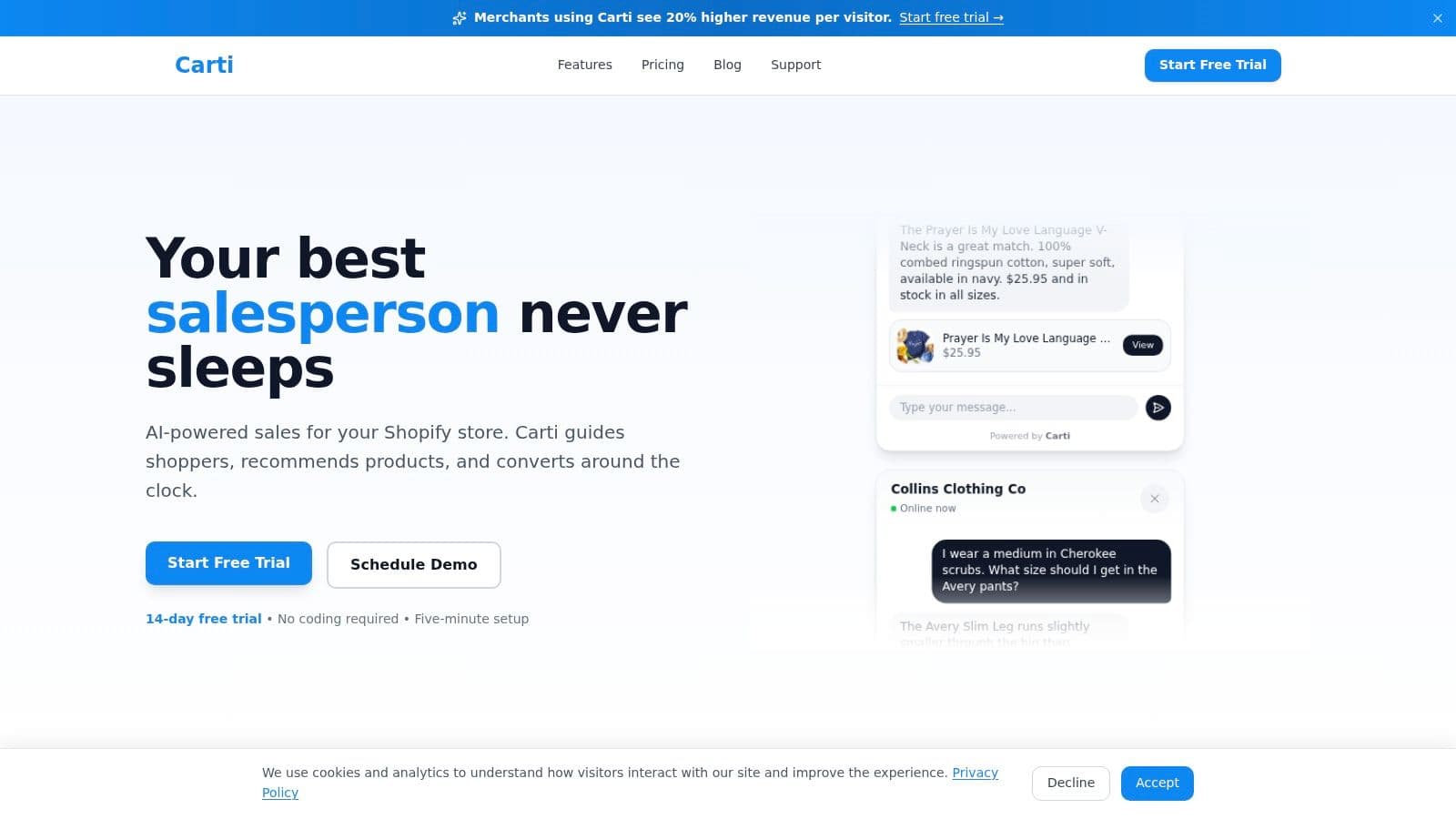
Why it fits the Shopify operating model
Carti is an AI Shopify chatbot with five-minute, no-code setup. It learns from your catalog, FAQs, and store policies automatically, then responds in 92 languages without extra configuration. That matters because most merchants don't have the time or headcount to build separate support flows market by market.
Instead of forcing merchants to bolt together translation tools, manual macros, and fragmented help content, Carti gives stores a single layer that can answer product questions, policy questions, and pre-purchase concerns around the clock.
For merchants comparing multilingual options specifically, Carti's own overview of 92-language multilingual Shopify support shows how quickly a store can go live without turning this into a custom CX rebuild.
What that changes on the storefront
The value isn't just speed. It's relevance.
Because Carti uses the store's own catalog and policy context, shoppers don't get generic translated filler. They get answers tied to the products they're viewing, the rules the store follows, and the buying questions that usually stall a checkout. That makes the chatbot function less like a basic help widget and more like a global sales associate.
In practice, that helps merchants do three things well:
- Serve international shoppers instantly: Customers don't wait for business hours or a bilingual team member to come online.
- Reduce repetitive support load: Common questions get answered before they become tickets.
- Protect buying momentum: Customers get clarity while they're still in decision mode, not hours later after intent has cooled.
For Shopify brands in fashion, beauty, home, and wellness, that combination matters because the line between support and selling is thin. When someone asks about sizing, ingredients, compatibility, delivery, or returns, the quality of the answer often determines whether the order happens.
Measuring Success: Key KPIs for Multilingual Support
If multilingual customer support is a revenue strategy, you need to measure it like one. Too many teams stop at ticket counts, response speed, or language coverage. Those matter, but they don't tell you whether support is helping international demand convert into actual sales.
The cleanest way to evaluate performance is to look at each language as its own operating lane.
Track operational health by language
Start with metrics that show whether the experience itself works.
- First contact resolution by language: Are customers getting a complete answer without follow-up?
- Average handle time by language: Where are conversations slowing down because routing, tooling, or phrasing is weak?
- Escalation rate by language: Which languages generate more handoffs from automation to human support?
- Self-service resolution rate: Which localized help articles or chat flows are preventing tickets?
- CSAT by language: Customer satisfaction should be segmented, not averaged across all markets.
If your team needs a simple refresher on support satisfaction measurement, this guide to what a CSAT score is is a useful reference point before you split reporting by language.
Track revenue outcomes, not just ticket metrics
The stronger proof lives one layer deeper, inside commerce metrics.
Watch for changes in:
| Business KPI | Why it matters |
|---|---|
| Conversion rate for international visitors | Shows whether support is helping buyers complete checkout |
| Repeat purchase behavior by market or language | Reveals whether the experience built enough trust to bring customers back |
| Cart abandonment in non-English sessions | Highlights whether unresolved questions still block purchase |
| Revenue influenced by support conversations | Connects chat and help interactions to commercial outcomes |
| Refund and return reasons by language | Exposes where expectations still aren't clear enough |
A useful discipline is to compare before and after at the language level, not storewide. Storewide averages can hide major gains in one market and ongoing friction in another.
For teams building a broader service playbook, this playbook for local businesses offers practical ideas for turning customer feedback and service patterns into operational improvements.
The KPI that matters most is simple. Are more international shoppers buying with less hesitation?
If the answer is yes, multilingual support is doing its job. If not, don't add more languages yet. Fix routing, improve localization, tighten self-service, and review the conversations where buyers still abandon.
Carti helps Shopify merchants turn multilingual support into a sales asset, not a support burden. If you want a no-code way to answer shopper questions, recover carts, and support customers in 92 languages using your own catalog and policies, take a look at Carti.

Written by
Daniel AndersonFounder of Carti. 10+ years building ecommerce brands in apparel and supplements. Still runs a Shopify store and built Carti to help merchants convert more browsers into buyers.