
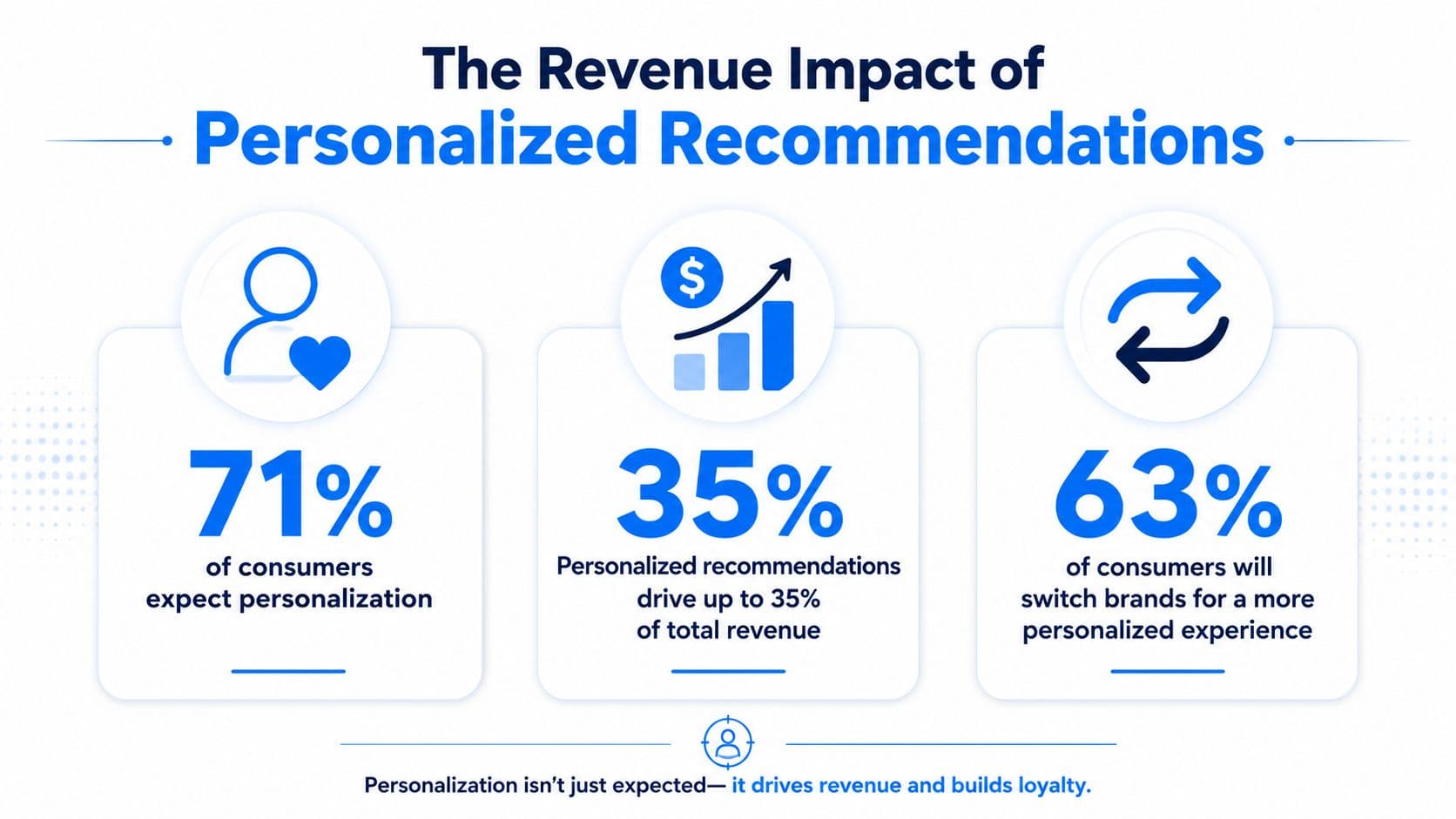
Personalized product recommendations can do more than decorate a storefront. In McKinsey's personalization research, as summarized by an ecommerce industry source, personalization typically drives a 5% to 15% revenue lift, and top performers generate about 40% more revenue from personalization than slower-growing peers, while recommendation engagement can lift average order value by 369% in the sessions where shoppers interact with those widgets. That's why recommendation systems are not a sidebar tactic. They're a revenue path that touches discovery, basket size, and repeat purchase behavior.
For Shopify merchants, the problem isn't whether recommendations matter. The problem is that too many stores still rely on generic bestseller carousels, static “you may also like” blocks, or rule sets that never adapt to the shopper in front of them. Those widgets can look busy and still miss intent, especially when the store has mixed traffic, a wide catalog, or a lot of first-time visitors. The stores that win treat personalized product recommendations as an operating system for merchandising, not as a visual add-on.
Why Personalized Recommendations Matter for Shopify Revenue
Shopify merchants do not need another generic personalization claim. They need to know where recommendations affect revenue, and the answer is usually in the cart, on product pages, and in the gap between anonymous browsing and repeat purchase behavior. Industry briefings on McKinsey's work have long pointed to meaningful revenue gains from personalization, and other industry sources say recommendations can account for a large share of ecommerce revenue. The practical takeaway is simple: recommendation logic is not a decoration layer, it is part of merchandising.
That matters because recommendations change what shoppers choose, not just whether they click. A good module can steer a browser toward the right bundle, a higher-margin accessory, or a product that matches the shopper's intent better than the default bestseller row ever could. It can also reduce the friction that shows up when a shopper is interested but not ready to search through the catalog on their own. In a store with broad assortments, that difference shows up in basket composition, not just session engagement.
The other point merchants miss is that recommendation quality depends on what the store knows about the visitor. Anonymous shoppers need different logic than engaged shoppers, and engaged shoppers need different logic than known customers. A first-time visitor often benefits from context-aware suggestions tied to category, landing page, or current session behavior. A returning customer, by contrast, usually responds better to prior purchases, replenishment patterns, or products that fit the last category they explored. A single recommendation rule applied to all three groups usually wastes space.
Operationally, the biggest mistake is treating recommendations as a design task. The widget can look polished and still underperform if the inputs are weak, the fallback logic is thin, or the placement ignores intent. That is why merchants need to check whether the engine has enough product data, whether the rules respect inventory and margin constraints, and whether the placement matches what the shopper is trying to do at that moment. For a practical implementation guide, see how recommendations work.
The other reality is that recommendation systems need maintenance. Product catalogs change, seasonal demand shifts, new arrivals need exposure, and returning customers should not keep seeing the same generic treatment they saw on their first visit. Stores that get meaningful results keep tuning inputs and placement instead of treating the setup as finished. The visible widget is only the last step. What matters is the logic behind it.
How Recommendation Engines Function
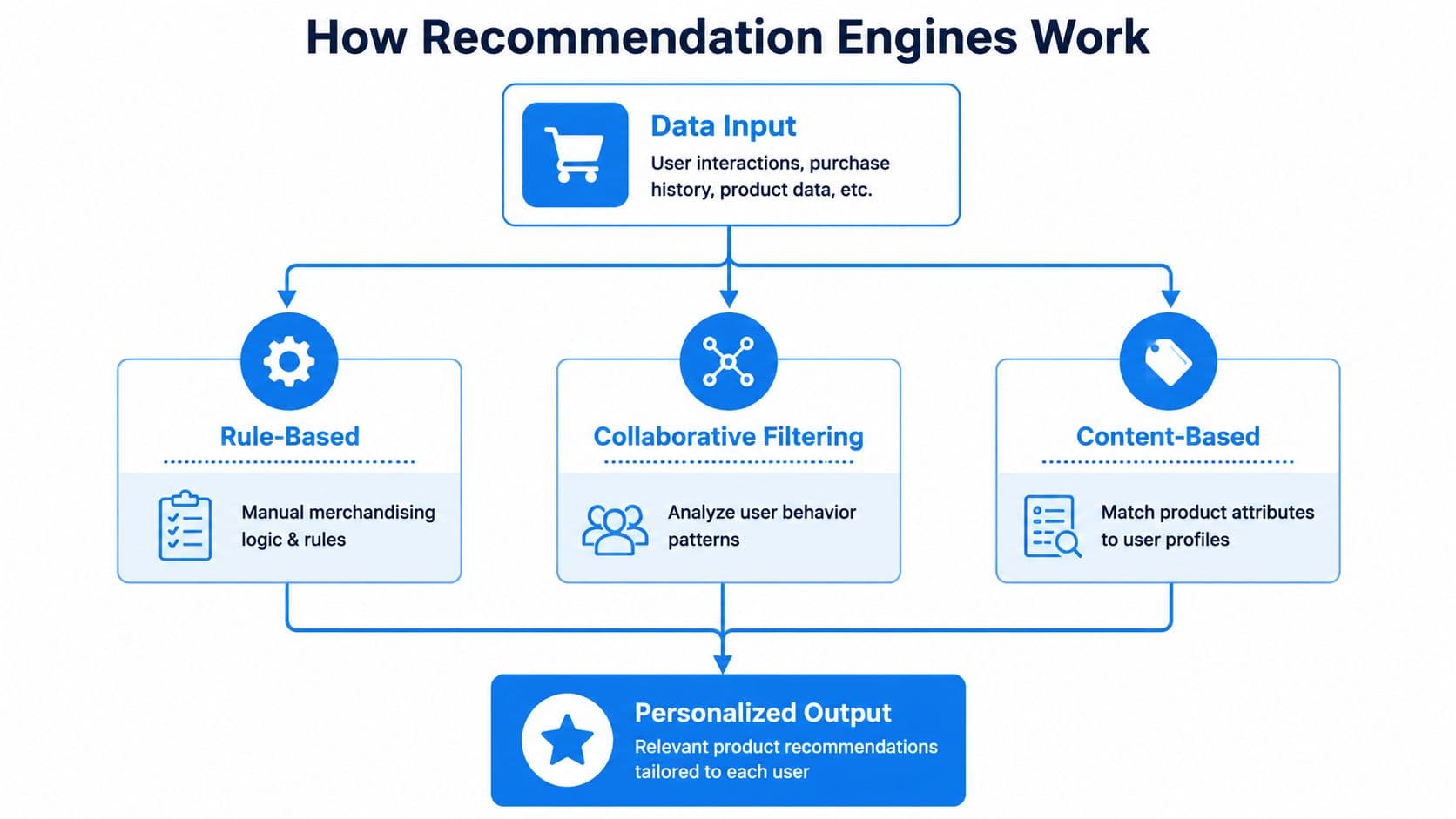
Recommendation engines usually look more complex than they are. In practice, they answer one question, what should this shopper see next? The answer can come from manual rules, similarity across shoppers, similarity across products, or a mix of all three.
Rule-based systems still have a place
Rule-based merchandising means a human sets the logic. A Shopify manager might show winter boots on a cold-weather collection page, or always promote margin-friendly accessories in the cart. That approach is easy to control and useful when the catalog is small or the business needs strict merchandising rules, but it does not learn from behavior on its own.
Collaborative and content-based systems solve different problems
Collaborative filtering asks what similar shoppers did and uses that pattern to infer what this shopper may want. A common ecommerce example is “customers who bought this also bought that.” Content-based filtering instead compares product attributes. If someone browses fragrance-free skincare, the engine can prioritize products with similar ingredient profiles, categories, or tags.
Hybrid and real-time systems do the heavy lifting
Hybrid systems combine those methods, which is usually where performance starts to improve in a meaningful way. More advanced setups add real-time signals, so the engine reacts to live browsing behavior instead of relying only on historical batches. That matters because intent changes during the session.
AI-driven recommendation systems can outperform rule-based bestseller lists by roughly 4x on conversion rate and revenue per visitor. The practical takeaway is simple. Static merchandising can support the store, but predictive systems usually do a better job of surfacing the right next product.
The strongest recommendation stacks start with good data, not clever UI. That means product titles, tags, browsing behavior, purchase history, and enough history to capture seasonality rather than only the last few days. Without that foundation, even a powerful engine can end up looking confident and behaving poorly.
A concise internal guide on implementation details is here: how recommendations work.
The Three-Stage Framework for Different Shopper Types
Most recommendation guides assume the store already knows the shopper. That's not how Shopify traffic works. Many sessions are anonymous, many buyers never build much history, and collaborative filtering can't do much when the signal is thin.
Anonymous visitors need structured fallback logic
For first-time visitors, strategic segmentation usually beats fake personalization. Use bestsellers, curated collections, seasonal picks, and contextual signals like category, landing page, or device context. Rule-based merchandising earns its keep, because the system needs to be helpful before it can be personal.
Returning browsers can support progressive identification
Once a shopper has shown repeated interest, the store can ask for more explicit preference data. Quizzes, short preference capture forms, and guided selling flows work because they turn soft behavior into stronger signals. An internal overview of this approach is available in the guided selling solution guide. That layer is often the bridge between anonymous traffic and real individualization.
Known customers justify full personalization
Known buyers are where transaction history and browsing history finally start to pay off. At that point, individual product recommendations can factor in past purchases, repeat cadence, and category affinity. The quality jump is usually obvious, because the engine is no longer guessing from sparse behavior.
The mistake I see most often is trying to force individual personalization too early. A store with too little history should not pretend it knows the shopper. It should be useful first, specific second.
A practical way to think about the framework is progression, not perfection. Stage one keeps new visitors moving. Stage two collects enough intent to narrow the field. Stage three uses richer customer data to sharpen the output. That sequence is more realistic than waiting months for a perfect dataset before turning recommendations on.
The privacy angle matters here too. As data collection gets tighter, merchants need lighter-touch ways to learn what shoppers want. Quizzes, explicit choices, and contextual merchandising still work when the account history is thin. That makes the three-stage model resilient, not just tidy.
Strategic Placement and Intent Matching
Placement decides whether recommendations feel helpful or intrusive. The same algorithm can perform well on one page and badly on another if the intent is mismatched. A homepage visitor, a product-page browser, and a cart-ready buyer are not asking for the same thing.
Homepage modules should usually favor “Most Popular” for new visitors and affinity-based or personalized picks for returning visitors. That split works because the homepage is often a discovery surface, not a decision surface. If a shopper has just arrived, broad social proof is safer than narrow personalization.
Product detail pages need a different logic. “Similar Products” helps when the shopper is comparing style, fit, or ingredient profile. “Bought Together” is stronger when the store wants upsell or cross-sell behavior, because it mirrors how people complete a set or routine. Those placements line up with where the shopper is in the funnel, which is why they usually convert better than a generic homepage widget copied across the site.
Cart placement deserves special care. Once the buyer is close to checkout, recommendations should reduce friction, not add analysis paralysis. Showing one or two complementary items can increase basket size, but a cluttered module can slow the purchase down and create doubt. The best cart recommendations feel like a smart assistant, not a second storefront.
Industry guidance notes that recommendation-driven sales uplifts of up to 11% are possible when model choice and placement are optimized together (Dynamic Yield product recommendations guide). That number matters less as a promise and more as a warning. Most underperformance comes from bad placement logic, not from a broken engine.
A useful rule in practice is simple. Match the recommendation type to the shopper's intent, not just to the available slot. That's the difference between a widget that gets looked at and a recommendation system that moves product.
Implementing Recommendations with Carti's Smart Suggestions
A lot of merchants want personalized product recommendations but don't have a data science team to tune models or maintain infrastructure. That's where AI shopping assistants become operationally useful, because they can sit on top of the catalog, answer questions, and recommend products in one flow.
Carti's Smart Suggestions are one example of that approach. It's an AI chatbot for Shopify that learns the catalog, policies, and FAQs through no-code setup, then uses shopper behavior to recommend relevant products in real time. For merchants comparing tooling options, the POD tool selection guide is a helpful resource because it frames the trade-offs between different recommendation workflows without assuming a full engineering team.
What this looks like in a store
A shopper asks a sizing question, gets an instant response, and then sees a relevant product suggestion tied to that conversation. Another visitor shows exit intent, and the assistant can surface a timely recommendation before the tab closes. A cart recovery flow can also nudge an abandoned checkout with a product reminder or support answer, which keeps the purchase path open.
Carti also exposes an internal explanation of its recommendation logic here, personalized recommendations. The important operational point is not the branding. It's that merchants can deploy product guidance without building custom infrastructure, waiting on model retraining, or hiring specialized engineering talent just to get started.
Practical rule: if your team can't maintain a custom recommendation stack, choose a system that can learn from catalog and conversation data without constant tuning.
That matters because speed of setup affects how fast merchants can learn. The fastest way to improve recommendations is often to get a working version live, then watch which products people click, ignore, or ask about. A chatbot-based layer can do that while also reducing the time shoppers spend waiting for answers.
The win here is operational simplicity. When recommendations and support share the same interface, the store can respond in the moment instead of routing shoppers to separate tools for answers and product discovery.
Measuring Success and Avoiding Common Pitfalls
The cleanest way to judge recommendation performance is to track behavior, not just impressions. The most useful metrics are conversion rate lift, revenue per visitor, average order value, widget click-through, and repeat visit behavior. If those numbers move in the wrong direction, the system may be generating activity without generating value.
Retention is where many teams misread the data. Shoppers who click a recommendation are more likely to come back than shoppers who never engage with one, which is a useful signal even before the purchase happens. Recommendations are not only a conversion lever, they also shape whether the shopper returns.
| Recommendation Performance Benchmarks | Baseline | Good Performance | Top Performers |
|---|---|---|---|
| Conversion rate lift | Little or no visible change | Clear positive movement | Strong uplift from matched intent |
| Revenue per visitor | Flat or inconsistent | Stable improvement | Material lift from recommendation traffic |
| Average order value | No basket expansion | Measurable increase | Large increase when recommendations are engaged |
| Recommendation click-through | Low and uneven | Healthy engagement on relevant placements | Strong engagement across homepage, PDP, and cart |
| Return visit behavior | Weak repeat intent | Better return rate among engaged shoppers | Repeat visits supported by personalized journeys |
The biggest mistakes are predictable. Teams overfit to sparse data, ignore cold-start visitors, and place recommendations in slots that do not match shopper intent. Another common failure is trying to personalize before the store has enough clean first-party data to support it.
Privacy restrictions make the problem sharper, not smaller. Recommendation systems now need to combine browsing history, purchases, and explicit preference capture while adapting across web, email, and other channels. Merchants should favor systems that work well with partial data instead of depending on every shopper leaving a perfect trail.
A second pitfall is treating the model as the only variable. Merchants often spend weeks debating algorithms and then place the widget in the wrong context. The result is a technically sound system with weak commercial output. In practice, the page, the intent, and the fallback logic matter as much as the engine itself.
Your Implementation Action Checklist
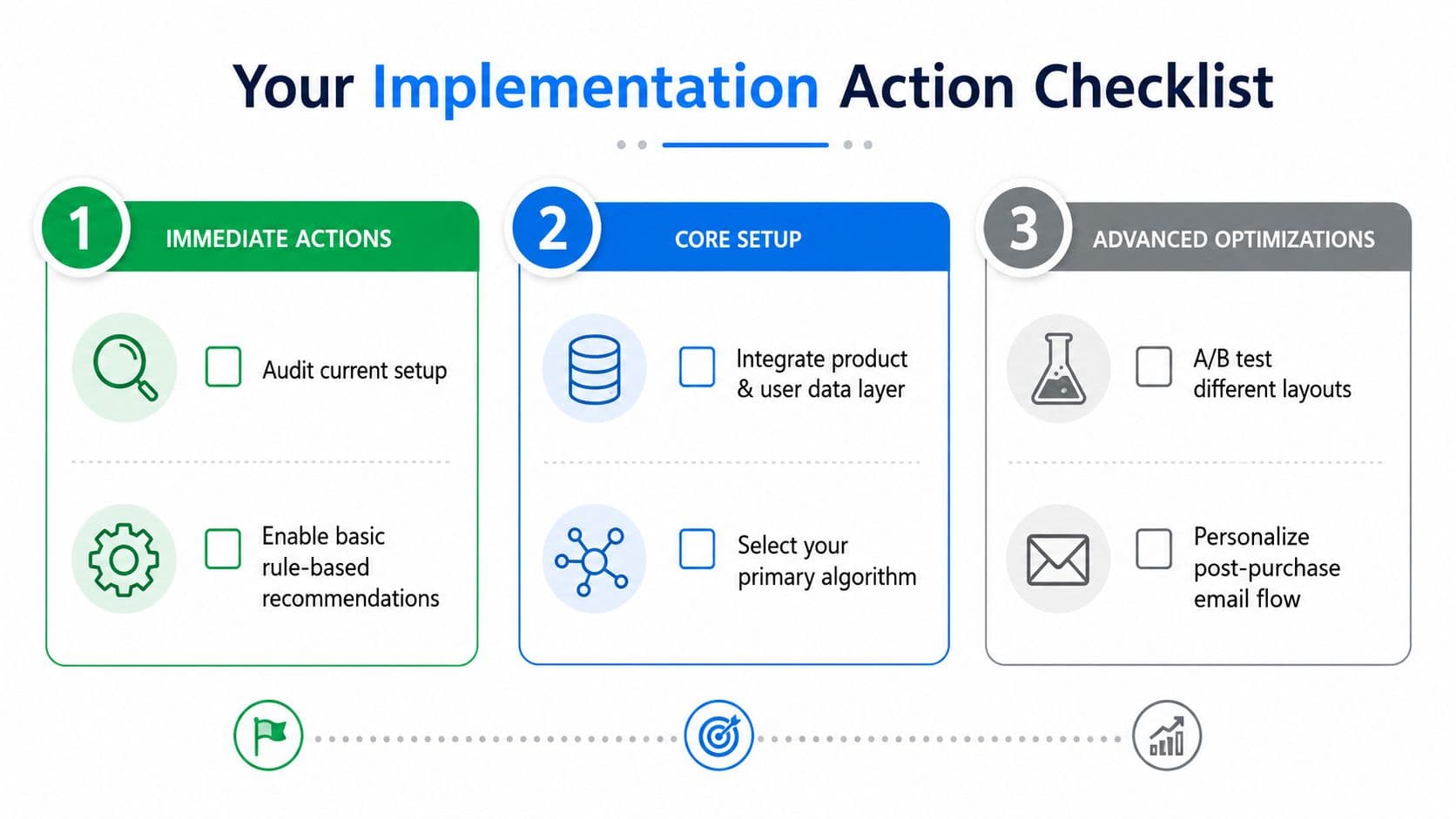
Start with the placements that already get traffic. Audit homepage, product detail pages, and cart modules first, then replace any generic bestseller block that ignores session intent. If the store has a chatbot layer, turn on a basic recommendation workflow so you can start learning from shopper questions and clicks immediately.
Immediate actions
- Audit current setup: Identify every place recommendations already appear, then check whether the same block is being reused everywhere.
- Enable basic rule-based recommendations: Use curated bestsellers or collection logic where the data is still thin, especially for new visitors.
- Set a measurement baseline: Track conversion, AOV, and revenue per visitor before changing anything so you can see what moved.
Core setup
- Connect product and user data: Bring browsing, purchase, and preference signals into one dataset instead of scattering them across tools.
- Add product page cross-sells: Use similarity and bought-together logic on PDPs, where intent is already clearer.
- Capture explicit preferences: Quizzes and guided questions help move anonymous traffic into a more usable segment.
Advanced optimization
- Build a longer history window: Centralized data with 1 to 2 years of history helps with seasonality and trend shifts (Dataforest personalization guide).
- Adopt hybrid logic: Blend rule-based, content-based, and behavioral signals instead of depending on one method.
- Adapt for privacy limits: Keep lighter-touch options ready, like curated rules and contextual suggestions, for sessions with limited consent or thin history.
If you want a practical way to start, use Carti to handle instant answers, Smart Suggestions, and cart recovery in one Shopify workflow, then compare the results against your current recommendation widgets. Visit Carti to see how the assistant fits your store and whether it can replace the manual work that's slowing your recommendation strategy down.

Written by
Daniel AndersonFounder of Carti. 10+ years building ecommerce brands in apparel and supplements. Still runs a Shopify store and built Carti to help merchants convert more browsers into buyers.