
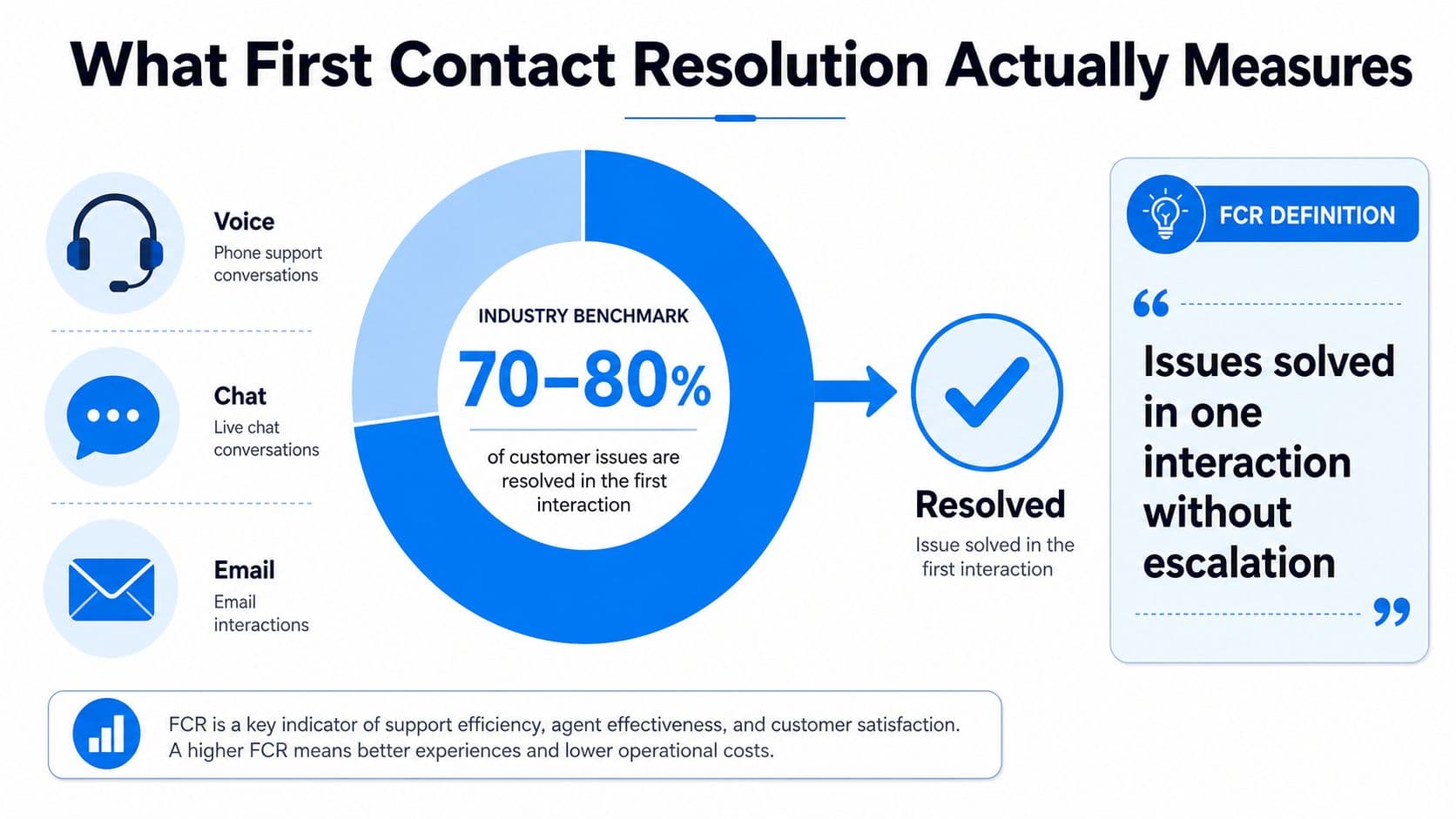
First contact resolution looks simple until you run it in a real Shopify support stack. The benchmark to recognize is roughly 70% to 75%, with top performers reaching 80% to 85% according to major industry guidance, which means even strong operations still have repeat contacts in the system (Intercom on FCR benchmarks). That's the useful reframe, because FCR isn't really a measure of agent charm or speed, it's a measure of whether your support system can solve the right issue on the first pass.
What First Contact Resolution Measures
The clean definition is simple, first contact resolution is the percentage of issues resolved during the first interaction without follow-up, and the standard formula is resolved-on-first-contact cases divided by total eligible cases, multiplied by 100 (Salesforce on first call resolution). That same measurement logic shows up across Salesforce, Zendesk, and Intercom, which matters because the metric needs to behave consistently whether the customer writes in by email, starts in chat, or calls support. Zendesk's framing also makes it clear that one-touch tickets can span email, phone, and chat.
A Shopify store can think about it in plain terms. If a shopper asks where an order is, and support answers with the exact tracking status, the issue is resolved on the first touch. If the reply creates a back-and-forth, or the customer has to recontact after the first interaction, that case didn't resolve. The number only means something if the team can tell the difference between a fast answer and a real resolution, which is why a solid customer service evaluation process matters before you trust the metric (Carti on customer service evaluation).
Why the benchmark matters
The benchmark helps you classify reality without pretending perfection exists. A good FCR rate sits around 70% to 75%, while top-performing teams reach 80% to 85% (Intercom on FCR benchmarks). In practical terms, that still leaves about 25% to 30% of customer contacts needing repeat outreach even in solid support operations, which is why FCR is better treated as a system-quality KPI than a vanity number.
That system view is the part many teams miss. The metric doesn't tell you whether a single agent was heroic, it tells you whether routing, knowledge access, and issue ownership made it possible to resolve the right cases on the first pass. I've seen stores blame individual reps for a low FCR when the problem was that every shipping exception landed in the wrong queue.
Practical rule: if your FCR is noisy, don't start with coaching. Start with case routing, knowledge access, and the kind of questions customers are actually asking.
The benchmark is only useful when you know what sits underneath it. That is why the key question is not “Is our number good?” but “What exactly are we counting?”
How to Calculate First Contact Resolution the Right Way
A technically honest FCR program starts at the case level, not the contact level. The numerator should include only issues resolved on the first interaction with no transfer, no reopen, and no repeat contact within a defined window, which is the approach recommended in operational guidance on FCR measurement (Umbrex on first contact resolution rate). The denominator should be eligible cases, not every raw message, because some interactions were never meant to be resolved on the first pass by design.
That distinction matters a lot in e-commerce. A contact-level view can make the team look better than it is when a shopper gets a quick acknowledgment but returns later with the same issue. A case-level view is stricter, but it tracks what customers experience.
| Method | What it counts | Common blind spot |
|---|---|---|
| Contact-level FCR | One interaction that looks resolved | Can overstate success if the customer returns later |
| Case-level FCR | Eligible cases resolved on first contact | Requires cleaner definitions and better ticket hygiene |
| Customer-validated FCR | Resolution confirmed by the shopper after the interaction | Needs survey or feedback data, and can be harder to operationalize |
Segment the number before you trust it
A blended FCR can hide very different realities across the store. Break it out by channel, queue or skill, customer tier, product or version, region or language, and issue category so the roll-up does not hide where the friction sits. A support team can look healthy overall while returns, exchanges, or damaged-item cases are dragging the whole operation down.
A repeat-contact window also has to be defined. Many teams use a short operational window, such as a week or two, to decide whether the issue stayed resolved, because post-contact reopens tell you more than a single closed ticket does. That is especially useful when a customer's first interaction looks clean in the ticketing system but the underlying issue resurfaces after the conversation ends.
A good FCR score with bad segmentation is a false comfort. It tells you the average, not the bottleneck.
The formula itself is easy. The discipline is in deciding what counts as eligible, what counts as resolved, and which slices of the business deserve their own view.
Why First Contact Resolution Matters for Shopify Revenue
FCR matters because every repeat contact adds friction on both sides of the chat. The store pays in agent time, software overhead, and queue pressure, while the customer pays in effort, delay, and annoyance. When support is efficient and accurate on the first pass, the store usually sees a cleaner operating rhythm and fewer escalations, which is why industry guidance consistently connects higher FCR with lower support cost and better customer experience (OTRS on improving FCR).
The revenue angle is real, but it's indirect. Shopify merchants don't buy FCR because it looks good in a dashboard, they buy it because it reduces the number of conversations needed to get an order shipped, a return approved, or a sizing question answered. That lowers operational drag, and it also changes how customers feel about the brand when support solves a problem instead of passing it around.
The trade-off nobody wants to admit
Pushing FCR too hard can backfire. Zendesk explicitly frames FCR as a useful metric that can become a friend, foe, or frenemy if teams optimize for one-touch closure at the expense of accuracy or empathy (Zendesk on FCR as friend, foe, or frenemy). That warning matters in Shopify, because some issues need follow-up, especially edge cases like damaged-on-arrival claims, address changes, and partial refunds.
The right question is not whether a case closed in one touch. It's whether the customer got the fewest contacts possible without sacrificing correctness. If an agent rushes a wrong answer just to protect the metric, the store may raise FCR on paper while making the experience worse.
Pair FCR with CSAT and refund or recontact analysis, then look for mismatches. If the number climbs while satisfaction falls, the system is probably trading speed for confidence. That's the signal to stop celebrating and start auditing.
Diagnosing the Five Reasons Your FCR Is Stuck
When FCR stalls, the usual advice is to train agents more. That advice is incomplete because it puts the burden on people when the bottleneck is often the workflow around them. The five most common failure points are knowledge access, routing, handoffs, policy edge cases, and purely reactive support.
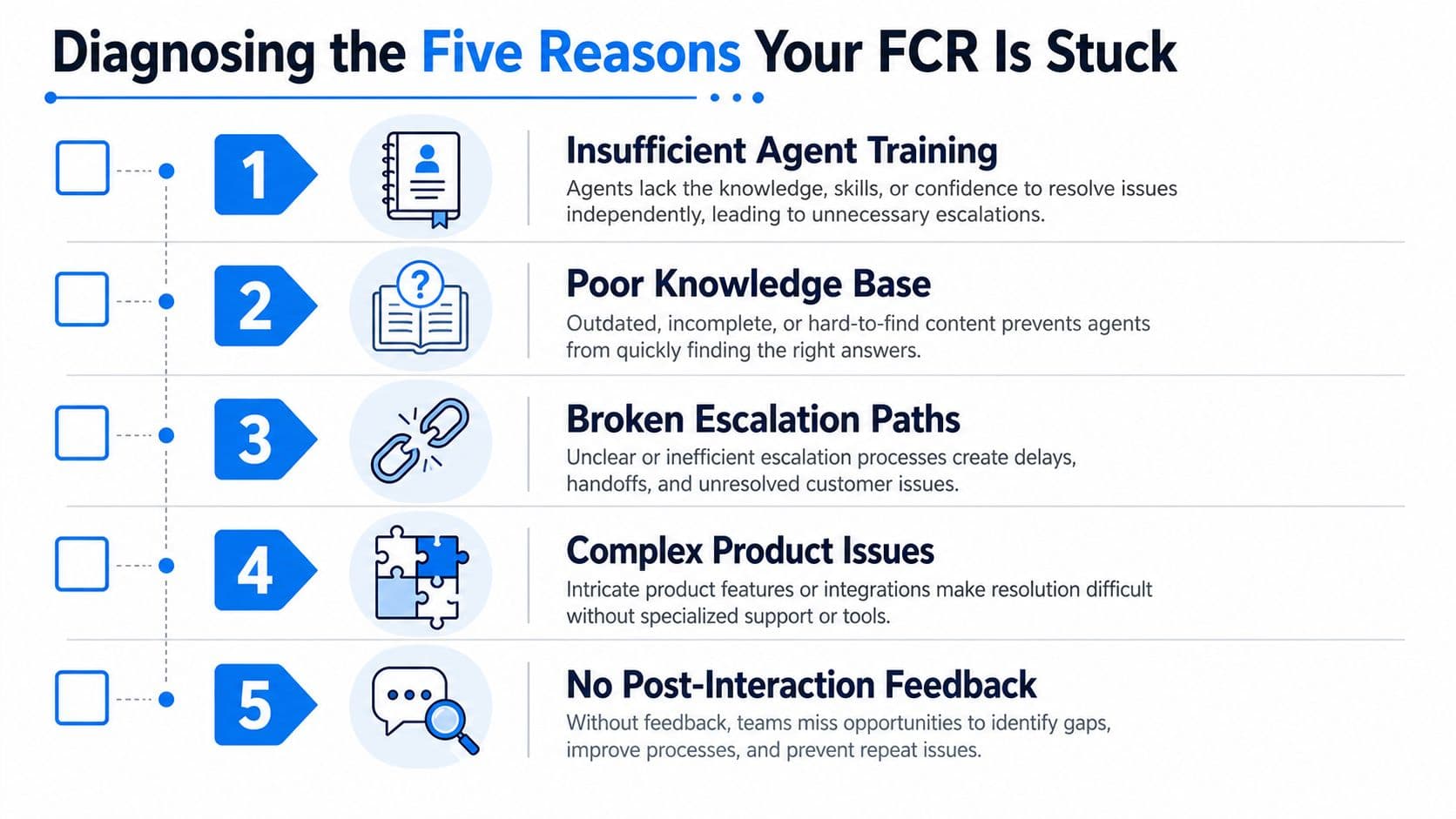
1. Knowledge exists, but no one can find it
The symptom is familiar, agents answer slowly or hedge because the right policy, product detail, or exception rule is buried. The fix is not another generic training session, it's tightening the knowledge architecture so the answer is searchable, current, and tied to the actual issue type. In Shopify terms, returns, shipping windows, and size guides should be easy to surface at the moment of contact, not hidden in a maze of docs.
2. The wrong queue gets the case
Routing errors show up when specialized issues land with generalists. You can spot this when transfers are frequent and first replies sound like clarifying questions instead of answers. The fix is better intent classification and queue design so product-specific or policy-sensitive tickets go straight to the right owner.
3. Handoffs restart the conversation
This is the classic support tax. A shopper explains the problem once, then has to repeat it after a transfer, which destroys the very idea of first contact resolution. The practical fix is to pass full context forward, including what the customer already said, what the system already knows, and what's already been verified.
If a handoff makes the customer repeat themselves, you didn't transfer a case, you reset it.
4. Some cases should be escalated by design
Not every issue belongs in one-touch resolution. If a policy exception needs approval, forcing a rushed closure is the wrong move. The answer is to mark those cases as exception paths, then separate them from the normal FCR pool so the metric reflects what was resolvable on first contact.
5. Support is always reactive
When customers only reach out after frustration sets in, FCR gets harder. Reactive support creates more complex conversations because the customer arrives angry, confused, or already on a deadline. The store does better when common questions are answered before the support ticket exists.
The pattern is clear, FCR is usually leaking through process design, not because an individual rep forgot how to do the job.
Chatbot Playbook to Lift FCR on Your Storefront
A chatbot should cover the high-frequency questions that don't need a human brain every time. For most Shopify stores, that means order status, shipping windows, returns and exchanges, sizing, product availability, and discount code issues. Those are the questions that can be answered quickly if the bot knows the catalog, the policy, and the current order context.
The flow has to be tight enough that the customer doesn't have to restate the problem. If the shopper asks about an order, the bot should confirm the order number or pull the order context, surface the answer, and offer escalation only when the issue falls outside the bot's coverage. If the customer asks about sizing, the bot should point to the relevant size guide, product notes, and common fit questions instead of dumping a generic FAQ page.
Handoff rules matter more than the bot script
A bot that escalates too late wastes time. A bot that escalates too early hands off work the automation could have resolved. The useful middle ground is simple, let the bot try the predictable intents, then transfer when the issue is policy-sensitive, emotionally charged, or clearly outside the answer set.
When the transfer happens, the agent should get the full conversation context, the intent the bot identified, and any data already collected. That's the difference between a real handoff and a dead-end transfer that forces the shopper to repeat themselves.
Good bot design: resolve the obvious, collect the context, and get out of the way fast when the case needs a human.
For a practical implementation pattern, the best practices in Carti's chatbot guidance align with a core FCR principle, the bot's job is to remove avoidable contacts, not to pretend it can solve everything.
What to measure in the first month
Watch whether the bot reduces avoidable questions, shortens time to answer, and leaves fewer cases needing a second contact. Also watch the failure modes, especially when the bot gives a partial answer that creates another ticket later. That's where many teams fool themselves, because a visible deflection can still hide a hidden recontact.
The strongest deployment pattern is the one that closes the simple cases, hands off the complex ones cleanly, and keeps updating its knowledge from the questions customers ask.
Reporting, KPIs, and How to Avoid Gaming FCR
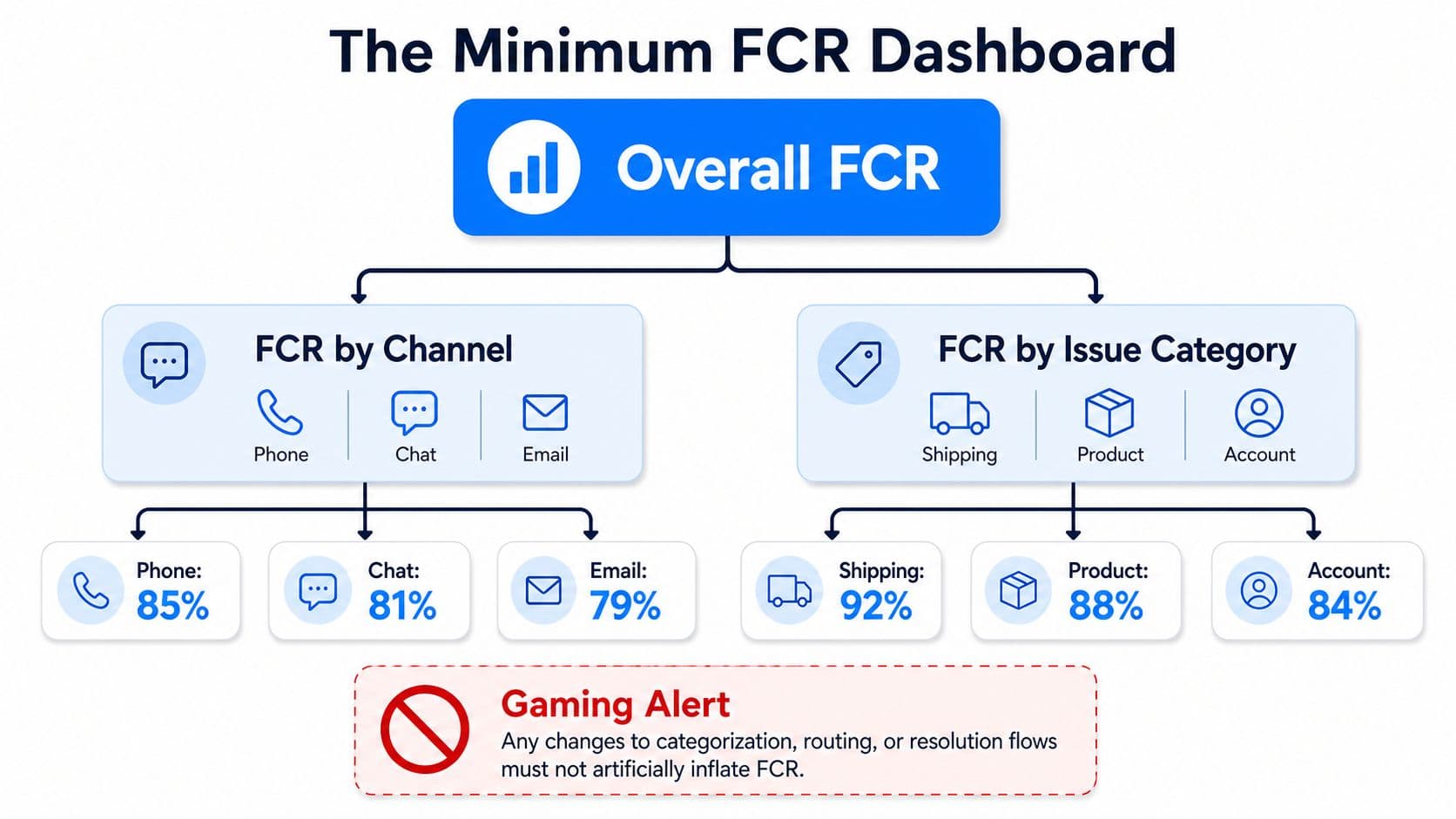
The minimum dashboard should show overall FCR, FCR by channel, FCR by issue category, repeat-contact rate within your chosen window, reopen rate, and CSAT paired against FCR. If the store wants to understand cost, add cost per resolved contact. That mix gives you a view of both speed and quality, instead of rewarding a clean-looking number that doesn't hold up in practice. For a broader KPI framework, it helps to anchor support metrics to the store's operating scoreboard, not to a single channel's vanity stat, and this e-commerce KPI guide fits that mindset.
Daily ops review should focus on active queue issues and obvious routing breakdowns. Weekly review should look for patterns in repeat contacts and reopen spikes. Monthly review should compare segments, as blended averages obscure the true issues.
Signs the metric is being gamed
The biggest warning sign is a rising FCR number paired with falling CSAT. That usually means the team is closing cases too aggressively, or pushing hard cases into a separate lane where they don't pollute the blended score. Another red flag is a policy culture that discourages follow-up even when follow-up is what the customer needs.
Keep the accounting honest. If a ticket is marked resolved but the shopper comes back with the same issue, that's not a success, it's a delayed repeat contact. If a specialist queue exists for complex cases, report it separately so the blended FCR doesn't punish the team for doing the hard work correctly.
The guardrail is simple, FCR up plus CSAT down means something is off. That's the moment to inspect the workflow, not the dashboard color.
A Shopify FCR Case Study and Quick Answers
A fashion store I worked with had a familiar pattern: slow email handling, repetitive questions about orders and returns, and a support team that felt busy without feeling effective. The system changed when the store tightened intent coverage, made escalation rules explicit, and used proactive answers to intercept the most common pre-purchase and post-purchase questions. The result was a cleaner support loop, fewer repeat touches, and a better path from question to resolution.
The important lesson wasn't that automation did everything. It was that the store stopped making customers work to find the answer, and support stopped rediscovering the same issue in every channel.
Quick answers
How long should a repeat-contact window be? Use a window that matches how long it usually takes for the same issue to reappear in your store. The key is consistency, not pretending every category behaves the same way.
Does AI inflate FCR falsely? It can, if you only measure the first visible response and ignore later recontacts. That's why case-level and customer-validated views matter.
What about low-volume stores? Low volume makes month-to-month swings noisy, so segment carefully and avoid overreacting to short spikes. The system still matters, even when the sample size is small.
How should FCR read during a product launch? Expect more exceptions and more questions. During launch periods, the question is less about hitting a perfect score and more about whether the support stack is absorbing the new demand without creating avoidable repeat contacts.
If you want a support stack that improves first contact resolution instead of just reporting on it, take a hard look at Carti.

Written by
Daniel AndersonFounder of Carti. 10+ years building ecommerce brands in apparel and supplements. Still runs a Shopify store and built Carti to help merchants convert more browsers into buyers.
Ready to boost your store's sales?
Install Carti in 5 minutes and let AI handle customer questions, recommend products, and close sales 24/7.
Start Free Trial14-day free trial