
CSAT stands for Customer Satisfaction Score, and it's usually reported as a percentage from 0 to 100 based on the share of respondents who chose the top satisfaction options, typically 4 or 5 on a 5-point scale. In practice, it tells you how happy a customer was with a specific moment, like a purchase, support chat, or onboarding step, which makes it very different from broader loyalty metrics that try to measure the whole relationship.
If you run a Shopify store, this is the question sitting underneath almost every order notification: did that customer leave the experience pleased, annoyed, or unconvinced? Revenue problems often show up first as experience problems. A shopper hesitates at checkout, can't get a shipping answer fast enough, or finishes a support conversation still unsure what happens next.
That's why understanding what a CSAT score is matters more than most merchants think. It's not just a support metric. It's a fast diagnostic for moments that influence repeat purchases, referrals, and whether a customer trusts your store enough to buy again.
The Most Important Question You Aren't Asking After a Sale
A customer completes checkout on your Shopify store. Payment goes through. Confirmation email lands. From the store's point of view, that looks like success.
From the customer's point of view, it might not.
They may be happy. They may be confused about delivery timing. They may have needed help and never got it. They may have bought despite friction, not because the experience felt smooth. That difference matters because a completed order doesn't always mean a strong customer experience.
CSAT gives you a way to measure that exact moment. It answers a narrow but useful question: how satisfied was the customer with this specific interaction? That could be the checkout flow, a support conversation, a return request, or a post-purchase onboarding message.
For Shopify merchants, that specificity is what makes CSAT useful. It doesn't try to summarize everything your brand means to the customer. It tells you whether one touchpoint worked.
Practical rule: Use CSAT when you need to diagnose a moment, not when you want to measure brand love in the abstract.
That distinction is easy to miss. Many merchants jump straight to broad loyalty thinking. They want to know whether customers would recommend the brand, come back later, or become advocates. Those are valid goals, but they don't help much if the immediate problem is that shoppers can't get a sizing question answered before they abandon a cart.
CSAT works best as an operational signal. It shows where friction lives in your journey.
Why this matters for ecommerce
In ecommerce, customer satisfaction lives inside small moments:
- Checkout confidence: Does the buyer understand shipping, returns, and payment options?
- Support clarity: Did your team solve the issue or just answer with a canned reply?
- Post-purchase reassurance: Does the customer know what happens after the order is placed?
- Product fit: Did the information on the product page set the right expectation?
A weak experience in any one of those moments can hurt trust. Trust affects whether someone buys again, contacts support angrily, or leaves and never returns.
A good CSAT program doesn't ask customers to validate your brand. It helps you find the exact step that needs fixing.
That's why merchants who use CSAT well don't treat it as a vanity metric. They treat it like a troubleshooting tool for conversion and retention.
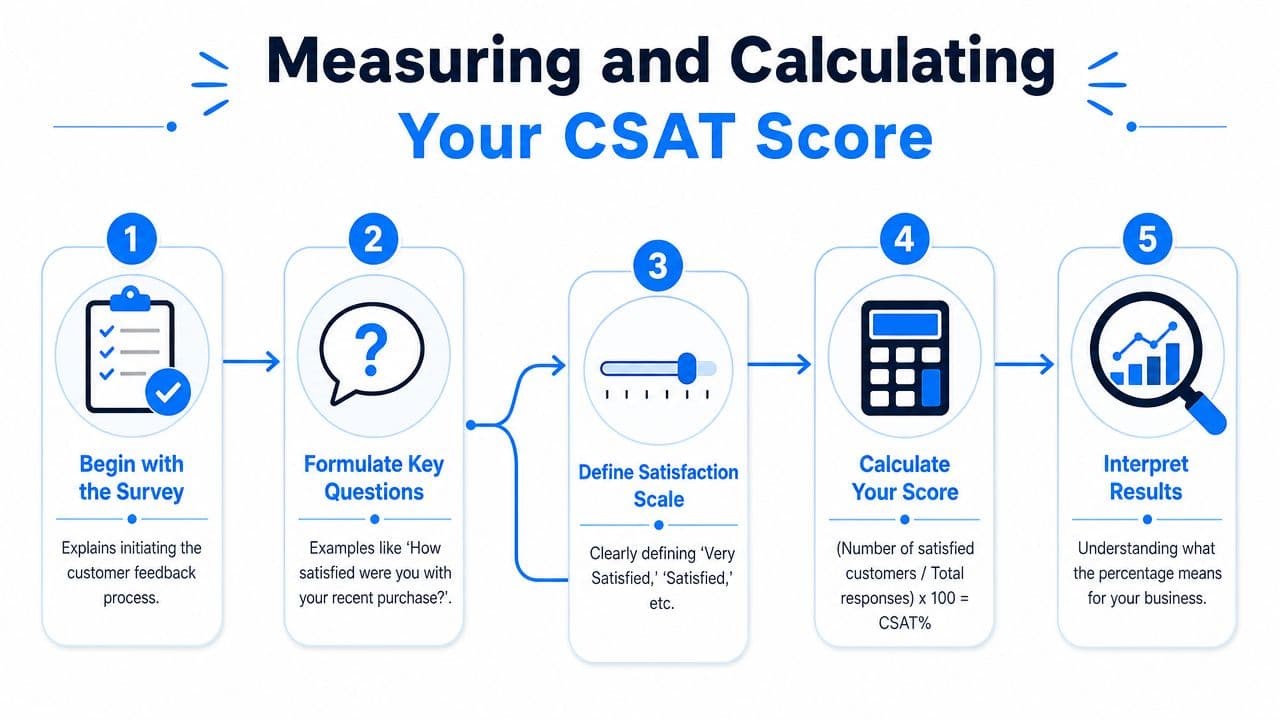
How to Measure and Calculate Your CSAT Score
A customer finishes checkout, gets the order confirmation, then hits a snag with shipping details. If you ask about that experience while it is still fresh, you get useful signal. If you wait a week and ask about the brand overall, you get blurrier feedback that is harder to act on.
Start with one touchpoint
CSAT works best when it measures a specific interaction. For an ecommerce store, that could be the checkout flow, a support chat, a return request, or the delivery experience. The narrower the moment, the easier it is to connect the score to a fix that improves conversion or repeat purchase rate.
Use a direct question tied to that event:
- After purchase: “How satisfied were you with your recent purchase?”
- After support: “How satisfied were you with the help you received today?”
- After a return: “How satisfied were you with the return process?”
Keep the response scale simple. A 1 to 5 scale is common, and so are star ratings or quick mobile-friendly icons. What matters is consistency. If your support team uses one scale and your post-purchase survey uses another, trend lines become less reliable and teams start arguing over the measurement instead of improving the experience.
For Shopify merchants, the best survey placements are usually right after live chat, after a help desk ticket is marked resolved, after a return is completed, or after a key post-purchase message. If you want to pair CSAT with operational review, this guide to evaluating customer service performance is useful because it connects customer feedback to queue management, resolution quality, and team execution.
Calculate the score the same way every time
The formula is simple:
CSAT = (Number of satisfied responses / Total responses) × 100
In practice, “satisfied responses” usually means the top two options on a 5-point scale, such as 4 and 5. If 200 customers answer your survey and 160 choose those top ratings, your CSAT score is 80%.
That method is strict by design. Neutral responses do not count as satisfied. That matters in ecommerce because a neutral checkout, neutral support interaction, or neutral delivery update rarely builds loyalty. It often means the experience was acceptable, but not strong enough to protect the next sale.
Set up the survey so the score is useful
A reliable CSAT program is usually simple:
- Send the survey immediately after the interaction. Response quality drops when customers have to reconstruct what happened.
- Ask one question first. You can add an optional comment field, but the rating question should stay clean.
- Tag responses by touchpoint. Keep support CSAT, delivery CSAT, and post-purchase CSAT separate.
- Review comments with the score. The percentage shows where friction exists. The written feedback usually shows what caused it.
There is a trade-off here. Short surveys get more responses, but they give less context. Longer surveys give richer feedback, but completion rates fall. For most stores, the best setup is a one-question CSAT survey with an optional follow-up comment, then deeper research only when a pattern shows up.
Avoid the setup mistakes that make CSAT useless
The biggest errors are operational, not mathematical. Teams ask broad questions, send surveys too late, or mix different customer moments into one report. Then the score looks tidy in a dashboard but does not help anyone reduce refunds, improve support, or recover abandoned carts.
Use CSAT as a diagnostic tool. If support satisfaction drops after you add an AI chatbot, do not scrap automation immediately. Check whether the bot is missing intent, escalating too slowly, or answering policy questions poorly. If post-purchase CSAT falls after a shipping policy change, inspect the promise on the product page and the message timing in your order flow.
That is the primary value of CSAT for ecommerce. It gives you a practical way to spot friction at the exact point where trust, conversion, and retention are won or lost.
What a Good CSAT Score Looks Like
A Shopify store can post a strong top-line CSAT and still have a revenue problem.
I see this when support scores look healthy, but checkout or delivery satisfaction is slipping. The average score gives false comfort, while a specific touchpoint is hurting repeat purchase rate, return volume, or conversion on the next order. A good CSAT score is the one that helps you catch that problem early.

A good score is one that is strong for that touchpoint and improving over time
General benchmarks can give you rough orientation, but they do not tell you whether your store is getting healthier. A post-purchase survey, a returns survey, and a live chat survey measure very different moments. Customers bring different expectations to each one.
For an ecommerce brand, the more useful question is: did this score improve after we changed the experience?
If checkout CSAT rises after you simplify shipping messaging, that matters. If support CSAT falls after you add an AI chatbot, that matters too, even if the total score still looks acceptable in a dashboard. CSAT earns its place when it helps you connect customer sentiment to business outcomes you already track, such as refund rate, repeat purchase rate, and other ecommerce KPIs that matter to store performance.
Compare the same experience against itself
Use CSAT trend lines by touchpoint, not one blended number across the whole journey. That gives you a cleaner read on what changed and where to act.
Compare:
- Checkout CSAT against prior checkout CSAT
- Chat CSAT against prior chat CSAT
- Delivery or post-purchase CSAT against prior results from that same stage
- Returns CSAT before and after policy, staffing, or automation changes
That approach is more useful than trying to guess a competitor benchmark you cannot verify. Internal trends show whether your own changes improved the customer experience or introduced friction.
A “good” CSAT score is a score that stays healthy for a specific touchpoint and moves in the right direction after you improve the process.
Use ranges carefully
Broad ranges can still be helpful as a gut check. If a score is clearly low, you likely have an experience issue worth investigating. If it is high, customers are probably getting what they need in that moment.
But merchants should avoid treating one number as a pass-fail line. A 78% CSAT for support may be acceptable during a high-volume sale week. The same score for returns, where customers want speed and clarity, may point to avoidable friction that will hurt loyalty.
That is why mature teams review CSAT in context:
- The touchpoint being measured
- The customer's urgency at that stage
- Recent changes to policy, staffing, site UX, or automation
- The downstream metric affected, such as conversion, repeat orders, or support cost
Trend lines are more useful than snapshots
A single score is just a reading. A trend lets you manage the business.
If your store launches an AI chatbot and chat CSAT drops over two weeks, you have a diagnostic signal. Review containment rate, handoff timing, and the questions the bot fails to resolve. If post-purchase CSAT dips after a shipping promise change, check whether the issue is delivery performance, expectation setting on product pages, or notification timing in your order flow.
Here's a useful explainer on customer satisfaction context and reporting:
The practical standard is simple. A good CSAT score helps you spot friction early, fix the right touchpoint, and protect the outcomes that matter most in ecommerce: conversion, retention, and customer loyalty.
CSAT vs NPS and CES for Ecommerce
Merchants often lump these metrics together and then wonder why the data feels confusing. The problem isn't the metrics. It's using them for the wrong job.
CSAT is best for immediate satisfaction with a specific interaction. NPS is about long-term loyalty and willingness to recommend. CES focuses on how easy or difficult the experience felt.
Use each metric for a different job
Think of them as three different lenses on the customer journey.
CSAT helps when you need to inspect a moment. A customer just finished a chat about delayed shipping. Were they satisfied with the help they got? That's a CSAT question.
NPS belongs at a higher altitude. It's more useful when you want to understand the strength of the overall relationship with your brand. If your store has repeat customers, subscriptions, or community-led retention, NPS can help you understand whether people feel loyal enough to recommend you.
CES is the friction lens. It's especially useful when customers complete a process that should feel effortless, such as finding a return label, updating a subscription, or getting an answer from support without bouncing between channels.
If a shopper says the outcome was acceptable but the process was painful, CSAT alone won't tell the full story. That's where CES earns its place.
For Shopify brands, the mistake is trying to make one metric do everything. CSAT won't tell you if your brand has advocacy. NPS won't show you which support workflow is broken. CES won't tell you if the final resolution left the customer pleased.
CX Metrics Compared: CSAT vs. NPS vs. CES
| Metric | What It Measures | Typical Question | When to Use |
|---|---|---|---|
| CSAT | Satisfaction with a specific interaction | How satisfied were you with your recent experience? | After checkout, support, onboarding, returns, or delivery updates |
| NPS | Long-term loyalty and advocacy | How likely are you to recommend our brand to a friend? | Periodic relationship checks, loyalty tracking, brand health reviews |
| CES | Ease or difficulty of completing a task | How easy was it to resolve your issue or complete this task? | Returns flows, self-service journeys, account changes, support processes |
A practical ecommerce setup
For most stores, a lean setup works better than an overbuilt voice-of-customer program.
Use this decision pattern:
- Choose CSAT when you've made a change to a specific touchpoint and want fast feedback.
- Add CES when your main problem is friction, repetition, or customer effort.
- Layer in NPS when your retention strategy depends on repeat buying, referrals, or subscriptions.
This creates a more complete picture. CSAT tells you whether the customer felt satisfied. CES tells you whether it felt easy. NPS tells you whether that relationship is compounding into loyalty.
That separation keeps your team from chasing the wrong fix. If your issue is support friction, work on ease. If your issue is disappointing outcomes, work on satisfaction. If your issue is weak emotional attachment to the brand, loyalty metrics become more relevant.
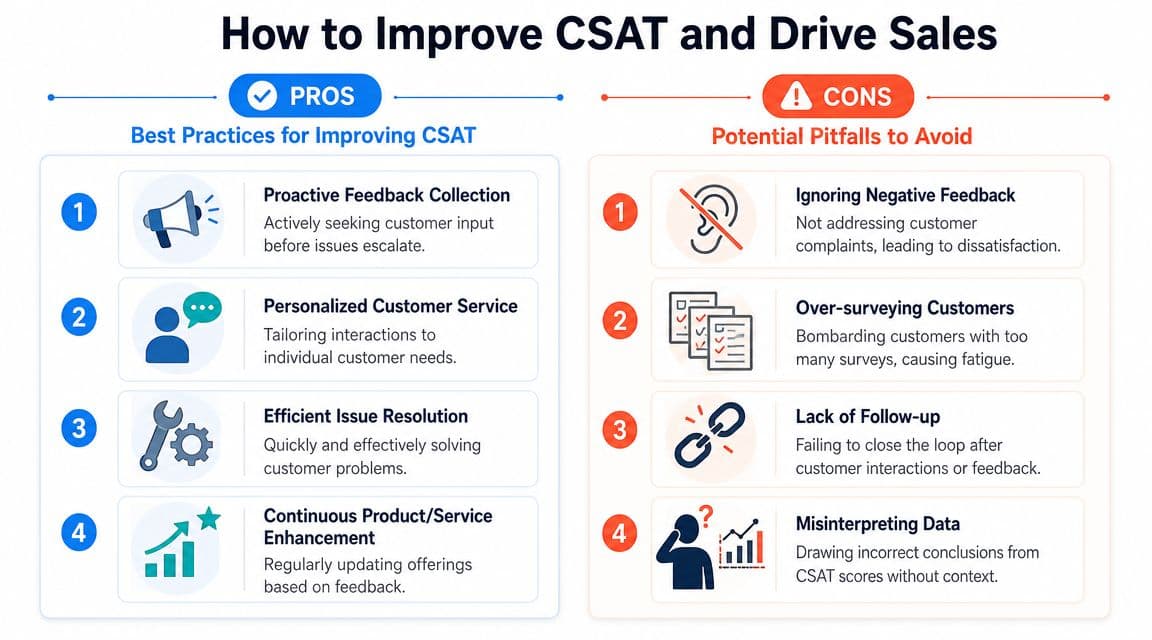
How to Improve CSAT and Drive Sales
Low CSAT rarely comes from one dramatic failure. More often, it comes from repeated small irritations that pile up across the buying journey.
For Shopify stores, the common culprits are familiar. Product pages leave unanswered questions. Live chat goes silent. Shipping policies are technically available but hard to understand. Returns feel like work. Checkout creates uncertainty right before payment.
Fix the moments that frustrate shoppers
CSAT improves when customers get clarity faster.
That sounds obvious, but many stores still design around internal convenience instead of customer questions. They bury return terms on a policy page, write generic product descriptions, and route every inquiry into a shared inbox that customers have to wait on.
The practical fixes are usually operational:
- Tighten product detail pages: Add the sizing, ingredients, materials, compatibility notes, and delivery expectations that shoppers ask for repeatedly.
- Reduce support lag: If customers need help before purchase, delayed replies don't just hurt satisfaction. They also stall conversion.
- Make post-purchase communication clearer: Confirmation, fulfillment, and tracking updates should answer the next question before the customer asks it.
- Remove checkout ambiguity: If taxes, shipping timing, or return rules feel unclear, buyers hesitate.
If you want a broader playbook for reducing friction across the shopping journey, this guide on improving ecommerce customer experience is a useful next step.
The fastest path to better CSAT is usually not a better survey. It's fewer moments where the customer has to stop and ask for help.
Survey design can help or hurt
Some teams damage their own data without realizing it. They ask too often, ask too broadly, or never follow up on negative responses.
A few rules keep the signal clean:
- Send surveys at meaningful moments: After support, purchase, delivery, or returns works better than random batch emails.
- Keep the ask short: One main rating question and an optional comment field is usually enough.
- Close the loop: If someone leaves a poor rating and a useful comment, treat that as operational input, not just reporting data.
- Avoid survey fatigue: If every action triggers a feedback request, customers tune out.
Outside ecommerce, other service-heavy industries use review analysis to identify recurring complaints before they become brand problems. If you want a simple example of that approach, TastyVox has a tool that helps understand restaurant customer feedback. The same principle applies to online stores. Repeated complaints usually point to process flaws, not isolated bad moods.
Turn feedback into revenue decisions
CSAT's role extends beyond a simple support metric.
If customers repeatedly report frustration before buying, your issue may be conversion friction. If satisfaction falls after delivery, the problem may sit with product expectation setting or post-purchase communication. If support scores dip during promotions, staffing or automation may be failing under demand.
AI chatbots can help here when they're implemented well. Not as gimmicks, and not as deflection machines. They work when they answer routine questions accurately, guide shoppers to relevant products, and provide instant responses outside support hours.
For ecommerce, that can improve satisfaction in ways that also support sales:
- Instant answers reduce hesitation: Shoppers often leave when basic questions sit unanswered.
- Product guidance improves fit: Better recommendations can help customers choose with more confidence.
- Always-on support protects after-hours demand: A buyer who shops late still expects help.
- Cart recovery support removes uncertainty: Follow-up prompts can bring customers back when the reason for abandonment was unresolved confusion.
What fails is using automation to dodge real service. If the chatbot can't answer accurately, traps the customer in loops, or hides the path to human help, CSAT usually suffers. Good automation reduces effort. Bad automation adds it.
The strongest merchants treat CSAT feedback as a map. They look for the customer questions that appear again and again, then fix the source. Sometimes that means changing copy. Sometimes it means changing workflow. Sometimes it means adding better self-service and chat support so the customer doesn't get stuck in the first place.
Turning Customer Satisfaction into Your Competitive Edge
A lot of stores treat customer satisfaction like a report they review after the month ends. That's too late.
CSAT works better when you use it as an operating signal. Ask after the right interaction. Read the comments for patterns. Tie low scores to a touchpoint your team can improve. Then measure again after the change.
Listen at the right moments
The value of CSAT comes from precision. A broad survey may tell you customers feel mixed. A targeted CSAT survey tells you the return flow is confusing, the live chat experience feels slow, or the checkout handoff leaves buyers uncertain.
That kind of feedback is useful because it points to action.
For a Shopify merchant, this can shape decisions across the business:
- Merchandising: Which product pages need stronger information
- Support operations: Where response gaps are hurting trust
- Retention: Which post-purchase moments weaken the second order
- Site experience: Which flows create avoidable friction
Act faster than your competitors
In crowded categories, products are often easier to copy than customer experience. A competing store can match a price, launch a similar bundle, or imitate your creative. It's much harder to consistently deliver a smoother buying journey.
That's where CSAT becomes a competitive edge. It gives you direct evidence about what customers experienced, not what your team assumes they experienced. When you act on that feedback consistently, you build a store that feels easier to buy from, easier to trust, and easier to come back to.
Customer satisfaction isn't the entire growth strategy. But it does reveal whether your operations support growth or undermine it. Used well, CSAT becomes one of the clearest ways to turn customer feedback into better decisions and stronger loyalty.
Carti helps Shopify merchants turn customer questions into conversions with an AI-powered Shopify chatbot that answers instantly, recommends products, and supports shoppers around the clock. If you want to improve customer satisfaction without forcing your team to handle every repetitive question manually, Carti is built to make that easier.

Written by
Daniel AndersonFounder of Carti. 10+ years building ecommerce brands in apparel and supplements. Still runs a Shopify store and built Carti to help merchants convert more browsers into buyers.
Ready to boost your store's sales?
Install Carti in 5 minutes and let AI handle customer questions, recommend products, and close sales 24/7.
Start Free Trial14-day free trial