
The number that should reset how Shopify merchants think about this category is this: the AI agents in eCommerce market is projected to grow from USD 3.6 billion in 2024 to USD 282.6 billion by 2034 at a 54.7% CAGR according to Market.us research on AI agents in ecommerce. That isn't a small feature trend. It signals a shift in how products get discovered, questions get answered, and carts get built.
Most merchants still treat chat as a support widget. That's too narrow. A well-built AI agent for ecommerce works more like a sales channel with memory, store access, and the ability to act. It can answer questions, reduce hesitation, recommend products, and move a shopper toward checkout without waiting on your team.
That distinction matters because the merchants who win with AI won't just install a bot. They'll connect the agent to real store data, let it take safe actions, and prepare their product and policy content so both on-site agents and external AI shopping assistants can understand the brand accurately.
What Is an AI Agent in Ecommerce
A basic chatbot is usually a scripted responder. It handles simple FAQs, points people to a page, and breaks when a shopper asks something messy. An AI agent for ecommerce is different. It behaves more like a strong sales associate who knows your catalog, remembers context, and can perform actions inside the store.
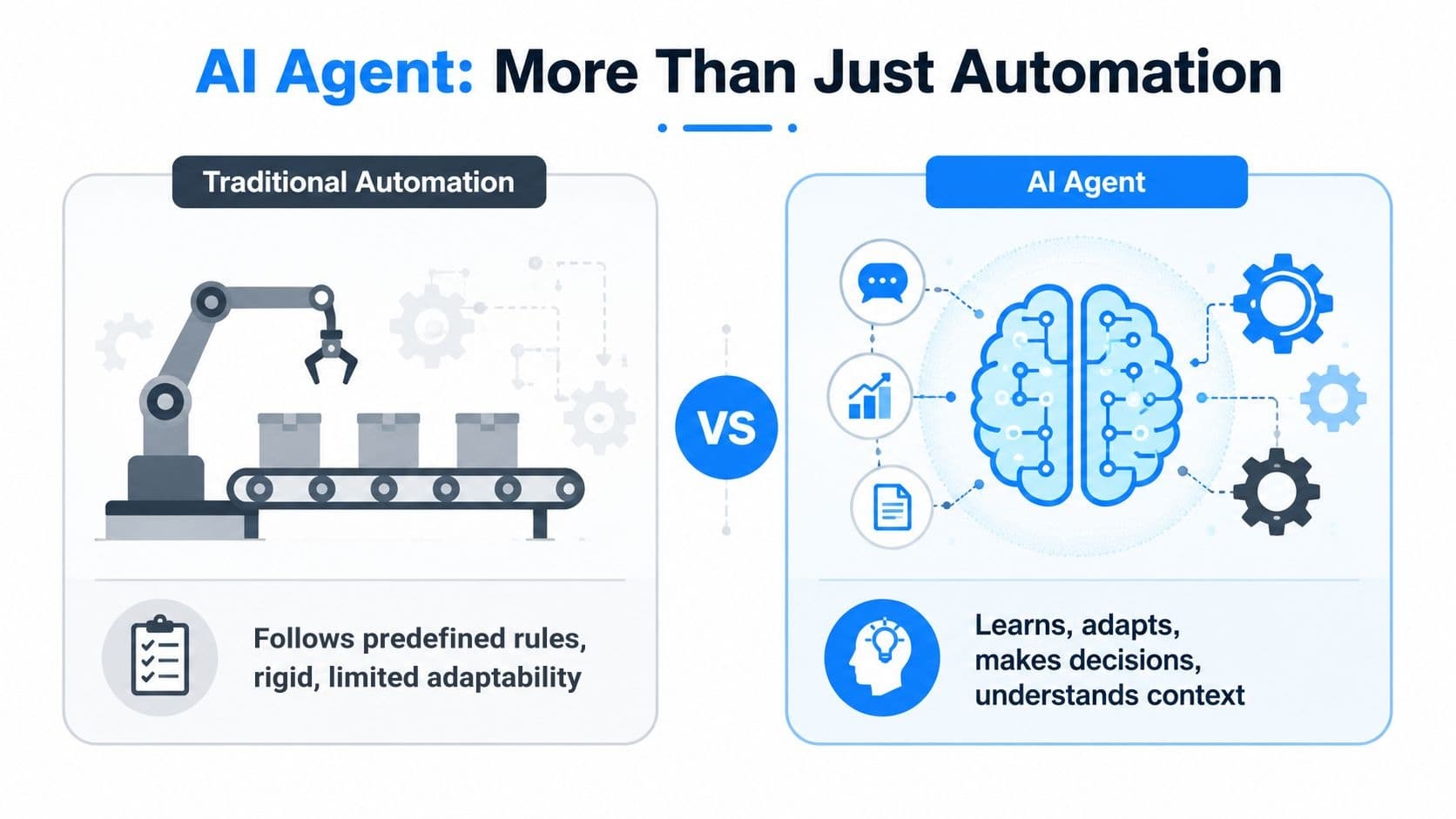
A chatbot answers and an agent sells
The key word is agency. The agent doesn't just respond to a sentence. It interprets intent, reasons through the request, checks store data, and then takes the next useful step.
A shopper might type, “I need a vegan leather work bag that fits a 15-inch laptop and ships fast.” A weak bot returns links that contain “bag.” A real agent narrows the catalog, checks availability, surfaces the products that match the constraints, answers shipping questions, and can push the shopper toward purchase.
That's why merchants should stop comparing agents to old support chat. The better comparison is this:
| Tool | What it does |
|---|---|
| FAQ chatbot | Replies to common questions with prewritten or lightly generated answers |
| Ecommerce AI agent | Understands shopping goals, uses store data, and can guide or trigger next actions |
Practical rule: If the system can't connect shopper intent to inventory, pricing, and cart actions, it's not operating as an ecommerce agent. It's still a chat layer.
Why merchants should treat it like a channel
Sales channels deserve different thinking than support tools. You measure them on assisted conversion, influenced revenue, faster path to checkout, and fewer dead-end sessions. You also design them differently. The prompt design, product data, policy clarity, and integrations matter because the agent is effectively selling on your behalf.
This is also why merchants exploring broader operations stacks often look at resources like Odoo 19 AI agents to understand how agent workflows connect across commerce systems, not just on-site chat. The same principle applies on Shopify. The useful agents are the ones tied to the underlying business logic.
A second shift is happening outside your storefront. Shoppers are starting to ask external assistants what to buy before they ever land on your PDP. If you want a deeper look at that change, this guide on AI shopping agents is worth reading because it frames agents as a discovery layer, not just a widget.
The Core Components of an Ecommerce AI Agent
The fastest way to tell whether a vendor understands ecommerce is to ask how the agent is built. If the answer is mostly about “smart conversations,” that's a warning sign. Production systems need architecture, not just fluent text.
According to Alhena's breakdown of ecommerce AI agent architecture, effective ecommerce AI agents need Retrieval-Augmented Generation (RAG) to ground responses in real-time catalog data, and the architecture requires five core components: a perception layer, a reasoning engine grounded via RAG, a memory system, an action layer with API integrations, and a safety layer.
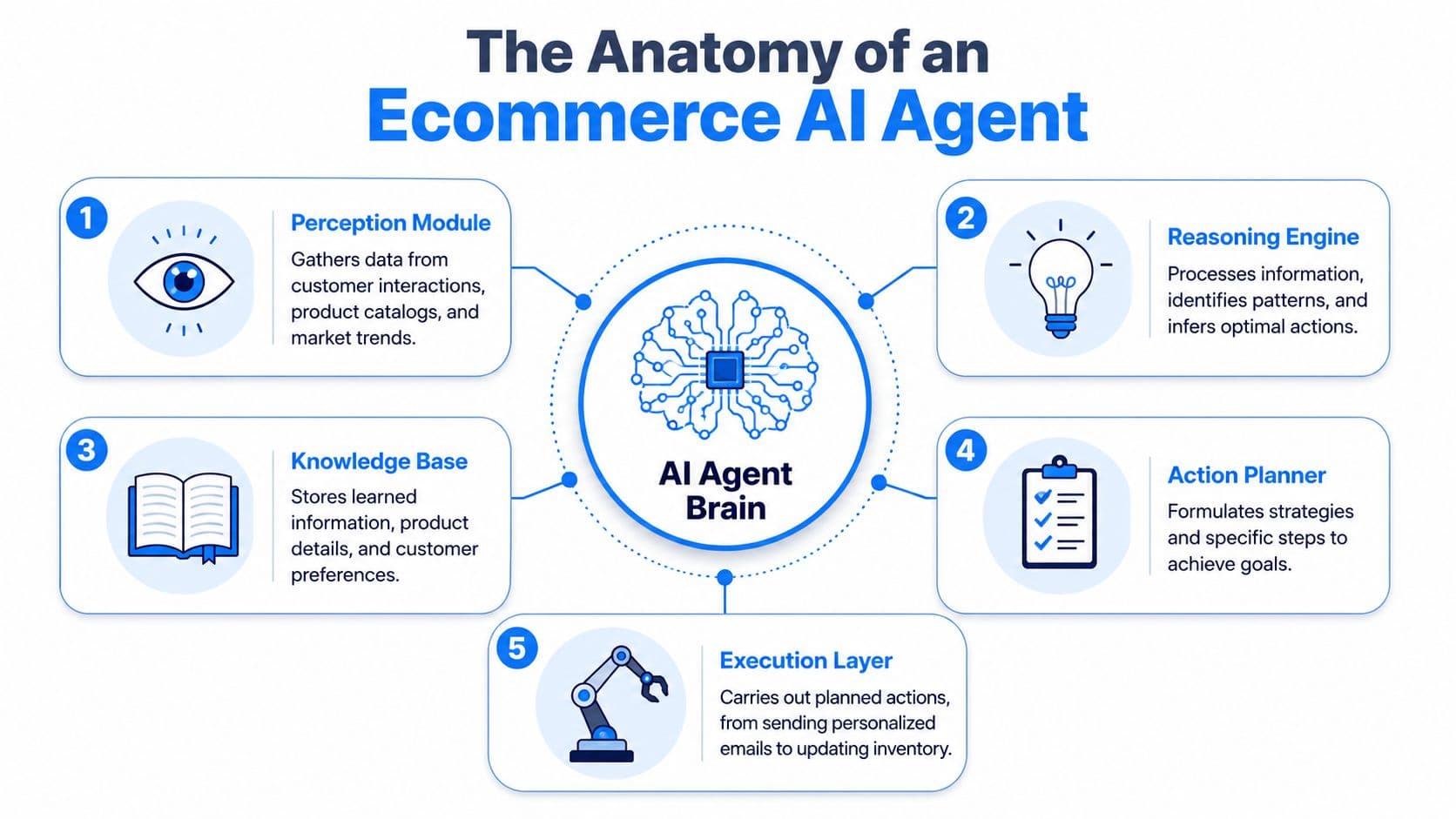
The five parts that matter in production
Here's what those five components mean in plain English for a Shopify merchant.
-
Perception layer
This is how the agent understands the shopper's request. It needs to detect intent, constraints, product attributes, and the difference between a support issue and a buying signal. -
Reasoning engine Within this component, the system decides what to do next. Good reasoning means it can handle multi-step requests such as finding a product, checking stock, clarifying shipping, then recommending a bundle.
-
Memory system
Memory is what keeps the interaction coherent. The agent should remember what the shopper already said in the session, and in some cases use customer context such as prior orders or preferences if your setup allows it. -
Action layer An agent's utility manifests in this layer. It should connect to your storefront and related systems through APIs so it can add items to cart, check inventory, apply a code when rules allow it, or pull order status.
-
Safety layer
This protects the business. It limits what the model can do and prevents unsafe or nonsensical actions from reaching the shopper or your systems.
Why grounding changes everything
RAG is the part many merchants never ask about, and it's often the difference between a tool you can trust and one that creates cleanup work.
The simple version is this. Before the agent answers, it should “check the stockroom.” It should fetch current product details, inventory, shipping rules, pricing, and policy content from your actual store data. Then it should generate the answer from that verified context.
Without grounding, agents drift. They may describe a variant that's out of stock, blend two policies together, or overstate what a product does. That's not a small UX issue. It creates support load, refund risk, and lost trust.
A useful evaluation checklist is short:
- Ask for live catalog access: Can it read current products, variants, pricing, and availability?
- Ask for action proof: Can it perform store actions through real integrations, not fake “simulations”?
- Ask how memory works: Does it retain session context so the shopper doesn't have to repeat themselves?
- Ask about guardrails: What happens when the model is unsure, or when a requested action falls outside policy?
Grounding is what turns a fluent model into a commerce system. If it doesn't retrieve real store facts before speaking, it will eventually make promises your store can't keep.
How AI Agents Drive Sales and Cut Costs
Most merchants don't need another abstract AI pitch. They need to know whether the system changes revenue and workload. That part is stronger than many operators realize.
Businesses deploying AI agents in eCommerce report a 4X higher conversion rate, with shoppers engaging in AI-powered chat converting at 12.3% versus 3.1% without support, according to Envive's AI chatbot vs agent statistics. The same source notes that 57% of businesses report significant ROI, with revenue increases between 7% and 25%.
Three revenue scenarios that happen every day
The first is the high-intent shopper who won't browse forever. They know roughly what they want but need help narrowing options. An agent can ask one or two clarifying questions, remove friction, and surface the right SKU faster than a category page can.
The second is the hesitant shopper. This person is close to buying but stuck on shipping, returns, fit, compatibility, or whether the product solves the actual problem. Human teams often answer these questions well, but not instantly. The agent closes that timing gap.
The third is the abandoned cart shopper. Static recovery emails treat every dropout the same. A better agent can use the abandoned context and respond to the actual objection, whether that's delivery timing, product uncertainty, or a missing recommendation.
For merchants thinking about broader ecommerce growth systems, a practical resource such as Data Hunters Agency on ecommerce can assist in framing the agent inside the rest of your retention and acquisition stack. The agent shouldn't sit alone. It should support how you sell.
Here's a simple before-and-after view:
| Scenario | Without agent | With agent |
|---|---|---|
| Product discovery | Shopper filters manually and exits if results feel broad | Agent narrows options from intent and constraints |
| Policy questions | Shopper waits, bounces, or guesses | Agent gives immediate store-specific answers |
| Cart hesitation | Generic reminder flow | Context-aware nudges tied to actual objections |
Where the cost savings actually come from
The savings don't come from “AI efficiency” in the abstract. They come from removing repetitive work from your team.
When the agent handles common pre-purchase questions, support reps spend less time on repetitive tickets and more time on edge cases, VIP customers, and exceptions that need judgment. That changes staffing pressure without lowering service quality.
One option merchants look at on Shopify is AI-powered sales assistant software. Tools in this category usually combine instant answers, product suggestions, and cart-recovery workflows in one system. That's the right direction because revenue and support are usually tied to the same moments of hesitation.
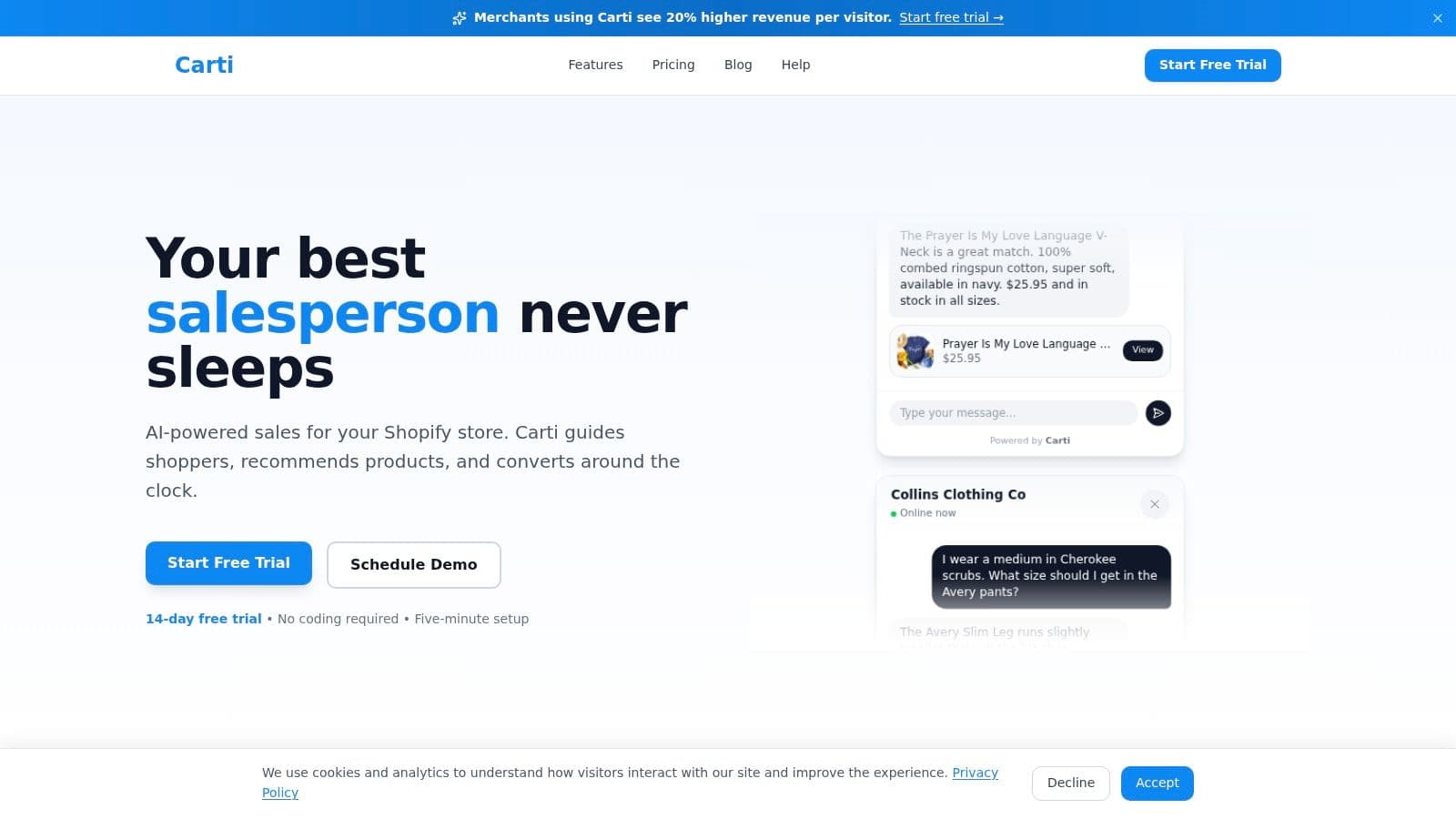
A practical example is Carti, which is built for Shopify and focuses on instant answers, product recommendations, and cart recovery through a no-code setup. That kind of implementation tends to work when the underlying catalog and policy data are clean, and it tends to disappoint when merchants expect the app to compensate for messy source content.
A short demo helps make the point:
How to Choose and Implement an AI Agent
Buying an AI agent for ecommerce is mostly an exercise in avoiding shortcuts that look good in a demo. The wrong tool gives you polished language and weak execution. The right one plugs into your store, answers from current data, and behaves safely under pressure.
What to look for before you buy
Start with integration depth. If you run Shopify, the agent should understand products, variants, inventory, carts, and order context without duct-tape workarounds. “Works with Shopify” can mean anything from a pasted script to full operational access.
Then test accuracy. Ask the vendor directly whether the system grounds answers in live store data. If they can't explain how it retrieves current catalog and policy information before responding, keep looking.
A quick shortlist helps:
- Real store connectivity: It should read catalog, inventory, and policy data from your live environment.
- Action capability: It should do more than answer. Cart actions and workflow triggers are where revenue impact starts.
- Clear analytics: You need to see assisted conversions, common objections, and where conversations break.
- Fast implementation: Long setup often means hidden services work, custom maintenance, or brittle logic.
- Editable controls: Your team should be able to refine brand tone, fallback rules, and escalation paths without waiting on an engineer.
Operator's view: Good demos hide edge cases. Evaluation should focus on returns, out-of-stock products, conflicting promotions, and messy customer questions.
A rollout plan that avoids the usual mess
Implementation usually works best in phases. Launching everywhere at once makes it harder to see what's broken.
First, clean the source material. Your product pages, FAQs, shipping details, returns language, and promotional rules need to be specific and current. Agents can only sell from what they can read and verify.
Second, map the high-value intents. Pre-purchase questions, fit and compatibility concerns, delivery timing, bundle suggestions, and cart recovery usually produce the fastest business impact. Start there.
Third, test the edge cases. Ask hard questions. Try unusual product combinations, partial policy questions, variant confusion, and sale-related scenarios. If the agent struggles, the issue is often your content structure or missing business logic, not just the model.
A rollout framework that works in practice looks like this:
-
Prepare store data
Tighten product titles, attributes, specs, fit notes, and policy wording. -
Prioritize revenue moments
Focus first on conversations that influence buying decisions. -
Define escalation rules
Decide when the agent should hand off to a human and when it should stop. -
Review conversation logs weekly
The transcripts will show you where PDP copy is vague and where policies confuse buyers.
The step most merchants miss is external visibility. The on-site agent matters, but external AI shopping assistants matter too. According to this discussion of optimizing for external AI shopping agents, 69% of ecommerce sales are lost to hesitation these agents can resolve, and merchants need to test how assistants like Perplexity or Gemini interpret their brand, then fix missing schema or vague product details.
That changes the implementation brief. You aren't only training an on-site assistant. You're preparing your store to be understood by outside agents that may recommend products before a shopper ever arrives.
Use a simple audit process:
- Prompt external assistants with buyer questions: Ask what your brand is known for, who your products fit, and how your policies work.
- Find the gaps: Look for missing use cases, vague product attributes, or inaccurate policy summaries.
- Fix the machine-readable layer: Improve schema, FAQs, product attributes, and policy pages so external systems can parse them cleanly.
Measuring ROI and Avoiding Common Pitfalls
The right ROI conversation starts with business questions, not dashboard vanity metrics. A large conversation count doesn't mean much if the agent isn't influencing purchase behavior or reducing team load.
The questions your data should answer
Ask your store data these questions:
- Which sessions assisted by the agent convert better than unassisted sessions?
- Which products show the most agent influence before purchase?
- Which objections appear most often in conversations before checkout?
- Which support topics no longer need human time?
- Which conversations end without resolution, and why?
Those answers tell you whether the agent is functioning as a sales layer or just absorbing traffic. If you want to model the business case before rollout, a tool like the Carti ROI calculator can help estimate impact based on your own store assumptions rather than generic benchmarks.
Common mistakes and the fix for each
The most common failure is buying a glorified FAQ bot.
Fix: Choose a system with real action capability and store integrations, not just answer generation.
The second failure is weak grounding. The agent sounds confident, but it answers from stale or partial information.
Fix: Require live retrieval from catalog and policy data before the model responds.
The third failure is ignoring safety controls. According to Pravaah Consulting's guidance on building ecommerce agents, production-grade agents should enforce deterministic guardrails, including maximum reasoning-step counters and explicit dollar-value ceilings the model cannot override.
Fix: Put hard-coded limits outside the model so it can't improvise past business rules.
The fourth failure is “set and forget.” Merchants install the tool and never use conversation data to improve merchandising, PDP copy, or FAQ clarity.
Fix: Review logs and unanswered questions on a regular cadence, then update source content where friction keeps showing up.
The transcript is often better than a survey. It shows what shoppers were ready to buy, what confused them, and what your site failed to explain clearly.
The Future Is Agentic Commerce
The useful way to view this shift is simple. Chat is no longer only a support surface. It's becoming an automated selling surface, and external AI assistants are becoming a discovery surface. Merchants who adapt early will shape how their products are recommended, compared, and purchased.
If you want a wider marketplace view, this piece on AI's role in Amazon ecommerce is a useful complement because it shows that agent-led commerce won't stop at your own storefront.
The practical move now is to treat your AI agent like revenue infrastructure, not a novelty.
If you run a Shopify store and want to test this shift directly, start with Carti. It gives merchants a practical way to launch an AI sales assistant that answers shopper questions, recommends products, and supports cart recovery without a heavy implementation project.

Written by
Daniel AndersonFounder of Carti. 10+ years building ecommerce brands in apparel and supplements. Still runs a Shopify store and built Carti to help merchants convert more browsers into buyers.
Ready to boost your store's sales?
Install Carti in 5 minutes and let AI handle customer questions, recommend products, and close sales 24/7.
Start Free Trial14-day free trial