
You're probably already feeling the pattern. Support keeps answering the same sizing, shipping, and return questions. Marketing is paying for traffic that lands, hesitates, and leaves. Your team tweaks product pages, tests bundles, rewrites FAQs, and still watches carts stall because the shopper needed one more nudge or one clearer answer.
That's where AI shopping agents stop being a novelty and start looking like an operating decision.
For Shopify merchants, the key shift isn't “chat on site.” It's having a system that can guide discovery, recommend products, handle objections, build carts, and in some cases move the shopper much closer to purchase without waiting for a human rep. That changes the role of AI from support cost control to revenue production. If you run a store where conversion rate, AOV, cart recovery, and repeat purchase matter every week, this channel deserves the same attention you'd give paid search or email.
Why Your Next Hire Should Be an AI Shopping Agent
A lot of Shopify teams are still treating AI like a nicer FAQ layer. That's too small.
The more useful way to frame it is this. If your store could add a round-the-clock sales associate who knows the catalog, answers repetitive objections instantly, and keeps moving people toward checkout, you'd at least look at the hire. An AI shopping agent does that kind of work at the point where revenue is won or lost: product discovery, hesitation, cart build, and purchase momentum.
The urgency is real. Salesforce data cited by eMarketer says 43% of retailers are already piloting autonomous AI and another 53% are evaluating it, which means 96% are already in some stage of considering or using AI agents. The same reporting says 75% of retailers think AI agents will be essential for a competitive edge by 2026. You can review that in eMarketer's retail adoption snapshot.
That matters because this won't stay in the “interesting experiment” bucket for long.
What merchants are really buying
When operators adopt AI shopping agents, they're not buying conversation volume. They're buying:
- More guided discovery: Fewer shoppers getting stranded on category pages.
- Faster objection handling: Sizing, compatibility, delivery, and returns answered before the click dies.
- Better cart progression: The shopper moves from “browsing” to “this is the one.”
- Less dependency on live coverage: Sales assistance keeps running when your team is offline.
Practical rule: If a shopper question shows up often enough to hurt conversion when unanswered, it belongs inside an agent workflow.
Why this is different from adding another app
A normal app usually improves one step. Reviews help trust. Upsells help AOV. Email helps retention. AI shopping agents can influence multiple stages at once because they sit inside the buying journey and respond to intent as it happens.
That's why the staffing analogy works. You're not adding a widget. You're adding selling capacity.
For a Shopify merchant, that's the useful lens. Not “what is agentic AI?” but “where can this system close more of the demand I'm already paying to acquire?”
How AI Shopping Agents Actually Work
A traditional chatbot is like a store directory. It points. It rarely guides. It can tell a shopper where to go, but it usually can't do much when the path breaks.
An AI shopping agent works more like a strong in-store associate. It understands what the shopper means, checks what the store can offer right now, and helps complete the next step instead of dropping the interaction.
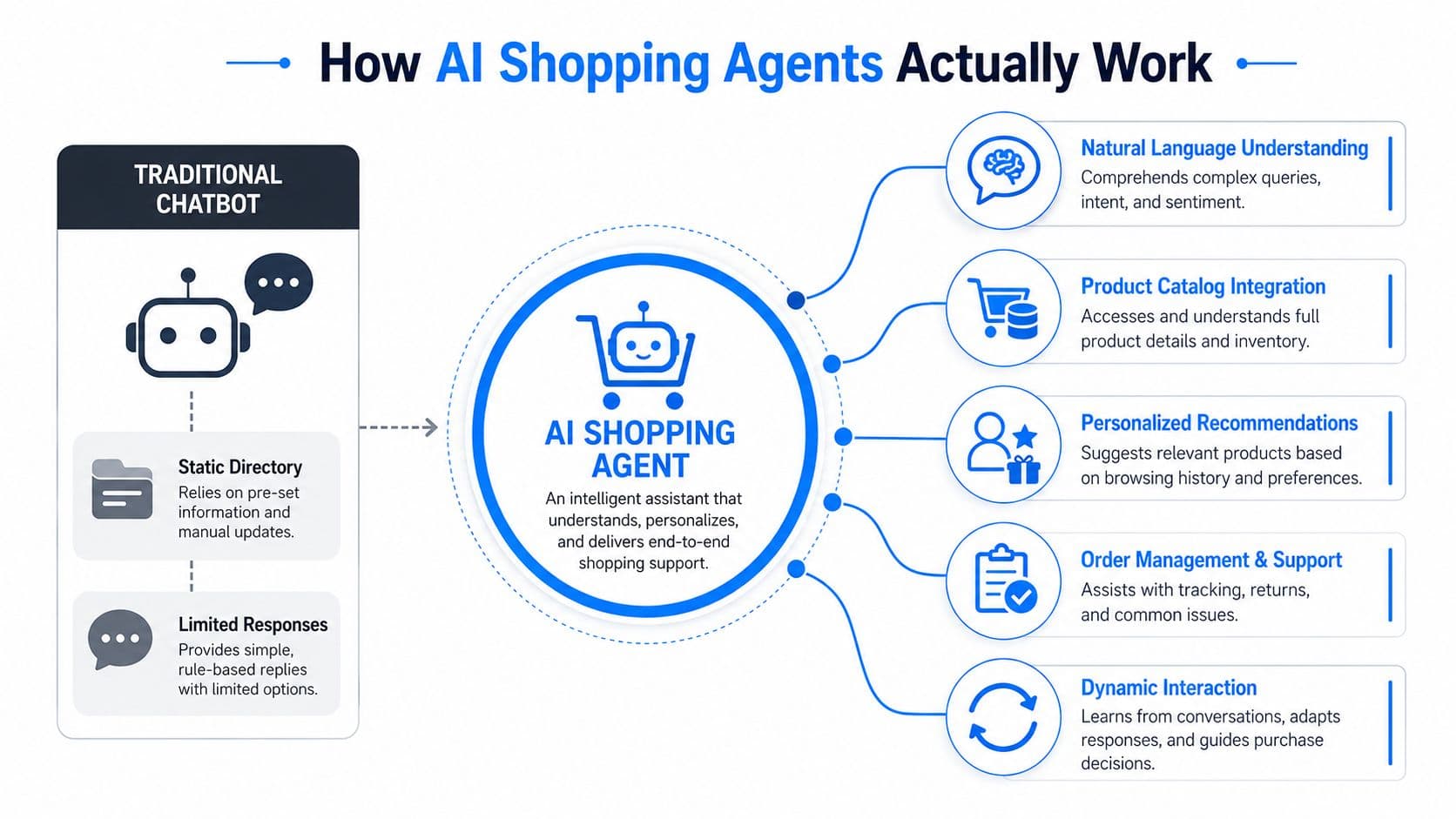
The difference between a bot and an agent
The architecture is the reason. Advanced agents are increasingly built as LLM-based orchestration systems. They combine language understanding with live commerce signals like product catalog data, inventory levels, customer profiles, and session behavior so they can make context-aware decisions rather than rely on static keyword matching. That shift is outlined in Constructor's breakdown of ecommerce AI agents.
For merchants, the practical takeaway is simple. Product data quality becomes a model input. If your titles are vague, your attributes are thin, or your stock status is stale, the agent gets worse.
Here's the cleanest comparison:
| Capability | Traditional Chatbot | AI Shopping Agent |
|---|---|---|
| Query handling | Matches keywords or scripted intents | Interprets natural language and shopping intent |
| Product discovery | Links to pages or canned answers | Recommends products based on context |
| Inventory awareness | Often limited or delayed | Uses live store signals when connected properly |
| Next-best action | Usually stops at the answer | Can suggest substitutes, bundles, or cart actions |
| Personalization | Minimal | Uses customer and session context |
| Commerce role | Support surface | Sales and decision layer |
The three parts that matter in practice
The first part is language understanding. The shopper doesn't need to speak in your navigation terms. They can say, “I need a lightweight jacket for travel that won't wrinkle,” and the agent can interpret the use case instead of waiting for the exact collection keyword.
The second part is commerce grounding. The agent needs access to your real catalog, your current inventory, your policies, and ideally customer context. That's what lets it answer with precision instead of generalities.
The third part is action. A true agent doesn't just respond. It helps move the transaction. That can mean ranking alternatives, building a cart, applying logic around preferences, or guiding the buyer to the best next click.
Most chatbot failures come from the same place. The bot can identify the problem, but it can't complete the next useful action.
If you're already working on Shopify product recommendations, this is where those recommendations undergo a significant transformation, becoming conversational, situational, and tied to live buying intent instead of staying locked inside static widgets.
What usually breaks first
In live stores, the weak spots aren't usually the language model itself. They're operational:
- Messy product attributes: Missing materials, fit notes, dimensions, compatibility fields.
- Poor inventory freshness: The agent recommends items that aren't available.
- Weak policy structure: Shipping, returns, and warranties are written for humans but not organized for machine reasoning.
- No fallback logic: The agent can't recover gracefully when confidence is low.
That's why merchants who win with AI shopping agents usually treat them as a merchandising and data project, not just a support install.
The True ROI Beyond Answering Tickets
If you evaluate AI shopping agents like a help desk tool, you'll underinvest and measure the wrong things.
Yes, ticket deflection matters. But that's not where the primary upside sits for most Shopify brands. The bigger opportunity is influencing revenue during the moments when shoppers hesitate, compare, need reassurance, or abandon.
A simple way to keep the conversation grounded is to track the agent like a sales surface.
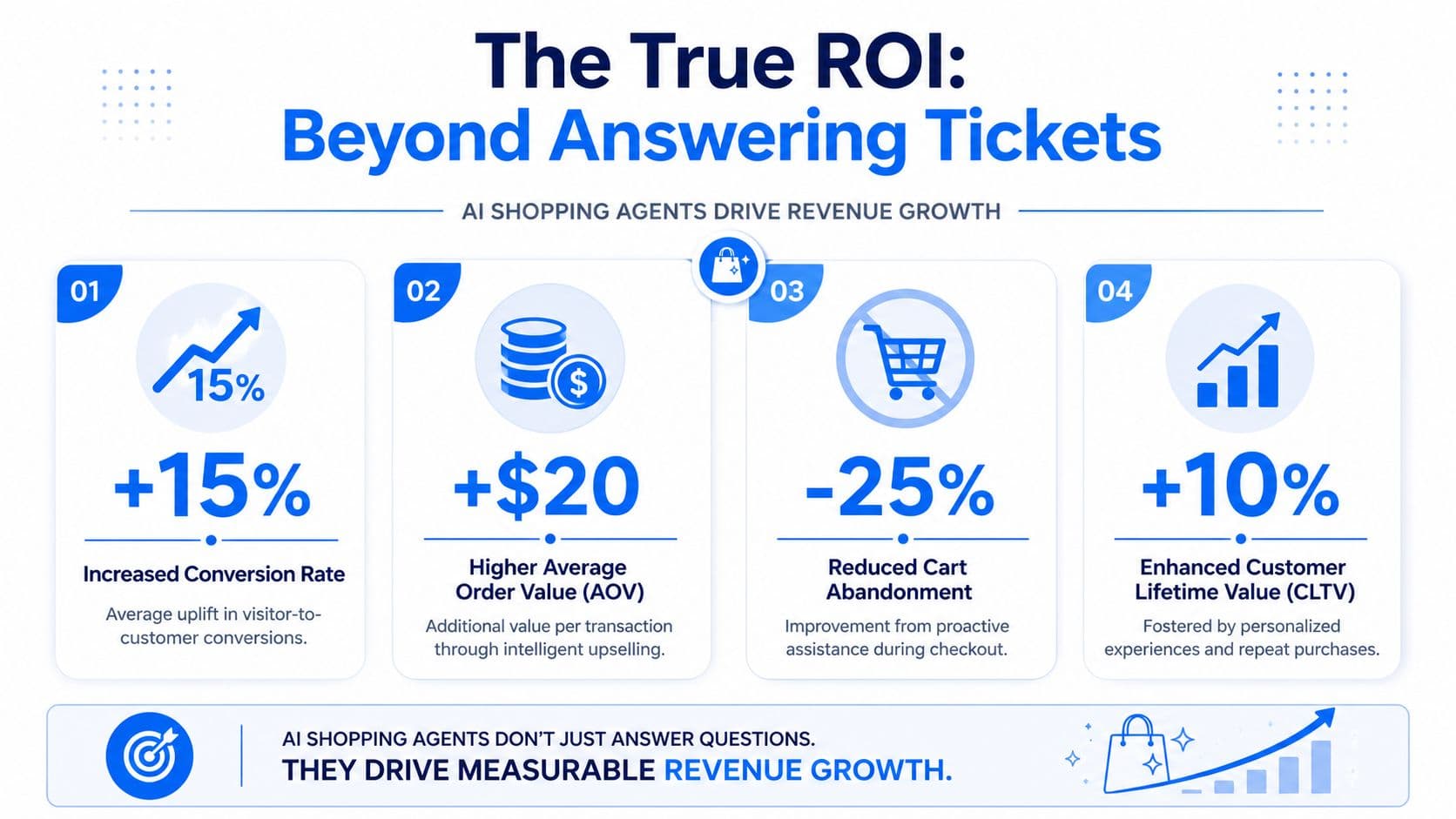
Track sales metrics, not vanity support metrics
The first KPI I'd look at is revenue per conversation. If the agent is talking a lot but not influencing transactions, you have activity, not performance.
Then track:
- AI-assisted conversion rate: Sessions that engaged with the agent and later purchased.
- Recovered cart value: Orders that were rescued after a high-intent prompt or objection answer.
- AOV on agent-assisted orders: Whether the agent is improving basket composition.
- Product page progression: Whether hesitant shoppers move deeper after using the agent.
- Escalation quality: Whether handoffs happen on the right edge cases instead of on basic sales questions.
For a broader view of how an onsite assistant can support selling behavior, this overview of AI sales assist workflows is useful.
A lot of merchants miss one more metric that matters. Track which questions appear before conversion loss. If shoppers repeatedly ask about fit, refill timing, compatibility, or delivery cutoffs, that's not just support noise. That's merchandising intelligence.
Here's a practical benchmark mindset. Judge the agent the same way you'd judge a sales rep on the floor. Did it help the shopper choose? Did it protect the cart? Did it lift basket quality? Did it free your team to focus on exceptions instead of repetition?
Later in the funnel, a different angle comes into play.
The trade-off merchants need to face early
As agents move from recommending to buying, the economics change. Industry analysis points to a key issue: who controls the trade-off between convenience, price, and brand preference? When an agent optimizes for the shopper, it may prioritize structured signals like faster delivery or clearer policies over branding or page design. That risk is explored in AlixPartners' analysis of AI shopping agents in retail.
Better UX still matters to humans. But when an agent is making or shaping the choice, structured attributes can outweigh persuasion design.
For merchants, that creates both upside and pressure.
The upside is obvious. If the agent removes friction, you can see fewer abandoned carts, faster decision cycles, and less support drag. The pressure is also obvious. Transparent pricing, delivery promises, and return policies become more exposed. If your margin strategy depends on shopper confusion or weak comparison, agents will punish that.
This is why ROI has to be discussed with both conversion efficiency and margin discipline in view. The right agent can drive more orders. It can also force cleaner operational competition.
Real-World AI Agent Use Cases and Metrics
The easiest way to understand the commercial impact is to look at how AI shopping agents show up in actual store moments. The key capability is task execution across the funnel. Industry analysis describes advanced agents as working from user preferences, price thresholds, and market conditions to compare options and trigger commerce actions across discovery and cart building, as covered in this guide to agentic commerce.
Gift finder that lifts conversion intent
A shopper lands on your store with no product name in mind. They type, “I need a gift for my sister who likes clean beauty and travels a lot.”
A basic bot returns a category page. A better agent narrows by use case, budget, size, and travel relevance, then surfaces a short list with reasons. The metric to watch here is assisted conversion rate. You want to know whether these guided sessions produce more completed orders than unguided browse sessions.
Cart rescue before the shopper bounces
The shopper adds two products, pauses at shipping, and starts asking about delivery timing or return conditions. That's a fragile point in the funnel.
A sales-focused agent can answer the objection in the moment, suggest a delivery-safe alternative if timing is tight, or prompt the shopper before exit. The metric here is recovered cart value. Not generic engagement. Did the order get saved?
When a customer is already in cart, speed matters more than copy polish.
Bundle building that raises order value
A shopper wants one core item but isn't sure what goes with it. Think serum plus moisturizer, espresso machine plus grinder, or sofa plus care kit.
An effective agent uses the primary item as the anchor and builds a sensible basket instead of pushing random add-ons. That changes the AOV conversation from “show a cross-sell block” to “assemble a complete purchase path.” Track AOV on agent-assisted orders and the attach patterns by product family.
Post-purchase support that opens another sale
Most merchants think the job is done after payment. That leaves money on the table.
A shopper comes back asking how to use, maintain, refill, or pair what they bought. If the agent answers clearly and suggests the next relevant item, support becomes retention and repeat revenue. The metric here isn't just deflection. It's repeat purchase influence and whether support conversations reopen commercial intent.
The common thread in all four cases is that the agent isn't acting like a help center. It's handling moments where buyers usually stall, second-guess, or drift away.
Your AI Shopping Agent Adoption Checklist
Most bad launches fail before the first shopper says hello. The store data is messy, the policies are buried in prose, and nobody defines what success should look like.
The more reliable approach is to treat rollout like a pre-flight check.
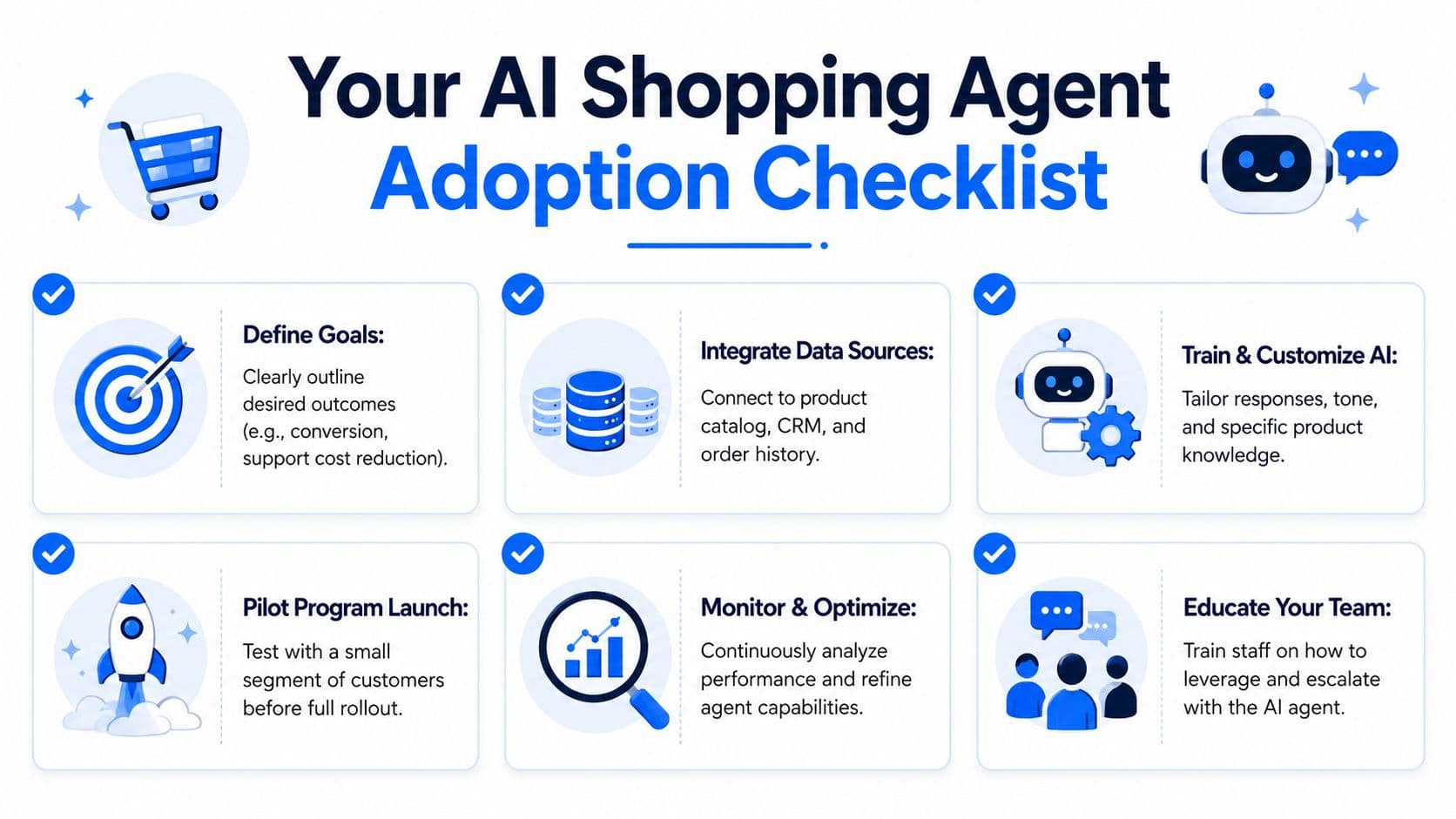
Get your store data ready for selection
One of the most under-discussed shifts is visibility. As shoppers rely more on agents, merchants compete less for clicks and more for selection. Recent analysis notes that agents evaluate structured signals like availability, delivery reliability, warranty and return policies, reviews, and price dynamics. If the data is incomplete or unstructured, your products can become effectively invisible to these systems. That argument is laid out well in ML6's look at retailer visibility for AI shopping agents.
That means your checklist starts with merchandising discipline:
- Clean product attributes: Materials, dimensions, fit, compatibility, ingredients, use cases, care instructions.
- Fresh inventory and pricing: The agent can't sell confidently if your feed is stale.
- Structured policy content: Shipping windows, return rules, warranty terms, and exceptions need to be machine-readable in practice.
- Trust signals: Reviews, delivery clarity, and policy transparency need to be easy for an agent to evaluate.
If Google SEO taught merchants to optimize for indexing, AI shopping agents are teaching them to optimize for selection.
Launch narrow, then widen the brief
Don't start with “handle everything.” Start with one high-friction sales moment where fast answers change outcomes.
A strong rollout usually follows this order:
-
Pick one use case with revenue exposure
Product recommendation on PDPs, gift finding, cart objections, or delivery questions are usually better starting points than broad support coverage. -
Write business rules before tone rules
Brand voice matters, but decision quality matters first. Define substitution logic, escalation triggers, excluded claims, and inventory handling. -
Create a human fallback path
Some interactions need a person. Refund edge cases, sensitive complaints, and exceptions should move cleanly to support. -
Review transcripts weekly
The fastest improvements often come from fixing the top recurring misses: bad attribute mapping, weak synonym coverage, thin policy answers. -
Train the team around the agent
CX, merchandising, and growth should all look at what shoppers are asking. The transcript stream is a live feed of buyer hesitation.
The stores that get value fastest don't launch the flashiest agent. They launch the most operationally grounded one.
Meet Carti: Your Shopify-Native AI Sales Engine
For Shopify merchants, tool choice matters less than fit. The best-looking demo won't help if setup is heavy, the catalog connection is weak, or the reporting stops at chat volume.
That's why Shopify-native systems tend to be more practical here. They can plug directly into the catalog, policies, and store workflows that shape conversion.
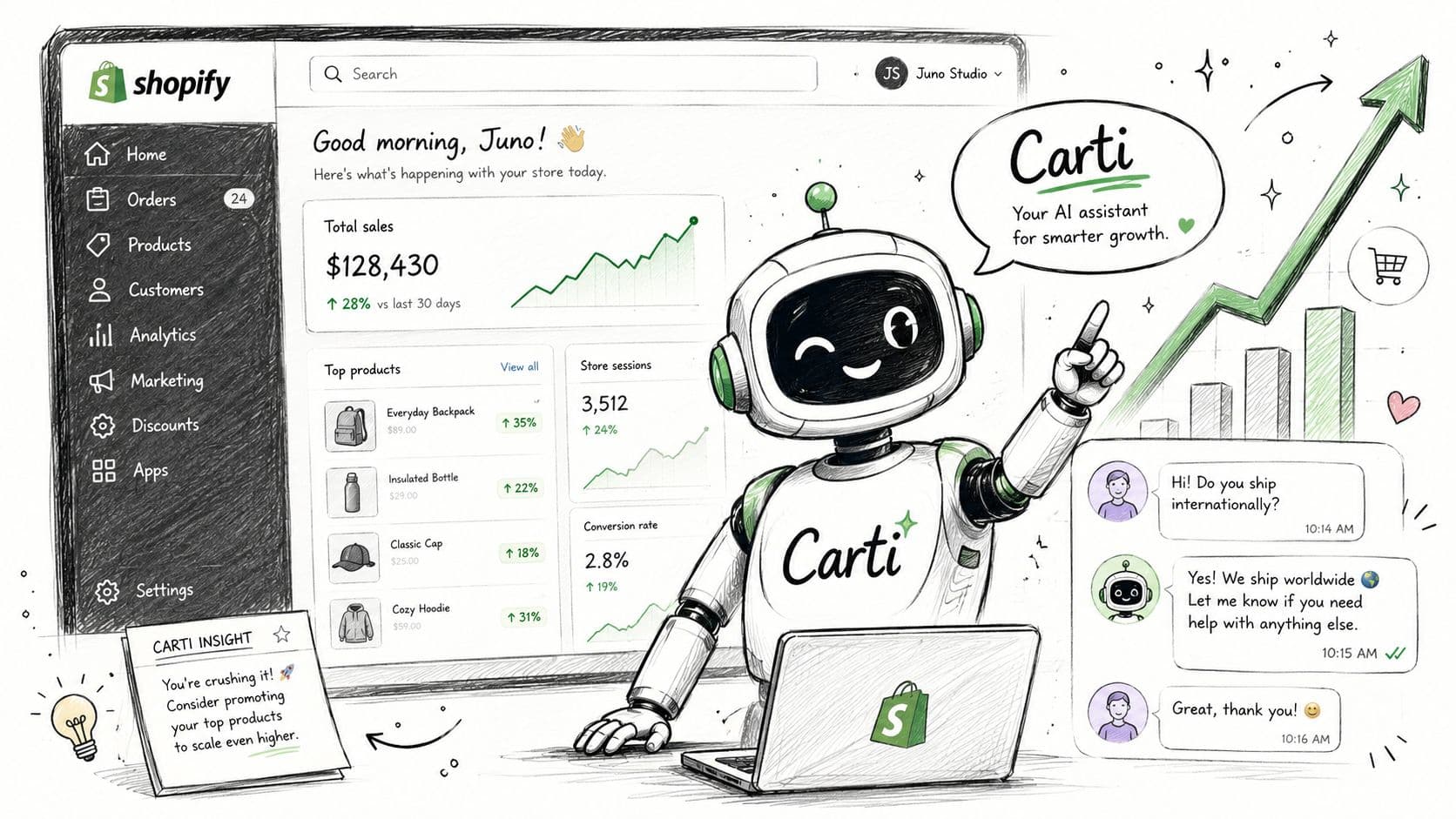
What a Shopify-native setup changes
A tool like Carti for Shopify stores is built around that operating reality. It learns the catalog, FAQs, and store policies automatically, supports no-code setup, and focuses on sales assistance features like instant answers, smart suggestions, cart recovery prompts, and analytics around what shoppers ask.
That matters because merchants usually need four things from an AI shopping agent:
- Fast implementation: If setup drags, the project stalls.
- Catalog grounding: Recommendations have to reflect the store you run.
- Sales behavior: The agent should help conversion, not just absorb questions.
- Clear insight loops: Merchants need to see what objections and product gaps keep showing up.
Where it fits in a merchant stack
For a Shopify operator, this kind of tool sits between support, merchandising, and conversion optimization.
It can answer policy and product questions fast enough to reduce friction. It can surface product suggestions while intent is high. It can also show the team where product data is weak, where policy wording creates confusion, and which pages generate repeated hesitation.
That's the right way to think about deployment. Not as “replace support with AI,” but as “add a sales engine that happens to answer support questions on the way to conversion.”
If you're comparing options, keep the scorecard practical. Look at data integration, recommendation quality, cart recovery support, transcript usefulness, escalation control, and how quickly a merchant team can start testing against real store KPIs.
The Future of E-commerce Is Autonomous
E-commerce is moving from assisted shopping to delegated shopping.
That doesn't mean every shopper will hand over every purchase decision. It does mean more purchase journeys will be shaped by systems that interpret intent, compare options, and act on structured commerce data instead of relying only on what a human sees on a page. For merchants, that changes what “good storefront execution” means.
The winners will treat AI shopping agents as a real channel. They'll measure revenue impact, not just response speed. They'll clean up product data so agents can select them confidently. They'll tighten delivery and returns communication because those signals increasingly influence machine-mediated choice.
There's also a visibility layer here that many brands still underestimate. If you're thinking about how AI-mediated discovery changes local and regional search behavior, Silva Marketing's practical guide for Northern Arizona businesses is a useful companion read because it explains how discoverability changes when AI systems become the interface.
The merchants who adapt early won't just answer shoppers faster. They'll close more of the intent they already have.
If you want to test this shift without turning it into a long implementation project, Carti is a straightforward place to start. It gives Shopify merchants a practical way to put an AI sales agent on-site, learn from real shopper questions, and measure whether the channel is driving conversion, cart recovery, and stronger orders.

Written by
Daniel AndersonFounder of Carti. 10+ years building ecommerce brands in apparel and supplements. Still runs a Shopify store and built Carti to help merchants convert more browsers into buyers.
Ready to boost your store's sales?
Install Carti in 5 minutes and let AI handle customer questions, recommend products, and close sales 24/7.
Start Free Trial14-day free trial