
Agentic AI could handle about 25% of total U.S. ecommerce sales by 2030, or roughly $300 billion to $500 billion, according to Bain & Company as reported by Digital Commerce 360. That number changes the conversation.
This isn't about adding another chatbot to your Shopify store. It's about preparing for a buying environment where software agents discover products, compare options, apply constraints, and complete transactions with less reliance on the traditional storefront journey.
Most articles on agentic AI for ecommerce stay on the consumer side. They focus on ChatGPT, Perplexity, or whatever shopping assistant is getting attention. Merchants need a different lens. The key question isn't whether AI agents will shop on behalf of customers. It's whether your catalog, policies, and storefront systems are structured well enough for those agents to understand, trust, and transact with your store.
What Is Agentic AI and Why It Matters Now
Adobe reported a sharp jump in AI-driven visits to U.S. retail sites in 2025. For Shopify merchants, that signal is more important than the hype cycle. Shoppers are starting to discover, evaluate, and buy through systems that can carry out tasks, not just answer questions.
That is the core idea behind agentic AI.
In ecommerce, an agentic system works toward an outcome like finding the right product, checking fit or compatibility, applying store rules, building a cart, and guiding the shopper to purchase. A basic chatbot waits for the next prompt. An agent keeps context, makes decisions within limits, and completes parts of the buying job.
The revenue implication is straightforward. If software can influence product discovery and purchase decisions before a shopper follows your usual path through search, collection pages, and PDPs, your store has to be readable and actionable by that software. A useful overview of AI shopping agents for ecommerce brands shows where that shift is heading for merchants, not just consumers.
Agentic AI changes where conversion happens
Many Shopify teams still optimize around a fixed journey: search, collection page, product page, cart, checkout. That journey still matters, but it is no longer the only one that matters.
An agent may enter at the product data layer instead. It needs clean attributes, current inventory, shipping and return logic, valid promotional rules, and permission to take approved actions. If those inputs are inconsistent, the agent cannot recommend well, and your products become harder to surface in high-intent moments.
Practical rule: In agentic commerce, your catalog quality affects conversion before the shopper lands on a PDP.
The same operating shift is happening in other revenue functions. This breakdown of the future of AI in lead gen is useful because it shows how AI systems are starting to qualify, route, and act across a workflow. Ecommerce is following the same pattern, closer to checkout and with less margin for bad data.
Why Shopify stores need to prepare now
Most merchants do not need custom models or a large AI team. They need store operations that an agent can interpret safely.
That usually comes down to three areas:
- Catalog discipline: Product titles, metafields, variants, sizing, and compatibility details need to be consistent.
- Operational context: Inventory status, shipping promises, return terms, and promo logic have to be current and machine-readable.
- Controlled action paths: The system needs clear rules for what it can recommend, discount, add to cart, or hand off to support.
Stores that get this right should see better conversion assistance, faster path-to-purchase, and less manual support load. Stores that ignore it face a quieter problem. They become harder for agents to trust, rank, and transact through.
How Agentic AI Works in an Ecommerce Context
Agentic AI makes more sense when you stop thinking about it as software and start thinking about it as a very capable store associate. A strong associate doesn't just answer, "Do you have this in blue?" They ask follow-up questions, remember preferences, narrow choices, handle objections, and move the shopper toward a purchase.
That's the right mental model for agentic AI in ecommerce.
Think Like a Personal Shopper, Not a Chat Widget
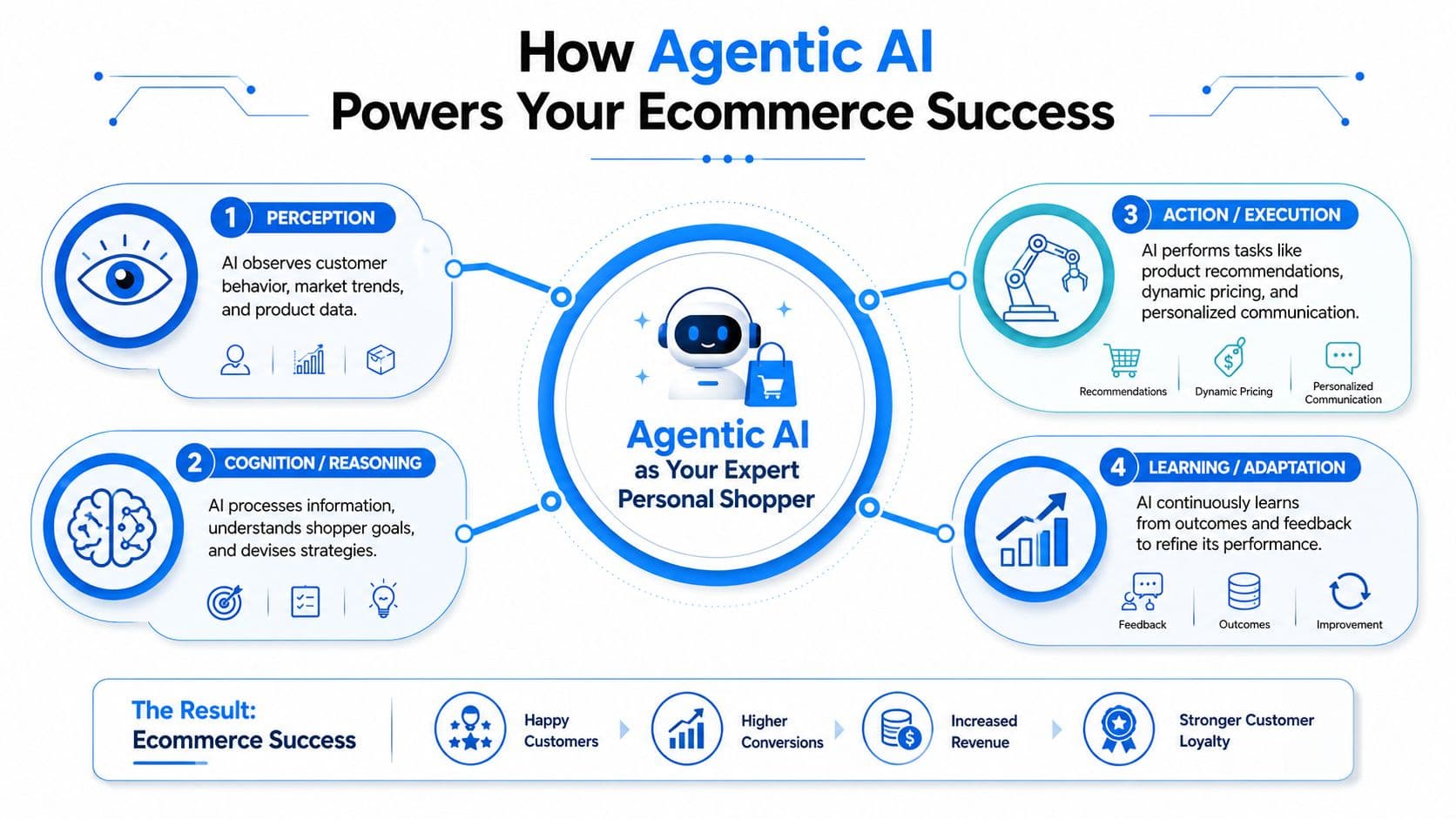
A useful agent usually handles four jobs at once:
- Perception: It reads what the shopper is asking, but also interprets behavior. A visitor who keeps comparing fabric, fit, and return policy is signaling uncertainty, not just interest.
- Memory: It keeps context. If the shopper already said they want a gift under a budget with fast shipping, the system shouldn't restart the conversation every two turns.
- Reasoning: It weighs trade-offs. Good agents don't just match keywords. They choose between products based on intent, constraints, and relevance.
- Action: It does something with the conclusion. That may mean showing the best option, applying a valid incentive, building a cart, or escalating to a human.
If you want a deeper look at where shopping agents are heading, this piece on AI shopping agents is a useful companion.
A short walkthrough helps make the model concrete:
The Five Layers That Make It Work
Under the hood, agentic AI for ecommerce relies on a five-layer architecture. The critical point is that the reasoning engine has to be grounded in real product data through Retrieval-Augmented Generation, or RAG, so it doesn't invent products, prices, or discount logic during multi-step actions, according to Alhena's analysis of AI agent architecture for ecommerce.
Here is the merchant-friendly version of those layers:
| Layer | What it does in a store |
|---|---|
| Perception layer | Interprets shopper intent from questions and behavior |
| Memory system | Tracks session context, catalog context, and prior preferences |
| Reasoning engine | Decides which product or next step best fits the shopper's goal |
| Action layer | Connects to tools and store actions such as cart updates or discount use |
| Safety layer | Stops bad actions and routes edge cases to a human |
Without those layers working together, the experience falls apart in familiar ways. The AI recommends out-of-stock items. It misunderstands variant logic. It applies the wrong offer. It gives an answer that sounds polished but doesn't map to your catalog.
A chatbot can be helpful and still be non-agentic. The line gets crossed when the system can reason across context and safely take action.
For merchants, that distinction matters because buying software with "AI" on the homepage is easy. Buying a system that can reliably support revenue workflows is harder.
Three Agentic AI Use Cases Driving Revenue Today
The market isn't waiting for some distant future. The global agentic AI in retail and ecommerce market reached $46.74 billion in 2025 and is projected to grow at a 29.29% CAGR to $218.37 billion by 2031, according to Mordor Intelligence's market report. That scale makes sense because the best use cases already map directly to revenue.
Use Case One Guided Selling That Actually Closes
A shopper lands on a skincare store looking for a routine for sensitive skin. In a traditional flow, they bounce between product pages, reviews, and FAQ content, then leave with too many open questions.
An agentic assistant handles that differently. It asks about skin concerns, texture preference, ingredient avoidance, and whether the shopper wants a full routine or a single hero product. Then it narrows the catalog to what fits those constraints and pushes the conversation toward action.
That matters most in categories with high consideration and variant complexity, including fashion, beauty, supplements, and home. For visual categories, generative AI try-on solutions are becoming part of this same guided-selling stack because they reduce uncertainty before purchase.
What works here is not generic conversation. It is controlled recommendation logic tied to real products, inventory, and policy data.
Use Case Two Merchandising That Responds in Real Time
A merchant launches a seasonal collection. The old workflow is familiar. The team manually edits collection pages, updates homepage placements, tweaks copy, and hopes search and merchandising rules steer people into the right assortment.
An agentic layer can make this more responsive. If shoppers repeatedly ask for products with a specific use case, material, or compatibility requirement, the system can surface patterns that your standard analytics miss. A merchant can then adjust collections, recommendation logic, FAQs, and offers based on live buying intent instead of waiting for a post-campaign report.
A strong AI-powered sales assistant proves operationally useful. It doesn't just answer questions. It reveals where your catalog language, collection structure, or policy communication is blocking purchase decisions.
Merchants usually don't lose sales because customers had no interest. They lose them because the store made the decision too hard.
Use Case Three Cart Recovery With Context
Standard cart recovery is blunt. It sends a reminder email or pop-up and hopes timing does the rest.
Agentic recovery is different because it can respond to why the cart stalled. If the issue was sizing doubt, it should offer fit guidance. If it was shipping timing, it should answer delivery expectations. If the shopper hesitated between two similar items, it should help compare them and close the gap.
Recovery is often treated as a messaging problem when it's really a decision-resolution problem. The stores getting value from agentic AI for ecommerce aren't only chasing abandonment. They're reducing the uncertainty that causes it in the first place.
A useful way to think about these use cases is simple:
- Guided selling helps shoppers choose.
- Autonomous merchandising helps merchants adapt.
- Contextual recovery helps stalled demand convert.
Each one touches revenue. Each one also cuts manual workload that would otherwise sit with support, merchandising, or lifecycle teams.
Managing the Risks of Autonomous AI in Your Store
Merchants should be skeptical here. The upside is real, but so are the failure modes. Autonomous systems can improve conversion and reduce operational drag. They can also create expensive confusion if the setup is sloppy.
Where Merchants Get Burned
The first risk is hallucination in a commercial workflow. If the system invents a variant, misstates a promotion, or misunderstands a bundle rule, the damage isn't abstract. A customer gets the wrong expectation, support gets the ticket, and trust drops.
The second risk is brand flattening. Some agents optimize too aggressively for lowest price or shortest path. That can hurt premium positioning, especially in stores that rely on bundles, formulation differences, design value, or loyalty cues rather than simple commodity comparison.
A third risk is over-automation. If every uncertain shopper gets pushed toward the same recommendation path, your store may become efficient but less persuasive. Good selling still needs nuance.
Research also points to this trade-off. UnleashX's write-up on agentic AI in ecommerce notes that AI-driven personalization can increase AOV by 26%, but it also raises the merchant-side concern that third-party agents may favor lower-priced products and erode premium margins if they optimize for cost over brand preference.
What Good Guardrails Look Like
The most important technical guardrail is grounded reasoning. As covered earlier, RAG tied to live product data is what keeps the system from making things up during actions that affect the cart or order flow.
Beyond that, merchants should look for guardrails such as:
- Catalog-bounded answers: The AI should answer from your actual products, policies, and approved content.
- Human escalation paths: Complex trade-offs, edge cases, or emotionally sensitive service issues should route to a person.
- Offer controls: Discounts and promotions need explicit rules. The system shouldn't improvise.
- Brand instruction layers: Tone, product priorities, and disallowed claims should be configurable.
- Action logs: Teams need visibility into what the system suggested or did, especially when a conversation influenced revenue.
Autonomous AI should expand your control surface, not reduce it.
The right way to evaluate risk isn't asking whether AI can ever be wrong. Every sales channel has failure modes. The better question is whether the tool constrains bad actions, learns from your store data, and knows when not to act.
A Phased Roadmap to Agentic AI on Shopify
Most Shopify teams fail with AI for the same reason they fail with analytics migrations or personalization engines. They start with the tool, not the foundation.
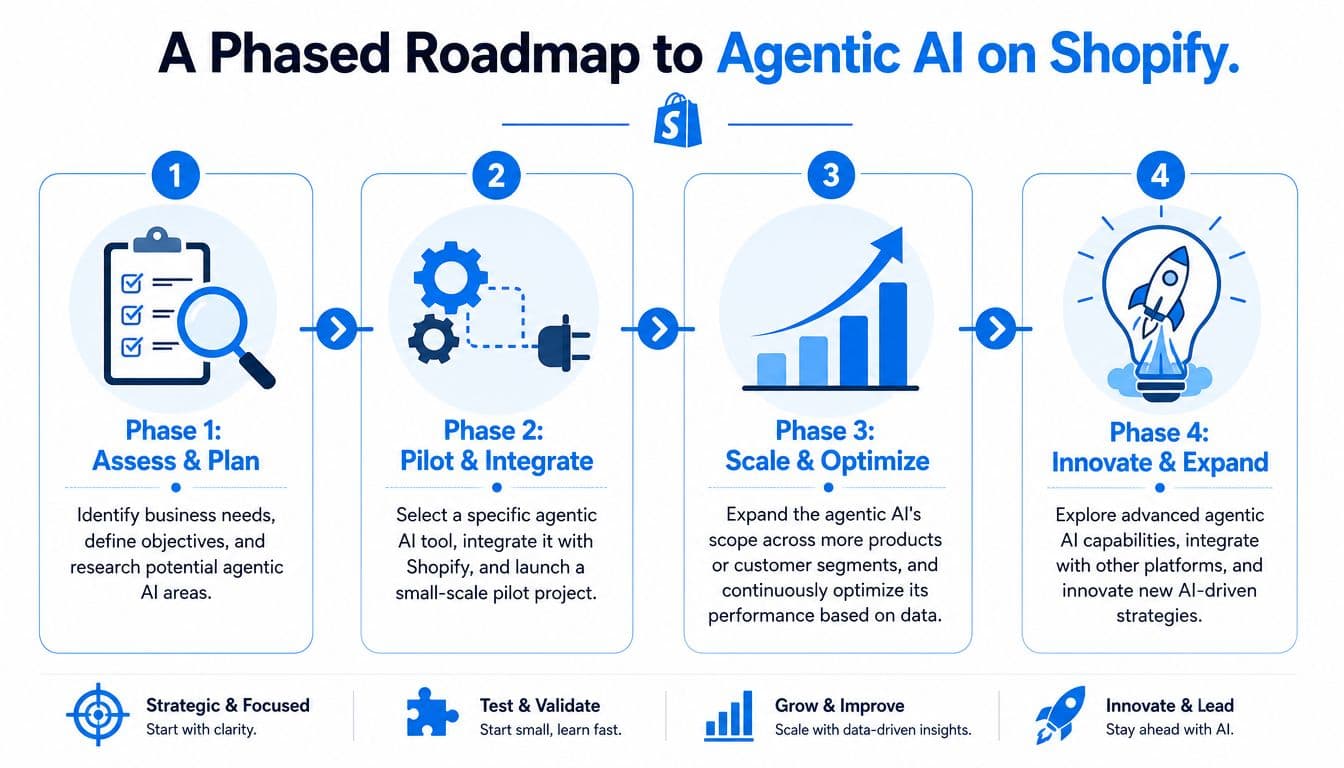
Phase One Fix the Data Before You Touch the AI
McKinsey notes that 70% of merchants lack the structured data architecture needed for agentic discovery, as summarized in Elsner's guide to agentic commerce. For Shopify stores, that usually shows up as inconsistent product attributes, weak variant naming, missing policy detail, scattered reviews, and mismatched metadata across channels.
Start with a data audit.
Check whether your best-selling SKUs have clean titles, complete attributes, normalized options, and readable descriptions. Review whether shipping, returns, sizing, compatibility, and care instructions are easy for a machine to retrieve, not just easy for a designer to place on a page.
A second layer matters here too. ALM Corp's overview of Agentic Commerce Optimization argues that merchants should implement complete product schema, including GTINs, brand entity markup, aggregate ratings, and return policy specifications, because agents increasingly select products based on structured data consistency across Merchant Center and marketplace listings.
Phase Two Pilot One Buying Job
Don't roll out agentic AI across every customer touchpoint at once. Pick one buying job where decision friction is obvious.
Good pilot candidates include:
- Pre-purchase product guidance: Useful when customers ask repetitive fit, compatibility, or routine-building questions.
- Cart hesitation support: Best when abandonment often comes from unresolved objections.
- Policy-heavy conversion support: Strong fit for stores where returns, shipping, or warranty terms shape buying confidence.
This phase should be narrow. One category is enough. One segment is enough. The point is to prove that the workflow holds under real shopper behavior.
Phase Three Measure What the Agent Influences
Classic ecommerce reporting doesn't capture the full value of an agent well. Last-click revenue is too narrow. Chat volume alone is too shallow.
Track a mix of commercial and operational signals:
| KPI type | What to watch |
|---|---|
| Revenue influence | Orders where the agent assisted product discovery, comparison, or cart completion |
| Conversion friction | Recurring questions that correlate with drop-off |
| Support deflection | Repetitive pre-sales tickets no longer handled by humans |
| Merchandising insight | Common missing attributes, confusing collection labels, or policy gaps |
Many merchants get a surprise. The first win often isn't "the AI sold more." It's "the AI showed us exactly why shoppers weren't buying."
Treat the first deployment like a measurement system for customer friction, not only a conversion layer.
Phase Four Expand Only After the Workflow Holds
Once the pilot behaves well, expand by use case, not by hype.
You might extend from one category to the full catalog. Or from product guidance into cart recovery. Or from onsite deployment into broader agent-readable data preparation. The wrong move is scaling a weak setup that still depends on incomplete metadata and inconsistent policy logic.
The merchants who get durable value from agentic AI for ecommerce usually sequence it like this: clean data, limited pilot, workflow proof, then expansion.
Choosing Your First Agentic AI Tool A Practical Checklist
The fastest way to waste time is to buy a tool that says "AI agent" but behaves like a dressed-up FAQ bot. Most demos look polished. The gap only shows up when you ask the system to handle messy catalog questions or purchase-adjacent actions.
Questions That Expose Real Capability
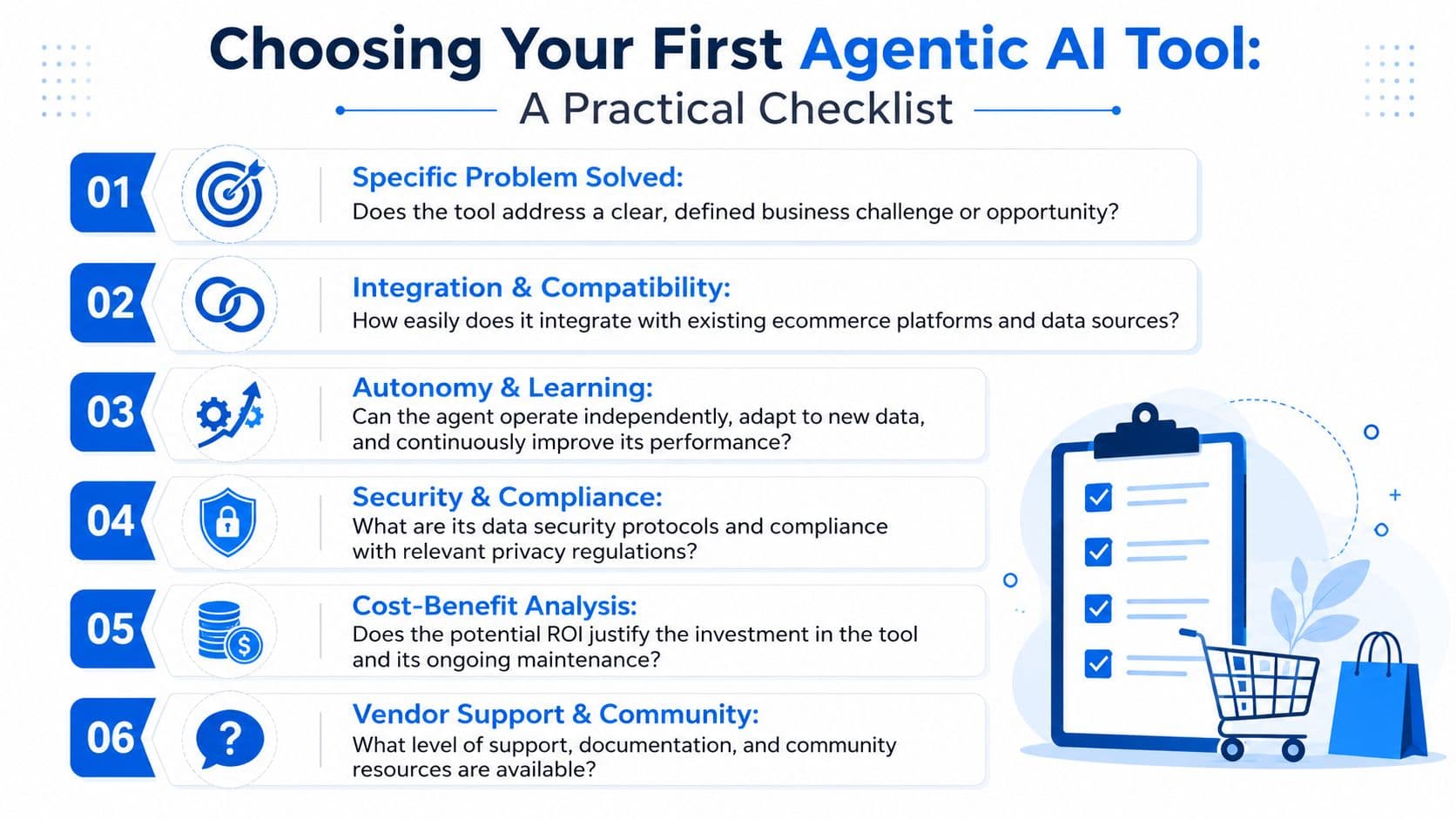
Ask vendors questions that force specificity:
- What data does the tool learn from automatically? If setup depends on manual scripting for every common question, it won't scale.
- How deep is the Shopify integration? A tool should understand products, variants, policies, and customer-facing store logic. Surface-level embed integrations don't cut it.
- Can it act, or only answer? The difference matters. Agentic systems should support progression toward cart or resolution, not just generate text.
- How does it stay accurate? You want grounded responses tied to catalog and policy sources, with clear fallback behavior.
- What analytics does it provide? Conversation transcripts are not enough. You need insight into revenue influence and repeated buying objections.
- How much maintenance does it require? If the team has to constantly retrain it just to keep pace with normal catalog changes, adoption will stall.
If you're comparing categories of tools, this list of ecommerce automation tools is a helpful starting point because it shows where conversational, support, and operational automation begin to overlap.
A Fast Evaluation Table
| If the vendor says this | Check for this instead |
|---|---|
| "We use advanced AI." | Ask how answers are grounded in live catalog and policy data |
| "Setup is easy." | Ask what happens when products, variants, or promotions change |
| "We personalize recommendations." | Ask whether the system can reason across constraints, not just click history |
| "We reduce support load." | Ask how it handles edge cases and when it escalates to a human |
| "We improve conversion." | Ask how influence is measured inside the buying journey |
A practical buying rule helps here. Favor tools that are narrow enough to solve a real revenue problem and deep enough to plug into your store's operational truth.
The Future Is Agentic Start Building Today
Agentic AI will change ecommerce through execution, not hype. The merchants who benefit first will be the ones whose store data, policies, and buying flows are usable by AI systems that can answer questions, compare options, and guide a shopper toward purchase.
That changes the standard AI question. It is no longer just, "Can this tool generate copy or answer support tickets?" The better question is, "Is my store set up so an agent can act reliably inside the buying journey without creating risk?" For Shopify teams, that means treating product data, policy logic, merchandising rules, and measurement as operating infrastructure, not cleanup work for later.
This is the practical shift. Consumer tools will keep changing. Shopify merchants still control the part that drives results: whether an AI system can access accurate product truth, handle constraints correctly, and produce measurable lift in conversion rate, average order value, or support efficiency.
That is also why the first win matters. The best starting point is usually a revenue-sensitive use case where buying friction is already clear, such as product selection, pre-purchase Q and A, or bundle guidance. A good pilot should tell you more than whether shoppers engaged with the tool. It should show whether the agent influenced purchase intent, reduced drop-off, or saved your team time on repetitive pre-sales questions.
For merchants who want a sensible first test on Shopify, Carti is built around that use case. It turns existing product, policy, and FAQ knowledge into buying assistance without a heavy implementation project, which makes it a practical way to assess whether your store is agent-ready before you expand into broader automation.

Written by
Daniel AndersonFounder of Carti. 10+ years building ecommerce brands in apparel and supplements. Still runs a Shopify store and built Carti to help merchants convert more browsers into buyers.
Ready to boost your store's sales?
Install Carti in 5 minutes and let AI handle customer questions, recommend products, and close sales 24/7.
Start Free Trial14-day free trial