
A shopper lands on your Shopify store, opens a product page, scrolls for ten seconds, and gets stuck on something small. Maybe it's sizing. Maybe it's whether the serum works for sensitive skin. Maybe it's whether the lamp includes the bulb or ships assembled. They don't want to email support and wait. They want an answer now.
Most stores still treat that moment like it doesn't matter. They publish a FAQ, add a contact page, and hope the customer does the work. In practice, many won't. They leave, compare options, or forget to come back.
That's the gap conversational marketing platforms close. For Shopify brands, this isn't mainly about lead capture or booking demos. It's about turning hesitation into purchases, lifting order value with better recommendations, and reducing the pile of repetitive support tickets that slow teams down.
The Billion-Dollar Question Your Shopify Store Ignores
The usual leak in e-commerce isn't traffic. It's uncertainty.
A customer wants to buy, but one unanswered question blocks the order. If you sell apparel, it's often fit. If you sell beauty, it's ingredients or routine compatibility. If you sell home goods, it's dimensions, materials, or delivery details. On a physical sales floor, a staff member steps in. On most Shopify stores, nobody does.
That mismatch is getting more expensive as buyer behavior changes. The conversational commerce market is projected to reach USD 22.56 billion by 2031, growing at a 12.28% CAGR from 2026 to 2031, and chatbots held 47.89% market share in 2025 in that category, according to Mordor Intelligence's conversational commerce market analysis. Customers increasingly expect to ask, get an answer, and keep moving toward checkout in the same session.
Stores lose sales in the gap between interest and reassurance.
That matters even more if you're already expanding channels and marketplaces. Brands working through Shopify, Amazon, Walmart, and Target often discover that customer expectations rise with each touchpoint. If you're mapping that broader shift, this breakdown of marketplace expansion is useful because it shows how quickly commerce gets more operationally complex once you sell beyond a single storefront.
Conversational marketing platforms are the practical response. For a Shopify merchant, the best way to think about one is simple. It's a sales associate that works all day, answers repetitive questions without getting tired, recommends products based on what the shopper is asking, and nudges people back when they're about to abandon the cart.
Used well, it doesn't feel like “adding chat.” It feels like staffing your store properly.
What Conversational Marketing Platforms Actually Are
A traditional Shopify site can be beautifully designed and still sell like an understaffed retail store. Products are on the shelves. Merchandising looks good. But if a shopper needs help, there's no one nearby.
From silent storefront to guided shopping
A conversational marketing platform adds that missing layer. It sits inside the shopping experience and turns a passive storefront into an interactive one. Instead of forcing people to hunt through product descriptions, policy pages, and buried FAQ links, it lets them ask directly.
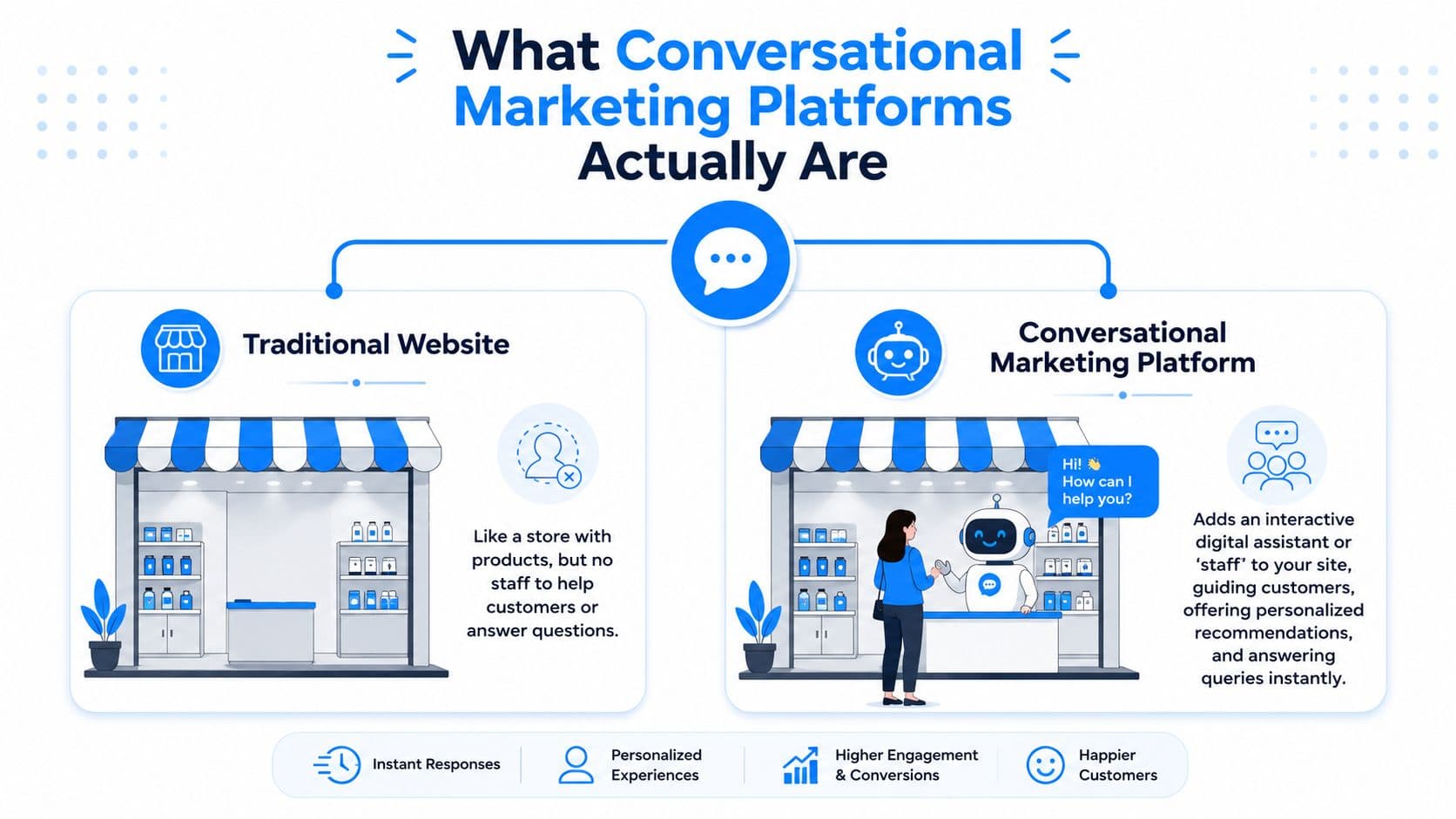
The important distinction is that modern systems aren't the old decision-tree bots that trapped shoppers in canned flows. Modern platforms have evolved from scripted bots into AI-native agents that use Natural Language Understanding to interpret open-ended questions, and that shift from static messaging to real-time natural language dialogue is associated with 30% to 50% shorter sales cycles compared with form-based lead capture, as noted by Salespeak's glossary entry on conversational marketing platforms.
For Shopify brands, that evolution changes what the tool is for. It's no longer just a support widget. It becomes part sales assistant, part merchandiser, part triage layer for customer service.
A useful comparison sits outside text chat too. If you're evaluating broader automation across customer interactions, including phone-based support, it's worth looking at how teams cut costs with AI voice solutions because the same operational trade-off shows up there. Good automation handles routine intent well. Bad automation creates friction and pushes customers away.
What good looks like in practice
A good platform for Shopify usually does five things well:
- It understands catalog context. The system should know product details, policy content, and common shopping questions without constant manual updates.
- It handles natural language. Shoppers don't ask tidy questions. They ask messy ones like “Which one is better for a small apartment and easy to clean?”
- It recommends, not just responds. Answering “Do you ship to Canada?” matters. Suggesting the right bundle or alternate size matters more.
- It stays inside the buying journey. The point is to move the shopper forward, not send them into a help-center maze.
- It knows when to escalate. When the question is edge-case, emotional, or high stakes, handing off to a human is the right move.
Practical rule: If the chatbot can answer questions but can't influence product discovery, cart recovery, or checkout confidence, it's a support tool, not a revenue tool.
If you want a plain-English primer on the category before comparing tools, this overview of what conversational marketing is gives a useful baseline.
The Business Case Why Your Shopify Store Needs One
Shopify teams don't need another app that produces activity without moving revenue. The case for conversational marketing platforms is stronger than that. When implemented well, they improve conversion, reduce friction in the path to purchase, and take repetitive work off support teams so humans can focus on exceptions and high-value interactions.
Revenue first, not chatbot theater
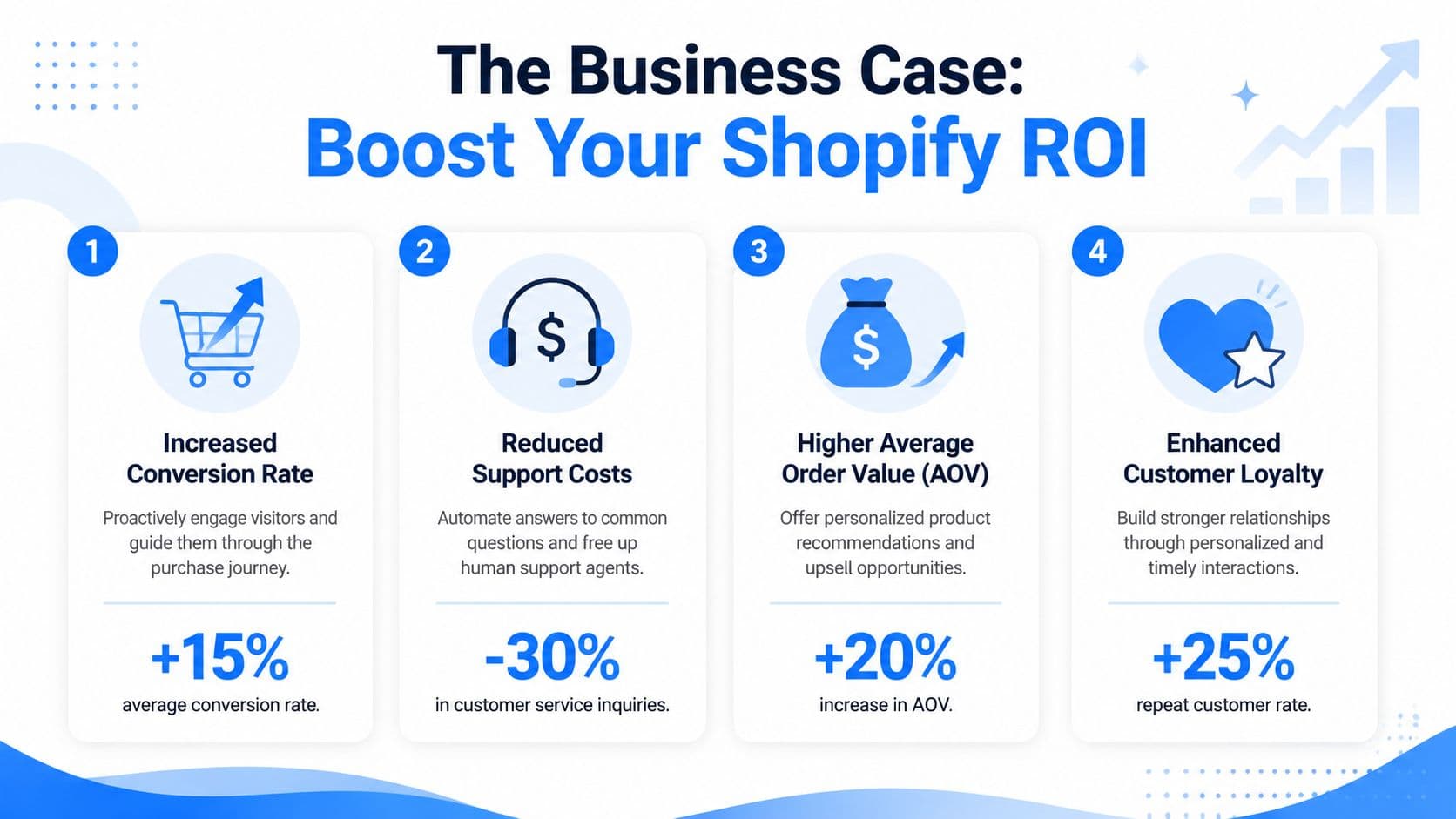
Many merchants install chat and then measure the wrong thing. They look at number of conversations, response rate, or deflection volume. Those metrics matter, but they aren't the first dashboard a founder or growth lead should care about.
The business question is simpler. Does the platform help more visitors buy, buy sooner, and buy more confidently?
In the market data, organizations deploying conversational marketing report 2 to 3 times improvements in conversion rates and 25% to 40% reductions in sales cycle length for prospects engaged through conversation, according to Research and Markets' global conversational marketing solutions report. That data comes from a broader category than Shopify retail alone, but the logic fits e-commerce perfectly. Buyers convert better when a question gets answered while intent is still fresh.
Where the ROI shows up on a Shopify store
The returns usually appear in three places.
First, product-page conversion. A shopper hesitates because they can't tell if a product fits their use case. Instant clarification removes the stall. This is especially visible in categories with specification or compatibility friction, such as skincare, supplements, furniture, décor, and apparel.
Second, average order value. Once a shopper starts a conversation, you've opened a path for relevant recommendations. A person asking whether a moisturizer is right for dry skin may also need a cleanser or nighttime treatment. Someone buying a standing desk may need a mat, cable tray, or matching storage. Good conversational flows behave like a strong in-store associate. They answer the immediate question, then expand the basket naturally.
Third, support efficiency. A large share of incoming tickets on Shopify stores is repetitive. Shipping windows, return policy, order tracking, ingredient questions, care instructions, sizing guidance, compatibility checks. Automating the first pass on those frees the human team to handle exceptions, escalations, and VIP cases.
To make the economics more tangible, think in terms of store functions:
| Store problem | What conversation changes | Business effect |
|---|---|---|
| Product-page hesitation | Answers arrive during the session | More checkouts started |
| Small basket sizes | Recommendations happen in context | Higher AOV |
| Repetitive support load | Common questions get handled instantly | Leaner support operations |
| Abandoned carts | Timely nudges re-open stalled intent | More recovered revenue |
Video can help if you're evaluating how these systems look in practice on live stores:
A common mistake is buying on feature count. A store doesn't need the longest checklist. It needs the shortest path from question to order.
The best conversational setup feels less like support software and more like a revenue-producing layer on top of your catalog.
That's why the winning implementation usually starts on high-intent pages first. Product detail pages, cart, checkout-adjacent moments, and post-purchase support flows all carry direct economic weight. Generic welcome bots rarely do.
Key Features That Drive Revenue on Shopify
The difference between a useful platform and a decorative one comes down to what it can do inside the shopping journey. On Shopify, four capabilities matter more than everything else.
Instant answers on product and policy questions
This is the first job. If the system can't answer common pre-purchase questions quickly and accurately, nothing else matters.
For fashion, that means sizing, fit notes, fabric feel, care instructions, and return policy. For beauty, it means ingredients, use order, skin type relevance, and shipping restrictions. For home and wellness, it means dimensions, assembly, materials, and compatibility.
The win here isn't abstract. It prevents a bounce at the exact moment a customer is deciding whether to trust you. The strongest setups also recognize question type and route accordingly. In a practical three-layer architecture described by Chatgrow's breakdown of conversational marketing platforms, confidence-based escalation can reduce misrouted tickets by 15% to 20% while maintaining fast automated responses for high-confidence answers. That's important on Shopify because wrong answers are more damaging than slow answers.
Smart product suggestions that raise basket size
Most stores treat recommendations like a static carousel. “You may also like” has its place, but it isn't context-rich. A conversation is.
When a shopper says, “I need something for a guest bedroom that doesn't look bulky,” they've given you merchandising signal. The best conversational marketing platforms turn that signal into guided selling. They narrow options, explain trade-offs, and suggest complements naturally.
What works:
- Use intent, not popularity. Recommend based on what the shopper asked, not just bestsellers.
- Keep the suggestion count tight. Two strong options usually outperform a long list.
- Explain why. “This one works well in small spaces and has removable covers” sells better than a blind link dump.
What doesn't work:
- Flooding the chat with SKUs. That creates the same overwhelm shoppers already feel on collection pages.
- Pushing add-ons too early. Solve the core purchase first.
- Ignoring price sensitivity. If the customer asks for the most affordable option, don't lead with premium bundles.
If you're comparing how revenue-focused bots approach recommendation logic and guided selling, this overview of e-commerce chatbots is useful background.
A good recommendation in chat should feel like a store associate narrowing the rack for you, not a pop-up trying to squeeze one more item into the cart.
Proactive cart recovery while intent is still alive
Email recovery still matters, but it reaches the shopper after momentum is already gone. Onsite conversation works earlier.
If someone lingers in cart, toggles shipping info, or returns to the same product page multiple times, a well-timed prompt can unblock the last concern. Maybe they need delivery clarity. Maybe they want to know whether a bundle saves money. Maybe they're deciding between two variants.
The practical trade-off is tone. Too passive, and the message doesn't change behavior. Too aggressive, and it feels intrusive. The best prompts are short, specific, and tied to likely friction. “Need help choosing a size?” usually beats “Hi, how can I help?”
Insights that improve merchandising and content
The strongest stores use conversations as customer research.
If shoppers repeatedly ask whether a dress runs small, your size chart or product copy is incomplete. If they ask whether a supplement can be taken at night, your PDP is missing basic usage context. If they keep comparing two sofa fabrics, merchandising should surface that comparison proactively.
At this point, conversational platforms become more than conversion tools. They become a voice-of-customer feed.
A simple pattern works well:
- Review recurring pre-purchase questions every week.
- Map them to page types such as PDP, cart, collection, or shipping.
- Update content or offers where friction repeats.
- Watch future conversations to see whether the same confusion persists.
That loop compounds. Better answers improve sales today. Better product pages reduce friction tomorrow.
Choosing the Right Platform A Shopify Checklist
Most evaluation mistakes happen before the trial even starts. Teams compare price tables, count integrations, and sit through polished demos, but they don't pressure-test whether the product fits the reality of a Shopify store.
Questions worth asking before you install anything
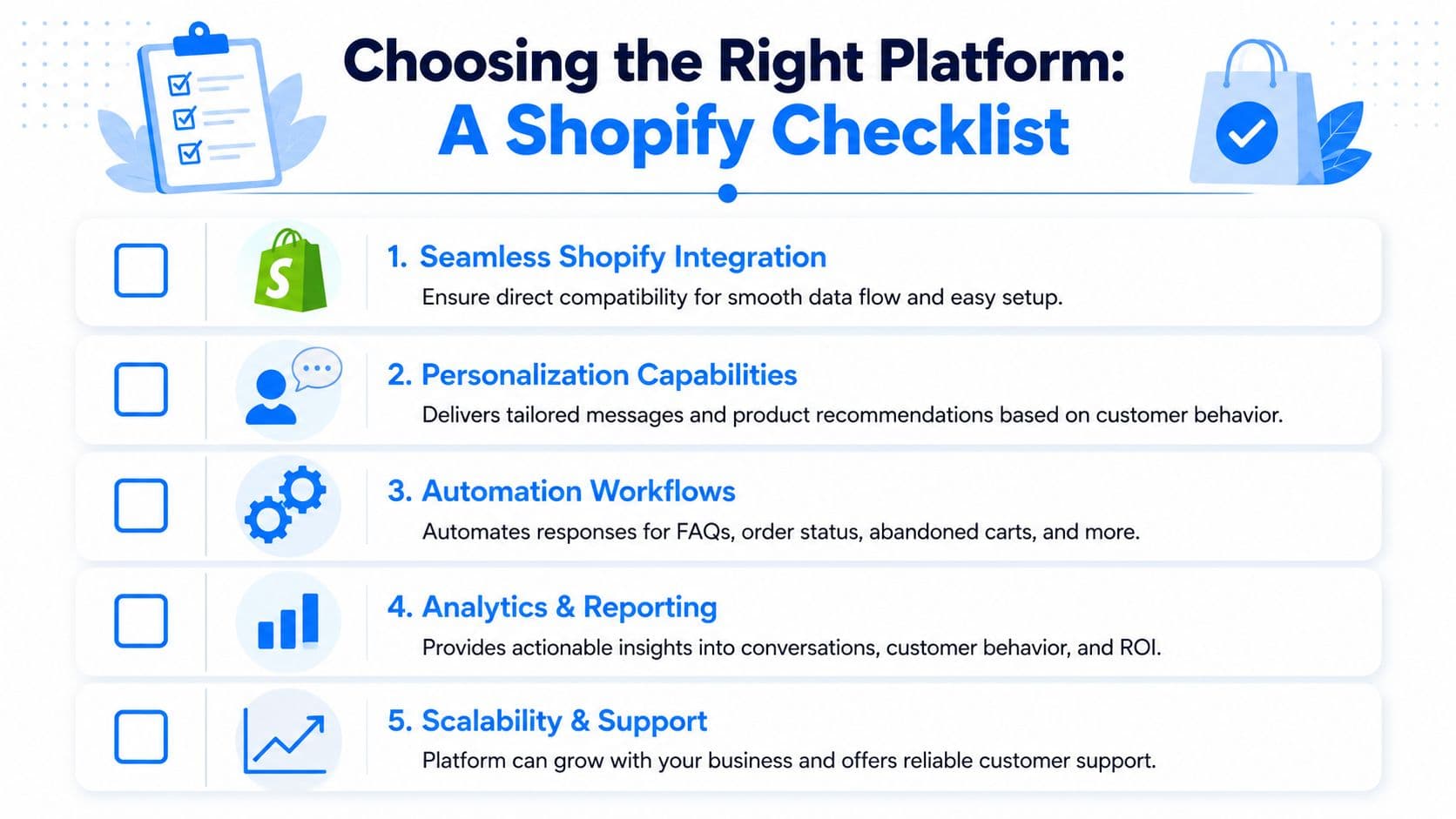
Ask these questions in plain terms.
- How deep is the Shopify integration? If the platform can't sync products, variants, policy content, and store context cleanly, setup becomes a maintenance project.
- Is it truly conversational? Some tools are still dressed-up FAQ bots. Ask it multi-part questions during the demo and see whether it handles context.
- Can it sell, not just support? You want recommendations, cart recovery behavior, and proactive engagement. Not just ticket deflection.
- How fast can you go live? If installation requires weeks of flow building, tagging, and developer cleanup, adoption usually stalls.
- How does it escalate edge cases? Returns disputes, damaged shipments, and unusual product compatibility questions still need humans.
- What will your team need to maintain weekly? Low-maintenance systems keep getting used. High-maintenance systems gradually decay.
One thing I'd push hard on is real catalog understanding. Many tools look convincing until you ask an ugly real-world question such as, “I'm between sizes, I want a looser fit, and I need this by Friday in Chicago. Which option should I order?” That's the kind of messy shopper language your store gets every day.
Don't buy the platform that demos best. Buy the one that handles your store's ugliest real customer questions with the least setup.
A fast evaluation table for Shopify teams
Here's a practical shortlist format you can use internally:
| Evaluation area | Strong answer | Warning sign |
|---|---|---|
| Shopify sync | Automatic catalog and policy learning | Manual uploads and constant retraining |
| Answer quality | Handles open-ended and multi-part questions | Breaks outside scripted prompts |
| Revenue features | Product suggestions and cart nudges are built in | Upsell or recovery requires extra tools |
| Setup time | Merchant can launch without heavy technical work | Needs custom implementation |
| Human handoff | Clear fallback path for edge cases | Bot guesses when it shouldn't |
| Reporting | Shows conversation themes and buying friction | Only tracks chat volume |
The right platform should feel native to retail. If it sounds like a B2B lead gen tool with a Shopify logo pasted on top, keep looking.
Real-World Examples From Shopify Stores
The best way to understand conversational marketing platforms is to look at how they behave inside common storefront situations.
Fashion
A fashion brand often gets the same pre-purchase questions all day. Does this run true to size? Is the fabric stretchy? Which option works for a curvier fit? A conversational layer can answer those questions on the product page and suggest the closest match instead of sending the shopper to a generic size chart.
That matters because the category's core advantage is immediate engagement. When platforms respond while interest peaks, they can drive 2 to 3 times improvements in conversion rates compared with static forms or delayed email responses, as described earlier in the Research and Markets data.
Beauty
A skincare store deals with more nuanced buying friction. Shoppers ask whether two products can be combined, whether a formula fits sensitive skin, or which routine works for morning versus evening use. A strong implementation acts like a trained beauty advisor. It guides the routine, recommends the next product only after the core need is handled, and keeps the customer in session.
That usually raises basket quality, not just basket size. Customers buy with more confidence when the recommendation feels informed instead of generic.
Home and wellness
Home, supplement, and wellness brands often struggle with repetitive support volume. Materials, dimensions, care, ingredient timing, subscription terms, and shipping questions pile up quickly. A conversational system can absorb much of that front-line demand, while still escalating exceptions to a person.
The practical gain is twofold. Shoppers get answers without waiting, and the support team stops spending the day retyping the same explanation.
Your Next Move Turning Conversations Into Conversions
If your Shopify store still relies on product pages, FAQ links, and contact forms to do all the selling, you're leaving too much work to the customer.
In 2026, shoppers expect help in the moment. They want the answer while they're deciding, not after they've left the tab. That's why conversational marketing platforms matter. They don't just make support faster. They make buying easier, recommendations more relevant, and recovery more timely.
Before you install anything, audit your own friction points. Look at product pages with high traffic and weak conversion. Review support logs for repetitive pre-purchase questions. Check where carts stall. Then compare platforms based on how well they solve those exact moments.
For a practical implementation lens, these chatbot best practices are worth reviewing before rollout. They'll help you avoid the common mistake of adding a bot that talks without selling.
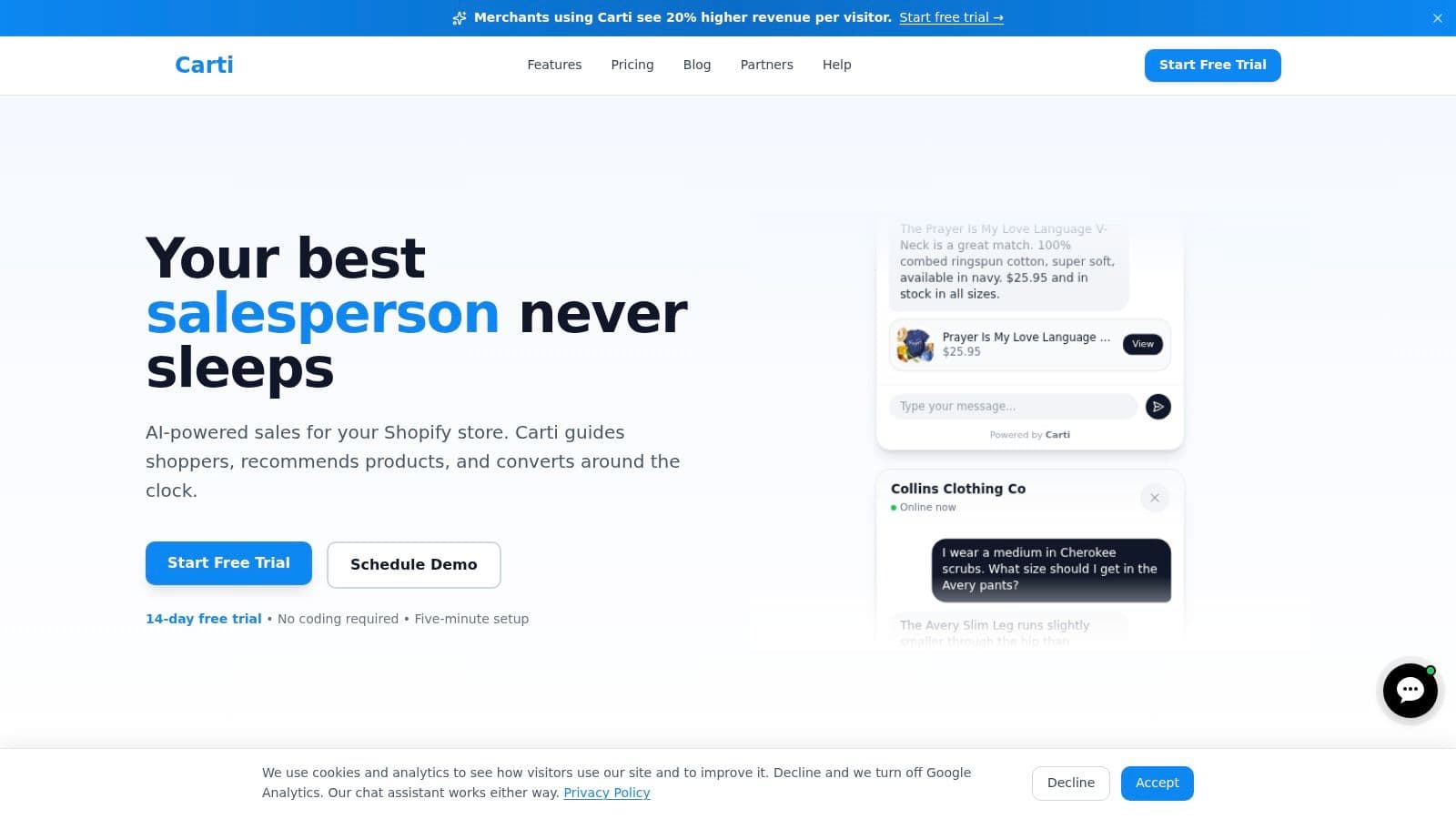
If you want a tool built specifically for Shopify stores, Carti is worth a close look. It's designed to turn shopper questions into sales with instant answers, product suggestions, and cart recovery workflows that fit how DTC stores sell.

Written by
Daniel AndersonFounder of Carti. 10+ years building ecommerce brands in apparel and supplements. Still runs a Shopify store and built Carti to help merchants convert more browsers into buyers.
Ready to boost your store's sales?
Install Carti in 5 minutes and let AI handle customer questions, recommend products, and close sales 24/7.
Start Free Trial14-day free trial