
Conversational marketing is a two-way, real-time dialogue that replaces static forms with chat, SMS, WhatsApp, and similar channels to help shoppers get answers fast and move toward purchase. It became mainstream when 58% of companies implemented conversational marketing in response to COVID-19, and 82% of consumers said they would talk to a chatbot.
If you run a Shopify store, you've probably seen the problem in plain sight. A shopper lands on a product page, likes what they see, then hesitates on one small question. Does this run true to size? Will it arrive before the weekend? Is the return policy easy? If nobody answers in the moment, that shopper often leaves and may never come back.
That's the practical answer to what conversational marketing is. It's the system that turns those fragile moments into useful conversations. Done well, it doesn't feel like a gimmicky popup. It feels like a great in-store associate who knows the catalog, understands context, and helps people buy with confidence.
The Unanswered Question That Costs You Sales
A shopper clicks into your best-selling product. They scroll the images, read the description, and hover near the add-to-cart button. Then they hit a practical objection.
They want to know whether the fabric is thick enough for winter, whether the supplement is safe with another routine, or whether the lamp works with a dimmer. Your site has the answer somewhere, but not in a way that helps fast enough. The visitor opens another tab, checks a competitor, gets distracted, or abandons the session.
That lost sale usually doesn't happen because your product is weak. It happens because your store stayed silent when the buyer was ready to ask.
Practical rule: The moment of highest buying intent is often the moment a customer asks a simple question.
That's where conversational marketing earns its keep. It's a dialogue-driven approach, formalized in the late 2010s, that uses channels like website chat, SMS, and WhatsApp to answer questions instantly, qualify leads, and move buyers through the funnel faster, with performance commonly measured by response time, conversion rates, and revenue generated, as outlined in this conversational marketing overview.
What it looks like on a Shopify store
On an e-commerce site, conversational marketing should work like a capable sales associate, not a generic help widget.
- On product pages: It answers purchase-blocking questions such as sizing, compatibility, ingredients, or shipping timing.
- At checkout: It handles hesitation around discounts, payment confidence, delivery expectations, or return terms.
- After purchase: It helps with tracking, order changes, and policy questions without forcing the customer into email back-and-forth.
When merchants miss this, they tend to treat chat as a support add-on. That's backwards. On Shopify, a good conversation often starts as support and ends as conversion.
Billboard vs Store Associate: How Marketing Is Changing
Traditional marketing still matters. Ads, email campaigns, landing pages, social posts, and product pages all play a role. But most of those assets behave like a billboard. They broadcast one message to many people and hope the right buyer responds.
A billboard can attract attention. It can't answer a question.
Conversational marketing works more like a store associate. It responds in real time, adjusts to the shopper's context, and helps an individual make a decision. That shift matters because online buyers don't shop in neat linear paths anymore. They jump from Instagram to a product page, from SMS to checkout, from a support question to a repeat order.
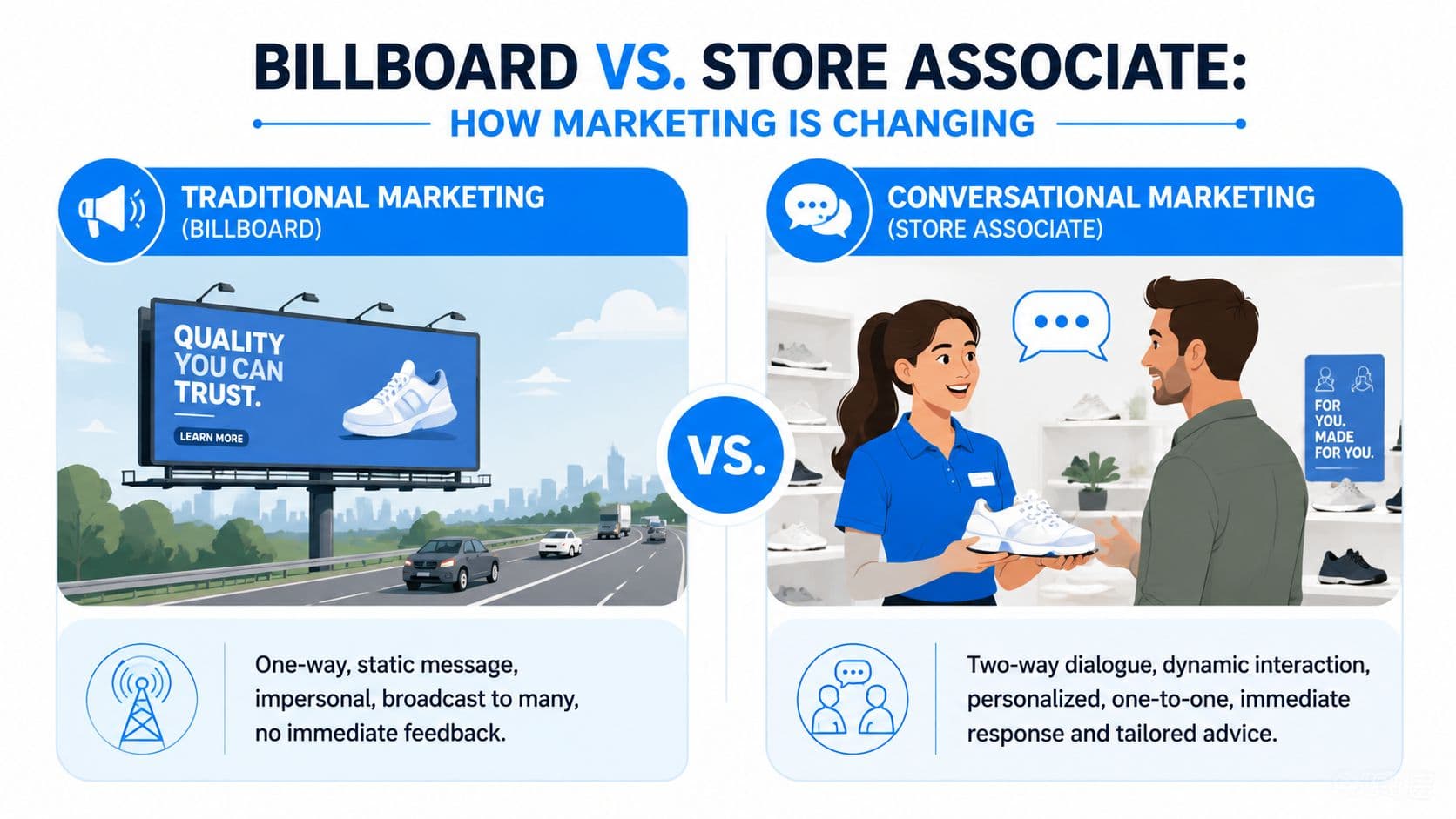
The core difference
Here's the simplest way to explain what conversational marketing is to a store owner deciding whether it's worth implementing.
| Approach | How it communicates | What the shopper experiences | Best use |
|---|---|---|---|
| Traditional marketing | One-way message | Passive reading or viewing | Reach, awareness, merchandising |
| Conversational marketing | Two-way dialogue | Active guidance and instant answers | Conversion, support, retention |
This isn't just a theoretical trend. Conversational marketing went mainstream during the pandemic, with 58% of companies implementing it in response to the shift to remote buying, and 82% of consumers willing to talk to a chatbot, according to Lift AI's conversational marketing summary.
Why the store associate model wins online
A strong sales associate doesn't dump information. They ask, listen, and narrow choices. They know when to recommend, when to reassure, and when to stop talking.
That's also what good conversational marketing does:
- It responds to intent: Someone on a returns page needs a different conversation than someone on a bundle page.
- It reduces friction: Buyers don't need to dig through FAQs or wait for email support.
- It personalizes in motion: The interaction changes based on what the shopper is doing right now.
A static page can present options. A conversation can resolve doubt.
What doesn't work is bolting on a chatbot that interrupts every visitor with the same canned greeting. That's not a store associate. That's a noisy popup. The better model is relevance first, timing second, automation third.
The Business Case: Benefits and KPIs for Shopify
If you're evaluating conversational marketing as a store owner, the wrong question is whether chat looks modern. The right question is whether it helps more shoppers buy, spend, and stay satisfied.
For Shopify merchants, the clearest business case is that conversational marketing isn't just a lead-gen tactic. Its value runs across product guidance, policy clarification, cart recovery, and post-purchase help. IBM's framing of conversational marketing supports that broader role across the customer journey, which is why it works better as a full-funnel conversion layer than a simple lead capture tool in e-commerce, as described in IBM's conversational marketing guide.
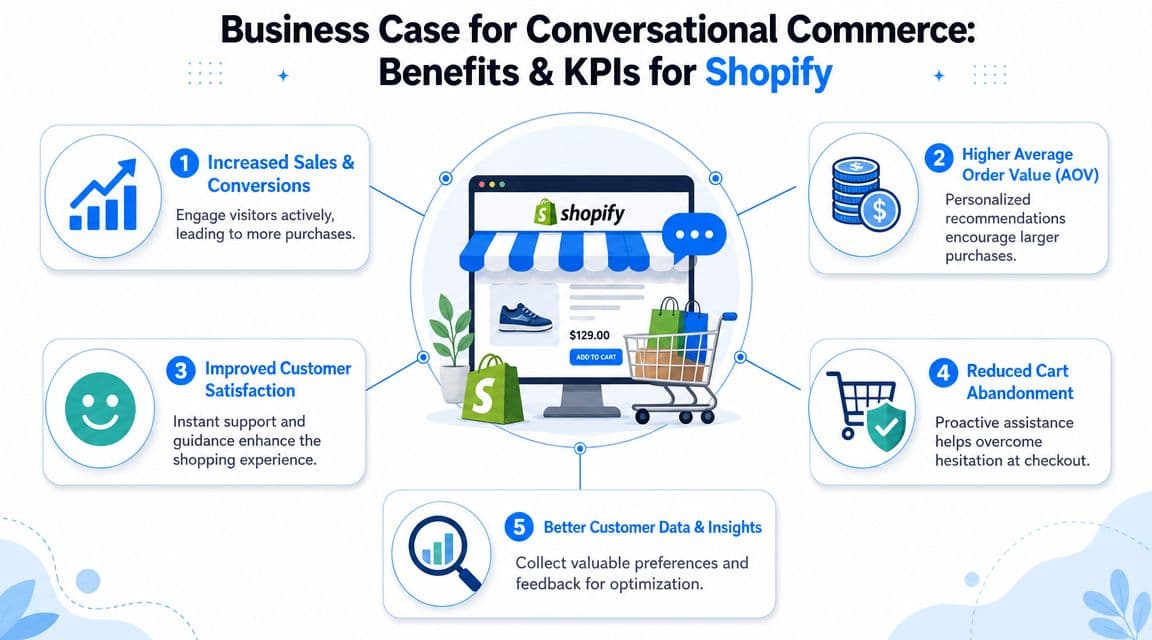
Where the value actually shows up
The most useful way to think about benefits is by commercial job, not by feature.
-
Higher conversion confidence
Buyers often need one answer, not a sales pitch. If chat resolves size, fit, ingredients, shipping, or product compatibility at the point of decision, more sessions turn into completed checkouts. -
Higher order quality
Better guidance often means customers choose the right item the first time. That can support larger baskets through recommendations and reduce preventable returns caused by poor product selection. -
Lower support drag
When repetitive questions get handled quickly, your team can focus on exceptions, VIP issues, and nuanced cases that need judgment. -
Stronger retention
Fast answers after purchase matter as much as pre-purchase support. Tracking help, policy clarity, and reorder guidance all shape whether the customer comes back.
What to measure on Shopify
Don't overcomplicate measurement. Track a small set of metrics that connect conversations to business outcomes.
| KPI | Why it matters |
|---|---|
| First-response time | Shows whether shoppers get help while intent is still high |
| Conversation-to-purchase rate | Reveals whether chats influence buying behavior |
| Revenue per conversation | Helps quantify whether the channel drives commercial value |
| Cart recovery rate | Shows whether checkout-stage messaging brings shoppers back |
| Customer satisfaction trends | Indicates whether support quality is improving or degrading |
For merchants that want cleaner attribution, a practical next step is reviewing chatbot analytics for e-commerce teams, especially if you're trying to separate vanity chat volume from real buying impact.
If you can't tie conversations to conversion, support efficiency, or customer satisfaction, you don't have a strategy yet. You have a widget.
What usually fails is measuring success by chat count alone. More conversations aren't automatically better. A high-volume chat program can still be weak if it creates noise, misses intent, or hands off too late.
Conversational Marketing Use Cases Through the Funnel
A lot of articles answer “what is conversational marketing?” as if it starts and ends with a homepage chatbot. That's too narrow. In practice, the value shows up across the full customer journey.
What makes it work is the data layer underneath. Each interaction can capture intent signals and behavioral context, which helps the system learn from customer habits and serve more relevant responses or recommendations, as explained in Vonage's breakdown of conversational marketing.
Discovery and consideration
At the top of the funnel, the job isn't to push a sale too hard. It's to reduce confusion and keep the shopper engaged.
A visitor arriving from a paid social ad might need orientation. They clicked because the creative caught their eye, but the product page still has to close the gap between curiosity and fit. A well-timed message can ask what they're shopping for and route them to the most relevant category, bundle, or best-seller.
During consideration, conversational marketing becomes a guided selling tool.
- Product matching: Help shoppers narrow choices based on use case, style, skin type, room size, or routine.
- Comparison help: Answer “what's the difference?” between two similar items without forcing customers to scan long tables.
- Objection handling: Clarify policies, restocks, subscription terms, or compatibility before doubt turns into exit.
If you're comparing implementation options, this guide to ecommerce AI chatbot solutions gives a useful overview of how retailers apply chat across sales and support workflows.
Decision and post-purchase
At the decision stage, the conversation should feel tighter and more specific. Generic greetings underperform here. If someone has viewed the same product repeatedly or reached cart, they usually need reassurance, not discovery.
Common bottom-funnel uses include:
-
Cart hesitation support
Answer last-mile questions about shipping windows, payment options, returns, or product details. -
Checkout rescue
Trigger a message when exit intent or inactivity suggests uncertainty, then point the shopper to the next best action. -
Human escalation
If the question involves exceptions, edge cases, or high-value orders, route the conversation cleanly instead of trapping the shopper in automation.
After purchase, the same channel becomes a retention tool.
| Funnel stage | Good conversational use case | Common mistake |
|---|---|---|
| Discovery | Guide to the right category or collection | Generic popup with no context |
| Consideration | Compare products and answer fit questions | Dumping links to FAQs |
| Decision | Resolve cart objections and checkout friction | Repeating canned discount prompts |
| Post-purchase | Track orders, handle returns, support reorder intent | Forcing email for every issue |
If you want the on-site experience to feel natural, it helps to study how a well-designed web chat widget for Shopify stores balances visibility, timing, and intent.
The trade-off is straightforward. The more aggressive you make proactive messaging, the more likely it is to annoy casual browsers. The more passive you make it, the more likely you are to miss high-intent moments. Good conversational marketing sits in the middle. Present when needed, quiet when not.
Your 5-Minute Path to Conversational Commerce
Implementation is where many merchants overthink things. They imagine weeks of scripting, tagging, and flowcharting before anything useful can go live.
In reality, the first version should be simple. Start with the pages where questions already block purchases, then build from what customers ask. The technical requirement that matters most is context persistence. The system should be able to access prior orders, page visits, and conversation history, and that information should be stored and shared so future conversations stay relevant, as noted in TechTarget's explanation of conversational marketing systems.
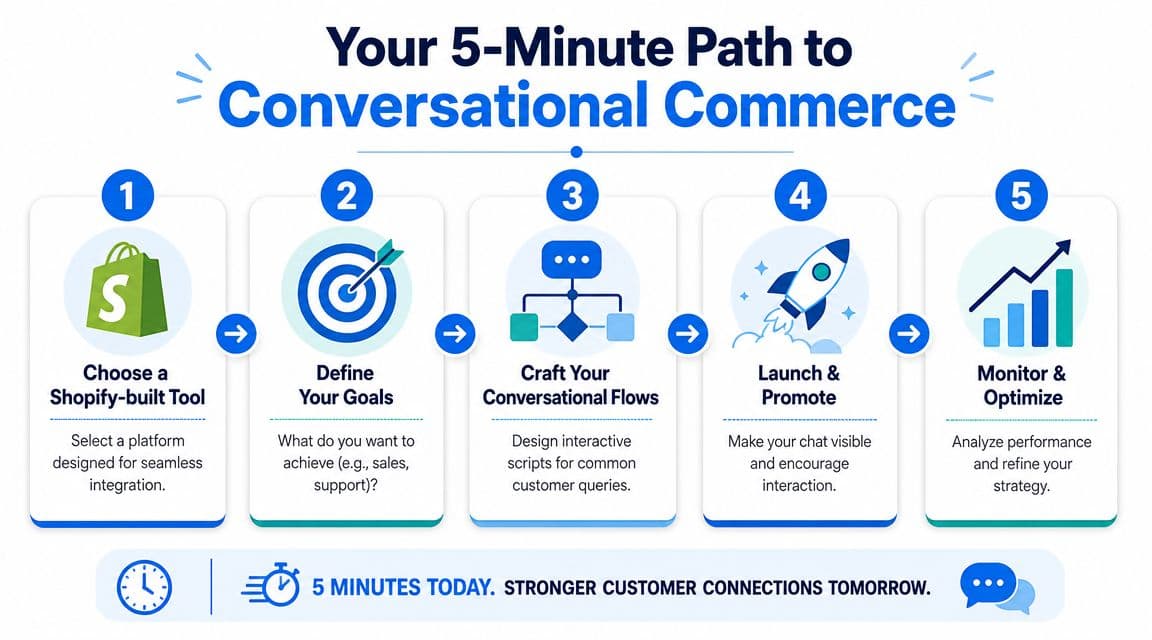
The setup that matters
A practical rollout usually follows five steps.
-
Choose a Shopify-native tool
The tool should understand products, collections, policies, and customer history. If it sits outside your store data, the answers will feel shallow. -
Define one commercial goal first
Start with one priority. Product guidance. Cart recovery. Support deflection. Post-purchase service. Stores that try to solve everything on day one usually create messy flows. -
Load real store knowledge
Catalog details, shipping rules, return policy, FAQs, and common objections should shape the responses. Weak inputs create weak conversations. -
Customize the widget experience
Placement, welcome prompts, tone, and triggers matter. A chat experience should match brand voice and page intent. -
Launch, review, refine
Read transcripts. Look for repeated questions, failed answers, and missed handoffs. Then tighten the experience.
The guardrails that keep it useful
Strong implementations distinguish themselves from flashy ones.
Keep automated conversations narrow enough to stay accurate, but flexible enough to be helpful.
A few essential elements:
-
Build for handoff
Some questions need a human. Returns exceptions, wholesale requests, damaged shipments, and custom orders shouldn't get trapped in a loop. -
Use context in the reply
If a returning customer asks about an order, the conversation should reflect that history. If a new visitor is browsing a product page, the prompt should relate to that product. -
Don't over-trigger
If chat opens too quickly or on every page, shoppers dismiss it as noise. Timing should reflect intent. -
Treat transcripts as merchandising feedback
Repeated questions often signal weak copy, unclear sizing info, missing comparison content, or policy confusion.
What doesn't work is copying a generic support script from another brand and calling it strategy. Your best conversation flows come from your own store's friction points.
Stop Broadcasting, Start a Conversation
Shopify stores don't lose sales only because of traffic problems. They lose sales because too many buying moments go unanswered.
That's the meaning behind conversational marketing. It turns a passive storefront into an active sales and service layer. Instead of asking shoppers to figure everything out alone, it gives them guidance when they're deciding, hesitating, or returning with a question.
If you want a smarter rollout, study proven chatbot best practices for e-commerce and apply them with discipline. Relevance beats volume. Context beats scripts. A clean human handoff beats fake automation confidence every time.
Stores that get this right don't just add chat. They redesign the buying experience around faster answers, better recommendations, and fewer dead ends. That's why conversational marketing isn't a side feature in 2026. It's part of how modern e-commerce converts.
If you want to put this into practice fast, Carti is built for Shopify merchants who need an AI sales and support assistant without a heavy setup. It learns your catalog, policies, and FAQs, helps shoppers in real time, and gives your team clearer insight into what customers are asking before they buy.

Written by
Daniel AndersonFounder of Carti. 10+ years building ecommerce brands in apparel and supplements. Still runs a Shopify store and built Carti to help merchants convert more browsers into buyers.
Ready to boost your store's sales?
Install Carti in 5 minutes and let AI handle customer questions, recommend products, and close sales 24/7.
Start Free Trial14-day free trial