
Your Shopify store can have healthy traffic and still feel stuck. People land on product pages, open the size guide, click into shipping, maybe even start checkout, then disappear. The problem usually isn't that they visited. It's that nothing on the site helped them move from interest to confidence.
That's where customer engagement matters. For a Shopify merchant, this isn't a branding slogan or a support metric you check once a month. It's the quality of the interactions that help a shopper understand the product, trust the store, and decide to buy.
If you've been asking why sessions aren't turning into sales, why support volume keeps rising, or why first-time buyers don't come back, you're already dealing with a customer engagement problem. The useful question isn't “Are people interacting with my store?” It's “Are those interactions helping revenue?”
The Difference Between Store Traffic and Store Sales
A lot of Shopify stores look busy from the outside. Paid traffic is running. Klaviyo flows are live. Product pages are polished. GA4 shows visitors arriving from Meta, Google, email, and organic search. Yet sales don't match the effort.
That gap usually shows up in ordinary moments. A shopper wants to know whether a serum works for sensitive skin. Another wonders if a couch fabric is pet-friendly. Someone else is ready to buy but doesn't want to commit before checking shipping times or return terms. If the answer takes too long to find, many leave.
Traffic measures attention. Sales require confidence.
A merchant might see lots of clicks and assume the top of funnel is working. Sometimes it is. But many stores are leaking revenue in the middle. The customer is interested enough to browse, compare, and ask questions, but not reassured enough to purchase.
A shopper who interacts with your store isn't automatically engaged in a way that helps the business. Some interactions signal curiosity. Others create buying momentum.
That distinction matters. A visitor opening three product pages may be confused. A customer asking a shipping question may be one clear answer away from checkout. A repeat site visit can mean strong intent, or it can mean the first visit failed to resolve objections.
For Shopify merchants, customer engagement sits in that middle layer between acquisition and retention. It's the set of interactions that turns passive browsing into active progress. Good engagement removes friction, answers real questions, and makes the next step obvious. Bad engagement creates noise. It interrupts, repeats generic prompts, or forces the customer to work too hard.
If you only measure traffic, you'll miss what's happening. Stores grow when they improve the moments that help people decide.
Defining Customer Engagement for E-commerce
Customer engagement gets defined too loosely. In practice, Shopify merchants need a tighter definition, because “more interaction” doesn't always mean “more sales.”
A practical definition for Shopify merchants
The simplest way to think about what customer engagement is in e-commerce is this:
Customer engagement is the ongoing quality of interactions a shopper has with your brand across the journey, before purchase, during checkout, and after the order. Good engagement helps the customer move forward. Weak engagement creates activity without progress.
That's the online version of a strong in-store experience. In a good retail store, an associate doesn't follow every customer around asking vague questions. They step in when needed, answer clearly, make relevant suggestions, and remove doubt. Online, your store has to do the same job through product pages, chat, on-site prompts, email, SMS, and support.
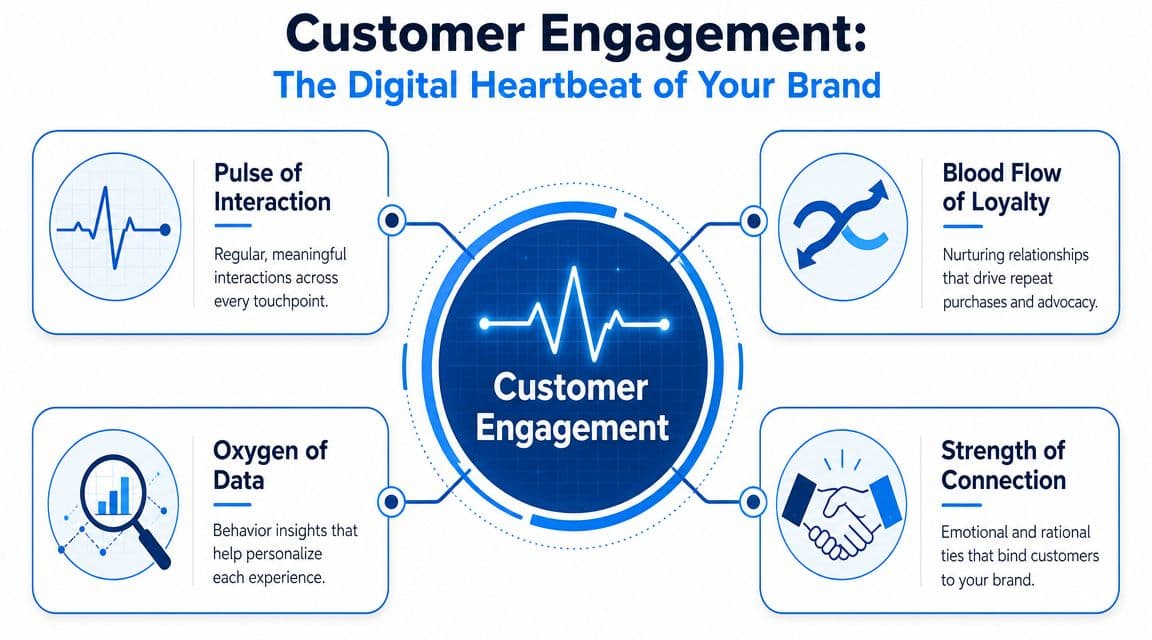
A useful definition also separates interaction quality from raw activity. A customer who clicks around your navigation, opens a chat widget, and reads your FAQ has interacted with the store. But if those actions don't reduce friction or improve purchase confidence, they aren't valuable engagement in any meaningful commercial sense.
Signals are not outcomes
Many teams get sloppy when defining customer engagement. Qualtrics notes that brands often define engagement too broadly and need to separate engagement signals from business outcomes, especially in commerce environments where a support or chatbot interaction may reflect either curiosity or purchase intent, not necessarily both, as explained in Qualtrics on customer engagement.
Use this distinction:
| Type | What it includes | What it tells you |
|---|---|---|
| Signals | Clicks, replies, repeat visits, support cases | The customer is interacting |
| Outcomes | Conversion, retention, revenue, churn reduction | The interaction affected the business |
A healthy store tracks both. If you only track outcomes, you won't know where the journey breaks. If you only track signals, you can convince yourself that engagement is strong while revenue stays flat.
That's why sharper scoring models matter. If you're trying to separate active buyers from passive browsers, this guide on customer health scoring for e-commerce teams is a useful next step.
Better engagement isn't “more messages.” It's better-timed, more relevant interactions that help the customer do the next logical thing.
For Shopify stores, that usually means answering pre-purchase questions faster, recommending products more intelligently, and reducing the number of moments where a shopper has to guess.
Why Engagement Directly Impacts Your Revenue
A shopper lands on a product page, hesitates on sizing, opens your shipping policy, adds to cart, then disappears at checkout. That drop-off often gets blamed on price or traffic quality. In practice, many of those lost orders come from unanswered questions and weak guidance at the exact moment the buyer is deciding.
That is why engagement affects revenue so directly. Useful engagement changes behavior inside the session and after the first purchase. It helps shoppers choose faster, reduces checkout hesitation, and gives past buyers a reason to come back. For a Shopify store, that shows up in the numbers that matter: conversion rate, average order value, repeat purchase rate, and customer lifetime value.
A simple way to frame it is this. Traffic creates opportunity. Engagement improves the odds that opportunity turns into revenue. If you want a tighter view of the metrics behind that relationship, track the e-commerce KPIs tied to conversion, retention, and profit, not just visits and clicks.
Engagement changes buying behavior
On Shopify, revenue usually leaks through small moments of uncertainty. A shopper cannot tell which variant fits their needs. A bundle sounds appealing but the value is unclear. Delivery timing feels vague. A final pre-purchase question goes unanswered, so the session ends.
Those moments look minor in isolation. Across hundreds or thousands of sessions, they shape top-line growth.
Good engagement fixes those leaks by reducing effort and increasing confidence. The shopper gets a relevant answer without hunting through policy pages. The store recommends the right product instead of forcing the buyer to compare six similar options alone. A post-purchase message helps the customer use what they bought, then introduces the next product at the right time. That is not passive interaction. It is active, conversion-driving engagement.
Why this matters on a Shopify storefront
Large brands already treat engagement as a revenue function, not a support afterthought. The same logic applies to smaller merchants, even if the tools and team size are different.
For Shopify stores, four revenue effects matter most:
- Higher conversion rates. Buyers convert when uncertainty gets resolved before they leave.
- Better average order value. Relevant guidance makes cross-sells and bundles easier to trust.
- Stronger repeat purchase rates. Post-purchase engagement keeps the first order from becoming the last.
- Lower reacquisition costs. Retaining a buyer is usually cheaper than paying to bring them back through ads.
There is a trade-off here. More messages do not automatically produce more sales. Poorly timed pop-ups, generic email flows, and aggressive chat prompts can interrupt the buying process and hurt trust. Effective engagement is selective. It shows up where hesitation is highest and where a timely answer can move the shopper to the next step.
If your store answers questions quickly, reduces uncertainty, and gives buyers relevant guidance at key decision points, engagement is contributing to revenue.
The practical question is not whether engagement matters. It is where your store is losing buyer confidence, and which interactions will recover the most revenue first.
How to Measure Customer Engagement That Matters
Teams often make one of two mistakes. They either track a pile of disconnected metrics and call it insight, or they try to squeeze engagement into a single score that hides what's broken.
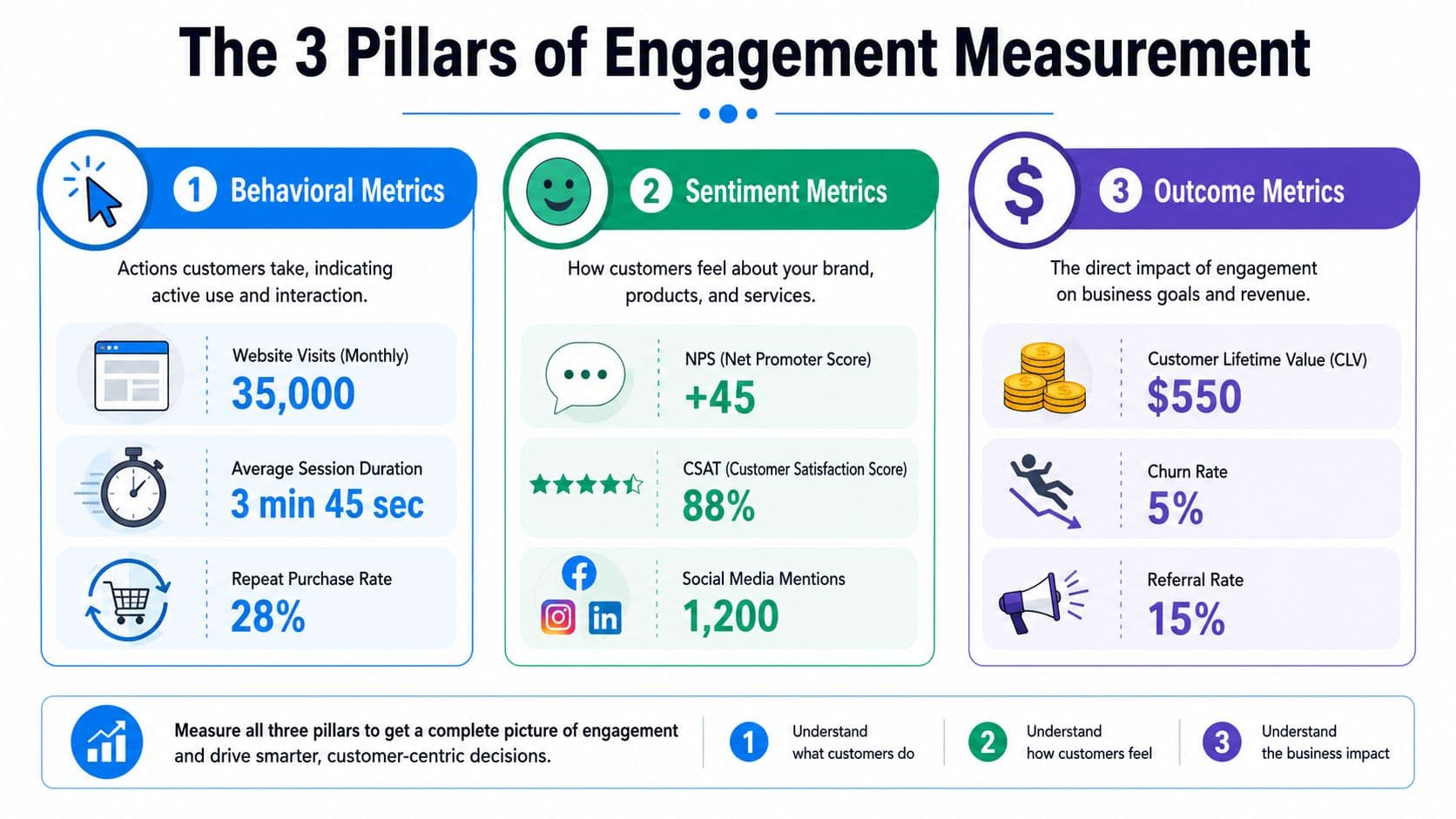
Twilio's framework is the better approach. Effective measurement uses a multi-layer metric system that separates behavioral, sentiment, and outcome metrics so teams can diagnose whether the issue is low interaction, poor experience quality, or weak business impact, as outlined in Twilio's guide to measuring customer engagement.
Start with this visual model:
Behavioral metrics
Behavioral metrics show what customers do. They're your first clue that someone is leaning in or drifting away.
For Shopify stores, useful behavioral indicators include:
- Repeat visits. A shopper who comes back may be building intent, or struggling to decide.
- Session depth. Product page views, time spent in collections, and movement into FAQ or shipping pages often signal evaluation.
- Activation behavior. Starting checkout, using search, opening size guides, or engaging with support can show buying progress.
- Stickiness signals. Product teams often use measures like DAU-to-MAU ratios, feature adoption, time to value, and conversion rate to understand whether users are forming a routine and reaching value quickly, as described in LaunchNotes on engagement metrics.
A spike in behavior isn't always good news. If support chats rise because shoppers can't find return details, you have more interaction but worse experience.
A practical benchmark document helps keep these metrics tied to commerce performance. This overview of e-commerce key performance indicators is worth keeping handy.
Sentiment metrics
Behavioral data tells you what happened. Sentiment tells you how the customer felt about it.
For merchants, the most useful sentiment inputs are usually simple:
- CSAT and NPS when you have enough volume to collect them consistently
- Review language that reveals whether customers felt confident, confused, disappointed, or pleasantly surprised
- Chat transcripts and support tickets that expose recurring friction
- Return reasons and refund notes that show expectation gaps
These metrics matter because they often reveal problems before revenue metrics move. If customers repeatedly ask whether a dress runs small, the issue isn't just support volume. It may be weak product page clarity.
Outcome metrics
Outcome metrics answer the only question that ultimately matters. Did engagement improve the business?
Track these closely:
| Outcome metric | Why it matters for Shopify |
|---|---|
| Conversion rate | Shows whether interactions help shoppers buy |
| Repeat purchase rate | Indicates whether the relationship continues after order one |
| Customer lifetime value | Connects engagement quality to long-term revenue |
| Churn or inactivity | Shows whether customers stop buying after initial interest |
Practical rule: Don't ask one metric to do three jobs. Use behavioral metrics to find friction, sentiment metrics to understand it, and outcome metrics to decide whether fixing it paid off.
That's how engagement becomes useful. Not as a slogan, but as a measurement system that points directly to revenue leaks.
Five Practical Customer Engagement Strategies
Most Shopify stores don't need more tactics. They need better execution in a few high-impact moments. These five strategies do that.
1. Offer instant support when buying friction appears
A customer on a product page usually doesn't want a full support experience. They want one clear answer. If they can't get it quickly, they leave and keep shopping elsewhere.
The best support prompts appear where hesitation is likely. On sizing-heavy products, that may be near the size selector. On home goods, it may be near materials, dimensions, or delivery timing. On beauty products, it may be near skin type or ingredients.
Good microcopy sounds like this:
- For fashion: “Need help with sizing or fit? Ask before you order.”
- For home: “Questions about materials, assembly, or delivery?”
- For beauty: “Not sure which formula fits your routine? Ask here.”
Bad microcopy is generic. “How can we help?” is easy to ignore because it asks the shopper to do the work.
2. Personalize recommendations without being creepy
Customers want relevance, not surveillance. That distinction matters. Research summarized by Emarsys reports that 40% of consumers say brands don't understand them as people and 44% say brand interactions feel more generic than before, which is a strong argument for better personalization, not louder messaging, according to Emarsys customer engagement statistics.
Effective personalization in Shopify usually looks simple:
- Recommend a complementary product based on what's already in cart.
- Surface a “best for” suggestion based on category behavior.
- Show a bundle that solves a complete use case, not just a random upsell.
For example, if someone is viewing a linen duvet cover, “Complete the bed setup” is stronger than “You may also like.” It reflects task-based intent.
3. Use proactive prompts that help a decision
Proactive engagement works when it is specific and contextual. It fails when it appears too early, too often, or with no relevance.
Try prompts tied to likely objections:
| Weak prompt | Better prompt |
|---|---|
| “Can I help you?” | “Need help choosing the right size?” |
| “Chat with us” | “Shipping deadline for weekend delivery? Ask here.” |
| “Welcome to our store” | “Shopping for a gift? We can help you choose fast.” |
The job of proactive messaging isn't to interrupt. It's to remove one obstacle at the right time.
A merchant selling supplements might trigger guidance after a customer views multiple similar products. A furniture brand might prompt when someone lingers on shipping or returns. Context beats frequency every time.
4. Recover carts with context, not pressure
Cart recovery often gets treated like a discount workflow. That's too narrow. Many abandoned carts aren't price problems. They're unresolved concerns.
Recovery messaging works better when it addresses likely friction:
- If shipping caused hesitation. Remind the shopper where to find delivery timing.
- If product comparison caused delay. Offer help choosing between two similar items.
- If trust is the issue. Reinforce returns, guarantee details, or customer support access.
Short examples:
- “Still deciding? We can help you choose the right option.”
- “Questions before checkout? Shipping and returns are easy to review.”
- “Your cart is saved. Need help with fit, timing, or product details?”
5. Stay useful after the order
A lot of stores stop engaging once payment clears. That's expensive thinking. The post-purchase window is where trust either compounds or fades.
Useful post-purchase engagement includes:
- Order reassurance with clear updates and policy reminders
- Getting-started guidance so the product works quickly
- Cross-sell timing based on actual use, not immediate pressure
- Feedback requests after enough time has passed for a real opinion
- Reorder or replenishment nudges when they make sense for the category
The point isn't to keep messaging the customer. It's to stay relevant after the sale. Done well, post-purchase engagement turns support into retention.
Putting Engagement Strategies into Action with AI
Most merchants understand the strategy. The hard part is execution at scale. Small teams can't answer every question instantly, personalize every recommendation manually, and follow up with every hesitant shopper at the right moment. That's where AI helps, if it's used with restraint.
Where automation helps
The strongest use of AI in customer engagement is operational. It handles repetitive, time-sensitive tasks that humans are too slow or too expensive to cover around the clock.
Here's a practical map:
| Engagement Strategy | Challenge for Merchants | How Carti Solves It |
|---|---|---|
| Instant support | Small teams can't answer every pre-purchase question in real time | Instant Answers respond immediately using catalog, FAQ, and policy data |
| Product personalization | Manual recommendations don't scale across all shoppers | Smart Suggestions recommend relevant products based on shopper context |
| Proactive guidance | Most on-site prompts are generic and badly timed | Proactive engagement can surface relevant help during hesitation moments |
| Cart recovery | Abandoned checkouts often go unaddressed or get generic reminders | Cart Recovery sends timely nudges tied to saved carts |
| Post-purchase usefulness | Support teams get pulled into repetitive order and policy questions | Automated answers reduce response burden while keeping help available |
Used well, AI gives a Shopify store broader coverage without making the experience feel robotic. That's the operational benefit of a purpose-built AI chatbot for e-commerce. It can support sales, support, and retention at the same time.
Where merchants go wrong with AI
Automation creates new risks when merchants use it to increase volume instead of relevance. The better rule is simple: fewer, better interactions beat constant outreach.
That trade-off matters because the tension between personalization and trust is real. Amazon's guidance emphasizes ethical, relevant use of customer data and the broader lesson is clear in Amazon's customer engagement guide. More engagement is not always better. In many cases, fewer but more relevant interactions build more trust and drive more sales.
Common mistakes include:
- Over-prompting. Chat opens too fast, too often, and on every page.
- Bad training data. The assistant gives vague or off-brand answers because it wasn't grounded in real store content.
- Pushing before helping. Recommendations appear before the customer's core question is resolved.
- Treating every visitor the same. First-time browsers, repeat customers, and cart abandoners need different support.
AI should act like a strong sales associate. Available, informed, and well-timed. Not pushy, noisy, or everywhere at once.
When merchants keep that standard, AI improves engagement without eroding trust.
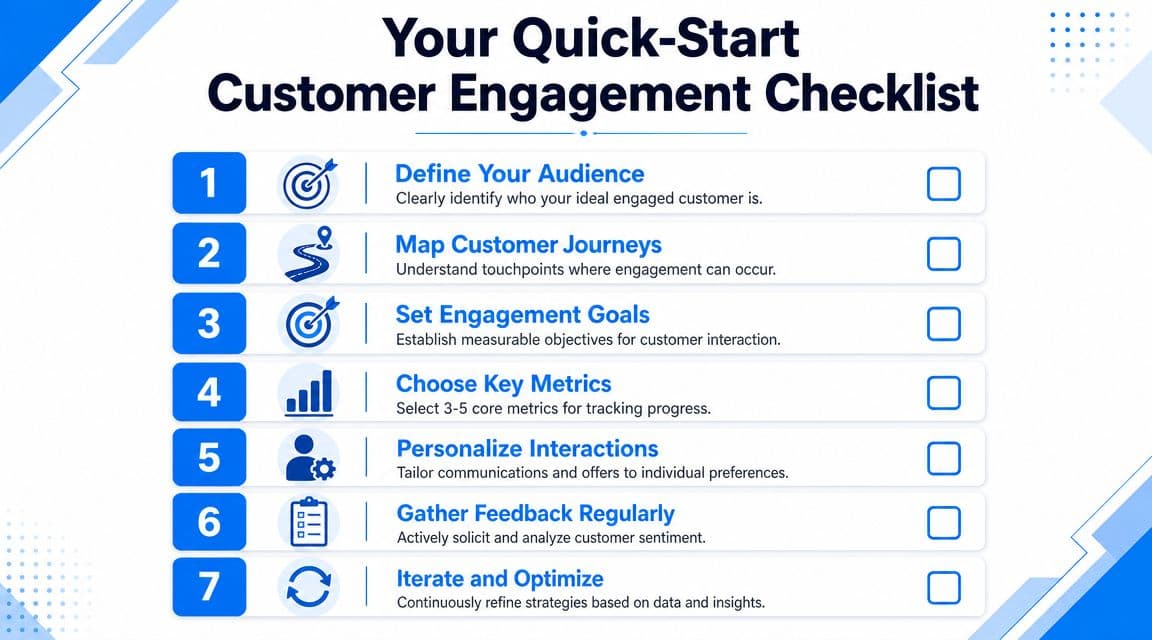
Your Quick-Start Customer Engagement Checklist
If you want to improve customer engagement this week, keep it tight. Don't rebuild the whole customer journey at once. Fix the moments that block purchase confidence.
Start with the buying journey
Use this checklist:
- List the top pre-purchase questions. Pull them from support tickets, chat logs, reviews, and returns.
- Audit your product pages. Check whether shipping, sizing, ingredients, compatibility, or returns are easy to find.
- Mark hesitation points. Look for pages where shoppers pause, revisit, or drop off.
- Rewrite weak prompts. Replace generic “Need help?” language with specific buying guidance.
- Set one cart recovery flow. Focus on resolving concerns, not leading with a discount.
- Add one post-purchase message. Help the customer use, care for, or understand the product after delivery.
Track a short list of metrics
Don't drown in dashboards. Start with a few measures that show whether engagement is improving:
- First-response time for pre-purchase questions
- Chat-influenced conversion rate or assisted conversion trend
- Cart recovery rate for shoppers who started checkout
- Repeat purchase behavior after post-purchase communication starts
A final test helps keep priorities clear.
If an interaction doesn't reduce friction, increase clarity, or improve confidence, it probably isn't valuable engagement.
That's the practical answer to what customer engagement is for a Shopify store. It's not every click, chat, or message. It's the set of interactions that help shoppers buy, come back, and trust the brand enough to choose it again.
Carti helps Shopify merchants turn customer engagement into revenue by answering shopper questions instantly, recommending the right products, and recovering carts without adding more work to the team. If you want a faster way to reduce friction across your storefront, explore Carti.

Written by
Daniel AndersonFounder of Carti. 10+ years building ecommerce brands in apparel and supplements. Still runs a Shopify store and built Carti to help merchants convert more browsers into buyers.
Ready to boost your store's sales?
Install Carti in 5 minutes and let AI handle customer questions, recommend products, and close sales 24/7.
Start Free Trial14-day free trial