
You know the pattern. A few customers buy again and again, a few complain loudly, and many others sit in the middle without giving you a clean signal. They browse, ask a question, abandon a cart, come back a week later, maybe buy once, then disappear. By the time you realize they were slipping away, they're already gone.
That blind spot costs Shopify stores more than most operators admit. Teams end up reacting to refunds, angry tickets, and abandoned checkouts instead of catching risk earlier. They also miss the opposite signal: shoppers who are naturally progressing toward a second purchase, a larger order, or long-term loyalty.
Customer health scoring fixes that. It gives you one operating signal built from behavior, support, engagement, and sentiment so you can stop treating every shopper the same. In e-commerce, that matters before and after the sale. The strongest models don't just look at repeat buyers. They also read pre-purchase behavior from anonymous visitors, active carts, product questions, and hesitations on the storefront.
Moving Beyond Guesswork in Customer Retention
Most store owners can name their best customers from memory. They can also name the hardest support cases. The problem is everyone else.
The middle group is where profit gets won or lost. These customers don't always open every email, they don't always submit a ticket, and they rarely announce that they're about to leave. They just buy less often, stop visiting certain product pages, hesitate at checkout, or go quiet after one order. If you run retention from your inbox and your instincts, you'll miss those patterns.
A better system starts with behavior, not hunches. Customer health scoring takes scattered signals and turns them into a single operating view of risk and potential. Instead of asking, "Who seems unhappy?" you ask, "Which customers are showing early signs of drop-off, and which ones are moving toward stronger loyalty?"
That shift matters for e-commerce because support data alone is too late. A shopper who keeps revisiting shipping details, lingers on return policy content, or abandons a high-intent cart is already telling you something. So is a recent buyer who never re-engages after their first order. Looking at post-purchase behavior patterns that shape repeat buying helps sharpen that view, but the broader point is simple: retention doesn't start after a complaint. It starts when behavior changes.
What guessing gets wrong
Teams usually make three mistakes when they don't score health:
- They overvalue loud signals. Complaints feel urgent, so teams chase the noisiest accounts while quiet churn builds in the background.
- They rely on one metric. Repeat purchase rate, support tickets, or email clicks each tell part of the story. None of them tell the whole story alone.
- They treat all customers the same. A first-time buyer who disappears means something different from a loyal customer whose order cadence suddenly slows.
Practical rule: If a customer only becomes visible when they ask for help or request a refund, your retention system is already late.
What a healthier operating model looks like
A good health scoring setup helps a Shopify store do four practical things:
- Spot risk early through shifts in browsing, support, and purchase behavior.
- Prioritize attention so the team spends time where intervention can still change the outcome.
- Trigger the right response instead of blasting the same flow to everyone.
- Find upside in customers who are showing signs of stronger intent, not just signs of trouble.
The core value isn't the score itself. It's the ability to move from reactive support to proactive growth.
What Is a Customer Health Score
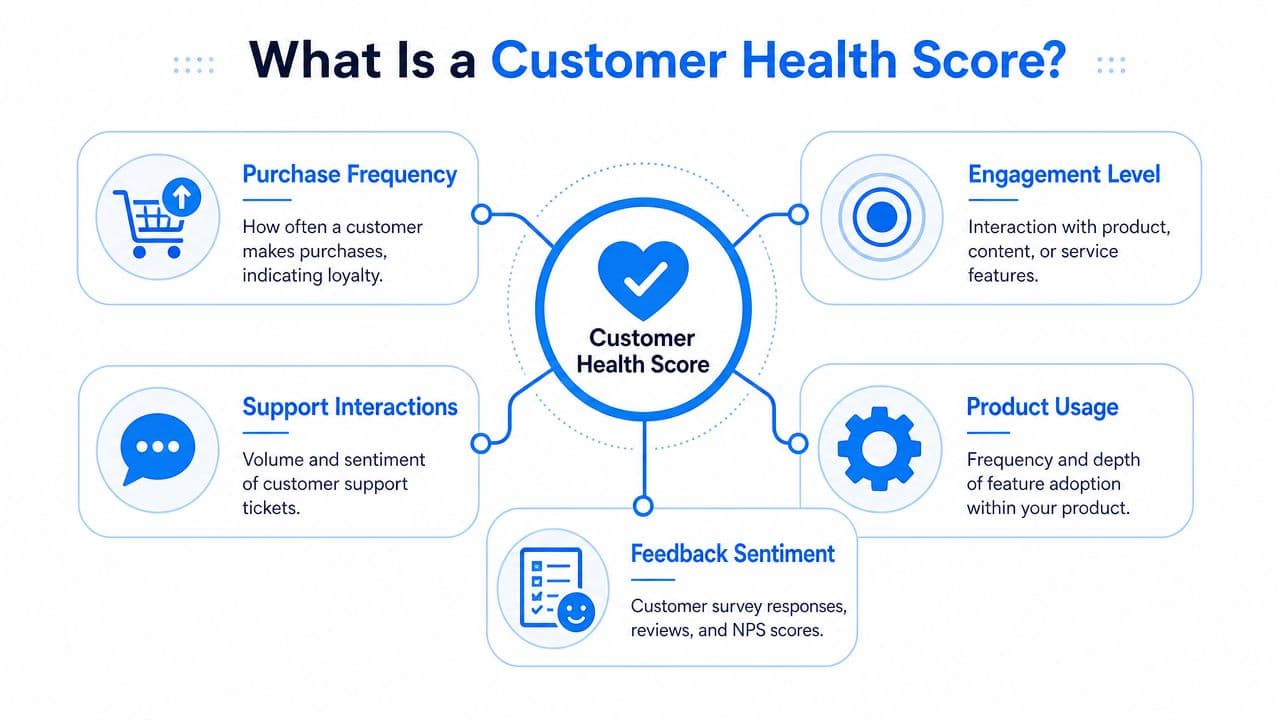
A customer health score is a single metric that combines several signals into one view of how strong or fragile a customer relationship is. It functions much like a routine checkup. One reading rarely tells the whole story, but several together show whether things are stable, improving, or drifting in the wrong direction.
In practice, the score isn't locked to one format. Industry guidance describes customer health scoring as a flexible composite metric that can use points, letter grades, or color coding, with examples like Healthy = 10, Concerning = 5, and At-risk = 0, built from inputs such as product usage, support history, and feature adoption, which is part of why it became such a durable framework for churn risk and upsell detection in different business models, as explained in Qualtrics' overview of customer health scores.
Why the flexibility is useful
Merchants frequently find themselves stuck. They assume there must be a standard formula they haven't found yet. There isn't one, and that's a strength.
A subscription software company might care most about product usage and onboarding milestones. A Shopify brand selling skincare, supplements, apparel, or home goods needs a different lens. Health might depend more on repeat purchase cadence, product education engagement, return behavior, sentiment after delivery, and pre-purchase hesitation before the sale even happens.
That means your score should reflect how customers create value in your business. If education drives conversion, content engagement matters. If reorder timing matters, recency becomes important. If returns destroy margin, post-purchase friction deserves real weight.
What the score is actually trying to predict
A good health score answers operational questions your team faces every day:
| Question | What the score helps you see |
|---|---|
| Will this customer buy again? | Signals of repeat-purchase readiness or drift |
| Is this shopper hesitant right now? | Friction before checkout or during consideration |
| Does this account need outreach? | Early risk indicators before a complaint arrives |
| Is there upside here? | Behavior that suggests loyalty, advocacy, or a larger next order |
For e-commerce, this expands the usual definition. You're not only scoring active customers. You're also evaluating known shoppers and anonymous visitors who are showing intent. Someone who keeps returning to the same product collection, asks detailed pre-purchase questions, and abandons checkout isn't "unhealthy" in the traditional customer success sense. But they are a high-priority relationship in motion, and your system should treat them that way.
A useful health score doesn't summarize the past. It tells your team what deserves action now.
What the score should feel like operationally
If your team can't understand it, they won't use it. The best scoring models are simple enough for support, retention, and growth teams to act on without debating definitions every day.
That usually means:
- A clear scale. Numeric, letter-based, or color-based is fine if everyone knows what each band means.
- Visible drivers. The team should see why a score changed, not just that it changed.
- A tie to action. Each band should trigger a different response, not just decorate a dashboard.
When built well, customer health scoring becomes less of a report and more of a daily triage system.
Identifying Key Health Signals for E-Commerce
Most health scores fail because the inputs are weak. The model looks polished, but the signals don't reflect how e-commerce customers behave.
For a Shopify store, the useful signals sit in four buckets: transactions, on-site engagement, support and sentiment, and pre-purchase intent. Looking at just one of those creates blind spots. A customer can buy often and still be dissatisfied. A visitor can look anonymous and still be one of the highest-intent opportunities on the site.
Transactional signals that show customer stability
Start with the obvious layer. Purchase history still matters.
A customer who buys repeatedly on a steady cadence is different from one who made a single discount-driven order and never came back. Return behavior matters too, especially when the pattern suggests mismatch, confusion, or poor product expectations. Refund requests, exchange patterns, and order mix can all point to underlying health.
This is also where merchants often revisit basics like returning customer rate and what it reveals about repeat demand. The metric is useful, but it shouldn't stand alone. Treat it as one clue, not the verdict.
A practical way to frame transactional signals:
- Recency: How long since the last purchase or meaningful session.
- Frequency: Whether the customer is establishing a repeat pattern.
- Monetary quality: Order value can matter, but product mix and margin often matter more.
- Returns and refunds: Not every return is bad, but repeated returns often indicate weak fit.
On-site engagement that reveals momentum
Site behavior gives you something transaction data cannot. It shows what the customer is considering before revenue lands.
Look at repeated visits to product detail pages, category depth, time spent comparing options, visits to shipping and returns pages, wishlist behavior, and cart starts. These aren't all positive by default. A long session can mean strong intent or confusion. That's why context matters.
Here's a simple way to separate stronger from weaker signals:
| Signal type | Usually means | Caveat |
|---|---|---|
| Repeated product page visits | High interest | Could also signal hesitation |
| Cart creation | Buying intent | Cart may still be price-sensitive |
| Return policy visits | Risk or reassurance need | Not always negative |
| Collection browsing depth | Active consideration | Can be low-intent window shopping |
Support and sentiment that expose friction
Support is where customers tell you what's broken in their experience. Ticket volume matters, but the pattern matters more. Repeated questions about sizing, shipping delays, ingredients, compatibility, or returns tell you where confidence is falling apart.
Reviews, survey responses, and direct feedback add context that raw behavior misses. A customer may still purchase while trust is slipping. Sentiment helps catch that gap.
Watch for combinations such as:
- High engagement plus negative sentiment
- Recent purchase plus support frustration
- Multiple pre-purchase questions with no conversion
- Positive review language followed by no repeat behavior
These mixed cases are exactly why customer health scoring works better than single-metric monitoring.
Pre-purchase behavior from anonymous visitors
This is the e-commerce angle widely underutilized. Health scoring shouldn't begin only after checkout.
Anonymous visitors show intent through page depth, repeat sessions, product comparisons, cart behavior, and the kinds of questions they ask on-site. Someone who asks about delivery timing, fit, ingredients, or return terms is often closer to purchase than their anonymous status suggests. Those interactions can act as leading indicators, especially when they repeat across sessions.
Pre-purchase health signals are often stronger than post-purchase reports because they surface hesitation before revenue is lost.
For many stores, this is the difference between using health scoring as a retention report and using it as a storefront operating system.
How to Build Your Customer Health Scoring Model
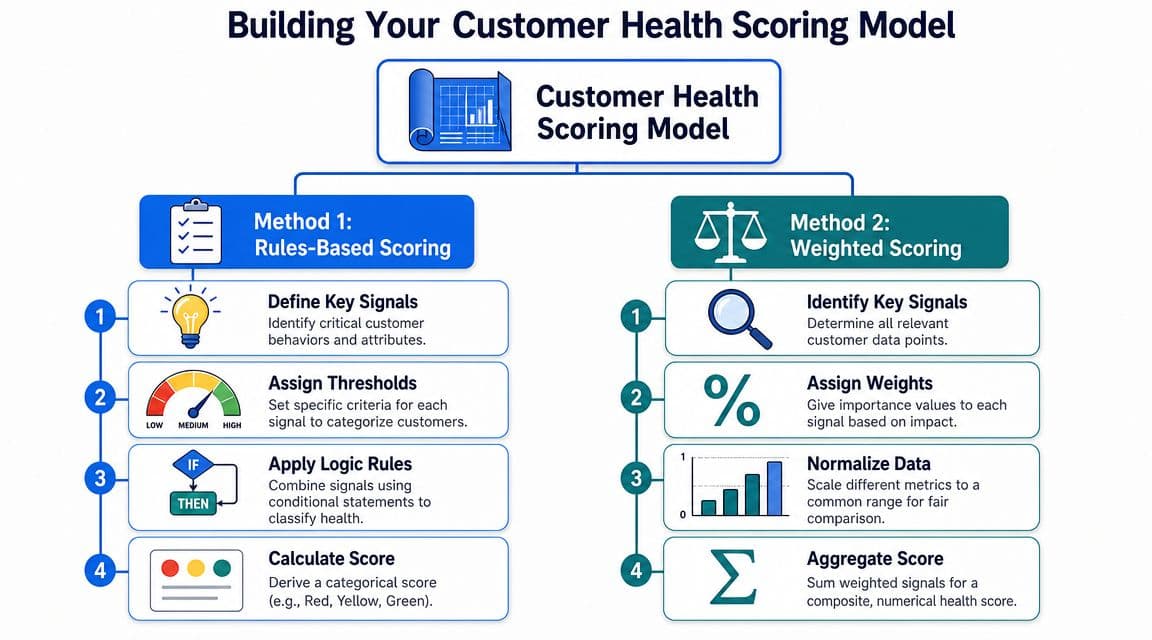
Once you've got the right signals, the job is to turn them into something your team can use quickly. There are two practical ways to do that. Start with a rules-based model if you need speed and clarity. Move to a weighted model when you have enough confidence in which signals matter most.
Start with a rules-based model
This is the fastest way to get customer health scoring live. You define a handful of signals, assign positive or negative point values, and let the total determine whether a customer sits in a healthy, caution, or risk band.
For a Shopify brand, that might look like this in practice:
- Positive points for repeat purchases, product review submissions, educational content engagement, wishlist additions, or quick post-purchase satisfaction signals
- Negative points for refunds, repeated support friction, abandoned carts after high intent, or long inactivity after a first order
- Neutral or contextual signals for behaviors that need interpretation, like multiple visits to policy pages
The strength of this model is usability. Everyone on the team can understand why a customer landed in a segment. The weakness is that it treats many signals too equally unless you actively tune it.
Move to a weighted model when patterns are clear
A weighted model works better once you've seen which signals consistently line up with retention, repeat purchase, or churn-like behavior. Here, not every input has the same importance.
Gainsight describes customer health scoring as compressing multiple signals into one risk indicator, often on a 0–100 scale or with bands like Healthy (71–100), At Risk (31–70), and Critical (0–30), and shares a weighted example that assigns 40% to product usage, 25% to support trends, 20% to sentiment, and 15% to executive engagement in its guide to customer health scores. Even though that example comes from a broader customer success context, the lesson applies cleanly to e-commerce: different behaviors deserve different weight.
How to adapt weighting for e-commerce
You don't need to copy a software-style score model. You need to borrow the logic.
A merchant might weight categories such as:
| Category | What belongs in it | Why it matters |
|---|---|---|
| Purchase behavior | Recency, repeat cadence, order pattern | Shows relationship momentum |
| On-site intent | Product views, carts, return visits, checkout progress | Captures active consideration |
| Support friction | Policy questions, delivery complaints, return issues | Flags confidence breakdown |
| Sentiment | Reviews, feedback tone, post-purchase responses | Adds human context |
Two customers can have the same total activity and very different health. One might be browsing heavily because they're close to buying. Another might be generating support contacts because they're unhappy. Weighting helps the model separate those cases.
Keep the formula simple enough to operate
Most merchants overbuild at this stage. They add too many signals, too many edge cases, and too many manual overrides. The score turns into a spreadsheet nobody trusts.
A better approach:
- Pick a small set of meaningful signals. Resist the urge to include everything available.
- Normalize the inputs. Make sure one behavior doesn't swamp the rest by accident.
- Assign weights based on business reality. Use what predicts repeat purchase, reduced friction, or stronger retention.
- Create action bands. The score should route people into clear response groups.
- Review edge cases. If the same kind of customer keeps landing in the wrong band, the model needs adjustment.
The best scoring model isn't the most complex one. It's the one your team can trust enough to act on every day.
Validating and Refining Your Health Score
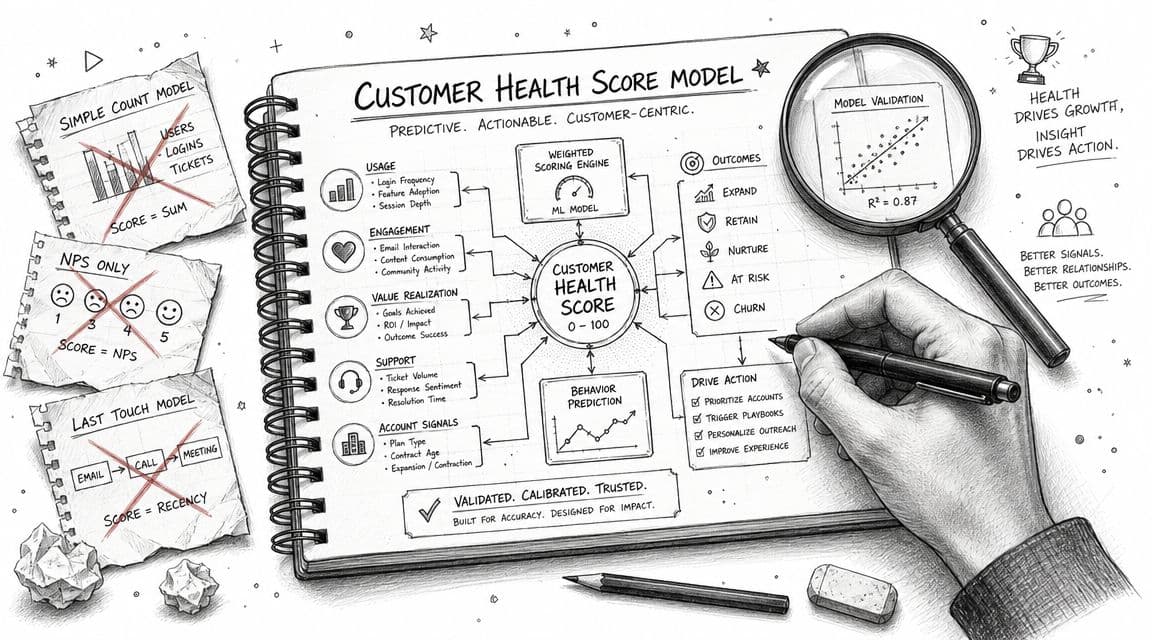
A health score that feels smart but predicts nothing is dangerous. It gives the team false confidence, which is worse than admitting you don't know.
Many stores halt the process prematurely. They build a score, color-code the dashboard, and assume the model is finished. It isn't. The score only becomes useful after you test whether it matches real outcomes.
Trust the score only after back-testing it
Take customers who already lapsed, refunded heavily, or stopped buying. Then look backward. Did their behavior weaken before the outcome? Did your score drop early enough to be actionable, or did it merely confirm what had already happened?
Do the same with strong customers. The healthiest segments should show patterns that line up with repeat buying, smoother support histories, and better overall relationship quality. If your "healthy" group is still full of customers who fade out quickly, your model is reading the wrong signals.
Data quality is usually the real problem
The formula is often blamed when the issue is data integrity. Signals arrive late, event tracking breaks, manual notes are inconsistent, and different systems disagree with each other.
That matters more than many operators realize. Only 29% of sales and marketing decision-makers say they fully trust their organization's data, according to the survey cited in Totango's piece on building customer health scores you can trust. The same guidance recommends automated collection, quarterly audits, and iterative validation against real renewal or churn behavior instead of assuming the score is correct on day one.
What to audit regularly
You don't need a complex governance project to tighten this up. You need repeatable checks.
- Signal accuracy: Are product views, carts, support tags, and purchase events all arriving reliably?
- Definition drift: Does "inactive" still mean the same thing for your current buying cycle?
- Manual bias: Are team-entered notes influencing the score inconsistently?
- Outcome fit: Do low-score customers behave like at-risk customers?
A short review cycle beats a large annual rebuild. Customer behavior changes when you change offers, pricing, merchandising, shipping, or site experience. Your model has to keep up.
If the team debates the data more than the action, the scoring system isn't ready for operational use.
Signs your model needs revision
Look for these warning signs:
| Warning sign | Likely issue |
|---|---|
| Too many customers cluster in one band | Thresholds are poorly set |
| Support-heavy customers look healthy | Friction isn't weighted enough |
| High-intent visitors score low | Pre-purchase signals are undervalued |
| Team ignores the score | The logic isn't credible or visible |
Validation isn't cleanup work. It's the core discipline that turns customer health scoring from a nice framework into a trustworthy decision tool.
How to Act on Health Scores with Proactive Automation
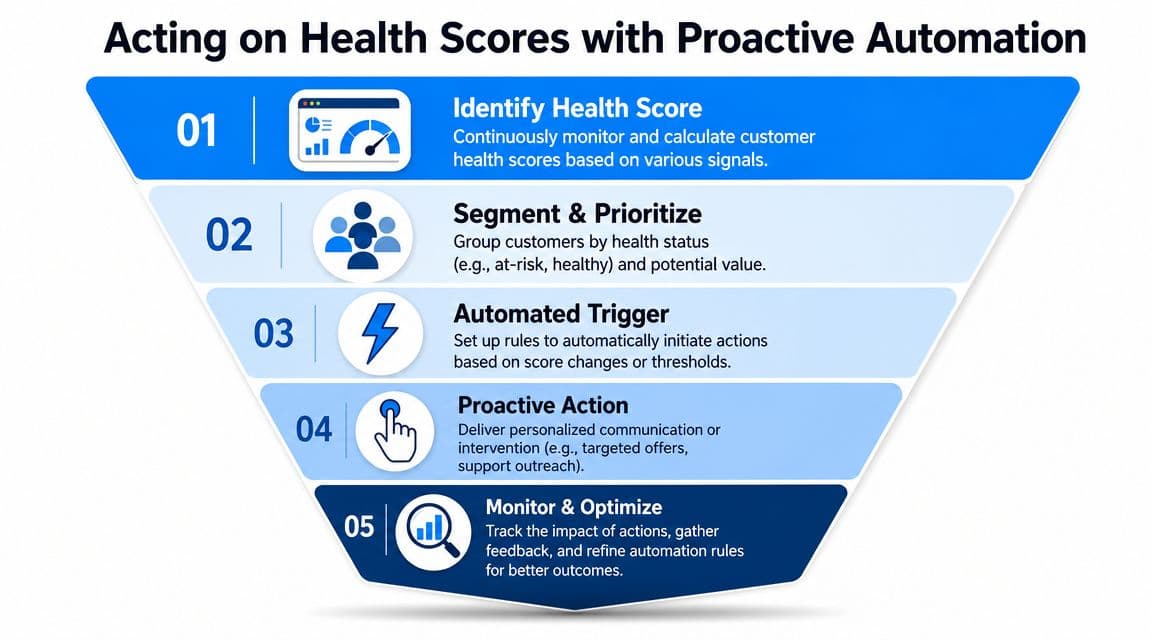
A score by itself doesn't recover a cart, prevent churn, or increase repeat buying. Action does. The point of customer health scoring is to tell your systems and your team what should happen next.
That means every score band needs a playbook. Not a vague note in a strategy doc. A real response tied to behavior, timing, channel, and ownership.
A short walkthrough helps make that real:
Match each segment to a different response
A common mistake is using the same automation for everyone below a threshold. That creates noise fast. Healthy customers don't need rescue messaging, and at-risk customers don't need a generic loyalty email.
A cleaner operating model looks like this:
- Healthy customers: Ask for reviews, recommend replenishment, invite them into loyalty or referral flows, and surface complementary products.
- At-risk customers: Trigger timely reminders, education, FAQ reassurance, or recovery offers when behavior suggests hesitation or drift.
- Critical customers: Escalate to a higher-touch intervention. This could be a direct email, a service recovery message, or a special save offer when margin allows.
- High-intent anonymous visitors: Respond in-session with relevant answers, reassurance, or product guidance before they leave.
Use triggers that map to real storefront behavior
For e-commerce, the strongest automations usually come from moments, not broad audience buckets.
Examples include:
| Trigger | Better response |
|---|---|
| Repeat visits to the same product without checkout | Offer fit, delivery, or return reassurance |
| Cart abandonment after policy-page visits | Address objections instead of sending only a discount |
| First-order customer goes inactive | Send education, usage tips, or replenishment timing |
| Repeat buyer shows rising support friction | Route to a service-first message, not a sales push |
A strong technological stack is essential. Merchants often evaluate e-commerce automation tools that connect storefront events to retention actions because the score is only as useful as the workflow it can trigger.
Build feedback loops into the automation
Automation should improve the score, not just react to it. If a rescue flow restores engagement, the score should reflect that. If a support issue stays unresolved, the score should keep pressure on the system.
That loop usually needs three pieces:
- A trigger condition based on a score band or score change
- A specific intervention tied to likely friction or opportunity
- A post-action check to see whether behavior improved
Automation works when it responds to the reason behind the score, not just the number itself.
Don't over-automate fragile moments
Not every low score should trigger a discount. Sometimes the issue is product confusion, shipping anxiety, fit uncertainty, or poor expectations set on the product page. If you automate the wrong response, you train customers to wait for incentives and you still don't fix the underlying friction.
The strongest teams use health scoring to decide whether the next best move is education, reassurance, recovery, or escalation. That's what makes the system profitable instead of noisy.
Using Carti to Power Your Health Scoring System
Most merchants don't struggle with the idea of customer health scoring. They struggle with execution. The raw signals live across Shopify, support tools, reviews, on-site behavior, and shopper questions. Then someone has to act on them fast enough to matter.
That's why the most practical setup treats the storefront itself as both a listening layer and an action layer. Pre-purchase questions, repeated objections, abandoned carts, policy concerns, and buyer hesitation shouldn't sit in separate buckets. They should feed the same health logic.
A tool like Carti demonstrates its value. On the input side, Carti's Insights Dashboard can surface the questions shoppers ask most often, which gives merchants a direct view into friction before purchase. If shoppers repeatedly ask about shipping times, returns, product compatibility, or sizing, those aren't just support topics. They're health signals. They tell you where confidence is breaking down and which visitors or segments need help right now.
On the action side, the same system can respond in the session instead of waiting for an email flow later. That's important in e-commerce because many health signals are short-lived. A shopper hesitating on a product page or abandoning a cart is giving you a small window to intervene. If the system can answer accurately, recommend the right product, or reduce uncertainty while intent is still high, the score becomes operational.
A strong setup usually works like this:
- Collect storefront signals: Track questions, hesitation points, cart behavior, and repeat visits.
- Feed those into the model: Treat pre-purchase behavior as part of customer health, not as separate noise.
- Trigger responses immediately: Use the score to decide who gets reassurance, who gets product guidance, and who needs follow-up.
- Refine the model over time: Fold new shopper objections and recurring themes back into the score logic.
That closes the loop. The health score stops being a static spreadsheet number and starts working like a live decision system on the storefront.
If you want that loop running inside your Shopify store, Carti gives you both pieces: shopper signals from real conversations and automation that can act on them while purchase intent is still alive. It's a practical way to turn customer health scoring from an internal framework into something that helps browsers become buyers.

Written by
Daniel AndersonFounder of Carti. 10+ years building ecommerce brands in apparel and supplements. Still runs a Shopify store and built Carti to help merchants convert more browsers into buyers.
Ready to boost your store's sales?
Install Carti in 5 minutes and let AI handle customer questions, recommend products, and close sales 24/7.
Start Free Trial14-day free trial