
McKinsey found that 71% of consumers expect personalized interactions, while personalization typically drives a 10% to 15% revenue lift, with results varying by sector and execution. McKinsey's personalization research makes the central point clear: personalization at scale has moved beyond clever product recommendations. It's becoming part of how serious commerce businesses acquire, convert, and retain customers.
For Shopify operators, that doesn't mean building an enterprise data science department. It means connecting the signals you already receive, deciding what they mean, and delivering a relevant response while the shopper's intent is still active. A returning customer browsing a familiar category, a first-time visitor comparing sizes, and a shopper who left a high-intent cart shouldn't receive the same experience.
Why Personalization at Scale Is Now Expected by Shoppers
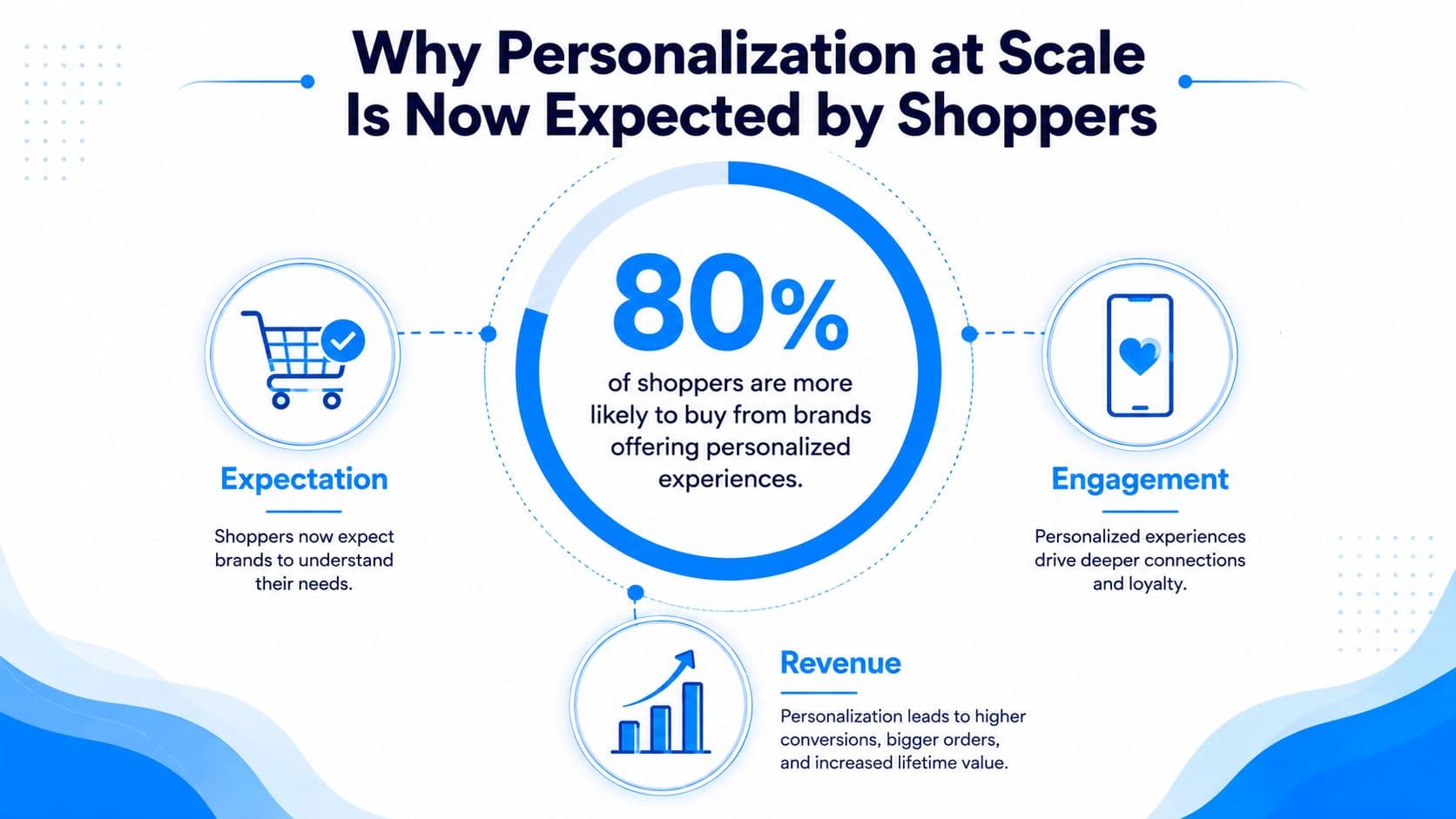
80% of shoppers are more likely to buy from brands offering personalized experiences, according to the evidence summarized in the infographic below. An infographic showing that 80% of shoppers are more likely to buy from brands offering personalized experiences.
Mass marketing grouped customers into broad audiences. Modern commerce treats each session as a set of intent signals. Product views, search terms, cart activity, purchase history, and support context can shape the content, offer, recommendation, or assistance a shopper receives.
McKinsey reported that fewer than 10% of companies had deployed personalization beyond digital channels systematically in 2019. That figure shows how early many organizations were in connecting separate one-to-one tactics into a coordinated customer experience. Its later research found that personalization typically produced a 10% to 15% revenue lift, with outcomes ranging from 5% to 25% by sector and execution. Faster-growing companies also derived 40% more of their revenue from personalization than slower-growing peers, as detailed in The full McKinsey analysis.
The expectation gap is now operational. Shoppers compare your store with every digital buying experience they use. They expect discovery to reflect their interests, support to recognize the page they are viewing, and follow-up to acknowledge their actions. Demographic segments alone rarely provide enough context.
The Shopify implication
A Shopify store does not need to personalize every pixel. It needs to personalize the decisions that reduce uncertainty or help a shopper continue.
Start with four questions:
- What does this shopper appear to want right now?
- What information would remove the next buying objection?
- Which product or offer fits the current context?
- Which channel can deliver the response without creating noise?
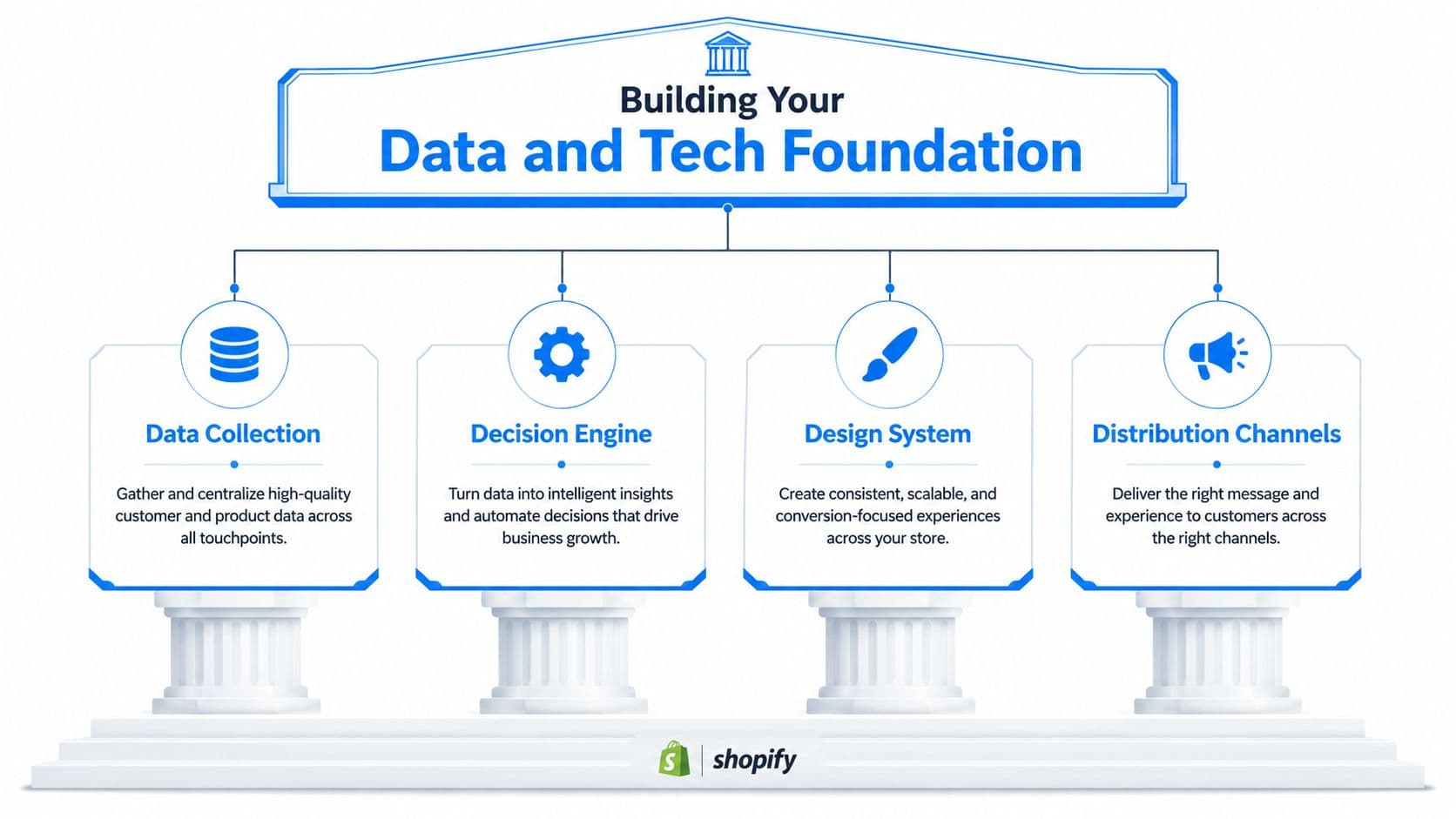
McKinsey's later explanation organizes the operating model around four “Ds”: data, decisioning, design, and distribution. Its 2023 explainer reports that personalization can reduce customer acquisition costs by as much as 50%, lift revenues by 5% to 15%, and increase marketing ROI by 10% to 30%. McKinsey's overview of personalization places the capability within commerce infrastructure, rather than inside a single email tool.
The right starting point depends on data volume and operating capacity. A solo founder can use rules based on product views and cart activity. A CX manager may connect behavioral data with chatbot conversations and merchandising decisions. Both approaches work when the signals are trustworthy, the response arrives while intent is active, and frequency limits prevent personalization from feeling intrusive. Add predictive sophistication only after measurement shows that simple rules have reached their practical limit.
Building Your Data and Tech Foundation Before You Personalize
Personalization fails when the store has plenty of customer data but no reliable way to use it. A product view may sit in one platform, an order history in another, and a support conversation somewhere else. Each tool can look functional on its own while the customer experience remains disconnected.
McKinsey's four-D framework provides a useful Shopify translation. Data captures behavior and permission. Decisioning determines which experience should appear. Design turns the decision into useful content or assistance. Distribution delivers it through the storefront, email, chat, or another channel.
Start with events, not profiles
A low-volume store doesn't need an elaborate customer profile before it can personalize. It needs clean, actionable events:
- Browsing behavior: Record viewed products, categories, search terms, and meaningful engagement with product detail pages.
- Cart activity: Distinguish an item added to cart from an item merely viewed. Cart state is a stronger expression of intent.
- Order history: Use previous purchases to identify replenishment, complementary products, and category familiarity.
- Explicit preferences: Capture stated needs through quizzes, guided questions, or chat. A stated size, material preference, or dietary constraint should outweigh a weak behavioral inference.
- Consent and suppression: Store permission status and exclusions alongside behavioral data. Personalization shouldn't override privacy choices or customer requests.
The data layer should also preserve recency. A shopper's current search and cart often matter more than an old purchase. If an item is out of stock, a recommendation engine must know that before presenting it. Stale inventory and delayed audience refreshes can make a technically personalized experience less useful than a simple static one.
Keep the stack lean
For most Shopify stores, the foundation can remain practical:
- Shopify acts as the catalog, order, customer, and inventory source.
- Analytics and event tracking capture what shoppers do across the storefront.
- A segmentation or automation layer turns events into audiences and triggers.
- A recommendation, chat, or merchandising layer presents the response.
- An email or SMS platform handles follow-up within consent boundaries.
- A measurement dashboard compares personalized and non-personalized experiences.
Before adding another app, document which system owns each field and how quickly updates move between systems. This guide to customer analytics solutions is useful when mapping the questions your data must answer, rather than collecting signals just because a platform makes them available.
Foundation rule: If you can't explain which event triggers an experience, which system reads it, and when the data refreshes, you're not ready to automate that experience.
Create a small data dictionary for product IDs, customer IDs, consent states, inventory status, and key behavioral events. Test each event with real sessions. A missing product identifier or duplicated cart event can distort a segment long before anyone notices the reporting problem.
Implementing Personalization Across the Shopify Journey
The most reliable rollout starts with behavior and adds complexity gradually. Don't begin by trying to personalize the entire storefront. Choose a small number of moments where the shopper has already given you enough context to make a helpful decision.
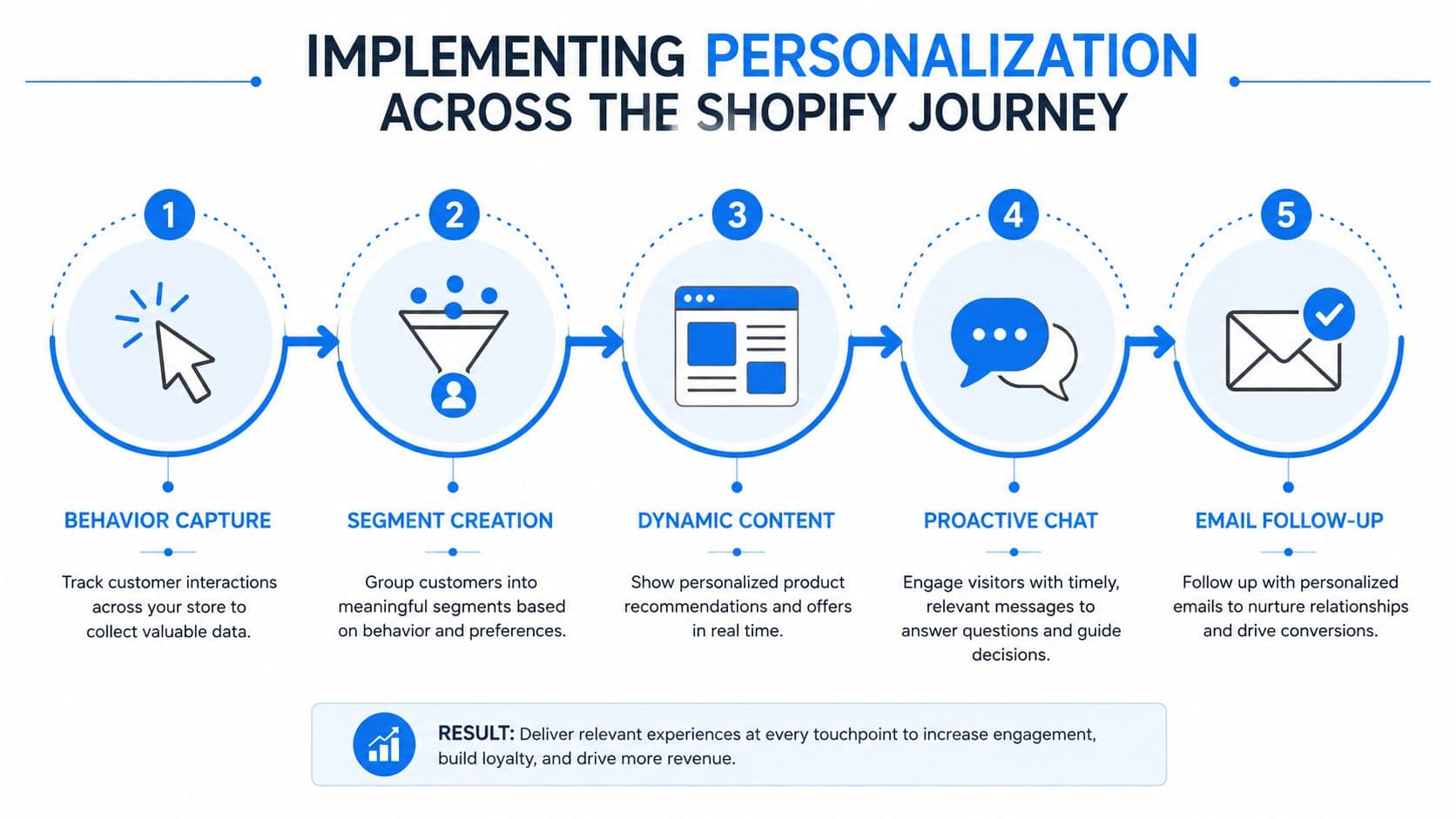
1. Capture behavior that signals intent
Start with events you can interpret without a predictive model. A product view is useful, but repeated views, a filter interaction, a size-guide visit, or an add-to-cart event carries more intent. Separate casual browsing from actions that indicate an unresolved buying question.
For a beauty store, a shopper viewing several shades in the same foundation range may need shade guidance rather than another generic recommendation. For a fashion store, repeated visits to a product with no purchase may indicate uncertainty about fit, fabric, delivery, or returns. The event doesn't tell you the answer by itself, but it tells you where to look.
2. Build small, behavior-based segments
Use segments that lead to a clear action. Examples include:
- High-intent browsers: Shoppers who repeatedly view a product or category receive context-specific help, such as fit information or a comparison.
- Cart builders: Visitors with items in their cart see assistance related to shipping, compatibility, or checkout concerns.
- Category returners: Returning shoppers who repeatedly browse one category see relevant arrivals or complementary products.
- Existing customers: Previous buyers receive replenishment or accessory suggestions based on what they purchased, not on a broad demographic label.
- Known preference holders: Customers who explicitly state a size, color preference, or product constraint receive filtered recommendations that respect that information.
Keep the segment logic visible to the team. A rule such as “viewed a product twice and opened the size guide” is easier to audit than an opaque audience generated by an unknown score.
3. Change the onsite experience selectively
Dynamic content should reduce effort, not decorate the page. Change one meaningful element at a time, such as a recommendation row, a comparison module, a category shortcut, or a message that answers a current objection.
A skincare store might show complementary products that match the shopper's selected routine. A home goods store could surface compatible sizes or replacement parts after a product view. If a shopper has already chosen a product, repeating the same item in every module wastes space. Use the known action to decide what assistance comes next.
Recommendations are only one part of this layer. This practical guide to personalized product recommendations can help teams think through relevance, placement, and the difference between showing more products and helping shoppers choose.
4. Add proactive chat where uncertainty is expensive
Chat works best when it has catalog and policy context. A shopper asking whether a jacket runs small needs a direct answer, not a generic “How can I help?” A customer comparing two coffee machines may need a feature distinction, compatibility check, or recommendation based on stated priorities.
A Shopify chatbot such as Carti can learn a store's catalog, policies, and FAQs, then provide instant answers, smart suggestions, and proactive sales assistance. The important implementation detail is not just installing chat. It's defining when the assistant should appear, what it can answer, and when it should stop prompting.
A useful trigger might be a visit to a size guide followed by continued browsing. Another might be repeated comparison of products with different specifications. Avoid opening chat on every page load. The assistant should respond to evidence of uncertainty or intent.
5. Follow up with timing discipline
Cart recovery should reflect the shopper's recent behavior and current product state. A message about a product that sold out, changed price, or no longer fits the shopper's stated preference damages trust. Keep inventory, suppression, and consent checks close to the trigger.
The Netcore ecommerce personalization benchmark report reported that personalization increased average conversion rates by 45% across retailers in its benchmark, with category examples showing conversion rates rising from approximately 1.04% to 1.43% before personalization to 1.50% to 1.79% after implementation. It also reported average cart abandonment falling from over 60% to 46%. Those figures support a funnel-wide approach, but they shouldn't be treated as a promise for every store. Your own holdout test matters more than a benchmark average.
A practical rollout can move from behavior capture to a few segments, then one onsite module, one chat trigger, and one carefully controlled recovery flow. Each step should earn the next through observed performance.
Use the video as an implementation prompt, then translate the ideas into one Shopify journey your team can inspect from event to response.
Choosing Between Predictive AI and Rules Based Personalization
The right question isn't whether AI sounds more advanced. It's whether your store has enough trustworthy signal for a predictive system to outperform a transparent rule.
Predictive AI looks for patterns across browsing, purchases, product relationships, and other events. It can identify combinations a merchant might not write manually. That flexibility becomes valuable when the catalog, audience, and event history are dense enough to support reliable predictions.
Rules-based personalization starts with explicit logic. “If a shopper views running shoes and then opens the size guide, show fit assistance” is easy to understand, launch, and revise. For a store with limited order volume, that clarity often produces faster learning.
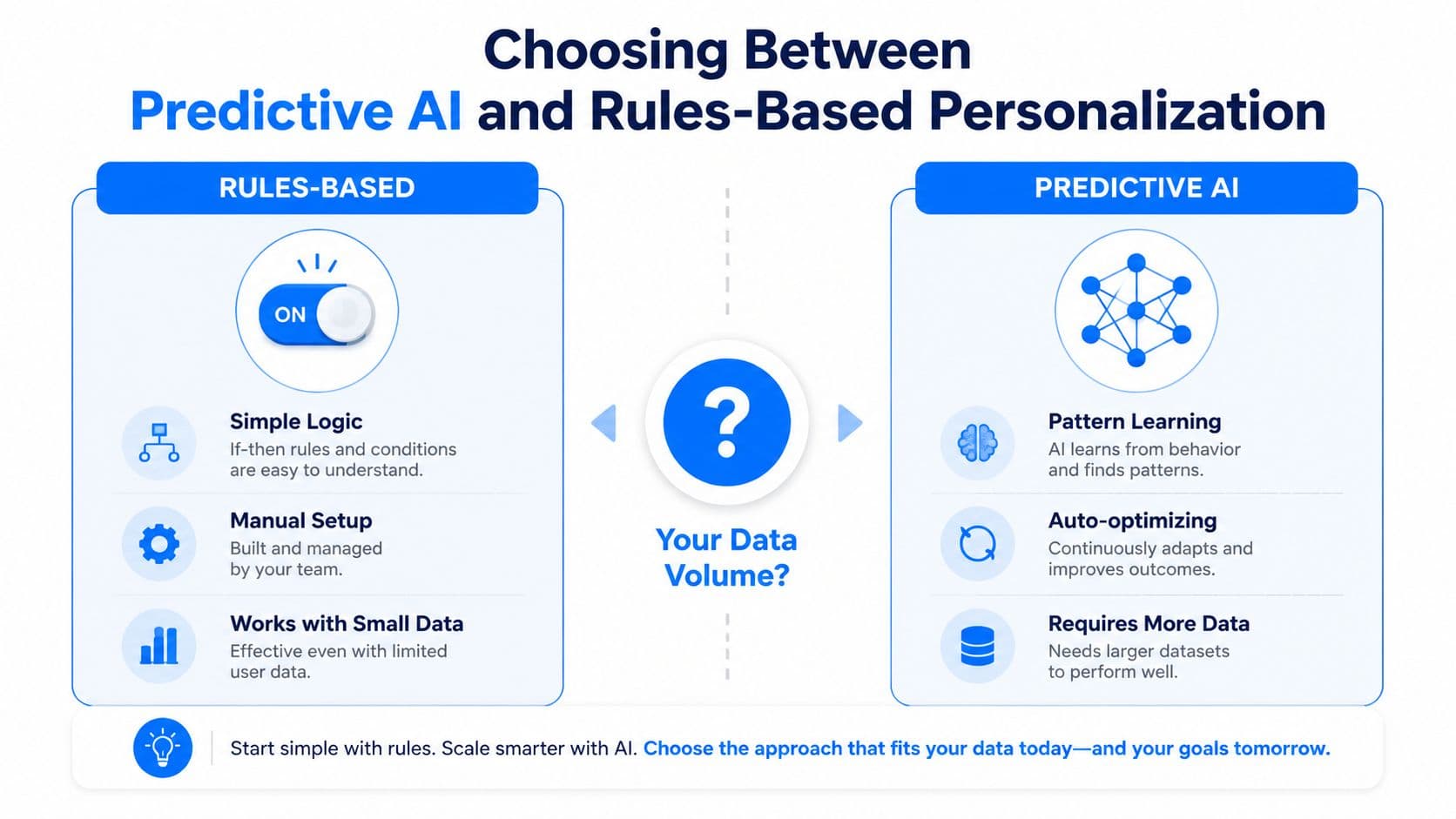
Compare the trade-offs
| Rules-based approach | Predictive AI approach |
|---|---|
| Uses explicit conditions | Learns patterns from historical behavior |
| Easier to audit and explain | Can identify less obvious relationships |
| Works with smaller data sets | Needs stronger data density and event quality |
| Requires manual maintenance | Requires model monitoring and validation |
| Best for clear intent signals | Best when many signals interact |
Independent commentary notes that many machine-learning personalization models need thousands of conversions to produce reliable predictions, meaning stores with only a few hundred orders per month may not have enough signal for predictive personalization to beat simpler rules-based approaches. This analysis of AI ecommerce personalization also reports that 95% of retailers are experimenting with AI in marketing and ecommerce, while only 5% report clear, scalable returns. The practical lesson is to evaluate profitability, not adoption theater.
Use a staged decision
Begin with rules when your store has limited traffic, a narrow catalog, obvious buying questions, or incomplete tracking. Create a small holdout group and compare the rule against the normal experience. If the rule doesn't help, investigate the offer, placement, timing, or event quality before adding model complexity.
Consider predictive AI when your store has broad product relationships, richer behavioral histories, stable event tracking, and enough volume to validate results by meaningful segments. Even then, keep guardrails around inventory, margin, exclusions, and message frequency.
For merchants evaluating the broader category, Refact's guide to personalization for your online store offers useful context on how AI can fit into an ecommerce stack. Treat any tool as a hypothesis to test. A simpler system that generates an incremental sale you can measure beats a complex system nobody can explain.
Measuring What Works and Iterating Without Guesswork
Personalization earns budget when it creates incremental value, not when a dashboard shows that personalized visitors clicked something. The measurement setup should answer whether the experience changed behavior compared with what would have happened without it.
Start with one primary outcome. Depending on the use case, that might be completed orders, revenue per visitor, checkout completion, or qualified conversations. Add supporting metrics that explain the result, such as product-detail engagement, add-to-cart rate, recovery rate, or support resolution.
Use holdouts before celebrating lift
A holdout group sees the normal experience while the treatment group sees the personalized version. Keep the assignment stable enough to compare outcomes, and define the evaluation window before reviewing results. If you change the segment, message, placement, and offer at the same time, you won't know which decision caused the outcome.
Check performance by meaningful context. A recommendation may help returning customers but distract first-time visitors. A chat prompt may assist shoppers with sizing questions while creating friction on low-consideration products. Aggregate results can hide those differences.
Measurement rule: A click proves attention. A holdout comparison helps establish whether personalization created additional commercial value.
Build a weekly operating rhythm
Use a lightweight review:
- Inspect event quality: Check whether views, carts, purchases, inventory states, and consent signals are arriving correctly.
- Review funnel movement: Compare the treatment and holdout through the intended journey, not just the final order.
- Read shopper questions: Look for repeated objections about fit, compatibility, shipping, or product use.
- Check freshness: Remove messages tied to unavailable products, outdated policies, or expired promotions.
- Choose one change: Adjust one trigger, message, recommendation rule, or placement before expanding the test.
The Shopify performance benchmarking guide can help structure that review around comparable measures instead of isolated campaign metrics.
Timing deserves its own check. A personalized message based on yesterday's inventory or an old browsing session may arrive after the shopper's intent has changed. Real-time event handling doesn't require an expensive architecture for every use case, but every automated experience needs a defined freshness expectation.
Double down on experiences that help shoppers decide. Pause experiences that generate engagement without movement, create support complaints, or perform only because they reach customers who were already likely to buy.
Avoiding Common Pitfalls and Scaling With Confidence
More personalization can make a store feel less personal. The problem isn't only inaccurate recommendations. It's excessive confidence, repeated prompts, and messages that reveal more behavioral knowledge than the shopper expects.
Gartner-reported survey results show the risk clearly: 53% of customers reported negative experiences from personalized marketing. Those customers were 3 times more likely to regret a purchase and 44% less likely to buy again. The same report found that over-personalized experiences made shoppers 2 times more likely to feel overwhelmed and 2.8 times more likely to feel time pressure. The reported Gartner findings support a conservative operating principle: relevance must outweigh cleverness.
Set guardrails before expanding
Use behavior-based triggers instead of exposing sensitive assumptions. Don't tell a customer that your store inferred a personal trait when you can offer a useful product filter or answer.
Set clear controls:
- Limit message volume: Coordinate chat, email, and onsite prompts so one shopper doesn't receive several versions of the same nudge.
- Respect recency: Give current actions more weight than old browsing behavior.
- Protect exclusions: Honor consent, unsubscribes, stock status, and explicit preferences.
- Keep ownership clear: Assign responsibility for data quality, content, merchandising, and measurement.
- Version changes: Record which rule, content set, or model produced an experience so the team can reverse a bad update.
Operational latency often causes more damage than weak model logic. A fragmented team can publish a recommendation that merchandising has already discontinued, while a delayed audience feed can target a customer who has already purchased.
Scaling doesn't mean showing more personalized content. It means delivering fewer, better decisions reliably across the journey.
Choose one high-intent use case this week. Verify its events, write a transparent rule, add suppression checks, and create a holdout. Review the result, document what changed, and only then add another channel or a more advanced model.
Carti helps Shopify stores turn personalization at scale into practical assistance through instant catalog and policy answers, behavior-based product suggestions, proactive chat, cart recovery, and an Insights Dashboard for recurring shopper questions. Visit Carti to add a no-code AI sales assistant to your store and start with one measurable customer journey.

Written by
Daniel AndersonFounder of Carti. 10+ years building ecommerce brands in apparel and supplements. Still runs a Shopify store and built Carti to help merchants convert more browsers into buyers.
Ready to boost your store's sales?
Install Carti in 5 minutes and let AI handle customer questions, recommend products, and close sales 24/7.
Start Free Trial14-day free trial