
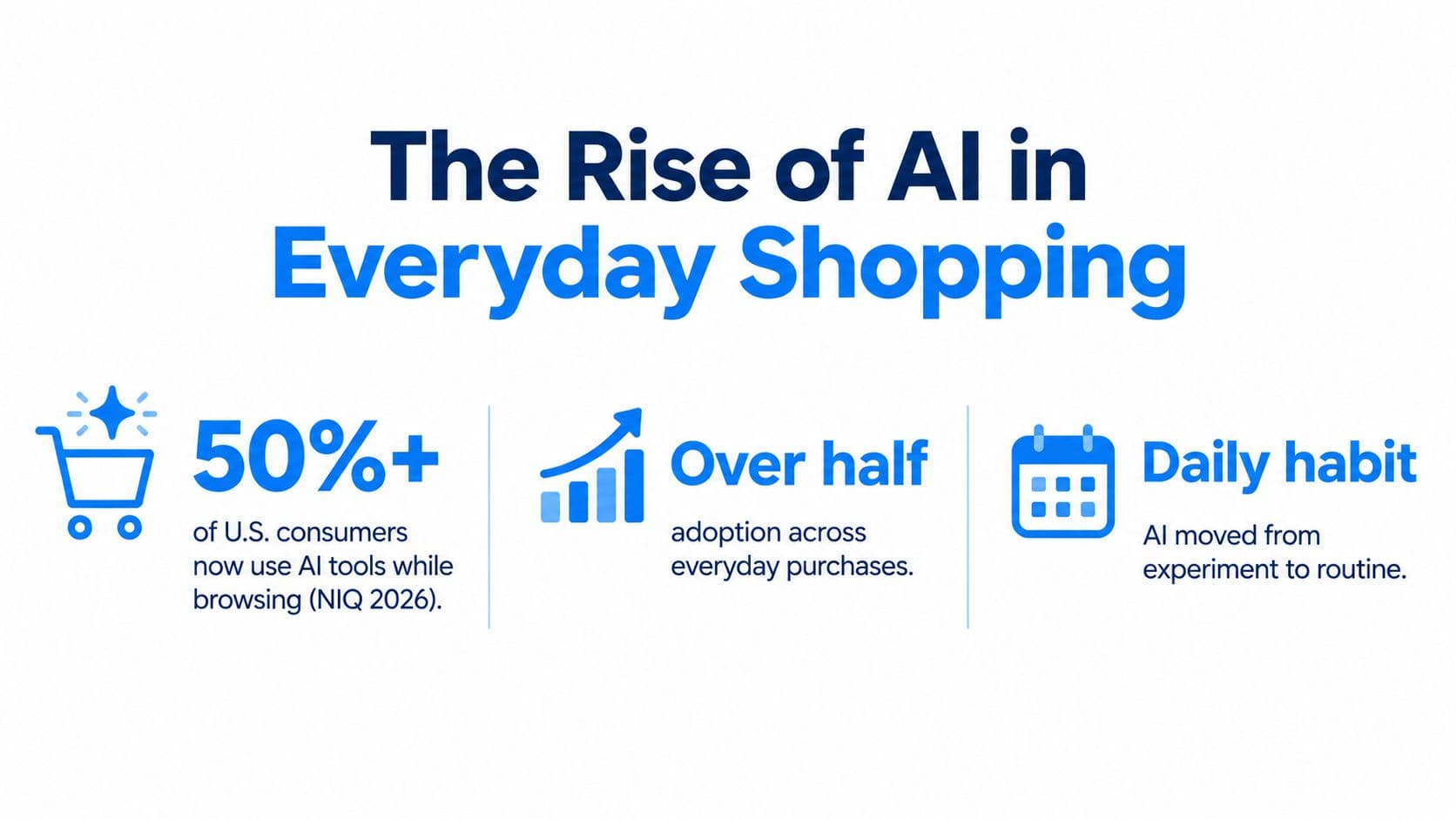
51% of U.S. consumers used at least one AI tool to help them shop in the past month, according to NIQ's 2026 retail research. That figure changes the operating question for Shopify merchants. AI for shopping isn't a distant sales experiment anymore. It already influences how people discover products, compare alternatives, and decide whether a store deserves their trust.
The opportunity isn't to hand the entire purchase journey to an autonomous agent. The practical opportunity is to build a faster, more useful storefront where AI answers questions accurately, narrows choices transparently, and keeps the shopper in control. Merchants that focus on those fundamentals will get more value than brands that rush into flashy automation without fixing catalog data, product guidance, or customer confidence.
The Rise of AI in Everyday Shopping
A shopper used to search a store, open several product pages, and message support when the information became difficult to find. Now, that same shopper might describe a need in natural language, ask an AI tool to compare products, and arrive at a shortlist before visiting a retailer. The behavior feels ordinary because the interface is conversational, but the commercial implications are substantial.
NIQ found that 51% of U.S. consumers used an AI tool for shopping during the past month, with product recommendations the most common use at 20% and AI personal shopping assistants reaching 16% adoption. These figures show a move beyond curiosity. Consumers aren't only testing AI to write emails or summarize documents. They're using it to reduce product-search effort in a market where stores often carry too many similar choices.
What changed for merchants
The strongest early use cases don't remove the shopper from the journey. They make the journey easier to move through. A customer can ask which moisturizer suits sensitive skin, whether a jacket runs small, or which accessory works with a specific device. The retailer wins when its answers come from accurate catalog, policy, and inventory information rather than generic model knowledge.
Practical rule: Treat AI as a decision-support layer first. Earn permission to automate more only after the assistant has proved that it can explain recommendations and preserve shopper control.
This also creates a competitive problem around interoperability. A store's product information may need to work across its own assistant, search experiences, shopping platforms, and emerging agents. Merchants evaluating that broader terrain can learn more about competing on interoperability in retail AI before committing to a closed implementation that can't travel with the customer.
The immediate response should be operational, not theatrical. Audit the questions shoppers ask, identify where product pages fail to answer them, and connect an assistant to the same source of truth that powers the storefront. AI has become part of everyday shopping, but useful product information remains the foundation.
Understanding How Shoppers Use AI Today
Shoppers draw a clear line between helping them choose and choosing for them. That distinction explains why guided AI assistance has a stronger long-term role than fully autonomous checkout.
A 2026 Gartner survey found that only 31% of U.S. consumers would let AI narrow choices for household supplies and 28% would allow it to narrow choices for personal electronics, according to the reported Gartner and Accenture findings. Accenture's research in the same coverage found that 74% would trust a personal AI agent more than a best friend to make a purchase, yet only 32% would hand over purchase decisions and 9% were open to fully autonomous shopping.
Those findings aren't contradictory. Consumers may trust an assistant to organize information while still wanting to approve the final decision. They want the system to explain why a product fits, identify trade-offs, and surface alternatives. They don't want an opaque process to spend their money without a clear checkpoint.
The right interaction model
A Shopify experience should therefore give shoppers useful delegation without removing agency. The assistant can ask about budget, intended use, fit, compatibility, delivery needs, or personal preferences. It can then present a small set of relevant products, explain the differences, and let the customer add an item to the cart or continue comparing.
Design the flow around visible choices:
- Clarify intent: Ask only questions that change the recommendation, such as size, use case, material, or compatibility.
- Explain the match: Show which product attributes satisfy the request, rather than presenting an unexplained ranking.
- Keep alternatives visible: Include a lower-priced, simpler, or more durable option when those trade-offs matter.
- Require approval: Let the shopper confirm the product and cart before any purchase action.
The conversational commerce principles described in this guide to AI shopping agents support that middle ground. The assistant becomes a knowledgeable sales associate, not an invisible buyer. That distinction affects copy, interface design, permissions, and measurement. If a customer can't tell why the system made a suggestion, the convenience of AI won't compensate for the loss of confidence.
Key Capabilities That Drive Revenue
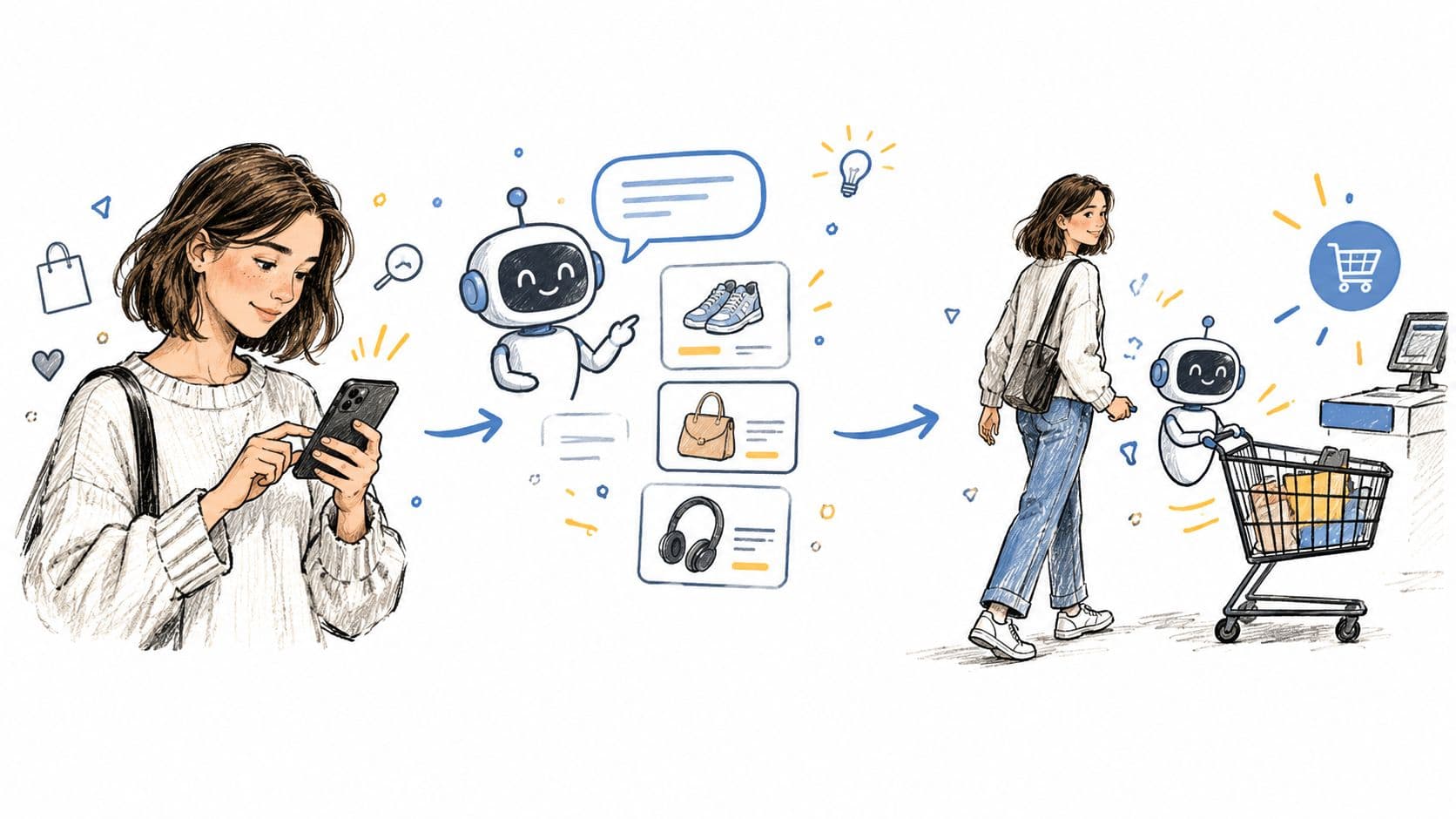
AI features create commercial value when they remove a specific buying obstacle. A recommendation engine that shows random bestsellers adds clutter. A chatbot that repeats product-page copy adds another support channel without improving the decision. The useful implementations connect intent, catalog knowledge, and action in one conversation.
Recommendations that reflect context
Smart suggestions should respond to what the customer is trying to accomplish, not just what they clicked last. A shopper looking for running shoes may need cushioning, terrain guidance, fit advice, and a replacement policy. A shopper buying a sofa may care more about room dimensions, fabric durability, delivery access, and matching pieces.
The assistant needs access to structured attributes, product relationships, reviews, and policies. It should also distinguish between a fact and an inference. “This case fits the listed phone model” is different from “this case will feel comfortable in your hand.” That separation helps prevent confident but unsupported advice.
For merchants selling apparel or fitness products, visual sizing and fit tools can complement conversational guidance. A practical overview of body scanner online options can help teams assess where measurement technology fits into a broader recommendation strategy. The assistant still needs to explain how the result informs the product choice.
Answers that remove hesitation
Instant answers matter most at the point where uncertainty blocks the next action. Customers commonly need clarification about shipping, returns, materials, compatibility, care, stock, and delivery timing. Those answers should come from current store data, not from a model improvising around incomplete information.
The best experience doesn't merely answer a question. It connects the answer to a decision. After explaining a return policy, the assistant can offer suitable products. After confirming compatibility, it can show the relevant variant. After discussing care requirements, it can suggest an appropriate accessory.
Recovery that respects intent
Cart recovery works better when the message reflects the reason a shopper hesitated. A reminder about a product with unclear sizing should address fit. A reminder about a high-consideration item should answer a remaining question. Repeated discounts can train customers to wait, while a useful clarification can restore momentum without eroding margin.
A more detailed discussion of AI product recommendations is useful when planning the recommendation layer. In practice, merchants should connect suggestions, answers, and recovery rather than operating them as unrelated features. The assistant should understand what the customer asked, what products were considered, and what unresolved concern remains.
Technical Readiness for AI Commerce
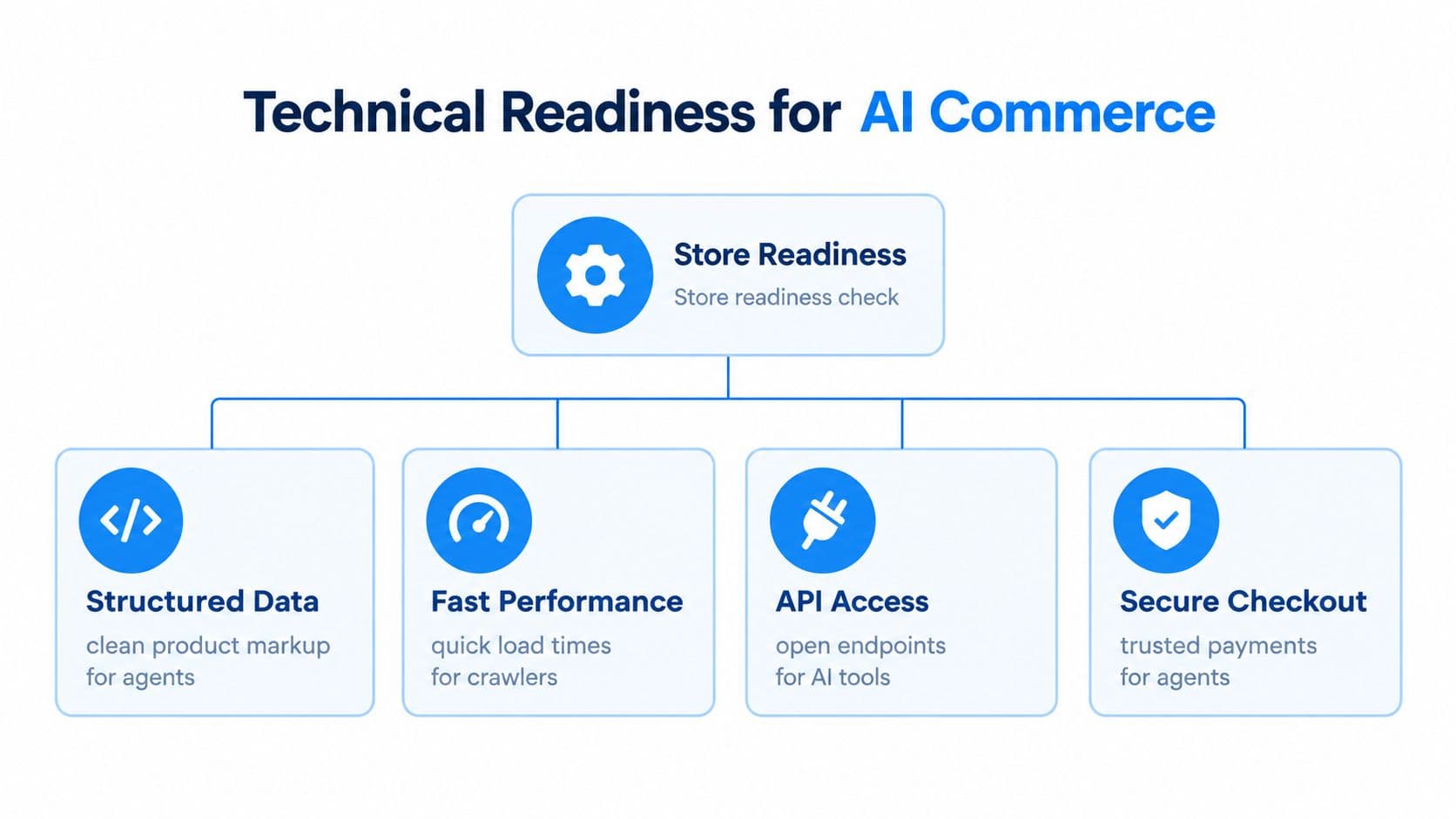
AI can't recommend what it can't reliably read. Before choosing an assistant, make the catalog understandable to machines and humans alike. Missing variants, stale availability, ambiguous product names, and inconsistent attributes will produce weak answers regardless of the quality of the AI layer.
The AI Commerce Rankings framework identifies four readiness signals: bot friendliness, AI-source traffic share, diversity of AI sources, and 90-day momentum. Together, they indicate whether agents can access the catalog, whether AI-powered discovery already sends visitors, whether the store depends on one source, and whether that activity is moving in a healthy direction.
Audit the catalog before the assistant
Start with the data that an agent needs to retrieve a product accurately:
- Product identity: Use clear names, descriptions, categories, and consistent terminology.
- Attributes: Expose size, color, material, dimensions, compatibility, ingredients, and other decision-making details in structured fields.
- Commercial state: Keep price, availability, variants, shipping rules, and returns current.
- Access paths: Confirm that legitimate crawlers and connected tools can reach the relevant product information.
The reason is simple. An agent can't provide a dependable answer about price, stock, or variants if those values are hidden, contradictory, or unavailable. Catalog accessibility is therefore a prerequisite for agentic commerce, not a technical detail to address after launch.
Performance and security still matter, but speed alone won't repair poor merchandising data. Test real customer questions against the live catalog, inspect the source used for each answer, and review failures by category. A readiness audit should finish with a prioritized list of data fixes, not just a software recommendation.
Measuring Real Impact on Conversion
The most useful comparison isn't “AI versus no AI” in the abstract. It's high-intent interaction inside the store versus lower-context referral traffic from an external language model. Those experiences enter the funnel at different moments, so merchants should measure them separately.
One reported analysis covering 17 million shopper interactions found that shoppers who engaged with AI chat converted at 12.3%, compared with 3.1% for shoppers who didn't engage, as documented in the e-commerce conversion analysis. The result suggests that a shopper who chooses to ask an on-site assistant may already have strong intent, while the assistant helps remove the final information barrier.
| Metric | Engaged Shoppers | Non-Engaged Shoppers |
|---|---|---|
| Conversion rate | 12.3% | 3.1% |
Why referral traffic behaves differently
Off-site LLM referrals often intercept customers earlier. The shopper may still be exploring brands, comparing broad options, or asking for general education. A merchant shouldn't expect that audience to behave like someone who opened a product page and asked whether the item is compatible with a specific need.
The same source describes a working paper covering 973 e-commerce sites and more than 50,000 ChatGPT-referral transactions. It found that LLM referral traffic converted worse than traditional channels overall, although conversion and revenue per session improved steadily over time. That pattern argues against judging AI only by referral volume. The quality of the landing experience, the customer's position in the journey, and the assistant's access to transactional context all influence the outcome.
A separate Attentive survey of 3,054 U.S. adults found that 68% had used a general AI chatbot for at least one shopping task during the previous three months, while 62% said an AI chatbot caused them to buy a different product or brand. The commercial lesson is broader than conversion reporting. AI can change consideration and brand selection before a shopper reaches a store.
Measure the moment, not just the channel. Track assisted sessions, questions answered, recommendation clicks, add-to-cart behavior, checkout completion, returns, and assisted revenue by intent type.
Don't promise that every AI visit will outperform paid search or direct traffic. Keep the assistant close to the catalog, give it a clear path to the cart, and evaluate whether it resolves uncertainty without creating new friction.
Overcoming Trust and Security Barriers
Convenience isn't the only adoption driver. Trust can determine whether a shopper accepts an AI recommendation or abandons the experience. Merchants that treat transparency as a compliance box will miss its role in conversion.
One 2026 retail study reported that 82% of respondents considered data security a top concern, 77% said transparency mattered most, and 67% said they would use AI more if it included fraud protection, according to coverage of the retail trust findings. The same coverage reported that 75% of Americans would lose trust in AI shopping if results were sponsored.
Make the recommendation inspectable
A trustworthy assistant should tell shoppers what information shaped a result. If the customer asks for a warm winter coat, the response can identify insulation, weather resistance, fit, and price as the relevant criteria. If a result is sponsored, promoted, or influenced by commercial placement, disclose that clearly rather than presenting it as a neutral match.
Merchants should also give shoppers an easy way to correct the assistant. A customer might say, “I don't want synthetic fabric,” “my budget is lower,” or “I need delivery by a specific date.” The system should update the recommendation and show the effect of the new constraint.
Protect the handoff to checkout
Fraud protection and data minimization belong in the experience itself. Explain what information the assistant uses, avoid requesting data unrelated to the purchase, and make the final product, price, shipping terms, and payment step visible before approval. Customers need a clear boundary between advice and commitment.
Accuracy controls are equally important. Teams can use this practical guide to preventing AI hallucinations to establish response rules, fallback behavior, and review processes. When the assistant lacks a verified answer, it should say so and route the question to a human or a reliable policy page.
Trust grows through repeated, observable behavior. Clear ranking logic, accurate answers, visible sponsorship disclosures, and secure checkout do more for adoption than a more human-sounding bot voice.
Moving Forward with AI Shopping
Shopify merchants don't need to automate every stage of commerce to benefit from AI. A controlled rollout usually produces better learning than a broad launch built around an untested promise. Start where customers already ask for help, then connect the assistant to the data and actions needed to resolve that friction.
A practical sequence looks like this:
- Choose one high-friction journey: Begin with sizing, product comparison, compatibility, gifting, or another category where shoppers routinely hesitate.
- Clean the source data: Review product attributes, inventory, variants, shipping information, returns, and FAQs before exposing them to an assistant.
- Set decision boundaries: Define what the system may recommend, what it must explain, and when it must defer to a person.
- Instrument the experience: Record questions, recommendation clicks, add-to-cart events, assisted checkouts, returns, and unanswered requests.
- Review failure patterns: Use recurring questions to improve product content, navigation, merchandising, and policies.
- Expand deliberately: Add proactive engagement or cart recovery only after the core answers remain accurate under real customer traffic.
The strategic priority is ownership of the customer relationship. External AI referrals may introduce a shopper, but an on-site assistant gives the merchant control over product context, brand voice, policy explanations, consent, and checkout. That control matters because AI shopping is more than just a new acquisition channel. It's a new interface for trust.
The strongest stores will make recommendations feel helpful without making them mysterious. They'll let AI narrow the field while keeping the customer in charge of the final choice. They'll also treat every unanswered question as a merchandising signal, not merely a support ticket.
For Shopify merchants ready to test this approach, Carti provides an AI shopping assistant that answers product questions, recommends items from the store catalog, and supports real-time buying conversations. Visit Carti to explore an on-site implementation focused on accurate guidance, product discovery, and assisted conversion.

Written by
Daniel AndersonFounder of Carti. 10+ years building ecommerce brands in apparel and supplements. Still runs a Shopify store and built Carti to help merchants convert more browsers into buyers.
Ready to boost your store's sales?
Install Carti in 5 minutes and let AI handle customer questions, recommend products, and close sales 24/7.
Start Free Trial14-day free trial