
91% of consumers are more likely to shop with brands that provide personalized offers and recommendations, and 71% feel frustrated when the experience isn't personalized, according to SellersCommerce's roundup of AI in ecommerce statistics. This is the fundamental context for AI product recommendations. This isn't about adding another Shopify widget. It's about whether your store feels helpful or generic at the exact moment a shopper is deciding to buy.
Most Shopify stores still treat recommendations like shelf labels. They show “related products” based on a collection, vendor, or manual rule. That's better than nothing, but it misses intent. A shopper looking at a serum because they care about sensitive skin needs a different next step than a shopper looking at the same serum because they want anti-aging results. Good AI closes that gap.
The practical question isn't whether AI recommendations matter. It's how to make them work when you don't have Amazon-scale data, your traffic is inconsistent, or a large share of visitors are logged out. That's where implementation gets interesting, especially on Shopify.
The Hidden Cost of a Generic Customer Experience
71% of consumers expect personalized interactions from the brands they buy from, and many get frustrated when that does not happen. On Shopify, that gap usually shows up in a simpler way. Shoppers see generic suggestions, hesitate, and leave.
The cost is not limited to a weaker product page. A generic experience slows product discovery, reduces average order value, and makes your store feel interchangeable with every other theme-based storefront. Merchants usually notice the symptom first. Lower conversion on PDPs, carts that stall, and returning customers who browse but do not add much.
Shoppers make this judgment fast. If someone is looking at trail running shoes and your store pushes office loafers, the recommendation block does not just miss. It tells the shopper your store is merchandising to everyone and helping no one.
That matters because recommendations shape momentum. Good ones answer the next buying question before the shopper has to ask it.
Practical rule: Every recommendation module should do one job well. Show what pairs with this item, show a close alternative, or show the next best product to buy.
Shopify merchants feel this problem earlier than larger retailers because many stores do not have years of customer history to train a classic recommendation engine. That is the main constraint. Limited data makes broad personalization harder. It also makes relevance more important.
In practice, smaller catalogs and thinner traffic often benefit from conversational guidance sooner than from a heavy recommendation setup. A shopper who can describe what they want in plain language gives the store useful intent data immediately. That helps fill the gap when past behavior is sparse. Merchants comparing tools should look at the wider ecommerce personalization software options for Shopify brands, especially if they need a system that can work with limited data instead of waiting for months of volume.
Used well, AI product recommendations are not a cosmetic add-on. They reduce decision fatigue in the moments that matter most.
- On product pages: reduce hesitation and help shoppers compare with confidence.
- In cart: increase order value without pulling attention away from checkout.
- After purchase: suggest the logical next product and bring customers back for a second order.
The stores that get results here are usually not the ones adding more widgets. They are the ones replacing generic prompts with relevant guidance, then tightening that experience page by page.
Beyond Related Products: What Makes AI Recommendations Smart
Basic related-product widgets are static. AI recommendations are adaptive. That difference matters.
A rule-based widget is like a mannequin in a shop window. It shows a preset combination. A smart recommendation engine is closer to a store associate who notices what a customer is interested in, asks a few questions, and adjusts suggestions on the fly.
Static logic versus live intent
Many Shopify merchants start with a simple rule. Show products from the same collection. Show the same brand. Show best sellers below the fold. Those rules are fast to set up, and sometimes they work well enough.
But they don't understand context. If a shopper browses a minimalist black handbag, then checks shipping, then opens a second tab for matching accessories, a static widget still shows the same generic set to everyone. AI product recommendations use patterns and signals to change the suggestion based on what that person appears to want.
That's the leap from broad merchandising to one-to-one relevance.
For merchants comparing tooling, this is also why it helps to understand the broader ecommerce personalization software landscape. Recommendations are one part of personalization, but they're often the most visible and easiest for shoppers to judge.
What actually makes a recommendation feel smart
A smart recommendation doesn't need to look complicated. It just needs to feel useful.
Here's the standard I use:
- Relevance over volume: Showing fewer, better suggestions beats showing a crowded carousel.
- Timing over placement: A recommendation in cart can outperform a better-looking widget on the homepage if it appears at the right moment.
- Intent over similarity: Similar products help when the shopper is comparing. Complementary products help when the shopper is committing.
A good recommendation engine doesn't just ask, “What looks like this product?” It asks, “What would help this shopper decide?”
That's why AI recommendations often outperform manual logic in categories with nuance. In beauty, ingredients and use case matter. In fashion, fit, occasion, and style matter. In home goods, compatibility and room context matter. Basic related-item blocks don't usually capture that.
The practical takeaway is simple. If your current recommendations are built mostly on collections or manual tags, you don't yet have a recommendation strategy. You have display logic.
How AI Engines Predict What Shoppers Want Next
Most AI recommendation systems sound more mysterious than they are. Under the hood, they usually combine a few familiar methods and apply them to shopping behavior.
At a practical level, recommendation quality depends on three data classes: consumer behavior, product information, and contextual signals, as outlined by Comarch's guide to AI product recommendation engines. That means clicks and purchases matter, but so do your product titles, categories, descriptions, seasonality, and even device context.
The three inputs that matter
If you strip away the jargon, AI recommendations learn from three kinds of evidence:
- Behavioral signals: clicks, product views, add-to-cart events, purchase history, and how long a shopper interacts with something.
- Catalog signals: product categories, descriptions, attributes, and price.
- Contextual signals: time of day, seasonality, and device type.
This is why clean catalog data matters so much. If your products are badly tagged, inconsistently named, or missing attributes, even a strong model struggles. The system can't recommend what it can't properly understand.
Comparing the main recommendation approaches
Most ecommerce tools use one or more of these methods.
| Approach | How It Works | Best For | Limitation |
|---|---|---|---|
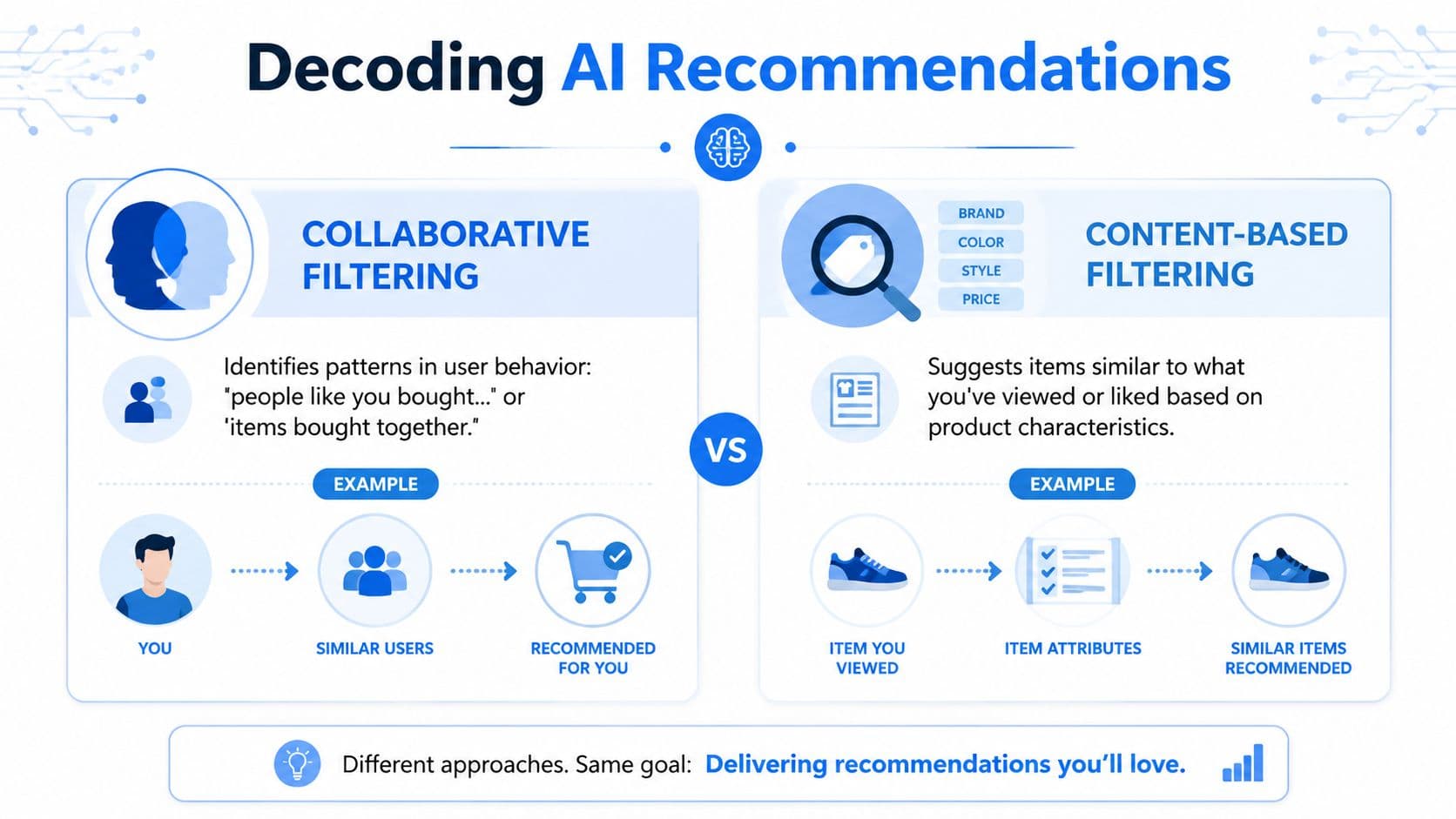
| Collaborative filtering | Learns from patterns across shoppers, such as “people who bought this also bought that” | Stores with enough behavioral history and repeatable purchase patterns | Weaker when traffic is low or products are new |
| Content-based filtering | Recommends items with similar attributes to products a shopper viewed or liked | Stores with rich catalog data and detailed product attributes | Can become too narrow and repetitive |
| Hybrid models | Combines shopper behavior with product similarity and context | Most mature ecommerce setups | Depends on both decent data quality and thoughtful tuning |
Collaborative filtering is the classic “bought together” model. It works well when your store has enough interaction history to reveal patterns. Content-based filtering is better at matching attributes. If someone keeps browsing fragrance-free skincare, the engine can keep the suggestions within that lane.
Hybrid models usually perform best because they blend both approaches. They don't have to choose between “people like you bought” and “this product is similar.” They can use both.
Some newer systems go further and use richer representations of meaning and context. That matters when a shopper's behavior is fuzzy rather than explicit. If you want a broader view of how these tools are evolving, this explainer on AI shopping agents is a useful companion.
Don't think of the model first. Think of the blind spots first. Is your problem weak traffic history, thin product data, or poor context capture? That tells you what kind of recommendation logic will struggle.
For Shopify merchants, that framing is more useful than the technical label. The engine only looks smart when the inputs are strong.
How to Implement AI Recommendations on Shopify
Shopify gives merchants several ways to add recommendations, but they are not equal. The best option depends less on budget than on your data reality.
Three ways Shopify merchants usually do it
The first path is built-in theme logic. Many themes support product recommendations, featured collections, and manually curated product blocks. This is the fastest route, and sometimes it's enough for smaller catalogs or highly focused brands. The downside is obvious. It doesn't adapt very much.
The second path is a dedicated app. These tools usually provide recommendation widgets for product pages, cart drawers, collection pages, and email flows. They often support common use cases like frequently bought together, recently viewed, or similar products. For stores with steady traffic and a reasonably clean catalog, this can work well.
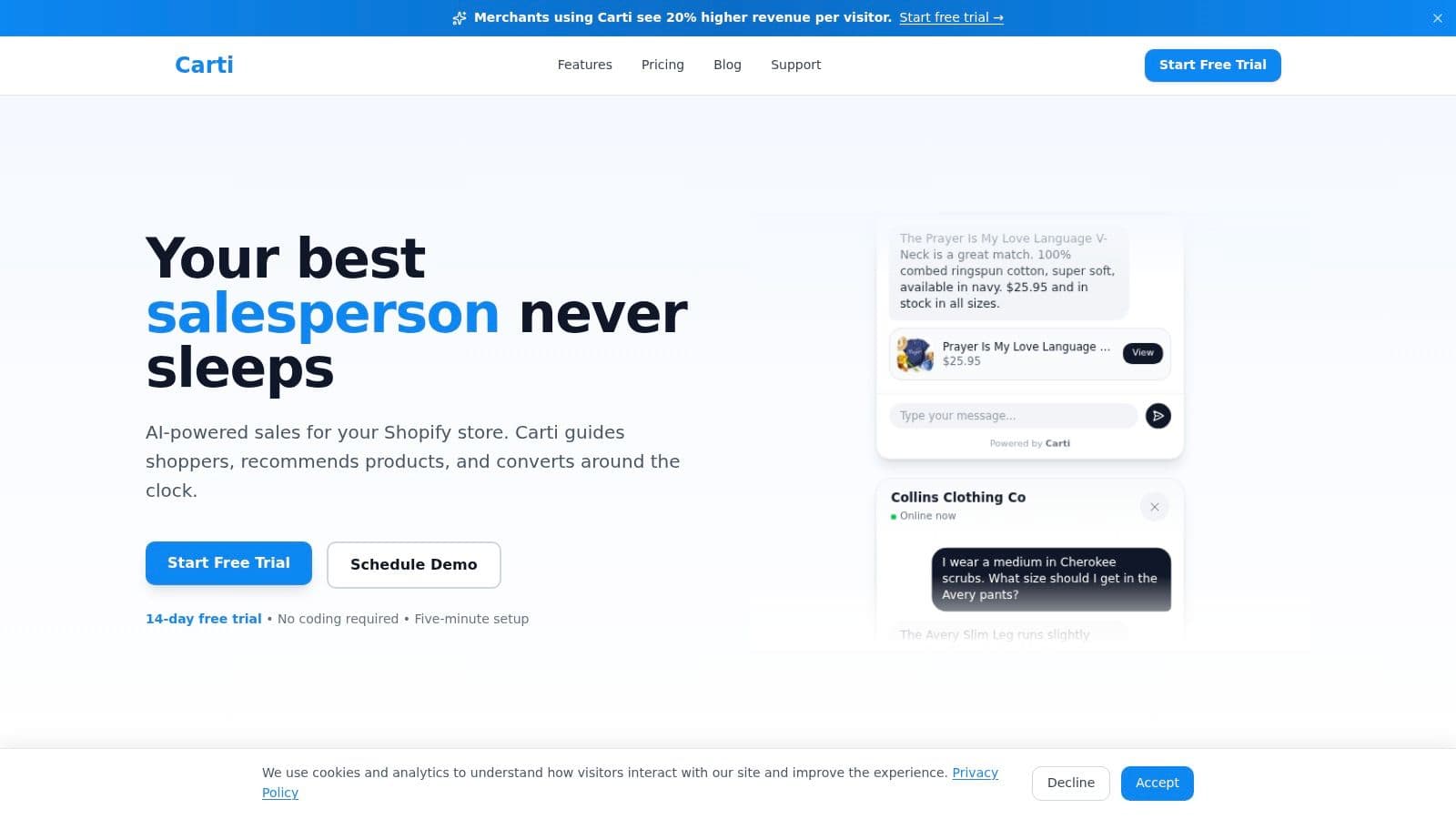
The third path is conversational AI. Instead of waiting for enough browsing history to accumulate, the system captures intent directly from shopper questions and responses. That changes the game for stores that don't yet have deep behavior data.
Here's the cleanest way to think about the tradeoff:
- Theme sections: simple, cheap, limited
- Recommendation apps: broader coverage, stronger automation, still data-dependent
- Conversational AI: dynamic, intent-led, especially useful when behavior history is thin
Why thin data changes the decision
The biggest implementation mistake I see is choosing a recommendation stack as if every store has rich first-party history. Many don't. New stores, niche catalogs, logged-out visitors, and privacy-constrained traffic all run into the same problem. The engine doesn't know enough yet.
That's the cold start issue. As RBM Soft's article on AI-powered product recommendations notes, conversational AI can help overcome thin data by capturing shopper intent in real time, even without historical purchase data.
That matters on Shopify because many buying decisions start with a question:
- Is this serum good for dry skin?
- What size should I buy if I'm between sizes?
- Which dining chair matches this table?
- What's the difference between these two bundles?
A traditional widget can't ask follow-up questions. A conversational layer can.
If you want a broader merchant-focused view of the category, you can also learn from Grumspot about Shopify AI, especially if you're mapping different AI use cases beyond recommendations.
A short product walkthrough helps make this concrete:
The practical lesson is that recommendation systems shouldn't depend on perfect data before they become useful. On Shopify, the most effective setups often combine page-level recommendations with a conversational layer that handles ambiguity, edge cases, and thin-data sessions.
Real-World Examples from Top DTC Retailers
The most effective recommendation strategies don't live in one widget under the product page. Good DTC brands spread them across the customer journey.
Fashion brands sell the outfit, not just the item
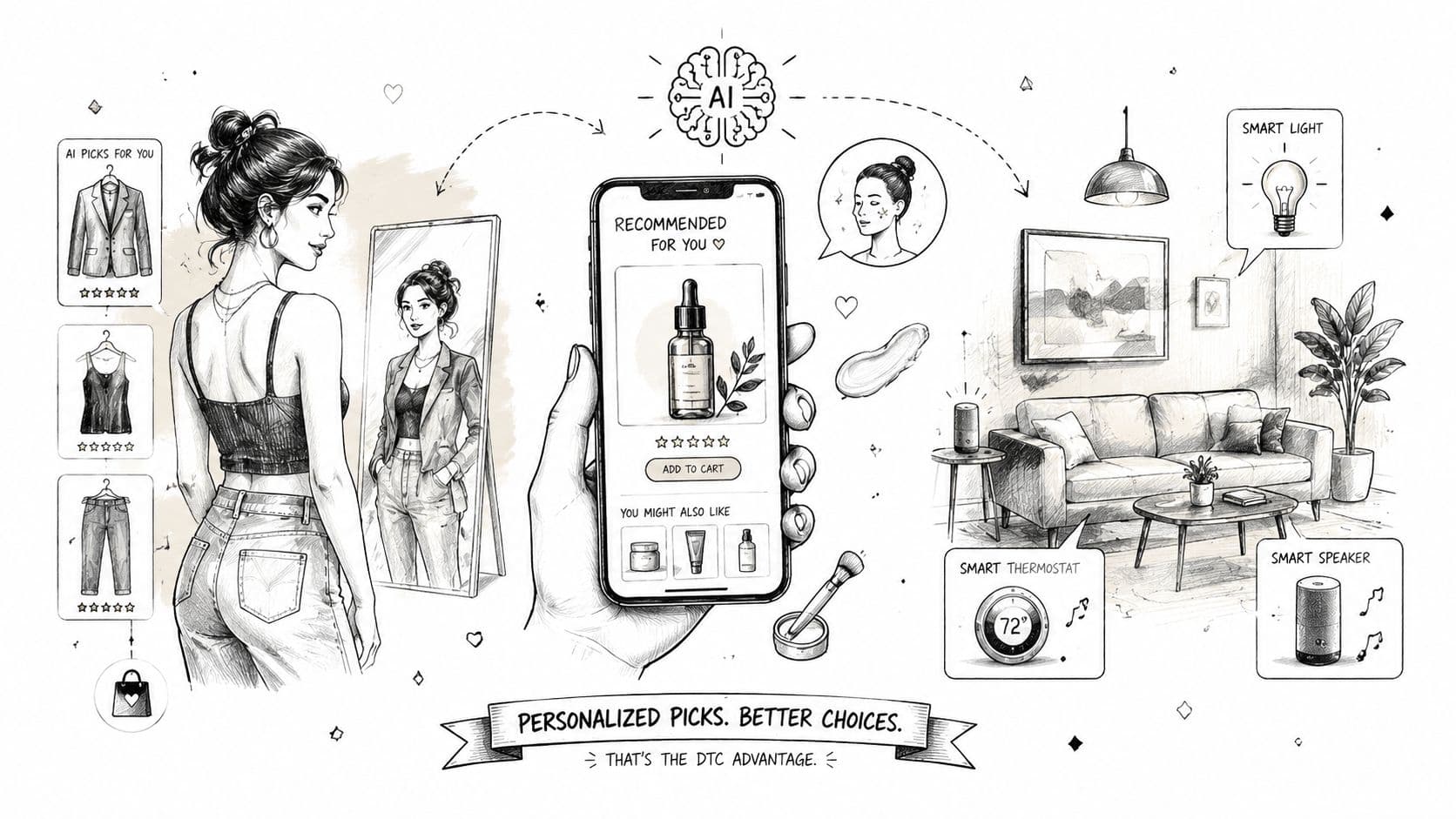
In fashion, recommendations work best when they support styling decisions. On the homepage, “Trending Now” can help a first-time visitor find the brand's current visual center of gravity. On product pages, “Complete the Look” works because it turns a single-item decision into a cohesive outfit decision.
The mistake is showing random alternatives too early. If the shopper has already shown commitment to a blazer, matching trousers or complementary shoes are usually more helpful than ten more blazers.
The recommendation should match the decision stage. Early session equals discovery. Late session equals confidence and completion.
Beauty and wellness brands reduce choice overload
Beauty and wellness stores often carry products that look similar to a new shopper. Same bottle shape, same category, slightly different purpose. Recommendation strategy here should reduce confusion, not add more options.
A strong pattern is to use collection and product pages differently. Category pages can highlight “Best Sellers” to establish trust. Product pages can suggest regimen-building items such as cleanser plus moisturizer, or serum plus sunscreen, based on product role rather than pure similarity.
For wellness brands, post-purchase recommendations can be just as important. If someone buys a sleep supplement, the next recommendation shouldn't always be another sleep product. It may be a companion product aligned to the same routine or goal.
Home brands extend the purchase journey
Home and furniture brands often have longer consideration cycles. Recommendation placement should reflect that. Homepage modules can surface room-based inspiration. Product pages can recommend matching finishes, dimensions, or compatible accessories. Cart-stage prompts should stay focused on utility, such as pads, care kits, or extension pieces.
This is also where email and retention flows matter. A customer who bought a desk may later need a desk lamp, cable tray, or matching chair. Good recommendations recognize that the first purchase was the start of a project, not the end of one.
A common thread across these categories is simple. Recommendations work best when they solve the next customer question. They fail when they just fill screen space.
Measuring Success and Testing Your Strategy
A lot of teams judge recommendations by clicks. That's understandable, but it's incomplete. A recommendation can earn clicks and still be bad for the customer.
The harder question is whether the recommendation helped the shopper make a better choice. That's where strategy gets more mature.
Clicks are not the goal
Research summarized by CEPR VoxEU on AI-powered recommendations points to a real tradeoff. Over-optimizing for conversion can produce repetitive or poor suggestions that erode trust, while transparency about why something is recommended can improve perceived value and purchase intention.
That lines up with what merchants see in practice. If your engine keeps pushing the same accessory, bundle, or substitute regardless of context, shoppers notice. They may still click. They may even buy. But over time, the store feels less helpful.
What to test in practice
The cleanest approach is to measure recommendation impact with holdout logic or A/B tests, not assumptions. You want to know whether recommendations changed behavior compared with a version of the experience that didn't show them or showed a different strategy.
Start with a small set of practical questions:
- Placement test: Does the cart drawer outperform the product page for complementary items?
- Logic test: Do complementary recommendations outperform similar-product recommendations on high-intent pages?
- Density test: Does a smaller module with tighter curation perform better than a larger carousel?
- Transparency test: Does explaining why an item is shown improve engagement or downstream conversion quality?
If your team needs a framework for choosing the right business metrics, this guide to e-commerce key performance indicators is a good reference point.
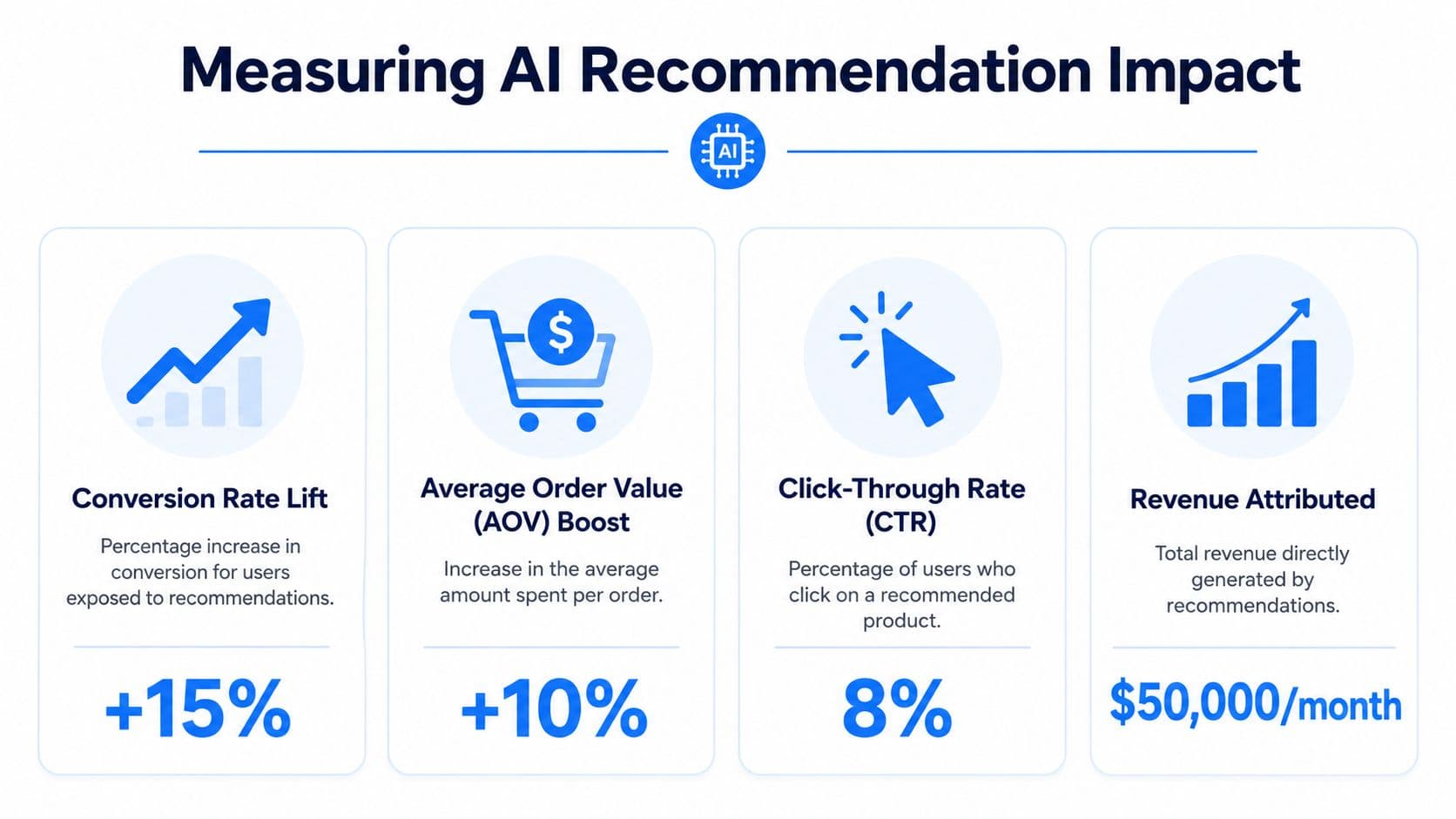
Use a scorecard that combines commercial and customer-quality signals. That usually includes conversion lift, average order value movement, recommendation-influenced revenue, and qualitative signals such as whether shoppers seem to find the suggestions repetitive or confusing.
Watch for this pattern: a recommendation unit that drives interaction but increases low-quality adds, weakens cart clarity, or creates repetitive exposure is not a win.
The strongest recommendation programs treat relevance as a long-term asset. They don't just ask what produced the extra order. They ask whether the shopper felt guided or pushed.
Frequently Asked Questions About AI Recommendations
Do small Shopify stores have enough data to use AI recommendations?
Usually, yes.
Small catalogs and lower order volume create a problem for traditional recommendation engines because those systems depend heavily on past clicks and purchases. Shopify merchants can still get useful recommendations by starting with cleaner inputs. Product tags, collection structure, compatibility rules, margin priorities, and shopper questions often matter more than raw traffic early on.
That's also where conversational AI earns its keep. If a shopper asks for a gift under $50, a moisturizer for sensitive skin, or a couch cover that fits a three-seat sofa, the system does not need years of browsing data to respond well. It can use live intent, then match that intent to your catalog. For newer stores, that closes a gap that classic "people also bought" logic often leaves open.
Start simple. Use complementary products, best sellers, recently viewed items, and guided recommendations tied to common pre-purchase questions.
Where should recommendations appear first?
Put them where hesitation costs you money.
For most Shopify stores, that means the product page, cart drawer, and any point where shoppers need help narrowing the choice. If customers pause because they are unsure about fit, routine, compatibility, or what to buy with the main item, recommendations have a clear job.
The homepage can wait. Intent is usually too broad there, especially for smaller stores that do not yet have enough behavioral data to personalize well. Product and cart placements tend to show impact faster because the shopper is already closer to a decision.
Can recommendations hurt conversion?
Yes. Poor recommendations create distraction, repeat the same items, surface irrelevant products, or interrupt the path to checkout on mobile.
I see this most often when merchants install an app, leave the default logic untouched, and let similar-item modules appear everywhere. That setup can increase clicks while lowering order quality. A shopper who wanted help choosing gets more noise instead.
The fix is operational, not theoretical. Limit the number of modules, change the logic by page type, suppress out-of-stock products, and review outputs the same way you would review a merchandiser's product picks.
Is this a trend or a durable ecommerce capability?
It's a durable capability. Market.us research on AI-driven personalized recommendations projects the market will reach USD 24.8 billion by 2034 at a 29.70% CAGR, and the same report says companies using AI often report revenue gains in the 10% to 12% range.
That does not mean every recommendation app deserves a spot in your stack. It means product guidance now belongs in core storefront operations, especially on Shopify stores with large catalogs, repeat purchase potential, or complicated buying decisions.
The merchants who win here are not the ones with the flashiest widget. They are the ones who help shoppers choose faster, choose with more confidence, and recover sales even when historical data is thin. Conversational AI is especially useful in that last case because it can work from what the shopper says right now, not only from what past visitors did months ago.
If a recommendation speeds up the decision and improves basket quality, keep investing. If it adds clutter, change the logic or remove the placement.
If you want to turn product discovery into a real sales assistant instead of another static widget, Carti is worth a look. It helps Shopify stores answer questions instantly, recommend products based on shopper intent, and support conversions even when historical data is limited. For merchants who need AI recommendations to work in real storefront conditions, not ideal lab conditions, that's a useful place to start.

Written by
Daniel AndersonFounder of Carti. 10+ years building ecommerce brands in apparel and supplements. Still runs a Shopify store and built Carti to help merchants convert more browsers into buyers.