
You've got a store full of good products, yet shoppers still ask the same question: “Which one should I buy?” The question gets harder when the visitor is buying a gift, doesn't understand the category, or can't tell meaningful product differences from marketing language. A product recommendation quiz for ecommerce can solve that hesitation, but only if it behaves like decision support rather than a form collecting data.
The practical standard is simple. Ask what you need to know, connect each answer to a recommendation rule, and show a small set of relevant products that are available now. Traditional quizzes can do this well, but a conversational assistant can often make the experience more adaptive because it doesn't ask every shopper the same questions. This guide covers both approaches, with a focus on the mechanics that help guided selling convert.
Why Shoppers Need Guidance Before They Buy
A gift buyer often arrives with a clear occasion and an unclear category. They know their partner's birthday is coming, they've set a budget, and they want something that feels considered. They may not know the right size, style, materials, or product differences. A large collection page doesn't remove that uncertainty. It makes the shopper responsible for solving it alone.
A useful quiz changes the shape of the decision. Instead of asking the shopper to inspect every SKU, it asks about the situation, the intended recipient, and the constraints that affect the choice. The result should feel like a helpful store associate has narrowed the field, not like the brand has assigned homework.
The recommendation moment has three parts
The recurring gift-buyer profile is a useful test case. The shopper might answer two questions, occasion and budget, then receive three in-stock options with a short explanation for each. The assistant or quiz should also handle the predictable follow-up about returns, because gift buyers worry about choosing incorrectly. The recommendation becomes persuasive when it includes:
- A reason: Explain why the item fits the occasion, budget, or stated preference.
- A safety net: Make returns, exchanges, sizing help, or support easy to find.
- A viable product: Don't recommend an unavailable variant or send the shopper back into an unfiltered catalog.
This is why a quiz should be treated as a decision-support tool, not merely a lead magnet. Capturing an email before delivering useful guidance can make the experience feel transactional. Asking for sensitive preferences that never influence the result creates the same problem.
Merchants exploring confidence-building commerce models may also find MerchLoom's perspective on try before you buy useful, especially for categories where physical reassurance matters. The principle carries over to quizzes: reduce the perceived risk of acting, rather than adding more information for its own sake.
Shorter usually beats more personalized
Every extra question can improve the information available to the recommendation engine, but it can also drain momentum. Early guided-selling flows often become interrogations because merchants want to understand every preference before showing anything. Shoppers usually want a defensible answer quickly.
A benchmark of ecommerce quizzes found that 3–5 question quizzes showed 65–75% completion, while 6–10 question quizzes showed 50–65% completion and 11 or more questions dropped to 35–45%. Those figures come from BuildGrowScale's interactive content benchmark. The practical interpretation isn't that every store must use the shortest possible quiz. It's that each question needs to earn its place by changing what the shopper sees.
For merchants deciding whether a quiz is appropriate, use one test: if a shopper can browse the same products just as easily without answering, the quiz probably needs stronger logic. If the category contains confusing trade-offs, many similar products, gift-buying uncertainty, or compatibility constraints, guided recommendations can remove meaningful friction. A guided selling solution for ecommerce can also help merchants apply that principle conversationally, where the next question depends on what remains unknown.
Designing Questions That Actually Change the Recommendation
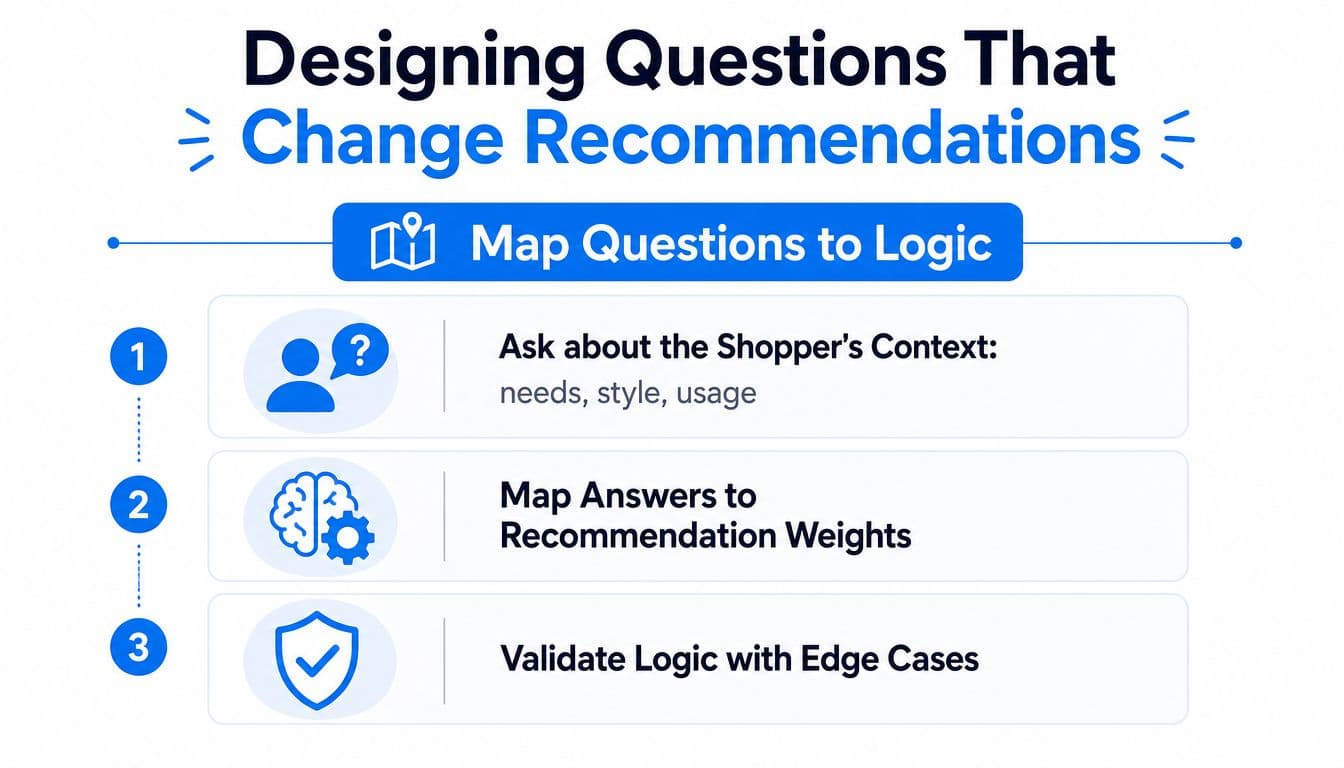
Start with the shopper's context, not your product taxonomy. A catalog may contain dozens of attributes, but shoppers rarely think in those terms. They think about daily wear versus special occasions, dry skin versus oily skin, a small room versus a large one, or a gift for someone whose taste they're still learning.
The question is useful only when the answer changes the eligible products, the product ranking, or the explanation on the results page.
Use a filtering question for every step
A strong question has a visible relationship to the result. Ask yourself, “If the shopper chooses a different answer, what will we show differently?” If the answer is “nothing,” remove the question or use it only for a clearly explained follow-up.
Examples by category:
- Fashion: “Is this for daily wear or a special occasion?” The answer can change formality, fabric, durability, and styling recommendations.
- Beauty: “What are you trying to address?” The answer can route shoppers toward products designed for dryness, sensitivity, tone, or repair.
- Home: “What space are you furnishing?” A bedroom, entryway, and living room can require different dimensions, materials, and use cases.
- Wellness: “What matters most right now, convenience or a specific goal?” That answer can distinguish a simple routine from a more targeted product set.
These questions ask about usage and intent, not whether the shopper knows your internal SKU names. They also give the result page language the shopper recognizes. “You chose special occasion, so these picks prioritize polished styling” feels more personal than “Product score: 84.”
Choose concrete formats
From watching thousands of guided-selling conversations, the most reliable interaction is one concrete question with real options, presented one at a time. “Is this for daily wear or special occasions?” is easier to answer than a large form containing multiple fields and a progress maze.
Use image swatches when the visual difference is central, such as color, shade, pattern, or finish. Use multiple choice for use cases and constraints. Sliders can work for preferences that vary along a continuum, but they often create false precision when shoppers don't know how to place themselves.
Keep the total flow to two or three decisive questions when the catalog and intent signals allow it. A benchmark report on product recommendation quizzes says shoppers who finish a quiz convert at about 5.5%, roughly 1 in 18, compared with a typical 2% online store conversion rate, and that quiz-driven stores see an 11–15% higher average order value within the same store. Those figures are reported in RevenueHunt's state of product recommendation quizzes. The commercial lesson is not to maximize question count. It's to reach a useful recommendation before curiosity becomes effort.
Practical rule: If an answer doesn't remove a product, change its rank, or improve the explanation, it isn't a recommendation question.
Branching Logic, Scoring, and Results That Feel Personal
Once questions are chosen, the difficult work moves into the recommendation engine. You need a reliable way to translate answers into eligible products without making the shopper experience feel mechanical.
There are two practical models. Branching logic sends shoppers down different paths based on their answers. It's easy to understand and works well when a decisive constraint separates clear groups, such as skin concern, room type, or compatibility. Weighted scoring gives products points for matching several answers, which works better when shoppers can have overlapping preferences.
A small catalog with distinct use cases may need only branching. A broader fashion or beauty catalog may need weighted scoring because several products can satisfy the same shopper, but in different degrees.
Choosing your quiz logic model
| Logic Type | Best For | Trade-off |
|---|---|---|
| Simple branching | Clear use cases, hard constraints, focused catalogs | Can become rigid when shoppers have mixed preferences |
| Weighted scoring | Broad catalogs with overlapping attributes | Requires careful product tagging and score validation |
| Hybrid logic | Stores with constraints plus nuanced preferences | More setup, but separates must-haves from ranking signals |
Use hard constraints first. If a product is unavailable in the required size, incompatible with the shopper's stated need, or outside a clearly stated budget, scoring shouldn't rescue it. After filtering, use weighted preferences to rank the remaining products.
Keep inventory inside the logic
Static results are a common failure point. A quiz recommends a product, the shopper clicks through, and the chosen variant is unavailable. The brand has created confidence and then taken it away.
Connect outcomes to the live catalog where possible. If the first choice sells out, replace it with the next eligible product and explain the substitution. If no product satisfies every preference, show the closest viable options and state which constraint required compromise. A clear explanation preserves trust better than pretending the match is perfect.
The result page should make the recommendation legible. For each product, include the product name, a concise reason, the relevant variant, availability, price or budget relationship where appropriate, and the next action. A shopper shouldn't have to reopen the quiz to remember why an item appeared.
For a deeper treatment of recommendation structure, personalized product recommendations from Carti offers useful context on matching shopper intent with catalog items. The same design discipline applies whether the engine is a quiz builder, a rules table, or a conversation.
Don't collect what you can't use
A shopper's answers are valuable only when they improve the experience. Avoid sensitive-preference questions unless the recommendation, customer support, or fulfillment process needs them. Explain why you're asking, make optional fields optional, and deliver the result without forcing an unnecessary data exchange.
The strongest result page doesn't claim to know everything about the shopper. It demonstrates that the store understood enough to make a useful decision.
Building and Deploying Your Quiz on Shopify and Beyond
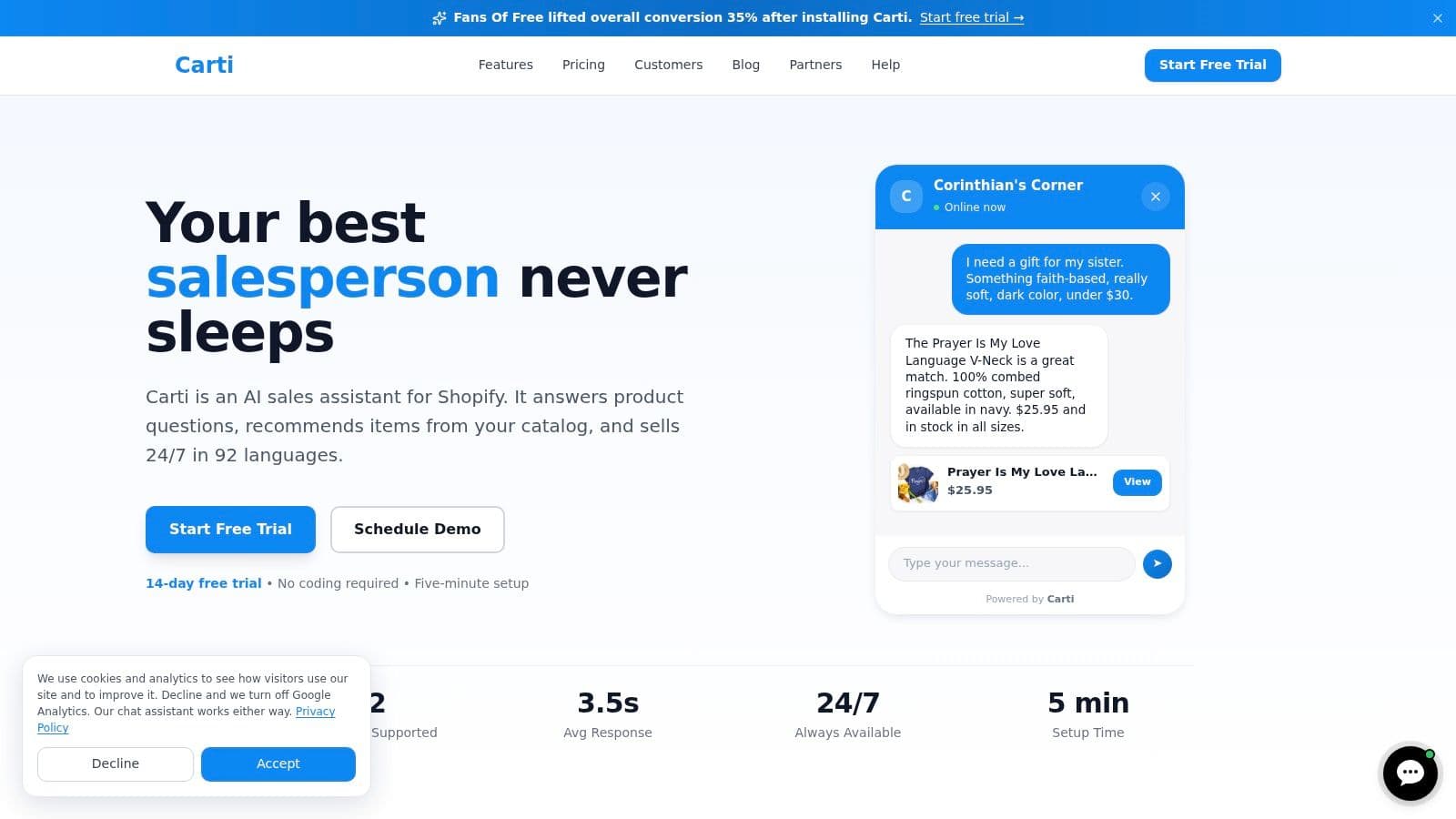
Shopify merchants generally have two routes. A traditional quiz builder presents a designed sequence of screens, maps answers to product rules, and displays a result page. A conversational layer asks questions dynamically, which means the conversation itself becomes the quiz.
The first route gives you predictable presentation and direct control over every screen. It's a sensible choice when your category has stable decision paths, visual comparison matters, or marketing wants a campaign-specific experience. The second route avoids asking known questions again. If a shopper has already mentioned the occasion, budget, or product concern, the assistant can focus on the remaining uncertainty.
For the conversational setup described here, the process is straightforward:
- Install the assistant on the Shopify store.
- Connect the catalog, inventory, policies, and frequently asked questions.
- Define the qualifying signals that matter, such as recipient, situation, and constraints.
- Let the assistant ask one question at a time.
- Return a small set of in-stock products with reasoning.
- Support follow-up questions about returns, sizing, compatibility, and delivery.
- Make the selected item easy to add to cart.
Carti is one option in this category. It's an AI-powered Shopify chatbot that answers product questions, recommends items from the store catalog, supports cart recovery, and responds in 92 languages. Its conversational approach fits stores that prefer adaptive guidance over a fixed quiz form.
Put guidance where uncertainty appears
A quiz hidden on a general landing page may attract curious visitors but miss shoppers who need help with a specific product decision. Consider placing the entry point on collection pages, product pages with many variants, gift-focused pages, and the cart when the shopper appears undecided.
For social traffic, a dedicated flow can preserve the context from the campaign. Merchants evaluating lightweight social discovery tools may also compare Hooked's TikTok quiz tool with a native Shopify experience, especially when the quiz needs to connect a short-form video audience to a product path.
Your deployment checklist should include mobile interaction, keyboard navigation, readable labels, sufficient contrast, and answers that don't rely only on color. If the store serves multiple markets, test translated product names, policy responses, currencies, and availability messaging rather than assuming the original flow will transfer cleanly.
Privacy needs the same practical attention. Tell shoppers what information is collected, why it's needed, and whether they can receive recommendations without subscribing. The quiz should earn data through usefulness, not pressure.
A conversational model can extend beyond the initial recommendation. It can answer objections, compare two products, explain returns, and help recover an abandoned cart. See personalized shopping experience design for Shopify for broader ideas on connecting guidance to the rest of the customer journey.
Testing UX and Analytics That Improve Conversion and AOV
A quiz can have excellent completion and still fail commercially. Shoppers may answer every question, view the results, and leave because the picks aren't available, the reasons are vague, or the next step is difficult.
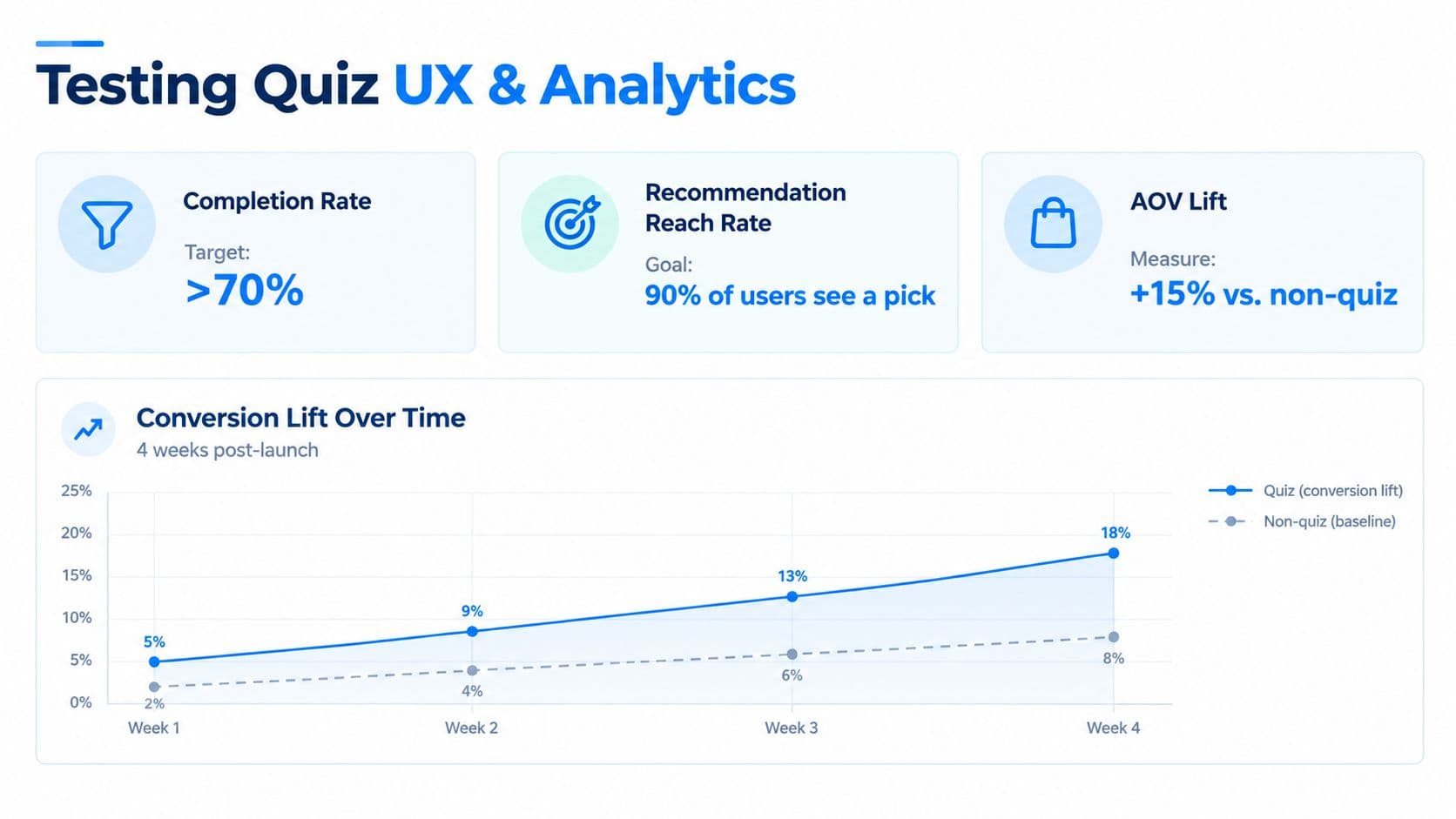
Track the path from entry to purchase. The useful dashboard follows behavior in sequence:
- Quiz start: How many eligible shoppers begin?
- Question progression: Where does engagement weaken?
- Recommendation reach: How many shoppers receive a defensible pick?
- Product click-through: Do result pages send shoppers to relevant product detail pages?
- Add to cart: Does the recommendation create a clear buying action?
- Conversion: Do quiz-engaged shoppers purchase?
- Average order value: Do recommended baskets differ from the store baseline?
- Delayed purchase: Do shoppers return and buy later after the quiz?
Measure the recommendation, not just the form
The benchmark data matters because it separates immediate and delayed influence. RevenueHunt reports that about 1 in 5 quiz-attributed orders happen more than 30 days after the quiz, which means a last-click report can understate the value of guided discovery. Track quiz exposure and recommendation timestamps alongside orders, while keeping attribution rules consistent.
Another benchmark cited by Interact draws on more than 80 million quiz leads, with 37.6% of ecommerce quiz starters converting to leads and 55.5% completing the quiz once engaged. Those figures are summarized in Gnosari's ecommerce product recommendation quiz analysis. Treat them as context rather than a promise for your store. Your own product category, traffic source, catalog quality, and result relevance will determine performance.
Run small tests before rebuilding the whole experience. Change one variable at a time:
- Test a shopper-centered question against a product-feature question.
- Test question order, putting the strongest decision signal first.
- Test two recommendations against three, while keeping the reasons equally clear.
- Test result copy that explains the match against product tiles with little context.
- Test a direct add-to-cart action against a product-detail-page click.
A 2026 benchmark summary reported 83.7% average quiz completion globally and 88.2% for mobile-optimized quizzes, with one-question-per-screen layouts identified as a major factor. The figures appear in Amra and Elma's interactive quiz statistics. The takeaway is useful even without copying the benchmark: mobile layouts deserve separate testing, and a single focused interaction often creates less friction than a dense form.
Turn answers into merchandising insight
Quiz answers reveal what shoppers struggle to articulate elsewhere. If many visitors ask for a use case your collection pages don't support, improve the navigation or create a targeted landing page. If shoppers repeatedly ask about returns after seeing a recommendation, make that reassurance visible earlier.
For merchants building a wider automation roadmap, Arlo Inc.’s actionable AI strategies for Shopify provides a useful comparison point for connecting guided conversations with support and sales workflows. Keep the testing backlog operational. Each experiment should name the friction, the change, the primary metric, and the decision you'll make afterward.
Launch Confidently and Keep Your Quiz Converting
A converting quiz doesn't need a complicated personality test or a branching tree that tries to model every shopper. It needs a small set of questions that distinguishes meaningful outcomes, a catalog that can fulfill the promise, and a result page that explains the recommendation.
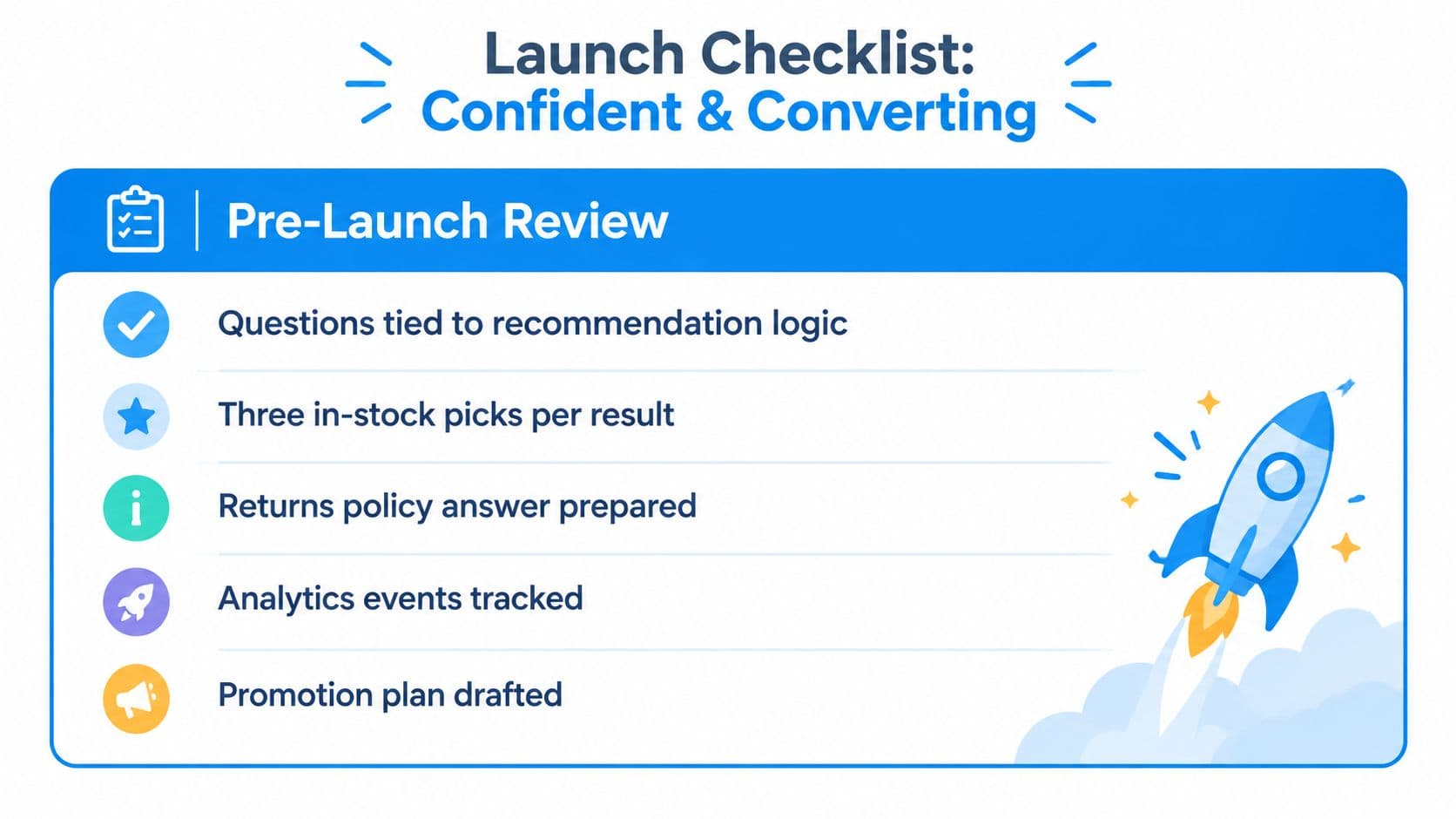
Use this launch review before publishing:
- Logic audit: Every question changes eligibility, ranking, or explanation.
- Inventory audit: Each result has available alternatives when the first product is unavailable.
- Reason audit: Every recommendation includes a plain-language explanation.
- Risk audit: Returns, exchanges, sizing, compatibility, and delivery answers are easy to access.
- Tracking audit: Starts, progression, recommendations, product clicks, carts, orders, and delayed purchases are recorded.
- Accessibility audit: The flow works with keyboard navigation, readable labels, mobile layouts, and non-color cues.
- Privacy audit: The store collects only useful information and explains the exchange clearly.
Use category-specific prompts
Templates help you start, but the answers must connect to real product differences.
Fashion: Ask whether the item is for daily wear or a special occasion, then follow with the fit or climate constraint only if it changes the available range.
Beauty: Ask about the shopper's primary concern first. Ask about sensitivity or routine complexity only when the answer changes the recommended formula or usage guidance.
Home: Ask which room and what the shopper needs the item to do. Dimensions, materials, and style should follow only when they affect the shortlist.
Wellness: Ask about the intended goal and preferred routine. Don't collect a detailed lifestyle profile if a simpler product choice can solve the immediate need.
A gift flow deserves its own standard. Ask the occasion and budget, show three in-stock options, explain the match, and answer the returns question before the shopper has to ask. The recommendation that converts isn't necessarily the most personalized one. It's the one that reduces category ignorance, fear of choosing wrong, and return anxiety at the same time.
Review the first month with discipline
During the first week, watch real sessions for confusing wording, dead ends, unavailable recommendations, and questions that shoppers skip. In the next review cycle, prioritize the point where shoppers stop reaching a recommendation. Later, compare recommendation clicks, add-to-cart behavior, conversion, and average order value against your chosen baseline.
Conversational commerce benchmarks offer additional context. One industry report claimed shoppers engaging with an AI conversation converted 154% better than those who didn't, while 93% of purchases following an AI recommendation occurred within 48 hours. These claims are published in MNT Future's AI shopping assistant report. Another report found that about 14% of Shopping Assistant conversations ended in an attributed web order within a three-day window, and that the assistant influenced about 1.9% of online revenue for brands using it, as reported by Gorgias research on AI shopping assistants.
Use those external benchmarks as directional context, not as targets you can assume. Your operating target should be simpler: more shoppers reach a relevant recommendation, more of those recommendations earn a product click or cart addition, and fewer shoppers need to restart the decision from scratch.
The best product recommendation quiz for ecommerce is often the one that behaves less like a quiz. Start with two or three questions, use live catalog options, show reasoned products, and stop asking as soon as the recommendation is defensible.
Carti turns guided product discovery into a live Shopify conversation, asking shoppers only what remains unknown, recommending from your catalog, answering policy questions, and helping move the chosen product toward checkout. Visit Carti to add conversational guided selling to your store and test a shorter path from shopper uncertainty to purchase.

Written by
Daniel AndersonFounder of Carti. 10+ years building ecommerce brands in apparel and supplements. Still runs a Shopify store and built Carti to help merchants convert more browsers into buyers.