
A shopper who engages with an AI chat assistant can convert at 12.3%, compared with 3.1% for shoppers who don't, a fourfold difference reported in recent retail analysis (AI Business Weekly). That gap reframes conversion rate optimization with AI. The opportunity isn't adding an impressive widget to a storefront. It's removing the specific doubt that stops a ready-to-buy customer from completing checkout.
For Shopify merchants, the practical order is clear: conversation first, situational recommendations second, static product carousels last. The assistant has to answer accurately before it asks shoppers to engage, recommend anything, or recover a cart. This is the sequence that turns AI from a novelty into an operating layer for ecommerce CRO.
Why AI Moves Conversion When Answer Quality Comes First
Most conversion problems don't begin with a broken button. They begin when a shopper asks a question the product page doesn't answer clearly.
Will this size fit? How quickly will it arrive? Can I return it? Is this compatible with the item already in my cart? These questions appear simple, but they sit directly between product interest and purchase completion. An AI assistant can help because it responds inside the shopping journey, while the customer is evaluating a specific product and deciding whether the remaining uncertainty is acceptable.
The critical distinction is answer quality. A proactive message that says “Need help choosing?” adds friction if the assistant can't explain sizing, shipping, returns, or fit accurately. Outreach creates an expectation. If the next response is vague, contradictory, or invented, the store has interrupted the shopper without resolving anything.
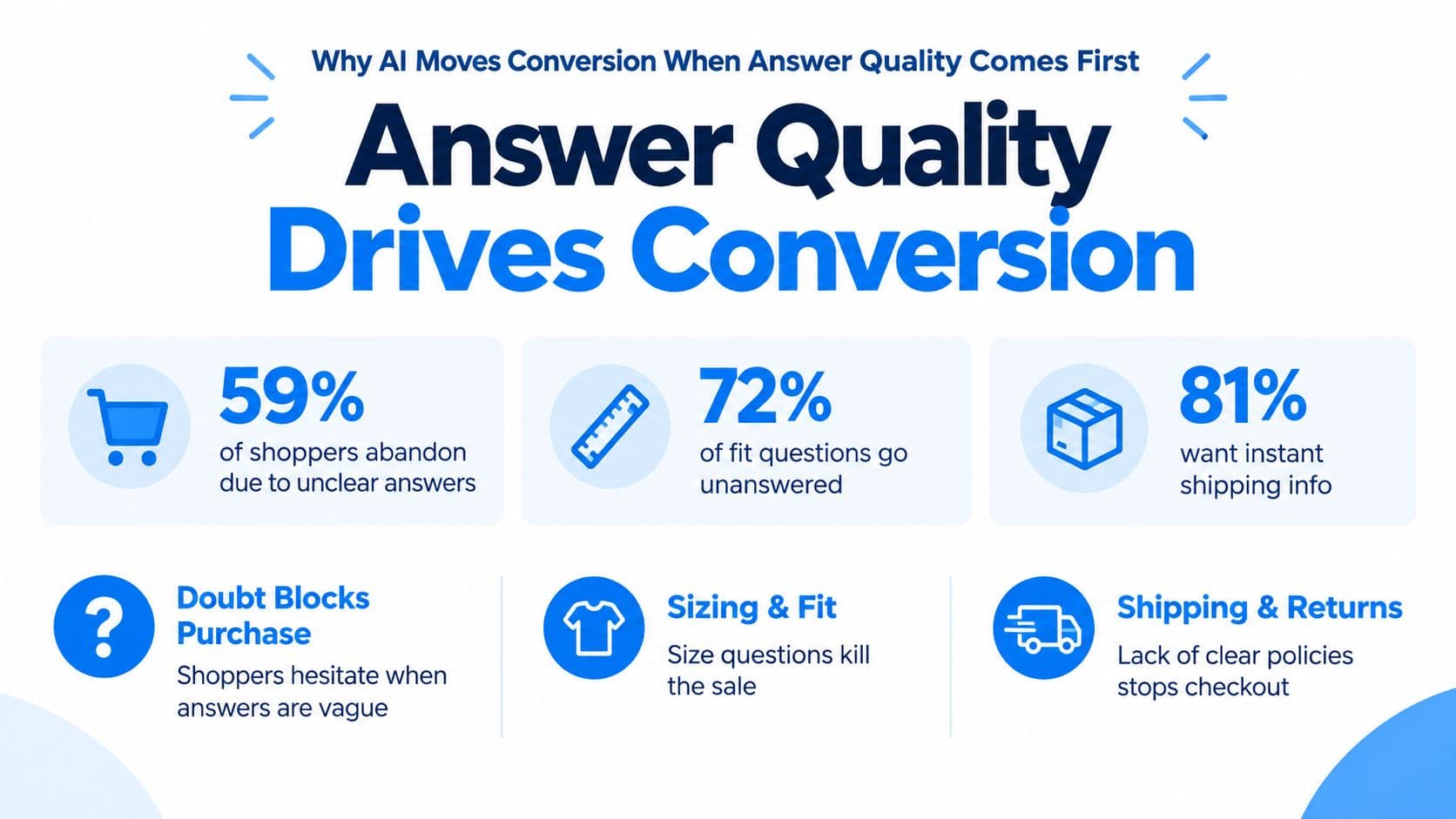
Practical rule: Answer quality comes first. Proactive outreach comes second.
Optimize the doubt, not the interaction
Chat volume is useful, but it isn't the commercial objective. A shopper can have a long conversation and still leave without buying. The useful question is whether the conversation resolved a purchase blocker and moved the customer toward the cart or checkout.
That's why an assistant should start with the store's existing knowledge. Product descriptions, size charts, shipping policies, return terms, compatibility notes, and FAQs form the foundation. If those materials contain gaps, the assistant will reproduce the gaps at scale. Merchants concerned about unsupported answers should also review how to prevent AI hallucinations before enabling automated selling conversations.
The same principle applies beyond onsite chat. If paid visitors leave after encountering unclear product information, teams should first diagnose paid social funnel gaps rather than cover the symptom with more aggressive prompts. AI can improve the experience, but it can't compensate for missing facts.
A useful operating model
A practical AI CRO program follows a simple loop:
- Identify the purchase blocker. Look for questions about size, delivery, returns, fit, or product suitability.
- Ground the answer. Improve the relevant product or policy content before asking the assistant to sell.
- Start the conversation at the right moment. Use prompts where uncertainty commonly appears, not immediately on every page.
- Connect assistance to outcomes. Join conversations and prompts to carts, checkouts, and completed orders.
- Feed repeated questions back into the store. One content fix can improve future conversations across the catalog.
The best use of AI here isn't replacing judgment. It's making reliable assistance available when a merchant or support agent can't answer instantly. That makes conversational assistance a CRO lever tied to purchase completion, not merely another engagement channel.
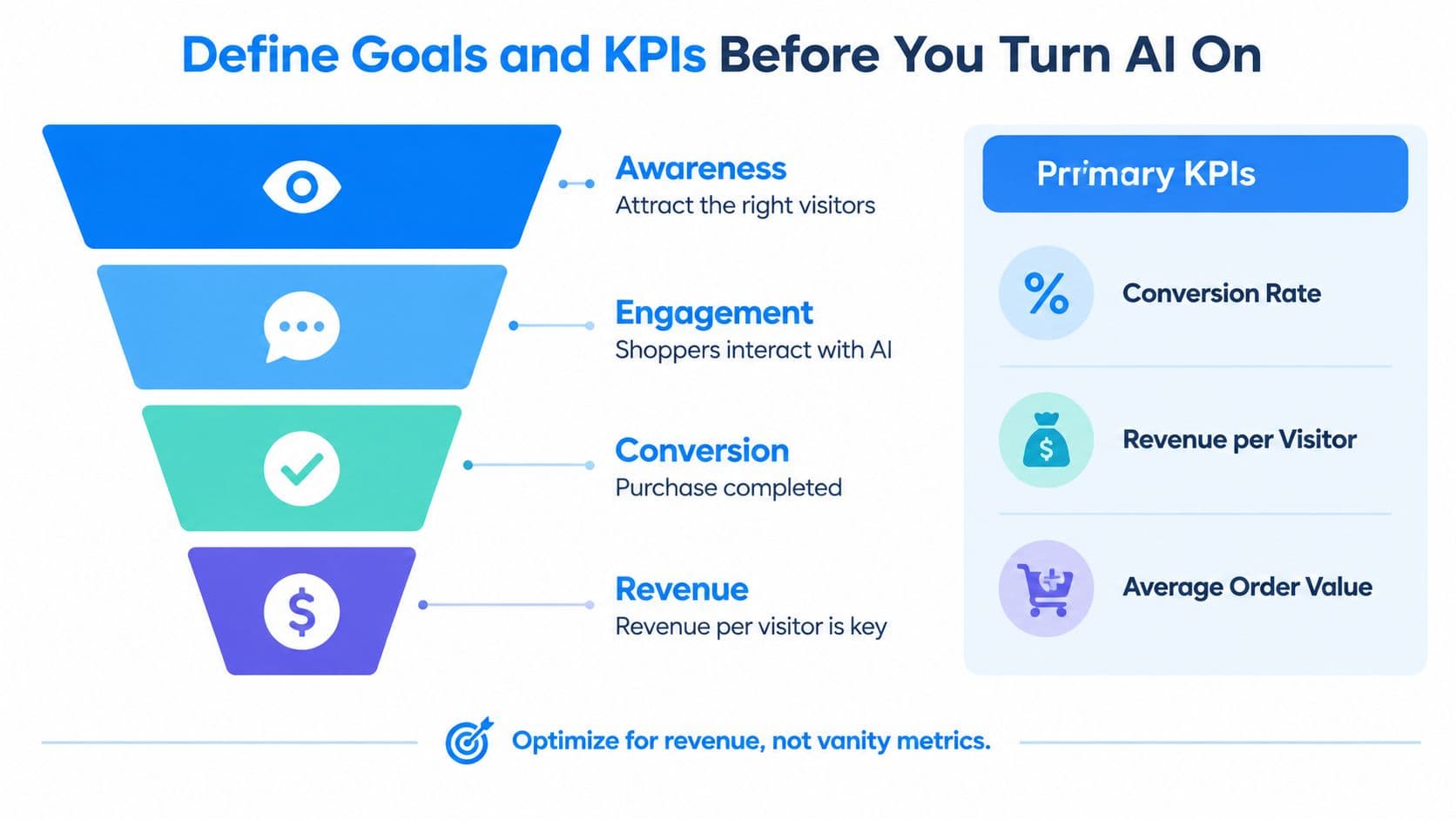
Define Goals and KPIs Before You Turn AI On
AI CRO becomes difficult to evaluate when merchants start with the feature instead of the business outcome. “More chats” may indicate stronger discovery, but it may also indicate confusing product pages. “More recommendations clicked” can look positive while average order value, margin, or completed purchases remain unchanged.
Start by selecting one primary commercial objective. For most Shopify stores, that means completed orders, conversion rate, or revenue per visitor. Cart-to-checkout completion can reveal whether the assistant helps shoppers through the final decision, while average order value shows whether recommendations increase basket quality rather than adding activity.
The funnel should separate shoppers who engage with AI from those who don't. Independent benchmark reporting found 49.3% cart-to-checkout completion with AI versus 26.3% without AI in one dataset covering 329 brands, but the same reporting warns that results vary substantially by channel and implementation (ThinkTide Journal). High-intent visitors may be more likely to open an assistant in the first place, so an engaged-versus-non-engaged comparison isn't automatically causal.
Build a KPI stack
Use metrics at three levels rather than relying on a single dashboard number.
- Commercial outcomes: Conversion rate, revenue per visitor, completed orders, and average order value.
- Funnel movement: Product views to cart, cart to checkout, checkout completion, and orders associated with an AI conversation.
- Diagnostic signals: Conversation volume, escalation rate, unanswered questions, response quality, and cart recovery activity.
Conversation volume deserves careful interpretation. A sudden drop usually points to a storefront change that broke the assistant, its placement, or its trigger. A sudden escalation-rate increase often means the assistant has encountered a knowledge gap. Attributed revenue tells you whether those interactions connect to actual orders, but it should be read alongside traffic source and intent stage.
Control the comparison
For every AI-engaged session, capture the context needed to avoid over-crediting the tool:
- Traffic source: Separate paid social, organic search, email, direct, and affiliate traffic.
- Device: Compare mobile and desktop behavior independently.
- Intent stage: A product-page visitor and a returning cart visitor shouldn't be treated as equivalent.
- Catalog context: A sizing-heavy apparel store has different friction from a simple replenishment catalog.
- Time period: Compare equivalent periods and account for promotions, stock changes, and merchandising edits.
Raw click probability is an especially weak optimization target. Uplift modeling research argues that merchants should estimate incremental treatment effect, then select the approach that creates utility under business constraints, rather than optimizing propensity or AUC alone (International Journal of Information Technology and Decision Making). A shopper who would have bought without an intervention doesn't need a discount, and an irrelevant intervention can waste margin or create resistance.
Your measurement plan should answer one question: Did AI create incremental commercial value, after accounting for who used it and why? Everything else is supporting evidence.
Choose the Right AI Levers and Rank Them by Impact
Not every AI feature deserves equal priority. In live Shopify operations, the ranking is straightforward:
- Chat assistance
- Situational recommendations inside the conversation
- Cart recovery
- Static recommendation carousels and broad personalization
Chat assistance leads because it addresses the question blocking the individual shopper. A recommendation row guesses what someone might like. A conversation can ask what they need, interpret the answer, and explain why a particular product fits the use case.
Independent coverage reports that visitors who interact with proactive live chat convert at 3.5 times the rate of visitors who don't (GreetNow). That doesn't mean every store should place a prompt over the entire storefront. It means conversation has a direct mechanism for resolving hesitation, provided the answers are grounded and the timing feels relevant.
Which AI Lever Moves Conversion Most
| AI Feature | Conversion Impact | Best For |
|---|---|---|
| Chat assistance | Highest when shoppers have product or policy doubts | Fashion sizing, beauty routines, compatibility-heavy home products, and wellness questions |
| Situational recommendations | Strong when based on the current product, query, or cart | Bundles, alternatives, complementary products, and guided product discovery |
| Cart recovery | Useful when the nudge answers a remaining concern | Shipping clarification, return reassurance, stock context, and checkout reminders |
| Static recommendation carousels | Lowest priority when shown without context | Broad catalog discovery after core assistance and product data are reliable |
The ranking doesn't mean recommendations have no value. Conversational recommendation research emphasizes current dialogue, shopper intent, and product knowledge over generic history-based rows (ACL Anthology). If a customer is viewing a cleanser and asks for a routine for sensitive skin, the assistant should recommend products based on that exchange. A “recommended for you” carousel based on old browsing history is less useful.
Match the lever to intent
A fashion store should lead with size, fit, fabric, and delivery answers. Beauty merchants can use chat to clarify routine compatibility and product suitability. Home brands benefit when the assistant handles dimensions, materials, assembly, and compatibility. Wellness stores need careful product explanations and transparent policy answers, especially where shoppers require confidence before purchasing.
Cart recovery belongs after the store understands why customers leave. A reminder that repeats the product name can feel intrusive. A message that answers the unresolved shipping or return question can reduce friction.
For a deeper framework on applying generative systems to product discovery and support, see this guide to generative AI for ecommerce. The implementation decision remains the same: deploy the lever closest to the actual blocker, then add complexity only when the fundamentals work.
Implement on Shopify Without Code and Get Answers Right
The launch sequence matters more than the installation itself. A fast setup is useful only if the assistant has accurate information to work with.
Carti's Shopify workflow starts with a five-minute, no-code install. After installation, it syncs the store catalog, policies, and FAQs so the assistant can answer questions using the merchant's own product and operational data. The first live task shouldn't be turning on every sales prompt. It should be checking whether the assistant can handle the questions shoppers already ask.
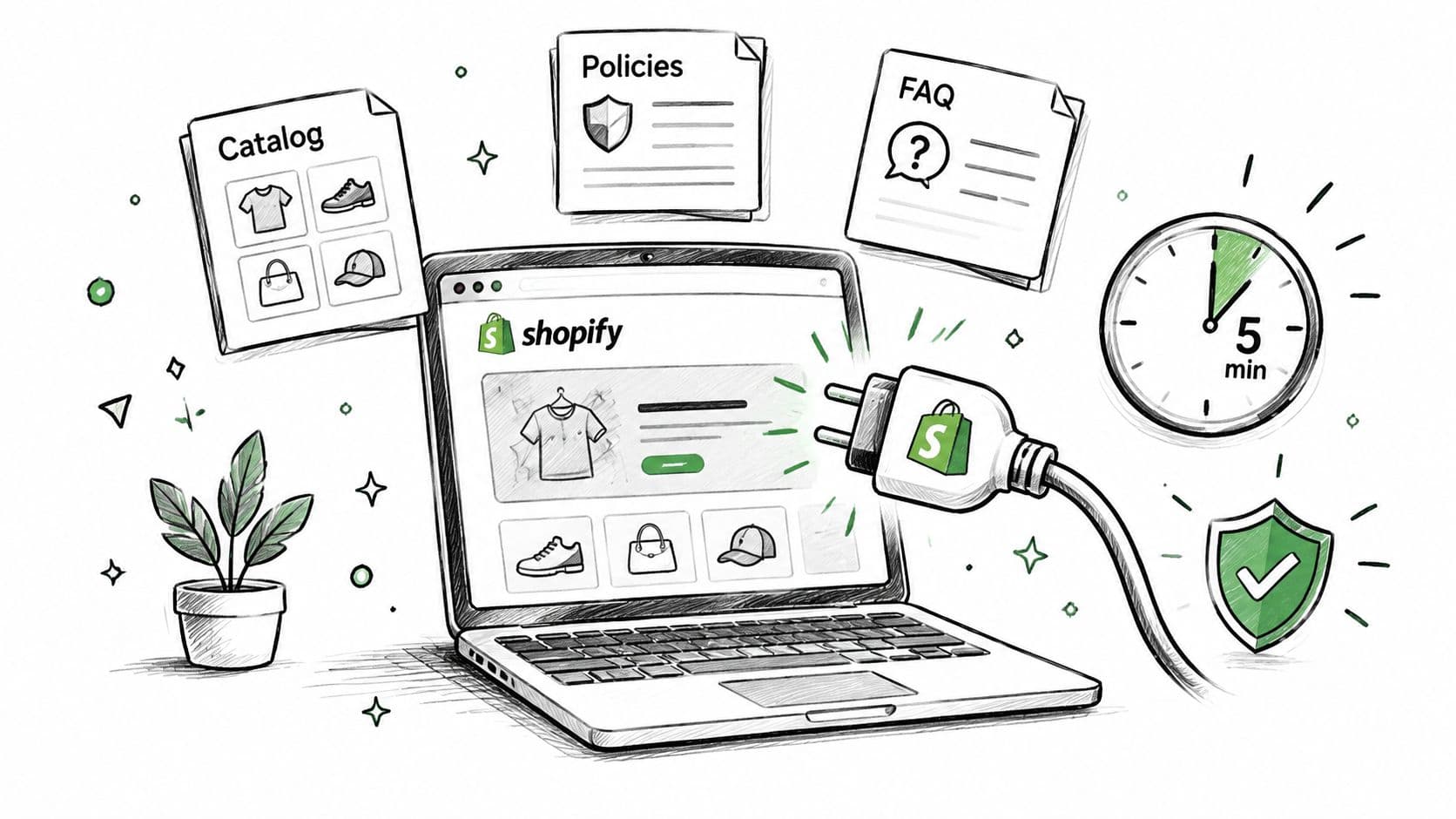
Follow the correct launch order
- Install the assistant. Add it to the Shopify store without custom development.
- Sync the knowledge base. Let the system pull the catalog, product details, shipping information, return policies, and FAQs.
- Spot-check ten answers. Ask the widget realistic questions about sizing, shipping, returns, and whether a product will work for a specific need.
- Repair the source content. If an answer is incomplete, update the product page, size chart, policy, or FAQ. Don't patch the symptom only inside the assistant.
- Enable proactive prompts. Once answer quality is reliable, activate prompts where shoppers commonly hesitate.
- Review conversations weekly. Read what customers ask, what the assistant misses, and which answers precede a purchase or escalation.
The assistant should become more useful because the store's information improves, not because the model is allowed to guess.
Grounding matters particularly for recommendation behavior. An assistant shouldn't suggest a product because it sounds generally relevant. It should use the shopper's current product view, cart contents, stated need, and verified catalog information. Merchants selling apparel can pair this approach with visual merchandising resources such as AI model outfit ecommerce, but visual tools should support accurate product understanding rather than replace it.
Keep the widget helpful
Place chat where a shopper can find it without allowing it to dominate the page. Use brand language, make the opening prompt specific, and avoid interrupting immediately after arrival. “Need help choosing a size?” is more useful on an apparel product page than a generic greeting.
The assistant should handle common questions directly and escalate when the store data doesn't support a confident answer. Localization can extend the experience across 92 languages, but language coverage doesn't excuse weak source content. A translated incorrect policy remains incorrect.
Merchants who want the technical walkthrough can use this guide on how to add a chatbot to Shopify. The operational discipline is simple: sync first, test real questions, improve the underlying content, and only then ask the assistant to proactively sell.
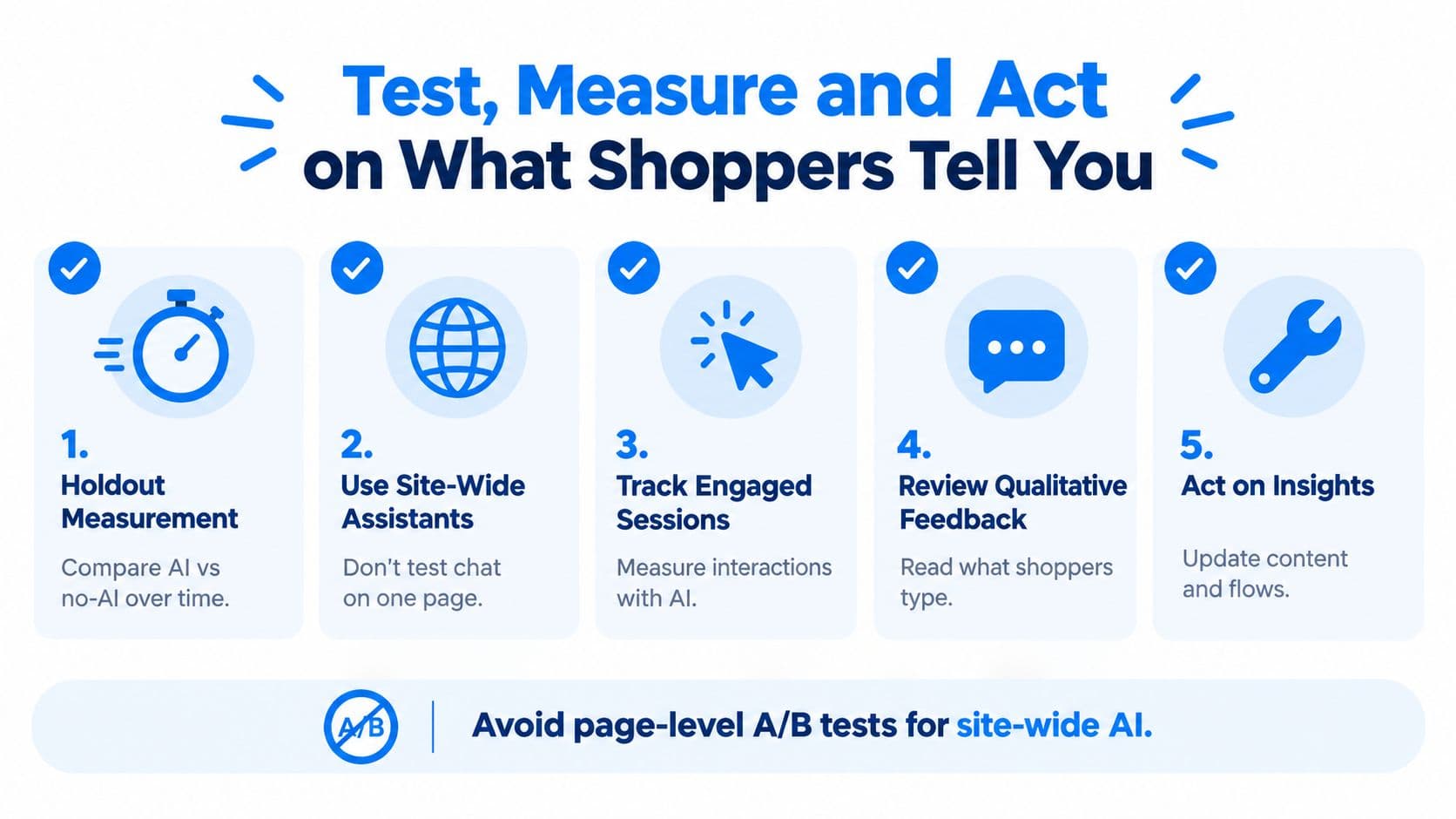
Test, Measure and Act on What Shoppers Tell You
A site-wide assistant isn't a landing-page element, so a page-level A/B test comparing one page with chat against one page without chat won't cleanly represent its effect. The assistant can influence product discovery, policy evaluation, cart decisions, and checkout confidence across multiple pages.
Use holdout-style measurement over time instead. Compare periods or eligible visitor groups with AI exposure against comparable groups without exposure, while controlling for traffic source, device, promotions, inventory, and intent. Within the same store and period, compare AI-engaged and non-engaged shoppers, then join conversations and prompts to actual orders.
The distinction matters because self-selection can inflate apparent performance. A shopper who opens chat may already have stronger purchase intent than someone who never interacts with it. Treat the observed conversion gap as a signal to investigate, not proof that every order was caused by the assistant.
Use the dashboard as an operating system
Daily monitoring should stay focused:
- Conversation volume: A sudden decline often means a theme change, placement change, tracking issue, or storefront update disrupted the experience.
- Escalation rate: A sudden increase points to unanswered questions, weak product content, or requests that require a human.
- Attributed revenue: Confirm that conversations connect to completed orders, not just clicks or carts.
Weekly review should move from numbers to language. Chat transcripts are one of the most valuable qualitative datasets a store owns because shoppers state the concern that nearly stopped them from buying. If the same sizing, shipping, return, or compatibility question appears repeatedly, add the answer to the relevant product page or policy.
That content change improves more than one conversation. It gives the assistant stronger material for future answers and helps shoppers who never open chat. The dashboard should therefore produce merchandising and content work, not merely a performance report.
Keep attribution disciplined
A useful review asks:
- Did AI-engaged shoppers convert at a different rate after traffic and intent were segmented?
- Did cart-to-checkout completion change?
- Did revenue per visitor improve, or did interaction volume rise without commercial value?
- Which questions preceded escalation or abandonment?
- Did a content fix reduce repeated questions afterward?
Teams that need a broader funnel view can explore how to beat BI tools with Querio's approach, but the core method remains grounded in order-level measurement.
A short visual walkthrough can reinforce the process:
Avoid Common Pitfalls and Keep Optimization Compounding
The biggest AI CRO mistake is treating conversion lift as permission to remove human control. Shoppers may welcome AI for product discovery while resisting autonomous purchasing. Evidence on trust shows only 16% of consumers are very comfortable with AI using payment information to complete purchases, 30% would never allow AI to handle shopping or access payment information, and 21% would allow it only if they could review transactions first (Stord).
Keep checkout human-verifiable. Let the assistant compare products, explain policies, clarify fit, and prepare the shopper for checkout. Require explicit confirmation before an order is completed, and make the transaction details visible. Side-by-side comparisons are more trustworthy than opaque recommendations.
Visible AI-generated marketing also needs restraint. In one cited report, only 7% of consumers said visible AI-generated marketing increased trust, while 31% said it lowered trust (Economic Times). Use AI to improve assistance, not to disguise generic or unsupported claims.
Cart recovery requires the same judgment. A useful nudge reflects the current cart and resolves a likely remaining concern. An invasive sequence that repeats urgency without context can damage confidence. Ground reminders in verified shipping, returns, stock, or product details, then provide a clear path to human help or confirmed checkout.
A sustainable weekly cadence looks like this:
- Daily: Check conversation volume, escalations, and attributed revenue.
- Weekly: Read transcripts, group repeated questions, and fix source content.
- After changes: Recheck answers in the widget and watch whether the original question declines.
- Monthly: Review channel-level attribution, margin impact, cart recovery, and trust-sensitive interactions.
The compounding advantage comes from this content flywheel. Each accurate policy or product answer helps the assistant, the product page, and the next shopper who arrives with the same doubt.
Carti provides Shopify merchants with a no-code AI sales assistant that syncs catalog information, policies, and FAQs, answers shoppers in 92 languages, offers situational recommendations, and supports cart recovery with an insights dashboard. Visit Carti to put answer quality first, measure AI-engaged sessions against real orders, and launch a more disciplined conversion optimization workflow.

Written by
Daniel AndersonFounder of Carti. 10+ years building ecommerce brands in apparel and supplements. Still runs a Shopify store and built Carti to help merchants convert more browsers into buyers.
Ready to boost your store's sales?
Install Carti in 5 minutes and let AI handle customer questions, recommend products, and close sales 24/7.
Start Free Trial14-day free trial