
71% of consumers expect personalized interactions, and 76% get frustrated when those interactions are missing, according to McKinsey's research on personalization. For ecommerce merchants, that changes the role of product recommendations. They're no longer decorative carousels placed beneath a product description. They're part of how shoppers expect a store to help them decide.
The strongest recommendation strategy doesn't just repeat what someone viewed yesterday. It identifies what the shopper is trying to accomplish right now, then reduces the distance between that mission and a confident purchase. Someone searching for an outfit for a wedding needs coordinated pieces, not another version of the shirt they opened five minutes ago. Someone with irritated skin needs a compatible routine, not a random bestseller.
That distinction matters across product recommendations ecommerce strategies. Relevance comes from context, product relationships, availability, and timing. The store that guides a shopper toward a complete solution can create more value than the store that displays the largest number of similar products.
Why Your Store Needs Product Recommendations Now
Personalization has become a customer expectation, not merely a growth experiment. McKinsey found that 71% of consumers expect companies to provide personalized interactions, while 76% become frustrated when those interactions don't happen. The same research reported that 76% consider personalized communications when evaluating brands, and 78% say personalized content makes them more likely to repurchase. These findings position recommendations as part of the retail experience itself, not an optional add-on.
Yet many stores still define personalization too narrowly. They show “recently viewed” items, repeat previously purchased products, or fill a product page with items that share the same category. Those tactics can help, but they often answer the wrong question. The shopper's past behavior tells you what happened before. It doesn't always reveal what the shopper needs today.
Replace repetition with helpful guidance
A useful recommendation system acts more like an experienced store associate than a mirror. It notices the current product, the surrounding catalog, the shopper's session, and the practical task behind the visit.
Consider three different missions:
- Occasion shopping: A shopper needs an outfit for a wedding. Recommendations should connect a dress or suit with suitable shoes, accessories, and alternatives that respect the occasion.
- Problem solving: A customer says their skin is irritated. Suggestions should prioritize compatible, gentle products and avoid ingredients or combinations that conflict with that concern.
- Replacement shopping: Someone needs a replacement part. The most useful recommendation may be an exact substitute, an installation accessory, or an in-stock compatible option.
The point isn't to show more products. It's to show the right next decision.
Practical rule: Treat every recommendation as an answer to a shopper's current question, not as a reward for past browsing.
Personalization can support revenue, discovery, and retention, but execution determines the outcome. Product availability, catalog structure, product data, and recommendation placement all affect whether a suggestion feels helpful or intrusive. A store should therefore build recommendations around shopper intent, then test whether those recommendations improve the entire shopping journey.
The Three Main Recommendation Engine Models
Recommendation engines use different kinds of evidence to decide what a shopper might want next. The easiest way to understand the main models is to compare them with three types of store associate.
A collaborative filtering system behaves like an associate who remembers what similar shoppers bought. If many customers who viewed a particular camera also purchased a certain memory card, the system can connect those products. It relies on patterns across shoppers and products rather than only on the product's written attributes.
A content-based filtering system behaves like a stylist who studies product details. It examines category, materials, color, use case, ingredients, size, and other catalog attributes, then recommends items that resemble the current product or match known preferences. This approach can be useful when a store has strong product data but limited behavioral history.
A hybrid model combines both perspectives. It can use shopper behavior to identify likely relationships while using catalog attributes to refine the result. This is often more practical for stores serving both returning customers and first-time visitors, because the system can adapt its evidence to the context.
The underlying choice matters because each model has a different failure mode. Collaborative filtering can struggle when a new shopper or product has little interaction history. Content-based filtering can keep recommending near-duplicates and limit discovery. Hybrid systems can reduce those weaknesses, but they require cleaner data and more deliberate configuration.
For a more technical explanation of how these approaches support an ecommerce product recommendation engine, compare the model's inputs with the type of evidence your store collects.
| Model Type | How It Works, Analogy | Best For | Potential Drawback |
|---|---|---|---|
| Collaborative filtering | Advice based on what similar shoppers viewed or bought | Stores with meaningful interaction patterns | New products and new shoppers may lack enough signals |
| Content-based filtering | A stylist matches product attributes and shopper interests | Catalogs with detailed, reliable metadata | Suggestions can become too similar |
| Hybrid models | An associate combines shopper patterns with product knowledge | Stores needing broader coverage across customer stages | More data, testing, and configuration are required |
Start with the data you can trust
The right model isn't automatically the most advanced one. A small Shopify store with well-maintained attributes may get more useful results from content-based rules than from a behavioral system with sparse data. A mature catalog with strong purchase and browsing signals can make collaborative relationships more valuable.
Product relationships also need human review. A system might detect that two items are frequently purchased together, but a merchandiser still needs to ask whether the pairing makes sense, whether both products remain available, and whether the suggestion supports the shopper's mission.
Popular Recommendation Types and How They Work
Recommendation types are best selected by the problem they solve on a specific page. “Frequently Bought Together” helps complete a purchase. “Recently Viewed” helps a returning shopper resume a decision. “Customers Also Viewed” supports comparison when the shopper is still exploring.
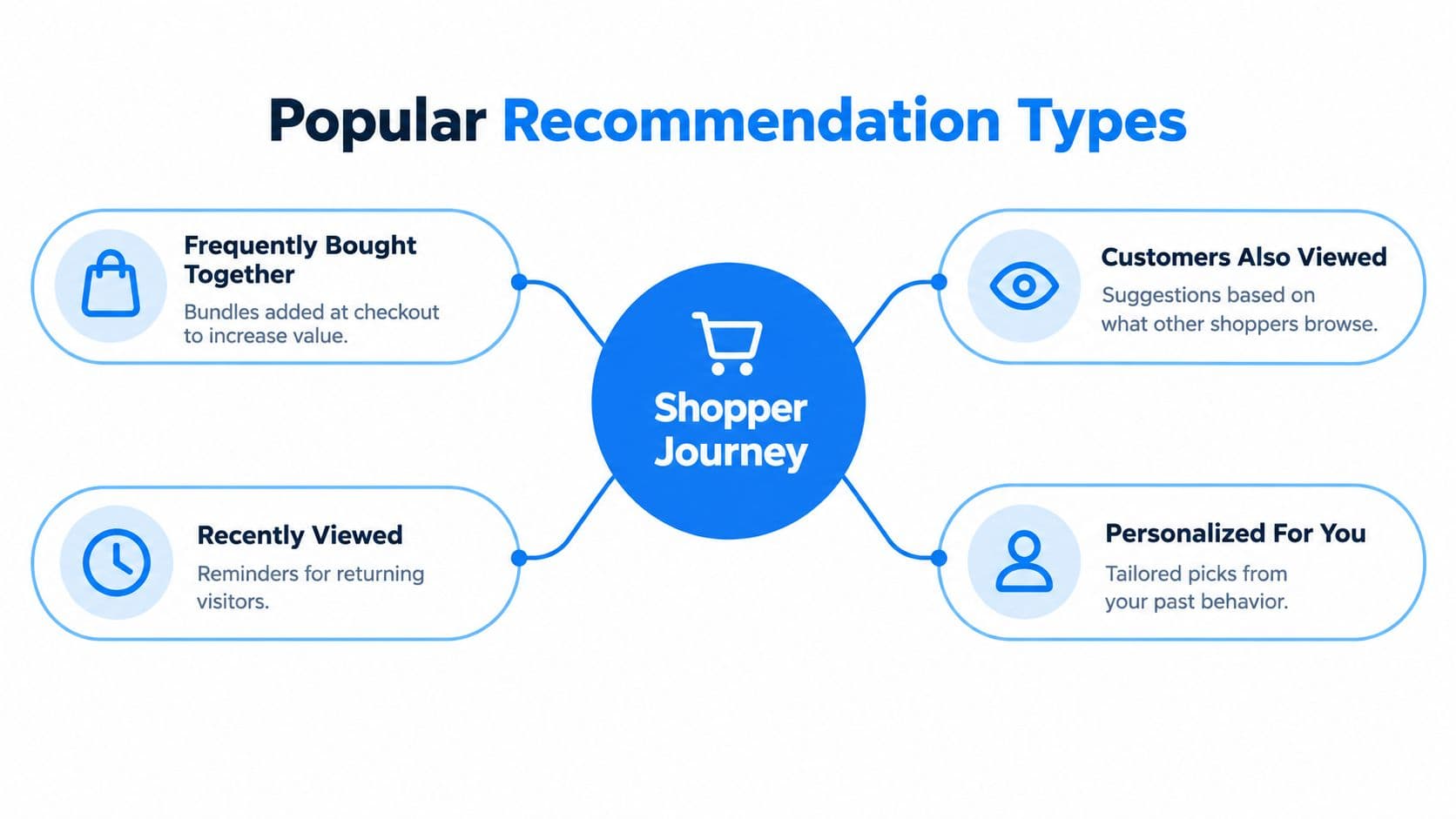
Frequently Bought Together
This widget works when products form a practical combination. A laptop may need a sleeve and a compatible adapter. A foundation may pair with a concealer or brush. A dining table may need chairs, care products, or a matching bench.
The recommendation should explain the relationship rather than display a disconnected list. “Complete your travel setup” gives the shopper a reason to consider the items. “Often purchased with this camera” gives a different reason, one based on observed buying patterns.
Merchants should also avoid automatic bundles that create awkward or unnecessary combinations. A recommendation that raises the price without improving the solution can reduce trust. The useful test is simple: would a knowledgeable associate suggest these items for the same task?
Customers Also Viewed
This type supports browsing and comparison. It's especially useful when the shopper hasn't settled on a product, such as when comparing sofas, running shoes, or skincare formulas.
Place alternatives where they help the decision, but don't let them compete with the primary purchase action too early. Product differences should remain understandable. If every suggestion looks identical, the widget adds visual noise rather than decision support.
Recently Viewed
Recently viewed products help shoppers recover a disrupted journey. They're valuable for visitors who compare several options, leave to check measurements, or return after a pause.
Use this pattern as a reminder, not as the entire personalization strategy. A returning shopper may still have a different mission from the one they had during the previous visit. Pairing recently viewed items with current-session signals can prevent stale recommendations from dominating the page.
Personalized For You
This format works best when the store has enough evidence to make the suggestions feel intentional. It can use prior browsing, purchases, stated preferences, or current catalog context.
For a practical view of how recommendation types support upselling and cross-selling, the Chicago Brandstarters guide to cross selling offers useful merchandising context. The central principle is to connect the suggestion to customer value, not just to a higher basket total.
Stores can also adapt the label to the mission. “Build your routine,” “Find your matching pieces,” or “Replacement options” communicates more than a generic “You may also like.” For further guidance on implementing complementary suggestions, see this resource on cross-sell recommendations.
Designing High-Converting Recommendation Placements
Placement determines what the recommendation is allowed to do. A homepage widget introduces possibilities. A product-page widget supports evaluation. A cart widget helps the shopper finish a solution without pulling them away from checkout.
Recent data reinforces why context matters. 63% of shoppers say the most important factor in choosing is finding products that match their current shopping mission, according to Constructor's ecommerce research. That finding supports a mission-based approach: the same customer may need completely different recommendations depending on the page, query, and task in front of them.
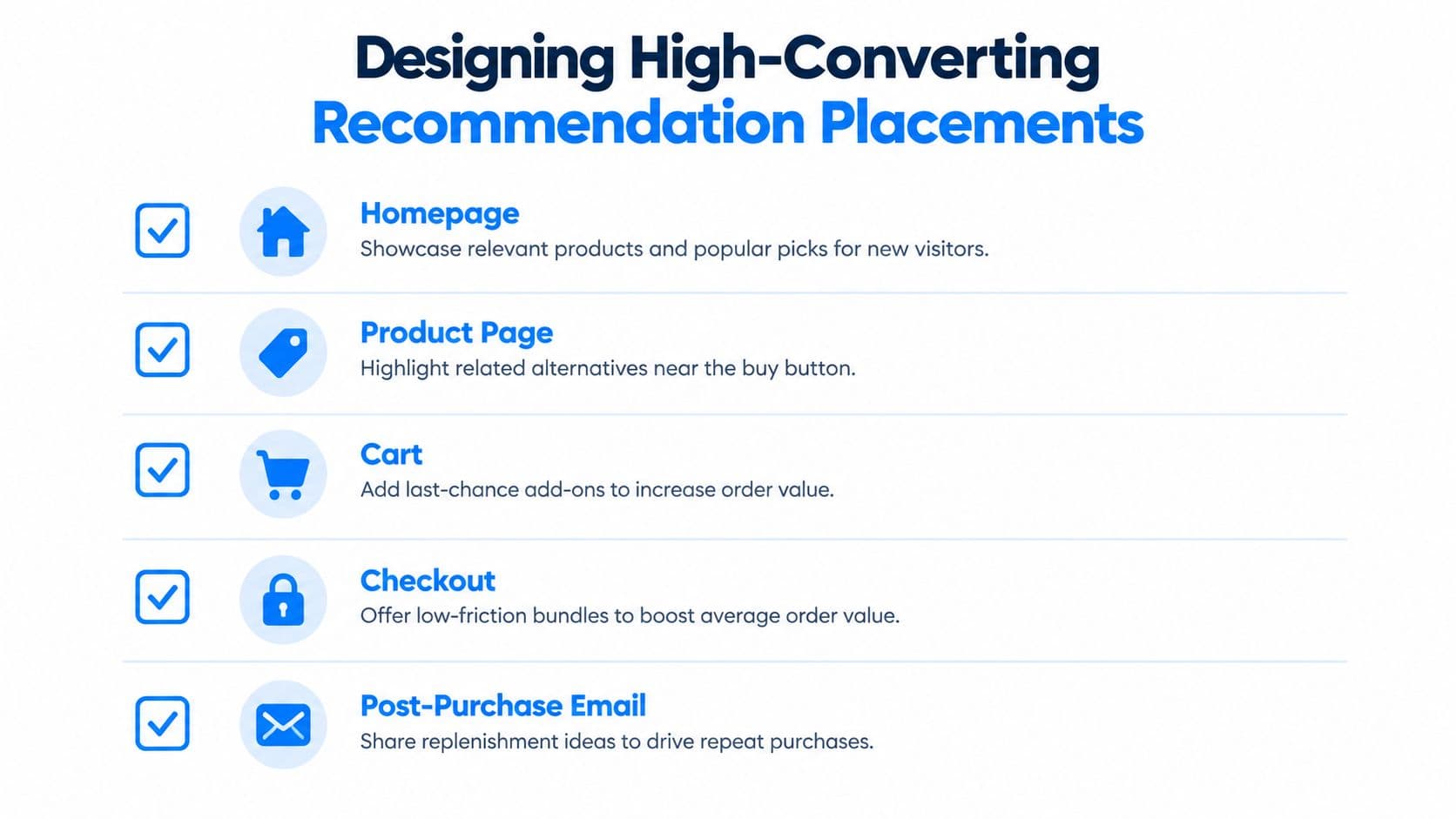
Match placement to shopper intent
Homepage: Use recommendations for orientation and discovery. New visitors need clear paths into categories, use cases, and popular entry points. A broad “Shop by need” area can be more useful than a carousel based on unknown visitor history.
Collection page: Help shoppers narrow the assortment. Recommendations can surface complementary categories, popular combinations, or products that fit a declared use case. Keep filters and sorting visible so the shopper remains in control.
Product page: Support the decision already underway. Show alternatives when the product may not fit, and show complementary items when the shopper appears ready to build a complete solution. Keep related products close enough to be discovered without pushing the buying information out of view.
Cart: Reduce last-minute friction. A cart recommendation should be easy to understand, compatible with the current items, and simple to add. If a shopper has added a camera, an in-stock memory card may be helpful. A completely unrelated bestseller is likely to distract.
Post-purchase email: Help with replenishment, care, or the next logical use. The message should reflect what the customer bought and the likely follow-up need, rather than reopening the entire catalog.
Recommendations should feel like a helpful handrail. If shoppers have to stop their task to interpret the widget, the placement is working against conversion.
Build around the mission, not the customer label
Labels such as “new visitor” or “returning customer” can help, but they're weak substitutes for actual intent. A returning customer might be buying a gift, replacing a damaged item, or shopping for a different season.
Use lightweight prompts to clarify the mission. A fashion store can ask whether the shopper is dressing for work, travel, or an occasion. A wellness store can ask what outcome the customer wants. A parts retailer can ask for the model or compatibility requirement.
Behavioral signals then refine the answer. Search terms, current product views, cart contents, category movement, and dismissed products can reveal what the shopper is doing now. Negative signals are particularly useful. If someone repeatedly skips a product family, stop showing it as the default recommendation.
Product-page structure matters too. Merchants evaluating recommendation placement should also review broader product detail page optimization for 2026, because recommendations can't compensate for unclear pricing, weak product information, poor imagery, or an uncertain primary call to action.
Measuring the True Impact of Your Recommendations
A recommendation widget can generate clicks without generating incremental business. A shopper may click a suggested product instead of buying the product they originally intended to purchase. If the merchant counts only widget-attributed sales, that substitution can look like success.
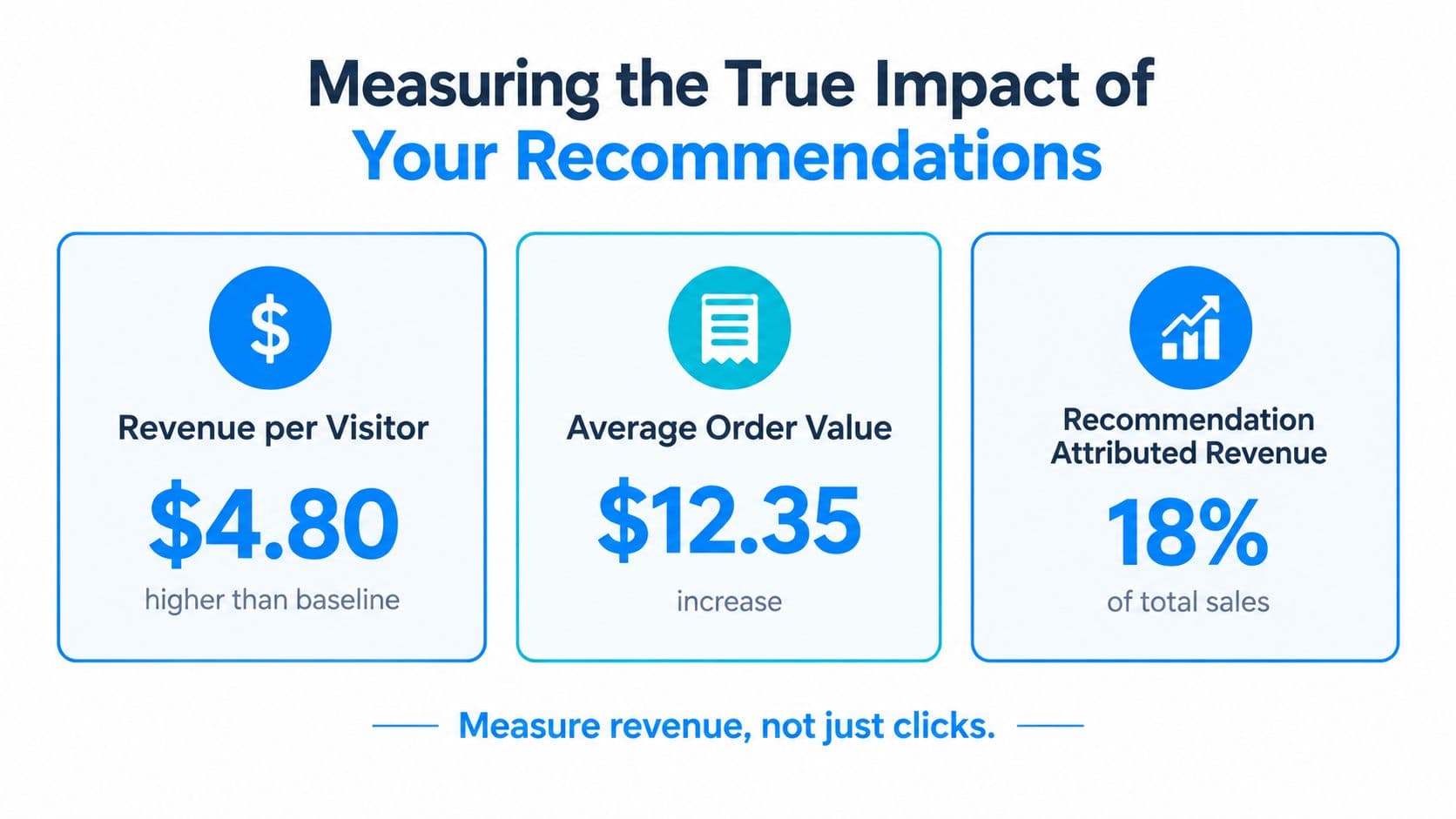
A University of Florida field experiment analyzed more than 2 million product-page views from nearly 1 million visitor sessions on a major fashion retailer's website. The researchers found that recommendations increased sales of recommended products by 9%, while sales of the products shoppers were originally viewing declined by 1.9%. After accounting for that substitution, overall product sales still increased by 11%. The findings are summarized by the University of Florida Warrington College of Business.
Measure the whole journey
The study's main lesson is methodological. Merchants should measure what happened to the entire order and customer journey, not only what happened inside the widget.
Track these outcomes together:
- Net revenue: Compare total revenue against a suitable baseline, including orders where shoppers saw recommendations but didn't click them.
- Average order value: Check whether recommendations increase the value of completed orders without introducing excessive discounting or low-margin products.
- Conversion rate: Monitor whether recommendation exposure helps more sessions reach purchase, while separating page and traffic contexts.
- Assisted conversion: Record cases where a recommendation influenced the journey even if the final product wasn't the suggested item.
- Return rate: A recommendation that increases orders but sends customers toward poor-fit products can create downstream costs.
- Usefulness signals: Track saves, add-to-cart actions, dismissals, and direct shopper feedback when those signals are available.
A clean test compares a recommendation experience with a control experience. Keep the comparison specific to the placement and audience. Homepage discovery should not share the same success criteria as cart add-ons, because the shopper's intent differs.
Watch for product-level differences
Recommendation performance isn't uniform across a catalog. The University of Florida researchers found that popular products connected to many other products received a stronger sales boost, while less-popular products could perform worse when recommendations appeared. That means merchants should avoid treating a single algorithm or widget setting as universally effective.
Review performance by category, product popularity, price position, margin, and shopper mission. An accessory recommendation might work well after a high-intent product view but perform poorly on an exploratory landing page. A “similar products” module might help comparison shoppers while harming a shopper who has already made a decision.
Measurement rule: Optimize for incremental value, not the easiest attribution story.
How AI Is Supercharging Product Recommendations
Shopify merchants can start with theme-level recommendation blocks, merchandising rules, or dedicated apps. Those options cover straightforward use cases, such as related products, frequently purchased combinations, and manually selected alternatives. The limitation appears when shopper intent changes faster than the merchant can maintain rules.
AI can interpret more context at once. Instead of relying only on a product ID or a historical purchase, an AI-assisted system can combine the shopper's question, current page, browsing behavior, cart contents, product attributes, and availability. That makes it possible to recommend alternatives, complements, bundles, or substitutes that fit the immediate mission.
A conversational interface is particularly useful when the shopper's need doesn't map neatly to a category filter. “I need a breathable outfit for a summer wedding” contains occasion, comfort, and style information. “I need a replacement for this discontinued part” contains compatibility and availability requirements. The recommendation should respond to those constraints, not just retrieve visually similar products.
Carti is one option for Shopify stores that want conversational assistance alongside product discovery. Its Smart Suggestions feature uses the store catalog and shopper behavior to surface relevant products, while its chatbot can answer questions and recommend complementary products, alternatives, bundles, or in-stock substitutes.
A store still needs clear product data and sensible business rules. AI can identify relationships, but merchants should define exclusions, protect compatibility requirements, respect inventory, and review recommendations that affect regulated or sensitive categories.
The practical implementation path is straightforward:
- Clean the catalog: Maintain accurate categories, attributes, compatibility details, variants, and availability.
- Define missions: Write the shopper tasks your store serves, such as gifting, replenishment, outfitting, replacement, or routine building.
- Choose page roles: Decide whether each placement supports discovery, comparison, completion, or follow-up.
- Test net outcomes: Measure total commercial impact rather than clicks alone.
- Review exceptions: Remove recommendations that conflict with customer intent, inventory, margin, or fit.
The following video can provide additional visual context on how recommendation experiences fit into ecommerce journeys.
For a closer look at conversational approaches, explore AI product recommendations for Shopify. The goal isn't to automate every merchandising decision. It's to give shoppers faster, more relevant help while giving merchants a clearer way to learn which missions, relationships, and placements create value.
Carti helps Shopify stores answer shopper questions, recommend relevant products in real time, and support cart recovery through an AI-powered sales assistant. Visit Carti to see how conversational recommendations can turn product discovery into practical buying guidance.

Written by
Daniel AndersonFounder of Carti. 10+ years building ecommerce brands in apparel and supplements. Still runs a Shopify store and built Carti to help merchants convert more browsers into buyers.
Ready to boost your store's sales?
Install Carti in 5 minutes and let AI handle customer questions, recommend products, and close sales 24/7.
Start Free Trial14-day free trial