
A shopper is comparing two products, pauses over sizing, then asks whether either will arrive before an upcoming trip. The store needs an answer while that customer is still deciding. Rep AI and Gorgias can both be part of the response, but they're built around different jobs: helping a shopper choose before checkout versus helping a support team manage customer issues.
That distinction matters more than a chatbot feature checklist. The right comparison depends on whether the store's most expensive friction is product uncertainty or post-purchase support work, and whether one tool can handle its own workload without becoming an awkward replacement for the other.
Why Shopify Merchants Compare Rep AI and Gorgias
A product question can look like a support issue while being a sales obstacle. If a shopper asks which of two moisturizers suits sensitive skin, an answer about the catalog could help them choose. If they ask where an order is after checkout, the store needs order context and a support process. Both conversations may start in chat, but they call for different systems and outcomes.
Rep AI approaches the first situation as an AI shopping assistant. It's designed to recognize browsing behaviors that may signal hesitation, then start a conversation with relevant product help. Gorgias approaches the second as an ecommerce helpdesk, where agents can work with Shopify order information and manage service requests. Its Shopping Assistant adds a pre-purchase use case, but the platform's center of gravity remains customer support.
That difference makes a simple feature list misleading. A tool that answers more questions isn't automatically better if it answers the wrong questions for the store's main bottleneck. Likewise, an automation rate that reduces agent workload doesn't establish whether shoppers found the right product or whether a conversation contributed to a sale.
Merchants comparing conversational tools can also benefit from a broader look at the helpdesk category, such as Convot's comparison of Convot and Gorgias. The useful starting point, though, is the store's own conversation mix. Catalog, fit, sizing, and product-comparison questions tend to arise before checkout. Order status, refunds, cancellations, and delivery problems tend to arrive after checkout.
The practical question isn't which chatbot is better. It's whether the store needs to sell more through storefront conversations, support more customers through service workflows, or cover both jobs with a clear handoff between them.
What Rep AI and Gorgias Actually Do
Rep AI is positioned around pre-purchase conversion. Its behavioral AI can use signals such as product comparisons, repeat browsing, exit intent, and cart hesitation to start contextual conversations. Within those conversations, it supports natural-language product discovery, follow-up questions, recommendations, and cross-sell prompts. That makes it relevant when shoppers need help narrowing choices before they buy.
Gorgias is primarily a customer-service helpdesk for ecommerce. It gives support teams Shopify order context alongside customer conversations, so agents can handle requests such as refunds, cancellations, order edits, and escalations. Its AI Agent and Shopping Assistant add automation and shopping-related capabilities, but the helpdesk remains central to how merchants use the product.
The products also differ in their business histories. Gorgias was founded in Paris in 2015, and its company profile reports more than $100 million in total funding, including a $30 million Series C round in 2022, and more than 10,000 customers (Gorgias company profile). Those milestones indicate a mature support-infrastructure business. Rep AI is more specialized around AI commerce, but the available comparison evidence doesn't establish an equally substantiated founding date, funding total, or customer count, so direct scale comparisons wouldn't be fair.
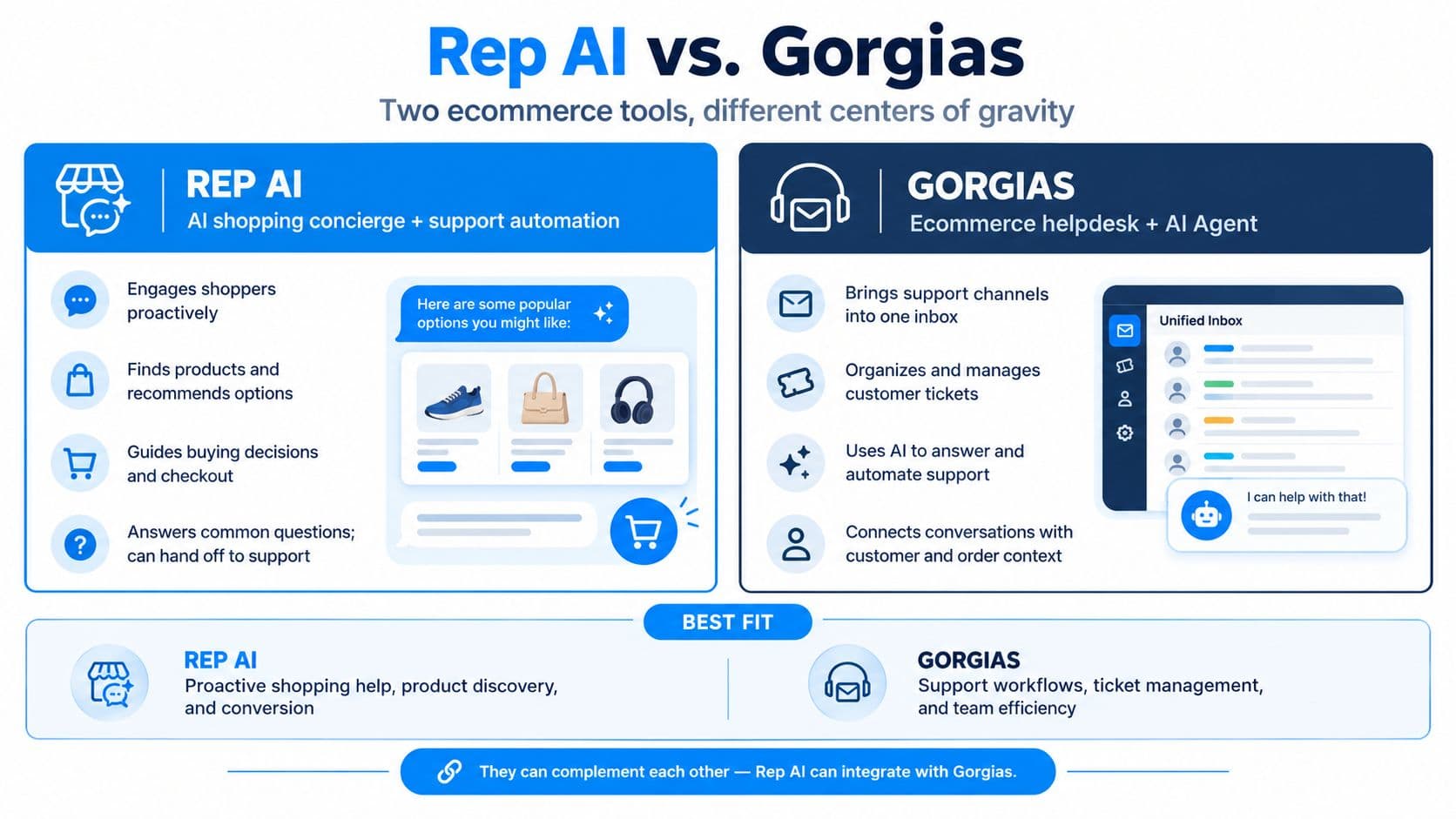
For a Shopify operator, that history is context, not a verdict. Gorgias is a helpdesk benchmark with a substantial installed base. Rep AI is a more focused benchmark for proactive shopping assistance and product discovery. The useful choice is the one that matches the workload the store needs to improve.
Feature Comparison Across AI and Shopify Integration
Rep AI's clearest distinction is behavioral triggering. Instead of waiting only for a shopper to open chat, it can initiate a conversation when browsing behavior suggests a comparison, hesitation, or possible exit. That approach fits product-led conversations, though proactive prompts still need careful setup: a timely offer of help can be useful, while an irrelevant interruption can get in the way.
Gorgias is stronger when the conversation needs customer history and operational action. Its official Shopify integration makes order history, lifetime spend, tags, fulfillment status, and order notes available in Gorgias. Agents can duplicate, cancel, refund, and edit Shopify orders from the ticket sidebar or through macros, without leaving the helpdesk (Gorgias Shopify integration documentation).
The boundary between the tools matters in a combined setup. When Rep AI can't resolve a conversation, it can hand the full chat to a Gorgias team for human handling. That keeps the shopper's context intact instead of making them start over. For broader thinking on how personalized product interactions fit into ecommerce, Presidio's guide to Shopify personalization strategies offers additional context.
| Capability | Rep AI | Gorgias |
|---|---|---|
| Primary role | Product discovery and proactive pre-purchase conversations | Ecommerce helpdesk, agent workflows, and support automation |
| Conversation start | Can trigger conversations using shopper behavior and context | Supports helpdesk conversations and a Shopping Assistant |
| Product assistance | Natural-language discovery, follow-up questions, recommendations, and cross-sell prompts | Shopping Assistant conversations, alongside its helpdesk functions |
| Shopify order work | Not the primary distinction described in the available comparison evidence | Agents can duplicate, cancel, refund, and edit orders from the ticket sidebar or macros |
| Human escalation | Can hand unresolved chats to a Gorgias team | Gives agents a place to manage escalated conversations |
These tools aren't interchangeable just because both involve AI and chat. A closer look at Gorgias versus Shopify Inbox can help merchants distinguish a dedicated helpdesk from Shopify's native messaging option. For this comparison, the central question remains whether storefront assistance or support operations are the larger gap.
Pricing and Cost per Conversation
Rep AI's Shopify App Store listing prices its plans by monthly visitor volume, not support-ticket volume. The listed tiers are $104 per month for up to 10,000 visitors and 1,000 products, $209 per month for up to 25,000 visitors and 2,000 products, and $368 per month for up to 50,000 visitors and 5,000 products. Additional usage is listed at $12 per extra 1,000 visitors (Rep AI's Shopify App Store listing).
Gorgias's official pricing page lists helpdesk tiers by tickets per month: 50, 300, 2,000, or 5,000 tickets. Its displayed plan limits include 3 user seats for Starter and 500 seats for each of Basic, Pro, and Advanced, as well as an API rate limit of 2 requests per second (Gorgias pricing). Those ticket limits make the helpdesk bill easier to relate to support volume, but they don't represent the full cost of AI automation.
Gorgias prices its AI Agent separately from the helpdesk subscription. The company lists $0.90 per independently resolved conversation on annual billing or $1.00 on monthly billing for most plans. Starter begins at $1.00 per resolved conversation, and listed plan coverage ranges from 90 to more than 2,500 AI-resolved conversations per month (Gorgias AI pricing information).
These pricing models measure different things. Rep AI's visitor tiers make traffic a key cost input, even when visitors don't contact support. Gorgias combines ticket-based helpdesk pricing with a separate charge for AI resolutions. To compare costs, a merchant should estimate storefront traffic, support-ticket volume, and the number of conversations likely to be resolved by AI, then include the helpdesk plan where applicable.
The published per-resolution figures aren't a controlled comparison. The vendors use different definitions of a resolution and price different workloads. A merchant looking at Shopify AI chatbot pricing considerations should therefore compare the actual bill against the intended outcome, not assume that a lower listed unit price makes one product cheaper for every store.
The Real Decision Is Workload Not Chatbot Features
Customer expectations span both sides of the purchase. Seventy-four percent of customers expect online shopping to offer capabilities comparable to in-person or telephone shopping, while 66% expect fast support through automated systems and 33% believe brands deliver it, according to the comparison evidence cited by ToolRadar's Rep AI versus Gorgias overview. The gap is a reason to examine the customer journey, not proof that one vendor will close it.
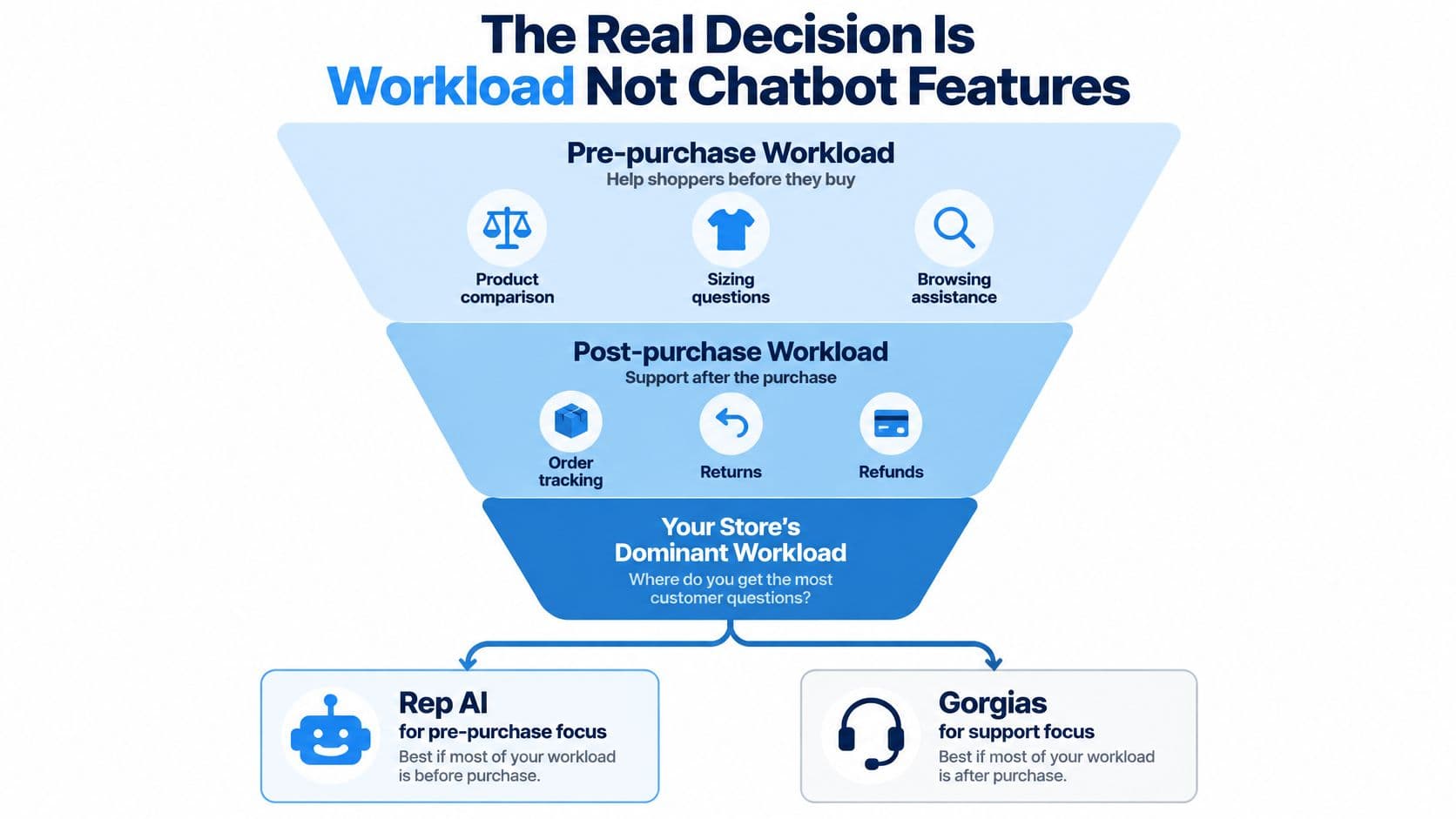
A store should begin by separating conversations into two broad groups:
- Before checkout: Product discovery, fit, sizing, shipping questions, and comparisons.
- After checkout: Order status, delivery problems, refunds, returns, and cancellations.
Rep AI aligns more naturally with the first group because it focuses on contextual engagement and product recommendations. Gorgias aligns more naturally with the second because it gives support agents Shopify order context and tools for order workflows. A merchant that uses a helpdesk automation rate as its only success measure may miss whether a storefront assistant helps shoppers find a suitable product.
Budget rule: Fund the workload that costs the store more when it goes unanswered. Don't buy a full helpdesk AI suite to address product uncertainty alone, and don't expect a shopping assistant to replace mature post-purchase operations.
This workload view also clarifies how other customer channels fit. For stores that handle customer conversations by text, CartBoss's 2026 guide to business texting provides a separate reference point for thinking about service outside the storefront chat widget.
Before committing to either product, merchants can classify recent conversations by topic and purchase stage. Then they can ask whether the dominant pain is shoppers leaving without product answers, or agents spending time on repeatable order questions. A broader explanation of chatbot versus live chat can also help teams set realistic expectations about automation and human involvement.
How to Choose Based on Your Store Profile
Start with the questions customers already ask. The category of store can offer clues, but the transcript is more useful than a stereotype. A fashion catalog may draw repeated sizing and comparison questions, while an essentials store may receive more delivery and order-status requests. Neither pattern should be assumed without looking at the store's own conversations.
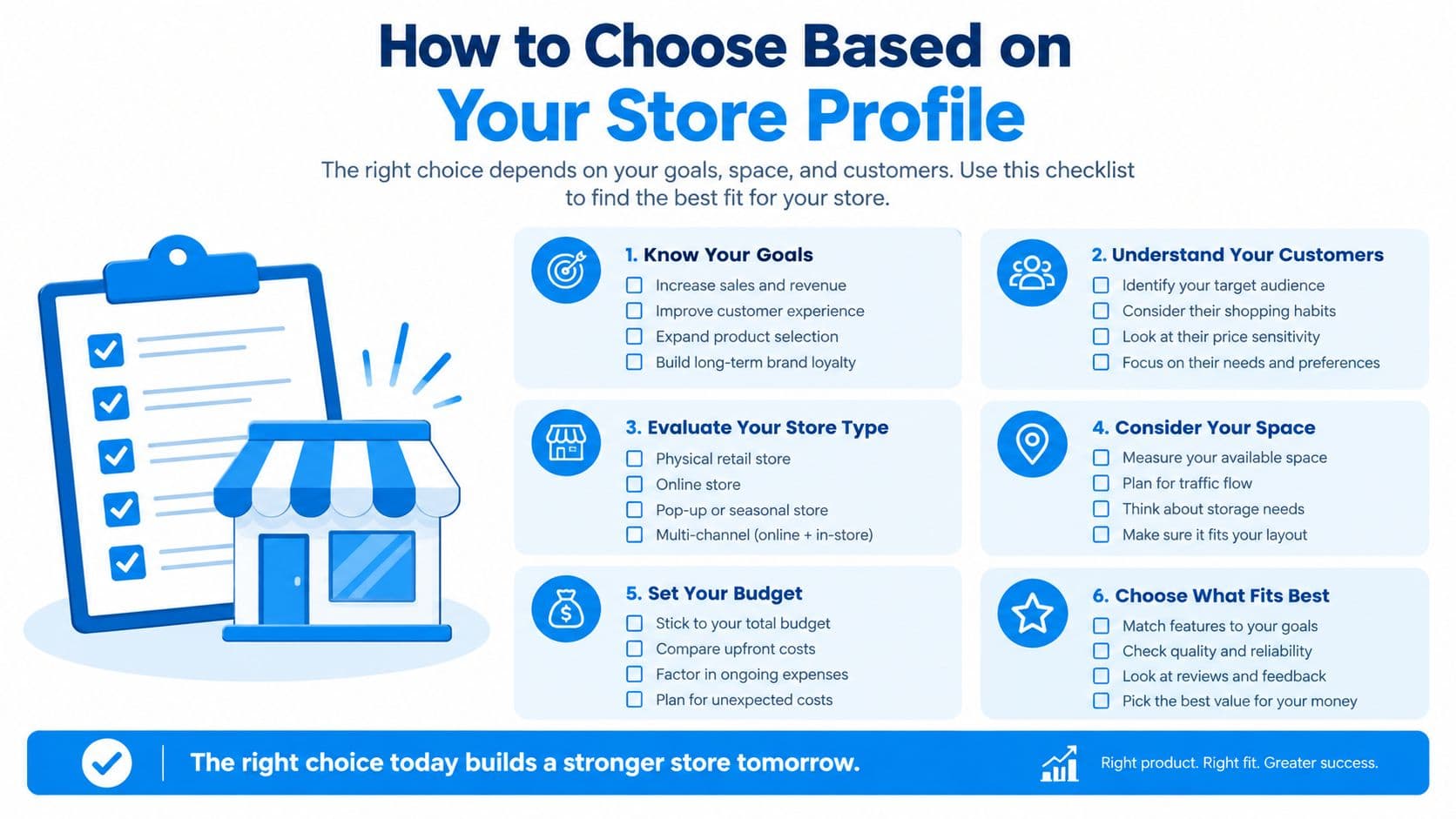
A practical decision can follow these steps:
- Sort conversations by stage. Label catalog, fit, sizing, shipping, and product-comparison questions as pre-purchase. Label tracking, refunds, returns, cancellations, and delivery problems as post-purchase.
- Identify the expensive failure. If shoppers abandon because they can't choose, test a storefront assistant. If agents spend time on order lookups and repetitive service work, assess the helpdesk workflow.
- Match the tool to the workload. Rep AI is the more direct fit for proactive product conversations. Gorgias is the more direct fit for agent queues and Shopify order operations.
- Measure outcomes separately. For pre-purchase conversations, track assisted conversion rate, revenue per engaged session, average order value, and product-question resolution rate. For support, track escalation rate, first-response time, and cost per resolved conversation.
- Review the quality, not just the count. Check whether answers are accurate, whether escalations reach the right team, and whether shoppers get useful help without unnecessary interruptions.
A fair test needs a holdout group, meaning a comparable portion of storefront traffic that doesn't see the assistant. Segment traffic consistently and compare the same measures across the test and holdout groups. Without that comparison, revenue attributed to a conversation can include shoppers who may have purchased anyway.
Keep the reporting focused on the tool's job. A lower ticket count doesn't necessarily mean shoppers got better buying advice, and a high number of product conversations doesn't prove that the helpdesk is resolving service issues. The useful result is a clear view of which workload improved and what it cost to improve it.
Best-Fit Store Profiles and When to Use Both
A store with product uncertainty as its main conversion obstacle should evaluate Rep AI first. Fashion, beauty, home, and wellness merchants may need customers to compare options, understand fit, or get a recommendation before buying. Rep AI's behavioral triggers and product-discovery focus are designed for that storefront moment.
A store with substantial support operations should look closely at Gorgias. Its Shopify order context and agent workflows fit teams dealing with order changes, refunds, cancellations, and escalations. That's particularly relevant when the support team needs to act on an order, not just answer a question about the catalog.
Stores with both needs don't have to force one product into the other's role. Rep AI can handle storefront conversations about sizing, product comparisons, recommendations, and FAQs. When it can't resolve a conversation, it can hand the chat to Gorgias for human support, allowing Gorgias to remain the place for post-purchase workflows and agent queues.
Keep the scorecards separate. Ticket deflection measures support efficiency. It doesn't, by itself, measure assisted revenue, product-discovery quality, or conversion lift.
That distinction helps merchants allocate budget without buying overlapping capability by default. If product uncertainty is the key friction, start by testing the shopping-assistant workload. If order operations dominate, invest in the helpdesk workflow. If both matter, treat the tools as complementary layers and require each to demonstrate value against its own measures.
Setup Migration and Measurement Tips
A fair evaluation starts with a defined question, not a vendor demo. Decide whether the test is meant to improve pre-purchase product help or post-purchase service handling. Then document the current process, including which conversations go to people, which receive automated answers, and where customers still need to repeat themselves.
For Rep AI, assess how the assistant triggers conversations and whether the resulting product guidance fits the store's catalog. For Gorgias, connect Shopify and configure the relevant ticket workflows, then check that order context and escalation practices suit the team. If an existing chatbot or helpdesk is already in place, map its handoffs and unresolved conversations before changing the setup.
Run a holdout test by storefront traffic segment and compare assisted conversion, revenue per engaged session, average order value, product-question resolution, escalation rate, first-response time, and cost per resolved conversation. Review conversation quality alongside the metrics, so an apparent reduction in workload doesn't conceal wrong answers or poor handoffs.
For merchants considering a focused alternative, Carti is an AI shopping assistant for Shopify with a Free plan covering 50 AI conversations a month, Starter at $49 for 250, Growth at $99 for 600, and Scale at $249 for 1,750. Paid plans include a 14-day free trial. Those limits make it possible to compare a storefront-assistant option against the distinct pre-purchase and helpdesk workloads described above.
Carti answers shoppers' pre-purchase questions about products, sizing, shipping, returns, and comparisons, then recommends suitable products through storefront chat. Review its plans and start a Carti evaluation if a focused Shopify shopping assistant fits the workload your store needs to address.

Written by
Daniel AndersonFounder of Carti. 10+ years building ecommerce brands in apparel and supplements. Still runs a Shopify store and built Carti to help merchants convert more browsers into buyers.
Ready to boost your store's sales?
Install Carti in 5 minutes and let AI handle customer questions, recommend products, and close sales 24/7.
Start Free Trial14-day free trial