
You're at the kitchen table late at night when the inbox gets two new conversations. One shopper wants a refund exception for a damaged order. Another is on a product page asking whether a particular size will fit, and that shopper won't wait until morning for an answer. There's no agent online, so one conversation needs judgment while the other needs a fast, accurate fact.
That's the core chatbot vs live chat problem for Shopify stores. A small team can't cover every time zone, product question, peak-demand spike, and emotional edge case with human agents alone. The practical decision isn't which channel replaces the other. It's what to automate, what to escalate, and where to route each intent.
A sizing answer can save a late-night sale. A delayed response can send that buyer to a competitor. Meanwhile, a bot forced to handle a damaged-order complaint can make a difficult situation worse. The stores that get this right use automation to capture routine demand and reserve people for conversations where trust, discretion, or merchant judgment matters.
The 11pm Refund Question Every Shopify Owner Faces
At 11pm, the refund request is personal. The customer may be angry, worried, or asking for an exception your published policy doesn't cover. A human should review that conversation, understand what happened, and decide whether the store can make an accommodation.
The sizing question beside it is different. The shopper wants to know whether a garment runs small, whether ingredients suit their needs, or whether an order can arrive before a specific date. Those are buying questions, and the shopper usually wants a direct answer immediately. If the answer arrives tomorrow, the sale may already belong to another store.
That split creates the operating model Shopify merchants need:
- Automate factual buying questions. Product details, sizing guidance, shipping windows, return rules, discount-code conditions, and stock availability are usually structured enough for a chatbot.
- Escalate judgment calls. Refund exceptions, damaged orders, payment problems, complaints, and account-related requests need a human path.
- Protect after-hours demand. A bot can respond when the founder is asleep, while the human team handles the conversation when it requires discretion.
Practical rule: Don't ask a human to answer the same shipping question at midnight, and don't ask a bot to decide whether an upset customer deserves an exception.
This matters before the purchase as much as after it. Fit uncertainty contributes to hesitation and returns, so merchants improving product guidance may also benefit from practical resources on fit-confidence fixes for online stores. Better sizing information gives the automated assistant a stronger foundation and gives shoppers a reason to trust the answer.
Live chat still earns its place. A human can inspect the order, interpret unusual circumstances, and communicate empathy when a standard policy isn't enough. But running live chat as the only channel leaves product questions unanswered outside staffed hours, exactly when a lean Shopify team has the least capacity.
The better question is simple: which conversations create value from instant automation, and which ones justify human attention?
What Chatbots and Live Chat Actually Do on a Store
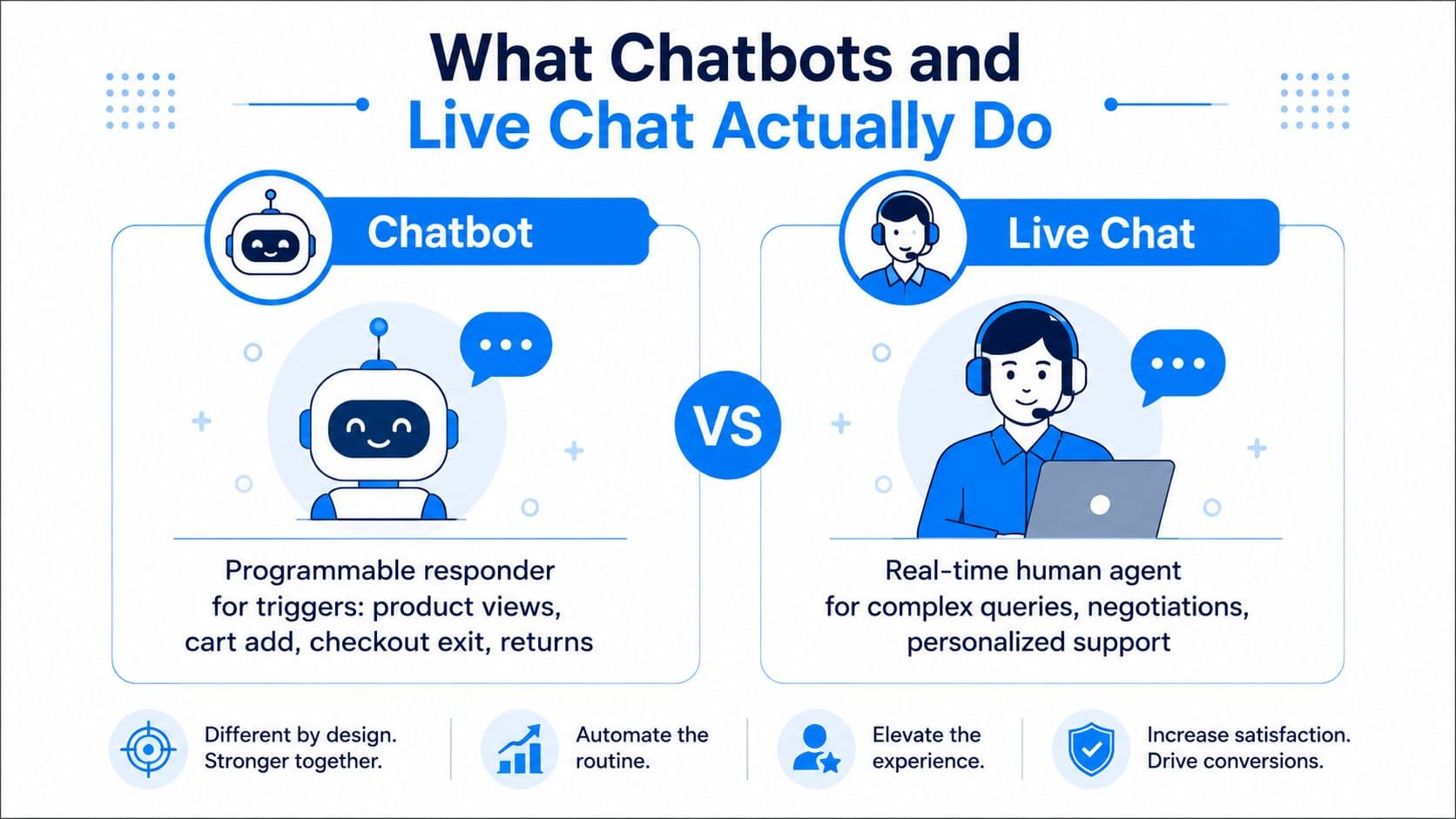
A chatbot is a programmable responder connected to your storefront information. It can react to product-page views, add-to-cart activity, checkout exits, return-policy visits, or direct questions. Depending on its integrations, it can use catalog data, FAQs, shipping rules, and order information to answer shoppers without putting them in a queue.
Live chat is a synchronous conversation with a human agent. The agent can verify identity, inspect a specific order, interpret a policy, issue or recommend a refund, negotiate an exception, and respond to emotional context. Its strength isn't just language. It's judgment.
The response-time gap shapes the commercial difference. One 2026 benchmark places average live-chat first response at 46 seconds, while top performers answer in under 15 seconds, and 71% of consumers expect a response in under 60 seconds (Chatbot.com's customer-service benchmarks). Another benchmark reports an e-commerce average of about 1 minute 48 seconds, with leading brands answering in 12 to 30 seconds and shoppers expecting less than a minute, as summarized in the same research.
A chatbot can answer immediately, including outside business hours. Live chat can deliver a better interaction when the right agent is available, but staffing determines whether that promise exists at the moment the shopper asks.
The channel is less important than the job
A bot should own repeatable questions with clear answers. A human should own ambiguity, emotion, and actions that require permission or account access.
That distinction explains why live chat hasn't disappeared. A large industry dataset analyzed 1.676 billion chats, with an average first response time of 35 seconds, a typical chat duration of 8 minutes 25 seconds, and availability of 17 hours 58 minutes per day (GreetNow's live-chat statistics). The same report counted 163.48 million chatbot-involved conversations, showing that automation is being embedded inside live-chat workflows rather than replacing human support.
For merchants building better automated answers, the difference between scripted matching and natural-language understanding matters. A useful overview of NLP and chatbots explains why a system must interpret shopper intent instead of waiting for one exact keyword.
The store-level architecture is therefore straightforward. Let the chatbot make first contact, answer what it can verify, and identify intent. Let live chat begin when the request needs a person.
Head-to-Head Comparison Across the Metrics That Matter
A shopper opens your store during a late-night promotion and asks about delivery. Another wants a refund for a damaged order. Routing both conversations to the same channel wastes either the shopper's time or your team's attention. Shopify operators should compare chatbot and live chat by intent, then assign each channel the work it handles best.
Chatbot vs live chat key performance metrics
| Metric | Chatbot | Live Chat |
|---|---|---|
| Response time | 1.8 seconds in one 2026 comparison | 2.5 minutes in the same comparison |
| Cost per conversation | $0.07 in the same comparison | $6.00 in the same comparison |
| Concurrent conversations | Unlimited in the cited comparison | 3 to 5 per agent in the cited comparison |
| Languages covered | 50+ languages simultaneously in one 2026 ecommerce comparison | 2 to 4 languages for live-agent teams in that comparison |
| Empathy ceiling | Limited when judgment or emotion dominates | High for personal, complex, or sensitive cases |
| CSAT | 64.7% for chatbot-handled chats in one benchmark | 64.2% for human-handled chats in the same benchmark |
The response-time and cost figures come from a 2026 comparison of AI chatbot and live-chat operations (LoopReply's chatbot versus live-chat analysis). The cited ecommerce comparison supplies the concurrency and language figures. The CSAT figures come from independent customer-service benchmarking.
What the rows mean for your store
Speed: Put the bot in front of shoppers who need a quick answer before buying. It can respond during queues, breaks, weekends, and overnight hours. Live chat earns its place when a question requires judgment, account access, or a decision the bot cannot make.
Cost: Human support includes staffing and operating costs. Automation absorbs repeatable demand without assigning an agent to every routine question. Use that saving to keep human coverage available for conversations where it affects trust or retention.
Concurrency: A bot can greet every visitor at once. An agent has finite attention, so live-chat capacity drops during launches, promotions, and support spikes. Set triggers that preserve the human queue for high-value or high-risk requests.
Languages: Multilingual automation gives a global Shopify store broader first-line coverage than a small agent team. Send conversations to a person when translation, cultural nuance, or a sensitive case could affect the customer's confidence.
Empathy: The bot should handle factual product and policy questions. A customer describing a damaged order, disputing a charge, or requesting an exception needs a human who can take responsibility and explain the available action.
CSAT: The near-parity between the cited chatbot and human averages does not make the channels interchangeable. Each channel may receive different intents, so measure resolution and satisfaction within those intent groups. Use a practical chatbot analytics guide to review intent, escalation, and outcome instead of relying on one blended score.
Which Shopper Questions Belong to the Bot
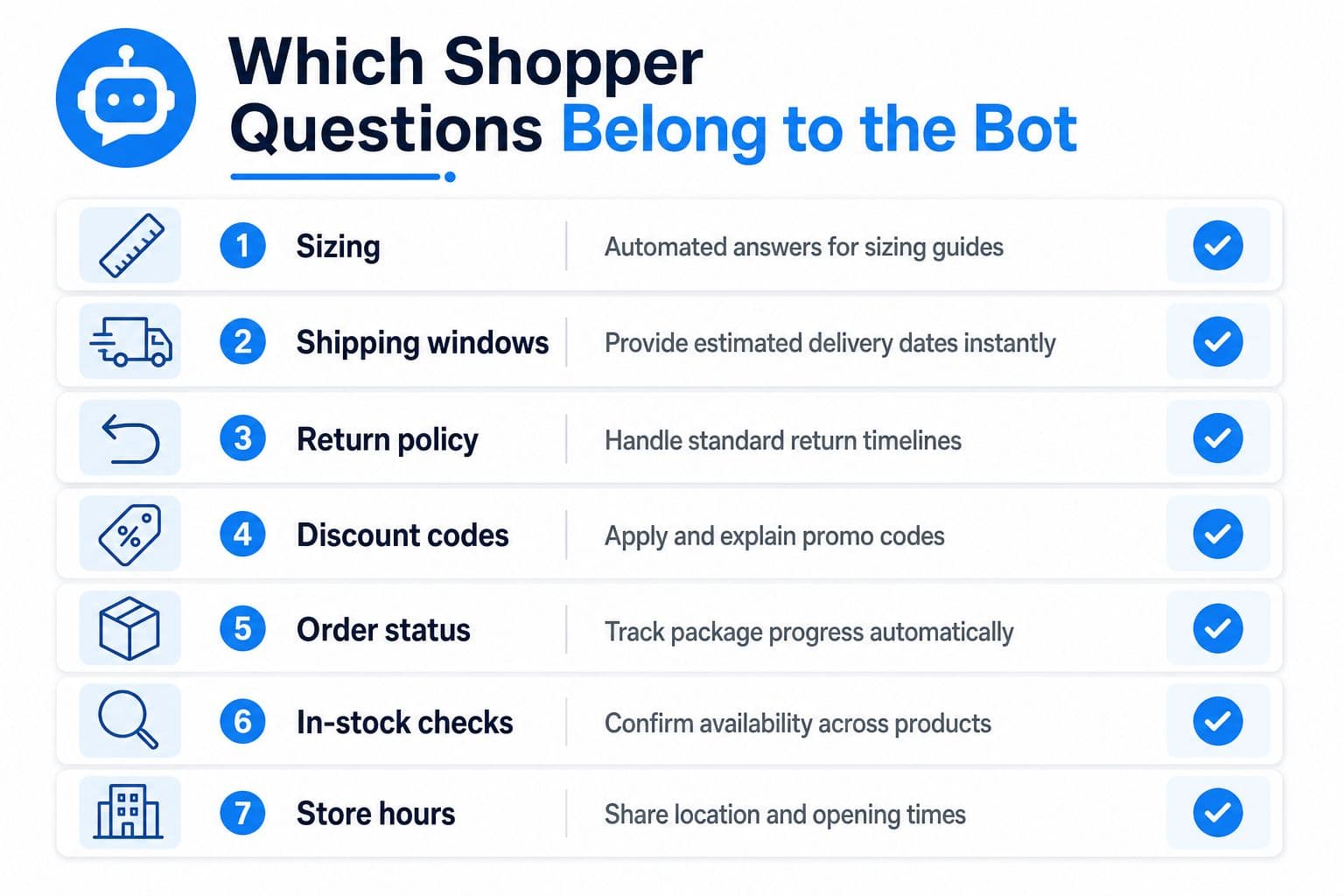
The bot should own questions with three characteristics: the answer is factual, the intent is common, and the emotional risk is low. That covers much of the pre-purchase journey and a large share of routine post-purchase requests.
Start with the questions that interrupt buying:
- Sizing: Explain size charts, measurements, fit notes, and product-specific guidance.
- Shipping windows: Provide delivery estimates based on the store's stated policy and destination rules.
- Return policy: Clarify eligibility, time windows, exclusions, and the basic process.
- Discount codes: Explain valid conditions without promising an exception.
- Order status: Retrieve tracking information or explain the next step.
- In-stock checks: Confirm whether a product, variant, or size is available.
- Store hours: Tell shoppers when human support is staffed and what the bot can handle meanwhile.
Independent ecommerce research supports this division. In a study of 5 billion website visits, Smartsupp found that chatbot-enabled shops handled 89.2% of inquiries, compared with 71.2% for shops without automated assistance (Smartsupp's analysis of ecommerce website visits). The result supports using bots for routine questions where quick, consistent answers remove friction.
The strongest bot question is one the shopper asks because they want to keep moving.
“Where is my order?” is a classic example. The system can provide status information without consuming an agent's time, while a human remains available for a package marked delivered but not received, a damaged parcel, or a delivery dispute.
The bot should not be the default route for four categories:
- Refund exceptions, because the merchant may need to weigh circumstances beyond the written policy.
- Payment failures, because account and payment details may require secure investigation.
- Account deletion, because identity, privacy, and confirmation steps matter.
- Complaints with prior context, because forcing an upset customer to repeat the history compounds frustration.
The rule isn't “automate everything simple.” It's automate what the store can answer accurately and safely.
The Three Triggers That Justify a Human Handoff
A handoff shouldn't happen because the bot has spent an arbitrary amount of time chatting. It should happen because the intent has crossed a clear boundary.
The shopper asks for a person
This trigger is essential. If someone types “human,” “agent,” or asks to speak with support, the bot should stop defending automation and offer the handoff. The request itself signals that continued bot interaction may damage trust.
The message shows frustration
Sentiment doesn't need to be perfect to be useful. Repeated questions, sharp language, accusations, or statements that the customer has already tried to solve the issue should prompt a human option. The goal isn't to diagnose emotion with certainty. It's to prevent a failing interaction from becoming a loop.
The topic requires judgment or access
Flag refund exceptions, damaged orders, payment failures, complaints, account changes, and other requests that require merchant authority. The assistant should never bluff through an action it can't perform.
The handoff should carry context, not just a notification. A useful summary includes:
- Who: Contact details and customer identity information available to the store.
- The issue: The shopper's stated intent and relevant order information.
- Attempts: Answers already provided and actions already tried.
- Reason: The exact trigger that caused escalation.
- Emotional temperature: Whether the shopper appears calm, confused, or frustrated.
A coordination study recommends escalating explicit human requests and verification failures immediately, while sentiment signals should prompt a human option, with a structured summary passed to the agent (HeyErnest's chatbot-human handoff guidance). The same principle applies across website chat and social messaging. On Messenger and Instagram, the escalation should remain in the same direct-message thread whenever the platform supports it.
A handoff that creates a dead end isn't a handoff. During staffed hours, set a response target of under 60 seconds, and after hours, tell the shopper exactly when a human will respond rather than implying someone is available.
Why Hybrid Beats Either Channel Alone
A hybrid setup routes shoppers by intent. The chatbot handles repeatable questions at any hour, while live chat takes over when the store must apply judgment, make an exception, or reassure a high-value buyer.
For a small Shopify team, that routing creates coverage without requiring someone to watch the inbox overnight. Carti's stated product coverage includes 92 languages and plans from a free tier (50 conversations a month) to Starter at $49 a month, which can help solo founders cover nights and weekends. These figures come from the product context for this guide, not an independent benchmark, so verify current plan details before choosing a tool.
Capacity also depends on the conversation. Chatbots can manage concurrent requests at scale, while one live-chat agent can handle only a limited number of conversations at once. Live chat earns its place when a shopper needs product judgment, negotiation, reassurance, or help with a situation the bot cannot resolve.
Automation should increase throughput, not remove human support. A bot can answer routine questions, capture intent, and collect useful context while the team focuses on complex sales, exceptions, and complaints. That division keeps human attention on conversations where it can protect revenue or prevent a poor customer experience.
Hybrid coverage by store size
| Daily Sessions | Bot Coverage | Human Coverage | Estimated Monthly Cost |
|---|---|---|---|
| Under 500 | Product questions, policies, order-status basics, after-hours coverage | Exceptions and escalations by founder or one agent | Tool subscription plus existing team time |
| 500 to 2,000 | Tier-one questions across the storefront and peak periods | Two-person coverage for complex sales and support | Bot subscription plus staffed support |
| Above 2,000 | First response, multilingual demand, repetitive support, and routing | Shifts or a part-time VA for escalated conversations | Bot subscription plus scheduled human coverage |
Use the table as an operating model, not a universal budget quote. Staffing costs vary by market, schedule, agent skill, and conversation complexity. The operating principle stays consistent: the bot absorbs volume while humans concentrate on value and risk.
Human access must remain visible. Shoppers dealing with complex problems often prefer a person, particularly for technical support, billing, damaged orders, and other issues that require account context or merchant authority. Hiding the live-chat option after the bot fails turns automation into a barrier.
Set the bot to answer routine questions, identify intent, and route the conversation when the request exceeds its authority. Keep the human path clear during staffed hours, then provide an honest after-hours response window. Hybrid works because each channel handles the moment it is built for, not because the store offers two disconnected chat widgets.
Implementation, Migration, and What to Measure First
Don't launch a chatbot across every page and hope the transcripts teach you what to fix. Start where a fast answer has the clearest commercial value, then expand after you've seen the questions real shoppers ask.
A practical rollout
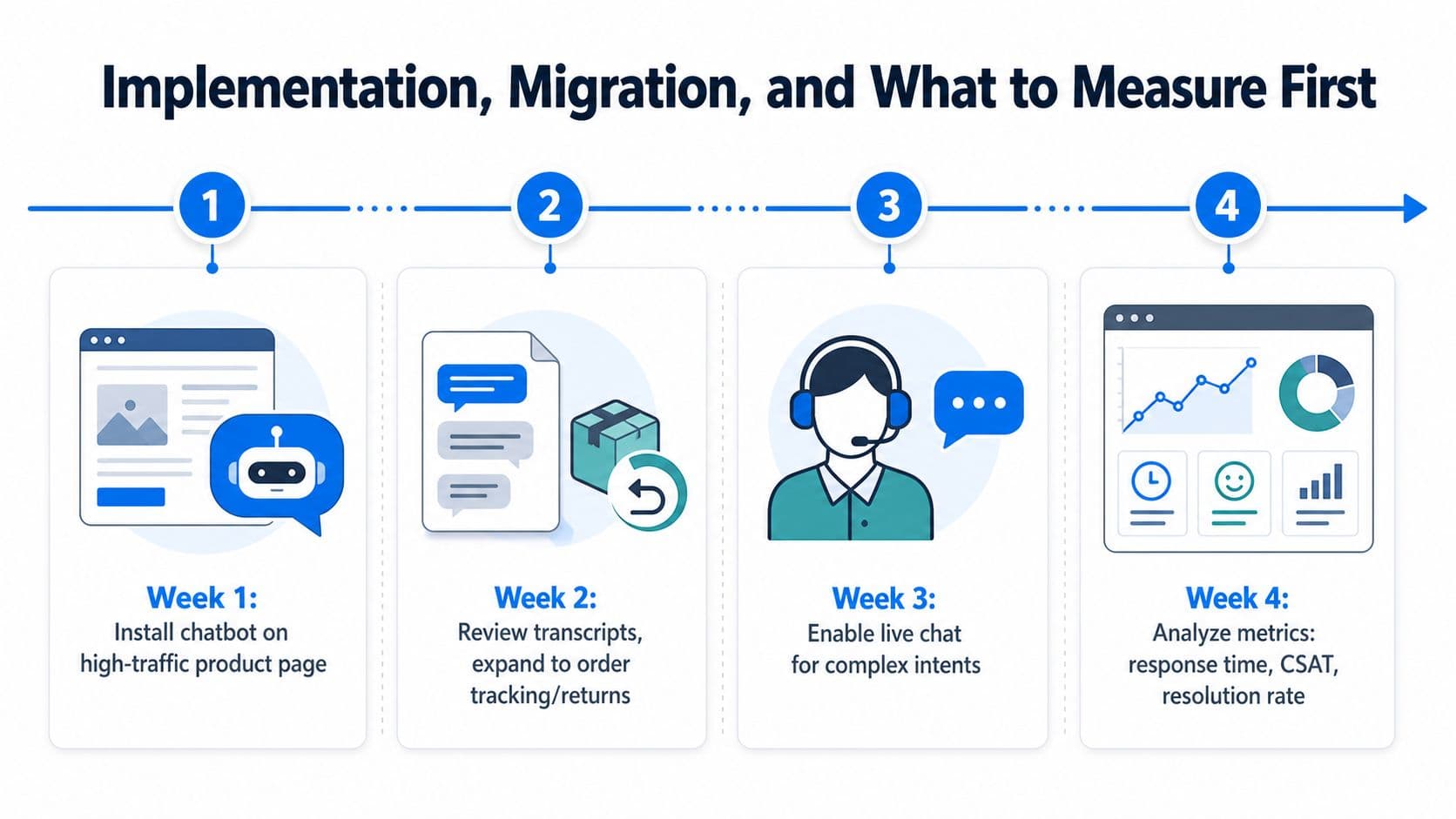
Week 1: Install the chatbot on one high-traffic product page. Load the catalog information, fit guidance, shipping details, and the questions the page already receives. Watch every conversation and mark wrong answers, missing information, and unnecessary escalations.
Week 2: Expand into order tracking and returns. Keep the bot inside clearly defined workflows, and update the source information when the transcript review shows ambiguity. Merchants discover that a vague shipping policy creates poor answers no matter how capable the software is.
Week 3: Enable live-chat handoff for complex intents. Add the three triggers, test the context summary, and run conversations where a human agent receives the transcript before responding. Don't turn on broad escalation until the agent can see what the shopper already asked.
Week 4: Move toward supervised after-hours coverage. Review the answers, inspect unresolved conversations, and decide which intents need stronger rules or a human fallback. A four-week roadmap can make this sequence easier to assign across a small team.
Moving from live chat only
If you already rely on live chat, audit your top 50 historical conversations and tag each by intent. Find the five recurring questions that agents answer repeatedly, then reproduce those answers as bot flows. Keep exceptions out of the first automation pass.
A greenfield launch can use two weeks for FAQ ingestion, one week for handoff testing, and one week of supervised deflection before overnight automation becomes the default, following the rollout plan for this guide. Those are planning allocations, not performance guarantees. A store with messy policies or poor product data will need more review.
Use only two primary measures during the first 30 days:
- Deflection rate on pre-purchase intents: Did the bot answer the shopper's question without unnecessary escalation?
- First-response time on handoff tickets: When a human was needed, how quickly did the store respond?
Review conversation quality every week. Grade accuracy, relevance, tone, and whether the assistant admitted its limits. Conversion data matters, but don't use it to excuse a bad answer that creates returns or erodes trust.
For Shopify merchants who want a no-code installation path, adding a chatbot to Shopify should begin with the same controlled rollout, regardless of the platform selected. The technology is only the delivery mechanism. The work is defining accurate answers and reliable boundaries.
Which Setup Fits Your Store Right Now
The right channel mix depends on three operating facts: team size, average order value, and traffic shape. A solo founder selling lower-priced products has a different support economics problem from a brand where one high-value order justifies a careful human conversation.
Channel mix by store profile
| Store Profile | Chatbot Role | Live Chat Role | Handoff Trigger |
|---|---|---|---|
| Solo founder, under 500 daily visitors, sub-$80 AOV | Answer product and policy questions, provide email handoff, cover nights and weekends | Skip live chat until support volume justifies an agent | Human request, exception, complaint, or account issue |
| Brand at $50K/month with $150+ AOV | Own pre-purchase FAQs, product discovery, shipping, and routine questions | Recover carts above $200 and handle post-purchase exceptions | High-value cart, refund exception, damaged order, frustration |
| High-traffic store above 10,000 daily sessions | Handle first response, multilingual questions, repetitive support, and routing | Cover complex sales, priority customers, and account-linked cases | Margin, lifetime-value signals, human request, sensitive intent |
The store profiles and thresholds in this table are operating recommendations for this guide, not independent benchmark findings. Use them as decision points, then adjust them after reviewing actual conversations, margins, and agent capacity.
A solo founder shouldn't install live chat just because a competitor's site has a human bubble. If the founder can't answer consistently, the widget creates an expectation the store can't meet. A chatbot with an email handoff gives the store broader coverage without pretending someone is online.
A higher-AOV brand should use both channels. Let automation answer sizing, ingredients, shipping, and compatibility questions, then route shoppers who need reassurance or are considering a significant purchase to a person. Human attention earns its keep when the conversation can change the decision or protect a valuable relationship.
Large stores need routing based on margin and lifetime value, not merely who arrived first. A first-time shopper with a complex product question may deserve human help, while a repeat customer with a simple order-status request should get a fast automated answer. The rule set should reflect the economics of the store, not the demo script of the software.
Teams building educational content about customer communication can also find relevant resources for educators, especially when training staff to distinguish factual questions from situations requiring empathy.
The recommendation is direct: start with a chatbot if your team can't cover demand, add live chat when human judgment affects revenue or retention, and connect the two with explicit handoff rules. Don't choose a channel based on novelty. Choose it based on the intent entering your storefront.
Carti provides Shopify stores with instant answers, product recommendations, cart-recovery assistance, and handoff support across routine and complex shopper conversations. Visit Carti to give pre-purchase questions around-the-clock coverage while keeping human attention focused on the cases where it matters most.

Written by
Daniel AndersonFounder of Carti. 10+ years building ecommerce brands in apparel and supplements. Still runs a Shopify store and built Carti to help merchants convert more browsers into buyers.
Ready to boost your store's sales?
Install Carti in 5 minutes and let AI handle customer questions, recommend products, and close sales 24/7.
Start Free Trial14-day free trial