
AI-driven traffic to Shopify stores grew 8 times year over year in Q1 2026, and orders from AI-powered searches increased nearly 13 times over the same period, according to Shopify's own reporting on agentic commerce. That's the clearest signal yet that the Shopify agentic storefront isn't a novelty layer. It's becoming a measurable sales channel, with real merchant analytics, real checkout outcomes, and real pressure on teams to treat AI shopping like revenue, not content.
The catch is simple. Most storefront bots still behave like polished FAQ widgets, while the stores winning with AI are building grounded systems that can answer, recommend, and take action without guessing. In practice, the difference comes down to whether the agent knows the store truth, can safely execute commerce actions, and can intervene when a shopper is hesitating instead of waiting to be clicked.
Why Agentic Storefronts Are Reshaping Shopify Commerce
Shopify has made agentic storefronts measurable inside merchant analytics, exposing sales, orders, AI-channel sessions, and online store conversion for each AI channel. Shopify defines online store conversion as the percentage of AI-channel visits that result in a sale, calculated as sessions that completed checkout divided by sessions, and merchants can review it over a selectable period such as the last 30 days. That matters because it turns AI-assisted shopping from a fuzzy trend into a channel you can manage, compare, and optimize inside the admin.
The bigger shift is structural. A legacy chatbot answers questions. An agentic storefront does that, but it also reasons over real-time catalog data, executes store actions, and nudges shoppers based on behavior signals. That means the agent can move from discovery to conversion without handing the user off to a product page maze.
Legacy Chatbot vs. Agentic Storefront
| Capability | Legacy Chatbot | Agentic Storefront |
|---|---|---|
| Data source | Often static help content or trained memory | Live catalog, inventory, policies, and FAQs |
| Commerce action | Usually stops at advice | Can add to cart and support shopping actions |
| Triggering | Waits for a question | Can act on signals like exit intent or cart idle time |
| Measurement | Engagement, deflection, vague leads | Orders, sessions, conversion, assisted revenue |
Shopify merchants are unusually well positioned here because the platform already connects product data, checkout, and channel attribution in one stack. Shopify says its native agentic storefront is active by default for eligible stores and surfaces products inside major AI assistants, including ChatGPT, Google AI Mode, Gemini, Microsoft Copilot, and Meta. That's a much cleaner foundation than stitching together separate AI widgets and hoping they all speak the same commerce language.
For a useful deeper read on how this category is evolving, the overview at NanoPIM agentic AI workflows is worth a look because it frames the same problem from a workflow and data-governance angle. The useful takeaway is consistent across both viewpoints. If the agent doesn't know the live store, it can't sell responsibly.
Practical rule: if the bot can't verify inventory and policy before it answers, it's not an agentic storefront. It's a risk surface.
The core tension is still there, though. Many deployed agents can talk convincingly and still fail at revenue generation because they skip the architecture that makes the conversation trustworthy. That failure usually shows up as wrong recommendations, dead-end support, or cart actions that don't happen.
The Grounding-First Build Sequence Every Merchant Should Follow
The first three tasks should be done in a fixed order, and reversing them is where a lot of implementations break. The sequence is grounding, actions, proactive behavior. That order isn't cosmetic, it's what keeps the experience tied to store truth instead of model guesswork.
Ground the catalog before the agent speaks
Start by syncing the full catalog, live inventory, policies, and FAQs into the agent's retrieval layer. Shopify's own setup guidance puts store-level configuration first, including optional checkout domain and optional discounts, which reinforces the idea that the storefront has to be tied to merchant truth before higher-level shopping behaviors can work. This is the part teams underestimate, then later wonder why the agent recommends unavailable items or quotes stale pricing.
If the agent can't see the same source of truth your ops team uses, it will eventually embarrass the brand in front of a buyer.
A strong grounding layer should include variants, inventory, pricing, metafields, and support content. The point isn't just better answers, it's fewer customer-visible failures. When a shopper asks for a size, color, or budget-specific option, the agent needs to query what's sellable right now, not what existed in yesterday's snapshot.
For implementation detail on knowledge-base alignment, the guide at knowledge base integration is a solid companion reference because it focuses on the practical plumbing behind accurate responses.
Put action safeguards around every commerce move
Once grounding is in place, define exactly what the agent can do autonomously. Add to cart can be allowed. Arbitrary discount application should not be. Order edits after purchase should usually escalate to a human. That permission boundary is what keeps a persuasive assistant from turning into a compliance problem.
Demo-grade bots usually fail here. They'll claim a variant was added when it wasn't, or they'll act on the wrong SKU because the execution layer isn't checking the shopper's explicit choice. A production-grade agent verifies the action before it reports success, and that verification has to happen against the live cart, not against the conversation transcript.
Turn on proactive triggers only after the first two layers work
Exit-intent, post-add-to-cart prompts, and idle-cart nudges belong after grounding and action safety are already stable. Independent abandoned-cart guidance consistently recommends triggers based on cursor movement toward browser close or back controls, plus tab inactivity signals, and one implementation pattern pairs exit intent with a short inactivity delay so the prompt doesn't interrupt normal browsing. A service-first prompt, such as asking whether shipping or payment needs help, usually fits better than leading with a discount.
That order matters because proactive behavior amplifies whatever the agent already is. If the catalog is stale or the actions aren't verified, proactive prompts just scale the damage. If the agent is grounded and safe, those prompts become a conversion layer instead of a nuisance.
Native Shopify Agentic Channels Versus On-Site AI Assistants
Shopify's native agentic storefront channel and an on-site assistant solve different parts of the same funnel. Native channels put products into AI assistants and shopping surfaces outside the merchant's site. On-site assistants live inside the storefront and own the pre-purchase conversation end to end.
The native channel is strongest when the shopper is already in an AI environment and expects discovery there. Shopify says the channel is built to make products discoverable and purchasable inside major assistants, and the merchant gets search and sales performance insights in the admin. That's valuable for reach, especially when the buyer starts inside ChatGPT, Gemini, Copilot, or another AI surface rather than a branded homepage.
Where native channels help most
Native channels are useful for cross-brand discovery, first-touch awareness, and post-purchase ecosystem reach. They extend the catalog into places where shoppers are already asking broad questions, and they do it without asking the merchant to build a custom integration for every platform. The trade-off is control. Conversation design, proactive triggers, and branded merchandising are more limited once the interaction leaves the store.
For merchants comparing tooling, the practical guide on use DocsBot on Shopify is useful because it highlights the difference between embedding a conversational layer and owning the full storefront journey. The decision is less about whether AI belongs in commerce and more about where in the funnel it should carry the most weight.
Where on-site assistants win
On-site assistants, like Carti, own the moment where intent is hottest. They can ground responses in the live catalog, manipulate the cart in-session, and keep the shopper inside a branded conversation while objections get resolved. That's where conversion tends to happen, because the shopper doesn't have to leave the thread, compare elsewhere, and come back cold.
Native channels drive discovery. On-site assistants convert the traffic that's already interested.
The best architecture isn't either-or. Native channels feed awareness and retention, while on-site agents close the gap between question and checkout. If your traffic is heavy on branded demand and product-page intent, start on-site. If your audience discovers through AI search and shopping assistants, put more weight on native distribution first, then use the on-site layer to capture the highest-intent visitors once they arrive.
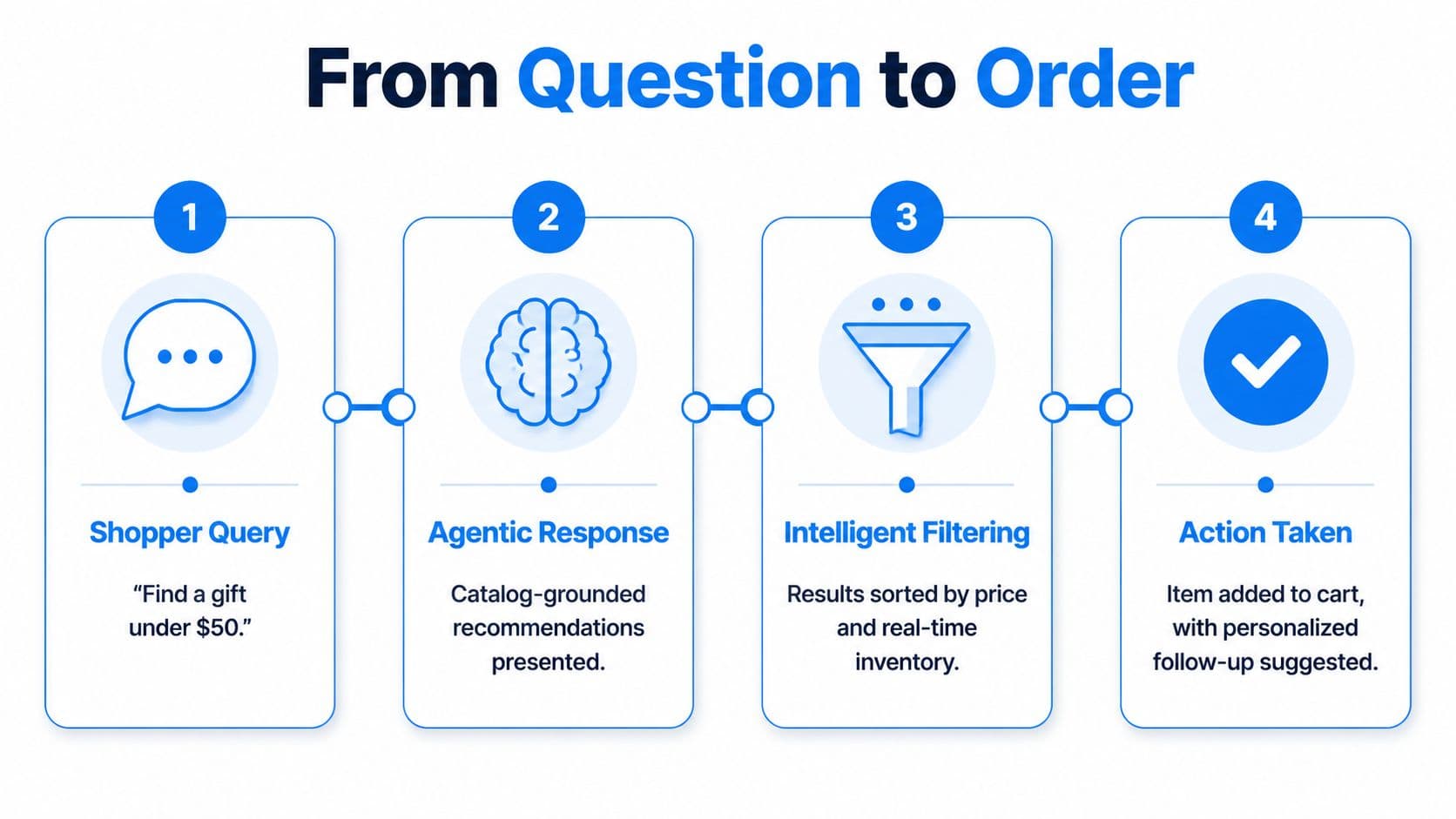
How Conversational Commerce Turns Questions Into Orders
A real storefront conversation starts with a shopper asking for something vague, like a gift under a budget. The agent doesn't answer with generic category links. It interprets the intent, queries the live catalog, and returns options that are in stock, with the right constraints already applied.
Smart Suggestions only work when the data is live
In a strong deployment, the agent ranks catalog results using the store's actual product graph, then presents options in a way the shopper can act on immediately. A shopper can ask for a gift under budget, then refine by size, color, or use case without restarting the flow. That keeps context intact, which matters because every extra step away from the conversation adds friction.
When the shopper asks a sizing question, the agent should answer from the store's own policies and product details, not from generic e-commerce language. If a chosen item is unavailable, it should suggest alternatives in real time instead of letting the conversation stall. That's the difference between a recommendation engine and a sales assistant.
The most useful pattern is simple. Interpret the need, filter against live availability, then give the shopper an action path that doesn't force a page hop. The fewer redirects you introduce, the less likely the session is to decay before checkout.
For teams mapping the revenue path from conversational events to orders, the framework at revenue attribution is helpful because it focuses attention on the exact moment a message becomes measurable commerce.
Why keeping the shopper in chat helps conversion
Traditional search-to-product-page-to-cart journeys make the buyer do more work. Conversational commerce compresses that work by answering the question and advancing the cart in the same thread. Shopify's own agentic commerce material shows that shoppers can ask follow-up questions and complete purchase without leaving the conversation, which is exactly the friction reduction merchants want when the catalog is already known to be relevant.
In one deployment pattern, the agent returns in-stock options, answers sizing questions, and adds the chosen item to cart without the shopper leaving chat. That's the practical win. The agent isn't trying to be a blog post or a search engine, it's trying to shorten the path from intent to order.
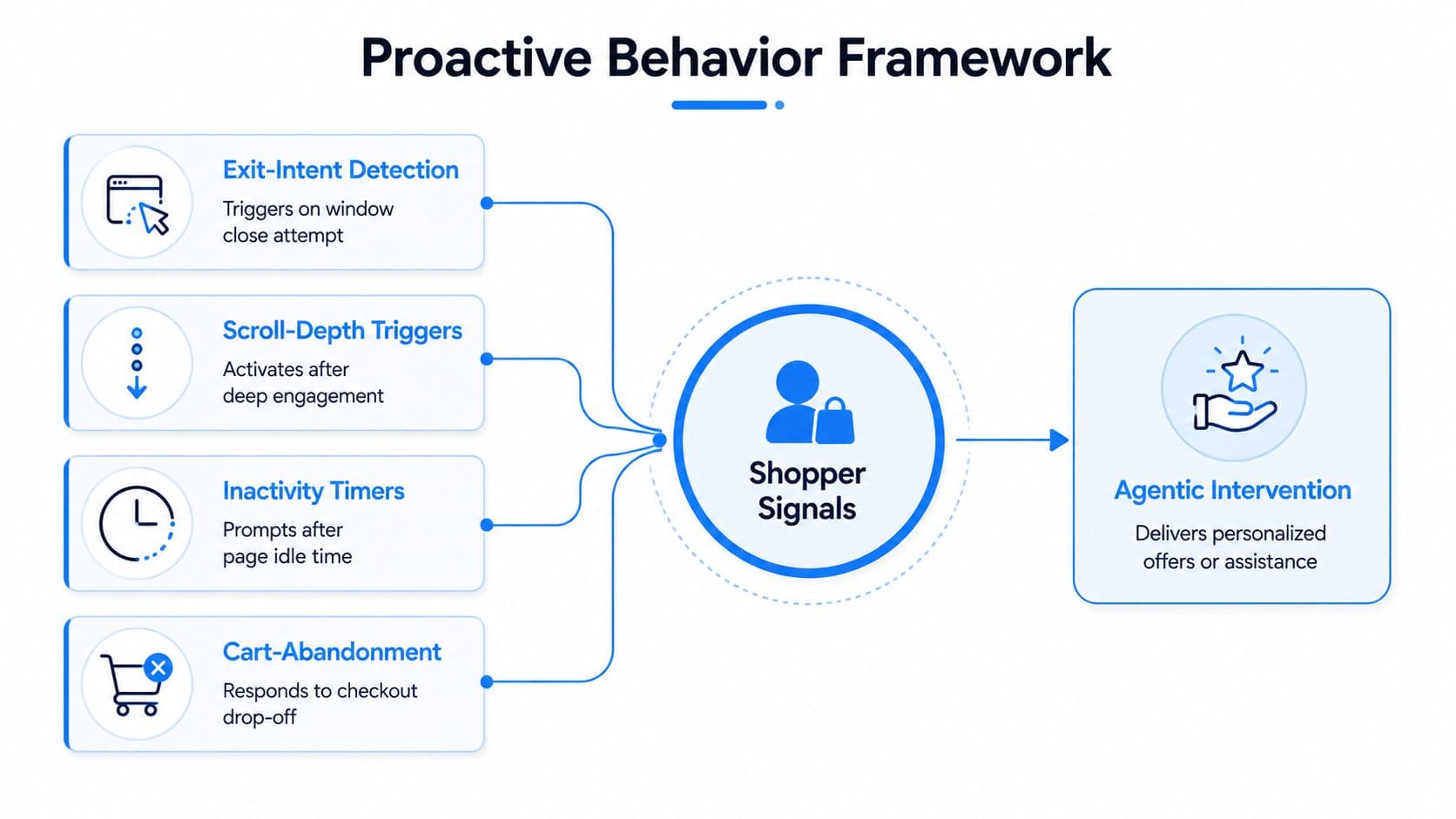
Designing Proactive Behaviors That Act on Shopper Signals
Proactive behavior is where the storefront stops waiting and starts reading intent. Exit intent, scroll depth, inactivity, and cart abandonment all tell a different story, and the agent should answer each one with a different kind of intervention. If every signal gets the same canned message, the experience becomes noise.
Map signals to a specific action
Exit-intent detection belongs on cart and checkout pages, because that's where abandonment is easiest to recover. Inactivity on a product page should trigger a brief product question or help offer, not a hard sell. A cart that's been idle for a while calls for a recovery nudge, ideally service-first if the buyer may just be comparing or getting interrupted.
The important part is matching the action to the signal. A discount on exit intent can make sense when the shopper is about to leave, but it's a mistake to lead with discounts before you've established whether the buyer is blocked by shipping, fit, or trust. The best teams treat proactive behavior as behavioral support, not a coupon cannon.
Add guardrails so prompts don't feel random
False triggers are expensive because they annoy high-intent buyers. Debounce windows, frequency caps, and suppression rules are the basic guardrails. Returning visitors who dismissed a prompt should not see the same prompt immediately, and a shopper deep in checkout should be protected from overlapping nudges.
Repeat-visitor history improves the timing further. A shopper who already viewed a category can get a more specific recovery message, while a first-time visitor may need a lighter touch. That personalization only works if the trigger engine respects session context and the agent's prior interactions.
Test thresholds like a merchant, not a demo user
The fastest path to a bad implementation is turning on every trigger at once. Start with one signal, review the responses, then tune the threshold. Keep an eye on whether the prompts are helping stalled sessions or just creating interruption.
A proactive prompt should feel like assistance at the exact moment of hesitation, not like a pop-up that escaped QA.
The merchant habit that pays off here is controlled iteration. Change one threshold at a time, watch the behavior in real sessions, and compare shopper reactions before you widen the rollout. The whole point is to act when the buyer needs help, not to train them to close the window faster.
Measuring Revenue Uplift With Per-Message Attribution
If you can't connect the agent's messages to orders, you're just measuring conversation volume. Shopify's agentic storefront analytics solve part of that by surfacing AI-channel sessions, sales, and orders in admin, and the rest comes from tying each interaction to checkout records. That's the difference between reporting activity and proving revenue.
The cleanest measurement model assigns credit to the messages that precede add-to-cart or checkout completion inside a defined session window. That lets merchants compute assisted revenue, revenue per conversation, and conversion lift from actual order data instead of self-reported engagement. Chatbot ROI frameworks also emphasize conservative attribution, where only a portion of influenced revenue gets counted, which keeps the reporting defensible.
What to put in the dashboard
| KPI | Definition | Attribution Method | Benchmark Target |
|---|---|---|---|
| Assisted revenue | Orders influenced by agent interactions | Fractional credit across messages in session | Qualitative improvement over unassisted sessions |
| Conversation-to-cart rate | Share of conversations that produce cart activity | Conversation tied to add-to-cart event | Rising over time |
| Revenue per visitor | Revenue from agent-exposed visitors divided by visits | Compare exposed cohort to holdout | Higher than baseline cohort |
| Cart recovery value | Value recovered after recovery prompts | Prompt message linked to order completion | Positive recovered-cart trend |
A practical reporting template should separate direct and assisted outcomes. Show the cohort that saw agent interactions, compare it to a holdout group, then isolate incremental lift from the difference. That's more credible than saying the bot helped because users chatted with it.
The strongest internal report includes message timing, checkout completion, and average order value for agent-assisted sessions versus unassisted ones. Shopify's native analytics help with the channel-level view, while per-message attribution provides the detailed trail that finance and leadership will ask about. If you're already mapping this for stakeholders, the guide at revenue attribution gives a useful lens on how to structure the numbers without overclaiming.
Why last-click alone misses the point
Last-click attribution undercounts AI influence because the agent often resolves the blocker before the final purchase click happens. A shopper might ask about shipping, get a policy answer, then return later through a different path and buy. If you only credit the final click, you miss the moment that removed friction.
The more durable model joins conversations to checkouts, then reports revenue from actual commerce records. That gives merchants a way to defend the ROI of the storefront agent without leaning on vague brand lift language.
Evaluating Agentic Storefront Vendors Before You Commit
The first question to ask any vendor is blunt. Does the agent verify actions before it executes them? If the answer is fuzzy, you're looking at a demo wrapper, not a production commerce layer.
A serious evaluation starts with catalog grounding depth. Ask whether the agent queries live inventory, variants, pricing, and policy content, or whether it relies on stale embeddings and trained responses. Then test the action layer. Add-to-cart should work only for explicitly selected items, and the agent should never claim a cart change happened unless the commerce system confirms it.
A practical vendor checklist
- Grounding depth: confirm the agent reads live catalog, inventory, variants, and pricing, not just static product text.
- Action verification: test whether add-to-cart, discount handling, and checkout actions are confirmed by the storefront system.
- Trigger control: check that exit-intent and inactivity thresholds are configurable, not hardcoded.
- Attribution quality: look for per-message or session-level order tracking, not just conversation counts.
- Edge-case handling: probe out-of-stock items, bundles, variants, and multi-currency setups before you sign.
You should also test real shopper messiness. Out-of-stock items, variant confusion, and bundle logic are where weak implementations fall apart. If the vendor only shines in a scripted happy path, it won't survive the first week of real traffic.
For merchants who are already working with a broader Shopify growth stack, a resource like shopify seo consultant guide can help frame how on-site discoverability and AI-assisted conversion fit together. SEO and agentic storefronts aren't the same channel, but they both depend on clean product data and a store that can answer shopper intent without friction.
Carti's deployment pattern is a useful benchmark because it starts with catalog grounding, then adds safe actions, then layers proactive prompts. That sequence is what production-ready agentic commerce looks like in practice. If you want a storefront agent that behaves like a sales tool instead of a demo, insist on a sandbox pilot with your own catalog before you commit to an annual contract.
If you're ready to turn AI-assisted shopping into a measurable sales channel, visit Carti and see how a grounded storefront agent can answer faster, recommend better, and act safely inside your Shopify store. Use it to test your catalog, validate your triggers, and prove whether conversational commerce can lift revenue on your own traffic.

Written by
Daniel AndersonFounder of Carti. 10+ years building ecommerce brands in apparel and supplements. Still runs a Shopify store and built Carti to help merchants convert more browsers into buyers.
Ready to boost your store's sales?
Install Carti in 5 minutes and let AI handle customer questions, recommend products, and close sales 24/7.
Start Free Trial14-day free trial