
The global chatbot market is projected to grow from roughly USD 7.66 billion in 2025 to USD 49.72 billion by 2034, at a 23.1% compound annual growth rate, according to Straits Research's chatbot market analysis. That expansion reflects a practical reality for Shopify merchants: shoppers don't wait patiently for answers. They ask about fit, stock, delivery, returns, or ingredients while the product page is open, and an unanswered question can become a closed tab.
Natural language processing, or NLP, gives a chatbot the ability to interpret those questions instead of waiting for a customer to select the exact button a developer anticipated. The commercial value isn't “sounding human.” It's recognizing intent, extracting product details, retrieving accurate store information, and responding quickly enough to keep a shopper moving toward the cart.
Why Most Shopify Stores Leave Conversions on the Table
A shopper visits an apparel store late at night and types, “Does this run small?” The product page contains a size guide, but it's buried below reviews. The contact form promises a reply later. No agent is online. After checking another product, the shopper closes the tab.
That interaction is ordinary, and it exposes a gap that many Shopify stores still treat as a content problem. The answer may already exist somewhere in the catalog or policy documentation, but information that arrives too late doesn't help the purchase happening now.
FAQ pages are useful for customers who already know where to look. They're less useful when a shopper asks a natural question using slang, shorthand, a typo, or product-specific language. Contact forms create a queue, while basic rule-based widgets often depend on exact phrases or narrow menu paths. A shopper who writes “will these sneakers fit narrow feet?” may receive a fallback even when the store has the relevant width information.
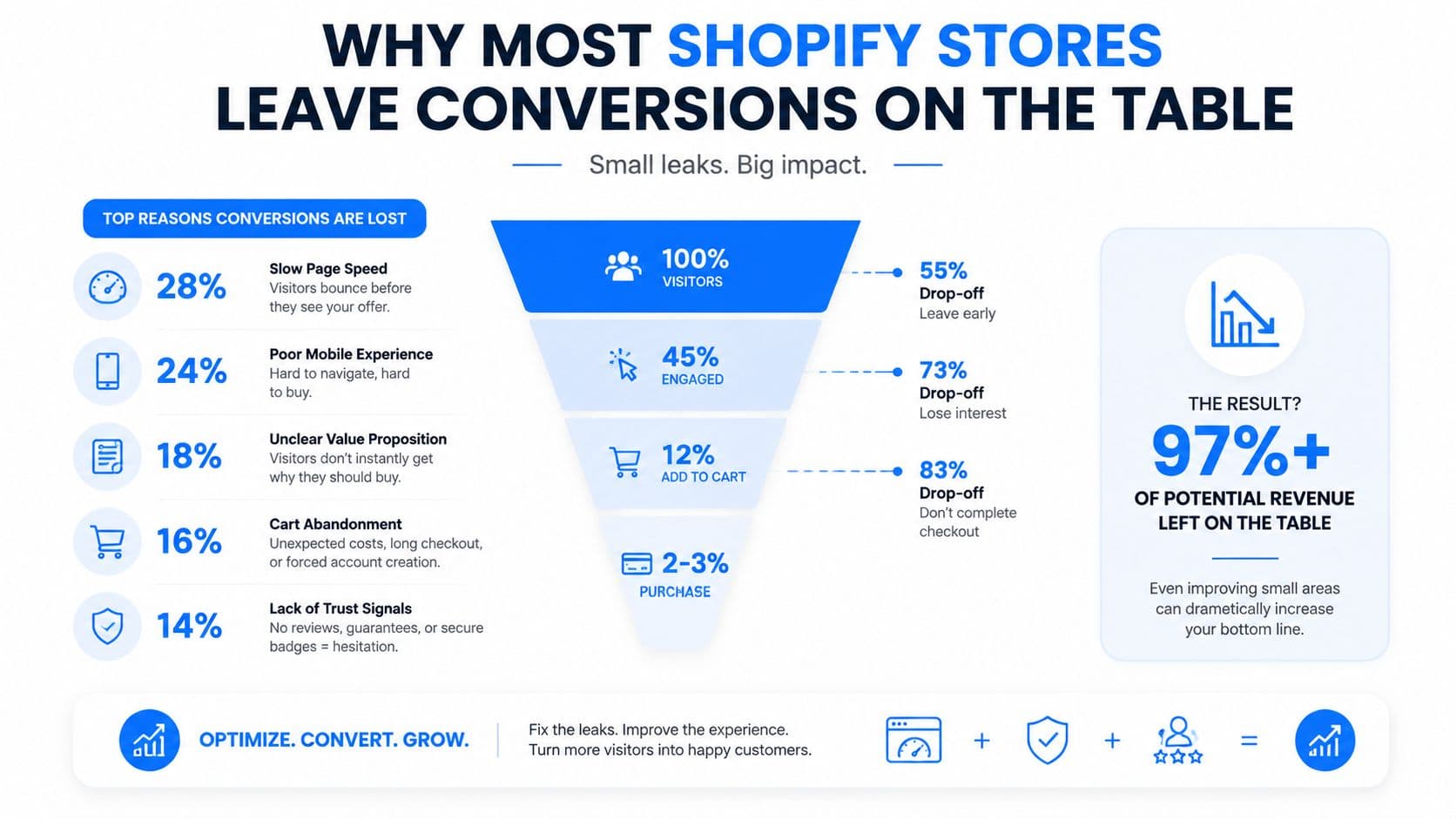
The cost of an unanswered question
The failure isn't limited to customer support. It appears at every stage of the buying journey:
- Product discovery: A shopper can't narrow a broad catalog using natural preferences.
- Evaluation: Product attributes remain scattered across tabs, images, and descriptions.
- Checkout: A shipping or returns concern interrupts purchase intent.
- Post-purchase support: Agents spend time answering repetitive order and policy questions.
NLP addresses the interpretation layer. It can map “is this in stock in medium?” to an inventory lookup, understand that “how long till it gets here?” refers to shipping, and recognize that “I need to send this back” signals a returns workflow. The chatbot still needs reliable store data and carefully designed actions, but it can begin with what the customer meant rather than what wording the merchant predicted.
Practical rule: A chatbot shouldn't be judged by how conversational it sounds. Judge whether it gives the right answer, quickly, and moves the shopper to a useful next step.
The rest of the implementation comes down to that discipline. NLP is valuable because it connects human language to storefront actions, not because it adds an AI label to a chat bubble.
What NLP Does Inside a Chatbot
A production chatbot runs on three layers: recognition, understanding, and response. Recognition converts typed or spoken language into usable input. Understanding identifies the shopper's goal and the details attached to it. Response selects information or an action that fits the conversation, while keeping latency low enough for a storefront interaction.
For a clearer distinction between language processing and intent understanding, see this guide to natural language understanding. The distinction matters in Shopify operations because each layer fails differently. A slow response points to one problem, while a wrong intent or missing product detail points to another.
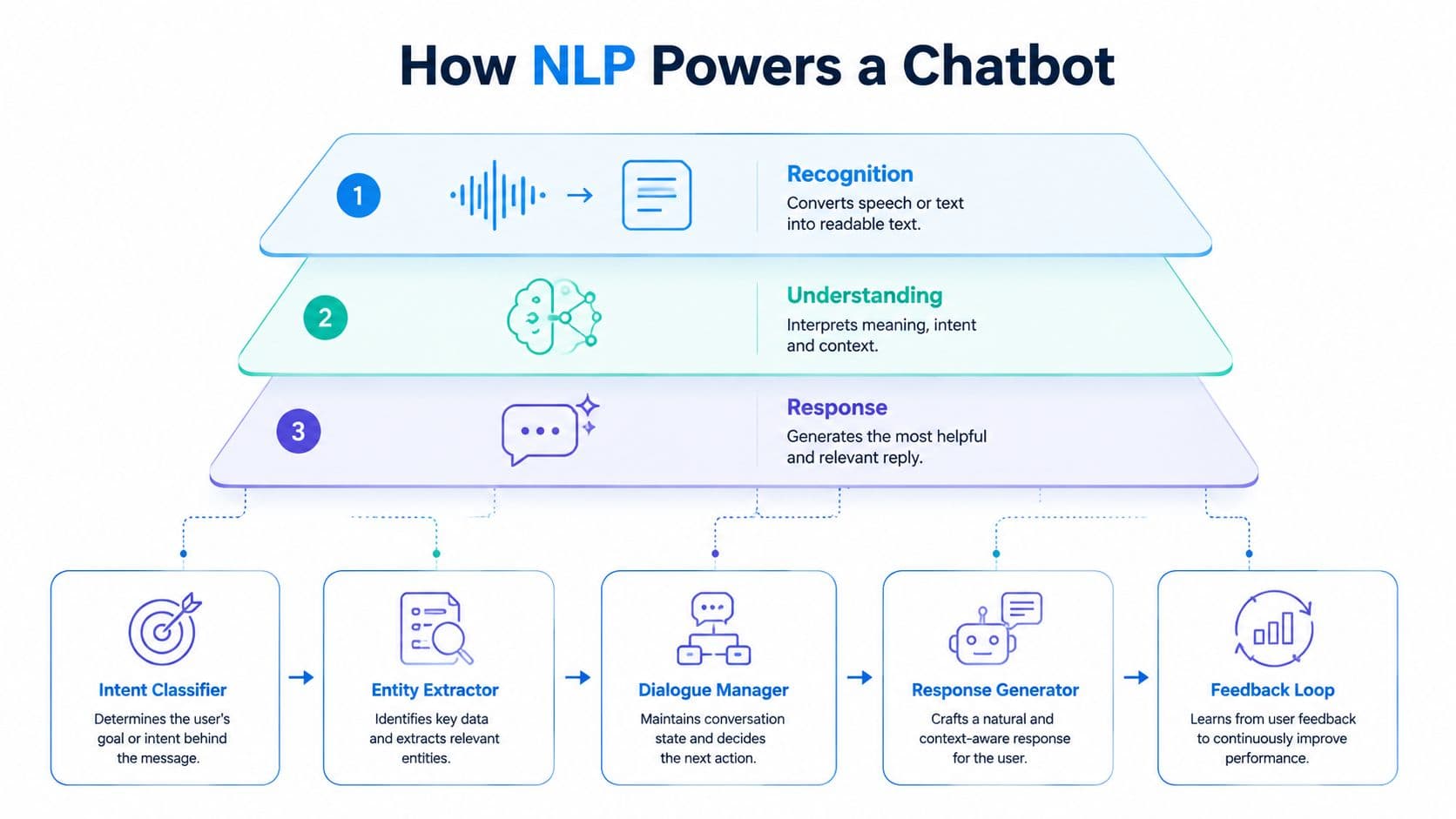
Intent classification
Intent classification maps a message to the action the shopper wants. “Is this in stock in medium?” should trigger a stock check, while “where's my order?” should start order-status handling.
Weak classification confuses nearby requests, such as product availability and order tracking. The result is an irrelevant answer, unnecessary escalation, and lower first-contact resolution. A benchmark across common NLP platforms reported overall F1 scores around 0.87 to 0.93, with the strongest tested system reaching 0.93 overall and 0.99 on the smallest corpus in that evaluation, as documented in the Botfuel NLP benchmark. Performance was weaker on broader, harder datasets, so Shopify stores need examples drawn from their own catalog, policies, and customer language.
Named entity recognition
Named entity recognition, or NER, extracts the details that make an intent actionable. These may include a product name, SKU, size, color, order number, skin concern, or delivery location.
A bot can identify that a shopper wants shoes yet miss the brand or size in “Do you have the black size 9 running pair?” Poor entity extraction leads to generic recommendations or incomplete lookups. Consistent product naming, structured catalog attributes, and accurate metafields give the extractor better signals.
Dialog management
Dialog management maintains state across multiple messages. If a customer says, “I'm looking for a moisturizer,” then adds, “for oily skin, and no fragrance,” the system must retain the category and apply the new constraints.
Without state tracking, every message becomes a separate request. The customer repeats information, confidence drops, and the conversation can end before a relevant product appears.
Sentiment analysis
Sentiment analysis detects frustration, urgency, or dissatisfaction. It can support a human handoff when a shopper repeats a question, disputes an order, or uses increasingly negative language.
Use sentiment as an escalation signal alongside confidence, topic, order status, and account context. A weak model may miss an escalating customer or overreact to harmless wording, so it should not control the entire experience.
Multilingual support
Multilingual support lets shoppers use their preferred language while connecting messages to the same catalog and policies. Code-switching, regional accents, slang, and limited training data make this harder to configure and test.
Research identifies continuing gaps in contextual ambiguity, multilingual complexity, intent misrecognition, and commonsense reasoning. A survey of multilingual chatbots for low-resource languages also highlights limited datasets, weak speech-recognition and NLU integration, and poor code-mixing support. For a Shopify storefront, language coverage is useful only when intent quality, product retrieval, and response speed remain acceptable.
How NLP Powers Real Shopify Storefront Outcomes
NLP capabilities only matter when they change a storefront decision. A fashion shopper asking, “Is this linen or synthetic?” needs a direct answer from the product data, not a search-results page. Intent recognition identifies a material question, NER identifies the product, and retrieval returns the relevant attribute.
That flow supports first-contact resolution because the shopper receives an answer in the same interaction. It can also support add-to-cart behavior when the answer removes a purchase objection. The chatbot shouldn't invent fabric details. If the catalog doesn't contain the attribute, it should say so and offer a human or a related source of information.
From preferences to relevant products
Beauty and wellness stores benefit from conversational filtering. “I have oily skin and don't want fragrance” contains a category, a skin condition, and a negative preference. A dialog manager can retain those constraints while the recommendation layer retrieves products whose structured attributes match them.
Home-goods shoppers use similar language differently. “I need a lamp for a small desk, warm light, and no drilling” combines dimensions, use case, lighting preference, and installation requirements. A chatbot that only searches product titles will miss much of that context. A chatbot connected to metafields and product attributes can turn the conversation into a more useful shortlist.
The business metrics differ by flow:
| NLP Capability | Storefront Outcome | Metric Moved |
|---|---|---|
| Intent classification | Routes stock, shipping, returns, and product questions to the right action | First-contact resolution |
| Entity extraction | Pulls size, color, SKU, product, or order details from free-form text | Add-to-cart rate |
| Dialog management | Preserves preferences across recommendation turns | Assisted conversion rate |
| Sentiment-aware escalation | Routes frustrated or high-risk conversations to a person | Support quality and cart recovery |
| Knowledge retrieval | Answers repetitive policies without a support queue | Support-ticket deflection |
Cart recovery needs context
A generic reminder treats every abandoned cart the same. A contextual flow looks at the conversation signal first. A shopper who asks about delivery may need reassurance about timing, while a shopper who asks about returns may need policy clarity before completing checkout.
The chatbot's role is to resolve the concern, not just send another promotion. If the shopper says the answer didn't help, the system should stop guessing and escalate. Poor intent classification and lost conversational context are repeatedly identified as causes of negative e-commerce experiences in this review of chatbot limitations.
Fast answers also protect the buying flow. Industry benchmark reporting places average chatbot responses in the 2 to 5 second range, while high performers reach roughly 800 to 1,200 milliseconds; the same reporting recommends website chatbot responses under 500 milliseconds for a noticeably better experience, as summarized in NLP chatbot benchmark resources. For Shopify, retrieval should happen before lengthy generation wherever possible.
Implementing an NLP Chatbot on Shopify
A practical launch starts with the smallest useful surface area. Install the Shopify app, set the brand tone, write greeting prompts, define escalation rules, and test the widget on product and cart pages. A no-code dashboard can speed up installation, but it does not replace clean product data or policy preparation.
Connect the information shoppers need
Ingest the sources that answer purchase and support questions:
- Product records: Include descriptions, variants, sizes, colors, materials, ingredients, dimensions, and availability signals.
- Store policies: Add shipping, returns, exchanges, warranties, and payment information.
- Merchandising data: Connect collections, tags, recommendations, and relevant metafields.
- Customer workflows: Define what the bot may do for order status, returns, cancellations, and human handoff.
Consistent structure improves intent and entity recognition. If “navy,” “midnight,” and “blue” identify the same variant but appear inconsistently, the model must resolve unnecessary ambiguity. If a return window appears only in a PDF while the product page implies something different, retrieval can produce a plausible answer that damages trust and delays purchase decisions.
Choose the architecture deliberately
A rules-plus-LLM hybrid fits stores where the opening question varies but the transaction follows a fixed path. NLP can identify a return request, then deterministic logic can collect order information and confirm the next step. Retrieval-augmented generation supports broader questions, but it needs strict source boundaries and confidence-based fallbacks.
Set guardrails before launch. The chatbot should answer from approved catalog and policy content, identify missing information, ask a clarifying question when confidence is low, and hand off to email or a human agent for exceptions, payment disputes, or sensitive account details.
Configure multilingual coverage around real store traffic rather than a marketing checklist. Test slang, mixed-language messages, product names, and local policy terms. Run a small pilot, review failed conversations, and expand only after fallback and escalation paths behave predictably. Keep retrieval fast, especially on product and cart pages, because slow answers interrupt the buying flow.
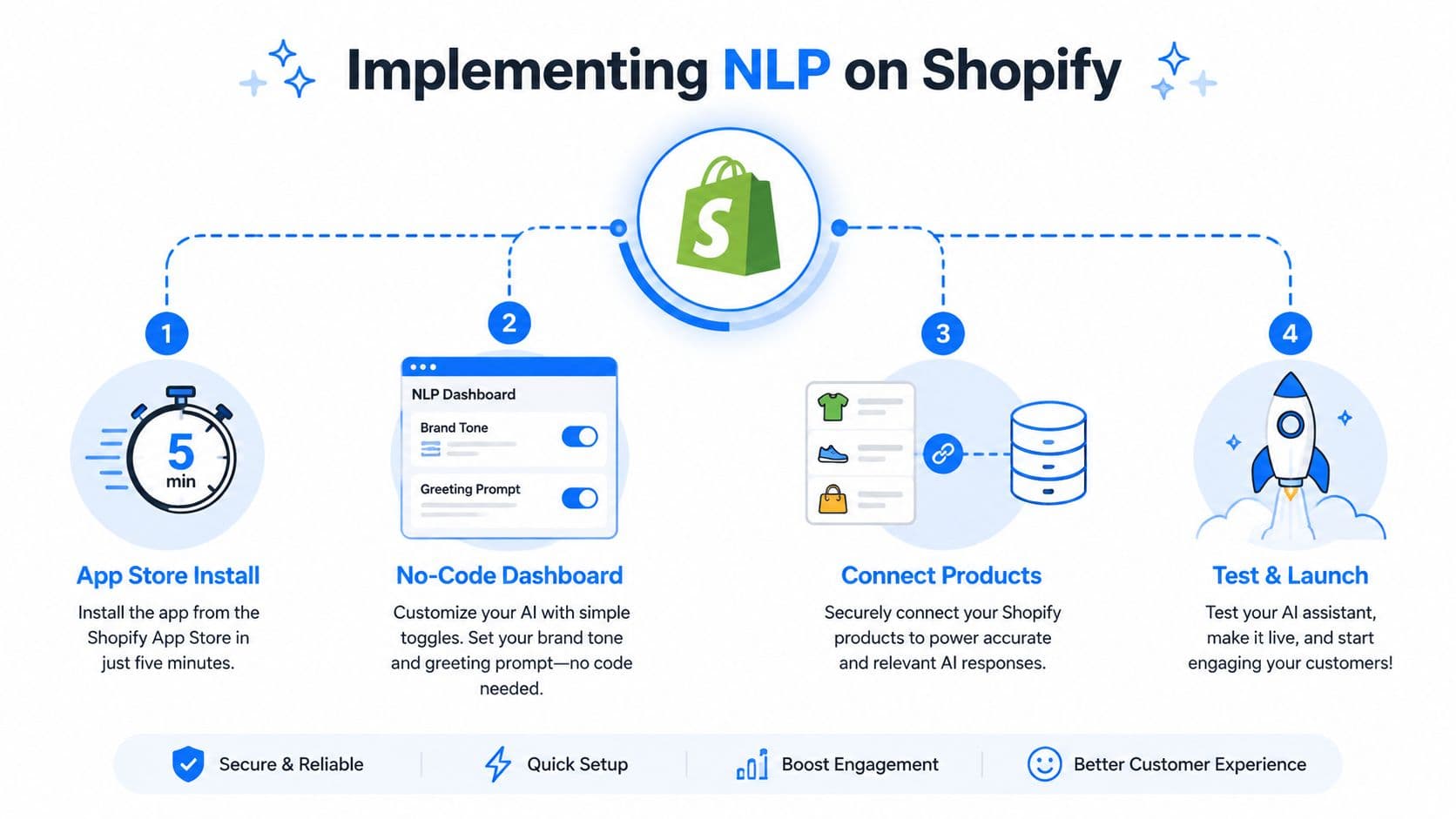
A short walkthrough demonstrates the setup sequence, content connection, guardrail configuration, and storefront widget experience. Use it to check the operational flow, then validate the same steps against your store's catalog, policies, and escalation process.
How to Measure Whether Your Chatbot Is Working
Conversation volume is an activity metric, not a business result. A store can generate plenty of chats while failing to answer questions, resolving little without agents, or distracting shoppers from checkout.
Start with the language model's quality, then connect it to merchant outcomes. Intent F1 shows whether the classifier balances missed intents and incorrect matches. A confusion matrix makes the problem readable: each row represents the customer's actual intent, each column shows what the model predicted, and clusters of mistakes reveal which intents need clearer examples or better separation.
The dashboard that matters
| Metric | What it measures | Target |
|---|---|---|
| Intent F1 | Quality of classification on store-specific utterances | Above 0.9 on the top 20 intents |
| Fallback rate | Share of conversations the bot can't confidently answer | Under 8% |
| First-contact resolution | Questions resolved without repeat contact or escalation | Improve consistently over time |
| Median response latency | Typical time before the shopper receives a response | Under 2 seconds |
| Latency p95 | Experience of slower sessions | Under 2.5 seconds |
| Assisted conversion rate | Purchases in sessions influenced by the chatbot | Track against a defined comparison group |
| Cart-recovery rate | Abandoned carts returned through chatbot assistance | Track by intervention and intent |
| Support deflection | Tickets avoided through successful automation | Track by topic and resolution quality |
The threshold values above come from the measurement plan for this guide, not from the benchmark sources, so treat them as operating targets, not universal laws. A fashion store may prioritize size and fit intents, while a wellness merchant may focus on ingredients, usage, and shipping.
Review unhandled queries every week. Group them into missing knowledge, ambiguous intents, unsupported actions, and genuine edge cases. Add representative customer phrasing to the training set, update the source content, and retest the confusion pairs.
For a broader measurement workflow, use this guide to chatbot analytics. Revenue attribution belongs beside support metrics. Leadership needs to know whether the assistant influenced add-to-cart activity, reduced avoidable tickets, or helped recover a checkout, not merely how many messages it exchanged.
What Separates a Real AI Sales Assistant from an FAQ Bot
An FAQ bot waits for a question and returns a prepared answer. An AI sales assistant recognizes buying intent, retrieves relevant products, responds quickly, and can act on hesitation before the shopper disappears.
That distinction isn't created by one feature. Intent quality, low latency, cart recovery, and multilingual access reinforce one another. A recommendation is useless if the bot misreads “compare running shoes” as “track my order.” A correct recommendation is less useful if the reply arrives after the shopper has left. A fast assistant still misses international demand if it can't understand the languages used by the store's audience.
Passive answers versus active assistance
A basic FAQ workflow might answer “What is your return policy?” It won't necessarily connect that answer to a shopper who says, “I'm worried these won't fit, can I send them back?” An assistant can identify the underlying purchase concern, retrieve the relevant policy, and offer the next useful action.
Carti is one Shopify option that combines catalog and policy syncing with real-time answers, product recommendations, cart-recovery assistance, and multilingual responses in 92 languages, based on the publisher information supplied for this article. Merchants should still validate its behavior against their own catalog, policies, latency requirements, and escalation standards.
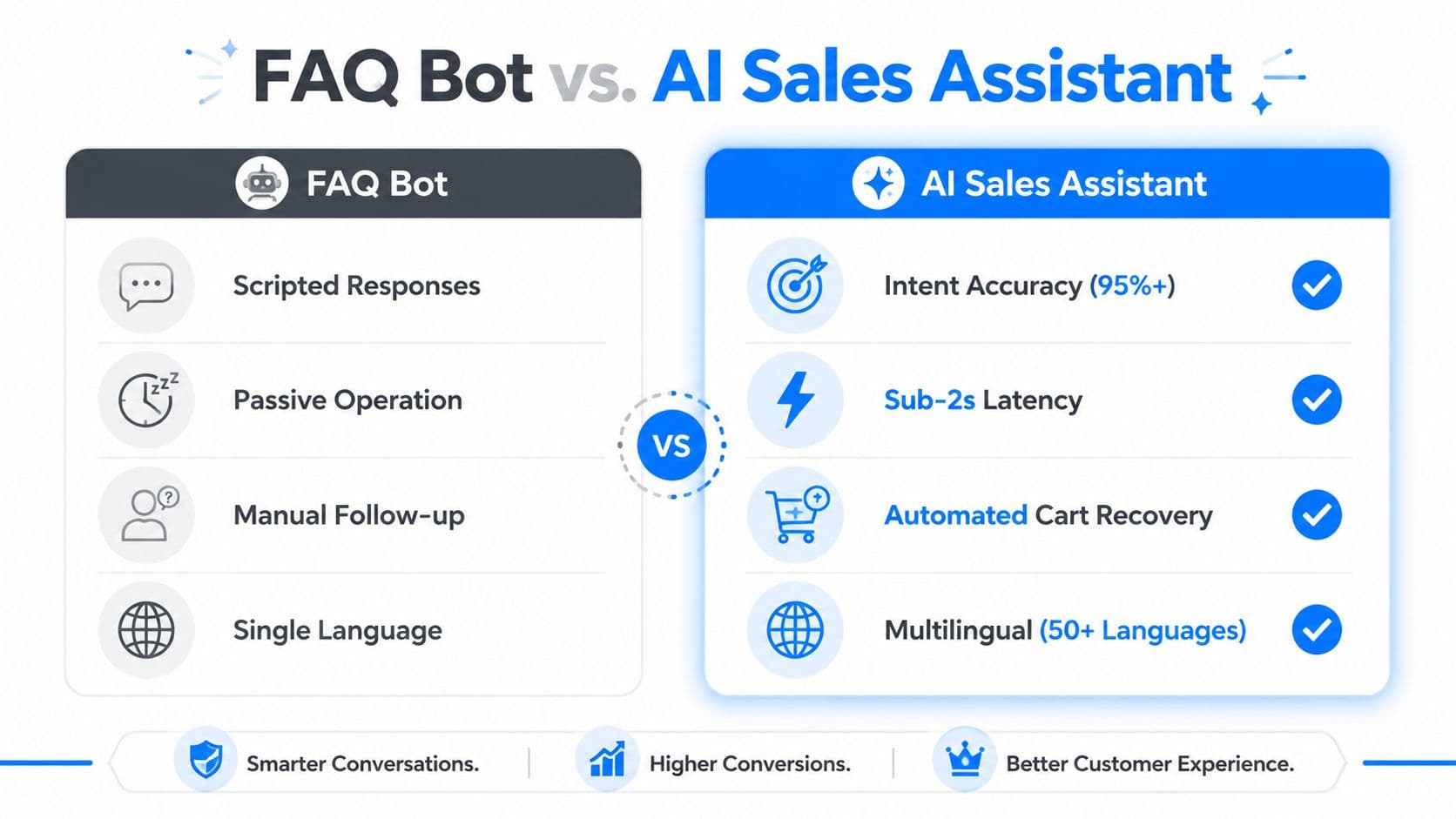
The risk is trust. A bot that confidently supplies an incorrect size, ingredient, delivery promise, or return exception can create more work than it saves. Use source-restricted retrieval, confidence thresholds, and human handoff instead of optimizing only for automation. This guide to preventing AI hallucinations covers the guardrail problem from a practical perspective.
The buying test: If the chatbot only answers questions, it's support automation. If it understands the shopper's goal and helps complete the next commercial step, it can contribute to sales.
Evaluate the assistant on conversion contribution, first-contact resolution, recovered carts, and ticket deflection. Conversation counts belong in the diagnostic layer, not at the top of the scorecard.
Best Practices and a Merchant Action Plan
Effective NLP chatbots share a small set of operational habits. They retrieve trusted store information quickly, learn from real conversations, escalate cleanly, and connect every meaningful interaction to a storefront outcome.
Keep retrieval fast enough that the shopper doesn't feel abandoned. Train on live store language, including misspellings, shorthand, product nicknames, and regional phrasing. Route low-confidence requests to a human or a clear support channel within the same conversation, rather than forcing the model to produce an answer.
A first-week plan
- Audit the top questions. Pull recurring queries about fit, stock, delivery, returns, ingredients, and order status.
- Prepare the sources. Clean product descriptions, variants, metafields, collections, size guides, and policies before connecting them.
- Configure commercial intents. Include product discovery, comparison, availability, shipping objections, and cart-recovery signals.
- Set operating limits. Define latency goals, fallback behavior, source restrictions, and escalation ownership.
- Test real language. Use actual customer phrasing across the languages your traffic uses, including slang and mixed-language messages.
- Review the first results. Inspect F1, fallback rate, first-contact resolution, latency, assisted conversion, and ticket deflection before scaling traffic.
The system compounds when the feedback loop is real. Each resolved conversation reveals which information customers couldn't find, each failed intent exposes a training gap, and each recovered checkout shows which objections deserve better product or policy content.
Deploy a Shopify-native assistant like Carti when you want catalog syncing, policy-based answers, recommendations, cart recovery, and multilingual support in one storefront workflow. Visit Carti to connect those NLP capabilities to your Shopify store and evaluate the experience against your own conversion and support metrics.

Written by
Daniel AndersonFounder of Carti. 10+ years building ecommerce brands in apparel and supplements. Still runs a Shopify store and built Carti to help merchants convert more browsers into buyers.
Ready to boost your store's sales?
Install Carti in 5 minutes and let AI handle customer questions, recommend products, and close sales 24/7.
Start Free Trial14-day free trial