
You probably know the feeling. A shopper lands on your store, types something that sounds simple to a human, and your chatbot answers like it missed the point. They didn't ask for a product name, they asked for “something similar but smaller and not itchy,” and the bot locks onto the wrong word, gives a generic answer, and the visitor leaves.
That gap is exactly where natural language understanding matters. It's the part of AI that tries to infer what someone means, not just what they typed. For Shopify merchants, that difference shows up in support load, cart recovery, and whether a conversation moves toward a sale or dies in the first reply. If you want a practical model for how this works in commerce, it helps to think about the same question merchants ask in listing optimization, customer support, and on-site search: how do you match real shopper language with the structure your store can act on? A useful parallel is how to optimise Amazon listings, because the core job is the same, translating messy human intent into something a product system can use.
Why a Shopify Store Can No Longer Rely on Keyword Matching
A keyword bot works only when the shopper talks like your catalog. Real shoppers do not. They ask for “the same thing, but in black,” “a gift under budget,” or “that sweater I saw yesterday, but not the itchy one,” and each phrase carries intent that keywords alone can miss.
That is the commercial problem. If your chatbot only matches words, it cannot reliably separate a size request from a style request, or a product complaint from a purchase question. The result is slower replies, dead-end conversations, and fewer chances to move someone toward checkout.
Why the old approach breaks on real queries
Statistical NLP made language systems measurable by turning them into problems of accuracy, precision, recall, F1-score, and word error rate. Word error rate is the number of deletions, insertions, and substitutions divided by the number of words in a test sample. That mattered because merchants needed systems they could compare and improve, not just demos that sounded smart.
The same logic applies to a Shopify chatbot. If a shopper says, “Do you have anything similar, but smaller and not that fabric?” the useful answer is not built from keyword overlap. It comes from understanding the request as a product comparison with constraints, then mapping those constraints to inventory, policy, and merchandising rules. That is also why merchants comparing automation options for support and discovery often end up reading guides on how to optimise Amazon listings, because the same principle applies, shoppers respond better when product language matches intent, not isolated terms.
A keyword match can find “smaller.” It cannot tell whether smaller means a different size, a shorter cut, or a lower price tier. It can catch “fabric.” It cannot tell whether the shopper is asking about material comfort, durability, or allergies. Carti works better here because it reads the full request, then routes the shopper toward the right product, follow-up question, or cart recovery step.
Practical rule: if a shopper's phrasing sounds like a human conversation, a keyword-only system is already behind.
A merchant does not need the theory first. They need the outcome. When the bot understands the shopper's intent on the first try, it can answer, recommend, or recover the cart before the session goes cold. That is why modern ecommerce chat tools lean on natural language understanding, not just search matching.
What Natural Language Understanding Means
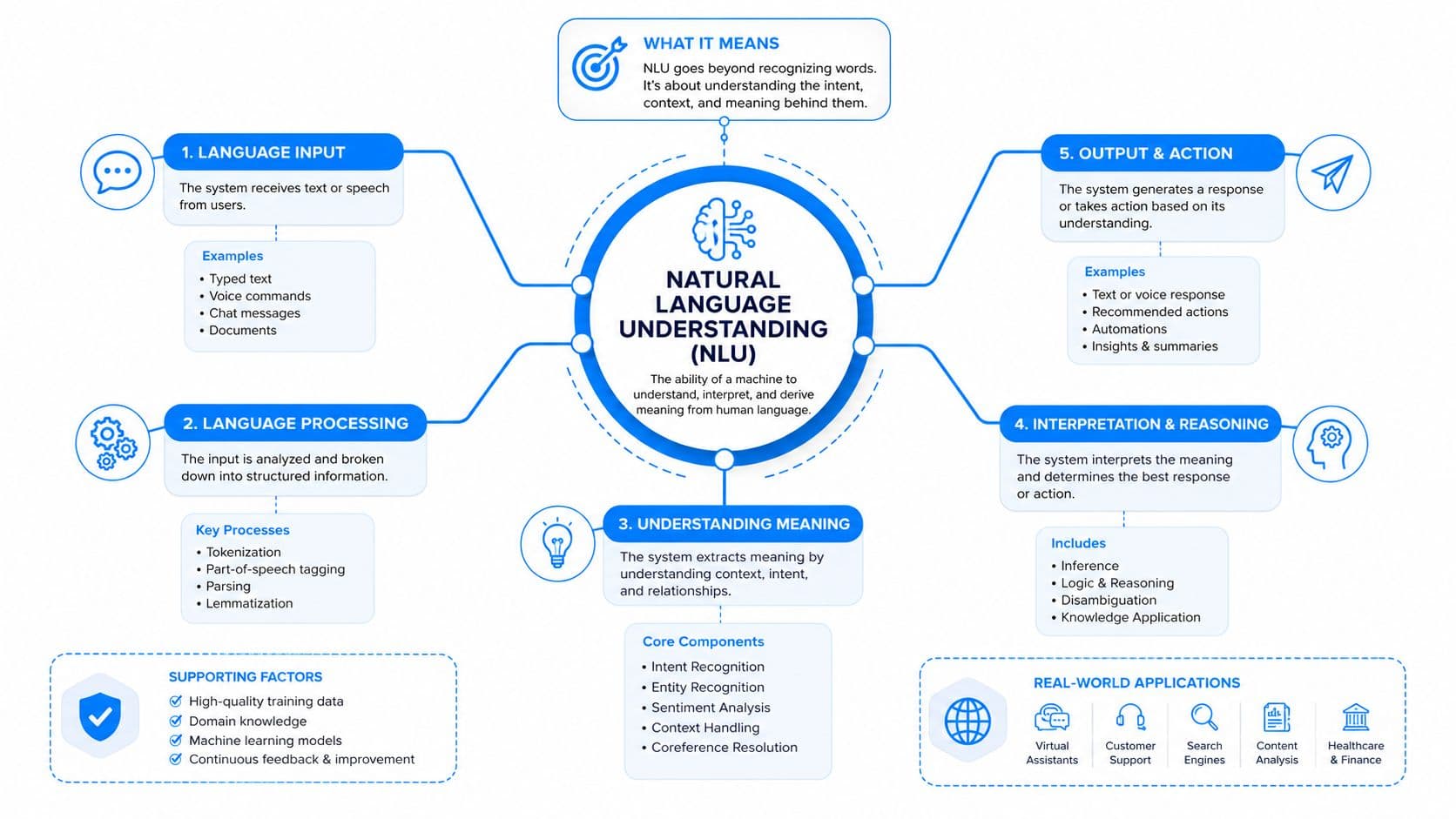
Natural language understanding is the part of language AI that tries to work out meaning. In a store context, it answers questions like, “What is this person trying to do?” and “Which details matter enough to act on?” That is different from just spotting keywords, because two shoppers can use the same words and want totally different outcomes.
A quick way to frame it is this, keywords are labels, while NLU is interpretation. If a shopper says, “I need a blue running shirt in medium,” the system should not just see separate words. It should recognize that the shopper is looking for product discovery, then separate the goal from the details that shape the result.
Intent and entities are the merchant's two core lenses
The first concept is intent, which is the shopper's goal. In ecommerce, that might be “track my order,” “compare sizes,” “find a gift,” “ask about materials,” or “recover my cart.” The second concept is entities, which are the structured details attached to that goal, like size, color, budget, product type, delivery window, or material.
A simple example makes this easier. If someone types, “Need a blue running shirt in medium,” the intent is probably product discovery or purchase, while the entities are blue, running shirt, and medium. A chatbot that captures both can route the shopper to the right collection, filter the right products, or ask a follow-up question when one detail is missing.
Carti uses that pattern in practice. If a shopper asks for something “similar, but smaller and not that fabric,” Carti should separate the comparison request from the sizing and material constraints, then send the shopper toward the right product path.
How to read a transcript like a product manager
NLU sits inside natural language processing, which is the broader field that covers language handling, while natural language generation is the layer that produces the response. In practice, a Shopify merchant cares less about the academic boundary and more about whether the transcript shows the bot understood the right goal and picked out the right details.
A useful review habit is to read the conversation the way a product manager reads a funnel. Did the bot identify the shopper's intent, or did it drift into a generic reply? Did it capture the entities that matter for the decision, or did it leave the shopper to repeat themselves? Did the response move the session toward a product, a policy answer, or a cart recovery step?
You can also judge the output by asking whether the bot can act on it. Accuracy tells you how often the system got the right answer overall. Precision tells you how often a positive prediction was correct. Recall tells you how many of the true cases the system found. F1-score balances precision and recall, so it helps when you want one number that reflects both sides.
A clean transcript should let you answer three questions quickly. Did the bot understand the shopper's intent? Did it extract the important entities? Did it respond in a way that moved the session forward?
NLU vs NLP vs NLG and the Modern LLM Stack
These three terms get mixed up constantly, so a plain comparison helps. NLP is the broad umbrella for language technology. NLU is the comprehension layer. NLG is the response layer.
| Layer | What It Does | Storefront Example |
|---|---|---|
| NLP | Handles language tasks broadly | Tagging text, routing queries, preprocessing conversations |
| NLU | Figures out meaning, intent, and entities | Understanding that “smaller and not itchy” is a sizing and fabric constraint |
| NLG | Produces the reply | Writing a helpful answer, recommendation, or follow-up question |
This matters more now because modern chatbots often sit on top of large language models, but the store still needs explicit grounding. A model can sound fluent and still miss the business rule, the product attribute, or the policy edge case. That's why teams use the LLM for language flexibility, then add NLU logic for reliable intent handling and entity capture.
Where the stack gets confusing for merchants
A lot of merchant teams assume “LLM” and “understanding” mean the same thing. They don't. The model may generate a polished response, but if it doesn't connect the shopper's request to a product size, shipping policy, or return condition, the conversation looks confident and still fails.
NLU earns its place inside the stack. It turns messy shopper text into structured data that the rest of the system can use, whether that means pulling products, triggering a cart recovery flow, or escalating to support.
The commercial test is simple. If the chatbot can only talk well, it's a copywriter. If it can understand intent and route the customer to the right outcome, it's part of the sales system.
Inside the NLU Pipeline and Why Transformers Changed Everything
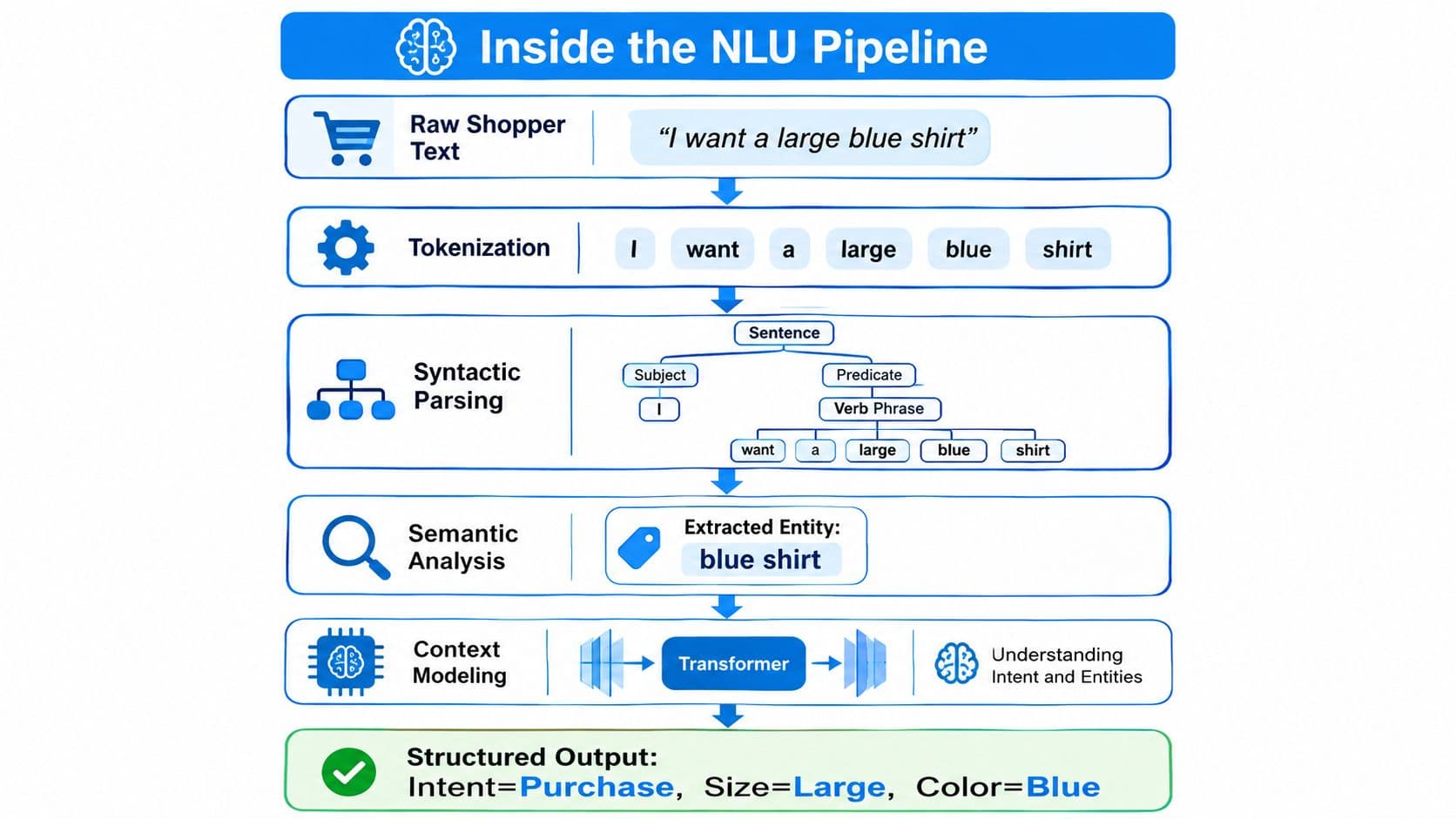
Modern NLU systems usually work in layers, not one magic step. The first layer splits the text into units, the next layer reads how those units fit together, then semantic logic and context modeling decide what the shopper means. That layered structure is why a chatbot can do better than word matching.
From raw text to structured meaning
Tokenization breaks the shopper's message into words or pieces of words. Syntactic parsing checks how those pieces relate grammatically. Semantic analysis starts mapping phrases to meaning, such as recognizing a color, a product type, or a material preference. Context modeling uses the surrounding conversation to resolve ambiguity.
That pipeline is especially useful in retail. If a shopper says, “Need the larger one, same color, but for colder weather,” the system has to connect “larger” to size, “same color” to a previously mentioned item, and “colder weather” to a product attribute or use case. Without context, each phrase looks incomplete.
The big technical shift came from deep learning and transformer-based pretraining, which replaced many hand-engineered features and earlier statistical methods because transformers handle long-range dependencies and bidirectional context more effectively (Science survey on NLP development). That's the reason modern systems are better at multi-turn conversations, indirect phrasing, and questions where meaning depends on what came before and after a word.
Context is the difference between “blue shirt” as a product search and “same blue one as before” as a follow-up order signal.
What this looks like in a Shopify chatbot
A Shopify chatbot with good NLU doesn't just answer the latest message. It keeps enough structure to remember what the shopper is trying to do. That's how it can connect a vague follow-up like “What about a lighter one?” to the earlier product discussion and return a relevant option instead of a generic help article.
The practical benefit is catalog awareness. The bot can align the shopper's language with the store's own product fields, which is what makes the answer feel useful instead of decorative.
How NLU Powers a Shopify Chatbot in Practice
A good Shopify chatbot doesn't wait for a perfect question. It handles the messy version people type. In a cart flow, that means reading the shopper's request, extracting the useful parts, and moving them toward the right next step without making them repeat themselves.
Three shopper moments, three different NLU jobs
First, a sizing question. A shopper says, “I like this jacket, but do you have it in a smaller fit and not the itchy fabric?” The bot should read intent as product comparison or product modification, then pull size and material sensitivity as entities. That can drive an instant answer, a filtered recommendation, or a clarification if the catalog doesn't have the exact variant.
Second, a cross-sell request. Someone asks, “What goes with this moisturizer for dry skin?” The chatbot has to understand that the user wants a complementary product, not a support article. That's the kind of moment where smart product suggestions matter, because the bot can recommend a cleanser, serum, or bundle based on the shopper's stated need and past context.
Third, a cart-recovery prompt. A visitor types, “I'm going to think about it for now.” That doesn't sound like an order status question, but it may be exit-intent phrasing. NLU can recognize hesitation and trigger a recovery flow instead of treating the message as a dead end.
For a concrete example of a Shopify-specific setup, Carti is an AI chatbot for sales that learns a store's catalog, policies, and FAQs, then uses that information to answer questions, recommend products, and recover abandoned carts. If you want a broader product framing, the e-commerce chatbot overview shows how those behaviors fit into store operations.
What the merchant actually sees
The merchant doesn't need the hidden model weights. They need a transcript that shows the bot understood the request, used the right product data, and pushed the shopper closer to checkout. That's the conversion mechanic.
When NLU works, the chatbot feels like a well-trained associate. It knows when to answer directly, when to suggest a product, and when to pull a shopper back before they leave.
Evaluating, Training, and Tuning NLU for Your Store
A chatbot only becomes useful if you test it against the language your shoppers use. The fastest way to miss that is to launch with a neat intent list that doesn't match real transcripts. The better way is to build, review, and adjust from actual conversations.
Start with transcripts, not assumptions
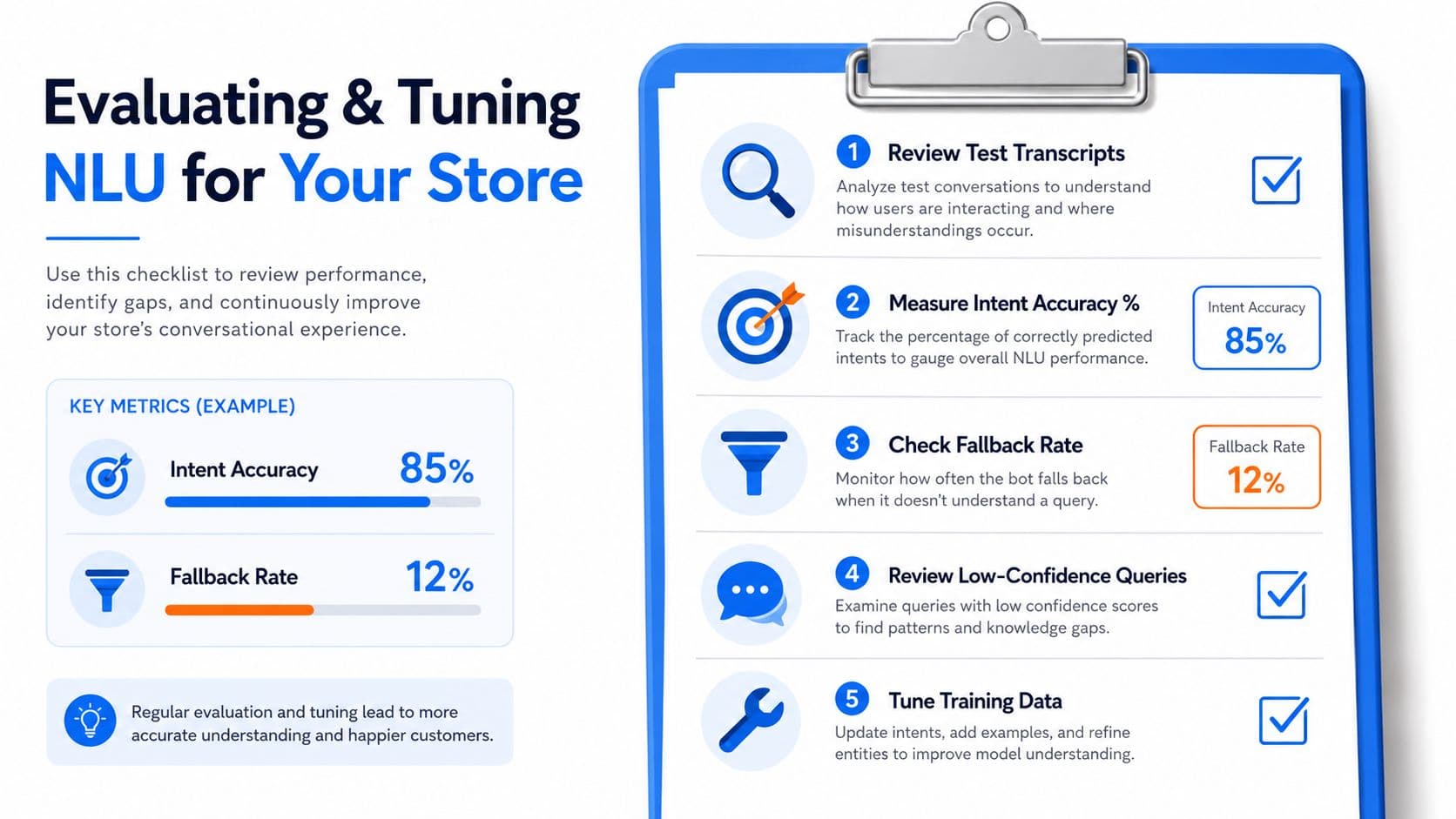
Read support chats, pre-sales questions, and failed bot sessions before you define intents. Look for repeated phrasing, repeated confusion, and the places where the bot falls back too often. If different shoppers use different words for the same ask, group them under one intent. If one phrase consistently leads to two different outcomes, split it into separate intents.
A practical dashboard should help you spot low-confidence queries and repeated fallbacks. That tells you where the bot lacks coverage, which product attributes need better grounding, and which policy questions need stronger content.
Useful rule: merge intents when shoppers mean the same thing, add a new intent when the store needs a different action.
Tune the taxonomy to match shopper language
A strong intent taxonomy is small enough to manage and broad enough to cover the entire store journey. That usually means separating purchase help from post-purchase support, then mapping common entity groups like size, color, material, use case, and delivery timing. For stores with a lot of repeat questions, a knowledge base can reduce the load on the model by giving it cleaner source material, which is why resources like the chatbot knowledge base guide are worth using during setup.
The loop should be simple. Review transcripts, label missed cases, retrain on the language patterns you see, then run the same test again. If the bot starts answering more of the right questions without drifting into vague replies, you're tuning in the right direction.
Measure conversion impact too. A chatbot that sounds polished but doesn't lift resolution, reduce abandonment, or surface the right products isn't doing merchant work.
Where NLU Still Breaks and How to Plan Around It
NLU is strong, but it isn't universal. The biggest mistakes happen when teams assume one general model will handle every language, dialect, and conversation style equally well. It won't.
The gaps merchants should plan for
Low-resource languages and regional dialects still need better data, clearer metadata, and store-specific curation. Surveys point out that many languages lack annotated datasets and digital resources, so multilingual support isn't just a model choice, it's a data choice. That matters for global ecommerce, where traffic often includes mixed-language queries and dialect-heavy phrasing.
Context is another weak spot. Shoppers use sarcasm, implied meaning, and shorthand all the time, and the bot can miss what's unsaid. A line like “Great, another size issue” may signal frustration, not praise, and the system needs fallback logic that recognizes the conversation is drifting.
Build guardrails, not just model confidence
If a query is ambiguous, ask a clarifying question. If the language mix is messy, route to a localized response set. If the system can't resolve intent with enough confidence, escalate to a human instead of forcing a guess.
Carti's support for 92 languages helps widen coverage, but the same localization rule still applies, because language support only works well when the store maintains the right data per locale. For teams thinking about governance and handoff, the GDPR and compliance guide is a useful companion to multilingual planning.
The advantage comes from humility in the design. Better general models help, but they don't erase the need for good training data, product taxonomy, and clear escalation paths.
Turning NLU Into More Revenue This Week
The fastest wins come from a short operating loop. Review your top shopper intents, fix the biggest fallback gaps, and make sure every unresolved question has a next step. That's how NLU turns from a technical feature into a revenue tool.
A simple weekly merchant playbook
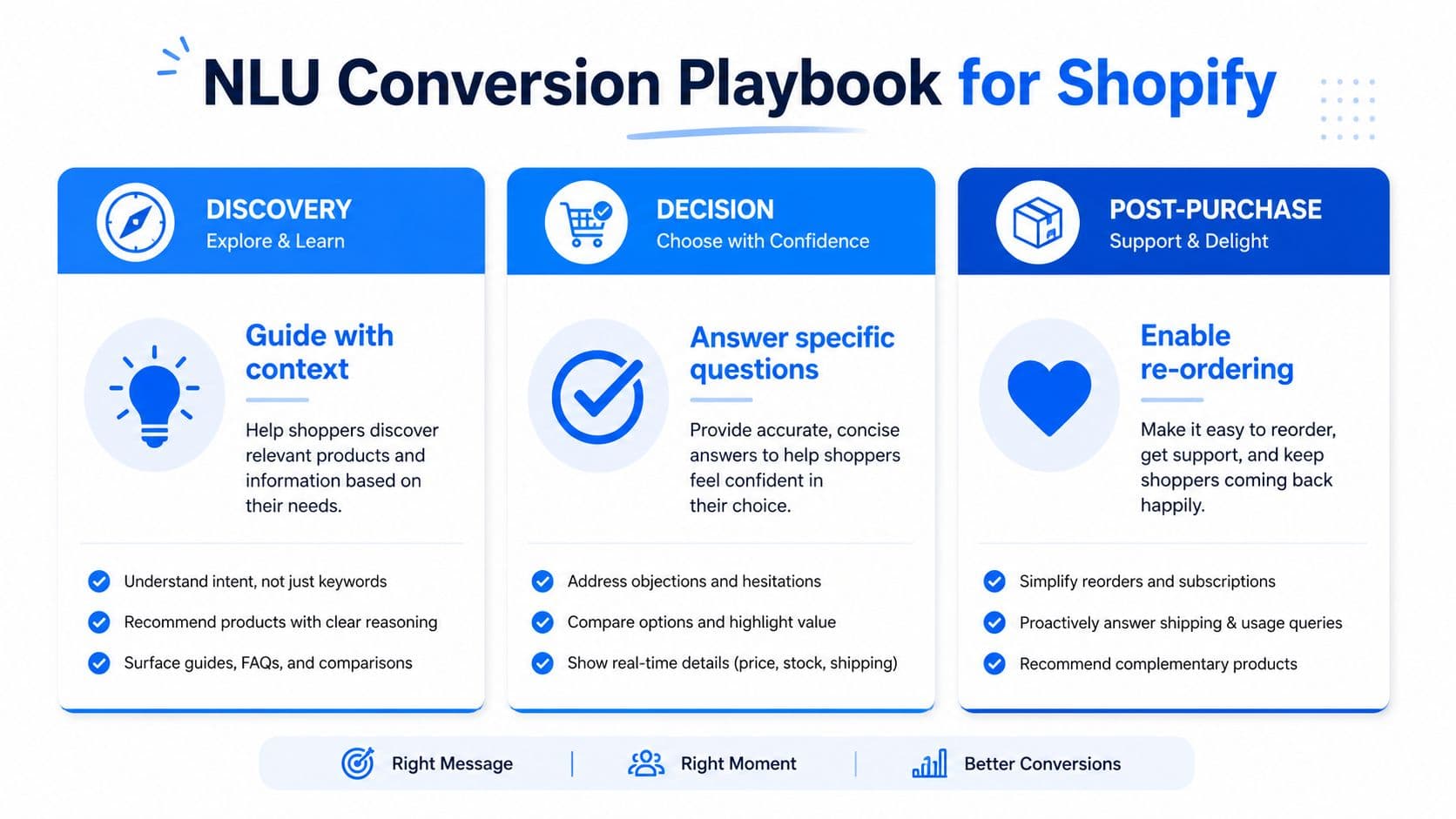
Use the same three shopper moments from earlier. Discovery should guide with context, Decision should answer specific questions, and Post-Purchase should support re-ordering, follow-up, or recovery. If your chatbot can't do those three jobs cleanly, the issue is usually in the intent map or the knowledge base, not the chat UI.
If you're evaluating an AI marketing partner alongside your own stack, the AI marketing overview from Silver Spoon Agency is a reasonable reference point for how support, ads, and automation can connect around the customer journey.
The weekly action list is straightforward. Check intent coverage, review fallback transcripts, measure revenue per conversation, and feed new phrases back into the model. That's the operating system for turning language understanding into store-floor outcomes.
Carti gives Shopify merchants an AI chatbot that learns the catalog, policies, and FAQs, then responds instantly across the shopper journey. If you want to see how that fits your store's support, recommendation, and cart recovery flows, visit Carti and explore how it can turn shopper language into conversion.

Written by
Daniel AndersonFounder of Carti. 10+ years building ecommerce brands in apparel and supplements. Still runs a Shopify store and built Carti to help merchants convert more browsers into buyers.
Ready to boost your store's sales?
Install Carti in 5 minutes and let AI handle customer questions, recommend products, and close sales 24/7.
Start Free Trial14-day free trial