
AI for customer service is no longer a side project. MarketsandMarkets projects the category will grow from $11.5 billion in 2024 to $47.4 billion by 2030, a 26.1% CAGR, while a separate Grand View Research-based estimate puts it at $13.01 billion in 2024 and $83.85 billion by 2033 at 23.2% CAGR. For Shopify operators, that growth only matters if the system does something real, like turn support into conversion support, cart recovery, and faster resolution without adding headcount.
The bad version of this conversation is a chatbot that repeats FAQ answers and hides behind a pretty widget. The useful version connects to your catalog, policies, and back office, understands intent, and takes action. That's the difference between a toy and a revenue system.
What AI for Customer Service Actually Means in 2026
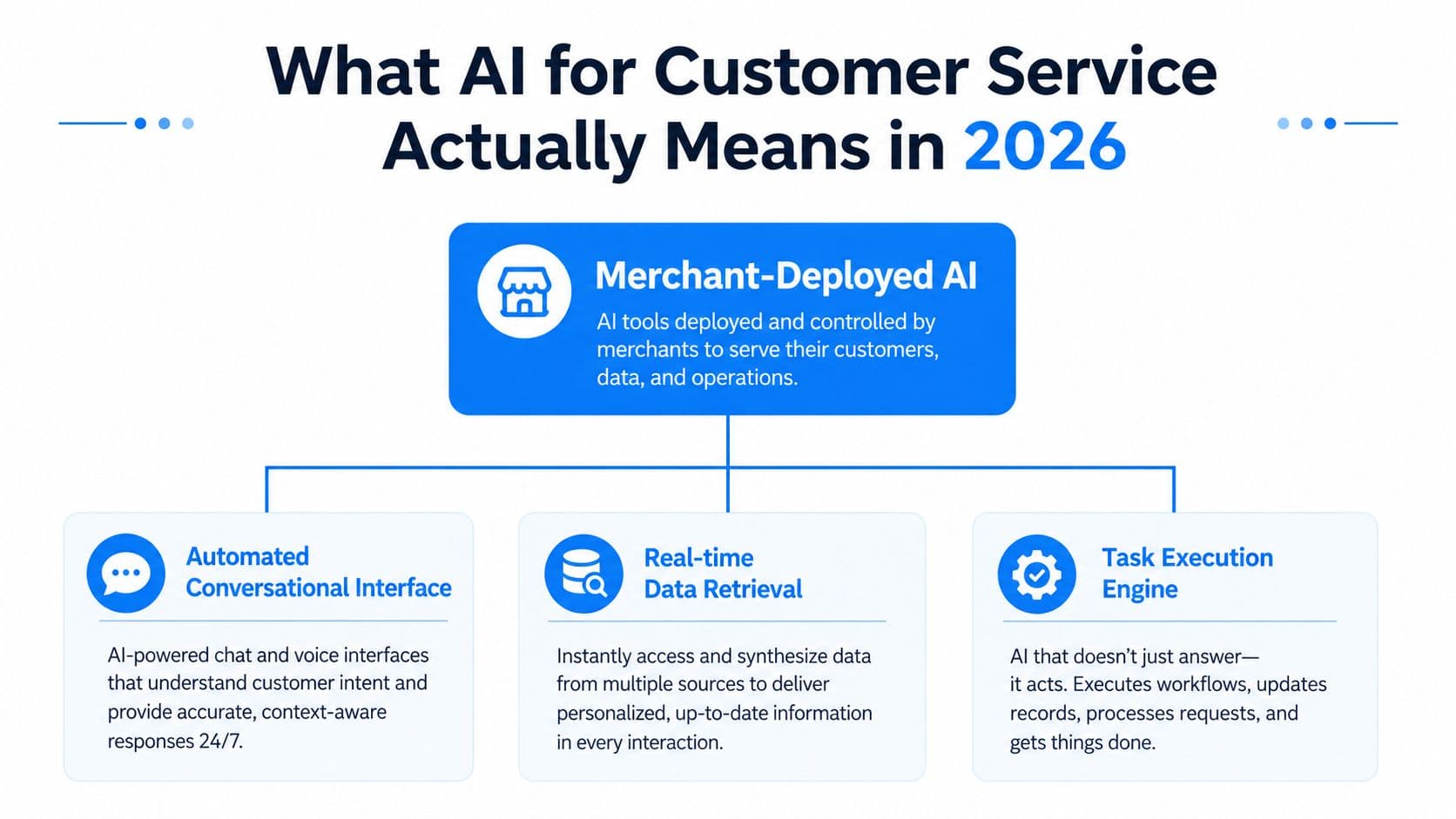
In 2026, AI for customer service means a merchant-deployed system that can understand a shopper's question, pull the right facts from store data, and either answer or act. IBM and Salesforce describe modern AI customer service systems as tools for faster, more accurate, more personalized interactions, while also automating repetitive work like ticketing, response generation, and case routing. For a Shopify store, that usually means the bot isn't just answering, it's helping a customer buy.
The line between legacy chatbots and modern AI is simple. Old bots follow keyword rules and fail the moment a shopper phrases a question differently. Modern systems use intent detection, knowledge retrieval, and workflow integrations so they can handle product questions, policy questions, and basic account tasks without making the customer start over.
That matters because support is now a commercial surface, not just a service queue. Gartner's projection that by 2025, 80% of customer service organizations will implement generative AI, and by 2029, agentic AI will autonomously resolve 80% of common customer service issues, shows where the category is heading, toward systems that complete routine work instead of only chatting about it, according to Devoteam's summary of Gartner's forecast. If your stack can't move from answer to action, it's already behind.
Practical rule: if the system can't connect to your catalog, policies, and order data, it's not customer service AI, it's a script with better wording.
For Shopify operators, the simplest mental model is this. A shopper asks a question, the AI identifies intent, checks trusted sources, and either resolves the issue or routes it cleanly. If the exchange also nudges a product, recovers an abandoned cart, or prevents a support delay from killing a sale, you're looking at revenue infrastructure, not a cost-center gadget.
You can see the broader ecommerce angle in this AI agent guide for ecommerce, but the important point is tactical. In 2026, the winner is the merchant who uses AI to reduce friction at the exact moment a customer is ready to buy.
The Core Components of a Modern AI Support Stack
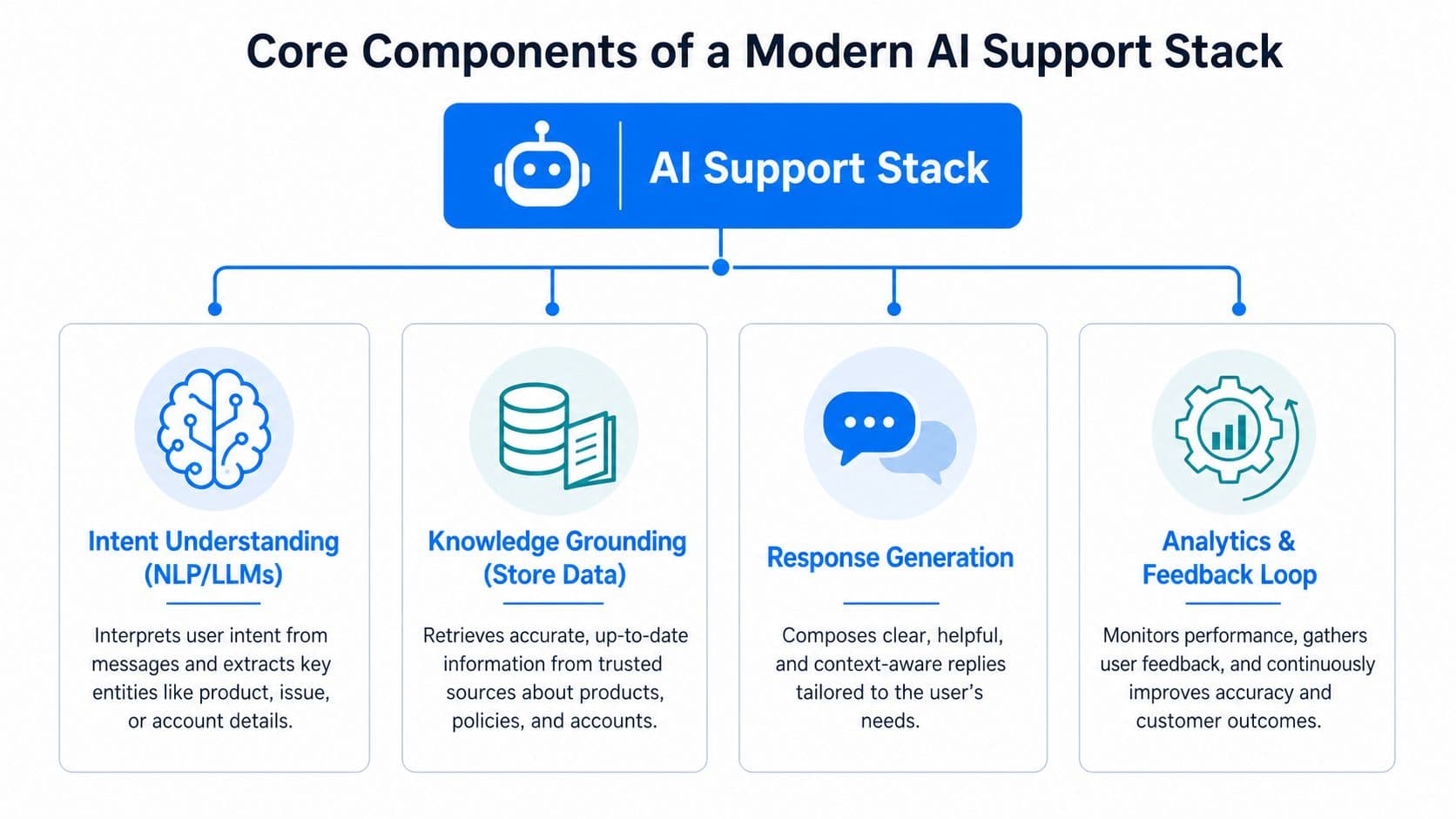
A useful AI support stack has four parts, and each one has to do its job. If one layer is weak, the whole experience gets flaky. That's why vendor demos that only show friendly chat windows are usually misleading.
Intent understanding
This is the layer that figures out what the shopper means. A customer might type, “do you have this in a size 10 and can it ship by Friday?” The AI has to recognize that the request includes sizing, availability, and shipping urgency, not just “size 10.”
Knowledge grounding
The response has to come from somewhere trustworthy. For ecommerce, that usually means catalog data, shipping policies, returns rules, FAQs, and sometimes inventory or fulfillment feeds. Without grounding, the model sounds confident and can still be wrong, which is exactly the failure mode merchants should avoid.
Response generation and triage
Once the system has intent and facts, it decides whether to answer directly, ask a follow-up, or escalate. Sentiment and confidence scoring matter here because not every interaction should be treated the same. A frustrated refund request needs a different path than a routine size check.
Action execution
AI becomes useful in a store. IBM notes that modern customer service AI can move beyond replies into actions through backend workflows, which means order status checks, refund initiation, and account updates can happen inside the flow of conversation. That's the difference between “I can help” and helping.
If the bot only explains policy, you still own the friction. If it can take the next step, you start removing it.
The practical test is easy. Ask any vendor how they handle a product question, a policy question, and a post-purchase task. If they can't show the path from intent to grounded answer to action, keep moving. A polished UI can hide a weak stack, but only for a minute.
For teams comparing approaches, this enterprise chatbot guide for ecommerce is useful because it forces the architecture question. The core issue isn't whether the bot sounds smart. It's whether the stack can answer accurately, hand off cleanly, and complete work inside your actual store systems.
Benefits and Use Cases for Shopify and DTC Stores
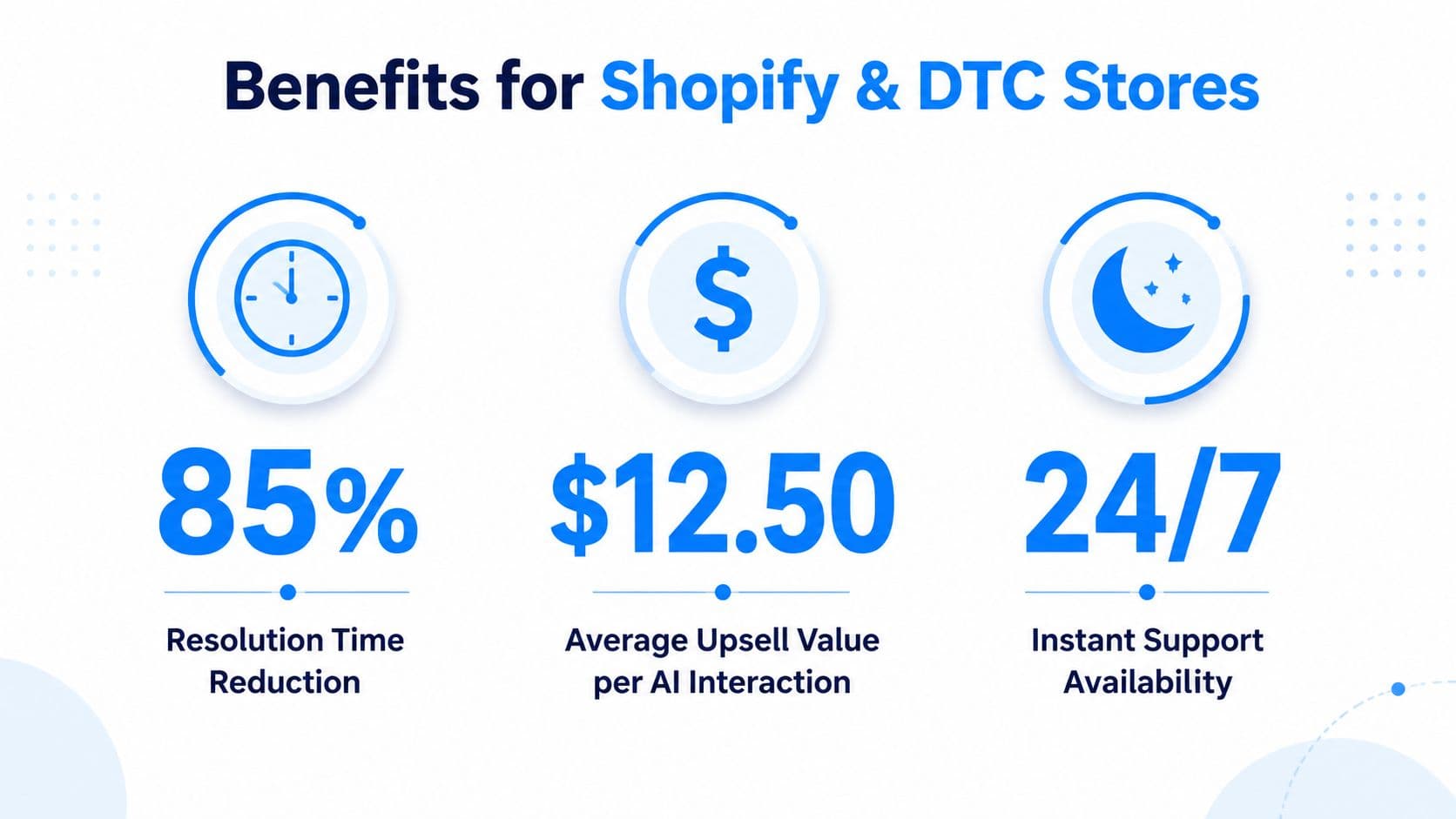
The biggest benefit of AI support in ecommerce is not ticket deflection. It's that the store stays responsive at the exact moment a shopper is deciding whether to buy. Sales happen when hesitation disappears, and AI is good at removing hesitation fast.
Instant answers keep the sale alive
A shopper who needs shipping, sizing, or policy clarification shouldn't wait for a human queue. Fast answers reduce the chance that they tab away and abandon the session. Gartner's forecast from the earlier section is why this matters, because support is moving toward automated resolution, not just automated acknowledgement.
Product guidance supports conversion
AI can guide shoppers toward the right item when they don't know what to pick. A beauty buyer asking about routine fit, or a home shopper comparing dimensions, doesn't need a generic FAQ dump. They need a recommendation grounded in the store's actual assortment.
Cart recovery works best when it's contextual
Abandoned carts are rarely caused by one dramatic problem. More often, the shopper had one unresolved question and left. A well-timed AI nudge can answer that concern, surface the right product, and keep checkout moving without forcing the customer to start a fresh support thread.
Multilingual support expands reach
Carti says it supports 92 languages, which is relevant because language coverage is one of the easiest ways to broaden support without adding a parallel staffing model. If you sell across regions, this matters more than a flashy chatbot skin. It's also one of the few cases where support can directly widen your addressable audience.
Ticket volume drops, but only after quality improves
Ticket reduction is nice, but bad automation just moves frustration around. The goal is fewer repetitive tickets because the system answered correctly the first time. Customer service solutions guidance usually says the same thing in different words, success comes from matching the right workflow to the right intent.
A merchant-friendly scorecard should be blunt:
- Incremental conversion rate, not vanity chat counts.
- Recovered carts, not just “engaged sessions.”
- Response time, because speed still closes sales.
- Resolution rate without human help, but only for the right intents.
- Post-chat customer satisfaction, especially after AI-handled sessions.
The wrong way to use AI is to treat it like a support vanity project. The right way is to treat it like a storefront assistant that can recover revenue you were already losing.
How to Implement AI Customer Service on a Shopify Store
Start with the tickets you already have. Pull the top repeated questions, group them by intent, and look for the ones tied to sales friction, shipping anxiety, returns, order edits, and product comparison. Don't begin with a giant rollout. Begin with the flows where a faster answer can change the outcome.
Choose the deployment model you can actually maintain
Native Shopify Inbox, a helpdesk AI layer, and a dedicated chatbot all solve different problems. Shopify Inbox is fine if you want simple messaging and light automation. Helpdesk AI works if your service team lives inside a ticketing system. A dedicated storefront assistant makes more sense when the goal is conversion support, cart recovery, and product guidance.
Carti fits that last category because it's built as a Shopify storefront chatbot that learns catalog, policies, and FAQs automatically, then responds in real time. That doesn't make it the only option, but it does make it structurally different from a generic support add-on.
Feed the system clean knowledge, not scattered docs
Your AI is only as strong as the material behind it. Product descriptions need to be current, return rules need to be unambiguous, and shipping policies need to match what customer service would say on a live call. If your knowledge base conflicts with your store policy, the bot will amplify the confusion.
Operational rule: if a support rep has to “know the context,” the AI has to know it too, or it shouldn't answer autonomously.
Run a narrow pilot before you automate broadly
Pick a small slice of traffic and a short list of intents. Put the AI in suggest mode for agents first if your helpdesk allows it, so humans can approve or edit responses before the system talks alone. That phase exposes bad knowledge, missing edges, and tone issues without letting them hit customers at full speed.
Five-minute setup claims are usually marketing shorthand. The widget may install quickly, but real deployment still requires policy cleanup, content alignment, integration checks, and ownership inside the team. That's not a flaw, it's the difference between software installation and operational readiness.
Once the pilot is stable, add proactive triggers. Start with cart recovery prompts, then move to product recommendation, then post-purchase automation. The expensive mistake is rushing to autonomy before your exceptions are mapped. The reversible part is the interface. The hard-to-undo part is teaching customers to distrust the bot.
Real-World Scenarios Across Fashion, Beauty, Home, and Wellness
Fashion support is mostly about fit, fabric, and timing. A shopper asks whether a jacket runs true to size and when a restock will land. The AI should answer from product and inventory data, then open checkout or surface an alert if the size is back. That's a sales conversation disguised as a service question.
Beauty is different because the stakes are ingredient sensitivity and routine fit. A shopper may ask whether a cleanser includes a certain ingredient or whether a serum belongs in the morning or evening. The right response is grounded, cautious, and policy-aware, then it either recommends a routine or creates a human ticket if the question crosses into medical territory.
Home brands get hit with compatibility questions. A customer wants to know if a shelf fits a specific wall space, whether two items can be bundled, or what the lead time looks like. The best bot doesn't just answer. It moves the shopper toward the right size, package, or shipping path without sending them to a dead-end FAQ.
Wellness support needs the most discipline. Reorder nudges are useful, subscription management is useful, and dosage questions often need strict policy handling. The AI should be helpful without acting like a clinician. If the question is routine and safe, it can guide. If the question is nuanced, it should escalate cleanly.
| AI Capability | Shopper Scenario | Merchant Outcome |
|---|---|---|
| Product grounding | “Will this fit my space?” | Adds the right item to cart or surfaces the right variant |
| Policy retrieval | “Can I return this after 30 days?” | Reduces confusion and protects the policy boundary |
| Action execution | “Where's my order?” | Resolves the issue or updates the customer account |
| Proactive suggestion | “I'm buying this as a gift” | Opens a relevant upsell or bundle path |
The pattern is the same across verticals. The shopper wants certainty. The merchant wants movement toward purchase or resolution. AI works when it shortens the distance between those two goals.
Risks, Governance, and When AI Support Falls Short
AI support fails in predictable ways. The worst one is the confident wrong answer. A bot that sounds sure while getting policy, product fit, or exception handling wrong does more damage than slow support, because it trains customers not to trust the channel.
Edge cases need humans, not optimism
Refund disputes, delivery exceptions, accessibility needs, and emotionally loaded complaints still need judgment. The research brief points to a real paradox, AI can standardize and speed up support, but it can also create weaker outcomes on edge cases and empathy-heavy interactions. That's why the question is not “chatbot or no chatbot,” it's “what gets routed to a person, and when.”
Handoff quality is a design choice
A bad escalation path is one of the fastest ways to annoy customers. If the bot collects the same details twice, loses context, or sends the shopper into a separate queue with no summary, you've added friction. Keep a structured handoff path, preserve context, and set confidence thresholds that force escalation before the AI starts bluffing.
Accessibility isn't optional
AI can help customers who face language or timing barriers, but only if it's built with accessibility and human transition in mind from the start. If the experience is difficult for keyboard users, screen-reader users, or people who need a live person quickly, you're not improving service. You're just moving the bottleneck.
Governance is cheaper than cleanup
Monitoring matters because brand risk compounds when no one watches the answers. Merchants should track hallucinations, review problematic sessions, and keep humans in the loop for high-stakes flows. Creatio's guidance on AI in customer service points in the same direction, start narrow, define metrics up front, and treat operational design as the work, not just chatbot setup, see Creatio's AI customer service glossary.
Bottom line: if you wouldn't let a junior rep answer a refund dispute alone, don't let AI do it either.
The strongest programs are boring in the best way. They answer simple questions fast, escalate hard questions cleanly, and keep the support team in control. That's not flashy, but it protects revenue and customer trust.
Evaluation Checklist and Success Metrics Before You Buy
Buy the system that proves lift at your traffic, with AI on, after the launch spike. Ignore sticker price unless it includes the operating cost of monitoring, setup, and cleanup. A cheap bot that creates bad answers is expensive the moment it touches customers.
Use this checklist in vendor calls:
- Knowledge grounding: Does it pull from catalog, policy, FAQ, and order data without manual babysitting?
- Integration depth: Can it check order status, initiate actions, or hand off with context?
- Language coverage: Does multilingual support exist natively, or is it a translation layer?
- Escalation quality: Can it pass the conversation to a human without losing context?
- Pricing transparency: What changes when traffic increases or when the bot is handling more than FAQ load?
For the pilot, define a narrow intent set and a real traffic slice. Measure the system on a short timeline, then compare AI-handled sessions against your baseline. The metrics that matter are incremental conversion rate, recovered carts, average response time, resolution rate without human intervention, and customer satisfaction after AI-handled sessions.
Don't let anyone sell you “automation” without proving outcome. If the vendor can't show how the AI improves purchase completion or reduces friction on post-purchase issues, it's not a revenue tool. It's a support costume.
If you want a storefront AI that's built to answer, recommend, and recover carts inside Shopify, look at Carti. It's designed around instant answers, product suggestions, and 24/7 support, which makes it a fit for merchants who care about conversion, not just ticket volume.

Written by
Daniel AndersonFounder of Carti. 10+ years building ecommerce brands in apparel and supplements. Still runs a Shopify store and built Carti to help merchants convert more browsers into buyers.
Ready to boost your store's sales?
Install Carti in 5 minutes and let AI handle customer questions, recommend products, and close sales 24/7.
Start Free Trial14-day free trial