
Increasing average order value profitably means keeping only the tactics that raise contribution margin per visitor, with a free shipping threshold starting at about 30 percent above current average order value as one testable example. Most advice on increasing average order value chases a bigger basket while ignoring whether the extra items were profitable after discounts, shipping, payment fees, and returns. The playbook below applies a stricter rule. A tactic stays only when it lifts profit per visitor, not just the number on the order confirmation.
Why Most AOV Advice Leaves Money on the Table
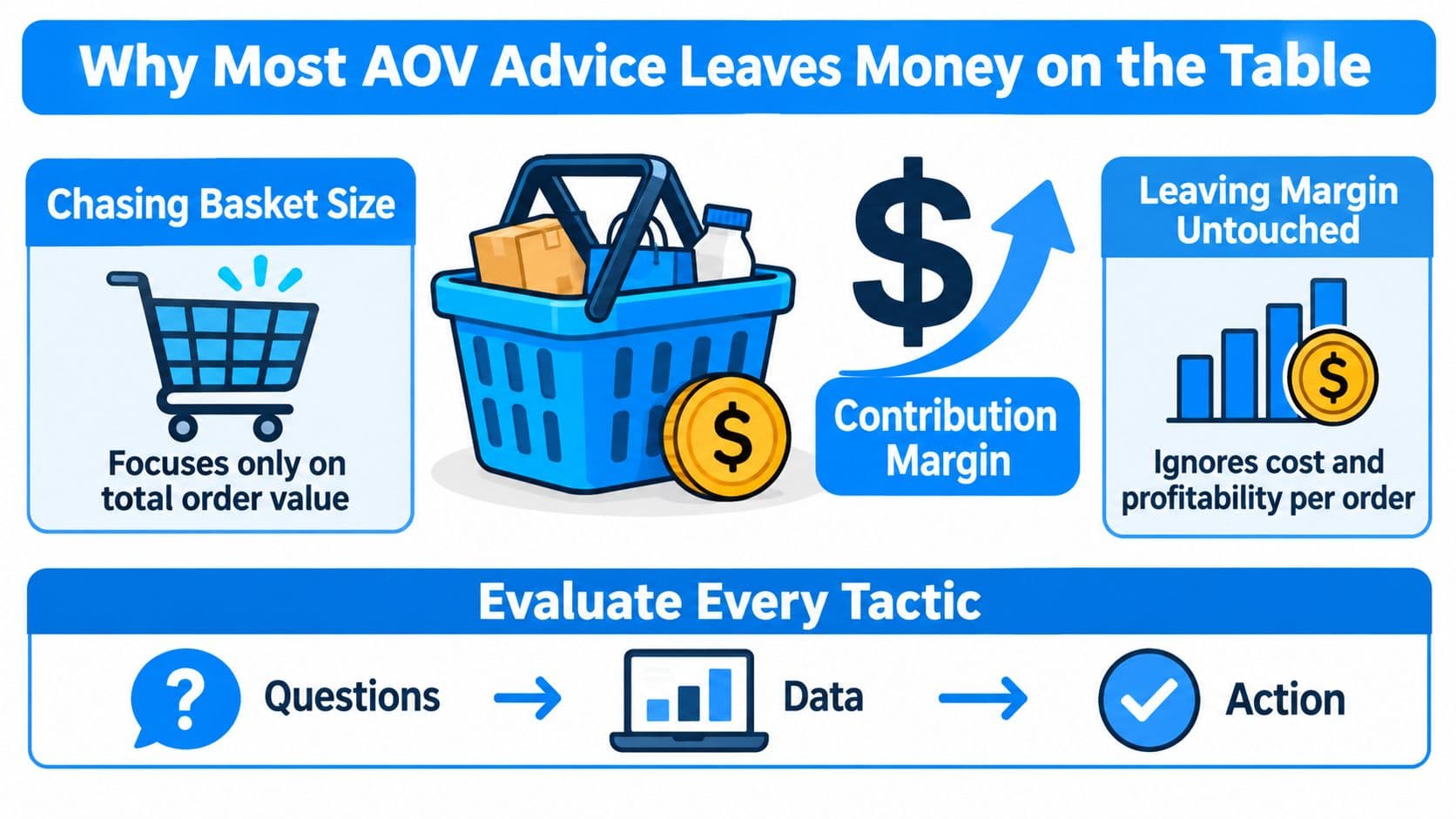
A larger order can be a worse order. Add a discounted bundle, a free gift, and subsidized shipping to the same cart and average order value climbs on the dashboard. Profit can fall at the same time, especially when the added item has thin margin, a high return rate, or expensive fulfillment.
That's the flaw in most AOV lists. They treat basket size as the outcome instead of asking what the basket costs to create. A merchant doesn't keep revenue. A merchant keeps what's left after product cost, payment fees, fulfillment, shipping subsidy, discounts, and expected returns.
The evidence for restraint is strong. Analysis cited for a 70.22% average cart abandonment rate and a possible 35.26% conversion increase from checkout design improvements appears in Baymard's ecommerce checkout usability benchmark. Roughly seven in ten carts already fail to become orders. Any upsell that distracts a shopper from paying makes that problem worse, not better.
Measure Profit Per Visitor First
The decision rule for every tactic in this playbook is simple. Keep it only if incremental contribution margin per visitor rises after discounts, fulfillment, returns, and cannibalization. If a recommendation shifts a shopper from a full price item to a discounted one, that's not growth. That's discount leakage with a nicer chart.
Start with baseline math before touching any offer. Current AOV equals revenue divided by completed orders. That single number is a starting point, not a plan, because averages hide how different shoppers behave.
- Segment by device: Mobile and desktop carts often need different thresholds and different offer timing.
- Segment by acquisition source: Paid, organic, email, and social traffic arrive with different intent and price sensitivity.
- Segment by category: A refill, an accessory, and a considered purchase don't carry the same margin or return risk.
- Segment by customer type: New and returning customers respond differently to bundles and gifts.
Why Percentiles Beat Averages
Averages get pulled around by a small number of very large orders. Medians and percentiles show what a typical order looks like, which is what a threshold or bundle needs to influence. A store setting a threshold from a skewed average can place it so far from normal behavior that shoppers ignore it or abandon.
Put four guardrail numbers on the same weekly dashboard as AOV. Track conversion rate, gross margin per session, attach rate, and refund rate. When AOV rises and margin per session falls, the tactic is buying revenue. When both rise, the tactic is working.
Practical rule: A lower AOV order can be worth more than a larger bundle when that bundle creates discount leakage, shipping complexity, or a product mismatch the shopper returns.
Match the Tool to the Shopper Problem
Execution tools map to specific jobs. Instant Answers resolves a sizing, shipping, or returns question that blocks the first item. Smart Suggestions recommends a complement once that question is answered. Proactive Triggers times a nudge to behavior such as scroll depth or exit intent instead of interrupting every visitor.
Merchants comparing approaches can also review 9 operator-tested ways to raise basket size from Reddog Consulting Group for additional tactic ideas. Each idea still needs the same profit test before it earns a permanent place on the store. An idea that can't clear contribution margin per visitor doesn't become a good idea because it appeared on a list.
Build a one page baseline before launching anything. Record AOV, median cart value, conversion rate, gross margin per session, attach rate, and refund rate for each major segment. That page becomes the control every later result gets judged against, and it prevents the most common AOV mistake. That mistake is celebrating a bigger average basket that produced less money.
The Core AOV Playbook and When to Use Each Lever
Four levers cover most profitable AOV work on Shopify. The right choice depends on margin, shipping economics, product relationships, and traffic intent. Copying a lever because another store uses it usually produces an offer shoppers don't want or a discount the store can't afford.
| Lever | Best fit | Main risk | Key guardrail |
|---|---|---|---|
| Free shipping threshold | Predictable shipping costs and healthy margin | Subsidy costs exceed added margin | Set from order percentiles and track profit per order |
| Bundles and complete kits | Products used together naturally | Discounting a purchase that would happen anyway | Test against individual item merchandising |
| Cart and post-add cross-sells | Clear accessories, refills, or complements | Distraction before payment | Show one or two high confidence matches only |
| Gift with purchase or tiered gifts | Launch moments or excess inventory | Gift cost and fulfillment complexity erase margin | Price the gift into contribution profit before launch |
Price transparency decides whether any of these levers helps. Research reporting that 39% of shoppers abandon because of additional costs such as shipping, taxes, or fees appears in Baymard's guide to reducing cart abandonment. A tactic that hides the final price until checkout fights that behavior. Shoppers who feel surprised by delivery costs don't reward the store with a larger basket.
Traffic quality matters just as much as offer design. Stores investing in ecommerce SEO services from AY Rank still need segment level AOV data, because search visitors comparing products behave differently from returning buyers opening an email. One threshold and one bundle rarely fit both groups.
Choose one lever first. Pick the one with the clearest product logic, the healthiest margin, and the cleanest measurement path. Stacking a threshold, a bundle discount, a gift, and a cart upsell at launch makes results impossible to attribute and gives away margin in four directions at once.
Set the Free-Shipping Threshold From Your Own Orders
A free shipping threshold shouldn't come from a competitor's announcement bar. It should come from the store's own transaction distribution, product margins, and real fulfillment costs. An arbitrary round number usually lands in the wrong place. It's either so low that the store subsidizes orders it would have won anyway, or so high that shoppers give up.
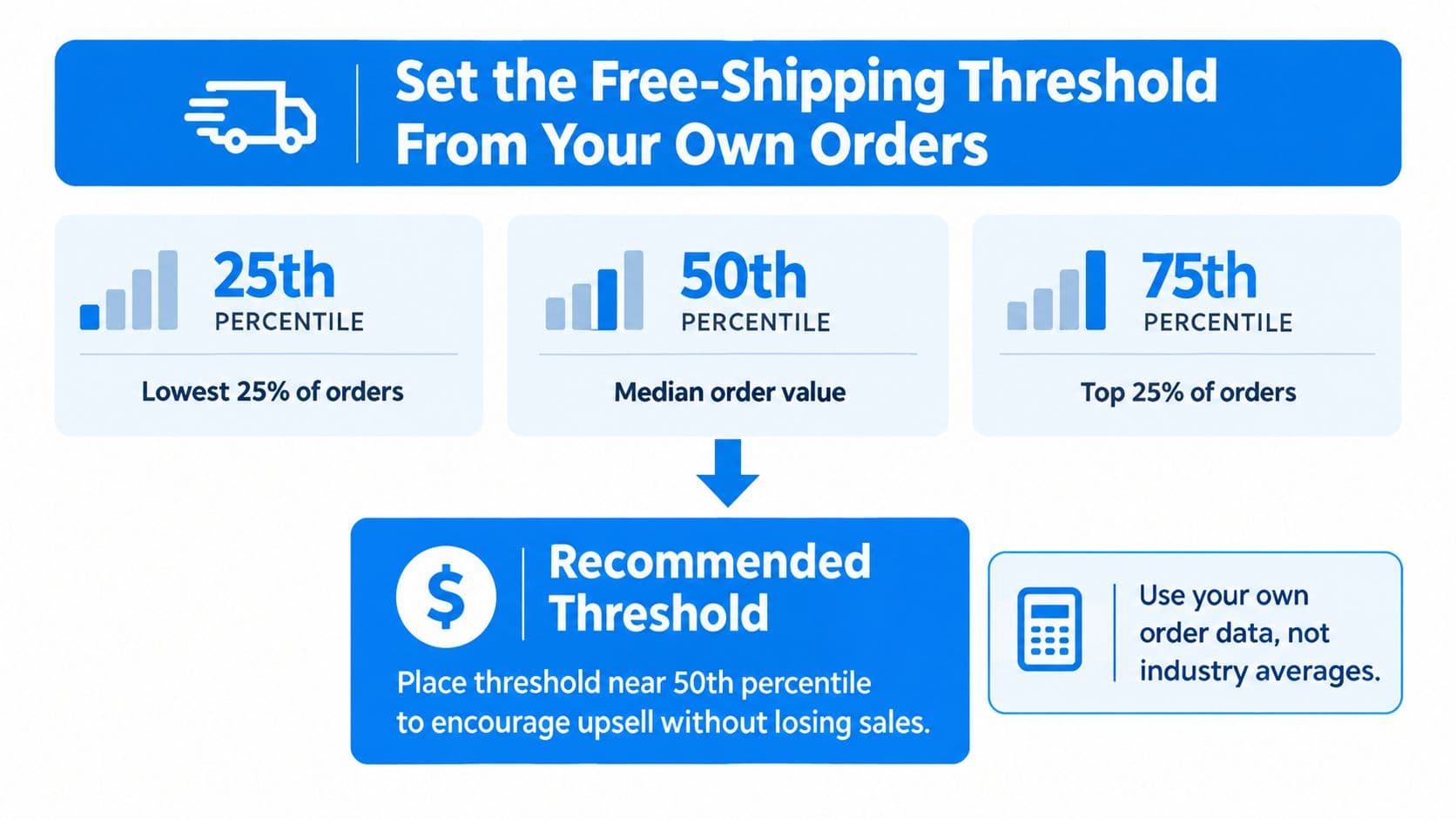
Start by computing the 25th, 50th, and 75th percentiles of pre-shipping cart value. The median shows the typical order. A threshold modestly above that median gives a reachable reason to add one useful item without asking for a completely different purchase.
A Concrete Starting Point
Guidance to start at about 30 percent above average order value, such as a $104 threshold for an $80 AOV store, appears in Shopify's guide to average order value. Treat that figure as a test hypothesis, not a universal answer. Modal order value, meaning the most common order value, can be more useful when a few large orders distort the average.
Display progress in plain language. A message showing the amount remaining works because the shopper can judge the gap immediately. Pair that message with low return, high margin complements that fit the current cart. Recommending an unrelated product just because its price closes the gap invites returns and erodes trust.
Test Threshold Variants Against a Control
Run a randomized test with a persistent control. Compare no intervention, threshold only, and threshold plus personalized recommendations. That structure separates the effect of the shipping incentive from the effect of the product suggestion.
- Threshold attainment rate: Shows whether shoppers reach the target.
- Incremental units per order: Shows whether the basket grew or the shopper paid more.
- Shipping subsidy and gross margin: Shows what the extra revenue cost.
- Cancellation and return rates: Reveals poor fit recommendations that AOV hides.
A bundle discount of 5 to 10 percent can serve as a starting hypothesis inside this kind of test, but contribution margin sets the ceiling. If the discount plus free shipping costs more than the added product contributes, the threshold is a promotion, not an AOV strategy. Validate compatibility with category rules, stock availability, review derived fit information, and common customer service questions before scaling the winner.
Run Relevance-First Cross-Sells and Cart Recovery With Carti
Relevance comes before recommendation. A shopper asking whether a shoe runs narrow or whether delivery arrives before a trip doesn't need a bundle pitch. That shopper needs an answer. Pushing an offer over an unresolved concern is how cross-sells turn into abandonment.
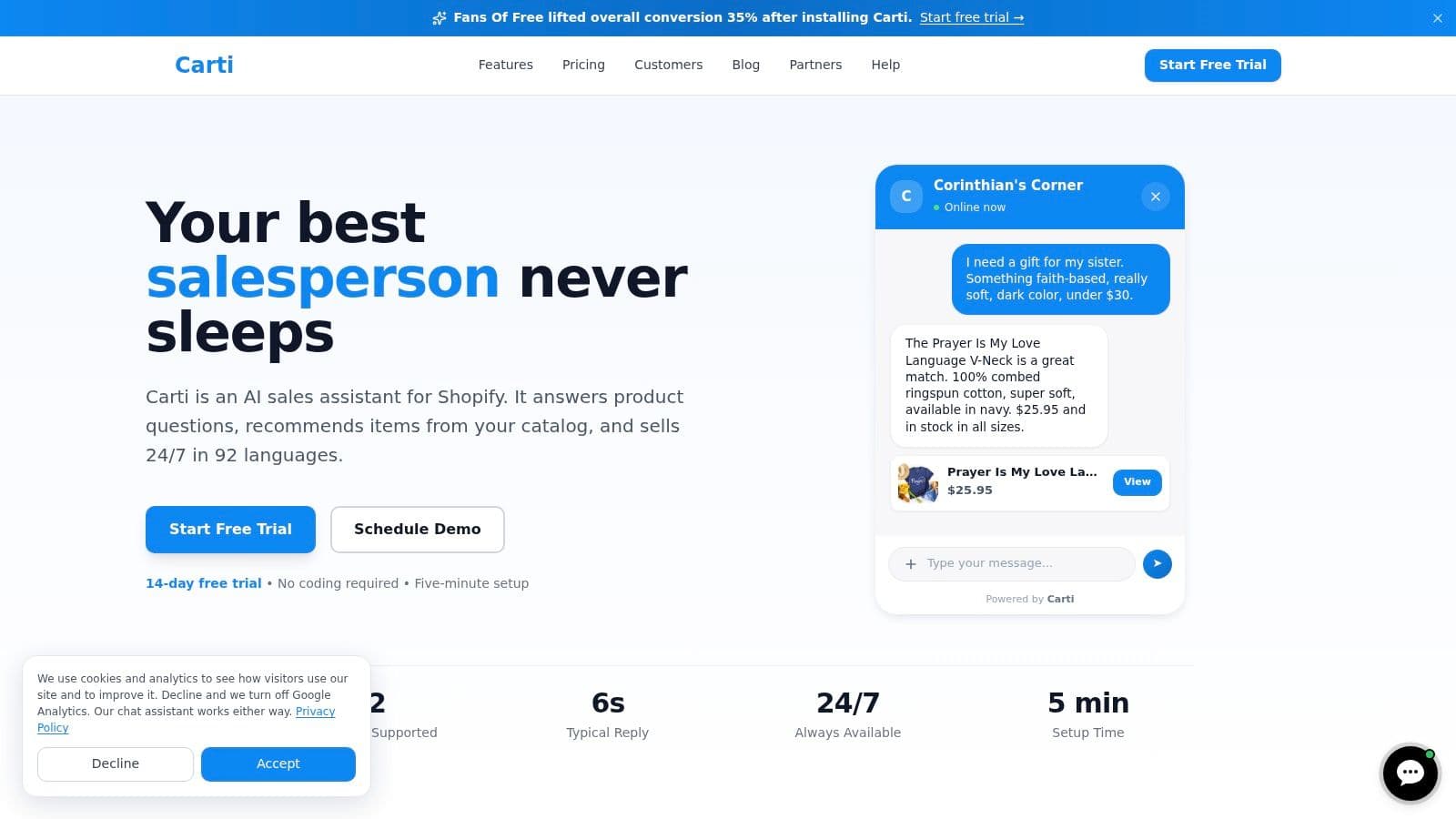
Carti is structured around that order of operations. Instant Answers addresses the shopper's actual question using the store's catalog, policies, and FAQs. Smart Suggestions can then surface one or two high confidence complements, such as a refill, an accessory, or the product that completes a routine or outfit. If confidence is low, the right move is to answer the question and stop.
Time the Nudge to Behavior
Proactive Triggers can present help at moments tied to browsing behavior, such as extended time on a product page, scroll depth, or exit intent. Timing matters because the same suggestion reads as help in one moment and interruption in another. Cart recovery nudges should reference the exact items left behind and answer the likely objection about shipping, returns, or fit. A generic discount teaches shoppers to abandon carts on purpose.
Review content strengthens recommendation quality. Carti can use reviews from Judge.me, Loox, Yotpo, Okendo, and Fera to answer fit and quality questions. Better fit answers support margin because they reduce the chance that an added item comes back as a return.
Merchants who want the detailed mechanics can read about building relevant cross-sell recommendations in chat. The operating principle stays the same on every surface. Resolve uncertainty first, recommend second, and suppress the offer when the match isn't defensible.
Turn Instagram and Messenger DMs Into Larger Orders
Consider a beauty shopper who messages a store on Instagram about a serum. She wants to know whether it suits dry skin, how it layers with products she already owns, and how long shipping takes. She has already declared intent. The conversation just needs to remove doubt.
A relevance first reply answers the dry skin question directly. It can then suggest one complementary moisturizer that addresses the same concern, rather than dumping a full routine into the thread. If the two products belong together, a sensible bundle becomes an easy next step. If they don't, the honest single product answer protects both the sale and the return rate.

Relevance drives that outcome. Survey results reporting that 77% of consumers were likely to purchase when recommendations were relevant, rising to 83% among Millennials, appear in Extend's discussion of Attentive's consumer survey. A DM is a strong place to earn that relevance because the shopper describes the problem in her own words.
Carti replies to Instagram and Facebook Messenger messages and supports replies in 92 languages. Matching the customer's language and tone matters in a channel that feels personal. Reply speed matters too, because a shopper comparing two brands in parallel conversations usually buys from the one that answers clearly first.
A DM conversation starts with consent because the shopper opened it. Proactive follow-up should respect channel norms and never become spam, or the channel that produced the larger order stops producing replies.
Stores building this channel can review the setup considerations for an Instagram chatbot for Shopify stores. The DM playbook mirrors the storefront playbook with one difference. The assistant gets richer intent signals, so it has less excuse for a generic recommendation.
Design A/B Tests That Measure Profit, Not Just AOV
Most AOV tests fail before they launch. Merchants split traffic, watch average order value for a few days, and declare a winner. That process can't detect margin damage, return damage, or the shoppers who stopped converting.
Keep a persistent holdout group that sees no AOV intervention. Without a stable control, seasonal demand, a sale, or a traffic mix shift can masquerade as a tactic working. Think about sample size at the cart level, because carts are where thresholds, bundles, and cross-sells operate.
Price clarity belongs inside the test design. Findings that 12% of shoppers abandon because they can't see or calculate total order cost upfront, while 40% leave when shipping, taxes, or fees make the final price too high, appear in Shopify's ecommerce checkout guide. A test variant that raises AOV by obscuring total cost is borrowing against checkout completion.
Guardrails That Can Disqualify a Winner
- Conversion rate: A treatment that adds items but loses buyers can reduce total profit.
- Gross margin per session: Captures discount depth, product mix, and shipping subsidy together.
- Refund and cancellation rates: Expose recommendations shoppers accepted but didn't want.
- Discount leakage: Shows whether full price demand moved into a promoted basket.
- Repeat purchase: Check behavior across at least one full replenishment cycle for consumable products.
The decision rule doesn't change. Retain a treatment only when incremental contribution margin per visitor increases after discounts, fulfillment, returns, and cannibalization. Merchants who want a broader testing framework can apply the same guardrails described for Shopify conversion rate optimization. AOV is one input to that decision. It is never the decision itself.
Your First 30 Days on This AOV Playbook
Thirty days is enough to build a baseline, run one clean test, and make a defensible decision. It isn't enough to launch every lever at once. Sequence matters because checkout friction, threshold math, and recommendations solve different problems.
Week 1 covers baseline math and a checkout friction review. Research placing the average checkout at about 23.48 form elements, versus an optimized flow near 12, appears in Baymard's checkout usability research. Remove nonessential fields and forced account creation before asking shoppers to add more products.
Week 2 covers threshold math from the store's own orders. Compute the percentiles, pick one threshold hypothesis, and design a single A/B test with a persistent control. Define the kill criteria in advance so a weak result doesn't get rationalized later.
Week 3 covers execution in chat and DMs. Enable one recommendation flow, one Proactive Trigger, and Instagram and Messenger coverage. Carti plan limits are Free at 50 AI conversations a month, Starter at $49 with 250, Growth at $99 with 600, and Scale at $249 with 1,750, with a 14-day free trial on paid plans.
Week 4 covers the read. Compare contribution margin per visitor, conversion rate, refund rate, and discount leakage against the Week 1 baseline. Scale what cleared the guardrails, hold what needs more data, and kill what only inflated basket size.
Three rules summarize the month. Measure profit, not basket size. Test before scaling. Skip any tactic that hides the final price.
Carti answers pre-purchase questions on the storefront, Instagram, and Messenger, then recommends relevant complements only after the shopper's concern is resolved, which supports larger orders without pushing poor fit add-ons. Merchants ready to run relevance first cross-sells and DM conversations from one assistant can visit Carti to start with the free plan or a paid trial.

Written by
Daniel AndersonFounder of Carti. 10+ years building ecommerce brands in apparel and supplements. Still runs a Shopify store and built Carti to help merchants convert more browsers into buyers.
Ready to boost your store's sales?
Install Carti in 5 minutes and let AI handle customer questions, recommend products, and close sales 24/7.
Start Free Trial14-day free trial