
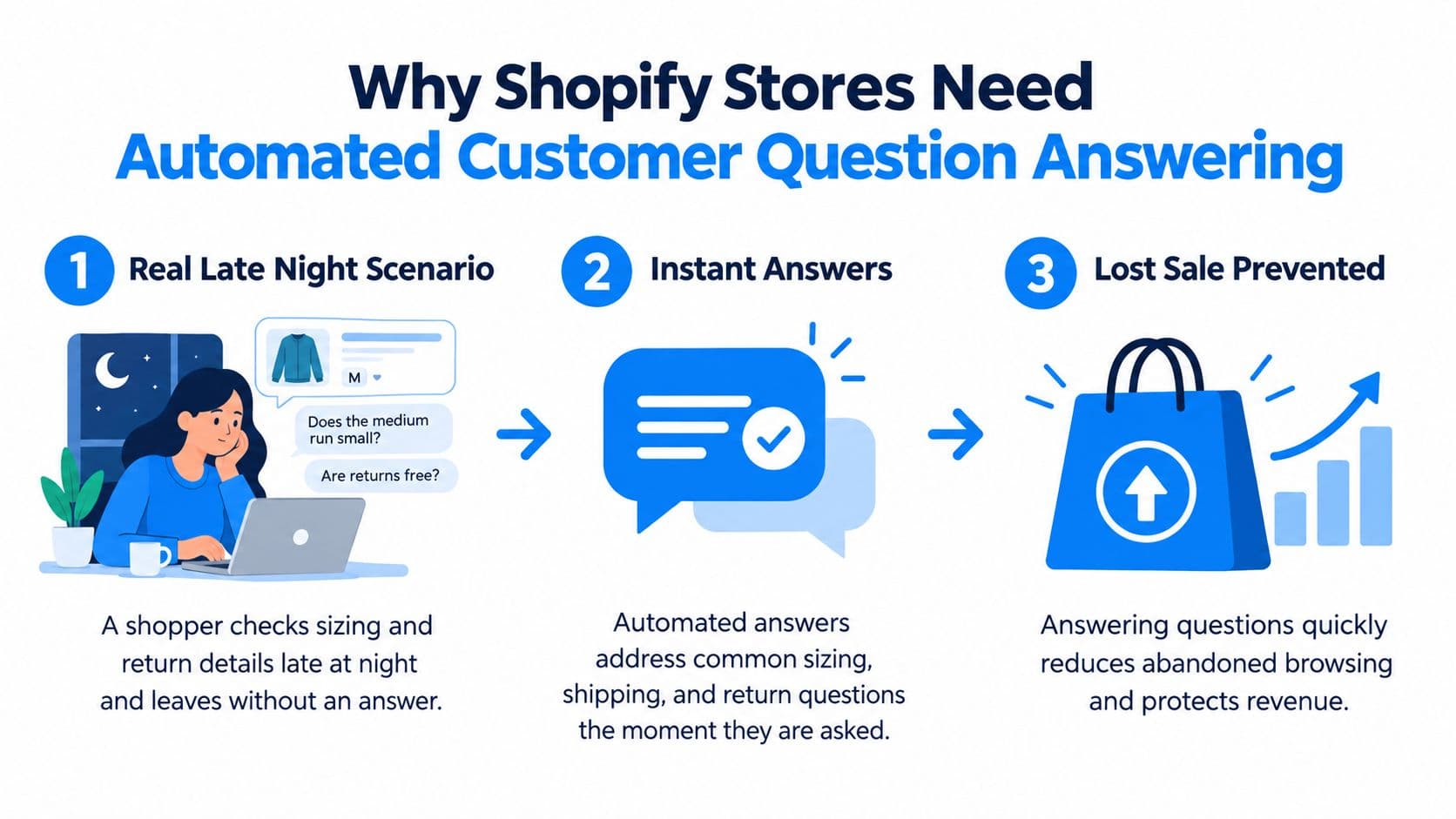
A shopper lands on a Shopify product page at 11pm, checks the size chart, and still can't tell whether the medium runs small. The next question is whether returns are free. Nobody answers, so the shopper leaves with both questions unresolved.
For merchants deciding how to answer customer questions automatically on Shopify, installing a chat widget is the easy part. The harder work is giving that widget trustworthy information, defining what it's allowed to promise, and making sure a human can take over when the answer needs judgment.
Why Shopify Stores Need Automated Customer Question Answering
Automated answers belong in the sales operation, not just the support queue. A sizing question asked before checkout is a purchase decision waiting for clarification. Sending that shopper into a help center may leave the underlying uncertainty untouched.
Salesforce reports that 64% of consumers expect real-time responses and interactions, 71% expect companies to communicate in real time, and 68% prefer self-service for simple questions. The same research finds that 78% expect to resolve complex issues by speaking with one person, which makes the boundary clear: automate routine information access, but preserve human ownership of difficult cases (Salesforce State of the Connected Customer).
Treat unanswered questions as purchase blockers
The late-night shopper doesn't necessarily need a conversation. A clear explanation of garment measurements, return shipping responsibility, and applicable exclusions may be enough.
The merchant's job is to put that information where the decision happens. Product-page assistance should connect the question to the item being viewed, rather than start every interaction with a generic greeting.
A sensible starting scope includes:
- Product clarification: Explain materials, dimensions, included components, and documented differences between products.
- Purchase conditions: Surface shipping rules, return eligibility, and exclusions without making shoppers interpret scattered pages.
- Fit guidance: Combine approved size information with clearly identified customer-review observations.
- Exceptions: Transfer requests that require discretion, account access, or a commitment the store hasn't already approved.
Build a controlled commerce system
A useful assistant needs more than a friendly tone. It needs approved sources, freshness rules, language coverage, testing, and an accountable person who fixes incorrect answers.
That operating model also changes how success gets judged. A short conversation that leaves a shopper misinformed isn't a win, even if no support ticket appears afterward.
Operating principle: The assistant should make buying easier without making promises the merchant can't keep.
For a store with unanswered pre-purchase questions, storefront assistance deserves attention alongside merchandising and checkout improvements. It addresses uncertainty while the shopper is still evaluating the purchase, rather than waiting for a support request that may never arrive.
Native Shopify Automations vs a Dedicated AI Shopping Assistant
Paying for another app only makes sense when it closes a specific capability gap. Merchants should start by inspecting what their current Shopify Inbox configuration can already handle.
There's an important distinction between predefined answers, staff reply templates, and an autonomous assistant. A saved reply still needs a person to send it. An instant answer can surface approved information without that intervention.
Choosing Between Shopify Inbox and a Dedicated AI Assistant
| Capability | Shopify Inbox | Dedicated AI Assistant (Carti) |
|---|---|---|
| Routine questions | Start with configured instant answers and staff templates | Answers using the store's catalog, policies, and FAQs |
| Product selection | Assess the features available in the store's current Inbox configuration | Recommends products and answers comparison questions |
| Review-informed guidance | Verify available source coverage before relying on it | Can use supported review sources for fit and quality questions |
| Languages | Check the language coverage of the enabled features | Replies in 92 languages, as described in the Shopify Inbox and AI chatbot comparison |
| Social messages | Verify channel coverage separately from storefront chat | Replies to Instagram and Facebook Messenger messages |
| Merchandising assistance | Check whether the required behavior is available | Includes Smart Suggestions and Proactive Triggers |
The wrong comparison assumes native software is permanently limited to canned replies. Shopify's available capabilities can change, so merchants should assess the actual features enabled in their admin rather than buy against an outdated checklist.
The better question is whether the current setup can answer the store's real questions, across the required channels, with acceptable supervision.
When native is enough
A small catalog, modest chat demand, support-first workflow, and limited language requirements can make native tools a sensible starting point. If approved answers cover most incoming questions and staff can manage the remainder, another subscription may add little.
A specialist becomes worth evaluating when shoppers need richer product guidance, review-informed answers, multilingual coverage, or consistent assistance in social DMs. None of those requirements automatically proves a financial return.
For merchants asking why anything beyond Inbox deserves a budget, the answer should be concrete: a demonstrated coverage gap plus a measurable business outcome. Traffic alone isn't a buying criterion, and an assistant doesn't pay for itself merely because it handles conversations.
How Automated Answering Actually Works on Shopify
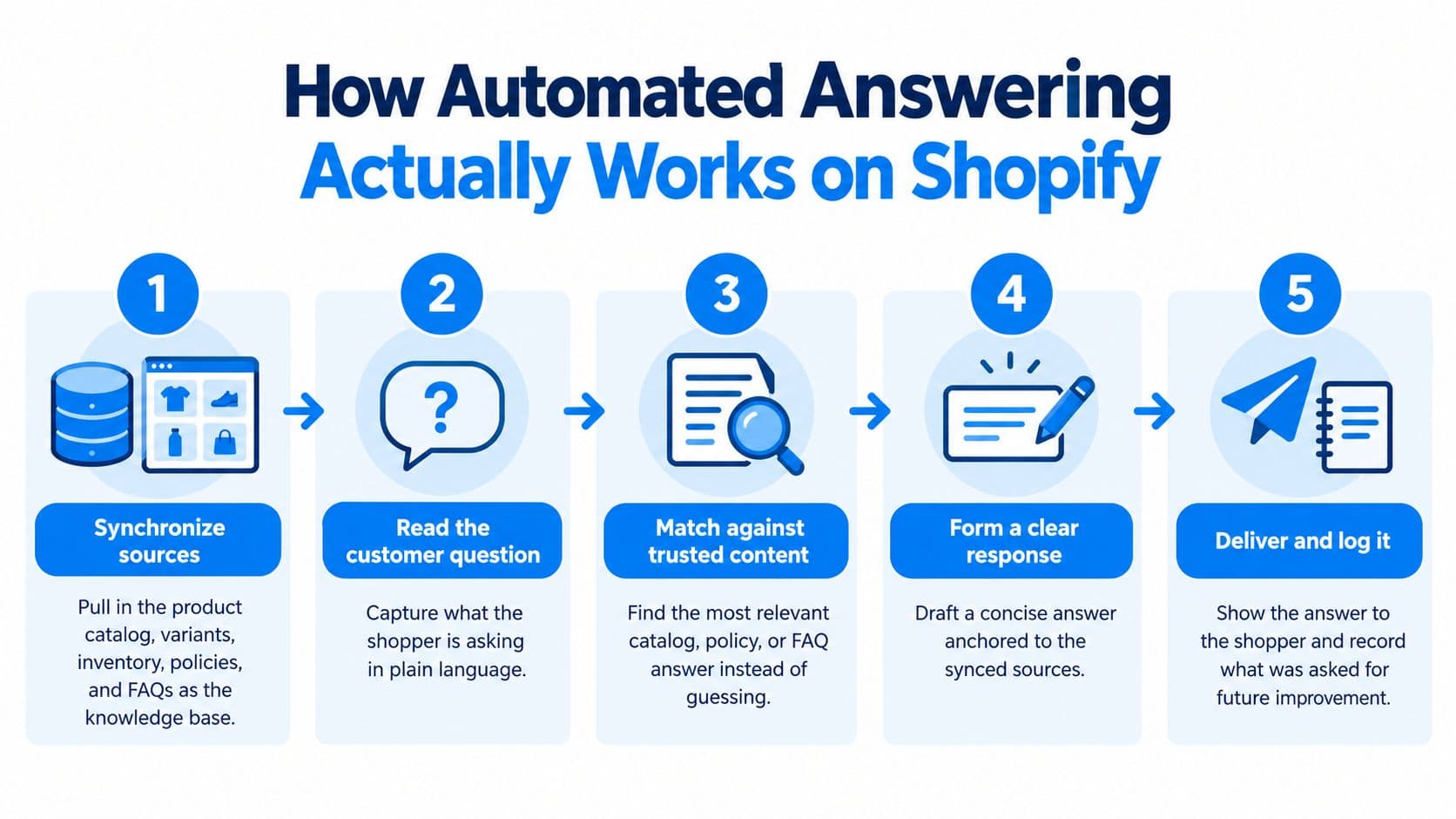
A reliable assistant shouldn't answer from a vague impression of the store. It should find relevant evidence, use that evidence to compose a response, and preserve enough context for the merchant to inspect what happened.
This architecture is commonly called retrieval-augmented generation, or RAG. NIST describes the combination of information retrieval and language generation, while also identifying risks including hallucinations, prompt injection, data exposure, and unauthorized access (NIST's RAG security and deployment discussion).
Follow the evidence from source to response
The practical pipeline should contain these stages:
- Synchronize approved sources. Bring together products, variants, inventory, shipping rules, returns, sizing guidance, FAQs, and approved reviews. Review sources may include Judge.me, Loox, Yotpo, Okendo, or Fera, depending on the assistant's supported connections.
- Organize and date the content. Store product IDs, locales, markets, document versions, and policy effective dates. A return rule without its applicable market can produce a plausible but wrong answer.
- Retrieve the relevant evidence. Combine keyword matching with meaning-based search. Filter by store, market, product, and language before selecting supporting passages.
- Generate within the evidence. Require the answer to stay inside the retrieved material. Missing details shouldn't become invented delivery promises or product attributes.
- Deliver, log, and route exceptions. Preserve source labels internally and provide an escalation path when documents disagree or don't answer the question.
Separate knowledge from authority
A review can describe how a garment felt to a shopper. It shouldn't override the official size chart or establish return eligibility.
Likewise, a shipping FAQ can explain dispatch procedures, but an old document shouldn't determine current stock availability. The system needs a source hierarchy, not a large collection of text.
That distinction matters during maintenance. If an answer is wrong, the merchant needs to know whether the problem came from an outdated source, an incorrect match, or unsupported wording in the generated response.
RAG isn't an automatic accuracy guarantee. A store should require evidence traceability and access controls, then test whether the complete system behaves correctly under ambiguity, contradictory content, and requests for information it shouldn't reveal.
Setting Up an AI Assistant on Your Shopify Store
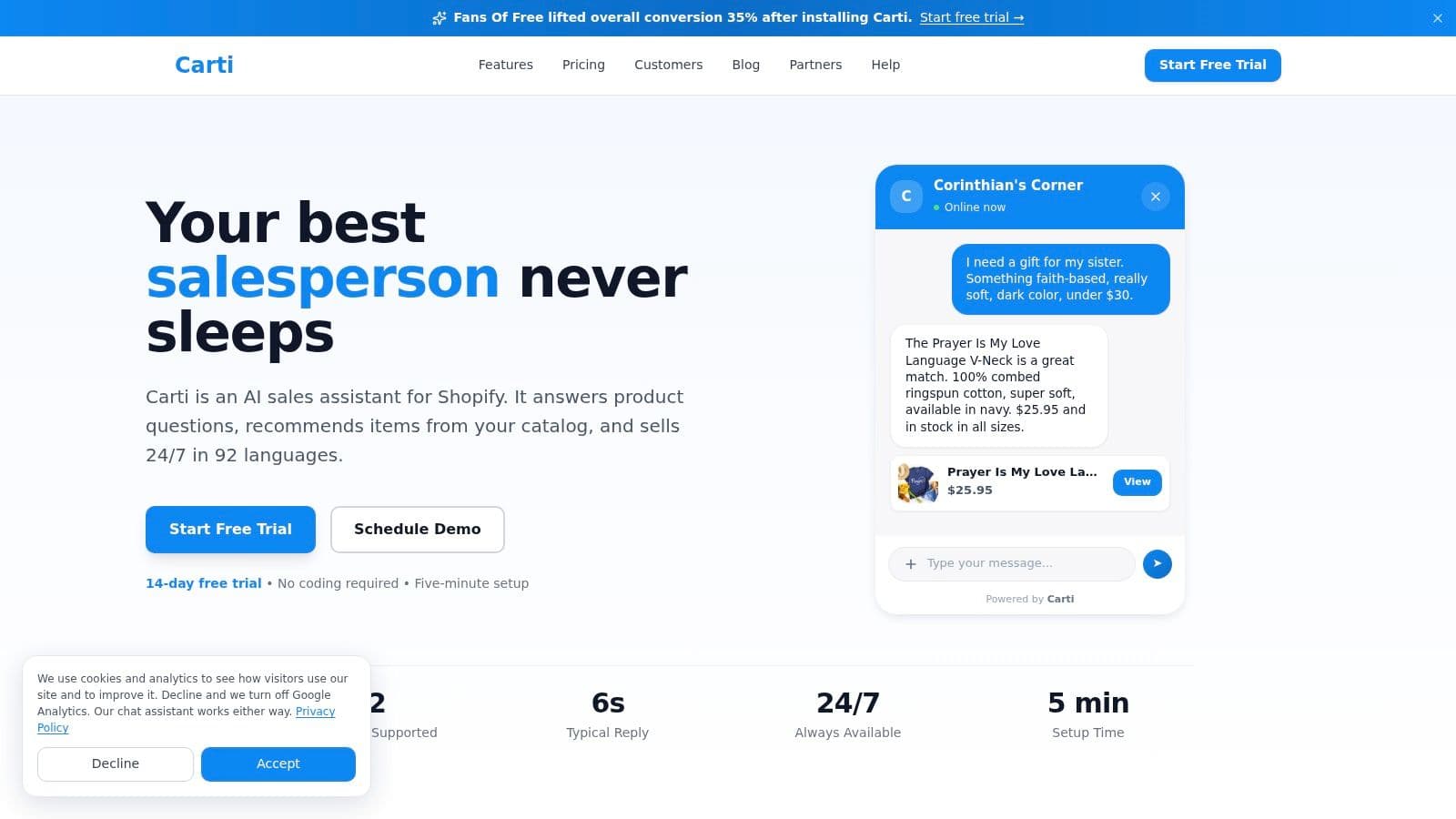
Install fast, approve slowly. Carti's product description offers no-code setup in a few minutes, but an app connection is only plumbing until someone decides which answers may reach customers.
Treat launch as a controlled commerce system: catalog in, policies in, channels in, then a human gate before automation touches revenue. Keep Shopify Inbox automations on predictable work such as order status, hours, and simple routing. Let a dedicated assistant handle product and policy questions that need evidence, while a merchant owns release approval. The greeting can wait; the correct answer on who pays return shipping cannot.
Connect the information before enabling outreach
A practical setup sequence is:
- Install and connect the catalog: Check that product names, variants, pricing, and descriptions appear against the correct items.
- Add policy sources: Connect shipping and return content, then remove obsolete or conflicting copies.
- Import FAQs and reviews: Add approved answers and supported customer-review sources for fit and quality guidance.
- Configure language behavior: Select the store's important locales and test market-specific wording rather than assuming translated text is sufficient.
- Connect social channels: Configure Instagram and Facebook Messenger, then confirm that policy answers match the storefront.
- Define ownership: Assign someone to review unanswered questions and maintain the underlying content.
The interface should expose what shoppers ask, which answers fired, and where the assistant stayed silent. A widget that only looks active is worse than a narrower one the team trusts.
Carti Plans and Conversation Limits
The following limits and trial terms come from Carti's published product and plan information.
| Plan | Price | AI Conversations / Month | Trial |
|---|---|---|---|
| Free | Free | 50 | Not applicable |
| Starter | $49 | 250 | 14-day free trial |
| Growth | $99 | 600 | 14-day free trial |
| Scale | $249 | 1,750 | 14-day free trial |
Plan selection should follow expected conversation demand, not storefront visits alone. Verify what the app counts as a conversation before committing; a buyer who asks three follow-ups may be measured differently than three separate chats.
Shopify supports recurring, usage-based, and combined app billing, so inspect the charging structure alongside the feature list (Shopify app pricing documentation). A Shopify platform trial doesn't necessarily prevent installed apps from generating charges (Shopify app trial billing guidance).
Make assistance relevant, not intrusive
Good Instant Answers surface product-specific sizing or return conditions. Smart Suggestions should help shoppers compare relevant options instead of pushing unrelated inventory.
Proactive Triggers deserve tighter restraint. A complementary product suggestion can suit a product detail page, while shipping information can help near an applicable free-shipping threshold. Repeated dismissals should suppress further prompts.
Sensitive products warrant extra caution. The Insights Dashboard, which shows what shoppers ask, should guide which missing answers deserve attention before more outreach gets enabled.
Training Your Assistant on Catalog, Policies, and Reviews
Training is a content operation, not a document upload. A merchant needs ownership, update rules, and a clear distinction between official product facts and customer opinion.
The starting material should come from frequently viewed products and actual inbox questions. Marketing copy alone won't explain the practical details shoppers ask about before buying.
Establish a dependable knowledge base
A useful starting scope is the top 20 SKUs by traffic and 30 to 50 real questions from inbox history. These are recommended working targets, not performance benchmarks.
The store should include complete shipping and return policies, the size guide, and answers that staff already trust. Each policy needs an owner, a version, and an effective date, with re-syncs scheduled around how often the information changes.
A structured chatbot knowledge base should make these relationships explicit rather than store disconnected copies of the same rule.

Use reviews without turning opinion into policy
Reviews from Judge.me, Loox, Yotpo, Okendo, and Fera can supply shopper language about fit, texture, finish, and everyday use. That makes them useful for questions that a specification sheet doesn't fully address.
The assistant should describe those observations as customer experiences. It shouldn't convert a reviewer's report of a snug fit into a universal instruction to size up, or infer allergy safety from a positive review.
Multilingual preparation needs the same discipline. Merchants should prioritize locales supported by their markets, configure switching based on the shopper's language and stated preference, and have fluent reviewers check policy terminology before launch.
A translated answer must still use the correct market's rules. Language and shipping destination aren't interchangeable.
Before customer access, the merchant should confirm:
- Source ownership: Every important document has a responsible editor.
- Freshness: Changed policies and discontinued products no longer conflict with active content.
- Review boundaries: Customer opinions remain distinguishable from official claims.
- Locale testing: Non-English answers preserve conditions and exclusions.
- Question routing: Ambiguous fit requests, return exceptions, and allergen concerns reach the appropriate review path.
The assistant can't compensate for a knowledge base nobody owns. Better source maintenance usually deserves priority over more elaborate prompting.
Accuracy, Escalation, and Trust on Automated Replies
Maximum automation is the wrong objective. A merchant should prefer an appropriate handoff over an immediate answer that creates a false expectation.
Confidence needs to come from observable evidence: relevant sources agree, required fields are present, and time-sensitive information is current. A fluent response is not a confidence signal.
Classify the question before answering
| Question type | Appropriate response |
|---|---|
| Low-risk product facts or comparisons | Answer directly from approved attributes |
| Policy-sensitive questions | Use the current policy wording and include applicable conditions |
| Inventory or delivery-date commitments | Consult live information or escalate |
| Refund exceptions | Route to staff with authority to decide |
| Medical or allergy questions | Avoid unsupported safety conclusions and escalate |
Sizing illustrates the distinction. A question about a garment's published measurements can receive a direct answer, while an unclear request for a guaranteed fit should prompt clarification.
Returns require similar restraint. Explaining the standard policy is different from approving an exception for a particular order.
A human handoff is part of the automation, not evidence that the automation failed.
A useful handoff includes the question, relevant product or order context, supporting sources, and the reason the assistant stopped. The shopper shouldn't have to reconstruct the conversation for staff.
Make the interaction transparent
Consumer research reports that 58% of surveyed shoppers worried about AI handling personal data, 28% trusted no company with their data handling, and 66% wouldn't let AI make a purchase for them, even with a better deal (consumer research on retail AI trust).
Those concerns call for practical controls, not reassurance copy. The store should disclose automated replies, avoid pretending the assistant is human, and explain which information supports recommendations.
Social DMs shouldn't become a loophole for more aggressive behavior or weaker privacy boundaries. The same approved claims and handoff standards should apply across channels.
A disciplined approach to preventing AI hallucinations also means asking a clarifying question when evidence is incomplete. When the missing information changes the answer, guessing is the wrong service decision.
Testing, Monitoring, and Optimizing for Conversions
A fast answer only matters if it helps the shopper make a sound decision. Before launch, the merchant should evaluate both ordinary questions and situations where the assistant ought to stop.
A merchant-specific test set should contain at least 100 real questions, covering sizing, delivery, returns, comparisons, and edge cases. The scoring should separate retrieval quality, factual correctness, evidence support, refusal quality, and escalation accuracy.
Use a staged rollout
The following 14-day rollout is a recommended operating schedule, not a promise of results:
- Days 1 to 3: Connect sources, resolve contradictions, and run the internal question set. Include requests that lack enough information for a safe answer.
- Days 4 to 7: Soft-launch to a limited traffic share. Review every escalation and inspect conversations that end after an unclear response.
- Days 8 to 14: Expand coverage only after correcting material errors. Add validated locales and adjust proactive prompts using observed shopper behavior.
The Insights Dashboard provides a starting point for discovering what shoppers ask. Merchants should combine that question view with conversation reviews and available analytics to identify poorly answered topics and repeated escalations, rather than assume every reporting dimension appears in the same interface.
Track outcomes alongside answer quality
A useful scorecard includes:
- Grounded-answer rate: Whether responses are supported by approved evidence.
- Escalation rate and quality: Whether staff receive the right cases with enough context.
- First-response latency and CSAT: Whether assistance is timely and satisfactory.
- Add-to-cart and conversion rates: Whether shoppers progress toward purchasing.
- Post-chat refunds and repeat contacts: Whether apparent resolutions create later problems.
- Incorrect-policy incidents: Which intents and languages produce consequential errors.
These measures should be reviewed by intent and language, not only as storewide averages. A broad containment figure can hide a weak experience in a particular category or locale (customer-service hallucination risks and measurement considerations).
Controlled experiments should compare chat availability against a non-chat baseline, with results segmented by device, traffic source, product category, and language. Comparing chat users with everyone else isn't enough, because those groups may arrive with different needs.
Release criterion: Conversion and customer trust should improve together. Fewer handoffs alone don't prove better assistance.
This week's practical starting point is a cleaned-up policy set, an inbox-derived test library, and a limited launch with an accountable reviewer. Expansion should follow evidence that shoppers receive correct, useful answers.
Carti offers Shopify shopping assistance grounded in a store's catalog, policies, and FAQs, with product recommendations and storefront and social-message replies. Store owners can visit Carti to assess the interface and plan options, then test the assistant against their own pre-purchase questions before expanding coverage.

Written by
Daniel AndersonFounder of Carti. 10+ years building ecommerce brands in apparel and supplements. Still runs a Shopify store and built Carti to help merchants convert more browsers into buyers.
Ready to boost your store's sales?
Install Carti in 5 minutes and let AI handle customer questions, recommend products, and close sales 24/7.
Start Free Trial14-day free trial