
A shopper opens your live chat with a simple question about sizing, shipping, or returns. They're close to buying. Your team is juggling inboxes, the answer takes too long, and the shopper leaves. That loss rarely shows up as “support failure” in a dashboard. It shows up as a missed order.
That's why average handling time matters more to Shopify and DTC brands than most operators realize. It isn't just a call-center metric. It's a way to measure how efficiently your team turns uncertainty into confidence. In ecommerce, that confidence is often the last step before checkout.
If you already spend time improving product pages, checkout flow, and onsite messaging, support speed belongs in the same conversation. Resources like this ecommerce conversion rate guide are useful because they frame conversion as a full-funnel problem, not just a design problem. The same goes for support friction during checkout, returns, and pre-purchase questions. If abandoned carts are piling up, support delay is often part of the story, which is why it helps to look at both support operations and tactics for reducing cart abandonment.
Why Your Support Queue Is a Leaky Bucket of Lost Sales
Most store owners first notice support problems as stress. The inbox gets heavier. Chat waits get longer. Agents spend their day answering the same questions about delivery windows, return policies, and product details.
The bigger issue is commercial. A slow answer during the buying journey doesn't just create a support ticket. It creates hesitation. In DTC, hesitation kills momentum, and momentum is what gets shoppers from product page to checkout.
A queue is a leaky bucket because the people waiting inside it aren't all post-purchase customers. Many are active buyers. They want one missing piece of information before they commit. If your team takes too long to answer, they don't always come back.
Why speed affects revenue
Support teams often separate “service” questions from “sales” questions. Customers don't. To the shopper, it's all one experience.
A pre-purchase question like “Will this fit a small apartment?” or “Does this serum work for sensitive skin?” sits right on the conversion path. Fast, clear answers keep the path open. Delayed answers send the shopper back to comparing options.
Practical rule: In ecommerce, every unanswered pre-purchase question should be treated like a checkout problem, not just a support problem.
Why average handling time belongs in the revenue conversation
Average handling time gives you a practical view of how long your team actively spends handling an interaction. That makes it useful for staffing, workflow design, and service capacity. For Shopify brands, this metric also reveals whether support operations are helping buyers move forward or slowing them down.
AHT won't tell you everything. It won't tell you whether the answer was persuasive, accurate, or warm. But it does reveal whether your operation is built for speed without chaos. When queues are growing and agents are buried in repetitive work, AHT usually shows the strain long before the P&L explains it.
What Is Average Handling Time Really?
Average handling time gets tossed around as if everyone means the same thing. In practice, many teams confuse it with reply speed, total resolution time, or even inbox backlog. That confusion leads to bad decisions.
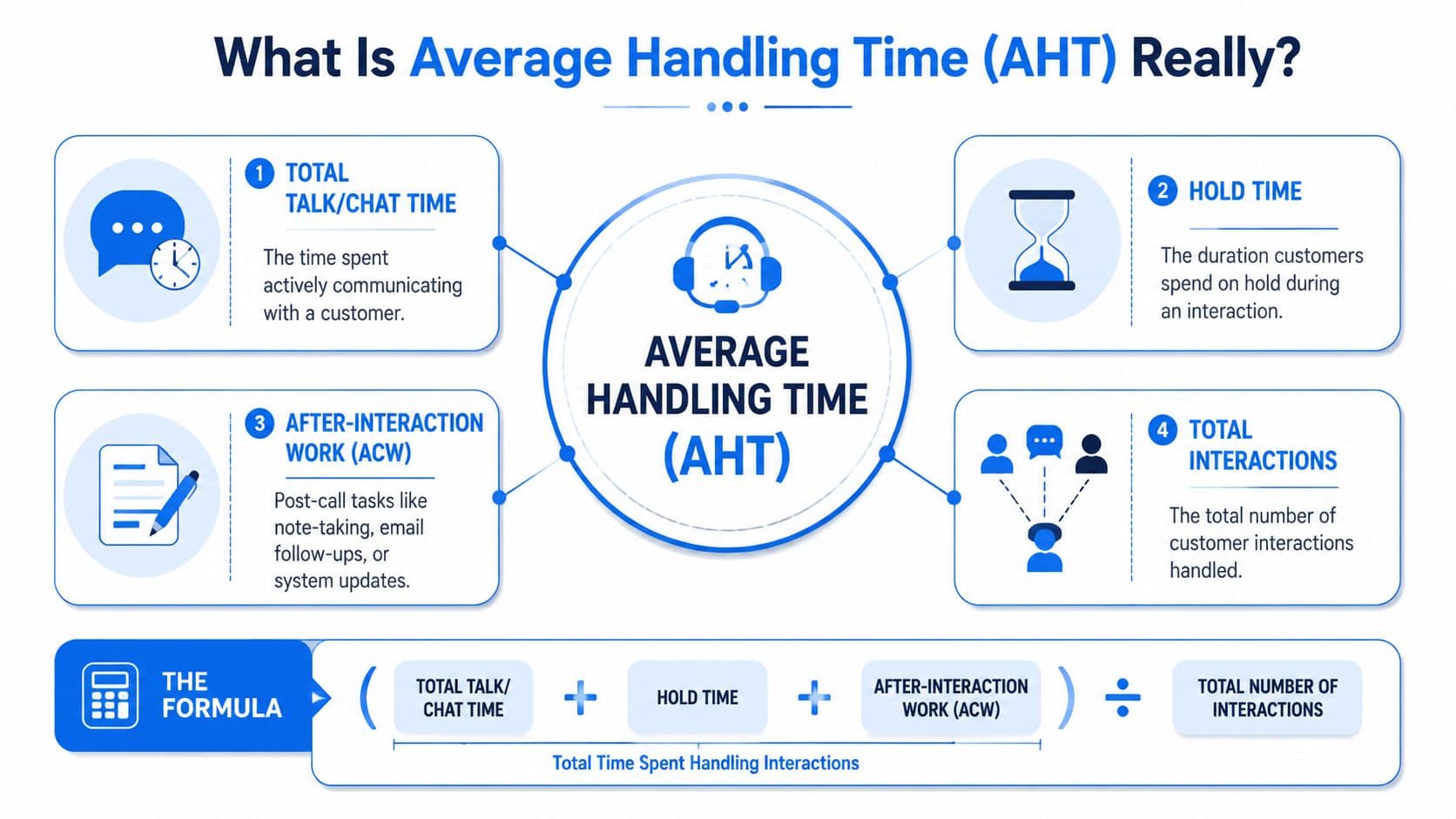
The clean definition is straightforward. AHT is calculated as the total duration of an interaction including talk time, hold time, and after-call work (ACW), and it measures only the time an agent actively works the case, excluding queue time and pending intervals, as explained in Decagon's overview of what average handling time includes.
The formula in plain English
For ecommerce teams, the core formula is:
(Total Talk or Chat Time + Hold Time + After-Interaction Work) ÷ Total Number of Interactions
That last part matters. After-interaction work is real work. If an agent spends time tagging the ticket, updating Shopify notes, sending a follow-up email, or logging a refund reason, that effort belongs in the metric.
A simple store example makes this clearer. A customer opens chat about a return for the wrong size. The agent spends time discussing the order, pauses briefly to check policy or eligibility, then finishes by updating the help desk and sending the return steps. The full handling time includes the live interaction plus the follow-up tasks needed to close the case properly.
What AHT is not
AHT is not first response time. First response time asks, “How long did the customer wait before someone replied?” A team can have a fast first response and still have a messy, bloated handling process after the conversation starts.
AHT is also not average resolution time. Resolution time includes the total elapsed time across the life of the issue, including waiting periods, internal delays, and pending customer responses. AHT excludes those inactive intervals and focuses only on active agent effort.
That distinction matters for diagnosis. If customers complain about waiting, first response time may be the problem. If your team feels overloaded even after they pick up the conversation, AHT may be the better lens.
AHT tells you how efficient your team is during active work. It doesn't tell you how long the customer has been living with the problem.
For Shopify operators, that makes AHT especially useful when you're trying to answer questions like:
- Are agents spending too long searching for information? If yes, your knowledge base or internal documentation may be weak.
- Are simple questions consuming the same energy as complicated ones? If yes, routing or automation probably needs work.
- Is post-chat admin slowing everything down? If yes, the issue may be workflow design, not agent quality.
Once teams stop mixing AHT with other service metrics, they can improve the right part of the support system instead of chasing the wrong number.
What's a Good AHT for a Shopify Store?
The answer often sought is a single number. That's usually an unhelpful perspective.
There is a long-standing benchmark of about 6 minutes for average handling time in many customer service environments, and Zendesk notes that a “good” AHT is generally near that mark. The same source also shows that norms vary by industry, with typical benchmark ranges of 3 to 4 minutes for retail, 4 to 6 minutes for banking and financial services, and 5 to 7 minutes for telecommunications in its guide to average handle time benchmarks.
The benchmark most teams start with
That six-minute benchmark is useful as a starting reference, not a target you should force onto every support channel and every issue type.
A Shopify store handling simple order edits, shipping questions, and return instructions will operate differently from a financial-services team or a telecom support desk. Even inside ecommerce, pre-purchase product advice is different from a damaged-order complaint, and both are different from a warranty dispute.
If you treat one blended number as the truth, you'll pressure agents to rush where they should slow down, and you'll miss obvious opportunities to speed up repetitive work.
A simple benchmark table
| Industry / Channel | Typical AHT Range (Minutes) |
|---|---|
| General benchmark | About 6 minutes |
| Retail | 3 to 4 minutes |
| Banking and financial services | 4 to 6 minutes |
| Telecommunications | 5 to 7 minutes |
What Shopify operators should actually compare
For a DTC brand, the more useful comparison is within your own operation.
Compare by channel. Chat interactions should not be judged the same way as email. Compare by intent. Pre-purchase sizing advice should not be grouped with a multi-step return exception. Compare by team and by workflow. One inbox may look “slow” because it handles the hardest issues.
Here's the practical standard I use. A good AHT is one that supports three things at once:
- Customers get answers fast enough to keep momentum.
- Agents can resolve the issue without cutting corners.
- The team can handle demand without drowning in backlog.
The best AHT isn't the lowest one. It's the one that protects conversion and keeps service quality intact.
If your number is dropping but repeat questions, escalations, or customer frustration are rising, the metric is being gamed. If your number is high because agents keep switching tabs, rewriting the same replies, or manually tagging everything, that's an operations problem worth fixing.
Proven Strategies to Lower AHT Without Hurting CX
Many teams chase lower AHT the way a fast-food chain chases shorter drive-thru times. That mindset breaks down fast in ecommerce. A buyer asking about fit, ingredients, compatibility, or shipping urgency doesn't want to be processed. They want confidence.
The better model is fine dining, not fast food. Speed matters, but so does timing, relevance, and accuracy. The goal is optimal average handling time. Not the lowest possible number.
Fix the work around the conversation
Support leaders often focus on agent behavior when the drag is in the system.
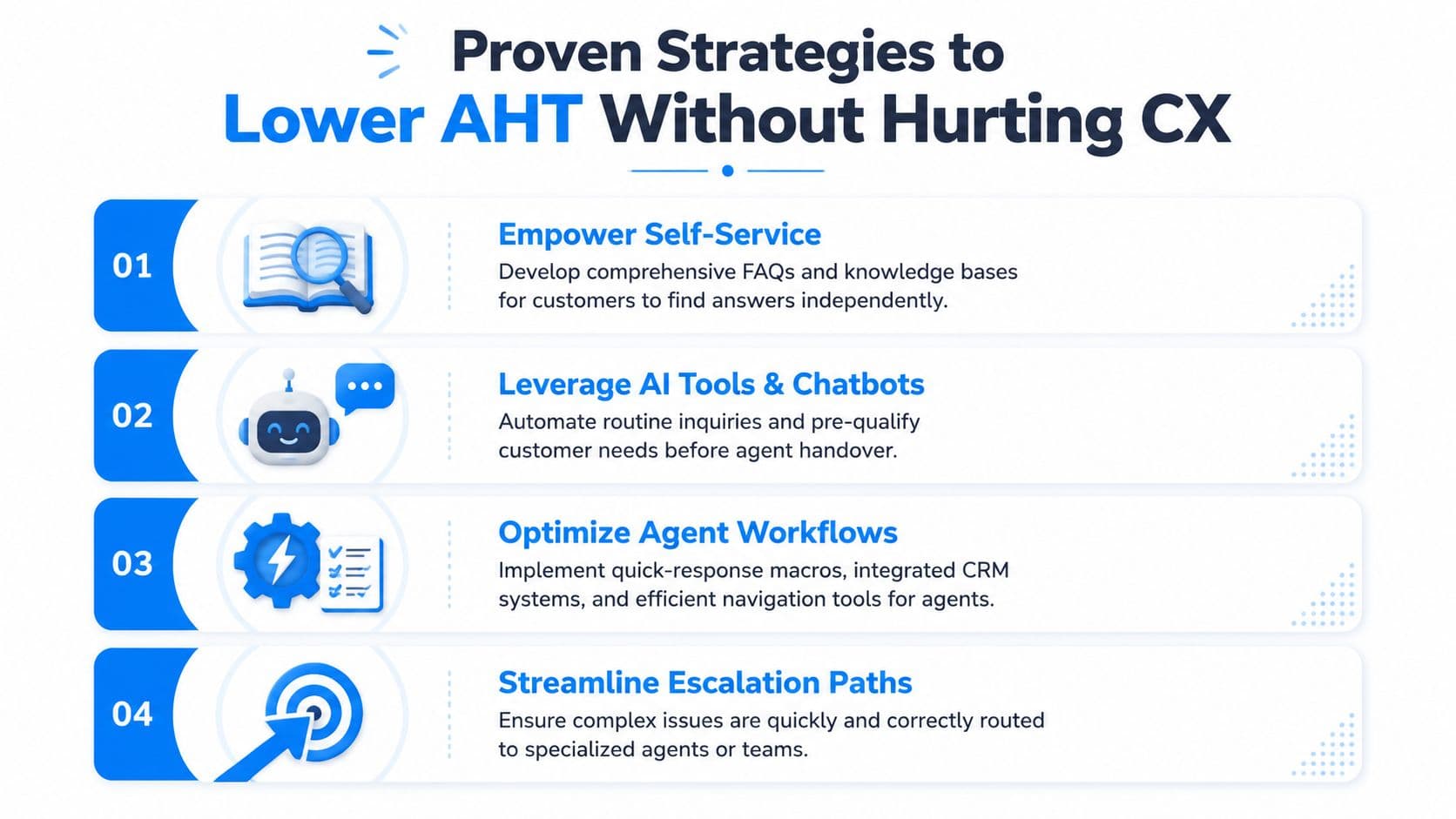
Start with your internal knowledge base. If agents have to hunt through Slack threads, old Notion pages, Google Docs, and policy PDFs, AHT will stay high no matter how good they are. Put shipping rules, return exceptions, SKU-specific notes, and promo edge cases in one place. Keep it searchable. Retire duplicate documentation.
Then clean up after-interaction work.
- Simplify tagging: Use fewer tags, with clearer rules. If your team debates whether a ticket is “delivery issue,” “carrier delay,” or “shipping inquiry,” they're burning time on reporting hygiene.
- Standardize follow-ups: Build approved templates for return instructions, exchange steps, address changes, and policy clarifications.
- Reduce tab switching: If agents need Shopify, your help desk, a returns app, and a policy doc open at once, they'll lose time in the seams.
Reduce typing and decision fatigue
A surprising amount of AHT comes from writing the same sentence repeatedly.
Create canned responses for the questions that appear constantly. Don't make them robotic. Make them modular. A strong macro should include a clear answer, the next step, and the right policy language. Agents can personalize the opening line, but they shouldn't have to reinvent the body every time.
Text expanders help too. Short snippets for order status language, product care instructions, or return-window explanations cut idle typing and reduce inconsistency.
A simple rule helps here:
If an agent has typed the same answer three times this week, that answer should probably become a reusable asset.
Hiring support capacity can also help if your queue problem is really a coverage problem. Brands that need bilingual support, extended-hour coverage, or more operational flexibility sometimes look at distributed staffing options such as Hire LatAm Virtual Assistants to widen support availability without overloading a core team.
Use automation where it helps most
Automation works best on repetitive, low-risk tasks. It works worst when it's used to avoid genuine customer nuance.
Good uses of automation include:
- Self-service answers: FAQ flows for shipping, returns, order tracking, and care instructions.
- Pre-qualification: Gather order number, issue type, and product name before handoff.
- Routing: Send complex tickets to the right person early instead of bouncing them around.
- Workflow triggers: Auto-apply basic tags or suggested macros based on keywords and order context.
If you're redesigning support operations, it helps to study practical models for help desk automation that remove repetitive work without making the experience feel cold.
What doesn't work is blunt pressure. Forcing agents to “keep chats short” often lowers quality, increases repeat contacts, and frustrates shoppers who were ready to buy. Faster support comes from better systems, not from telling people to hurry.
How AI Chatbots Like Carti Redefine the AHT Metric
The old way to improve average handling time was to make human agents faster. Better macros. Better training. Better routing. That still helps, but it doesn't change the underlying model. You still have a person handling each question.
AI changes the model because many ecommerce questions don't need handling in the traditional sense at all.
When handling time stops being the main goal
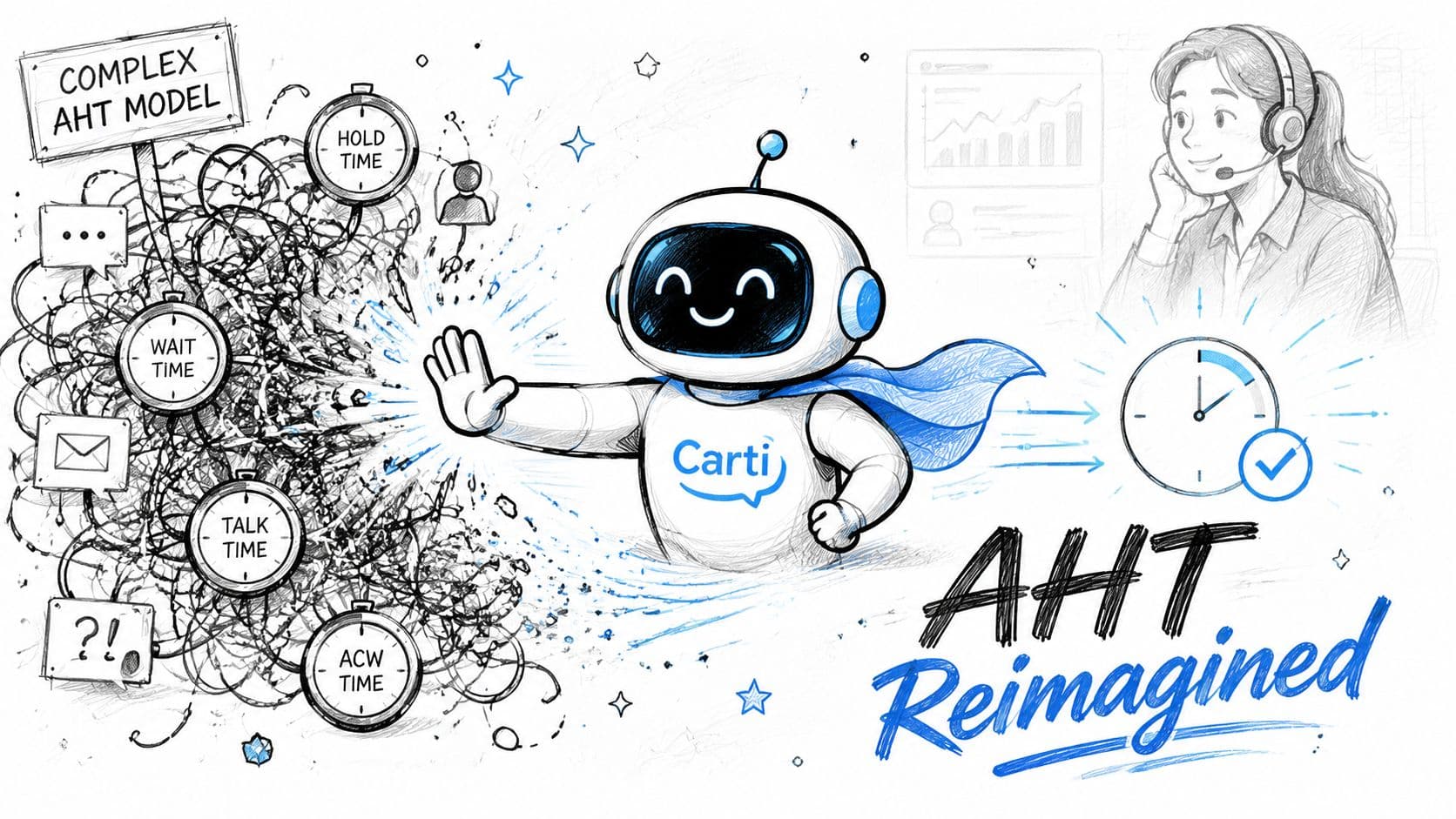
As support has moved beyond phone into chat, email, and bots, measurement has become messier. Zoom notes that AHT now applies across newer channels too, and raises an important issue: if a chatbot resolves a question instantly, it effectively brings AHT to near-zero for that interaction. It also notes that mainstream benchmarking still lacks a standard way to attribute AI-driven time savings across omnichannel support in its discussion of average handle time in modern support.
That gap is real. If a bot answers “What's your return policy?” immediately, is that zero AHT, deflected AHT, or a different metric entirely? Operators still need a practical answer even if the benchmarking world hasn't settled on one.
For ecommerce, the practical answer is simple. Count the business outcome first. If the shopper got an accurate answer instantly and moved forward, the experience improved whether the legacy metric caught up or not.
How to think about AI assisted support
AI chatbots are strongest when they handle the repetitive, transactional, and pre-purchase questions that create queue volume:
- Order and policy questions: shipping times, return windows, exchange steps, tracking help
- Catalog guidance: size help, compatibility questions, product comparisons
- Sales assistance: matching products to shopper intent before they bounce
- Triage: collecting details before a human ever enters the conversation
For the human team, this changes the workload mix. Agents spend less time repeating known answers and more time solving unusual cases, calming frustrated customers, and handling edge-case revenue conversations.
That's a healthier use of human time.
A good explainer on how this fits the storefront experience is this look at the modern AI chatbot for ecommerce, especially for brands that want support and sales assistance in the same flow.
A short demo helps make the shift concrete:
The important operating change is this: once AI handles a meaningful share of repetitive questions instantly, average handling time becomes less about squeezing humans and more about designing the right division of labor. The best teams don't ask, “How do we make every conversation shorter?” They ask, “Which conversations should a human never have needed to handle in the first place?”
From Cost Center to Conversion Engine
Support earns a very different role in a DTC business once you stop treating it as cleanup work.
A shopper asking about delivery timing before a gift purchase is not creating overhead. A shopper asking whether two products work together is not creating overhead. Those are buying signals. If the business answers them quickly and accurately, support directly supports conversion.
The real operating model shift
Traditional AHT thinking starts with cost control. How many interactions can an agent handle? How fast can a team move through the queue? Those questions matter, but they're incomplete for ecommerce.
The stronger view is operational and commercial at the same time. Support should reduce friction, protect checkout momentum, and rescue uncertain buyers before they leave. In that model, average handling time is useful because it reveals where the machine is slow, but it isn't the end goal.
Three shifts separate high-performing ecommerce support teams from overloaded ones:
- They measure support in the context of revenue. Pre-purchase questions are treated as part of the buying journey.
- They optimize workflows, not just agent behavior. The system gets faster, so the team doesn't have to rush.
- They use automation to remove repetitive work. Humans stay focused on nuance, judgment, and trust-building.
Fast support matters most when the customer is still deciding whether to buy.
What to do next
Start by looking at your support operation through a buyer's eyes. Which questions appear right before purchase? Which ones create wait time? Which ones force agents to search, copy, and repeat?
Then look at active handling work. Break down where the time goes inside the interaction and after it. If the drag comes from policy lookup, manual triage, repetitive typing, or avoidable follow-up work, you already know where to act.
The old trade-off was speed versus quality. That trade-off is weaker now than it used to be. Better workflows, stronger self-service, and AI-assisted support let brands answer common questions quickly without making the experience feel rushed or generic.
For Shopify and DTC brands, that changes the job of support. It stops being a team that merely handles issues after the fact. It becomes a conversion layer that answers doubts, protects demand, and helps shoppers complete the purchase they were already close to making.
If you want to turn support into a faster, conversion-focused part of your store, Carti is built for that job. It gives Shopify brands an AI chatbot that answers shopper questions instantly, helps with product discovery, supports cart recovery, and reduces the repetitive load on human agents so they can focus on the conversations that need them.

Written by
Daniel AndersonFounder of Carti. 10+ years building ecommerce brands in apparel and supplements. Still runs a Shopify store and built Carti to help merchants convert more browsers into buyers.
Ready to boost your store's sales?
Install Carti in 5 minutes and let AI handle customer questions, recommend products, and close sales 24/7.
Start Free Trial14-day free trial