
Most advice about conversational AI for ecommerce starts in the wrong place. It tells merchants to automate frequently asked questions, reduce ticket volume, and keep shoppers away from human agents. That can lower workload, but it doesn't answer the harder commercial question: how do you convert the visitor who has a product question, hesitates, and leaves before checkout?
A revenue-focused assistant treats the conversation as part of the buying journey. It uses product data, inventory, policies, and shopper intent to answer questions, recommend relevant products, recover hesitation, and hand off cleanly when judgment matters. The distinction matters because independent Rep AI behavioral data from 17 million shopper interactions in 2025 found that chat-engaged shoppers converted at 12.3%, compared with 3.1% for shoppers who didn't engage with chat, according to this industry summary of the Rep AI data.
The Biggest Myth About Ecommerce AI
The biggest myth is that ecommerce AI means a scripted decision tree designed to deflect support tickets. That model asks shoppers to choose from rigid buttons, fails when they phrase a question differently, and often ends with a link to an FAQ that the shopper already couldn't find.
Modern conversational AI works differently when it has access to the store's actual systems. It can interpret natural language, retain context, retrieve product and policy information, and guide a shopper toward a purchase. The commercial benchmark isn't “how many tickets did the bot avoid?” It's whether the interaction helped a qualified shopper make a confident decision.
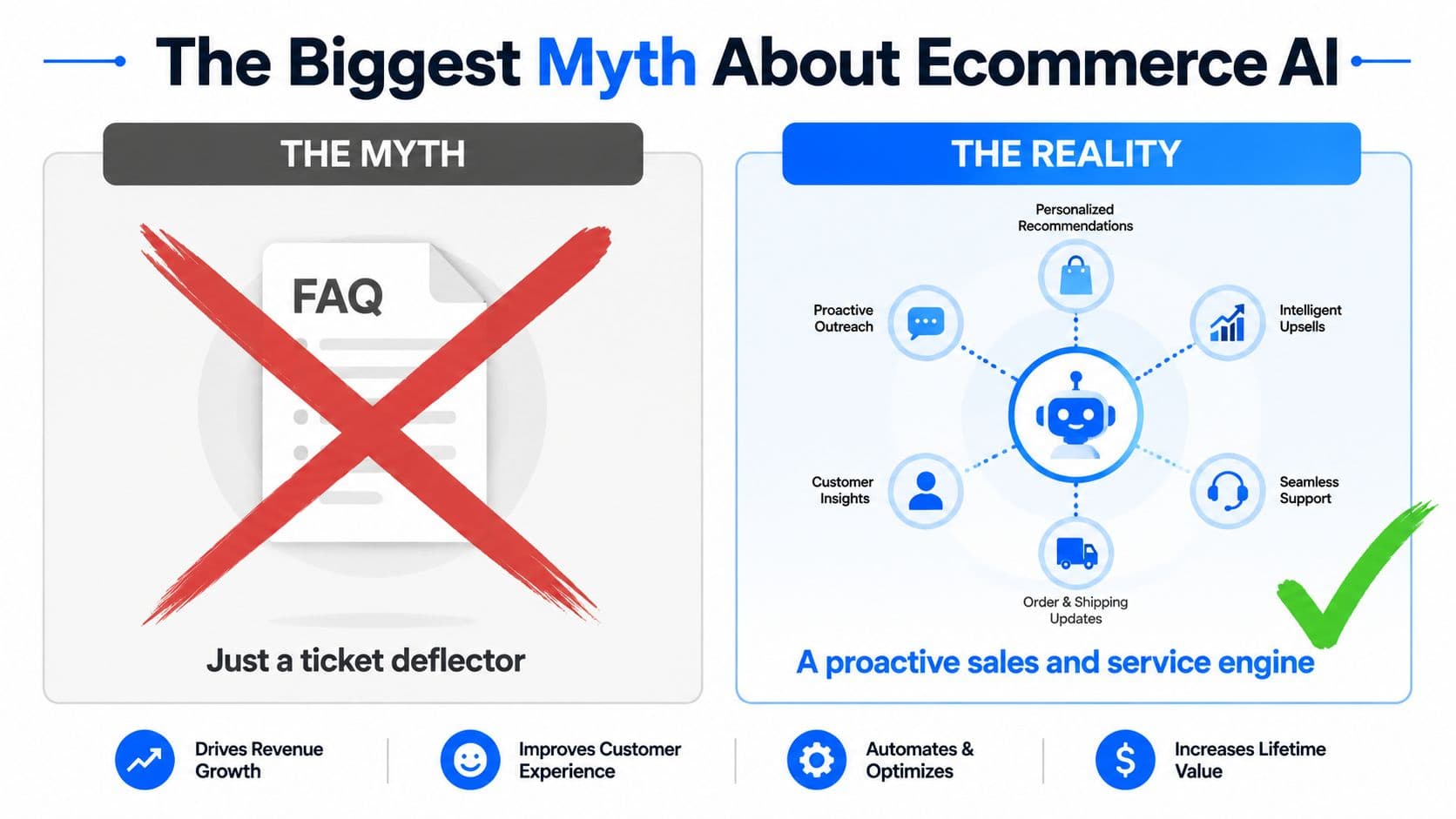
From ticket deflection to guided selling
A capable assistant behaves more like a strong store associate than a searchable help center. A shopper might say, “I need a gift for my dad who hikes,” without knowing the right category or product name. The assistant can ask about budget, use case, fit, or existing equipment, then narrow the catalog to options that make sense.
That same interaction can resolve the objections that usually interrupt a purchase. The shopper may need to know whether a size runs small, whether an item is compatible with existing equipment, when it will ship, or how returns work. A chatbot that only links to a policy page has transferred the work back to the shopper. A sales assistant keeps the context and helps move the session forward.
Practical rule: Own the revenue outcome, not just the conversation volume.
Carti's product positioning illustrates this shift. It learns a store's catalog, inventory, and policies on installation, answers in natural language in 92 languages, and is designed to sell rather than merely deflect. The publisher reports that shoppers who talk to Carti convert at about 3.5 times the store average, while one early store attributed $3,480 in conversation-linked revenue during its first 30 days. Those are publisher-provided figures, so merchants should validate them against their own order attribution rather than treating them as a universal benchmark.
That validation discipline is important. An assistant belongs under revenue ownership when it recommends products, creates carts, and handles purchase objections. Support metrics still matter, but they shouldn't become the only definition of success. Merchants building a broader acquisition and conversion system can also use these e-commerce marketing tips to connect conversational engagement with the rest of the storefront experience.
Four Use Cases That Actually Drive Revenue
The most useful way to evaluate conversational AI is by the commercial job it performs. Product discovery, cart recovery, post-purchase engagement, and returning-customer personalization each require different data and different controls.
Product discovery and guided recommendations
Natural-language discovery helps a shopper move from an imprecise need to a relevant product. “I need something for a rainy commute” contains an occasion, a problem, and implied product attributes, even if it doesn't contain a SKU or category name.
The assistant should ask only the questions that reduce uncertainty. It can clarify budget, fit, color, compatibility, or delivery needs, then explain why selected products match. The revenue mechanism is shorter decision time and greater purchase confidence, not a generic recommendation carousel.
Cart recovery through objection handling
Cart recovery works best when the assistant responds to the reason for hesitation. A shopper who asks about shipping needs reassurance, not an arbitrary discount. Someone comparing two products may need a side-by-side explanation. A failed payment may need a route back to checkout.
The assistant can engage at the point where intent is visible, preserve the cart context, and offer a human route when the issue isn't safely automatable. This is more useful than sending every abandoned cart the same reminder.
Post-purchase service with relevant merchandising
Order-status questions are often treated as pure cost-center interactions. That misses the opportunity to resolve the immediate issue and support the next purchase.
After retrieving accurate order information, the assistant can answer a follow-up question about care, compatibility, replenishment, or a related product. The cross-sell must follow the service resolution and fit the customer's context. A promotional interruption before answering “where is my order?” damages trust.
Returning-customer journeys
Returning shoppers shouldn't have to restate information the store already holds, provided the merchant has appropriate consent and data controls. Purchase history, preferences, size information, and prior questions can help the assistant make the next interaction more relevant.
The experience should still remain optional and transparent. Personalization is valuable when it reduces effort. It becomes intrusive when the shopper can't understand what information the assistant used or how to opt out.
| Use Case | Primary Revenue Mechanism | Typical Conversion Lift | Best Suited For |
|---|---|---|---|
| Guided product discovery | Faster matching between shopper intent and relevant products | Validate through controlled testing | Broad catalogs and high-consideration products |
| Cart recovery | Resolving price, delivery, fit, or checkout objections | Measure against a non-assisted baseline | Stores with meaningful cart activity |
| Post-purchase engagement | Retention, replenishment, and contextually relevant cross-sell | Measure repeat purchase and assisted revenue | Consumables and products with accessories |
| Returning-customer personalization | Lower decision effort and more relevant recommendations | Compare assisted and non-assisted returning sessions | Brands with permissioned customer history |
Measurable Benefits and the KPIs That Matter
Adoption has moved beyond experimentation. A 2026 industry report summarized ecommerce AI usage at 69% in 2024, 77% in 2025, and 96% in 2026, with social messaging used by 78% of brands, SMS by 70%, and website live chat by 51%, according to Gorgias's conversational commerce trends report. The same report said 57% of brands used AI for 26% to 50% of customer interactions, while 37% expected that share to reach 51% to 75% within two years.
Those figures describe adoption, not success. Forrester's review of 100 US retailers found conversational commerce quality varied across categories, reinforcing a practical point: adding a chat widget isn't a performance strategy. Intent coverage, journey-specific prompts, catalog grounding, and workflow integration determine whether the assistant creates revenue or only shifts support volume. Forrester's review of conversational commerce in US retail is useful context for comparing implementation maturity across retail environments.
The KPI stack for a revenue team
Start with metrics tied to the assistant's job:
- Assisted conversion rate: Compare orders from sessions with meaningful AI engagement against an appropriate non-engaged baseline.
- Revenue per conversation: Count revenue joined directly to a conversation, and document the attribution rule.
- Average order value: Compare AI-assisted orders with comparable orders, while controlling for product mix.
- Intent-level performance: Separate product discovery, order status, policy questions, cart recovery, and returns.
- Human handoff quality: Track whether the agent receives enough context to resolve the issue without repetition.
- Customer experience signals: Review satisfaction, frustration, fallback, and repeat-contact patterns alongside sales.
A 2026 analysis of 94 ecommerce sites reported ChatGPT-referred traffic converting at 1.81%, compared with 1.39% for non-branded organic search, a 31% lift, while the channel still represented a small share of total revenue. The Search Engine Land analysis of ChatGPT and non-branded organic conversions shows why traffic volume alone isn't enough. Teams need to understand intent quality and downstream behavior.
For a broader KPI vocabulary across marketplaces and retail channels, merchants can consult 9 key Amazon metrics for 2026, then adapt the measurement logic to Shopify conversations. A useful internal reference is this ecommerce key performance indicators guide.
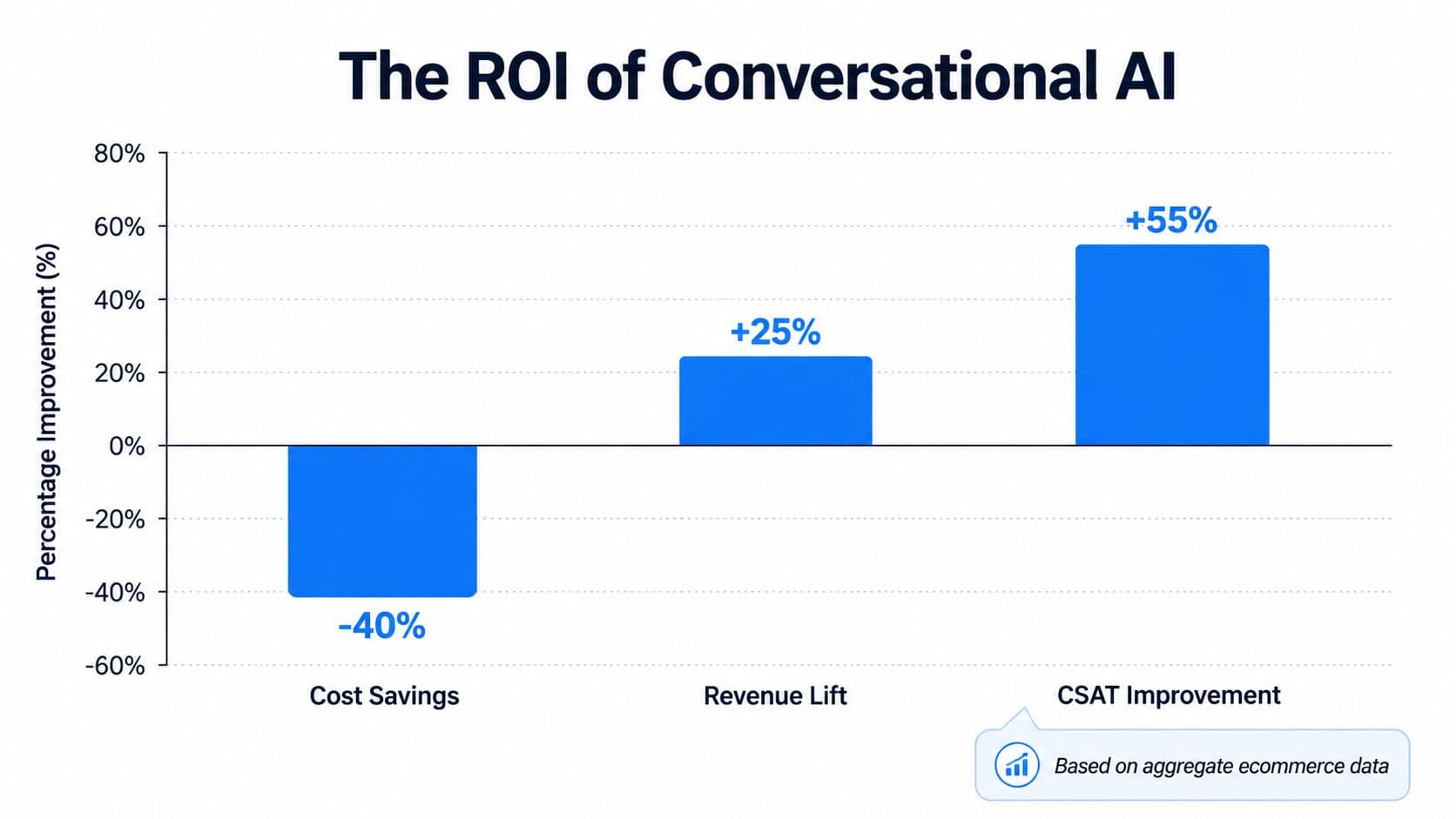
Implementation Roadmap for Shopify Stores
A Shopify deployment usually fails before the AI model becomes the problem. The store has incomplete product attributes, stale inventory information, disconnected order data, or policies that contradict the help center. The assistant then exposes those gaps in front of shoppers.
Begin with a data and workflow audit. Identify which system owns the catalog, inventory, orders, customer records, returns, and support history. Confirm what the assistant can read, what it can write, and which actions require human approval. A product recommendation can tolerate some uncertainty. A refund, delivery promise, or stock answer cannot.
Connect the systems that make answers actionable
A storefront widget without backend access can only provide general information. Connect Shopify product data, variant availability, pricing, order history, and relevant policy content before promising transactional support.
Next, prepare the knowledge layer using the store's own material:
- Catalog content: Add useful attributes such as materials, fit, dimensions, use cases, compatibility, and care guidance.
- Policy sources: Include current shipping, return, exchange, warranty, and cancellation rules.
- Conversation history: Review real support transcripts to capture how shoppers phrase questions, not just how internal teams label them.
- Operational boundaries: Define which actions are automatic, which require confirmation, and which always go to an agent.
Test before shoppers become the test
Use shadow mode where possible. Let the assistant draft answers while agents review them, then inspect inaccurate retrieval, missing intents, unsupported claims, and unnecessary escalation. Test normal questions and hostile edge cases, including unavailable variants, conflicting policies, delayed orders, and ambiguous product requests.
Privacy needs the same attention as accuracy. Configure retention rules, activate consent mechanisms, limit access to personal information, and make GDPR and CCPA requirements part of the design rather than a post-launch patch. The system shouldn't expose payment details or infer sensitive information just because a shopper mentioned it.
The implementation can then move from a focused pilot to broader coverage. Start with one or two journeys that have clean data and clear measurement, review transcripts and revenue attribution, and expand only when the assistant performs reliably.
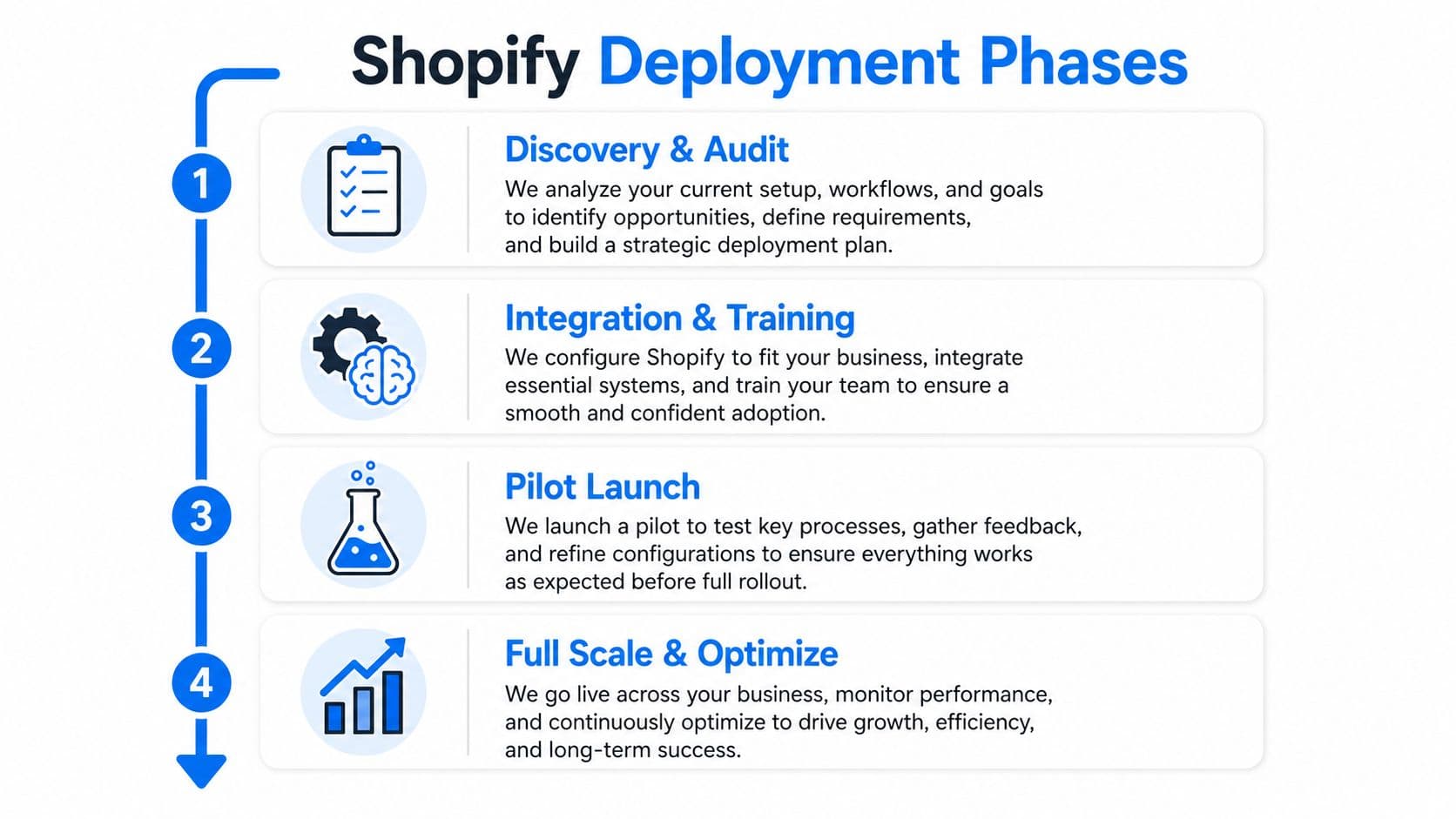
For merchants that need a practical installation reference, this guide on how to add a chatbot to Shopify covers the storefront setup context. The technical standard remains the same regardless of vendor: the assistant must be grounded in live store data, measurable against a baseline, and easy to escalate.
Best Practices and Common Pitfalls to Avoid
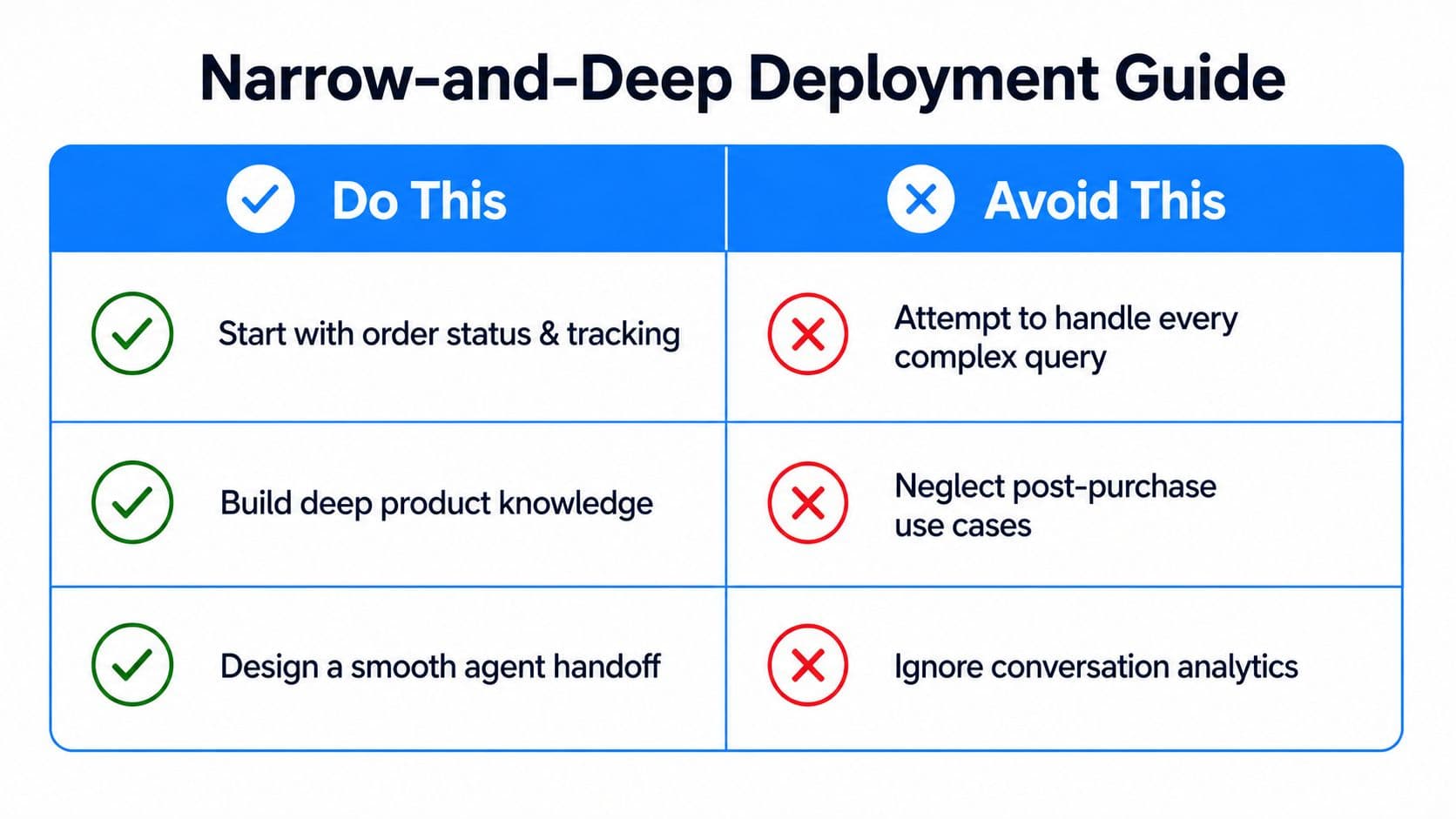
The most reliable deployments are narrow and deep. They don't attempt to answer every possible question on launch. They handle a small set of valuable scenarios accurately, learn from failures, and expand as the data and workflows improve.
A product-discovery assistant should know the catalog thoroughly. An order-status assistant should retrieve current information without inventing a delivery date. A returns assistant should understand policy boundaries and recognize exceptions. These are different jobs, and combining them without clear routing creates confusing conversations.
Make handoff a designed capability
The rule I enforce is simple: never trap the shopper, and never bluff. The assistant should offer a human whenever the shopper asks, when the topic requires merchant judgment, or when the conversation shows frustration.
A damaged-order example makes the standard clear. Carti should collect the order number and issue, confirm the shopper's email, and pass the merchant the complete context. The human reply can then resolve the problem without asking the shopper to repeat the entire story.
The handoff is a feature, not a failure.
Avoid measuring success through deflection alone. A bot may close many routine interactions while failing to improve shopping outcomes. Review fallback patterns, repeated questions, abandoned conversations, and the revenue attached to assisted sessions. If the assistant doesn't know, it should say so and route the shopper rather than produce a confident but inaccurate answer.
Transparency also beats fake personality. Tell shoppers they're interacting with AI, use direct language, and make the escalation route visible. People are generally more tolerant of automation when the system sets accurate expectations and preserves their control.
Building Shopper Trust in an AI-First Experience
Trust is a conversion requirement, not a legal footnote. In a February 2025 US survey, 58% of shoppers said they worried about how AI handled personal data, 42% said current AI felt more like an upselling tool than a helpful assistant, and 39% said they had abandoned purchases after frustrating AI interactions, including inaccurate recommendations or poor chatbot experiences, according to the survey summary published by PR Newswire.
A separate survey summarized in the same source found that the leading adoption barriers included lack of perceived need at 54%, preference for human help at 45%, and privacy or data-security concerns at 34%. Merchants shouldn't respond by hiding the assistant. They should explain what it is, what it can access, and when a human can take over.
Transparency that supports the purchase
Put the AI disclosure near the conversation entry point. Link to a plain-language privacy explanation. Don't collect payment details in chat unless the architecture and consent model explicitly support that use. If a product quiz uses personal preferences, tell shoppers how those answers influence recommendations and give them a clear way to stop personalization.
The assistant also needs commercial restraint. If every answer ends with a pushy upsell, shoppers will treat the system as an advertising surface. Answer the question first, make recommendations only when relevant, and distinguish helpful guidance from paid promotion.
| Trust Practice | Implementation | Impact on Conversion |
|---|---|---|
| Clear AI disclosure | Identify the assistant before the first exchange | Reduces surprise and sets accurate expectations |
| Permission-based personalization | Explain which data informs recommendations | Makes relevance feel useful rather than invasive |
| Visible human handoff | Let shoppers request an agent without repetition | Protects high-friction and high-value interactions |
| Honest uncertainty | State when information isn't available | Prevents inaccurate answers from damaging confidence |
| Plain-language privacy controls | Explain retention and opt-out choices | Gives shoppers control over the experience |
For Shopify teams formalizing these controls, this guide to understanding GDPR compliance provides useful implementation context. The practical test is whether a shopper can understand the assistant's role without reading legal language first.
Your Conversational AI Buyer Checklist
A vendor demo can look impressive while hiding the capabilities that matter after launch. Ask each provider to show a real Shopify workflow, not only a polished scripted path. The assistant should retrieve a product detail, handle a follow-up question, check an order, explain a policy, and transfer a difficult case with context.
Start with Shopify-native depth. Can the system access products, variants, inventory, carts, discounts, and order status? Can it recommend an actual item rather than merely describe one? Can the merchant see the conversation tied to the resulting order?
Then inspect the training and maintenance model. A platform that requires extensive manual flow construction may become expensive to maintain as products and policies change. A platform that learns from store data still needs governance, review, and clear controls. Ask how updates propagate and how the system prevents outdated policy content from surviving in responses.
Questions that separate sales infrastructure from ticket automation
Use these questions in vendor evaluations:
- Revenue attribution: Does the platform report directly attributed orders, influenced revenue, or only conversations and deflected tickets?
- Intent measurement: Can the team segment product discovery, cart recovery, order status, returns, and policy interactions?
- Proactive engagement: Can triggers respond to relevant browsing behavior without interrupting every shopper?
- Handoff quality: Does the human agent receive the transcript, order details, shopper identity, and unresolved issue?
- Experimentation: Can the merchant compare prompts, timing, recommendation logic, and escalation rules?
- Privacy controls: Can the team configure consent, retention, access, and deletion workflows?
- Pricing alignment: Does the pricing model reward solved commercial outcomes, or does it encourage the platform to close conversations as cheaply as possible?
A vendor charging per resolution may optimize for deflection even when a human handoff is the correct outcome. A vendor that cannot explain fallback logic may leave the merchant unable to diagnose failures. A vendor showing only button-based flows may not support genuine natural-language discovery.
| Evaluation Criteria | Key Questions to Ask | Weight | Red Flags |
|---|---|---|---|
| Shopify integration | Can it access catalog, inventory, carts, discounts, and orders? | High | Generic widget with limited store access |
| Revenue attribution | Can it connect conversations to orders and revenue? | Highest | Only reports messages or ticket deflection |
| Data and training | How does it ingest policies, catalog content, and transcripts? | High | Manual upkeep with no governance controls |
| Human handoff | What context reaches the agent, and when does escalation trigger? | High | Transfer without transcript or order details |
| Analytics and testing | Can teams segment intent and test prompts or triggers? | High | No control group or journey-level reporting |
| Privacy and security | What data is retained, and how is consent managed? | High | Vague answers about personal information |
| Commercial model | Does pricing align with conversion and customer value? | Medium | Per-resolution incentives that discourage handoff |
Score three to five vendors against the same matrix. Weight revenue attribution and Shopify-native capabilities above surface-level personality or demo polish. A conversational AI platform earns a place in the stack when it can answer accurately, recommend relevant products, prove commercial impact, and get out of the way when a person needs to take over.
Carti provides Shopify merchants with a conversational sales assistant that learns catalog and policy information, answers product questions, recommends items, supports cart recovery, and operates across 92 languages. Visit Carti to evaluate whether its conversation layer can help your store convert more qualified browsing sessions without trapping shoppers in automation.

Written by
Daniel AndersonFounder of Carti. 10+ years building ecommerce brands in apparel and supplements. Still runs a Shopify store and built Carti to help merchants convert more browsers into buyers.
Ready to boost your store's sales?
Install Carti in 5 minutes and let AI handle customer questions, recommend products, and close sales 24/7.
Start Free Trial14-day free trial