
You're probably in a familiar spot. Ad costs keep rising, traffic is still coming in, and the dashboard says you're getting clicks, but your margin tells a different story. The campaign might look fine in Meta or Google Ads. Your Shopify P&L doesn't care about clicks.
That's why more merchants start looking at a cost per acquisition network. On paper, it sounds cleaner: pay when a sale or another defined action happens, not when someone merely lands on the site. That shift matters when paid acquisition feels less predictable and more expensive than it used to.
The pressure is real. A 2025 benchmark reports that customer acquisition costs have increased 60% over five years across major digital channels, which is why so many brands are rethinking how they buy growth and what they count as efficient acquisition in this CPA benchmark summary.
The Problem with Paying for Clicks, Not Customers
Most Shopify stores don't fail because they can't buy traffic. They fail because they buy traffic that doesn't convert well enough to support the cost. You can keep feeding budgets into search, social, influencers, and retargeting, then still end the month with a thin or negative contribution margin.
The core issue is misalignment. CPC and CPM models charge you for attention. Your store only makes money when attention turns into orders. If the landing page is weak, the offer is unclear, or checkout friction gets in the way, you absorb the cost and carry the risk.
That's why a cost per acquisition network gets attention from operators who are tired of paying for “maybe.” In a true CPA setup, the network and its publishers only get paid when a defined action is completed and validated. Usually that means a sale, though some programs use leads, signups, or trial starts.
Practical rule: If a traffic source looks affordable before conversion and expensive after conversion, the problem isn't traffic volume. It's economics.
There's a trade-off, though. CPA isn't magic. It doesn't automatically make bad traffic good, and it doesn't protect you from poor onsite conversion. It changes the buying model so performance matters earlier in the chain.
For a Shopify merchant, that changes the conversation from “How many clicks can I buy?” to “Which partners can send buyers, and can my store convert them efficiently once they arrive?” That second question is where most of the profit lives.
What Is a Cost Per Acquisition Network?
A cost per acquisition network is easiest to understand as a large commission-only sales layer sitting outside your store. Instead of hiring one affiliate directly, you join a marketplace that connects your brand with many publishers who promote offers in exchange for a payout when a tracked action happens.
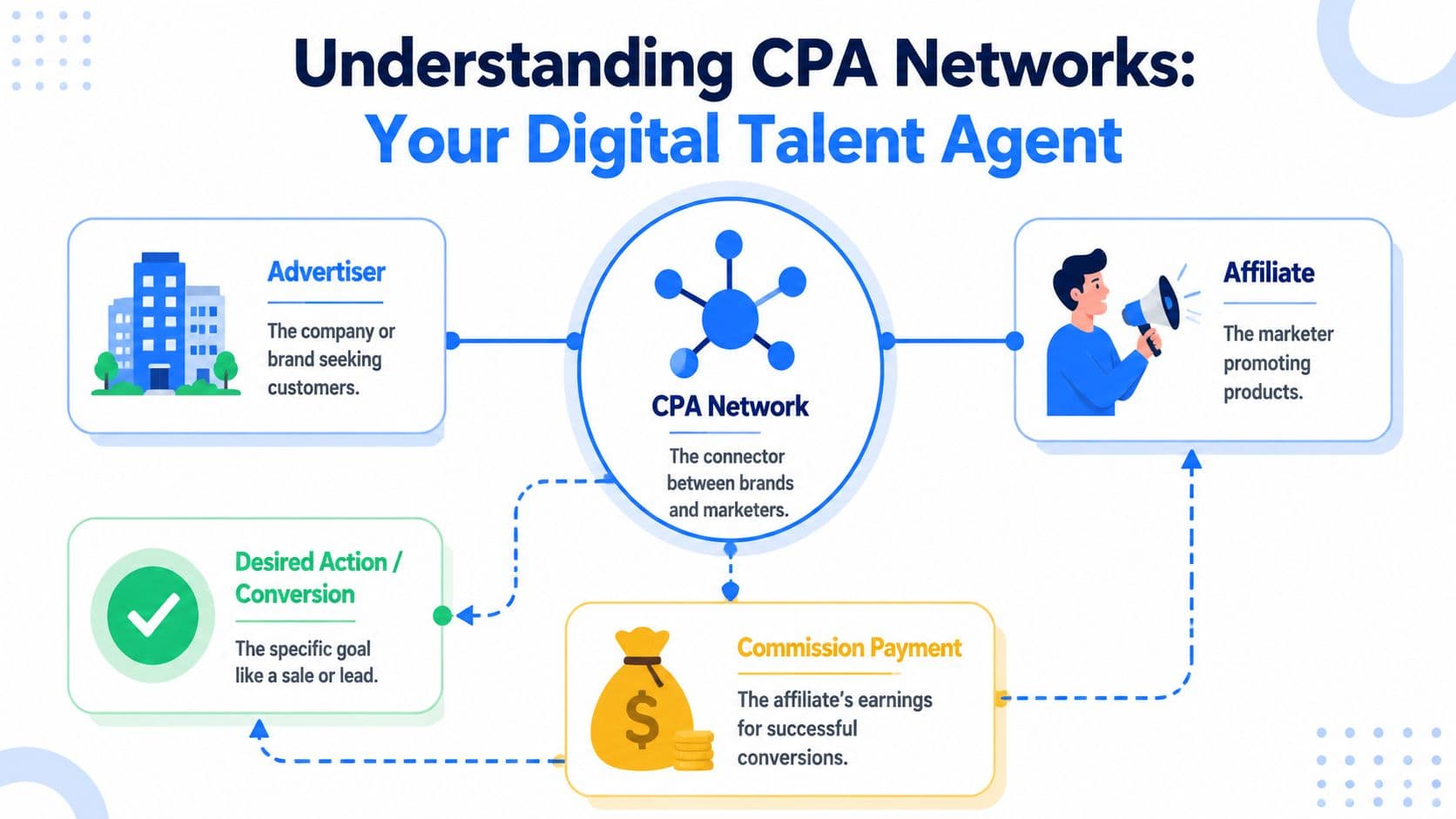
A commission-only growth channel
Think of the network as your talent agent and operating layer. It recruits publishers, manages offer distribution, tracks conversions, handles payout rules, and gives both sides reporting. You don't need to negotiate one-off deals with every coupon site, creator, media buyer, content publisher, or review site that wants to promote your products.
That's different from buying ads on Google or Meta. In those systems, you pay the platform for delivery. In a CPA network, you pay for the agreed action after verification.
The distinction matters:
- CPC campaigns charge for clicks, whether the visitor buys or not.
- CPM campaigns charge for impressions, even earlier in the funnel.
- CPA campaigns charge for a completed action that matches your program terms.
For merchants with tight margins, that can feel safer. It often is. But it also means you need strong rules around attribution, fraud checks, order validation, and what counts as a payable conversion.
Who does what inside the network
Four parties are involved:
- Merchant: Your Shopify store creates the offer, sets the payout, defines the conversion event, and approves or rejects transactions based on program rules.
- Network: The platform manages tracking, partner access, compliance, and payment administration.
- Affiliate or publisher: This is the traffic source. It could be a content site, loyalty site, email publisher, influencer, media buyer, or niche review property.
- Customer: The shopper clicks through, lands on your site, and completes the desired action.
A good CPA network doesn't replace your acquisition strategy. It adds another route to market with a different risk profile.
What works well in practice is using CPA networks for controlled expansion. You already know your hero products, margins, and audience signals. The network gives you more partners to test against that foundation.
What doesn't work is joining a network because you hope it will fix a weak offer. If your product page confuses buyers, your shipping policy creates hesitation, or your checkout leaks intent, affiliates will still send traffic that fails to turn into profitable orders.
How CPA Pricing and Tracking Actually Work
The mechanics are less mysterious than they sound. A customer clicks a publisher's tracking link, lands on your store, browses, and buys. The system then records that journey so the right publisher gets credit and the merchant only pays for valid conversions.
A simple visual helps:
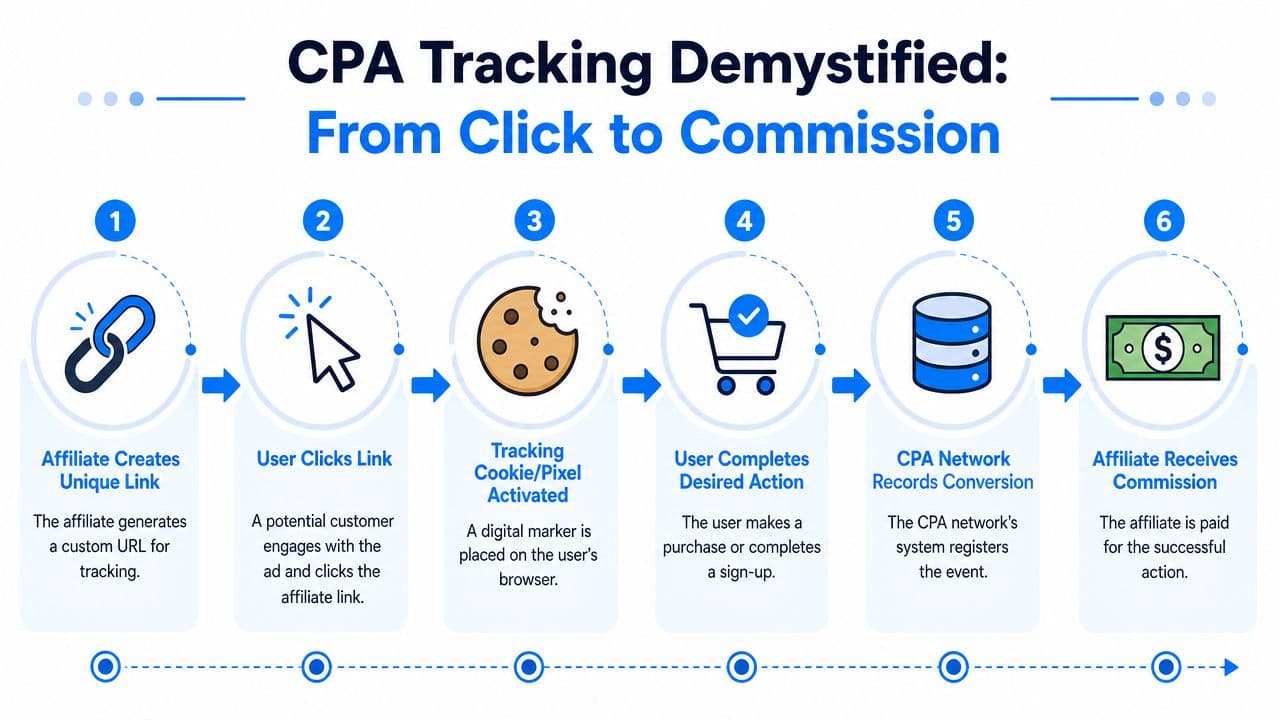
What gets tracked
Most CPA setups rely on some combination of browser-based tracking and server-side confirmation. The customer journey usually looks like this:
- A publisher gets a unique tracking link. That link identifies the partner and the offer.
- The shopper clicks through. A browser identifier, cookie, or network parameter gets set.
- The shopper completes the action on your Shopify store. This might be a purchase or another approved conversion event.
- The network receives confirmation. That can happen through a tracking pixel on the confirmation page or a server-to-server postback.
- The conversion is matched. If the event meets the program rules, the affiliate gets credit.
Server-to-server postbacks are usually more dependable because they don't rely as heavily on the browser to complete the signal. Pixels are common and often easier to implement, but merchants should still ask how the network handles blocked scripts, duplicate events, and delayed purchases.
Attribution rules matter just as much as the technical setup. If your network gives a publisher credit within a click window, you need to know how long that window lasts and how it interacts with your other channels. If you don't, you'll end up paying for conversions you would've won anyway.
For a broader view of how acquisition metrics connect, this guide to e-commerce KPIs that matter in Shopify growth is useful because CPA only makes sense when it's tied to conversion rate, margin, and repeat purchase behavior.
A quick walkthrough of affiliate mechanics can also help non-technical teams align on the process:
Where merchants get into trouble
Tracking failures usually aren't caused by one catastrophic mistake. They come from sloppy setup and loose definitions.
Common problems include:
- Paying on the wrong event: Counting any checkout start as an acquisition instead of a completed and valid order.
- Ignoring order quality: Approving low-intent or discount-hunting orders without checking whether they're profitable.
- Double attribution: Letting another paid channel and the CPA partner both claim the same sale internally.
- Weak validation rules: Not filtering canceled orders, returns, or repeat customers if the offer was meant for net-new acquisition.
If the payout logic is cleaner than the conversion logic, the network will get paid faster than you learn what actually worked.
The merchants who handle CPA well treat tracking as finance infrastructure, not just marketing plumbing. They define the event precisely, test it before launch, and reconcile reported conversions against real Shopify orders.
How to Calculate Your Target CPA for Profitability
A target CPA isn't a guess. It's a limit based on margin and customer value. If you don't calculate that ceiling before joining a network, you'll accept payouts that look workable in the dashboard and erode profit in the backend.
Start with contribution margin, not revenue
Start with what you keep from the first order after product cost, fulfillment, transaction fees, discounts, and the operating costs directly tied to winning that customer. Don't anchor to revenue. Revenue is what the customer paid. Contribution margin is what's available to fund acquisition.
A lot of merchants make the same mistake here. They look at average order value, see a healthy top-line number, and assume they can support a high payout. That only works if gross margin is strong and repeat purchases are reliable.
CPA itself is a channel-level metric defined as total campaign cost divided by the number of acquisitions, and one widely used benchmark says the LTV-to-CPA ratio should be at least 3:1 so lifetime value is at least three times acquisition cost in this CPA guide for marketers.
A practical target CPA framework
Use this sequence:
- First-order breakeven CPA: The maximum you can pay if you need the very first order to carry the acquisition cost.
- Blended target CPA: A more flexible number if repeat purchase behavior is strong enough to justify lower first-order contribution.
- Partner-specific CPA: A separate cap for coupon affiliates, content affiliates, loyalty partners, and other publisher types because order quality won't be identical.
Your internal worksheet should include:
- Average order value
- Gross margin after cost of goods
- Discount impact
- Shipping and fulfillment burden
- Creative and app costs tied to acquisition
- Support cost for newly acquired customers
- Expected repeat purchase value
Healthy judgment matters more than spreadsheet elegance. If your repeat purchase rate is inconsistent, be conservative. If your category relies on subscriptions or replenishment, you can usually justify a more patient payback model.
The best target CPA is the one you can defend after refunds, support load, and repeat behavior are included.
If you want a faster way to sanity-check the math before setting partner payouts, a Shopify ROI calculator for acquisition decisions can help frame whether your allowable CPA leaves enough room for profit.
One more practical note. Don't create one universal target and force every acquisition source into it. New-customer CPA, reactivation CPA, and branded-intent CPA are not the same business problem. Treating them as if they are leads to bad approvals and worse scaling decisions.
CPA Networks vs Other Digital Marketing Channels
CPA networks aren't better than every other channel. They're better for certain goals, risk tolerances, and operating models. The key decision is how much control you want, how much upfront risk you can absorb, and whether your team is better at media buying or partner management.
Where CPA networks fit best
Search and social give you direct platform control. You choose targeting, budgets, placements, and creative testing. That's powerful, but it also means you carry the spend before you know whether the traffic will pay back.
Channel costs vary a lot. Industry guidance notes that Google Search CPA averages about $56.11, while paid search more broadly can run $200 to $500 per customer, which shows how wide the spread can be even within adjacent acquisition models in this marketing analysis guide.
CPA networks shift some of that risk because partners are incentivized to produce the conversion, not just the visit. But the trade-off is reduced control over exactly how traffic is sourced unless your terms, compliance standards, and publisher approvals are tight.
Direct influencer deals sit somewhere in the middle. They can work well for product discovery and creative credibility, but they often depend heavily on brand fit and negotiated deliverables. If the creator underperforms, your spend is still gone.
Acquisition channel comparison for Shopify
| Channel | Cost Model | Upfront Risk | Best For |
|---|---|---|---|
| CPA network | Pay on verified acquisition | Lower than click-based media if tracking and approval rules are strong | Brands that want performance-based partner growth |
| Google Ads | Usually click-based | Higher, because spend happens before purchase | High-intent demand capture |
| Facebook and Instagram Ads | Usually click or impression-based | Higher, especially when creative fatigue sets in | Product discovery and retargeting |
| Direct influencer marketing | Negotiated fee, hybrid deal, or affiliate arrangement | Medium to high depending on structure | Social proof, launches, niche audience access |
| SEO and content partnerships | Time and production cost | Slower payoff, lower paid-media dependency | Long-term acquisition efficiency |
What works well is using CPA alongside search or paid social, not instead of them. Search captures existing intent. Social creates demand. CPA partnerships add performance-based distribution through external publishers.
What doesn't work is trying to force one channel to do every job. A cost per acquisition network won't replace branded search intent, and Google Ads won't replace trusted third-party recommendations from publishers who already own audience attention.
Choosing the Right CPA Network for Your Shopify Store
A network can look polished in a sales call and still be a bad fit for your store. The difference usually comes down to publisher quality, tracking discipline, and how much control the merchant keeps over approvals and program rules.
What to vet before signing
Start with publisher mix. Ask who drives conversions in their network. A program dominated by coupon or cashback traffic behaves very differently from one with review sites, niche content publishers, and email partners. Neither is automatically bad, but the economics and incrementality won't be the same.
Then look at the operational side:
- Tracking setup: Ask whether they support pixel-based tracking, server-to-server postbacks, and clear conversion validation workflows.
- Order approval workflow: You need a clean process for handling canceled orders, refunded orders, duplicate transactions, and restricted geographies.
- Merchant controls: The network should let you approve publishers, restrict promotional methods, and define what counts as a payable acquisition.
- Support quality: Good account management matters because publisher recruitment, compliance questions, and troubleshooting don't stop after launch.
Integration with Shopify usually isn't the hard part. Most established platforms support app-based or script-based implementation and can pass order details into the network. The harder part is making sure the data passed is the data you want to pay on.
A network is only as good as the publishers it attracts and the rules it enforces.
Red flags worth taking seriously
Some warning signs show up early:
- Vague answers about traffic sources: If they can't explain how publishers acquire traffic, you're taking blind risk.
- Pressure to approve everyone: Broad publisher access without review sounds scalable. It often creates cleanup work later.
- Weak fraud conversation: Serious networks talk openly about compliance, suspicious patterns, and validation standards.
- No discussion of incrementality: If every sale is treated as equally valuable, you'll likely overpay for shoppers who were already close to buying.
Another common mistake is launching too many offers at once. Start narrow. Pick a clear conversion event, one or two product lines, and a payout you know you can support. Learn how the network behaves before widening the aperture.
Merchants who do this well act more like channel managers than passive advertisers. They recruit intentionally, watch order quality, and revise terms when traffic looks opportunistic rather than additive.
Lower Your Effective CPA by Optimizing Conversion
Most conversations about a cost per acquisition network focus on the payout. That's only half the job. If your site converts poorly, even “performance-based” traffic becomes expensive in practice because too few of the referred visitors become profitable customers.
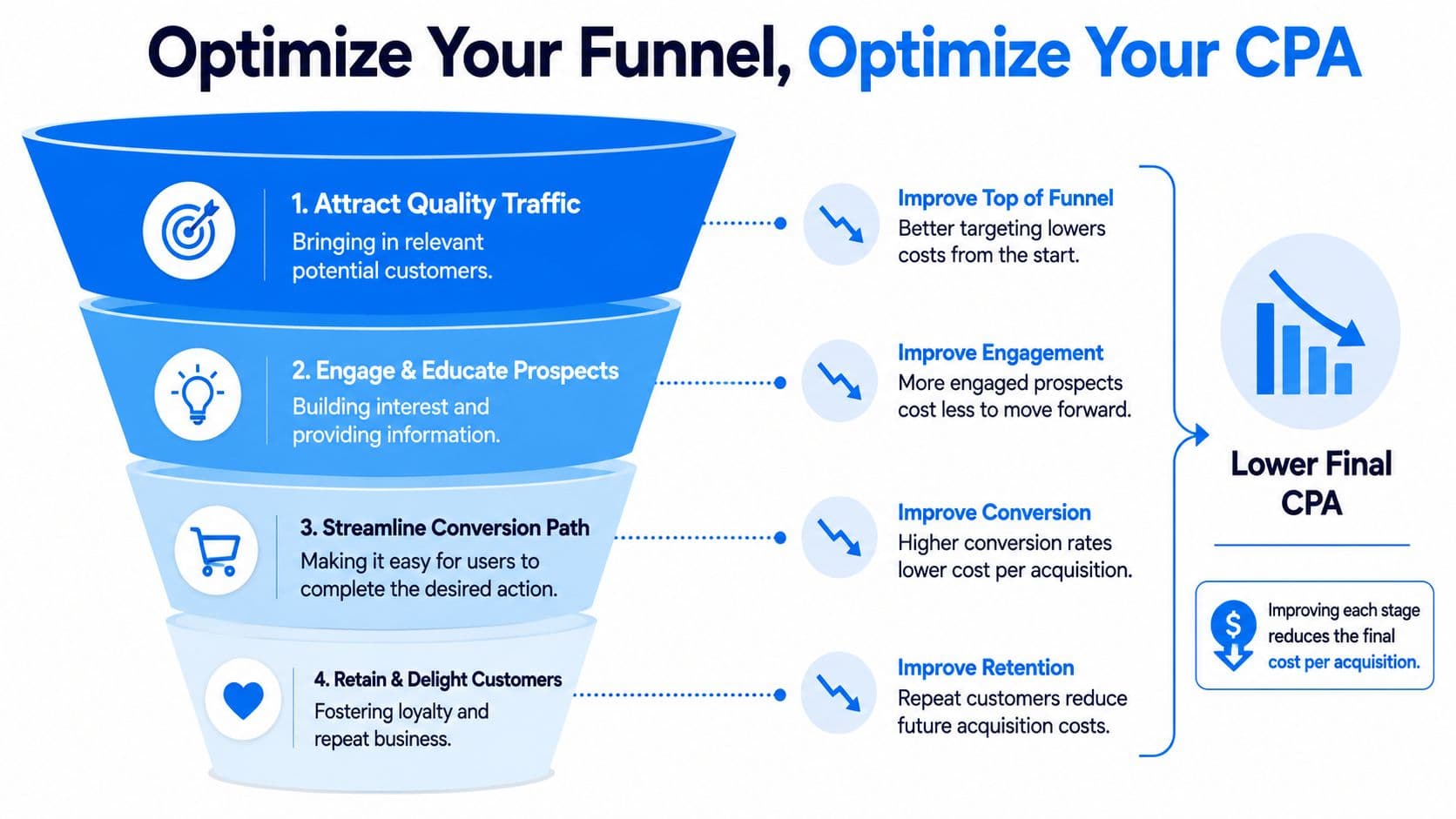
Cheaper traffic is not the only lever
Yet, merchants miss the bigger opportunity. They negotiate harder, cut bids, reject publishers, and hunt for lower acquisition prices. Sometimes that helps. Often the bigger win comes after the click.
Guidance for 2026 notes that healthy e-commerce CPAs often fall in the $25 to $80 range, and it also points out that onsite conversion tools can dramatically lower effective CPA without changing ad spend.
That idea is straightforward. If the same traffic produces more completed orders, your acquisition cost per actual sale improves. You didn't buy cheaper traffic. You made the traffic worth more.
What improves effective CPA after the click
For Shopify stores, the highest-impact fixes are usually operational, not glamorous:
- Faster answer delivery: Shoppers hesitate over shipping, sizing, ingredients, compatibility, returns, or stock uncertainty. If they can't get answers immediately, many leave.
- Smarter product guidance: Visitors who land on a collection or product page often need help choosing the right item, bundle, or variant.
- Cart recovery inside the session: A lot of abandonment happens because the shopper loses momentum, not because they rejected the product.
- Cleaner decision paths: Fewer dead ends, fewer unclear policies, fewer moments where the buyer has to “figure it out.”
If you want a practical outside perspective, these insights for Shopify app conversion strategies are useful because they focus on the tools and patterns merchants use to remove friction rather than just buying more reach.
The same principle shows up in strong CRO work. Product page clarity, trust signals, answer speed, and checkout support often do more for effective CPA than another round of audience expansion. This is why merchants who care about acquisition efficiency should also study Shopify conversion rate optimization tactics that reduce drop-off.
If referred traffic doesn't convert, the network isn't your only problem. Your store is part of the acquisition system too.
That's the practical takeaway. A CPA network can improve how you buy traffic. Conversion optimization improves what that traffic becomes worth. The merchants who win usually do both at the same time.
If you want to make more of the traffic you already pay for, Carti gives Shopify shoppers instant answers, product guidance, and cart-saving support around the clock. It's a practical way to reduce hesitation, recover more checkouts, and improve the effective CPA of every acquisition channel you run.

Written by
Daniel AndersonFounder of Carti. 10+ years building ecommerce brands in apparel and supplements. Still runs a Shopify store and built Carti to help merchants convert more browsers into buyers.
Ready to boost your store's sales?
Install Carti in 5 minutes and let AI handle customer questions, recommend products, and close sales 24/7.
Start Free Trial14-day free trial